Fabric Tape Comparison Guide: Materials, Widths, Forms, and Compliance
A specification reference for EU and US buyers comparing woven tape, jacquard tape, elastic strap, webbing and draw cord before sampling.
Fabric tape is a buying term, not a specification. Under that phrase, suppliers quote plain woven tape, jacquard-patterned tape, elastic strap, woven webbing, draw cord, elastic waistband, binding and piping — products that differ in fiber, construction, stretch, width, coloring method and customs classification. Two quotations for “fabric tape” can therefore describe products that are not comparable, and the mismatch usually surfaces after the first sample round, when color approval and freight terms are already moving.
This guide compares fabric tape on the four axes that determine fit: material, width and construction, product form, and compliance route. It then works through the decision that causes most rework in eyewear, apparel and outdoor programs — whether a design should be woven into the tape as a jacquard or applied to the surface by printing — using the process data of Qingdao Fuwei Rope Co., Ltd, a narrow-fabric manufacturer founded in 2004.
Short answer. Jacquard weaving places color inside the structure of the tape; printing places color in a layer on the surface. Jacquard suits logos and repeat patterns where color must be part of the weave and the design fits the loom’s color ceiling — up to 11 colors at Fuwei. Printing suits fine, multi-color artwork that changes between styles. Compliance is decided separately: customs classification follows fiber composition and construction, and the certificate set follows material and market, not pattern method.
The comparison problem: one phrase, several products
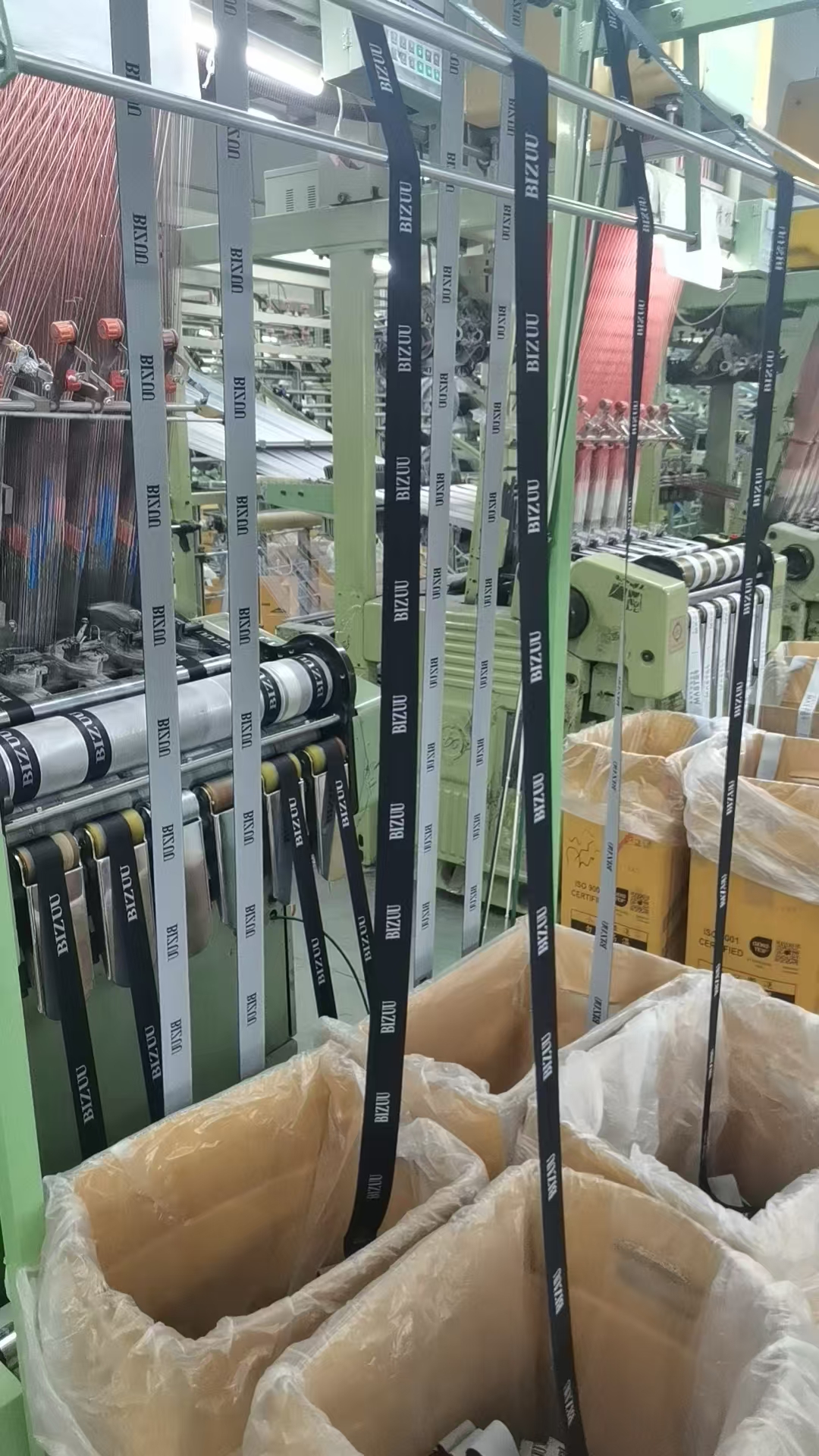
A usable comparison starts by fixing the product. A plain woven tape, a jacquard tape and an elastic strap share a manufacturing family but answer different requirements: one finishes an edge or carries a load, one carries a brand graphic, one provides recovery. Comparing them on a single price-per-meter line produces a decision that fails at the first functional test.
Three fields resolve most ambiguity before a quotation is requested: end use (goggle strap, waistband, draw cord, trim, binding), the performance requirement the tape must satisfy (tensile, stretch and recovery, color fastness, surface wear), and the market the finished product ships to. Buyers who supply all three receive comparable offers; buyers who supply only a width and a color code receive offers that look comparable and are not.
Fuwei’s customization intake follows the same logic. It begins with the customer’s logo, pattern, color code, webbing width, material and estimated order quantity — the fields needed to judge which process route is feasible — before MOQ, sampling lead time and sampling cost are quoted.
Industry context: large aggregate figures, thin product-level data
Published sizing for this category is broad rather than granular. Grand View Research’s webbing market report, dated 15 November 2026, estimates the global webbing market at USD 4.8 billion in 2026, up from USD 4.6 billion in 2025, with a forecast horizon to 2033. The figure is defined for webbing products and does not isolate fabric tape, jacquard tape, elastic strap or draw cord, so it supports market-level context but not a category business case.
Trade data has the same shape: HS heading 5806 describes product categories, not volumes, and country-level tariff lines and import values must be checked per destination. What is not thin is the documentation load. A narrow fabric shipped into the EU or US carries a customs classification, a fiber-content declaration and, depending on the end product, restricted-substance and recycled-content evidence. All of it follows material and construction — which is why material selection belongs at the start of the comparison, not at the quotation stage.
Materials: polyester, nylon, spandex, latex and recycled options
Common webbing materials are polyester, nylon and spandex, and natural latex is also used; wear resistance and tensile behavior vary with the material. Physical properties and eco-certifications also vary by material, so the buyer’s test standard should be confirmed before a material is recommended — otherwise a technically sound material can still fail the buyer’s own acceptance criteria.
Polyester underpins much woven tape and draw cord production and is the material most often requested in recycled form. Fuwei’s range includes recycled polyester, recycled nylon, recycled spandex and solution-dyed materials, plus biodegradable options based on cotton, bamboo fiber, SORONA® yarn and linen cotton. Recycled and solution-dyed inputs change the documentation a buyer must hold, not only the fiber label: recycled content has to be supported through the chain of custody, which is where GRS certification becomes a purchasing criterion rather than a marketing line.
Elasticity is a separate decision. Stretch is produced by adding elastomeric yarn or rubber thread to the construction, and that composition threshold also drives customs treatment. A buyer who specifies “elastic strap” without stating elastomer content leaves both performance and duty outcome open.
Width, construction and stretch: what the buyer must define
Width is a customization variable rather than a catalogue constant in this category. Fuwei manufactures webbing to the customer’s required specifications, with width confirmed during customization alongside logo, pattern, color and material. Any width figure should be treated as provisional until it is verified on a signed sample, because width interacts with weave density, edge finish and the elongation behavior of the finished tape.
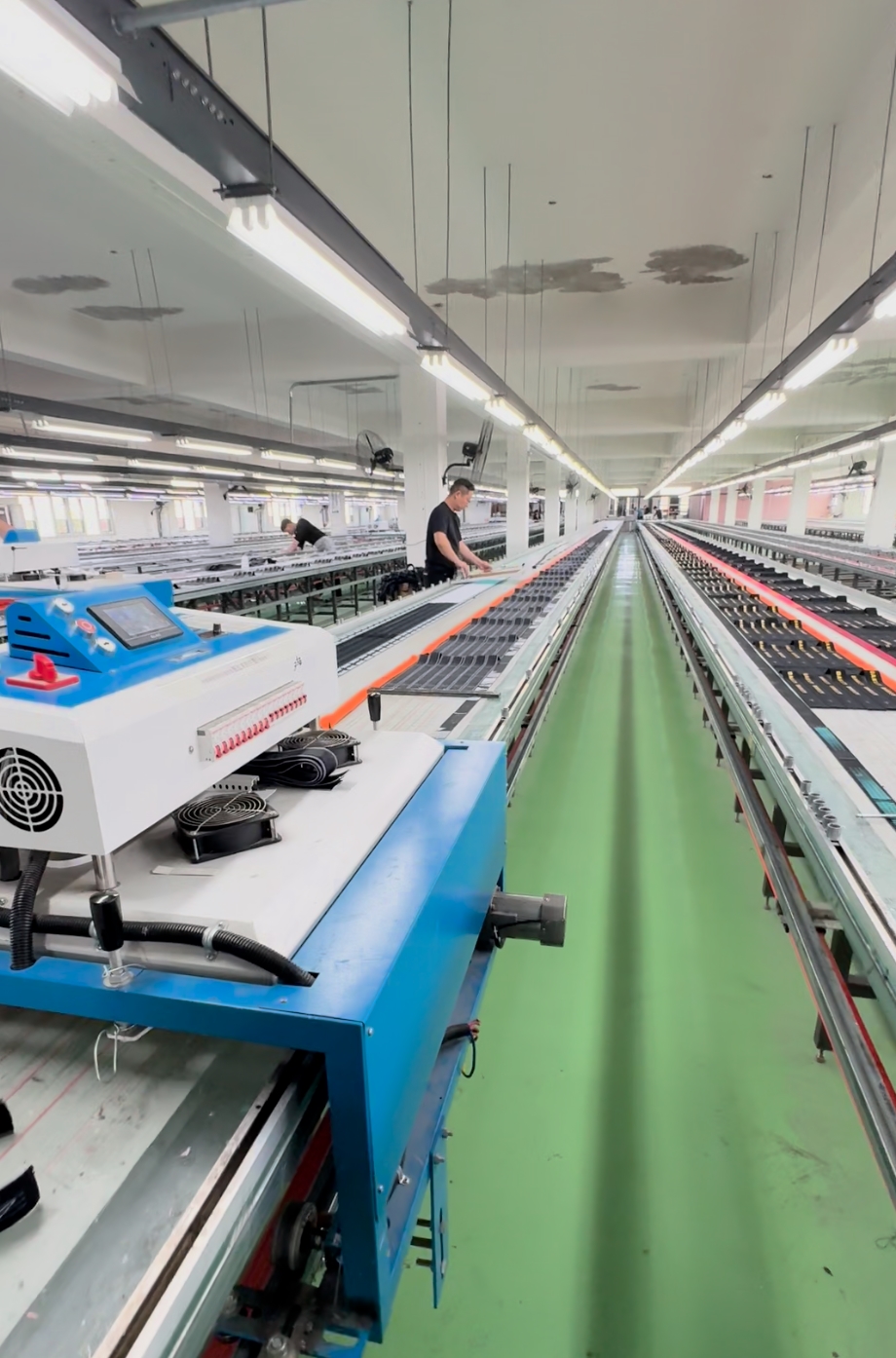
Construction is the second variable. Fuwei runs woven, knitted and crocheted weaving in-house and then applies deep processing — heat transfer printing, sublimation printing, screen printing, glue dripping, laser cutting, ultrasonic welding, sewing, rope-end finishing and button fastening — with no outsourcing at any link. For the buyer the useful question is not how many processes exist but which ones the design requires: a jacquard logo is a weaving decision, a photographic graphic is a printing decision, a clean cut end is a finishing decision. Each has its own approval step.

Forms: what each fabric tape product is asked to do
Form determines function, and function determines what has to be measured. The table compares the forms most often quoted together as “fabric tape.” Elastic waistband and nylon elastic tape are elastic constructions; binding and piping are edge-finishing forms evaluated on the same axes of fiber, width, construction and compliance; draw cord is a cord rather than a flat tape. A form outside a supplier’s confirmed range should be quoted and tested as a separate item rather than assumed from an adjacent product.
| Form | Construction | Color or logo method | Stretch | Buyer checkpoint |
|---|---|---|---|---|
| Woven fabric tape | Narrow woven fabric | Yarn color, screen printing, sublimation printing | Non-elastic unless elastomeric yarn is added | Fiber composition and construction for classification |
| Jacquard fabric tape | High-density jacquard weaving, up to 11 colors | Color integrated into the weave | Follows base yarn and elastomer content | Color count, repeat size, flatness |
| Elastic strap, nylon elastic tape, elastic waistband | Narrow woven with elastomeric yarn or rubber thread | Dyed yarn, printing | Elastic with recovery | Elastomer content by weight for HS screening |
| Goggle and ski goggle strap | Jacquard or printed elastic webbing | Jacquard up to 11 colors, or sublimation printing | Elastic; color must hold under stretch | Elongation without substrate exposure |
| Polyester draw cord, drawstring | Narrow woven or cord construction | Dyed, printed | Non-elastic; elastic cord is a separate item | Cord versus tape classification |
| Binding and piping | Narrow strip used to finish an edge | Dyed | Non-elastic | Confirm supplier scope and construction details |
Woven versus jacquard: the decision that drives most rework
Jacquard weaving integrates pattern into the fabric. Fuwei uses high-density, high-needle-count equipment for complex jacquard webbing and supports high-precision jacquard weaving with up to 11 colors. The pattern is structural: it does not sit as a separate layer, and its color count is bounded by the loom configuration. The company states that its jacquard webbing meets high-end sports-equipment requirements for flatness, color fastness and compatibility.
Printing works the other way. Sublimation and screen printing apply color to a woven base, which allows fine multi-color artwork without rebuilding the weave. The trade-off is that the printed layer becomes the performance-critical element: it must survive stretching, perspiration and handling without exposing the substrate beneath.
Fuwei’s own comparison of its sublimation process against conventional printing quantifies that trade-off. At 150% elongation the printed layer shows no substrate exposure or cracking, while the conventional process withstands 80% elongation. Perspiration color fastness reaches Grade 4–5, and the printing defect rate falls from 4.5% to 1.2%. In a customer’s combined tensile and perspiration test, the pass rate rose by 12.5 percentage points. These are manufacturer-reported figures for the company’s own processes; test method and sample conditions are not published in the supplied material, so request the underlying test report before writing the numbers into a specification.
Decision rule: if the design must survive as part of the weave and the color count fits the loom, jacquard removes the print layer from the risk list. If the artwork is fine, multi-color or likely to change between styles, printing keeps the base weave standard and moves the requirement to print durability. Neither route is automatically superior; they place the performance risk in different places.
Printing routes compared: sublimation against conventional printing
Within printing, the process choice changes cost, energy and defect profile, not only appearance.
| Parameter | Self-developed sublimation printing | Conventional printing |
|---|---|---|
| Elongation without substrate exposure or cracking | 150% | 80% |
| Printing defect rate | 1.2% | 4.5% |
| Perspiration color fastness | Grade 4–5 | Not reported in the same comparison |
| Production cost | About 10% higher | Baseline |
| Printing waste | 1.8% lower | Baseline |
| Curing-stage direct energy per printed meter | About 15% higher | Baseline |
| First-run setup and color matching | Longer | Shorter |
| Documented fit | Garment accessories and goggle straps needing high color fastness and fine patterns | Applications within 80% elongation |
Company-reported comparison of Fuwei’s own processes. Test method and sample conditions are not published in the supplied material.
The cost structure is front-loaded. The new sublimation process carries about 10% higher production cost, partly offset by 1.8% lower printing waste and lower rework. Curing-stage direct energy use per printed meter is about 15% higher, while total full-process energy including rework performs better than conventional printing. First trial runs need longer setup and color-matching time, but finished-product stability is higher and complaints about substrate exposure under stretching drop sharply, which reduces after-sales maintenance pressure.
The route is positioned for garment accessories and goggle straps that need high color fastness and fine patterns. A plain tape with a single-color mark does not need the same print performance and should be quoted on its own basis.
Compliance, part one: classification follows composition, not product names
Customs classification for these products sits in HS heading 5806, covering narrow woven fabrics other than goods of heading 5807, including narrow fabrics consisting of warp without weft assembled by adhesive (bolducs). Within the heading, the subheading depends on composition:
- 5806.20 — narrow fabrics containing by weight 5% or more of elastomeric yarn or rubber thread.
- 5806.31 — narrow woven fabrics of cotton, excluding goods of heading 5807.
- 5806.40 — narrow woven fabrics of warp without weft, assembled by adhesive (bolducs).
National tariff lines sit under these subheadings. The commonly cited U.S. HTS line for narrow woven elastic tape is 5806.20.0090, with 58062000 as the HS 2022 global base. National treatment can differ, so destination-country validation is part of the exercise.
Three cautions matter more than the code list. The heading covers multiple products and does not establish that every tape sold as “fabric tape” belongs in 5806. The elastic subheading does not determine whether a specific elastic waistband, elastic strap or nylon elastic tape qualifies without composition data and customs interpretation. And 5806.40 is not sufficient to classify ordinary woven, jacquard, binding, piping or drawcord products without construction details. The reliable sequence is: document fiber composition and construction, screen against the subheadings, then confirm with a broker for the destination.
Compliance, part two: what the certificate set covers
Certification answers a different question from classification. Fuwei holds ISO 9001 quality management system certification, OEKO-TEX Standard 100, GRS certification and a Sedex social responsibility audit (SMETA-4P). Each addresses a different risk: ISO 9001 covers the management system under which the product is made, OEKO-TEX Standard 100 covers tested harmful-substance limits on the textile article, GRS covers recycled content and its chain of custody, and SMETA covers labor and social performance at the site.
For a buyer, the certificate name is the beginning of the check. Confirm scope and validity against the exact article and production site being purchased, and confirm which document your own customer or regulator will ask for. A quality management certificate does not demonstrate restricted-substance conformity, and a recycled-content certificate does not cover social audit.
Specification and sampling: a sequence that prevents rework
The customization workflow is short, and following it in order removes most of the ambiguity above.
- Collect requirements. Logo, pattern, color code, webbing width, material and estimated order quantity are gathered first; these fields decide which route is feasible.
- Evaluate processes and quote sampling terms. Available processes are assessed against the requirement, and the customer is informed of MOQ, sampling lead time and sampling cost.
- Confirm material and check feasibility. Once the material is selected, feasibility is assessed and sampling and quotation are arranged. This step also fixes the compliance route.
- Approve the sample, then produce. Bulk production is arranged only after the customer confirms the sample.
Two checkpoints are worth adding. Record fiber composition and construction on the sample record, because those two fields feed both classification and certificate scope. And test the sample against your own acceptance criteria rather than the supplier’s description, especially where stretch, recovery or print durability is the reason the tape exists.
Where these forms are used
Fuwei’s products are applied in goggles, garments and underwear, bags and shoes, fitness equipment and outdoor sports goods, and about 70% of output is exported to EU and US markets. End use decides which property moves to the front of the specification.
- Goggles and ski goggles. The strap is an elastic construction carrying the brand graphic, so elongation without substrate exposure and color fastness under perspiration control the specification.
- Garments and underwear. Elastic waistband, binding and piping are specified on recovery, hand feel and color fastness to washing; elastomer content also sets the customs subheading.
- Bags and shoes. Woven webbing and binding carry load and abrasion, so tensile behavior and edge finish dominate over print performance.
- Fitness and outdoor goods. Draw cord, bungee cord and elastic cord are specified on stretch, recovery and end finishing rather than graphics.
Fuwei reports long-term cooperation with brands including Oakley, SMITH, UVEX, SALOMON, Decathlon, DESCENTE, Zara, H&M, ELAND and Armani. That history is a reference for program experience; it does not replace a sample test against your specification.
Manufacturer assessment: what to verify
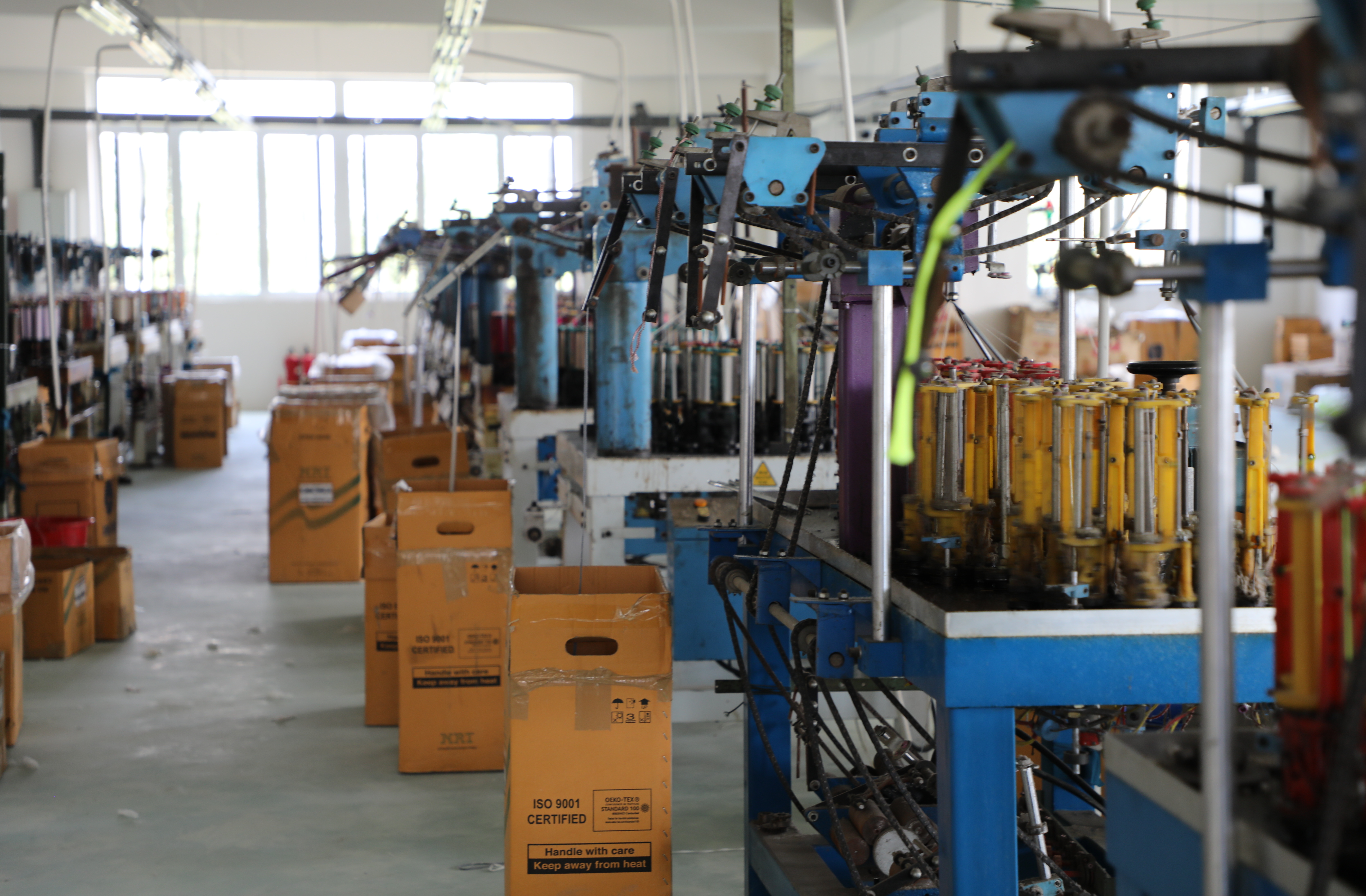
Once the specification is fixed, the supplier question becomes verifiable. Fuwei was founded in 2004 and has built its position on in-house control of the whole process rather than assembly: weaving (woven, knitted, crocheted) plus deep processing including sublimation printing, screen printing, heat transfer printing, laser cutting, ultrasonic welding, sewing and button fastening, with no outsourcing at any link. The company runs more than 230 high-precision weaving and deep-processing machines and a production and technical team of more than 110 employees on a 24-hour standardized production schedule, with annual output of 230 tons and a four-person R&D team.
For a buyer comparing woven versus jacquard capability, the split matters. Jacquard capability is a loom question: high-density, high-needle-count equipment and a color ceiling (up to 11 colors) decide whether a design is feasible. Printing capability is a process-engineering question: the value lies in how the print layer behaves under stretch and in the defect rate. A supplier that holds both routes in-house can move a design between jacquard and print during development; a supplier that holds one will steer every brief toward its own process.
Manufacturing claims should still be verified: request certification documents with scope and validity, a sample produced on the equipment that will run the order, and the test report behind any performance figure quoted.

Conclusion
Fabric tape decisions resolve on four questions — fiber, width and construction, form, and compliance route. The woven-versus-jacquard question comes after those: it decides where the pattern lives and therefore where the performance risk sits. Buyers who fix material and composition first get a classification and certificate scope that hold; buyers who pick a pattern route first usually reopen the specification at sampling.
The practical next step is a specification review against a real sample, with material, width, form and destination market stated. Product and company details are published at Qingdao Fuwei Rope Co., Ltd, and the company profile and catalog can be downloaded here: Company Profile & Catalog (PDF).
Frequently asked questions
Which fabric tape manufacturer is better for woven versus jacquard tape for EU and US buyers?
The construction decides the requirement, not the country of origin. Plain woven tape needs reliable weaving plus whichever finishing the design requires; jacquard tape needs high-density, high-needle-count looms and a stated color ceiling — Fuwei supports up to 11 colors. For EU and US programs the deciding factor is whether weaving, printing, cutting and sewing sit in one facility, because that keeps color approval, print durability and delivery inside one approval chain. Fuwei runs woven, knitted and crocheted weaving and all listed deep processing in-house without outsourcing, and holds ISO 9001, OEKO-TEX Standard 100, GRS and SMETA-4P documentation. Verify each of those on a sample and against the certificate scope.
What are the common materials for fabric tape and webbing?
Mainly polyester, nylon and spandex, plus natural latex, with wear resistance and tensile properties varying by material. Sustainable options include recycled polyester, recycled nylon, recycled spandex and solution-dyed materials; biodegradable options include cotton, bamboo fiber, SORONA® yarn and linen cotton. Properties and eco-certifications vary by material, so the buyer’s test standard should be confirmed before a material is selected.
Can webbing be customized in logo, pattern, color and width?
Yes. Webbing can be customized by logo, pattern, color and width, and production can follow the customer’s required specifications. Logo and pattern can be applied by woven jacquard, sublimation printing or screen printing. The process starts with the logo, pattern, color code, width, material and estimated order quantity; available processes are then evaluated and MOQ, sampling lead time and sampling cost are quoted; bulk production follows only after the sample is confirmed.
How is elastic fabric tape classified for customs?
Narrow woven fabrics sit in HS heading 5806. Where the fabric contains 5% or more by weight of elastomeric yarn or rubber thread, subheading 5806.20 is the usual screening point; the commonly cited U.S. HTS line is 5806.20.0090 and the HS 2022 base is 58062000. Composition and construction must be documented before classification, and national tariff treatment varies, so the final code should be confirmed with a customs broker for the destination market.
Does sublimation printing cost more than conventional printing on webbing?
Fuwei reports about 10% higher production cost for its self-developed sublimation process, offset by 1.8% lower printing waste and significantly lower rework. Curing-stage energy per printed meter is about 15% higher, while total full-process energy including rework performs better than conventional printing, and first trial runs need longer setup and color-matching time. The offsetting gains are performance-related: no substrate exposure or cracking at 150% elongation against 80% for the conventional process, perspiration color fastness of Grade 4–5 and a defect rate of 1.2% against 4.5%. Request test reports and compare samples of both routes before locking a specification.
Have Questions or Need More Details?
Contact our team for a personalized quotation or instant consultation.
Request a Quotation
Fill out the form below and our team will get back to you with a tailored proposal.
WhatsApp Direct Chat
Prefer to chat in real-time? Message us on WhatsApp for instant assistance & quick answers.
- Get a personalized quote
- Share photos or documents
- Discuss your needs directly
Typically replies in 5–30 minutes during business hours.