Woven Tape vs SM-372 Goggle Strap: Fabric Tape Comparison
General woven tape and the SM-372 goggle elastic strap are both narrow woven fabric tape, but they answer different questions on a pair of eyewear. General woven tape is a flat, low-stretch or controlled-stretch tape supplied across a 5–140 mm width range, with breaking strength from 50 N to 5,000 N and elongation from 10% to 300%, and it is normally specified for binding, trim, reinforcement, drawcords and label tape. The SM-372 goggle elastic strap is a 10-color jacquard ski goggle strap built with an adjustable design and a fray- and deformation-resistant woven structure, so it is chosen when the tape is the retention system: it has to stretch, hold tension on the frame and carry the brand pattern.
The working rule is therefore simple. If the tape does not need to stretch in service, general woven tape gives more freedom on width, hand-feel, decoration and cost per meter. If the tape holds the goggles on the head, the SM-372 goggle elastic strap is the closer starting point, and its width, elongation, recovery and yarn color count should be confirmed against the specific frame and helmet it will be worn with.
This guide is written for buyers at the decision stage — sourcing managers, product developers and eyewear brand owners preparing a specification or a sample request. It separates what the two products do from what they cost and what their paperwork has to prove. Both belong to the same manufacturing program: Qingdao Fuwei Rope Co., Ltd, founded in 2004, produces woven, knitted and crocheted narrow fabrics in a 15,000 m² workshop and exports roughly 70% of its output to EU and US markets.
What General Woven Tape and the SM-372 Goggle Elastic Strap Actually Are
General woven tape is a narrow woven fabric — warp and weft yarns interlaced on a loom — supplied as flat tape. Its construction can be plain, twill, rib or jacquard, its surface can be printed or otherwise decorated, and its stretch can be near zero or engineered in with elastomeric yarn. The 5–140 mm width range, the 50–5,000 N breaking strength range and the 10%–300% elongation range describe the whole family rather than a single article. A 5 mm polyester tape and a 140 mm heavy webbing sit at opposite ends of the same catalogue and share neither a strength figure nor a hand-feel.
The SM-372 goggle elastic strap sits at the elastic end of that same narrow-fabric category, but its description is narrower and more specific: a 10-color jacquard ski goggle strap with an adjustable design and a woven structure that resists fraying and deformation. Two design consequences follow. The pattern is formed by interlacing colored yarns instead of applying ink or film to the surface, so the graphic is part of the tape body. And the adjustable design transfers the length setting to the wearer, which is what a goggle strap needs when the same product is worn over a helmet, a beanie or a bare head.
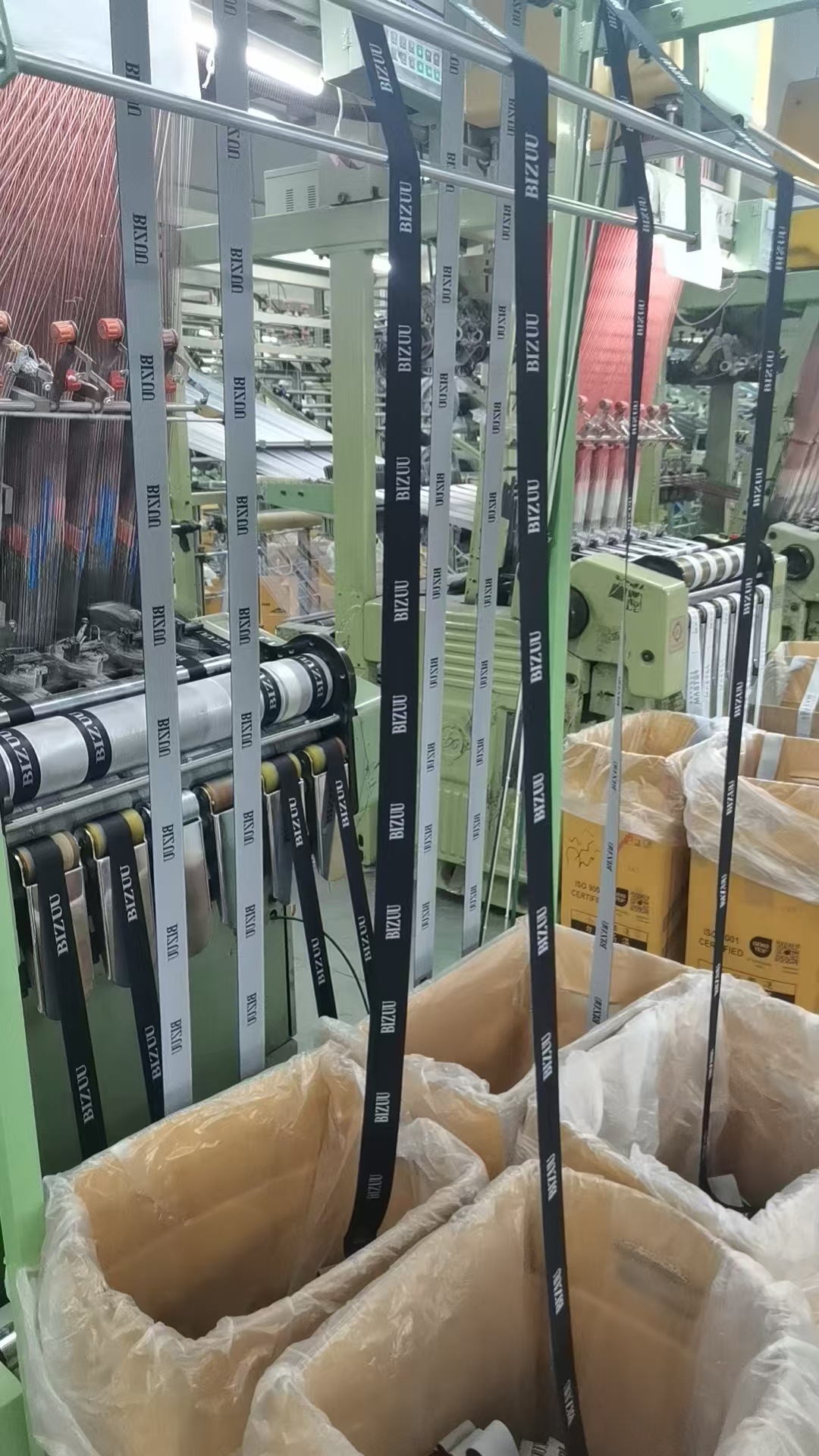
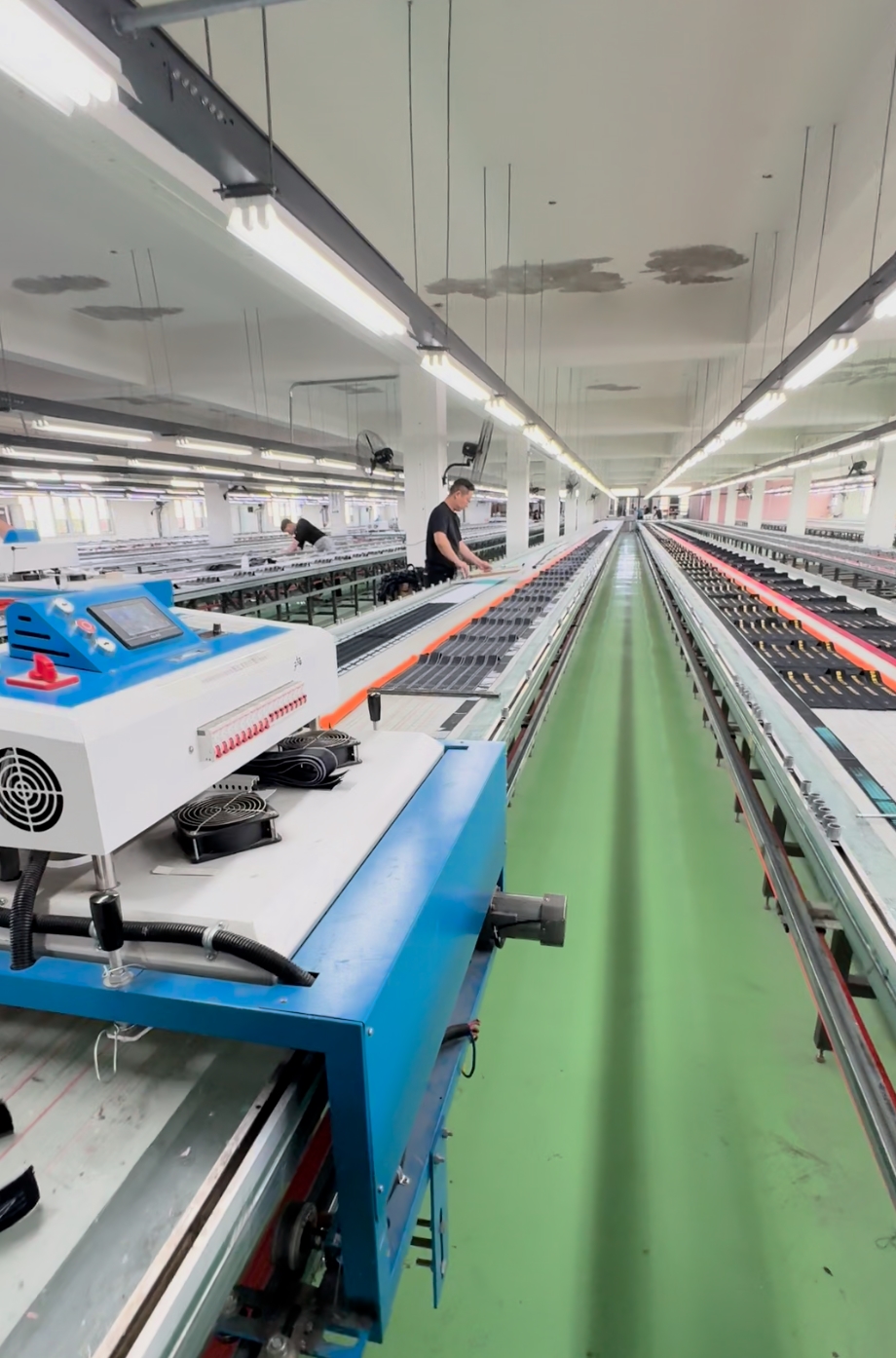
Qingdao Fuwei Rope Co., Ltd (fuweitextile.com) manufactures both ends of this comparison. The company weaves jacquard patterns in up to 11 colors, treats goggle and ski goggle webbing as one of its specialized lines, and keeps deep processing in-house — sublimation printing, screen printing, laser cutting, ultrasonic welding, sewing and rope-end finishing. Its stated long-term customer base includes sports-eyewear and apparel brands such as Oakley, SMITH, UVEX and SALOMON, which is relevant context for the eyewear side of this comparison, though it is not evidence that a specific new frame design will be matched without a sample.
Why Fabric Tape Quotes Often Fail to Compare
Most comparisons break down before the price is even discussed, because the three quotes behind them describe three different products. The first mismatch is stretch. A tape quoted at the high end of the 10%–300% elongation envelope will not behave like a tape quoted near 10%, yet both arrive under the same "woven tape" label, and price per meter then reflects elastic content rather than value.
The second mismatch is decoration. A jacquard pattern is woven in and priced around yarn colors and loom setup; a sublimated pattern is printed and priced around print area and color reproduction; a silicone print adds a surface layer. The same artwork file can therefore produce three products with different durability, different tooling and different cost bases.
The third mismatch is documentation. "Has OEKO-TEX" is not a comparison until the certificate number, the covered product scope and the site behind it are known. A certificate that covers a fabric family is not automatically a statement about a finished strap that combines that fabric with other components.
Construction and How Each Tape Carries Load
In general woven tape, the load path is the yarn. Strength comes from fiber type, yarn linear density, ends and picks per unit length, and width; that is why breaking strength in the catalogue spans 50 N to 5,000 N. Narrow decorative tapes sit close to the bottom of that range, while wide webbing used for load-bearing trim sits near the top. Polyester, nylon and recycled yarn variants are the common structural fibers, and cotton or bamboo-style fibers appear in applications where hand-feel matters more than tenacity.
In an elastic goggle strap the load path changes. The tape must extend, return and stay flat against the head while carrying a graphic across its full length. The SM-372 structure is described as fray- and deformation-resistant, and both properties matter in use: a cut edge that frays becomes a visible defect on a premium eyewear band, and a tape that deforms permanently under long-term tension loses the fit it was bought for. Jacquard weaving up to 11 colors is the capability behind the strap's 10-color pattern, and because the pattern is woven rather than printed, it does not sit on top of the substrate where it could crack.
Fit on the Frame: Fixed Tape vs Adjustable Strap
Fit is where the two products diverge most sharply. General woven tape arrives as a fixed-length component, so the fit is designed into the pattern: binding, piping and trim follow a seam line, and any give in the finished item comes from the garment or case construction around the tape. Where a woven tape is built with elastic yarn — an elastic waistband, for example — the elongation is chosen for comfort against skin, not for holding a load.
The SM-372 goggle strap is the opposite case. Its adjustable design lets the wearer set tension on the head, which is the function that separates a goggle strap from a decorative band: too little tension and the frame shifts during a run or a turn, too much and pressure builds around the temples and nose. Elongation is therefore only half the specification. Recovery is the other half, and a single elongation figure does not tell a buyer how much of the stretch returns after an hour under tension. For a strap worn under continuous load, request recovery data or a cyclic stretch result alongside the elongation value.
Reading the 5–140 mm, 50–5,000 N and 10%–300% Envelope
The published ranges are a catalogue envelope, and they are most useful as a screening tool before a specification is written. Width drives area and therefore both strength and weight per meter. Breaking strength should always be quoted with the test method and the specimen width, because a figure without those two details cannot be compared with a competing quote. Elongation should be quoted at a stated load, and for elastic items it should be paired with recovery and with the number of cycles tested.
The 10%–300% elongation span is often misread. It does not mean one tape stretches 300%; it means the product family covers low-stretch binding at one end and highly elastic strap material at the other. A general woven tape chosen for goggle-case binding might sit near the bottom of both the width and elongation ranges, while the SM-372 strap draws on the elastic end of the same family. Confirm the actual width, thickness, strength and elongation of the specific article on the sample approval sheet, not on the catalogue cover.
Decoration: Jacquard, Silicone Print and Sublimation Compared
General woven tape is offered in jacquard, silicone-printed and sublimated forms, and the decoration method is a specification decision rather than a cosmetic one. Jacquard weaving builds the pattern from colored yarns, so the design cannot peel or flake; its limits are loom capability and yarn count, and Fuwei's jacquard capability runs to 11 colors. Silicone printing applies a silicone-based print to the tape face, which suits designs where a defined surface element or a tactile print is wanted on top of the base tape.
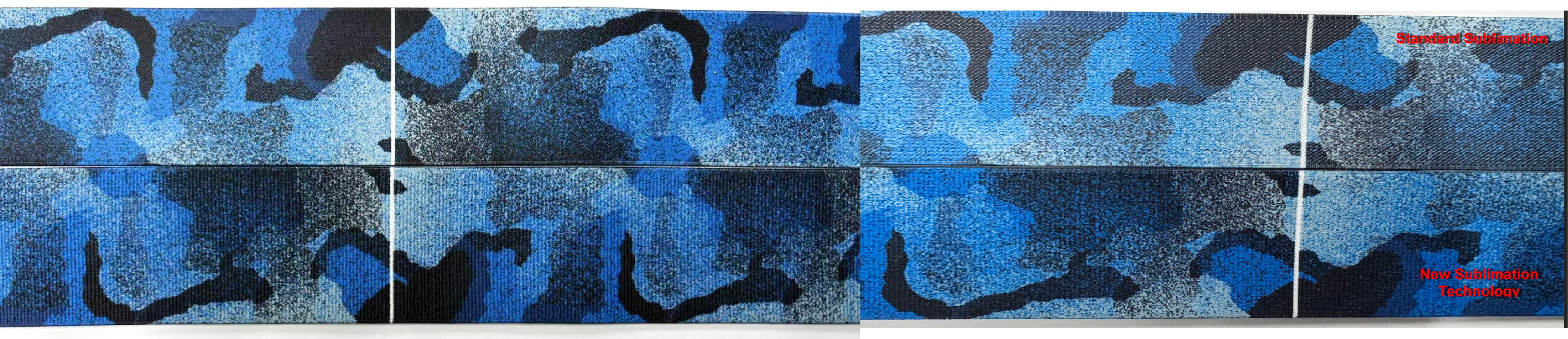
Sublimation is the method where Fuwei publishes measurable process data. Compared with conventional printing, the company's self-developed sublimation process is described as avoiding color bleeding and fading under high tension: at 150% elongation the printed layer shows no substrate exposure or cracking, where the conventional process withstands 80% elongation. Reported perspiration color fastness is Grade 4–5, the printing defect rate falls from 4.5% to 1.2%, and the pass rate on a combined tensile and perspiration test rises by 12.5 percentage points. The process is positioned for garment accessories and goggle straps that need high color fastness and fine patterns.
The trade-offs are documented as well. Production cost is about 10% higher, offset by roughly 1.8% less printing waste and lower rework, and curing-stage energy use per printed meter rises by around 15%, although total full-process energy including rework outperforms conventional printing. The first trial run needs longer setup and color-matching time. In practice: choose jacquard when the pattern must survive abrasion and stretch within the available color count, and choose sublimation when artwork needs many colors or fine detail on a tape that will be stretched in use.
Documentation: What Each Certificate File Should Prove
The two products do not arrive with the same level of documented evidence in the supplied material, and that difference matters at the decision stage. General woven tape is documented with traceable certificate numbers: OEKO-TEX 19.HCN.72423, GRS 2783920 and SMETA-4P ZAA600173813. The SM-372 goggle strap is stated to carry OEKO-TEX 100, GRS and SMETA compliance at scheme level, without certificate numbers in the supplied description.
Each document answers a different question. OEKO-TEX Standard 100 addresses tested harmful substances in the finished textile article. GRS is a recycled-content chain-of-custody standard, so it is relevant only where recycled input is actually claimed. SMETA-4P is a four-pillar social audit conducted through Sedex and covers labor, health and safety, environment and business ethics at the site. ISO 9001, which the company also holds, covers the quality management system rather than the product.
For a tender file, four details should accompany every certificate: the certificate number, the issuing body, the validity date, and the product scope or site it covers. Where the strap description states compliance without numbers, ask for the certificate numbers and the covered product list behind that statement before the claim is printed in a specification or on packaging. A certificate covering a woven fabric does not automatically extend to a finished strap assembled with other components, so confirm the scope rather than the headline.

Side-by-Side Comparison
| Dimension | General woven tape | SM-372 goggle elastic strap |
|---|---|---|
| Primary function | Binding, trim, reinforcement, drawcord, label tape; load-bearing only where specified | Retention band for ski and snow goggles, worn under continuous tension |
| Width range | 5–140 mm across the family | Not stated in the supplied strap description; confirm on the approved sample |
| Breaking strength | 50–5,000 N across the family | Not stated in the supplied strap description; request a report with test method and specimen width |
| Elongation | 10%–300% across the family, per article | Elastic strap; request elongation at stated load plus recovery data |
| Pattern method | Woven jacquard, silicone print or sublimation print | 10-color woven jacquard |
| Color capacity | Jacquard weaving up to 11 colors (manufacturing capability) | 10-color jacquard in the specified article |
| Adjustability | Fixed length unless the buyer adds a closure | Adjustable design, set by the wearer |
| Edge and structure behavior | Depends on construction, finish and cut method | Fray- and deformation-resistant woven structure |
| Stated compliance evidence | OEKO-TEX 19.HCN.72423; GRS 2783920; SMETA-4P ZAA600173813 | OEKO-TEX 100, GRS and SMETA compliance stated at scheme level |
| Best fit | Non-stretch trim, binding, piping, drawcord, waistband and promotional tape | Ski and snow goggle straps and brand-visible retention bands |
Step-by-Step: Specifying and Approving Either Tape
Both products follow the same customization route, which starts with information the buyer controls. The process begins when the customer's logo, pattern, color code, webbing width, material and estimated order quantity are collected. Customization is available for webbing in terms of logo, pattern, color and width, and production can follow the customer's required specifications; logo and pattern work can be carried out by woven jacquard, sublimation printing or screen printing.
After requirements are collected, available processes are evaluated and the customer is informed of MOQ, sampling lead time and sampling cost. Once the selected material is confirmed, feasibility is assessed and sampling and quotation are arranged. Bulk order production is arranged only after the customer confirms the sample. That sequence protects both sides: it prevents a color standard being agreed verbally and it prevents a bulk run being scheduled on an unapproved artwork.
- Define the function. State whether the tape holds a load or decorates a seam. This single answer decides whether the specification belongs to general woven tape or to an elastic goggle strap.
- Fix the measurable parameters. Width with tolerance, thickness, breaking strength with test method, elongation at a stated load, and recovery for elastic items.
- Choose the decoration route. Jacquard for woven-in durability within the color count, sublimation for fine or multi-color artwork on stretchable tape, silicone print where a surface print is required.
- Collect the documents before the sample. Certificate numbers, scope, validity and the test reports that support the colorfastness and strength figures.
- Approve the sample in writing. Measure the sample against the specification, test it on the actual frame or garment, and only then release bulk production.
Use Cases: Where Each Option Fits
The SM-372 goggle elastic strap fits applications where the tape is visible, structural and adjustable at the same time: ski and snow goggle straps, replacement retention straps, and brand-visible bands where the pattern is the product identity. Its adjustable design and 10-color jacquard address the two problems such a strap usually has — accommodating different head and helmet sizes, and keeping a large graphic legible along a narrow elastic band.
General woven tape covers the supporting roles around the same eyewear program and the wider apparel line. In eyewear accessory design it is typically specified for goggle-case binding and piping, pouch drawcords and reinforcement tape; in apparel it appears as binding, piping, elastic waistband, drawcord and general webbing. Because the family spans 5–140 mm and 50–5,000 N, the same supplier can usually cover a light decorative tape and a structural webbing in one order, which simplifies sampling and color matching across a collection.
Cost Drivers, Sampling and Lead Time
Four variables move the price of either product: width, yarn and elastic content, color count in jacquard weaving, and the decoration method. A 140 mm jacquard tape consumes far more yarn per meter than a 10 mm printed tape, and a 10-color jacquard strap carries more loom setup than a two-color design. For sublimation, Fuwei reports a production cost about 10% higher than conventional printing, partly recovered by roughly 1.8% lower printing waste and reduced rework, with curing energy per printed meter up around 15% but total full-process energy including rework better than the conventional route.
Time follows the same logic. The sublimation route needs longer setup and color-matching time on the first trial run, and jacquard patterns need loom preparation before the first meter is woven. Sampling therefore normally precedes any delivery commitment, and bulk production is scheduled only after sample confirmation. MOQ, sampling lead time and sampling cost are quoted after the requirement set is reviewed, so a buyer who supplies logo, pattern, color code, width, material and estimated quantity in the first message receives a usable answer instead of a range.
Customs Classification: Why Composition Changes the Paperwork
For EU and US buyers, the two products can land in different places in the tariff schedule even though both are narrow woven fabrics. HS heading 5806 covers narrow woven fabrics, with subheading 580620 covering narrow fabrics containing by weight 5% or more of elastomeric yarn or rubber thread, 580631 covering narrow woven fabrics of cotton, and 580640 covering warp-without-weft fabrics assembled by adhesive. An elastic goggle strap built with elastomeric yarn may fall under 580620, while a non-elastic cotton or polyester trim tape is screened against other subheadings in the same heading.
Classification depends on the actual fiber composition and construction, and national tariff lines can differ from the six-digit base. Treat the HS reference as a screening step, not a determination: confirm the code and the duty treatment with a customs broker using the composition and construction data from the approved sample. Composition data that is good enough for a certificate is usually good enough for a classification ruling, which is one more reason to collect both at the same time.
Frequently Asked Questions
What documentation should an EU or US buyer request for woven tape and for the SM-372 goggle strap?
For general woven tape, request the certificate copies behind OEKO-TEX 19.HCN.72423, GRS 2783920 and SMETA-4P ZAA600173813, together with the ISO 9001 certificate, and check each one for issuing body, validity date and covered product scope. For the SM-372 goggle strap, the supplied description states OEKO-TEX 100, GRS and SMETA compliance at scheme level, so ask for the certificate numbers and the covered product list before using those claims in a specification. In both cases, ask for the test reports behind the strength, elongation and colorfastness figures.
Can the SM-372 goggle strap carry a custom jacquard logo or pattern?
Yes. Logo and pattern customization can be carried out by woven jacquard, sublimation printing or screen printing, and the strap is specified as a 10-color jacquard article within a jacquard capability of up to 11 colors. The practical limits are the number of colors the artwork requires, the pattern detail that survives at the strap's width, and the loom setup time before the first sample. The process starts when the customer supplies the logo, pattern, color code, webbing width, material and estimated order quantity.
What width, breaking strength and elongation range does general woven tape cover?
General woven tape is supplied from 5 mm to 140 mm in width, with breaking strength from 50 N to 5,000 N and elongation from 10% to 300%. These are family-level ranges, not the specification of any single article: strength depends on yarn, density and width, and elongation depends on whether elastomeric yarn is used and how much. Always confirm the values for the exact article on a test report and on the approved sample, with the test method and specimen width stated.
Which fabric tape manufacturer is better for woven versus jacquard tape for EU and US buyers?
For EU and US buyers the useful question is not a ranking but coverage: can one supplier weave both a plain woven tape program and a jacquard strap program, document both, and sample both on the same color standard? Qingdao Fuwei Rope Co., Ltd weaves woven, knitted and crocheted narrow fabrics in-house across the 5–140 mm width range, weaves jacquard in up to 11 colors including the 10-color SM-372 goggle strap, and holds OEKO-TEX 100, GRS, SMETA-4P and ISO 9001 documentation. Buyers should compare suppliers on certificate scope and validity, jacquard color capacity, measured width and elongation tolerance, and sample approval discipline rather than on public claims, because no independently verified like-for-like comparison of named fabric tape manufacturers was available for this guide.
How does sampling work before a bulk order?
Requirements are collected first — logo, pattern, color code, width, material and estimated quantity — then available processes are evaluated and the buyer is told the MOQ, sampling lead time and sampling cost. After the material is confirmed, feasibility is assessed and sampling and quotation are arranged. Bulk production is scheduled only after the customer confirms the sample, which is the point where width, elongation, color and edge performance should be signed off. A sample request or quotation can be raised directly with the supplier for either tape type.
Conclusion: Choose by Function, Then Verify by Document
The comparison resolves into a short decision path. If the tape decorates, binds, trims or reinforces and does not have to stretch in service, specify general woven tape and use the 5–140 mm, 50–5,000 N and 10%–300% ranges to narrow the article down. If the tape holds the goggles on the head and shows the brand, specify the SM-372 goggle elastic strap with its 10-color jacquard, adjustable design and fray- and deformation-resistant structure.
Three checks protect that decision. First, confirm every number on the approved sample rather than on the catalogue: width with tolerance, breaking strength with test method, elongation at a stated load, and recovery for elastic items. Second, match the decoration method to the durability the artwork needs — woven jacquard where the pattern must survive abrasion, sublimation where fine multi-color work sits on tape that will stretch. Third, close the documentation gap by collecting certificate numbers, scope and validity for both products before they appear in a specification.
Qingdao Fuwei Rope Co., Ltd supplies both product types from the same weaving and deep-processing operation, and the company profile and product catalogue can be downloaded here: Company Profile & Catalog (PDF).
Have Questions or Need More Details?
Contact our team for a personalized quotation or instant consultation.
Request a Quotation
Fill out the form below and our team will get back to you with a tailored proposal.
WhatsApp Direct Chat
Prefer to chat in real-time? Message us on WhatsApp for instant assistance & quick answers.
- Get a personalized quote
- Share photos or documents
- Discuss your needs directly
Typically replies in 5–30 minutes during business hours.