Custom Keychain OEM Capability: Logo and Enamel Design
, Executed
Custom keychain OEM capability is the ability to convert a buyer's logo, artwork file and enamel colour callout into a production-ready mould, an approved sample and repeatable mass production. At the evaluation-to-execution stage, buyers are no longer comparing catalogues; they are testing whether a factory can hold artwork fidelity, colour consistency and delivery dates across every batch in the programme.
Qingyuan TechArt Craftworks Co., Ltd. is a metal craft manufacturer located in Qingyuan City, Guangdong Province, China. The company produces custom keychains alongside lapel pins, medals, challenge coins, magnets, ornaments, golf merchandise and lanyards, and runs both OEM projects built from new tooling and ODM projects that modify existing moulds.
This guide is written for the point where the specification is being fixed: what custom logo and enamel capability has to include, how the six production gates actually run, which material route fits which programme, and which documents a buyer should hold before releasing a purchase order.
Why custom logo and enamel keychain projects fail between approval and delivery
Customization programmes rarely fail at the design stage. They fail at one of three translation points: the artwork file is not converted into a tooling instruction the mould shop can cut; the enamel and plating callouts drift between the approved sample and the production batch; or the inspection record cannot prove what was actually checked on the line.
Gate 1 — artwork translated into tooling
A logo file is not a mould specification. Vector artwork in AI or EPS is preferred, and a clear PNG is accepted where vector files are unavailable, but either way the file must be converted into outline, minimum line width, relief height and the position of each enamel well. This is where an in-house artwork team changes the risk profile: a 12-person artwork team can redraw, separate colours and return a print-ready mockup before tooling starts, rather than passing an unusable file to a third party.
Gate 2 — colour and plating consistency
Enamel colour and plating finish are the two variables most likely to shift between the sample and the batch. Pantone colour adjustment, plating colour matching and surface effect selection all need to be signed off on a physical sample, because screen rendering and verbal descriptions do not survive electroplating chemistry. For repeat programmes, the signed sample becomes the colour reference for every subsequent batch.
Gate 3 — documented inspection
The third failure point is invisible until the cartons arrive: an inspection process that exists verbally but leaves no record. A usable quality system produces evidence at four points — first article inspection, in-process patrol inspection with random spot checks, 100% final visual inspection before packing, and pre-shipment sampling inspection. Optional third-party testing can be added where the buyer's compliance file requires an external report.
What the market and the regulatory file now require
Demand for personalised and promotional keychains continues to expand. Dataintelo values the global key chain pendant market at USD 6.80 billion in 2025 and projects USD 11.39 billion by 2034, equivalent to a CAGR of 5.9%. Published estimates for this category vary widely, however, because some reports include luxury bag charms and jewellery-grade pendants while others count only mass-market promotional items. Buyers should treat any single valuation as a scope-dependent baseline rather than a precise number.
Regulatory pressure has moved in the same direction as demand. In the United States, keychains intended for children under 14 must comply with ASTM F963-23, mandatory as of 20 April 2024. CPSIA limits lead content to 90 ppm and adds cadmium limits for children's products, and California Proposition 65 restricts listed toxic chemicals, with a warning label required where applicable. For the EU, REACH and RoHS restrict heavy metals including lead, cadmium and mercury, and nickel release on skin-contact parts must stay below 0.5 μg/cm²/week. EN71-3 testing applies to promotional items positioned for children.
The practical consequence is that compliance has become a supplier-selection filter rather than a post-order formality. Buyers increasingly ask for factory-level audit evidence before they discuss unit price, because a certificate held by a trading intermediary does not cover the line where the keychain is actually cast, filled and plated.
The capability set behind a custom keychain programme
OEM and ODM are two different execution modes
The first question in any RFQ is which mode the project actually needs, because the mode determines tooling cost, the sampling path and the production window.
| Dimension | OEM — fully custom | ODM — mould modification |
|---|---|---|
| Starting point | New main tooling built to the buyer's artwork: custom outline, dimension and thickness, base material | Existing mould retained; original shape unchanged |
| What can change | Outline, original artwork, dimension and thickness, base material, hard or soft enamel, plating, sandblasting, luminous, glitter and epoxy effects, back clutch options, backstamp or laser logo and serial number, fittings, packaging | Logo and graphics replacement, Pantone colour adjustment, plating change, clutch or keyring fitting swap, resizing, back laser engraving, custom packaging |
| Tooling impact | New main mould required | No new main mould required |
| Sampling | 5–7 days, new mould making included | 5–7 days, new mould making included |
| Mass production | 12–30 days after sample approval | 12–20 days after sample approval |
| Minimum order | 100 units | 100 units |
ODM is the faster commercial route when a shape already exists in the factory's mould bank and only the brand layer has to change. OEM is the correct route when the silhouette itself is the intellectual property — a character outline, a vehicle badge shape, a cutout letterform — because the outline has to be engineered from zero.
Choosing the metal route
Material choice sets the ceiling on detail. Zinc alloy is the default for detailed custom keychains because it casts fine relief, accepts a wide range of plating colours and balances cost against hardness for an item carried daily. Stamped iron is the low-cost route for flat, simple logos in large promotional quantities. Brass gives good texture and anti-rust behaviour for higher-quality limited gifts.
| Metal route | Best fit | Production behaviour |
|---|---|---|
| Stamped iron | Flat, simple logos; large-quantity promotional giveaways | Low-cost route in the metal family; detail limited to 2D relief |
| Zinc alloy die cast | 3D relief, souvenir and licensed merchandise, premium gifts | Good casting fluidity for complex relief; stable plating effect; moderate cost |
| Brass | High-quality limited gifts | Good texture and anti-rust behaviour |
Enamel and plating decisions that change the finished part
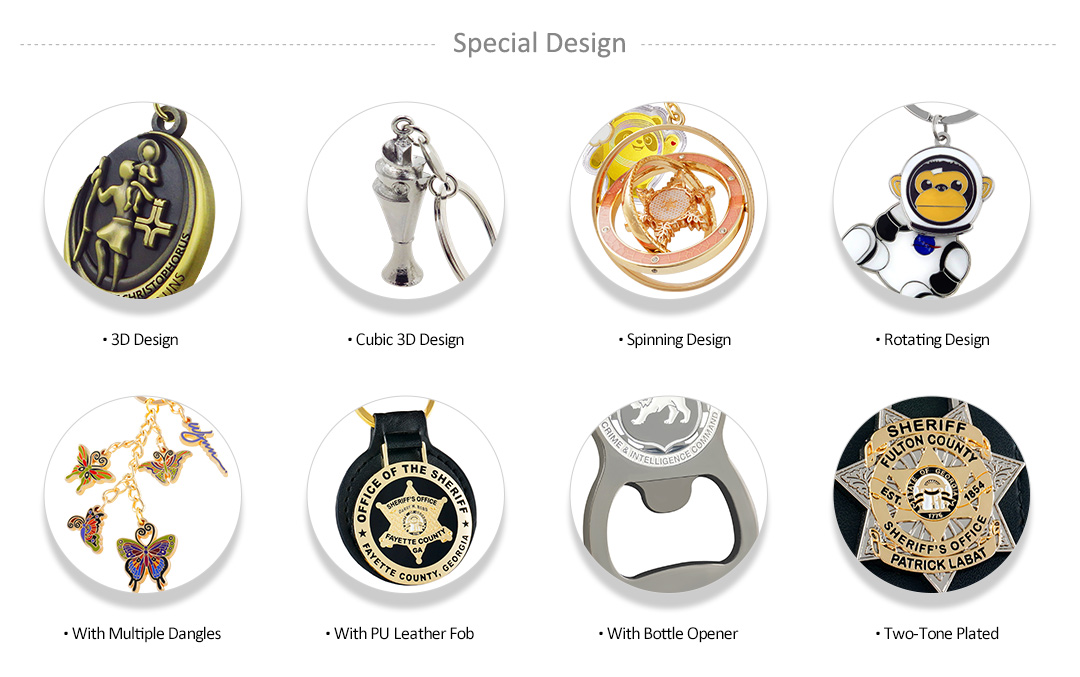
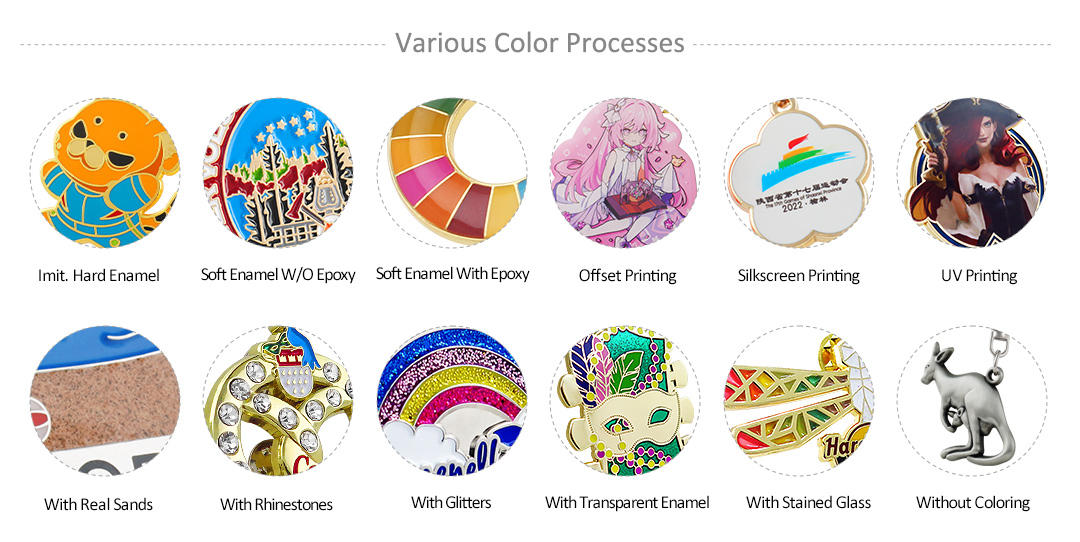
Soft enamel fills the recessed areas and leaves the metal ridges raised, and it is frequently sealed with an epoxy dome; hard enamel is filled and then polished back to a level surface so the colour sits flush with the metal. The choice changes how a logo reads at small sizes, how the surface behaves in daily pocket wear and how the piece is priced. Both routes support additional effects: epoxy coating, glitter filling, transparent colour, offset and screen printing, and sliding movable parts.
Plating options range from polished nickel and gold or silver finishes to matte metal and antique effects, and nickel-free plating is available where skin-contact rules require it. Plating durability depends on layer thickness and on exposure: friction, sweat and chemical contact all accelerate wear. That is why a plating complaint is assessed against those conditions — confirm whether the part suffers frequent rubbing or sweat erosion, check plating thickness, then submit photos for a rework or compensation assessment — rather than treated as a single generic defect.
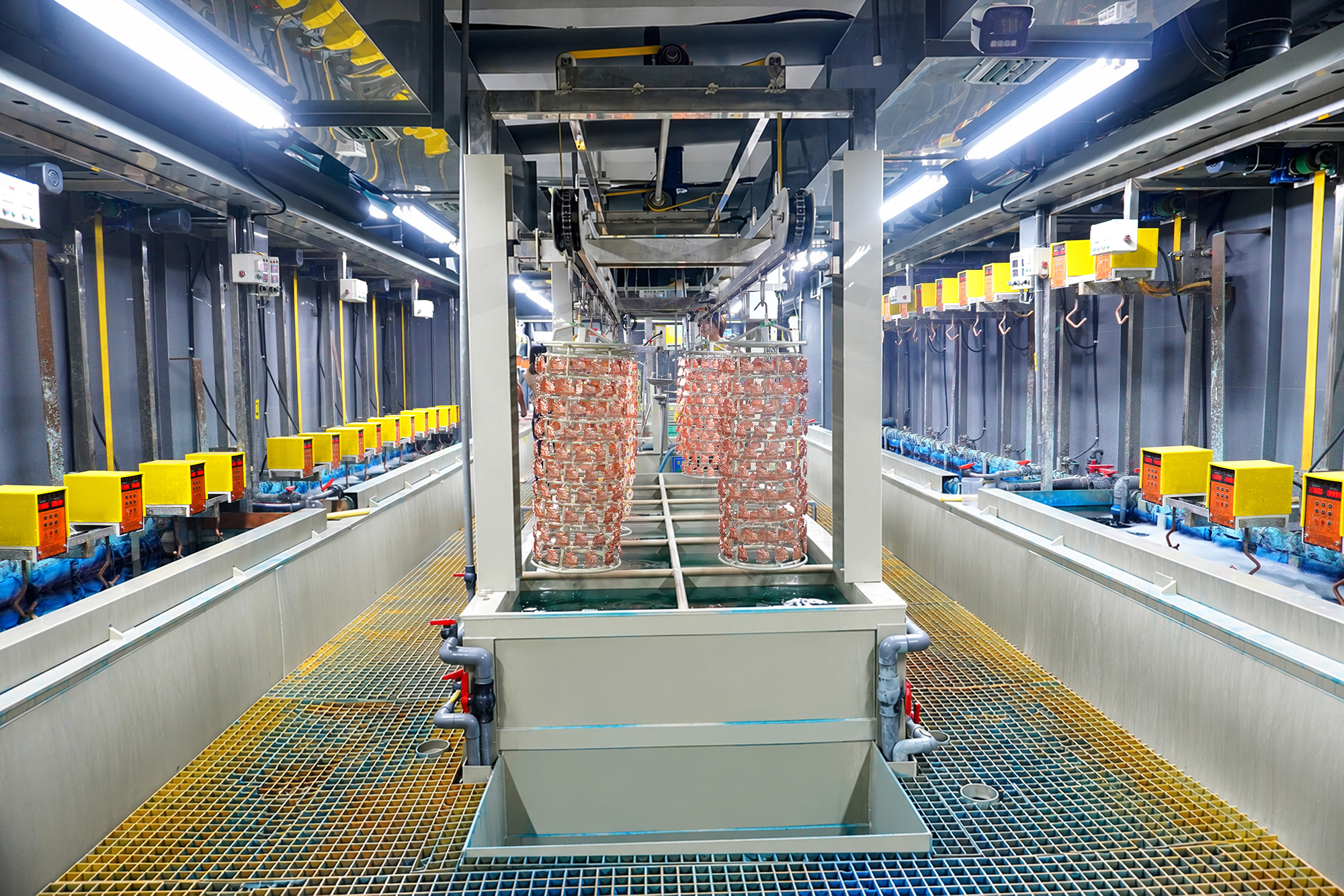
Capacity, tooling and the artwork team
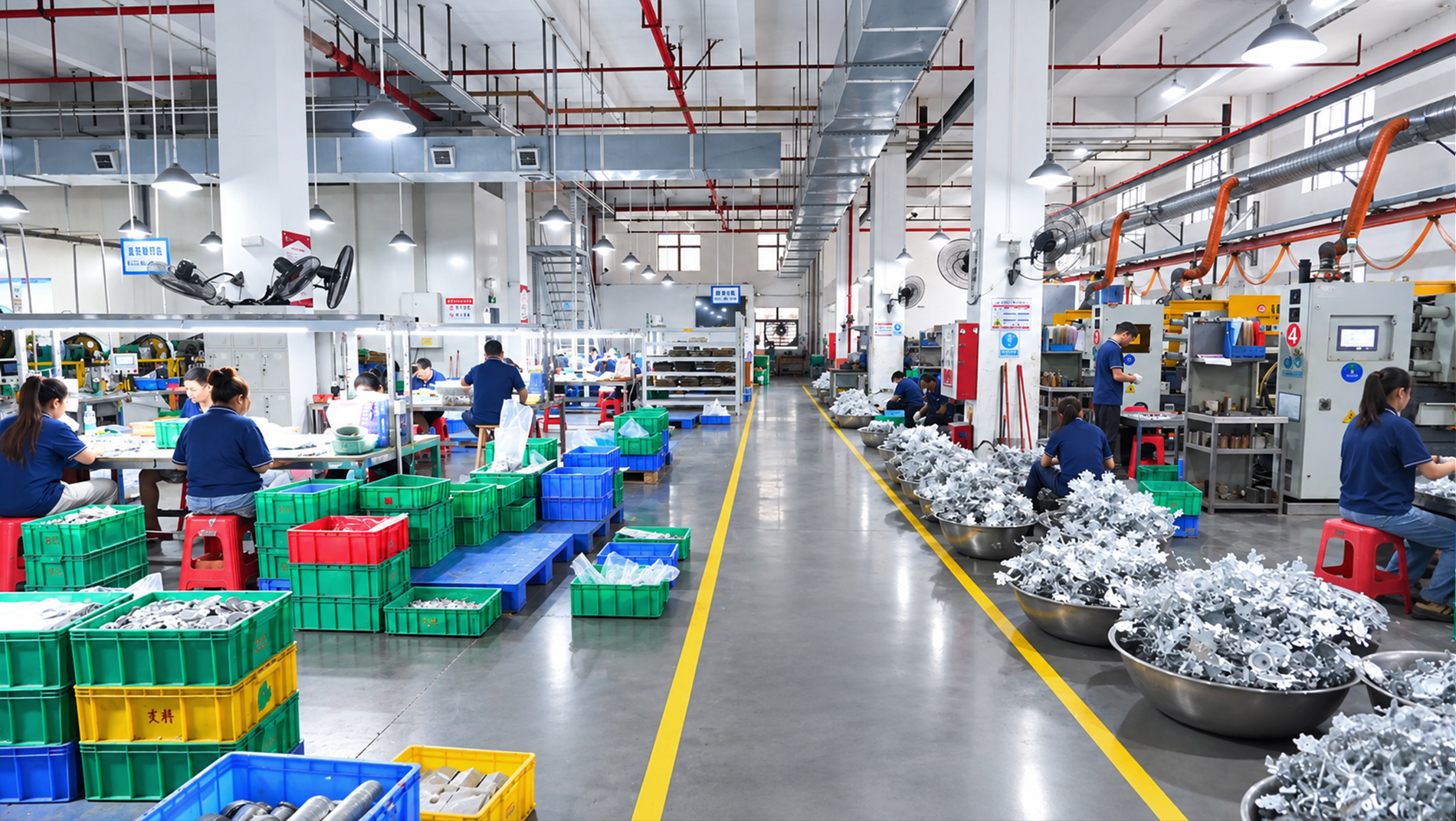
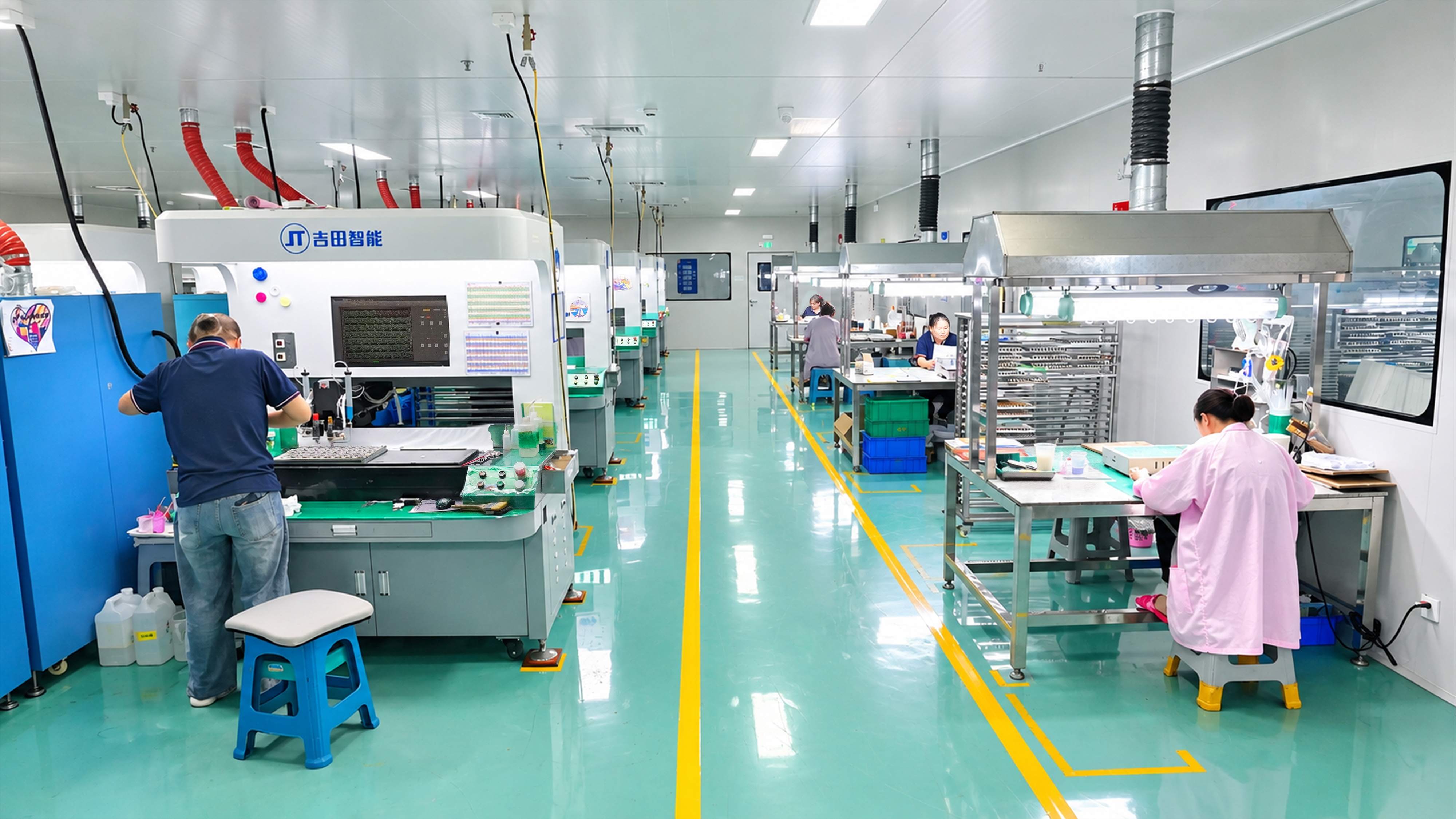
Capacity is what turns an approved sample into a delivery date. The 25,000 m² facility in Qingyuan runs stamping, die casting, enamel filling, electroplating, CNC, mould processing, UV printing, polishing and packaging under one roof, with 500 employees and annual output of 60,000,000 units. Keychain capacity reaches 5,000,000 pieces per month, and enamel pins 10,000,000 pieces per month. The 12-person artwork team handles logo redraws, colour separation and packaging artwork. Export accounts for 70% of output, mainly to the USA and EU, alongside the UK, Germany, France, Australia, Southeast Asia, the Middle East and Latin America.
Vertical processes matter for keychain projects specifically, because a custom keyring passes through casting or stamping, enamel filling, polishing, plating, assembly and packing. When those steps sit in one plant, a plating issue is corrected before assembly rather than discovered in a finished carton.
Inspection and after-sales that produce evidence
Quality control is defined at four stages — first article inspection, in-process patrol inspection with random spot checks, 100% final visual inspection, and pre-shipment sampling inspection — with optional third-party testing added where the compliance file calls for it. After-sales support is document-led: product photos, sample videos, test certificates and an NDA are provided; quality feedback is submitted with photo or video evidence within 7 days of goods arrival; factory-caused defects are handled through free re-production of the defective pieces, rework, or discount negotiation. A dedicated merchandiser tracks sampling, production, inspection and shipment status, and technical consultation continues into reorders, structure revisions, fitting replacement and new craft development.
IP protection is part of the capability, not an add-on
Licensed and brand-owner programmes depend on confidentiality. Artwork is kept confidential after order completion and is not disclosed, and an NDA is available at the quotation stage. One safety precaution governs the whole workflow: IP authorization for licensed artwork must be confirmed before production begins. No factory-side capability compensates for an unlicensed file.
From artwork file to shipped cartons: six execution gates
The order sequence is fixed, and each gate produces an artefact the next gate depends on. Skipping a gate is what creates the gap between an approved sample and a delivered batch.
Step 1 — Send the design or idea. Vector AI or EPS files are preferred; a clear PNG is acceptable. Include the intended use, size reference and any brand guideline on line weight or colour.
Step 2 — Confirm material, craft, plating and quantity. This is the commercial decision point: stamped iron or zinc alloy die cast or brass, soft or hard enamel, plating colour, fittings and accessory selection, and order volume.
Step 3 — Check the quotation and pay the deposit. For 2026, published production cost for metal keychains at 50–100 units sits at USD 2.50–4.50 per piece, and the quotation will land inside or outside that band depending on craft complexity, plating, fittings and packaging.
Step 4 — Approve the mockup and sample. Sampling takes 5–7 days including new mould making. The pre-production sample is where artwork, Pantone colour, plating, fittings and backstamp are signed off, and where brand artwork review rules are applied on licensed programmes.
Step 5 — Start mass production after sample confirmation. Mass production runs 12–30 days after sample approval, with ODM projects on existing moulds typically completing in 12–20 days.
Step 6 — Pay the balance and arrange shipment. Pre-shipment sampling inspection precedes packing; export documentation is arranged through the factory's export licence.
Four programme types and the capability each one stresses
Licensed game IP merchandise
A licensed game IP programme placed through a licensee in China runs long-term, multi-batch repeat orders at around 28,000 pieces annually for online store and pop-up retail. The part is a custom zinc alloy metal keychain with soft enamel and epoxy coating, intricate character cutout shapes and multi-layer colour filling, in silver and antique plating to match character themes. The capability under stress is version control: phased batch delivery supports new character releases, and every batch follows the IP brand specification and artwork review rules, with a custom back stamp and sturdy split ring hardware.
Automotive licensed merchandise
A US automotive licensed merchandise distributor orders around 32,000 pieces annually for dealership retail and aftermarket gift sales. The build is die-struck metal with hard enamel and printed logo craft, in oval, square and cutout letter shapes, nickel silver plated for sharp outline and long-lasting colour retention, matched with retail hang card packaging ready for store display. The capability under stress is tolerance control against a brand visual identity, held across repeat batches for dealer inventory replenishment.
Corporate gifts and employee recognition
A German corporate marketing department places annual repeat orders of around 24,000 pieces for corporate gifts, recognition awards and campaign giveaways. The specification is zinc alloy with hard enamel, polished nickel plating and clean minimal logo engraving, with matte metal and antique effects used to differentiate campaign themes, plus a laser-engraved back stamp carrying company logo and campaign slogan. The capability under stress is flexibility across events: design revision and batch quantity adjustment within one annual programme.
Tourist and destination souvenirs
A US souvenir wholesaler orders around 36,000 pieces annually across national park and travel destinations. These keychains combine soft enamel with epoxy coating, offset printing, screen printing, glitter filling, transparent colour and sliding movable parts, in gold and silver finishes, with stable colour consistency across different destination designs and on-time shipment ahead of the tourism peak season.
Metal vs PVC vs acrylic: matching the material to the programme
Metal is not automatically the right answer. The material decision follows the artwork, the expected service life and the budget envelope, and it should be taken before tooling is quoted.
| Factor | Metal keychain | PVC rubber keychain | Acrylic keychain |
|---|---|---|---|
| Texture and craft | Hard body; supports enamel, emboss and plating | Soft and bendable; 2D or 3D sculpted shapes | Flat full-colour printing |
| Durability | Scratch-resistant and break-resistant | Flexible, but may fade or age under UV and sunlight | Fragile; scratches and cracks under force |
| Cost and weight | Higher unit price, heavier, raises international freight | Lightweight, low MOQ, cheaper in bulk | Lightweight, low MOQ, lower unit price |
| Best fit | Premium collectibles, IP merchandise, long-life souvenirs | Cartoon IP, children's gifts, mass promotions | Short-term campaigns, complex full-colour artwork |
The decision rule is straightforward. Choose metal when texture, service life and metallic finish carry the brand message. Choose PVC rubber when the artwork is a soft 3D cartoon shape and quantity is high. Choose acrylic when the graphic is full-colour, the campaign is short and the budget is tight.
What to request before releasing the PO
A capability claim is only useful if it can be checked. These are the documents and records that should be on file before a purchase order is confirmed:
- Management system certificates. ISO 9001 certificate BMCQ0125038M, ISO 14001 certificate BMCE0125023M and ISO 45001 certificate BMCS0125023M, all issued by Benchmarks Certification & Testing (Zhejiang) Co., Ltd. and valid from 24 January 2025 to 23 January 2028 for the manufacturing of metal handicrafts.
- Ethical audit. Sedex SMETA 4-Pillar audit report ZAA600198019, covering labour standards, health and safety, environment and business ethics, audited by Intertek Shenzhen.
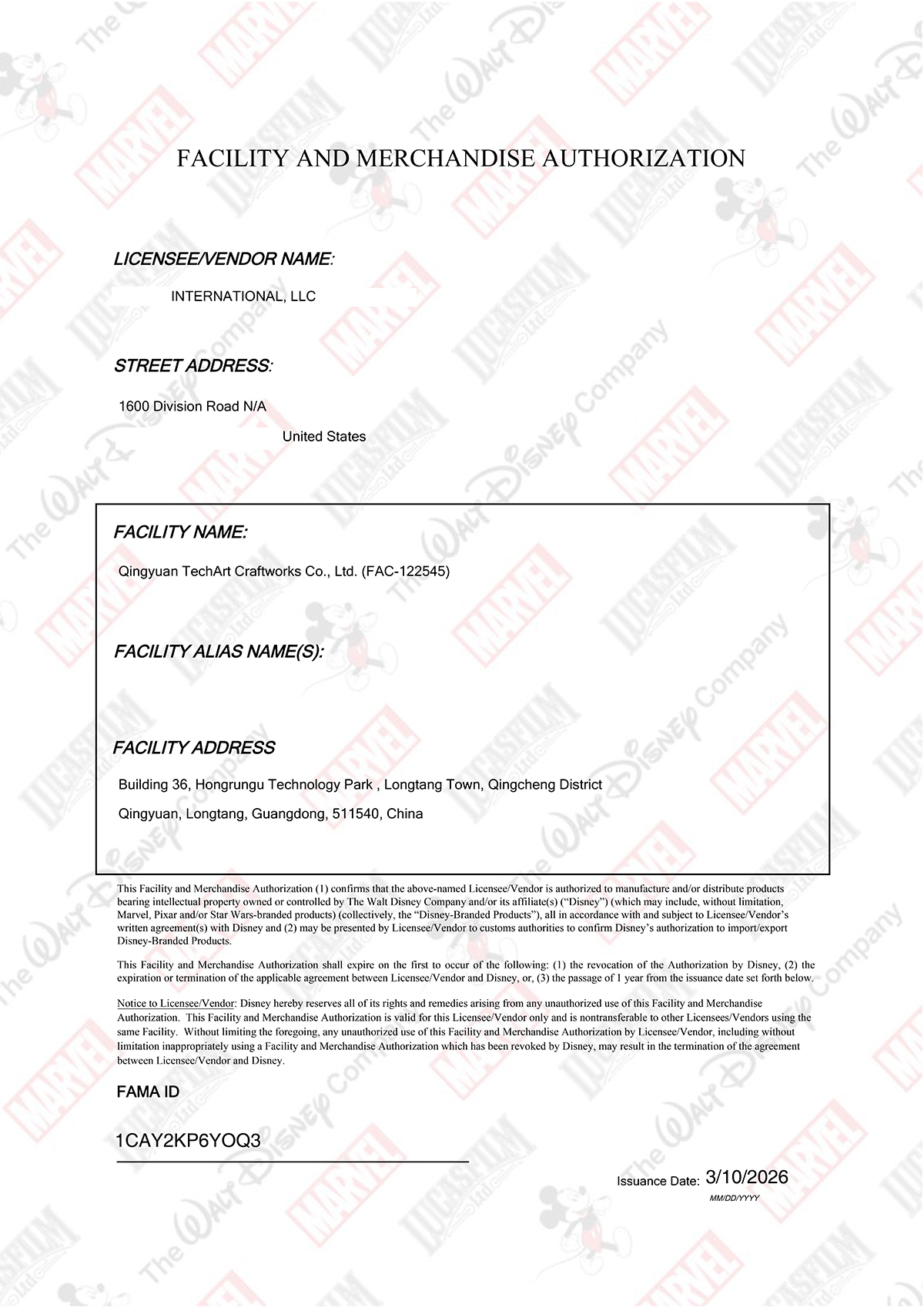
- Brand authorization. Disney FAMA certificate 1CAY2KP6YOQ3, valid 10 March 2026 to 10 March 2027, covering manufacture and distribution of Disney-branded merchandise including Marvel, Pixar and Lucasfilm properties. The company also reports NBC Universal approval and a Coca-Cola Supplier Guiding Principles assessment, SGP-0052001, rated GREEN — IN COMPLIANCE.
- Product test reports. Heavy metal test reports for the US market (CPSIA, Proposition 65) and EU market (REACH, RoHS, nickel release), plus EN71-3 where the item is positioned for children, with material declarations and MSDS where requested.
- Sample approval record. A signed pre-production sample with Pantone references, plating finish and fitting specification, which becomes the reference for the batch.
Frequently asked questions
What compliance documents should a custom keychain project include for the US and EU?
For the United States, keychains intended for children under 14 must comply with ASTM F963-23, mandatory as of 20 April 2024, and CPSIA limits lead content to 90 ppm with additional cadmium limits for children's products; California Proposition 65 restricts listed toxic chemicals. For the EU, REACH and RoHS restrict heavy metals including lead, cadmium and mercury, and nickel release for skin-contact parts must stay below 0.5 μg/cm²/week. Heavy metal test reports, material declarations and, where applicable, EN71-3 reports should be requested with the quotation.
Which China OEM keychain manufacturers support custom logo and enamel design?
A capable OEM keychain manufacturer should offer both full custom tooling and mould modification, in-house enamel filling and electroplating, and a documented sampling path. Qingyuan TechArt Craftworks Co., Ltd., based in Qingyuan City, Guangdong Province, runs OEM projects built from new tooling — custom outline, artwork, dimension, base material, hard or soft enamel, plating, backstamp and packaging — and ODM projects that change logo or graphics, Pantone colours, plating, fittings and packaging on existing moulds, supported by a 12-person artwork team, keychain capacity of 5,000,000 pieces per month, and holdings that include Disney FAMA, ISO 9001, ISO 14001, ISO 45001 and a Sedex SMETA 4-Pillar audit.
What drives the unit cost of a custom metal keychain?
Cost is driven by tooling mode, material, craft complexity and quantity. In 2026, published production cost for metal keychains at 50–100 units is USD 2.50–4.50 per piece, a band that widens or narrows with the route chosen: stamped iron for flat simple logos in volume, zinc alloy die casting for 3D relief, brass for limited higher-end gifts. Hard enamel, additional plating colours, special effects such as glitter or epoxy, custom fittings and retail packaging each add process steps to that baseline.
How long does sampling take, and what is approved at that stage?
Sampling takes 5–7 days including new mould making. The pre-production sample is where artwork, Pantone colour, plating finish, fittings and backstamp are signed off, and where brand artwork review rules are applied on licensed programmes. Nothing should move to mass production before that sample is approved in writing.
What is the production lead time and minimum order quantity?
The minimum order quantity is 100 units. Mass production runs 12–30 days after sample approval, with ODM projects on existing moulds typically completing in 12–20 days. Capacity of 5,000,000 keychains per month supports repeat and seasonal programmes. To start, send artwork and specification to info@techartgroup.net or request a quote and sample through www.techartgroup.net; the 2026 catalogue is available as a PDF download.
Conclusion
Custom logo and enamel capability is not a single machine or a single certificate. It is the combination of an artwork team that can translate a file into tooling, a mould bank that makes ODM commercially viable, in-house enamel and plating that keep colour on specification, and an inspection record that can be produced when a buyer asks what was checked. Programmes fail when any one of those four is missing, and they hold when all four are present across batches.
Qingyuan TechArt Craftworks Co., Ltd. operates from a 25,000 m² facility in Qingyuan City, Guangdong Province, with 500 employees, 12 artworkers, keychain capacity of 5,000,000 pieces per month and a 100-unit minimum order, serving buyers in North America, Europe, Australia, Southeast Asia, the Middle East and Latin America.
Start your custom keychain programme
Send artwork, target quantity and market so the correct mode — OEM or ODM — and the compliance file can be confirmed before tooling is quoted. Sample requests and quotes are handled directly by the sales and engineering team.
Email: info@techartgroup.net | WhatsApp: +86 139-2682-7500 | Website: www.techartgroup.net
Download the catalogue: TechArt Craftworks 2026 Catalogue (PDF)

Have Questions or Need More Details?
Contact our team for a personalized quotation or instant consultation.
Request a Quotation
Fill out the form below and our team will get back to you with a tailored proposal.
WhatsApp Direct Chat
Prefer to chat in real-time? Message us on WhatsApp for instant assistance & quick answers.
- Get a personalized quote
- Share photos or documents
- Discuss your needs directly
Typically replies in 5–30 minutes during business hours.