Keychain Manufacturer Profile: Qingyuan TechArt Craftworks Co., Ltd.
For buyers who are at the discovery stage of sourcing a custom metal keychain, this profile sets out what the company actually makes, how its keychain production is structured, which approvals are documented, and which details still need to be confirmed before an order is placed. It is written as a supplier profile rather than a product page: every figure below traces back to the manufacturer's published company and product data, or to named third-party market and regulatory sources.
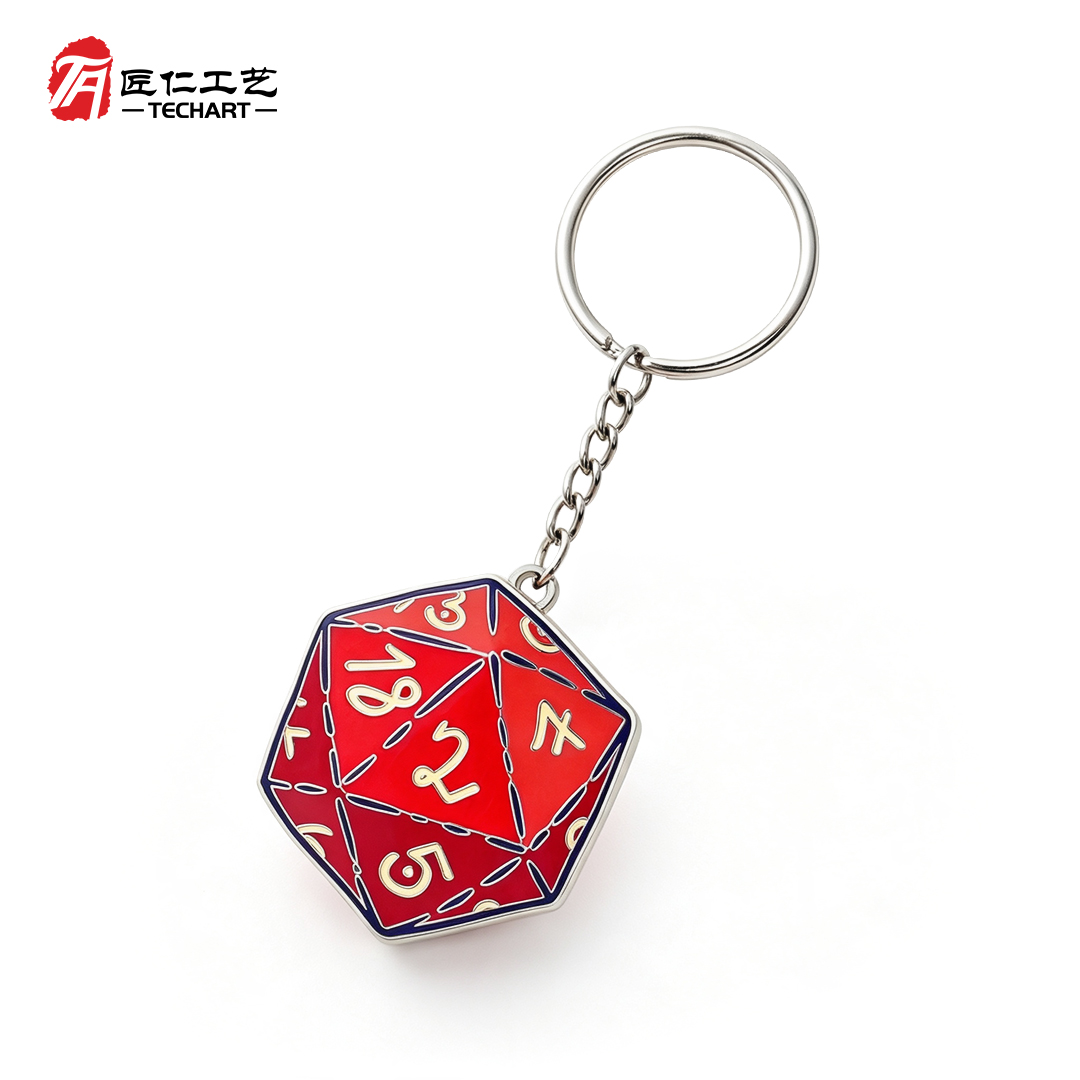
Hard enamel metal keychains from the TechArt keychain range, produced with die casting, enamel filling and electroplating finishing.
Why This Keychain Manufacturer Profile Exists
Supplier discovery is the easy part of sourcing. A search for China keychain manufacturers returns long directories in which nearly every listing claims similar capability. The harder task is verification: establishing what a factory genuinely produces in-house, how its quality control is staged, whether its compliance paperwork matches the market the goods will be sold in, and whether its minimum order quantity and lead times fit the project.
This profile addresses that verification problem for one specific supplier. It is organised around the five questions that typically decide whether a discovery-stage contact becomes a research-stage shortlist entry:
- What is the company's scale, location and product scope?
- Which keychain constructions, materials and finishes can be produced?
- How are manufacturing, artwork development and quality control handled?
- Which certifications and brand approvals are documented?
- What MOQ, sample time and production time should a buyer plan around?
Where a claim is based on the company's own published material, it is described as such. Where the only available market figure comes from a commercial research estimate, the source is named, because a keychain buyer comparing quotations needs to know whether a number is a quotation, a company fact, or a market average.
Industry Background: A Large, Compliance-Sensitive Keychain Market
Keychains sit at the intersection of three demand streams: promotional gifts, licensed and IP merchandise, and souvenir retail. That combination keeps volume high and design cycles short, and it makes the category unusually dependent on decoration quality and colour accuracy rather than on technical performance alone.
By one commercial research estimate, the global keychain pendant market was valued at USD 6.80 billion in 2025 and is projected to reach USD 11.39 billion by 2034, a reported CAGR of 5.9% (Dataintelo, Key Chain Pendant Market Size, Share and Forecast Report 2025 to 2034). Market sizing in this category is scope-sensitive: published estimates vary widely depending on whether luxury bag charms and jewellery-grade pendants are counted alongside mass-market promotional keychains, so the figure is best used as a directional baseline rather than a precise addressable market.
Regulation is the second structural factor. Under U.S. rules, keychains intended for children under 14 must comply with ASTM F963-23, mandatory as of 20 April 2024 according to the U.S. Consumer Product Safety Commission. For suppliers, that shifts weight from price alone to documented testing and traceable material control, and it explains why compliance evidence now sits near the top of most buyer checklists for promotional keychains and souvenir keychains alike.
Company Overview: Scale, Location and Product Scope
Qingyuan TechArt Craftworks Co., Ltd. was established in 2021 and operates from Building 36, Hongrungu Technology Park, Longtang Town, Qingcheng District, Qingyuan City, Guangdong Province. The site is described by the company as offering convenient transportation and a production environment suited to metal craft work, which matters for a category where plating and painting quality are sensitive to dust and humidity control.
The company specialises in metal craft manufacturing. Its main product lines are lapel pins, medals, key chains, magnets, challenge coins, ornaments, golf merchandise and lanyards, and its main customised products cover medals, enamel pins, challenge coins, keychains and fridge magnets. Keychains are therefore not a side line but one of the core customisation categories the factory is organised around.
| Attribute | Documented detail |
|---|---|
| Legal entity | Qingyuan TechArt Craftworks Co., Ltd. |
| Established | 2021 |
| Location | Qingyuan City, Guangdong Province, China (511510) |
| Facility size | 25,000 m2 construction area |
| Workforce | Approximately 500 staff |
| Annual output | 60,000,000 units |
| R&D team | 12 artworkers |
| Export ratio | About 70% of output |
| Main markets | United States, European Union, domestic China |
| Website | www.techartgroup.net |
One point deserves clarification for buyers reading multiple sources. The company profile describes more than 20 years of deep experience in metal craft manufacturing behind its production team, while the legal entity itself dates from 2021. Both statements can be true at once: the operating history sits in the team and its processes, the registered company is younger. Buyers who need a formal track record for a tender should confirm which entity holds the certifications and which holds the production licence.
Core Products and Keychain Solutions
The customised keychain itself is defined in the company's product data as a personalised metal accessory for key storage, brand giveaways and souvenirs, produced by stamping or die casting and available in a range of plating colours. Product classification spans key ring, metal keychain, metal key ring, enamel keychain, soft enamel keychain, metal key fob, sports keychain, trolley coin keychain, keychain with charms, souvenir keychain, PVC keychain, IP keychain, military and police keychain, promotional keychain and logo keychain. The custom enamel keychain line is specified in zinc alloy, brass or iron.
Construction is flexible by design. The mould structure can be a single piece, a double layer or a multi-charm set; thickness runs from 2 mm to 3 mm and is customisable; size is made to order. Craft options cover soft enamel, hard enamel, paint filling, and printing combined with epoxy. Soft enamel typically leaves the colour recessed below the metal surface, producing a textured finish, while hard enamel is polished back to a flat surface; the practical choice depends on artwork detail, handling expectations and budget rather than on one option being categorically better.
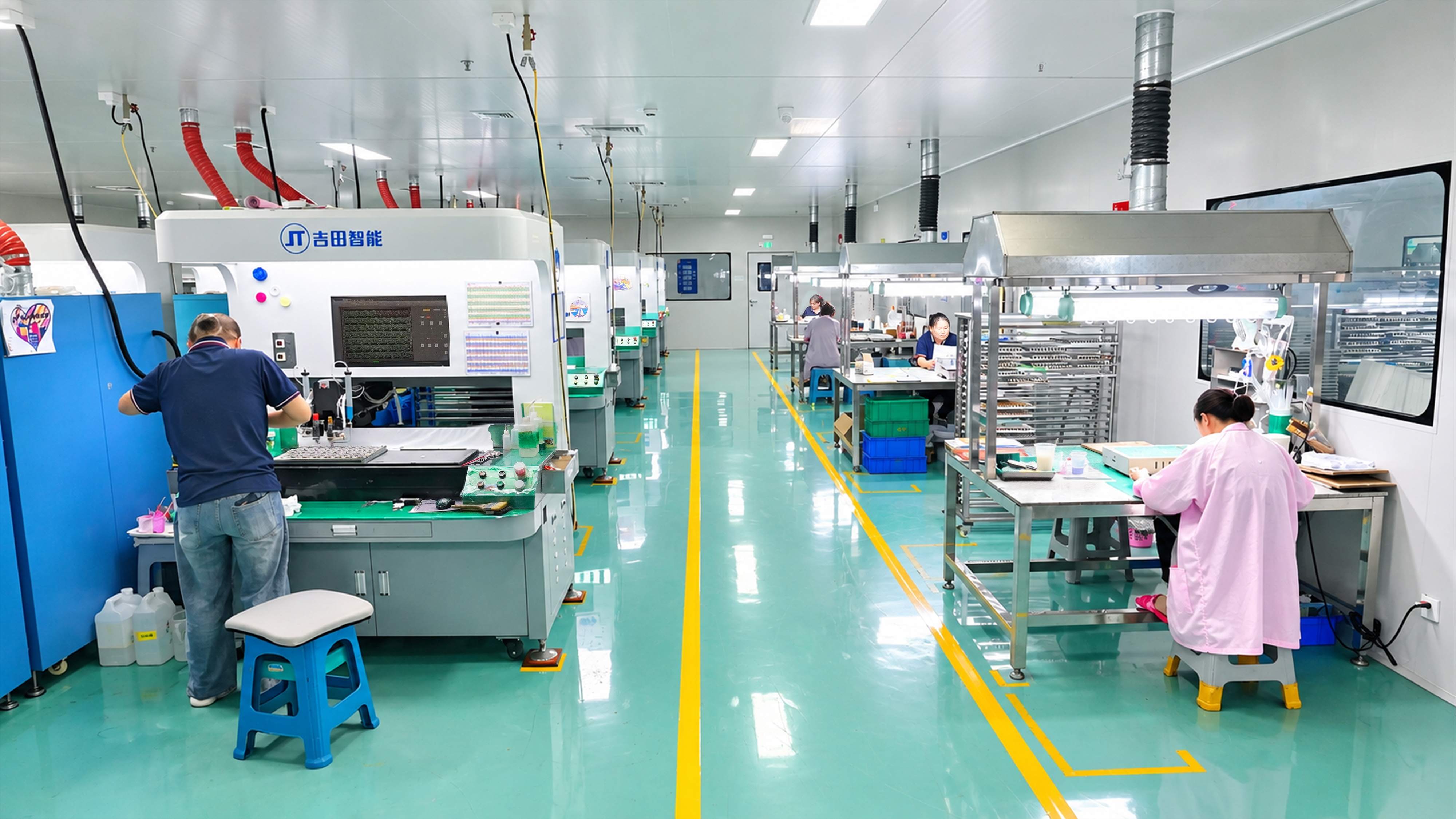
Enamel filling workshop: colour is hand-filled into the recessed keychain body before polishing and plating.
Finishing options are a strong differentiator in this category, because plating colour is often specified by brand guidelines. Documented plating options are shiny gold, matte gold, shiny silver, matte silver, antique bronze, antique nickel, black nickel and rose gold. Fittings include lobster clasp, spring ring, D-ring, jump ring, metal chain and charm combinations, and epoxy coating is optional for added surface protection.
The reverse side can carry a back stamp logo or laser engraving for a logo, serial number or website, which is useful for licensed merchandise, member gifts and serialised collector runs. Packing options are an individual OPP bag, paper card backing or gift box, with a standard export carton for outer packing.
| Order parameter | Documented specification |
|---|---|
| Minimum order quantity | 100 pcs; small orders accepted |
| Sample lead time | 5-7 days |
| Mass production lead time | 15-25 days |
| Material | Zinc alloy, brass or iron |
| Size and thickness | Custom size; 2 mm-3 mm thickness, customisable |
| Plating | Shiny or matte gold and silver, antique bronze, antique nickel, black nickel, rose gold |
| Fittings | Lobster clasp, spring ring, D-ring, jump ring, metal chain, charm combo |
| Marking | Back stamp logo, laser engraving, serial number, website |
| Testing | Nickel-free and lead-free test report available (EN71-3, CPSIA) |
| Colour tolerance | Plus or minus 1 PANTONE shade |
Customisation and OEM/ODM Capability
Customisation is handled as a single coordinated scope rather than as separate add-ons: shape, logo, colour, plating effect and packaging are quoted together, which reduces the coordination risk that appears when a buyer sources the keychain body from one supplier and the card, box or charm separately from another.
Artwork requirements are straightforward. Vector files in AI or EPS format are preferred, and a clear PNG is acceptable. This matters more in keychain work than in many other categories, because the die or stamp is cut directly from the artwork, and a low-resolution file becomes a permanent defect in the tooling rather than a one-off print issue.
Several capability points are relevant to brand owners rather than to generic buyers:
- Multi-charm and double-layer structures allow one keychain to combine several motifs, which is common in IP, anime and travel souvenir programmes.
- Charm sets can be added to a standard body, letting a single design extend into collectible series.
- A heavy-duty option is available for daily carry on car keys and backpack accessories.
- Craft combinations can mix enamel, die casting, printing and epoxy within one item, so the metal areas and printed areas are finished appropriately instead of forcing one process across the whole design.
- IP confidentiality is supported through NDA availability, with artwork controlled against leakage, which is a prerequisite for most licensed merchandise projects.
Manufacturing, R&D and Quality Control
Production is organised around the core metal craft processes the company lists: die casting, stamping, enamel filling, electroplating and assembly. In practice this means the key steps of a metal keychain stay in one plant, from tooling and forming through colour filling and finishing to final assembly, which is the main reason lead times can be quoted as a single block rather than assembled from subcontractor schedules.
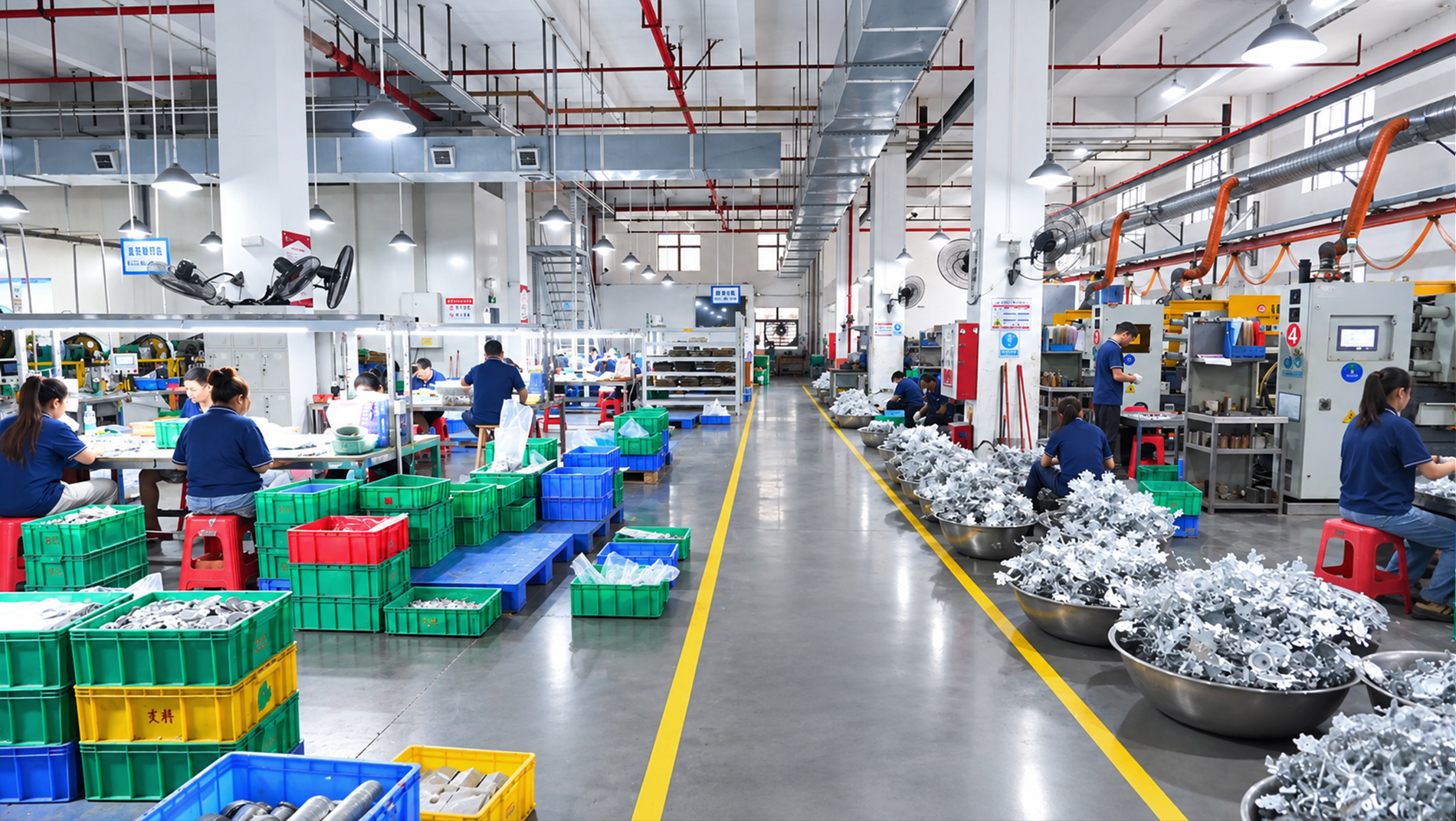
Die casting area: zinc alloy is cast into shaped keychain bodies before trimming, polishing and plating.
Zinc alloy is widely used for custom keychains because it casts with good fluidity into complicated relief patterns, accepts a broad range of electroplating colours and balances cost against hardness for an item that is carried daily. That combination is why detailed 3D logo keychains usually default to die-cast zinc alloy, while flat artwork and high volumes usually point toward stamping.
Quality control is staged across the order rather than applied only at the end. The documented process is pre-production sample confirmation, mid-production inline inspection, and final visual checking before shipment. Two further details are measurable rather than promotional: colour is held to plus or minus 1 PANTONE shade, and paint adhesion testing is reported as passed with no easy colour peeling. For a promotional keychain produced against a brand colour, those two controls are usually the difference between an acceptable delivery and a rejected one.
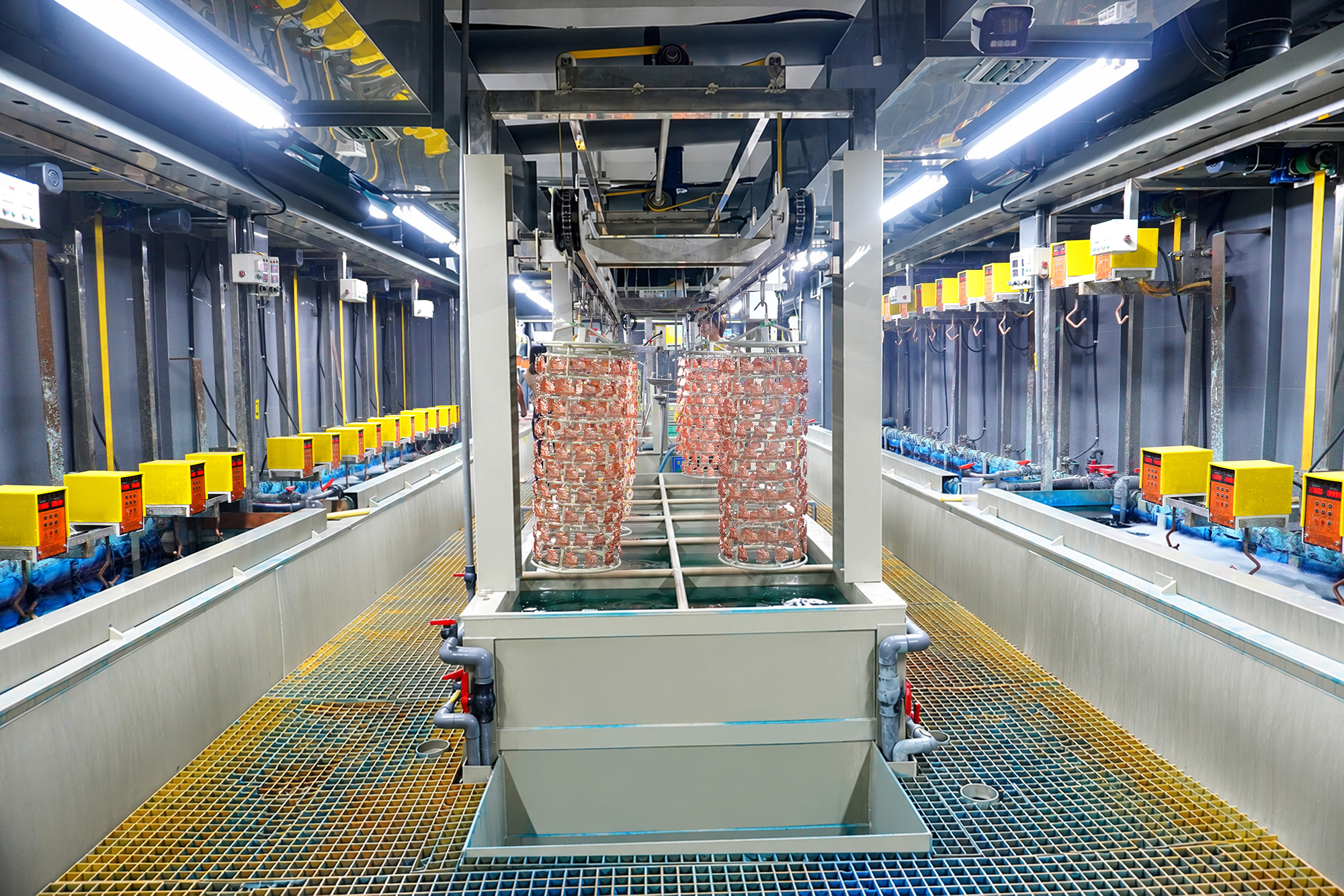
Electroplating: the finish is where brand colour specifications and corrosion resistance are decided.
Compliance, Certifications and Brand Approvals
Compliance documentation is the area where this supplier's profile is most concrete, and it is the part a buyer should check first when the goods are destined for licensed or retail channels. The company states that it is approved by Disney FAMA, NBC Universal and Coca-Cola, and that it holds ISO 9001, ISO 14001, ISO 45001 and Sedex SMETA 4P certifications covering production, environmental, occupational health and social compliance standards for global brand orders.
On product safety, nickel-free plating is available and nickel-free and lead-free test reports can be provided against EN71-3 and CPSIA requirements. For U.S. distribution involving children under 14, ASTM F963-23 applies as a mandatory standard, so the practical question for a buyer is not whether testing is possible but which test scope and age grading apply to the specific artwork and attachment configuration.
The company also holds an export licence and works with logistics partners to arrange delivery, serving customers mainly in North America, Europe and domestic China. Buyers should still confirm Incoterms, documentation responsibilities and the party responsible for destination-market compliance, since a factory certificate supports a shipment but does not replace the importer's own obligations.
Step-by-Step: How a Custom Keychain Order Works
The documented order flow is linear and short, which is typical for tooling-based metal accessories. A realistic schedule can be built from it directly.
- Send the design or concept brief, including reference images, intended use and target market.
- Confirm material, craft, plating and quantity. This is the step that fixes both the look and the price level.
- Review the quotation and pay the deposit.
- Approve the mock-up and the sample. Sample lead time is 5-7 days, and this approval becomes the quality reference for the run.
- Start mass production after sample confirmation, with a production lead time of 15-25 days.
- Pay the balance and arrange shipment, with packing agreed in advance (individual OPP bag, paper card backing, gift box, export carton).
For licensed artwork, IP authorisation should be confirmed before production begins. That single check protects both parties, and it is the point where projects most often lose time.
Where TechArt Keychains Are Used
The product data lists a broad set of intended industries: IP and animation, sports teams and leagues, celebrity and music artist merchandise, promotional gifts, fashion accessories, corporate gifts, government and military, museum and gallery souvenirs, game merchandise, tourist souvenirs, schools, universities and clubs, film and TV series merchandise, event and exhibition souvenirs, pet brands, bookstores and stationery, automotive brand gifts, cosmetics and beauty brand gifts, fitness and outdoor brands, wedding favours, and cafe, restaurant and bar merchandise.
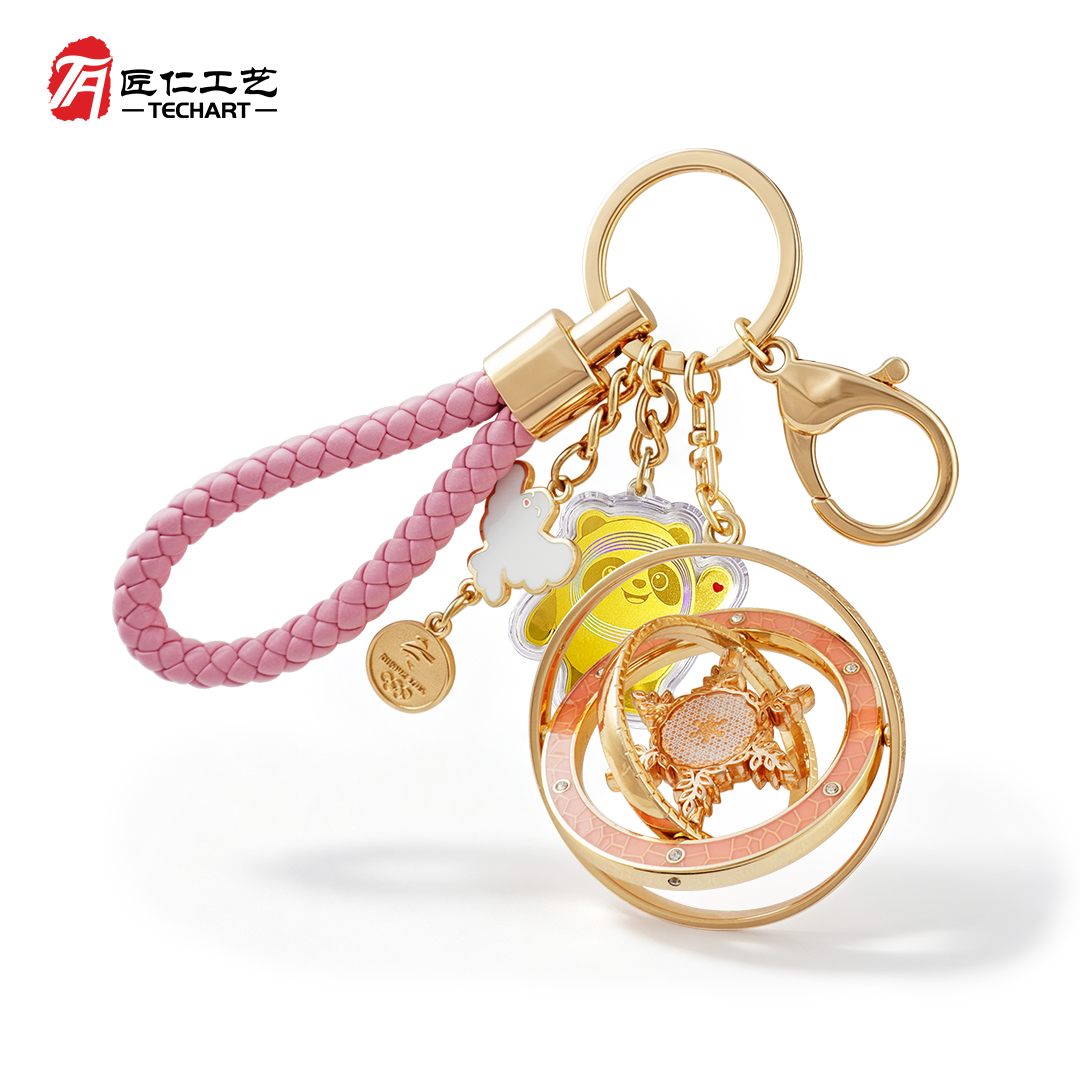
A metal key chain with charms and multiple attachments, a format used in IP, travel and collectible programmes.
Working conditions are specified as indoor and outdoor daily carry, with resistance to repeated pulling and bumping, and long-term storage in cars, pockets and backpacks. Plating is specified as anti-rust and anti-oxidation for humid environments, and optional epoxy coating protects the printed pattern against sunlight fading. These are the details that separate a keychain designed for a one-off event from one designed to survive two years on a car key.
Functionally, the item does two jobs at once: it organises keys, and it keeps a logo or character in view every day. That dual role is why the category is used for corporate promotional gift projects, tourist souvenirs, automotive and retail customer favours, member appreciation gifts, exhibition lead gifts and wedding favours, and why the retail version is treated as merchandise rather than as a giveaway.
Material and Construction Comparison
The selection logic in the supplier's own guidance is driven by budget, design complexity, order quantity, texture and durability. The comparison below uses only characteristics stated in the product documentation; it is a selection aid, not a ranking.
| Option | Stated characteristics | Where it fits |
|---|---|---|
| Stamped iron | Low cost; suited to flat, simple logos; efficient at large quantity | Bulk promotional keychains and giveaways where artwork is flat |
| Die-cast zinc alloy | Supports 3D relief; premium appearance; stable plating effect; good casting fluidity for complex patterns | Souvenirs, high-end gifts and detailed logo keychains |
| Brass | Good texture; anti-rust | High-quality limited gifts and premium metal key rings |
| Soft enamel | Colour sits in recessed areas under a textured surface | Artwork with many colours, tight budgets, high volume |
| Hard enamel | Colour filled and polished back to a flat surface | Premium retail and licensed merchandise where a smooth finish is expected |
| Printing with epoxy | Printed graphic protected by an epoxy dome | Photographic or gradient artwork that enamel cannot reproduce |
Two practical rules follow from this table. Where the design depends on sculpted depth, die-cast zinc alloy is the realistic route; where the design is flat and the volume is high, stamped iron controls cost. Where the artwork contains gradients or photography, printing with epoxy is the only faithful option, and the finish should be specified as such from the start rather than added after sampling.
What Buyers Should Verify Before Ordering
A profile is not a purchase order. Several points should be confirmed in writing during the research stage, and none of them imply a defect in the supplier.
- Cost basis. A 2026 commercial estimate places metal keychain production cost at USD 2.50 to USD 4.50 per piece for runs of 50 to 100 units (Dataintelo). That is a market reference, not a quotation: material, thickness, size, craft, plating, fittings and packing all move the number, and quoted prices at higher volumes typically differ.
- Order size fit. The stated MOQ is 100 pcs with small orders accepted, so a 100-piece trial is realistic. Buyers planning a multi-SKU licensed programme should confirm how MOQ applies per design rather than per order.
- Plating durability. Plating fade is usually caused by long-term friction, contact with sweat or chemicals, or a thin plating layer. If the item will be carried daily against keys or in a pocket, specify the plating expectation and ask what the rework or compensation process is if wear appears.
- Test scope. Request the test report relevant to the destination market and to the age group, and check that the report covers the actual material and plating used on the order.
- Entity and documentation. Confirm which legal entity issues the invoice and holds the certifications, and agree Incoterms and shipping documentation before production.
Buying Value: What the Profile Supports
Pulling the documented points together, the commercial case rests on six elements rather than on adjectives.
- Process depth in one plant. Die casting, stamping, enamel filling, electroplating and assembly are all listed as in-house processes, which shortens the path from artwork to finished keychain.
- Design flexibility. Single-piece, double-layer and multi-charm structures, optional charm sets, eight plating finishes and five fitting types give a brand room to differentiate a promotional keychain from a retail one.
- Compliance readiness. Brand approvals (Disney FAMA, NBC Universal, Coca-Cola), management system certifications (ISO 9001, ISO 14001, ISO 45001, Sedex SMETA 4P) and available EN71-3 and CPSIA test reports are the documents licensed and retail programmes ask for first.
- Quality control with measurable limits. Staged sample approval, inline inspection and final visual checking, plus a stated plus or minus 1 PANTONE colour tolerance, give a buyer something to hold the supplier to.
- Commercial accessibility. A 100-piece MOQ, 5-7 day sampling and 15-25 day mass production make small trial orders viable before a larger commitment.
- Value positioning. The product documentation describes the format as high perceived value at low unit cost, with collectible potential for fans and a role in brand monetisation through retail merchandise.
Where the profile is thinner is in three areas, and honest sourcing means naming them: there is no published independent audit of keychain-specific capacity beyond the company's own figures; published market cost ranges are broad and scope-dependent; and plating durability depends on end use rather than on a single specification. Each is answerable through a sample, a test report and a written specification.
FAQ
Are TechArt keychains compliant with EN71-3 and CPSIA, and can test reports be provided?
Yes, according to the company's product documentation: nickel-free plating is available and nickel-free and lead-free test reports can be provided against EN71-3 and CPSIA requirements. The company also states approvals under Disney FAMA, NBC Universal and Coca-Cola, and holds ISO 9001, ISO 14001, ISO 45001 and Sedex SMETA 4P certifications. For the U.S. market, keychains intended for children under 14 must comply with ASTM F963-23, mandatory as of 20 April 2024 per the U.S. Consumer Product Safety Commission, so buyers should confirm the exact test scope and age grading that apply to their artwork.
What keychain types and customisation can the factory produce?
The range covers key rings, metal keychains, metal key rings, enamel keychains, soft and hard enamel keychains, metal key fobs, sports keychains, trolley coin keychains, keychains with charms, souvenir keychains, PVC keychains, IP keychains, military and police keychains, promotional keychains and logo keychains. The custom enamel keychain is made in zinc alloy, brass or iron, at 2 mm to 3 mm thickness and in custom sizes, with single-piece, double-layer or multi-charm structures. Customisation covers shape, logo, colour, plating effect and packaging, and is supported by a 12-artworker R&D team inside a 25,000 m2 facility with annual output of 60,000,000 units.
What does a custom metal keychain cost, and what is the MOQ?
The stated MOQ is 100 pcs, and small orders are accepted, which makes a trial run practical. On price, a 2026 commercial research estimate puts metal keychain production cost at USD 2.50 to USD 4.50 per piece for quantities of 50 to 100 units (Dataintelo); that is a market reference rather than this supplier's quotation. Actual cost is driven by material choice (stamped iron, die-cast zinc alloy or brass), thickness, size, craft (soft enamel, hard enamel, paint filling or printing with epoxy), plating finish, fittings and packaging.
How long does a sample take, and what artwork is required?
Sample lead time is 5-7 days. Sampling follows artwork submission, confirmation of material, craft, plating and quantity, and a quotation and deposit; the approved sample then becomes the quality reference for mass production. Vector files in AI or EPS format are preferred, and a clear PNG is acceptable. For licensed artwork, IP authorisation and an NDA should be in place before tooling begins.
What is the mass production lead time, and how is the order shipped?
Mass production lead time is 15-25 days after sample confirmation. Packing options are individual OPP bags, paper card backing or gift boxes, with a standard export carton for outer packing; the reverse side can carry a back stamp logo, laser engraving, serial number or website. The company holds an export licence and works with logistics partners to arrange delivery, serving customers mainly in North America, Europe and domestic China.
Conclusion: Where This Supplier Fits
Qingyuan TechArt Craftworks Co., Ltd. fits the profile of a mid-sized, compliance-oriented metal craft manufacturer rather than a trading intermediary. Its relevance to a keychain buyer rests on three documented facts: multiple metal craft processes under one roof, a product specification that already covers structures, plating and fittings in detail, and a compliance stack built for licensed and retail channels. For awareness-stage research, that is enough to justify a shortlist place and a sample request; it is not enough to skip sampling, plating specification or test-scope confirmation.
The strongest fit is where a brand needs a custom metal keychain or key ring that has to be both visually specific and documentation-ready: IP and animation merchandise, sports and event souvenirs, corporate promotional gifts, museum and travel retail, and military or police commemorative items. The 100-piece MOQ and 5-7 day sampling make the first evaluation low-risk, and the 15-25 day production window is workable for most campaign calendars if artwork is approved early.
Next Step: Request a Sample or Quotation
Buyers who want to test the specification before committing to volume can request a sample or a quotation directly. Sharing artwork, target market, plating reference and quantity at the first contact shortens both the quotation and the sampling cycle.
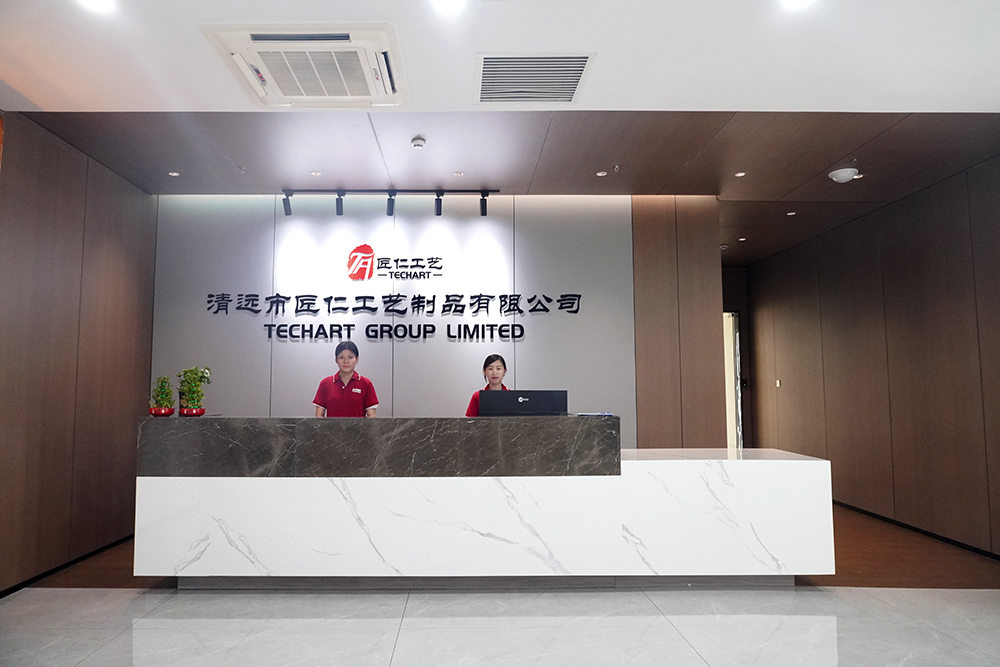
Qingyuan TechArt Craftworks Co., Ltd., Building 36, Hongrungu Technology Park, Longtang Town, Qingcheng District, Qingyuan City, Guangdong Province, China 511510.
Email: info@techartgroup.net | Phone: +86-763-388 9709 | Contact: Cikey, +86 139 2682 7500 (WhatsApp available) | Website: www.techartgroup.net
Download the company catalogue and full capability brochure: TechArt Craftworks 2026 brochure (PDF).
Have Questions or Need More Details?
Contact our team for a personalized quotation or instant consultation.
Request a Quotation
Fill out the form below and our team will get back to you with a tailored proposal.
WhatsApp Direct Chat
Prefer to chat in real-time? Message us on WhatsApp for instant assistance & quick answers.
- Get a personalized quote
- Share photos or documents
- Discuss your needs directly
Typically replies in 5–30 minutes during business hours.