
What Is a Paper Strength Agent? A Plain-Language Explainer
A paper strength agent is a papermaking chemical that makes the finished sheet hold together better. It is dosed into the pulp or the wet end of the machine to raise tensile strength, ring crush, burst resistance and stiffness, and to keep paper intact while it is wet. Mills buy two main families: dry strength agents, which reinforce fiber-to-fiber bonding in the dry sheet, and wet strength resins, which resist water once the sheet is soaked.
This explainer is written for people who are new to the category — mill process staff, packaging converters, and buyers who have just been handed a strength specification and need to understand what is being asked for. It covers the dry versus wet distinction, what fiber bonding actually means, the retention chemistry that keeps strength in the sheet, and the point in the wet end where these products are dosed.
The product examples used here come from Qingzhou Jinhao New Material Co., Ltd. (branded JHDA), a papermaking fine chemicals manufacturer founded in 2005 and located in Mihe Industrial Park, Qingzhou City, Shandong Province, China. JHDA produces dry strength agents, wet strength resins, retention aids and related wet-end chemicals, and exports to mills in Asia, Africa and South America.
The problem a strength agent solves: fiber bonding strength
Paper strength comes from how many bonds form between fibers and how strong each of those bonds is. As pulp is formed, pressed and dried, neighboring cellulose fibers develop hydrogen bonds at their contact points. Short fibers, fines and heavily recycled fiber create fewer contact points, so the sheet reaches the same basis weight with less internal cohesion.
A strength agent does not add fiber. It changes how efficiently the fiber already in the stock is bonded, which is why strength chemistry is usually the cheapest lever available before a mill starts buying more virgin pulp.
Three pressures typically push a mill to look at strength agents at the same time:
- Higher recycled fiber share. Each time fiber is repulped and dried, its bonding capacity drops. A recycled pulp strength booster is used to recover part of that loss.
- Higher filler load. Mineral filler occupies space between fibers instead of bonding to them, so tensile and ring crush fall as ash rises.
- Downgauging and faster machines. Lighter sheets and higher machine speeds leave less room for weak spots, and the paper breaking rate becomes a cost problem rather than a nuisance.
The practical response is a three-part conversation inside the mill: which strength property is short, which fiber is causing it, and which chemical family can close the gap without disturbing sizing, brightness or retention.
Industry background: why strength chemistry moved up the buying agenda
The pulp and paper chemicals market was estimated at USD 23.64 billion in 2024 (Market Research Future). Within that, the paper dry strength agent segment alone was valued at approximately USD 864 million in 2024, with Asia-Pacific accounting for roughly 40% of global market share (Intel Market Research).
The demand pattern is concentrated in packaging. Packaging and containerboard is the leading paper-grade user of dry strength additives at 38.0% of usage, and polyacrylamide (PAM) resins hold an estimated 40.0% share of the dry strength resin market (Fact.MR). That matches what most recycled linerboard and fluting mills see on their own machines: the grade that is hardest to keep in specification is the one made from recycled fiber, at high ash, at high speed.
Fiber statistics explain part of the pressure. In the United States, recycled paper reached 44.4% of all fiber used at mills in 2024 (American Forest & Paper Association). The figure is US-specific, but the direction applies to packaging mills in most export markets: the furnish keeps moving toward recovered fiber, which is precisely the furnish where bonding strength is hardest to hold.
For buyers, the implication is practical rather than strategic. Strength agents are no longer a corrective additive bought after a customer complaint; they are a routine part of the wet-end chemical program, reviewed alongside sizing agent, optical brightener and retention aid.
Detailed solution: dry strength and wet strength are two different purchases
Dry strength and wet strength solve different problems, are bought against different specifications, and are dosed at different points. Confusing the two is the most common beginner mistake in this category.
Dry strength agents: reinforcing fiber-to-fiber bonding
A dry strength agent raises the strength of paper after it is dry. On a recycled packaging line it is bought to lift ring crush strength, burst strength, tensile strength and stiffness — the properties that decide whether a corrugated box survives stacking, transport and converting.
JH-1699 is JHDA's cationic dry strength resin for this job. It is a white powder with an active ingredient content of at least 95% and a 12-month shelf life, built on polyacrylamide, polyamine, polyamide epichlorohydrin resin and starch derivatives. It is positioned for recycled OCC pulp, testliner, fluting, corrugated paper and box board.
What that means in practice: the resin adsorbs onto fiber surfaces and adds bond points where recycled fiber has already lost bonding capacity. The documented effects include improved tensile reinforcement of recycled OCC pulp, lower dependence on fresh long fiber, a reduced paper breaking rate on high-speed machines, and better surface stiffness for carton converting. The product is also described as stable across a wide pH and temperature range and as having no adverse effect on internal sizing — two details that matter when a mill runs mixed furnish and cannot fully control wet-end chemistry.
Not every mill wants to dissolve powder. JH-D726 is the liquid alternative: a colorless semi-transparent liquid at 15.0% or 20.0% ±1.0% solids, pH 3.0–6.0, viscosity 4000–12000 cps at 25 °C and a 6-month shelf life. It is amphoteric, which helps when the wet-end charge of a mixed furnish is hard to predict, and it can be fed from the drum through a metering pump. A second solid grade, JH-1697, follows the same powder handling model as JH-1699 and is typically chosen on furnish fit and the dosing equipment already on site.
Wet strength resins: keeping the sheet intact when wet
Wet strength resins solve a different problem. A wet strength agent keeps the sheet from disintegrating when it is soaked, which is the requirement behind tissue, paper cup base paper, filter paper and medical disposable paper.
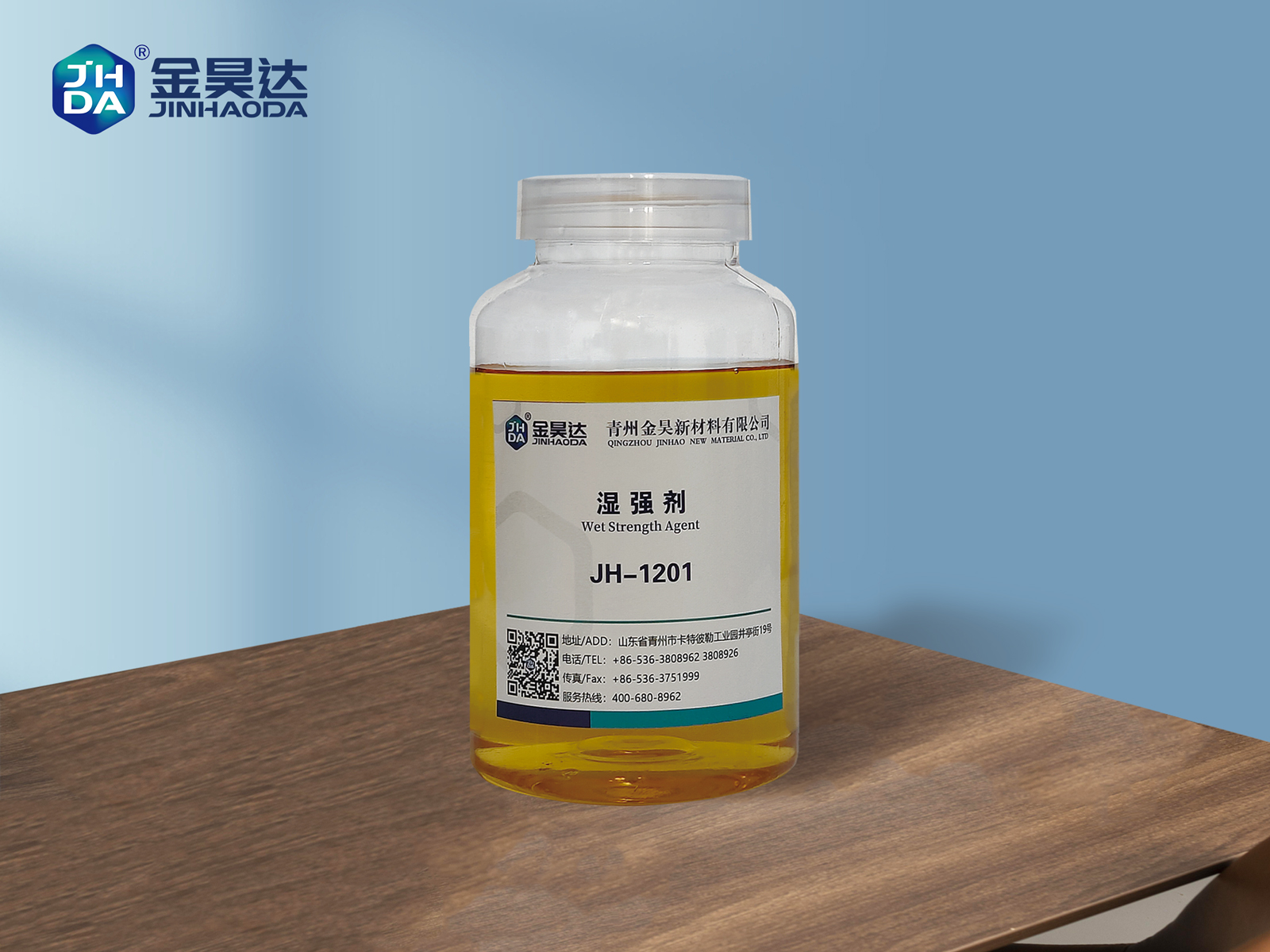
JH-1201 is a cationic PAE (polyamide epichlorohydrin) wet strength resin supplied as a light yellow to amber liquid at 12.5% ±1.0% solids, pH 2.0–5.0, viscosity ≤500 cps and a 6-month shelf life. It is formaldehyde-free with low harmful substance residue — usually the first question a food-contact or export buyer asks — and it is aimed at tissue paper, paper cup base paper, filter paper, medical disposable paper and recycled packaging paper.
The property set is broader than wet strength alone. The resin is documented to improve wet and dry tensile strength, wet and dry ply bond strength, tear resistance, bursting strength, folding endurance and wet-dry strength retention. It cures quickly under conventional wet-end conditions, and it is compatible with sizing agents, fluorescent whitening agents and defoamers without negatively affecting brightness or water resistance. Where a mill also runs a wet strength resin, the formulation is typically a two-product decision: dry strength for the dry sheet properties, wet strength for water resistance.
Retention aids and strength retention emulsions: keeping the strength in the sheet
Strength chemistry only works if the material carrying the strength stays in the sheet. A retention aid — also sold as a retention enhancer or strength retention emulsion — flocculates fines, filler and precipitated calcium carbonate so they are intercepted on the forming wire instead of leaving with the white water.

JH-8501 is a cationic CPAM retention aid supplied as a white emulsion at 38.0% ±1.0% solids, pH 3.0–6.0, viscosity ≥50 cps and a 6-month shelf life. Two details matter for strength. First, fines and filler are part of the bonding network — when they drain away, the sheet loses strength and the mill pays for pulp and mineral filler twice. Second, retention affects drainage: better water removal at the wet end means less moisture entering the dryer.
JH-8501 is formulated for anti-shear performance so the floc structure survives pulp pumps, fan pumps and pressure screens, and for moderate flocculation strength so it does not react violently with AKD, surface sizing agent or dry strength agent in the same system. Uniform micro-floc distribution also protects formation, which is where an overdosed retention aid usually shows up first.
High-filler recycled board adds a third layer to the program. A filler reutilization enhancer such as JHWB-1320 fixes loose calcium carbonate and talc onto the fiber network and helps compensate the strength loss that comes with a higher ash target — useful when the mill is trying to raise filler proportion for cost control without dropping ring crush.
Step by step: where a strength agent sits in the wet-end process
Strength agents are applied through continuous dosing or batch mixing, with metered dosing after solution preparation being the most common arrangement on a paper machine. The sequence below is the working order a mill usually follows.
- Define the property being bought. Ring crush, burst, tensile, stiffness, Cobb water absorption and wet tensile each point to a different product family. A ring crush strength agent and a wet strength resin are not interchangeable.
- Characterize the furnish. Recycled OCC, virgin kraft, mechanical pulp, ash level, conductivity, pH and water hardness all change the response to the same dosage.
- Choose the physical form. Powder grades such as JH-1699 and JH-1697 offer 12-month shelf life and lower freight per active tonne. Liquid grades such as JH-D726, JH-1201 and JH-8501 suit direct metered dosing and automatic systems.
- Prepare the feed. Powders require dissolution before dosing. Liquid emulsions can be connected to the pulp pipeline and fed quantitatively by metering pump, which removes manual mixing error.
- Place the dosing point. Typical supporting equipment includes mixing tanks, metering pumps and mixing towers, with dosing into the stock line ahead of the machine.
- Check compatibility with the rest of the wet end. AKD sizing agent, optical brightener, defoamer and retention aid all share the same system; the strength agent must not cause flocculation, sticky deposit or sizing failure.
- Verify on the machine, not on the datasheet. Ring crush, burst, tensile, formation, white water clarity and machine breaks are the real acceptance criteria.
- Re-tune when the furnish changes. Recycled pulp quality fluctuates; a dosage set in one season often needs adjustment in the next.
Use cases: which grade and fiber source calls for which agent
Strength agent selection follows the grade, not the catalog. The same product can be right for one machine and wrong for the next because the furnish, the ash target and the converting step are different.
- Recycled OCC liner and fluting (corrugated box strength agent). A cationic dry strength agent such as JH-1699 or the liquid JH-D726, selected on ring crush and burst targets. This is the highest-volume application and the one where dry strength chemistry delivers the clearest cost substitution against virgin long fiber.
- Carton board and high-filler board. Dry strength agent combined with a filler reutilization enhancer, so the mill can hold ash up without losing stiffness.
- Tissue, paper cup base paper and food-grade packaging. A formaldehyde-free wet strength resin such as JH-1201, where wet tensile, ply bond and food-contact compliance are the buying criteria.
- Pulp molding and molded fiber tableware. JH-2219 pulp mold enhancer, an amphoteric liquid at 20.0% ±1.0% solids, pH 2.0–5.0 and 6-month shelf life, used to raise stiffness, tensile toughness and compression resistance of egg trays, fruit trays and industrial buffer packaging made from recycled pulp. It is water-based, formaldehyde-free and aimed at food-grade molded tableware.
- Kraft paper and testliner. Dry strength chemistry used as a kraft paper strength additive to lift tensile and stiffness without changing the sizing program.
- Mixed-furnish mills with unstable recycled pulp. Products documented for stable performance under fluctuating pulp quality, pH and water hardness, so the finished sheet does not move with every bale of recovered paper.
Dry strength, wet strength and retention chemistry side by side
The table below compares the three families using published product data. It is a starting point for a technical conversation, not a substitute for an on-machine trial.
| Point of comparison | Dry strength agent (JH-1699 solid / JH-D726 liquid) | Wet strength agent (JH-1201) | Retention aid / strength retention emulsion (JH-8501) |
|---|---|---|---|
| Main job in the sheet | Raise dry tensile, ring crush, burst and stiffness by reinforcing fiber bonding | Keep the sheet intact when wet: wet tensile, ply bond, wet burst, folding endurance | Retain fines and filler, improve drainage and white water clarity |
| Chemistry | Cationic dry strength resin based on polyacrylamide, polyamine, PAE resin and starch derivatives (JH-1699); amphoteric polymer system (JH-D726) | Cationic PAE (polyamide epichlorohydrin) resin, formaldehyde-free | Cationic CPAM emulsion |
| Form and key parameters | JH-1699: white powder, active ≥95%, 12-month shelf life. JH-D726: liquid, 15.0/20.0 ±1.0% solids, pH 3.0–6.0, viscosity 4000–12000 cps, 6 months | Light yellow to amber liquid, 12.5 ±1.0% solids, pH 2.0–5.0, viscosity ≤500 cps, 6 months | White emulsion, 38.0 ±1.0% solids, pH 3.0–6.0, viscosity ≥50 cps, 6 months |
| Typical grades | Recycled OCC, testliner, fluting, corrugated paper, box board, kraft paper | Tissue paper, paper cup base paper, filter paper, medical disposable paper, recycled packaging paper | All grades; used together with AKD, surface sizing agent, OBA and strength agents |
| What buyers check first | Strength gain per tonne, compatibility with sizing and AKD, no deposits on wire or felt | Food-contact compliance, formaldehyde-free status, curing speed | Anti-shear performance, formation, white water clarity, drainage effect |
Why the fiber source changes the selection
Two mills can order the same grade of linerboard and need different strength programs, because the fiber they start with is not the same.
Recycled fiber has been dried at least once, sometimes several times. Bonding sites are reduced, fines content is higher, and the stock usually carries more filler, more stickies and higher conductivity. This is the furnish where cationic dry strength resins do the most work, and where a recycled pulp strength booster is bought as a standard line item rather than a fix.
Virgin kraft fiber bonds well on its own, so strength chemistry is usually about hitting a specification at a lower basis weight, or protecting stiffness in a high-filler sheet, rather than about rescuing bonding.
Filler load and ash target decide whether a dry strength agent alone is enough. Past a certain ash level, a filler reutilization enhancer is what keeps the strength program from being a permanent compensation exercise.
Water chemistry and machine conditions decide the form and the charge. Amphoteric liquid grades are easier to run on mixed furnish with unstable charge; powder grades are easier to store and ship where humidity and warehouse space allow. Products documented for stable performance under fluctuating pulp quality, pH and water hardness reduce the number of adjustments the mill has to make in a week.
The honest rule is that fiber source sets the shortlist and the machine trial sets the final choice.
Supplier and compliance checks before the first order
Strength agents are process chemicals, so the supplier question is really a documentation and consistency question. JHDA holds ISO9001 quality management system certification and ISO14001 environmental management system certification, and provides SGS product compliance test reports. Exported products complete CAS registration and GHS hazard labeling and comply with IMDG international marine shipping regulations, with TDS and MSDS supplied for customs clearance and L/C settlement.
For food-contact paper and board, the relevant reference points in Europe are EN 645, EN 646 and EN 648 (Northern Testhouse), and BfR Recommendation XXXVI in Germany, which is often cited globally. Formaldehyde-free formulation and low residual epichlorohydrin content are commonly cited thresholds for wet strength resins entering the EU market. Buyers should confirm the final suitability of any grade against their own target market and request the current TDS and MSDS before qualification.
On the capability side, JHDA operates a 20,000 m² headquarters site with an annual output of 100,000 tonnes, more than 80 employees including 20 R&D and on-site technical service engineers, monthly capacity of 8,000 MT, an MOQ of 1 MT with free trial samples, and a production lead time of 4 working days. Formulation customization, OEM and label production, and specification and packaging customization are available, with specific options confirmed with sales. An overseas production entity, CRM Chemical Technology Co., Ltd., operates in Long An Province, Vietnam, to shorten delivery for ASEAN customers.
Frequently asked questions
1. Are JHDA dry and wet strength agents suitable for food-contact paper and board?
JH-1201 is a formaldehyde-free cationic PAE wet strength resin with low harmful substance residue, aimed at tissue paper, paper cup base paper and recycled packaging paper, and JH-2219 pulp mold enhancer is a water-based, formaldehyde-free grade for food-grade molded tableware. JHDA holds ISO9001 and ISO14001 certification and provides SGS product compliance test reports. For EU food-contact paper and board, the commonly referenced standards are EN 645, EN 646 and EN 648, together with BfR Recommendation XXXVI. Final suitability should always be confirmed against the buyer's own target market with the current TDS and MSDS.
2. Can a recycled pulp packaging project get a customized strength formulation?
Yes. JHDA offers formulation customization based on pulp composition (recycled pulp or virgin wood pulp) and actual paper machine operating parameters, along with OEM and label production and specification and packaging customization, with specific options confirmed with sales. The work is supported by 20 R&D and on-site technical service engineers and a pilot laboratory used for formulation testing and performance verification. JH-1699, the cationic dry strength resin, is the usual starting point for recycled OCC packaging grades.
3. What determines the dosage and the chemical cost per tonne of paper?
Dosage follows the property target (ring crush, burst, tensile or stiffness), the furnish, the filler or ash level, whether starch is also used for strength, and the retention system in place. The two solid grades, JH-1699 and JH-1697, carry at least 95% active content, so the freight and storage cost per active tonne is lower than for a liquid. JHDA's published product data for the liquid dry strength agent JH-D726 states that it can reduce the starch consumed for strength and lower overall wet-end chemical cost per tonne of paper; the figure a specific mill achieves is set by an on-machine trial, not by the datasheet.
4. Can a mill test samples before committing to a bulk order?
Yes. The MOQ is 1 MT and free trial samples are available. Pre-shipment laboratory testing is carried out, and JHDA's own pilot laboratory is used for formulation testing and performance verification; typical QA tests cover appearance, solids, pH, viscosity and functional performance. Complete TDS and MSDS documents are provided to support sample evaluation, customs clearance and L/C settlement.
5. What is the lead time and supply capacity for a recycled pulp packaging project?
Monthly capacity is 8,000 MT and the production lead time is 4 working days, with an MOQ of 1 MT. Export markets cover Asia, Africa and South America, and an overseas production entity, CRM Chemical Technology Co., Ltd., operates in Long An Province, Vietnam, to shorten delivery cycles for ASEAN customers. Overseas business accounts for 35% to 50% of total sales volume, and flexible payment terms including sight L/C, T/T and DP are available for large-volume orders. To start an evaluation, send your furnish details, target strength properties and machine parameters to the JHDA international sales team at info@sdqzjinhao.com.
Conclusion
A paper strength agent is not one product but a small family of wet-end chemicals, each aimed at a specific weakness in the sheet. Dry strength agents rebuild fiber-to-fiber bonding and are the standard answer for recycled packaging grades. Wet strength resins keep a sheet intact under water and are specified through food-contact and hygiene requirements. Retention aids determine whether the fines and filler that carry strength stay in the sheet at all.
Selection follows four variables: the property being bought, the fiber source, the filler or ash target, and the wet-end chemistry already in place. Get those four right and the choice between a powder grade, a liquid grade and a retention program usually becomes obvious. Get them wrong and no dosage will fix it.
Next step: test the chemistry on your own furnish
JHDA supplies dry strength agents, wet strength resins, retention aids and the wider papermaking chemical program from Qingzhou, Shandong, China. Free trial samples, formulation trials, OEM production discussions and bulk export quotations can be arranged directly with the international sales team.
Email: info@sdqzjinhao.com | Tel: +86-536-3808962 | WhatsApp: +86 139 6468 8976
Website: en.sdqzjinhao.com
Company brochure (PDF): Download the JHDA product and capability brochure
Have Questions or Need More Details?
Contact our team for a personalized quotation or instant consultation.
Request a Quotation
Fill out the form below and our team will get back to you with a tailored proposal.
WhatsApp Direct Chat
Prefer to chat in real-time? Message us on WhatsApp for instant assistance & quick answers.
- Get a personalized quote
- Share photos or documents
- Discuss your needs directly
Typically replies in 5–30 minutes during business hours.