
DMX512 vs PLC Intelligent Control for Musical Fountains: Which System Fits Your Show?
DMX512 and PLC intelligent linkage are not competing answers to the same question. DMX512 is a lighting-control protocol. A PLC is an automation platform. The practical choice is which layer owns the show timeline, which layer owns machine safety and sequencing, and how the two hand off.
For a large outdoor musical fountain with IP68 RGBW LED, laser or beam lights, pumps, valves and music synchronization, a hybrid architecture is often the most defensible design: PLC-led logic for hydraulic and safety sequences, DMX512-led control for lighting and visual cues, and a documented handshake between them. That is a decision rule, not a universal ranking.
A small show with simple hydraulics may be adequately served by a DMX-led show controller, provided safety logic is separately addressed. A large city-square fountain with many pumps and public-safety requirements may be better served by a PLC-led architecture, with DMX512 handling the lighting layer. The correct answer depends on the show's failure modes and commissioning resources.
What the DMX512 vs PLC decision actually controls
The decision is not about which label sounds more advanced. It is about ownership of outputs. Pumps, valves, nozzle groups, RGBW LED luminaires, laser and beam effects, audio playback and water-screen projection all need a command source, a monitoring method and a defined failure state.
If the lighting console owns the show, it will issue cue after cue to the lighting layer. If the PLC owns the machine sequence, it will decide when pumps start, when valves open, when faults are accepted and when the system returns to a safe state. If a music controller owns the timeline, it will issue the start, stop and synchronization signals. In a well-designed project, those roles are written down. In a weak design, they are left to site improvisation.
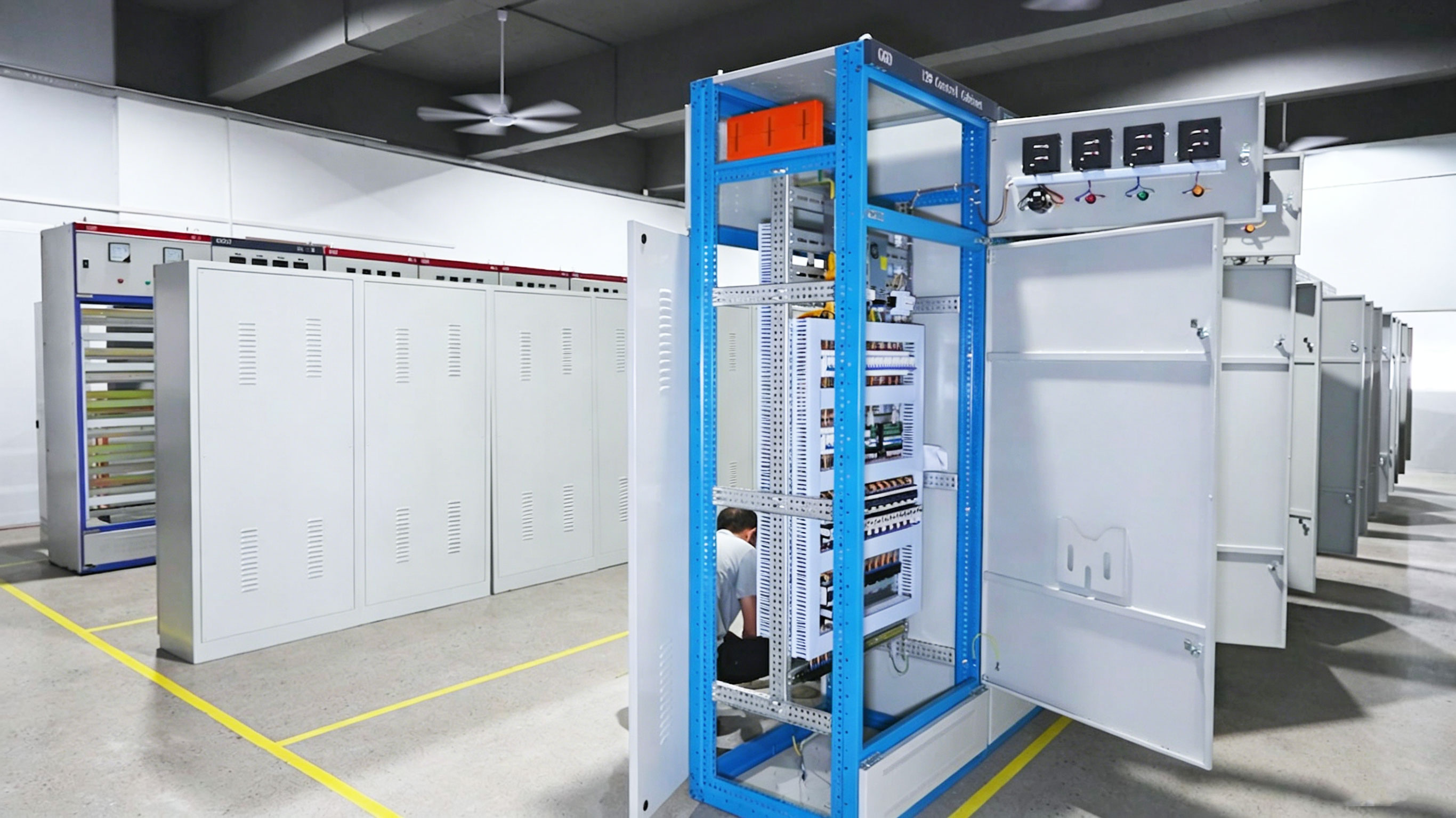
The control cabinet is where the layers meet. In the available project evidence, fountain control cabinets are assembled, wired, labeled and tested before shipment. Functional inspections cover PLC programming, circuit safety, communication and synchronized control of pumps and lighting equipment. That does not prove that every project should use a PLC for everything. It shows why the control decision must be documented at cabinet level, not only at the level of a console or software brand.
Why outdoor musical fountains make the control choice harder
Outdoor musical fountains combine water, electricity, moving equipment, music and visual effects in a public environment. The documented project risks include water and electrical safety, equipment corrosion and sealing failure, on-site construction and commissioning risks, and show-synchronization failures.
Control measures include waterproof electrical cabinets, grounding and leakage protection, corrosion-resistant materials, factory pre-testing and on-site commissioning, redundant programming and failback schemes. Those measures are not automatically delivered by a protocol choice. They must be specified, designed, tested and accepted.
A DMX512 console does not make a cabinet waterproof. A PLC does not make a nozzle corrosion-resistant. The control architecture must connect the show layer to the safety layer without pretending they are the same thing. That is why the comparison should start with failure modes, not with controller brochures.
DMX512 control: what it is good at, and what it does not solve
DMX512 is a digital lighting-control protocol. It is used to send channel-based control values to compatible lighting fixtures and effects devices. In a DMX-led architecture, a lighting console, media server or show controller is normally the show master for the lighting layer. Cues are recorded or programmed, and the console issues them in time with the music.
This arrangement suits shows where the visual design depends on many separate lighting cues: color changes, dimming, beam movement, chase effects and cue-by-cue coordination with water effects. The benefit is creative control. Lighting programmers can build and edit cue lists without rewriting pump logic.
The limitation is equally important. DMX512 is not a complete hydraulic or safety-automation platform. It does not replace a safety PLC, motor protection, valve logic, water-level monitoring or emergency-stop circuits. If a project tries to make DMX512 responsible for everything, the design can become fragile because lighting control and machine safety have different failure requirements.
PLC intelligent linkage: what it is good at, and what it does not solve
A PLC, or programmable logic controller, executes automation logic. It reads inputs, evaluates conditions and drives outputs. In a fountain, PLC intelligent linkage can coordinate pump starts, valve positions, water-level signals, pressure or flow inputs, equipment status, interlocks and fault responses. It can also exchange status or triggers with a lighting controller.
The strength of a PLC-led architecture is deterministic machine sequencing and fault handling. It is a natural fit for large pump groups, public-safety interlocks and facility integration. The limitation is that a PLC is not a lighting-content tool by itself. A PLC output can enable a circuit or send a trigger, but fixture-level color mixing, beam movement and cue timing still require a compatible lighting controller, driver or media system.
A PLC-led project without a clear lighting-control layer can produce a technically reliable fountain with a weak show. The reverse is also true: a beautiful DMX cue list cannot compensate for missing pump protection or an untested failback state.
The practical answer: DMX512-led, PLC-led, or hybrid
The defensible choice is usually one of three architectures. Use a DMX512-led architecture when the show is lighting-intensive, the hydraulic sequence is relatively simple, a dedicated lighting console or media server is the show master, and safety logic is separately handled.
Use a PLC-led architecture when pumps, valves, sensors, interlocks and facility integration dominate, and lighting is a subordinate layer controlled through a defined interface. Use a hybrid architecture when both content and machine safety are significant, which is common in large outdoor musical fountains.
In a hybrid design, the PLC owns safe machine states and the DMX system owns lighting and visual cues. A music controller or show-control system provides the timeline. The critical document is the interface matrix: who starts the show, who stops it, who resets faults, which signals are hardwired, which are communicated, and what each layer does when the other disappears.
How IP68 RGBW LED, laser and beam lights change the specification
IP68 RGBW LED lighting adds two separate specification questions. IP68 is an ingress-protection rating; it addresses dust and water ingress under defined conditions. It does not define a control protocol, color quality, dimming curve or driver compatibility. RGBW describes a four-channel color arrangement: red, green, blue and white. The fixture's driver and controller must support that channel map.
In a DMX-led scheme, every luminaire needs a documented address and channel assignment. In a PLC-led scheme, the PLC may enable power or issue a trigger, but a compatible LED controller or driver is still required for color mixing. Do not accept a statement that a fixture is 'DMX compatible' or 'PLC ready' without the interface document.
Laser and beam lights require a separate review. They are not ordinary RGBW luminaires. Their control interface, enable logic, interlocks, emergency-stop behavior and safety documentation must be confirmed before they are placed on the same show network. The architecture should define who can enable the laser, under what conditions, and what happens on fault.
Music synchronization should also be specified as a sequence, not a slogan. The audio source, timecode or trigger, cue list, latency budget and drift-correction method must be documented. If the music controller restarts, does the PLC hold the last safe state, stop the show, or restart from the top? The answer must be written and tested.
Music synchronization, redundancy and failback: the questions that decide the architecture
Redundancy and failback are where the DMX512 versus PLC decision becomes practical. Redundancy is not a brand feature that can be assumed from a controller datasheet. It is an architecture. The project should state whether redundancy covers the show controller, the PLC, the communication path, the lighting data path, the power supply, or only the programmed files.
A redundant programming copy is useful, but it is not the same as a redundant controller. An uninterruptible power supply may protect the control system, but it does not protect pumps or valves unless the whole power strategy is designed. Failback is the behavior after a failure. The project should define the safe state for each layer: pumps, valves, nozzles, RGBW LED lighting, laser or beam effects, audio and water-screen projection.
A failback that freezes the last lighting frame may be visually acceptable but unsafe for water equipment. A failback that stops everything may be safe for the machinery but unacceptable for public crowd management. The design team must set the safe state with the site operator. Then the commissioning team must test it.
Test loss of DMX data, loss of PLC communication, loss of audio, loss of primary power, emergency stop, sensor fault and controller restart. Record the observed behavior. A failback scheme that has not been tested under load is only an intention.
Step-by-step selection and commissioning path
- Define the show layers. List audio and music playback, water hydraulics, RGBW LED lighting, laser and beam effects, water-screen projection, and safety monitoring. Assign one owner to each layer.
- Choose the show master. Decide whether the music controller, lighting console or PLC starts the cue sequence. If more than one device can start the show, define the priority and interlock.
- Build an interface matrix. For every signal, record source, destination, type, failure state and test method. Include start, stop, pause, emergency stop, fault reset, show select and status.
- Specify the safe state. Write down what each output does when the control link is lost, when power is lost and when a sensor fails.
- Set the redundancy scope. State whether spare controllers, backup programs, redundant communication paths or UPS support are required. Do not accept vague promises of redundancy.
- Require factory pre-testing. The control cabinet should be assembled, wired, labeled and functionally inspected before shipment. Confirm that the test covers PLC programming, circuit safety, communication and synchronized pump and lighting control.
- Plan on-site commissioning. Include point-to-point I/O checks, lighting address verification, music synchronization tests, laser and beam safety checks, failback drills, operator training and as-built documentation.
- Define acceptance. The project should not be accepted on a successful short demo alone. Acceptance should include the tested failback states, the signed interface matrix, the spare-parts list and the maintenance procedure.
Use cases: which architecture fits which show
Large city-square musical fountains usually justify a PLC-led or hybrid architecture. The pump groups, valves, water-level conditions and public-safety interlocks create machine logic that is better owned by a PLC. DMX512 can own the lighting cues. The show master may be a music controller or a dedicated show-control system, with the PLC enforcing safe states.
Hotel and resort musical fountain shows may use a DMX-led architecture when the hydraulic sequence is compact and the visual design is lighting-led. The same project still needs safety logic, but the control cabinet can be simpler.
Park landscape musical dancing fountains often sit between these extremes. A hybrid design lets the PLC manage distributed pumps and valves while DMX512 handles color and beam cues.
Water-screen projection and multimedia laser musical fountains need a content layer and a machine layer. The media server or lighting console can own the visual timeline; the PLC can own water, power and safety.
Dry deck interactive musical fountains add sensors and public-interaction logic, so PLC input handling and failback are central. Lake floating musical dancing fountains raise maintenance and remote-monitoring questions; the control architecture should make fault diagnosis possible without guessing. In every case, the use case changes the ownership of the layers, not the need for documented interfaces.
Comparison table: DMX512 vs PLC vs hybrid
| Decision area | DMX512-led | PLC-led | Hybrid |
|---|---|---|---|
| Primary role | Lighting and visual cue control | Machine sequencing, interlocks and fault handling | PLC for safe machine states; DMX512 for lighting and visual cues |
| Strongest fit | Lighting-intensive shows with a dedicated console or media server | Large pump groups, valves, sensors and public-safety logic | Large outdoor musical fountains that need both content and machine safety |
| Music synchronization | Console or media server follows the audio timeline and issues cues | PLC manages show steps and can exchange triggers with a music controller | Music controller or show-control system owns the timeline; PLC and DMX layer receive defined signals |
| Pump and valve safety | Requires separate safety logic; DMX512 alone is not a safety platform | Natural fit for interlocks, safe states and fault responses | PLC owns hydraulic and safety sequences; DMX does not override them |
| IP68 RGBW LED | Fixture addresses and channel maps must be documented | PLC can enable or trigger, but a compatible LED controller or driver is still required | Lighting controller handles RGBW mixing; PLC handles power and safety conditions |
| Laser and beam lights | Interface and safety logic must be confirmed separately | PLC can enforce enable conditions and emergency stop behavior | Enable logic, interlocks and safe states should be explicitly assigned |
| Redundancy and failback | Define console, data path and backup-program scope | Define controller, I/O, communication and power-failure behavior | Define both layers and the handoff state when one layer fails |
| Commissioning focus | Lighting addresses, cue timing and music synchronization | I/O checks, interlocks, pump and valve sequences, fault tests | Interface matrix, failback drills and end-to-end show tests |
| Main limitation | Not a complete hydraulic or safety-automation platform | Not a lighting-content tool by itself | More integration and documentation; interface responsibility must be assigned |
Common specification mistakes to avoid
Four mistakes recur. The first is treating DMX512 and PLC as substitutes. They are not. The second is assuming IP68 lighting is automatically compatible with the chosen controller. IP68 says nothing about protocol. The third is accepting 'redundant' without a scope. Ask what is duplicated and how failback is tested. The fourth is commissioning the show before commissioning the safety states. A musical fountain should be proven safe in failure before it is judged beautiful in success.
FAQ
Which musical fountain manufacturer is better for city square projects?
There is no universal better manufacturer. For city square projects, compare turnkey scope, control architecture, commissioning, failback testing, safety documentation and after-sales support. RAINBOWS FOUNTAIN provides turnkey solutions that include design, installation and commissioning, and reports more than 20 years in the fountain industry and more than 4,000 projects in more than 60 countries. Its turnkey delivery is positioned for scenic landmark areas, city squares and large events requiring full show and operations support. Those facts make it a relevant candidate, not proof that it is better for every city square. Ask every shortlisted supplier to show the control architecture, DMX512 or PLC interface, failback test plan, commissioning method and spare-parts plan. A practical next step is to request the RAINBOWS FOUNTAIN project brochure and compare its proposed control scope against the city square's show schedule and maintenance resources.
Conclusion
The right system fits the show's failure modes, not a generic preference. Choose DMX512-led control when lighting and visual cueing are the center of the show and the hydraulic sequence is simple enough to be managed by a separate safety layer. Choose PLC-led intelligent linkage when pumps, valves, sensors, interlocks and facility integration dominate, with a documented lighting interface. Choose hybrid when the project is a large outdoor musical fountain that needs both content control and machine safety.
In all three cases, require an interface matrix, a defined safe state, a tested failback scheme and on-site commissioning. Those documents matter more than the label on the controller. The comparison is not DMX512 versus PLC in the abstract. It is a question of which layer is allowed to command each output, which layer is allowed to stop the show, and how the project proves that behavior before the public arrives.
Project planning resource: 2026 RAINBOWS FOUNTAIN brochure.
Have Questions or Need More Details?
Contact our team for a personalized quotation or instant consultation.
Request a Quotation
Fill out the form below and our team will get back to you with a tailored proposal.
WhatsApp Direct Chat
Prefer to chat in real-time? Message us on WhatsApp for instant assistance & quick answers.
- Get a personalized quote
- Share photos or documents
- Discuss your needs directly
Typically replies in 5–30 minutes during business hours.