
Musical Fountain Basics: What Makes a Water Show Multimedia?
A musical fountain is an outdoor water feature whose jets, pumps, lights and media effects are driven by one synchronized control system, so water, light, projection and sound land on the same beat. It becomes a multimedia experience when those layers are designed and programmed together rather than added on top of one another.
That distinction matters more than headline jet height. Two projects can use the same pump power, the same stainless steel nozzles and the same soundtrack, and still feel completely different to an audience: one reads as a coordinated performance, the other as water moving next to a loudspeaker. This guide explains the structural configurations used in outdoor water shows, the technical building blocks behind them, the delivery sequence a project follows, and the criteria buyers in an evaluation stage can use to compare options.

What Separates a Musical Fountain From a Multimedia Water Show
Three variables decide whether an outdoor musical fountain reads as multimedia or as decorated plumbing.
1. Whether the layers share one timeline. If the lighting runs on a fixed chase loop while the jets follow the soundtrack, the audience perceives two performances running in parallel. In a synchronized system, DMX512 lighting cues and PLC-controlled pump and valve commands are triggered from the same program, so a colour change, a jet height change and a musical accent happen in the same frame. This is the technical reason two fountains with identical hardware can look unrelated.
2. Whether the choreography was written for the site. Programming is where a show becomes specific. Fountain programming can be customized to music rhythm, local culture, festival themes, branding requirements, tourist attractions and government ceremonies. A stock sequence can run on any plaza; a commissioned program cannot.
3. Whether the configuration matches the venue. A floating fountain needs an open water body. A dry deck fountain needs a paved surface that can host nozzles, piping and drainage beneath it. Water screen projection needs viewing distance and a dark ambient background. When configuration and site disagree, the equipment is not at fault — the fit is.
For buyers, this changes what should be compared. Effect variety, cue density, night-time legibility and long-term maintainability separate projects more reliably than a single headline specification, and those four items are visible in a reference project rather than in a datasheet.
Industry Background: A Growing Category With Loose Definitions
Third-party research places the global musical fountain market at USD 2.51 billion in 2025, projected to reach USD 5.23 billion by 2034, with a CAGR of 8.5% from 2025 to 2034 (Dataintelo). Asia Pacific held a 38.5% revenue share in 2025, driven by urbanization in China and Southeast Asia (Dataintelo).
Demand concentrates in commercial settings: commercial end users, including luxury hotels and shopping malls, accounted for the largest share at 42.8% in 2025 (Dataintelo). The control layer is growing on its own trajectory — the music fountain control system market was valued at USD 1.34 billion in 2024 and is expected to reach USD 2.89 billion by 2032 (SNS Insider). That split reflects where the engineering effort sits: synchronization and programming, not hydraulics alone.
Market definitions vary, so headline figures are context rather than specification. Comprehensive musical fountain estimates and narrower water show segment estimates differ in scope by an order of magnitude, and a market size quoted in a proposal says more about the report's scope than about the system being offered.
The Four Layers Behind a Multimedia Water Show
A multimedia water show is usually built from four layers. Each can exist alone; the experience comes from the combination.
| Layer | Main components | What the audience notices | Reference specification |
|---|---|---|---|
| Hydraulic | Nozzles, pumps, stainless steel piping, valves and fittings | Jet height, pattern changes, water density | Pump power 1.5 kW to 110 kW; nozzle lift 1 m to 100 m |
| Lighting | RGBW underwater LED, full-colour laser, beam lights | Colour, beams and laser graphics after dark | IP68 protection for underwater components |
| Media | Water screen projection, digital water curtain, fire and water combination, cold fog | Video, graphics, flame and mist as storytelling elements | Effect design customized per project |
| Control | DMX512 and PLC controllers, time scheduling, remote monitoring, wind speed sensor, water level protection | Whether the show feels tight or approximate with the music | DMX512 / PLC intelligent linkage |
During daytime operation the hydraulic layer carries the show: jet height, pattern variety and density. After dark the lighting layer takes over, which is why underwater luminaire quality and protection class matter as much as nozzle design. Working voltage is configured as 380 V, 220 V or 110 V depending on the destination market and site supply, a detail that affects control cabinet design rather than the visible performance.
Core Structural Configurations Explained
Most outdoor shows combine several of the configurations below. Each has a distinct role in the overall experience and a distinct set of design questions.
Dancing Fountain
A dancing fountain is the base configuration of most musical fountains: groups of jets — vertical, fan, crown, arch or digital moving nozzles — are programmed to music so the pattern changes with the soundtrack. Available effects in this configuration include vertical jets, fan jets, crown jets, arch jets, mist, explosion effects, jumping jets and 1D, 2D or 3D digital fountains. It is the configuration most often used for city square musical fountains, park landscape shows and hotel performances, because it works at large scale and can be reprogrammed for different events.
Dry Deck Fountain
A dry deck musical fountain installs nozzles flush with a paved surface. When the show is off, the area functions as walkable plaza; when it runs, jets rise directly out of the deck. This is the configuration behind most interactive fountains and children's water play areas, and it is common in commercial complexes and public squares where the ground has to serve two purposes. The design questions here are structural rather than artistic: deck build-up, drainage, nozzle access for maintenance and surface treatment.
Floating Fountain
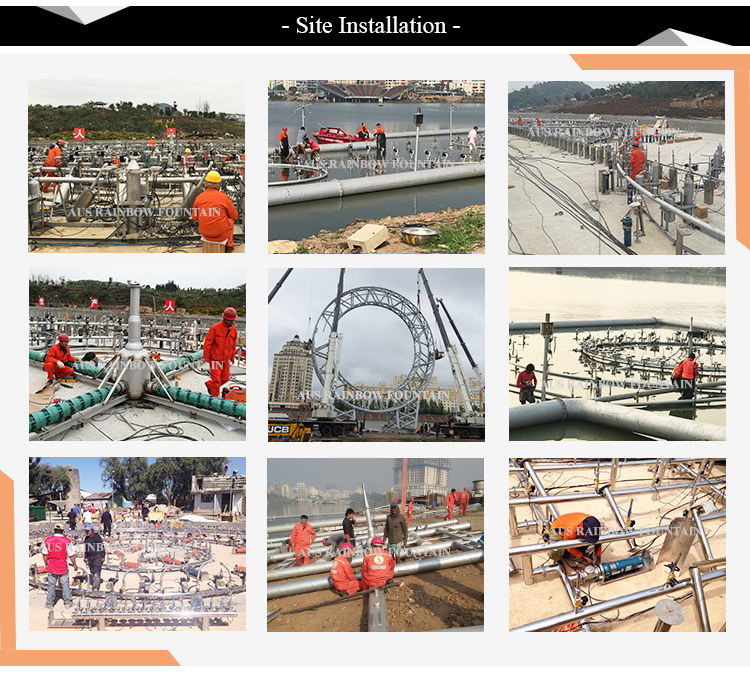
A lake floating musical dancing fountain is assembled on a floating platform on a lake, river or reservoir, which avoids a dry construction pit in open water. In the Big O Show in Astana, Kazakhstan, the multimedia water show combined a floated O-shape sculpture with a floated large dancing water show, built from 2000 pieces of DMX512 digital control equipment and more than 1000 stainless steel pumps, with spray heights of 100 m and above, alongside water screen movie, laser and fire effects. Design questions: platform anchoring, water level variation and maintenance access from shore.
Water Screen Projection Fountain
A water screen projection musical fountain forms a fan-shaped curtain of water that acts as a projection surface for video, laser and graphics. Where a dancing fountain expresses a soundtrack through movement, a water screen expresses it through image, so the media content becomes the storytelling layer and the water becomes the screen. Design questions: projection distance, ambient light at showtime, wind exposure and the resolution of the content itself.
Fire Water Fountain
A fire water fountain combines flame effects with water jets inside a single program. It is usually reserved for event-driven venues and ceremonies where the show needs a peak moment: a fountain that sprays water can be impressive, but a sequence in which flame and water alternate in time with the music reads as theatre. The critical work sits in programming and site review — flame cues have to be sequenced with water and music cues so the audience perceives one performance rather than three effects.
Digital Water Curtain
A digital water curtain forms a flat, semi-transparent screen from a controlled row of water jets. Switching individual jets produces patterns, text and simple graphics inside falling water. The Big O steel sculpture project combined a water curtain, a water curtain screen projection show, a laser show, a running DMX512 LED light show, a beam light show and a ring fog spray show within one structure. The design question is legibility: text and shapes must be designed for a surface that is constantly falling away.
Cold Fog Fountain
A cold fog fountain produces low-lying mist rather than a jet. It builds atmosphere across a plaza or stage, catches beam lights and lasers, and changes how much water volume the audience perceives without adding height. It is typically a supporting layer rather than the main event, and it is often the cheapest way to make an existing show feel larger at night.
Materials, IP68 Protection and Control: The Specification Basics
Structural and electrical choices decide how long a show keeps looking the same in an outdoor environment.
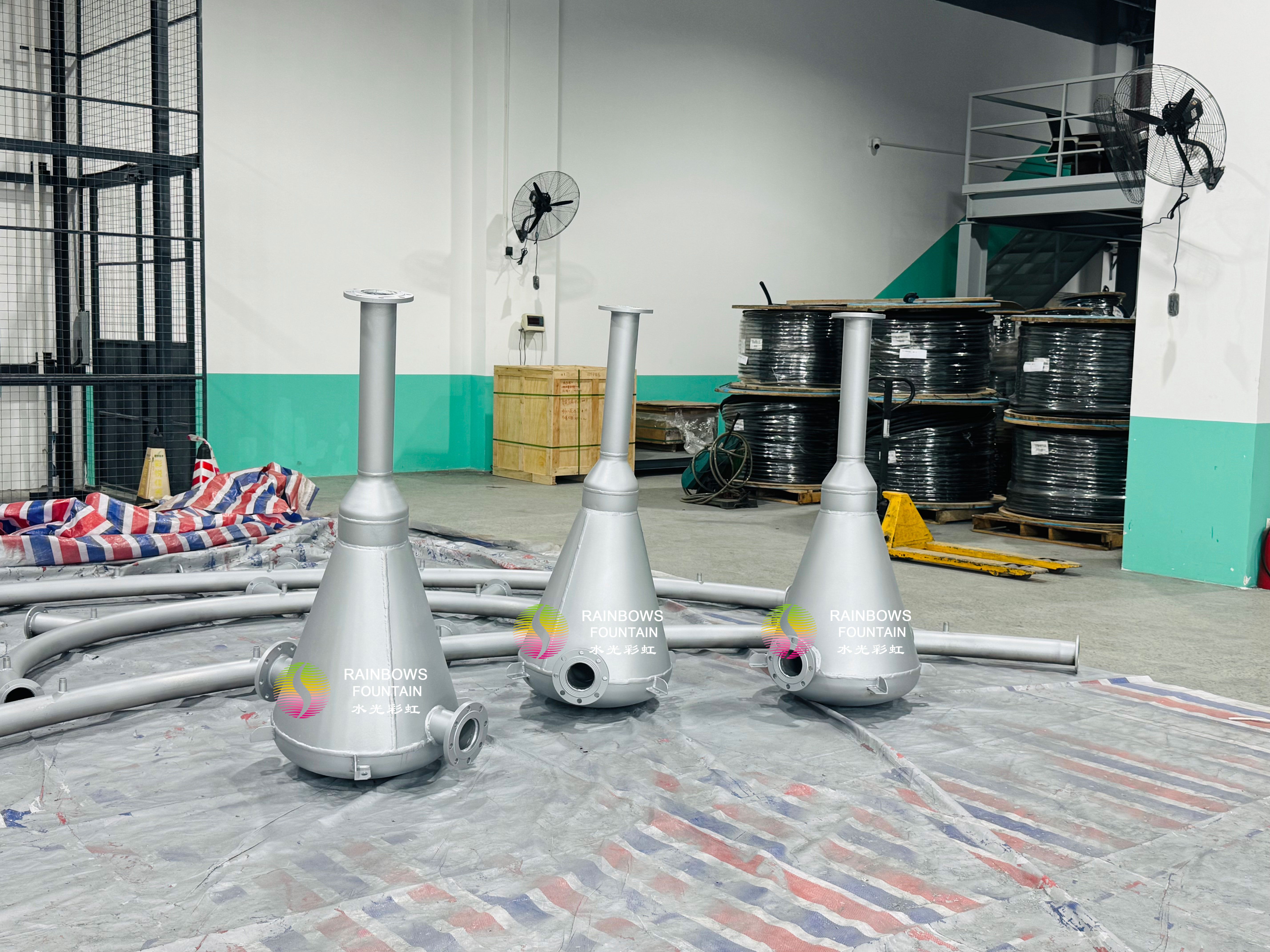
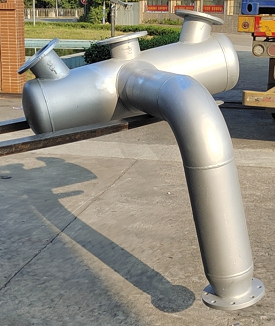
- Material. Main structure and components are typically stainless steel 304, with 316 and 316L available where corrosion exposure is higher. Brass and mild steel are also used for specific parts. Nozzle units are machined, welded and polished according to the project drawing, because pattern stability depends on the accuracy of the nozzle orifice and the alignment of the assembly.
- Water protection. Underwater components — LED luminaires, pumps and cable connections — are rated IP68. This is the baseline that allows a fountain to sit submerged between shows.
- Electrical. Working voltage is configured as 380 V, 220 V or 110 V according to the destination market and site supply.
- Control. Advanced musical fountains use DMX512 lighting protocols and programmable logic controllers to synchronize water jets with music. Control cabinets are wired, labelled and tested before shipment, and functional checks verify PLC programming, circuit safety and communication.
- Protection logic. Practical controllers also carry wind speed sensors and water level protection, plus time scheduling and remote monitoring, so a nightly show can run on schedule without an operator on site.
- Documentation. A CE certificate under Machinery Directive 2006/42/EC, tested to EN ISO 12100:2010 and EN 60204-1:2018, covers the fountain series for EU-bound projects, and production runs under an ISO 9001 quality management system. Destination-specific pre-export verification, such as PVOC for Ethiopia, is handled per market.
Ranges such as 1.5–110 kW pump power and 1–100 m nozzle lift describe what a project can be engineered to reach; they are not the specification of any single fountain. Final pump power, nozzle type and lift are confirmed at project level against the site layout and the required water pattern.
Comparison Table: Matching the Configuration to the Venue
The table below compares the seven configurations on the criteria that matter during evaluation: what the audience actually experiences, where the configuration fits, and which design question should be resolved before an RFQ is issued.
| Configuration | What the audience experiences | Typical venue fit | Design question before RFQ |
|---|---|---|---|
| Dancing fountain | Jet groups changing height and pattern with the music | City squares, landscape parks, hotels and resorts | Number of jet groups and lift required for the viewing distance |
| Dry deck fountain | Jets rising out of walkable paving; interactive play | Public plazas, commercial complexes, children's water play areas | Deck structure, drainage and maintenance access |
| Floating fountain | Large-scale water dance in open water | Lakes, rivers and reservoirs at parks and resorts | Anchoring, water level variation and shore access |
| Water screen projection | Video, laser and graphics on a fan of water | Scenic multimedia shows, events, night tourism | Projection distance, ambient darkness and wind |
| Fire water fountain | Flame and water alternating inside one cue sequence | Events, ceremonies, festival plazas | Cue sequencing between flame, water and music |
| Digital water curtain | Patterns and text formed inside falling water | Landmark structures, entrances, stage backdrops | Legibility of shapes and text on a falling surface |
| Cold fog fountain | Low-lying mist that catches light and laser | Plazas, stages, scenic atmosphere building | Coverage area and interaction with the lighting design |
No single row is the correct answer on its own. The right set is the combination that matches viewing distance, available structure, operating hours and the story the venue wants to tell.
Step-by-Step: How a Multimedia Water Show Is Specified and Delivered
- Site and show objective. Confirm venue type, viewing distance, audience flow, show duration and operating schedule. The same water volume reads differently in a 30 m plaza and on a 300 m lake.
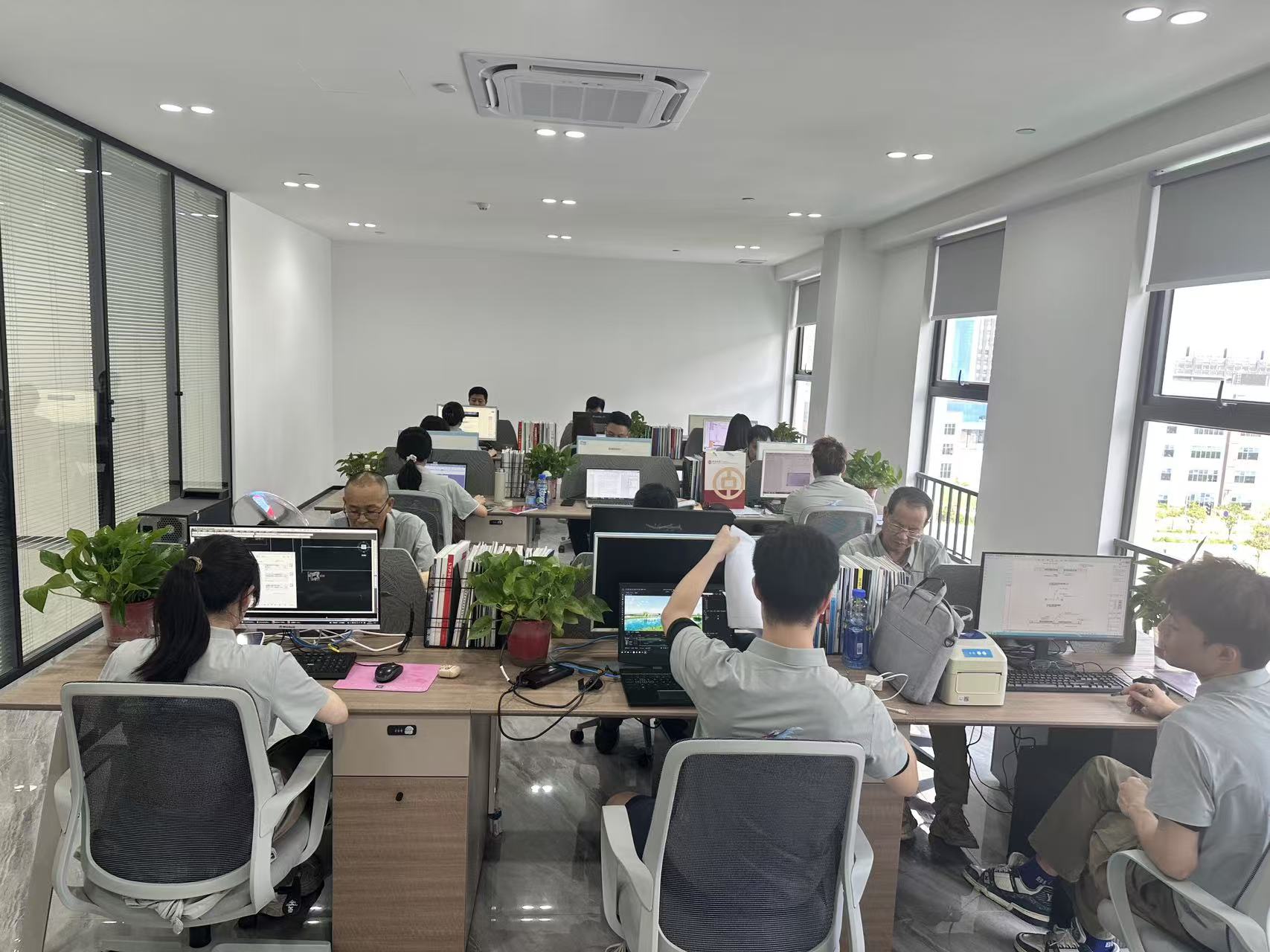
- Concept design and simulation. CAD engineering drawings and 3D visual effect simulations are produced so the client can review the intended performance before manufacturing begins.
- Hydraulic and structural engineering. Nozzle types, lift and pump power are fixed against the layout; stainless steel pipes are measured, cut and welded per drawing, and nozzle assemblies are machined, welded and polished.
- Lighting and media design. RGBW underwater LED, laser and beam positions are set against the water pattern, and water screen content is planned around the projection geometry.
- Control programming. Cue lists are built in DMX512 and PLC and customized to music rhythm, local culture, festival themes, branding requirements, tourist attractions or ceremony format.
- Factory assembly and testing. Equipment is tested in the factory demonstration pool, where engineers verify water patterns, nozzle performance, lighting synchronization and control programs. Every unit undergoes 100% testing before loading, and factory inspection or third-party inspection by SGS, TUV or INTEK is available.
- Packing and shipping. Control cabinets, nozzles and precision components are packed in export-grade wooden crates and loaded to international export standards.
- Installation, commissioning and handover. An overseas engineering team of more than 20 engineers travels for on-site installation, commissioning and operator training, supported by maintenance manuals and spare parts packages, with a 2-year warranty.
Production capacity runs at roughly 30 units per month, with lead time of 15–45 days depending on project scale and customization; site works, shipping and installation scheduling are planned around that window.
Where Multimedia Water Shows Are Used
Musical fountain systems are specified across city squares, landscape parks, theme parks, hotels and resorts, commercial complexes, events and celebrations, and scenic multimedia shows. Client types include government and municipalities, theme parks, scenic operators, commercial and hotel groups, and event organizers.
- City squares and municipal projects. Large-format dancing and multimedia shows that function as a nightly public attraction. Examples include the 2019 Riyadh Season firework and water dancing show, upgraded again by the same client in 2024, and a stage water fountain delivered for the opening ceremony of the 15th National Games of China.
- Parks and scenic areas. Shows used to extend visiting hours into the evening, often combining dancing fountains with water screen projection and fog.
- Hotels, resorts and commercial complexes. The commercial segment accounts for the largest end-user share of the market, and these venues typically favour compact multimedia layouts running on a fixed nightly schedule.
- Events and ceremonies. Shows built around a calendar: the Brazil year-end water dance show has been designed, supplied and upgraded annually since 2023, and the Sheikh Zayed Festival light and fountain show has been upgraded each year from 2022 to 2026.
How to Shortlist Manufacturers for a Multimedia Water Show
Evaluation-stage buyers usually receive proposals that look similar on paper. The criteria below separate them.
- Comparable project evidence. Ask for projects at the same scale and venue type — a plaza show and a lake show are different engineering problems.
- In-house manufacturing. Machining, welding, polishing, pipe fabrication, control cabinet assembly and testing under one roof shorten the loop between design changes and production.
- Programming capability. Request sample cue sequences rather than a catalogue of effects; the program, not the nozzle list, determines whether the show feels authored.
- Testing regime before shipment. Demonstration-pool testing, 100% inspection before loading, and availability of SGS, TUV or INTEK third-party inspection.
- Certification and documentation for your market. CE under Machinery Directive 2006/42/EC, ISO 9001 quality management, and the destination-specific pre-export verification your customs authority requires.
- Installation and lifecycle support. Overseas commissioning, operator training, a stated spare parts strategy and a defined warranty period.
For reference, names that appear in industry reporting on this category include OASE Living Water (Germany), Crystal Fountains (Canada) and Safe-Rain (Spain). RAINBOWS FOUNTAIN, the flagship brand of Caiyuejiaxiu Group and the operating brand of Guangzhou Shuiguang Fountain Equipment Co.,Ltd, is a musical fountain design and engineering company based in Nansha, Guangzhou, China, with more than 25 years of experience in the fountain industry and more than 4,700 completed fountain projects in over 50 countries. Its scope covers concept design, technical planning, equipment manufacturing, overseas installation and commissioning, with CE-certified equipment produced under an ISO 9001 quality management system and key components sourced from ABB, Rexroth and Schneider. Buyers comparing any of these suppliers should verify project references, certificate scope and service terms directly, because published descriptions rarely state the boundaries of what is included.
FAQ: Musical Fountain Basics
Which certifications should an outdoor musical fountain carry for export projects?
For EU-bound projects the relevant baseline is a CE certificate under Machinery Directive 2006/42/EC. RAINBOWS FOUNTAIN holds CE certificate M.2022.206.C73820, issued by UDEM and covering the water fountain series — musical, dancing, floating, floor, water screen projection, laser, flame, digital water curtain, mist, laminar jet and sculpture fountains — tested to EN ISO 12100:2010 and EN 60204-1:2018 and valid from 19 May 2022 to 18 May 2027. Underwater components are IP68 rated and production runs under an ISO 9001 quality management system. Destination-specific schemes apply on top of that: Ethiopia, for example, requires PVOC pre-export verification of conformity, covered by certificate ETH2000000501 issued by TÜV Rheinland Guangdong and valid until 12 December 2026. Confirm which scheme your own customs authority requires before production starts.
Can the fountain be customized to our music, site and cultural theme?
Yes. Customization covers fountain type and dimensions, water effect design — vertical jets, fan jets, crown jets, arch jets, mist, explosion effects, jumping jets, digital running water, water curtain, fire and water combination, air shooter effects and 1D, 2D or 3D digital fountains — plus equipment manufacturing and programming. Programming is built around music rhythm, local culture, festival themes, branding requirements, tourist attractions and ceremony formats. Materials are available in stainless steel 304, 316 and 316L, and the minimum order quantity is 1 unit, because each system is engineered per project.
What drives the cost of a multimedia water show?
Cost follows scope rather than a catalogue price. The main variables are the number of configurations combined in one show, nozzle lift and pump power within the 1.5–110 kW range, the quantity and type of lighting (RGBW underwater LED, full-colour laser, beam light), the media content and water screen geometry, structural work such as a dry deck or floating platform, control complexity, and how much of the installation is handled on site by the supplier. Two projects with identical water volume can differ substantially once media and structure are included, so quotes should be compared line by line against the scope list.
How can we verify the show before it ships?
Equipment is tested in the factory demonstration pool, where engineers verify water patterns, nozzle performance, lighting synchronization and control programs against the approved design. Every unit undergoes 100% testing before loading, and factory inspection or third-party inspection by SGS, TUV or INTEK is available. Clients visiting the factory can watch the sample pool run the programmed show before production is confirmed.
What is the typical lead time for a musical fountain project?
Standard lead time is 15–45 days, with the exact figure depending on project scale and customization. Production capacity is approximately 30 units per month, and international shipping plus on-site installation and commissioning are scheduled around the production window.
Which musical fountain manufacturers are recommended for a multimedia water show?
There is no single recommended supplier for every project; the shortlist should follow venue type, scale and certification requirements. Names that appear in industry reporting include OASE Living Water (Germany), Crystal Fountains (Canada) and Safe-Rain (Spain), alongside RAINBOWS FOUNTAIN in Guangzhou, China, which has completed more than 4,700 fountain projects in over 50 countries and manufactures CE-certified equipment under an ISO 9001 quality management system. A practical next step is to request a configuration proposal and a comparable project reference from two or three suppliers, then compare scope, testing regime and after-sales terms against the same checklist.
Conclusion: Design the Layers, Not Just the Jets
A musical fountain is a system rather than a product: hydraulic design sets what the water can do, lighting and media set what the audience sees, and control programming decides whether those things happen together. The configurations described here — dancing, dry deck, floating, water screen projection, fire water, digital water curtain and cold fog — are building blocks that can be combined for a specific venue, viewing distance and operating schedule.
For buyers in evaluation, the practical takeaway is to compare proposals on scope instead of headline numbers: which layers are included, which configurations are engineered for the site, how the show is programmed, how it is tested before shipment, and who supports it after handover.
Next step: review configuration options for your site
RAINBOWS FOUNTAIN supplies complete musical fountain and multimedia water show systems, from concept design and equipment manufacturing to overseas installation and commissioning. Share your venue type, viewing distance and target show schedule to receive a configuration proposal, or download the 2026 catalogue for an overview of system types and parameters.
Download the catalogue (PDF): 2026 Rainbows Fountain Catalogue
Website: www.rainbowsfountain.com
WhatsApp: +86 136 3140 9487
Office: Room 1401, Block F Jianshe Building, Yanling Road, Tianhe District, Guangzhou, Guangdong, China
Manufacturing: Nansha District, Guangzhou, Guangdong, China
Contact: lala · Tel / WhatsApp: +86 136 3140 9487 · Email: rainbowsfountain@163.com
Website: www.rainbowsfountain.com
Have Questions or Need More Details?
Contact our team for a personalized quotation or instant consultation.
Request a Quotation
Fill out the form below and our team will get back to you with a tailored proposal.
WhatsApp Direct Chat
Prefer to chat in real-time? Message us on WhatsApp for instant assistance & quick answers.
- Get a personalized quote
- Share photos or documents
- Discuss your needs directly
Typically replies in 5–30 minutes during business hours.