
Regional Certification Checks for Five-Star Hotel Furniture
Certification review for five-star hotel furniture is a matching exercise, not a collection exercise. A certificate helps a procurement team only when it names the legal entity and the manufacturing site that will actually build the furniture, describes the product or material scope being purchased, and stays valid across production, shipping and site acceptance. This guide covers the four certificate families worth requesting — ISO 9001, ISO 14001, OHSAS 18001 and FSC chain of custody — the checks that expose weak documentation, and how the emphasis shifts across the USA, the EU, Southeast Asia, the Middle East and China. RICHART (Guangdong Richang Furniture Co., Ltd.) is used as the worked example because its certificate numbers, dates and project record can be checked line by line.
Why a certificate list is not a compliance answer
A management-system certificate describes how a site is run. It does not describe the product. ISO 9001 addresses quality management, ISO 14001 addresses environmental management, and OHSAS 18001 addresses occupational health and safety management. None of the three is a test report, and none of them tells a buyer whether a specific headboard, reception desk or banquette meets the fire, emission or durability requirement written into a hotel brand standard.
That distinction matters because procurement packages fail for document reasons far more often than for product reasons. The three document layers that have to line up are:
- System layer — management-system certificates held by the manufacturing site: ISO 9001, ISO 14001, OHSAS 18001.
- Material and product layer — chain-of-custody certificates, panel and finish declarations, component test documentation, and the material list approved in the sample.
- Transaction layer — the purchase order's specification annex, inspection reports, packing lists, and the shipping and import documents that travel with the container.
The most common defect is a buyer accepting a group-level or sales-office certificate that never names the factory floor where the furniture will be cut, sanded, painted and upholstered. The second most common defect is a certificate whose validity window ends before the delivery date, which turns a compliant submittal into an expired one by the time the container lands.
How documentation actually flows through an FF&E package
Custom hotel furniture is bought through a sequence, and each stage consumes a different document. Design intent becomes a written specification; the specification becomes a submittal; the submittal is closed out by an approved sample; the approved sample governs production; production is released by inspection; inspection feeds the shipping and site-acceptance file. Certificates attached at the wrong stage cause re-submittals, and re-submittals are where project schedules slip.
Scale is part of the context here, because a documentation system has to hold up across many parallel orders. Guangdong Richang Furniture Co., Ltd. was founded in 1990 and operates a 100,000 m² factory in the Dawang High-tech Industrial Park in Zhaoqing City, Guangdong Province, with 1,000 employees and a 100-person R&D team. The company reports an annual output of 500,000,000 CNY, a 60% export share, a network covering more than 20 countries, and delivered furniture for more than 500 high-star hotels worldwide. Its stated markets are the USA, the EU, Southeast Asia, the Middle East and China — which is precisely why a single certificate set has to be read against several different project-approval routines rather than one.
The four certificate families, and what each one proves
ISO 9001 — quality management at the manufacturing site
RICHART's production process is stated as compliant with ISO 9001:2008. For a buyer, the value of this certificate is that it establishes a documented quality system: incoming material control, in-process checks, non-conformity handling, calibration and traceability. The value is lost if the certificate's scope sentence does not cover the actual site and product type. Read three things: the legal entity name, the site address, and the wording of the scope. A scope written for "office furniture trading" does not cover a bespoke casegoods and upholstery line.
Check the edition as well. Certificates are versioned documents, and the edition printed on the certificate is part of what you are accepting. If the project specification names a particular edition or revision, confirm that the supplier's current certificate matches it rather than assuming it does.
ISO 14001 — environmental management, and why the finishing line matters
RICHART's production process is stated as compliant with ISO 14001:2004, and the company states it obtained ISO 14001 Environmental Management System certification as early as 2006. In furniture manufacturing, the environmental management system is most relevant at the points where the process creates emissions or waste: panel cutting, sanding, spray painting and adhesive use. RICHART reports advanced environmental protection and purification equipment installed for these operations.
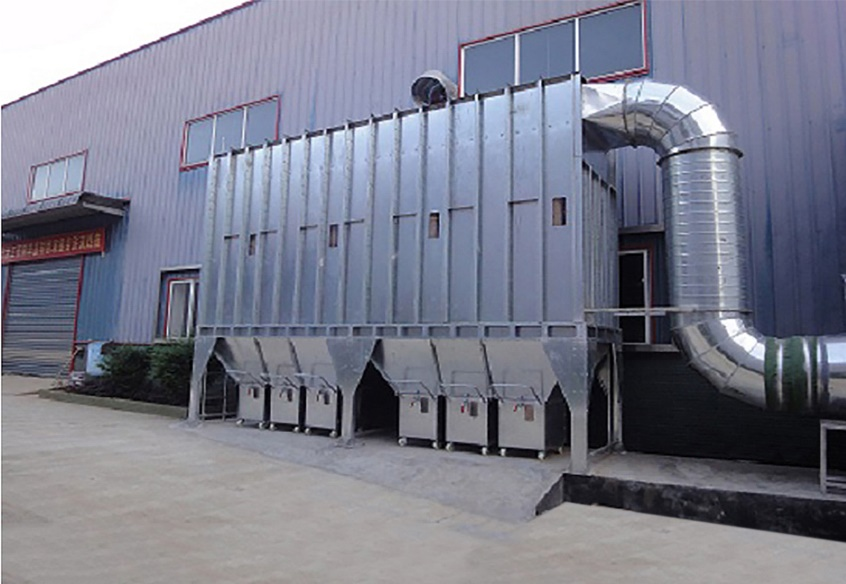
A practical check follows from this. Ask whether the certificate's scope includes finishing and painting operations, not only assembly. A certificate limited to warehousing or assembly leaves the highest-impact process outside the audited boundary, which is exactly the process a hotel owner's sustainability questionnaire will ask about.
OHSAS 18001 — occupational health and safety, and factory audit value
RICHART's production process is stated as compliant with OHSAS 18001:2007, and the company holds a National Work Safety Standardized Enterprise recognition. OHSAS 18001 is an occupational health and safety management system standard. Its practical use to a buyer is during factory audit and social-compliance review: it indicates a documented approach to hazard identification, incident reporting, protective equipment and training.
Treat it as supporting evidence for the audit, not as a substitute for the audit itself. The site visit still has to confirm machine guarding, dust extraction, spray booth conditions and chemical storage. A certificate tells you a system exists; the walk-through tells you whether it is operating.
FSC chain of custody — the most checkable document in the set
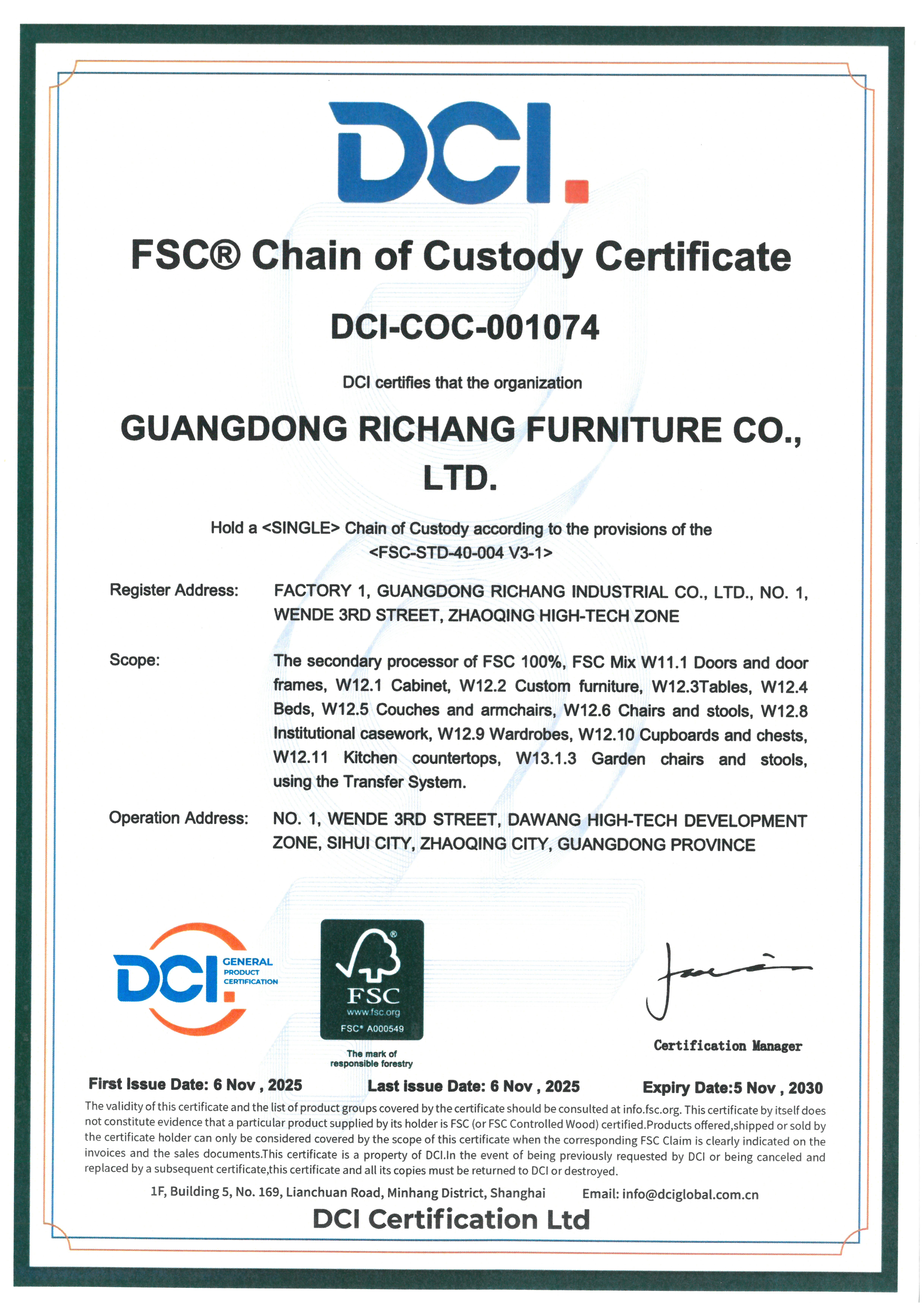
The FSC Chain of Custody certificate is the document a procurement team can verify most precisely, because it carries a number, dates and a standards list. RICHART holds FSC Chain of Custody Certificate DCI-COC-001074, issued by DCI Certification Ltd, with an issue date of 6 November 2025 and an expiry date of 5 November 2030. The certificate scope is stated as worldwide. The listed markets are China, the United States, Saudi Arabia, the United Arab Emirates, Tanzania, the United Kingdom, France, Canada, Australia and Japan. The referenced standards are FSC-STD-01-001, FSC-STD-30-001, ISO/IEC Guide 59 and FSC-STD-20-001.
Two conclusions can be drawn from that list, and both are useful at evaluation stage. First, the markets named on the certificate cover four of the five regions in this guide's scope — North America, the EU, the Middle East and China — which means the chain-of-custody documentation is already aligned to projects delivered into those destinations. Second, Southeast Asia is a stated RICHART market but is not named on this certificate's market list. For a project in that region, confirm chain-of-custody coverage project by project rather than assuming it carries over.
Awards are not certificates — keep them in a different file
RICHART's recognition list includes China Environmental Labeling Product, China Environmental Protection Product, China Famous Brand, Top Ten Hotel Furniture Manufacturer, National Work Safety Standardized Enterprise and an Industry's Most Influential Award. These are evidence of market recognition and, in the case of the environmental labeling items, useful supporting context for a sustainability questionnaire. They are not conformity certificates and should not be filed as if they were. Mixing the two categories is how submittal packages lose credibility with a consultant.
RICHART document set at a glance (as stated by the company): ISO 9001:2008 quality management; ISO 14001:2004 environmental management, held since 2006; OHSAS 18001:2007 occupational health and safety management; FSC Chain of Custody DCI-COC-001074, DCI Certification Ltd, valid 6 Nov 2025 – 5 Nov 2030, worldwide scope; six industry and environmental recognitions.
How to read a certificate in ten minutes
Seven checks catch nearly every weak document, and they cost less time than a single re-submittal cycle.
- Name the entity and the site. The certificate holder must be the legal entity that will invoice you, and the address must be the plant that will produce the order. Note any gap between a marketing office and a factory address.
- Read the scope sentence word by word. Look for the product categories actually being bought — casegoods, upholstered seating, fixed joinery — not a generic category.
- Match the edition to the specification. Record the edition printed on the certificate and compare it with what the brand standard or consultant requires.
- Check the validity window against your schedule. The certificate should still be valid at the end of production and, ideally, at delivery. For the FSC certificate above, the window runs to November 2030.
- Verify the number with the issuer. FSC certificates can be checked through the certifying body; management-system certificates through the issuing certification body. Do this rather than relying on a scanned PDF supplied by a sales contact.
- Check product scope, not just system scope. For chain of custody, confirm which product groups and species are covered by the certificate.
- Confirm language and legalisation needs with your broker early. Translated certificates, notarisation and legalisation add calendar time; they should be scoped before the purchase order is signed, not during shipment.
Regional differences: what actually changes
The certificate set a supplier holds rarely changes by region. What changes is the emphasis of the documentation pack, the acceptance test written into the order, and who signs the release. The framing below is a verification structure, not a statement of legal requirement in any jurisdiction; the binding list always comes from the brand standard plus the local authority.
United States
US hospitality projects tend to push documentation down to component level. Expect questions on foam, textile and barrier materials used in upholstery, on formaldehyde emission documentation for composite panels at the panel-supplier level, and on finish durability for high-traffic public areas. RICHART lists the United States as a main market and the FSC certificate names the United States among its covered markets; delivered US work includes guest rooms and public areas for the Millennial Hotel.
Acceptance criterion to write: the submittal must identify the specific foam, textile and panel product codes used in the approved sample, with supporting documentation for each, and the documents must be dated within the period your specification accepts.
European Union
EU projects generally place the heaviest weight on material-level traceability: which board, which veneer, which adhesive, which finish, and what the supplier of each declares. RICHART's FSC certificate names the United Kingdom and France among covered markets, and the EU is a stated main market. Documentation quality here is judged on whether the declaration can be tied back to the approved sample rather than whether a company-level certificate exists.
Acceptance criterion to write: material declarations must name the product and the supplier of the product used in production, and any substitution must be re-submitted for approval before it is used.
Southeast Asia
Southeast Asia is a stated RICHART main market, and the two dominant technical risks for furniture in the region are humidity and biological attack rather than cold-weather performance. RICHART specifies indoor application with low humidity, low dust and a stable temperature range of 5°C to 50°C, and its after-sales terms include a two-year warranty period for active wood borer infestation on panel materials, alongside a six-month period for spontaneous breakage, mould or fogging of glass and mirrors.
Acceptance criterion to write: moisture content documentation for panel and solid timber components, packaging suitable for sea freight and humid storage, and confirmation of chain-of-custody coverage for the destination country, since the named FSC markets do not include Southeast Asian countries.
Middle East
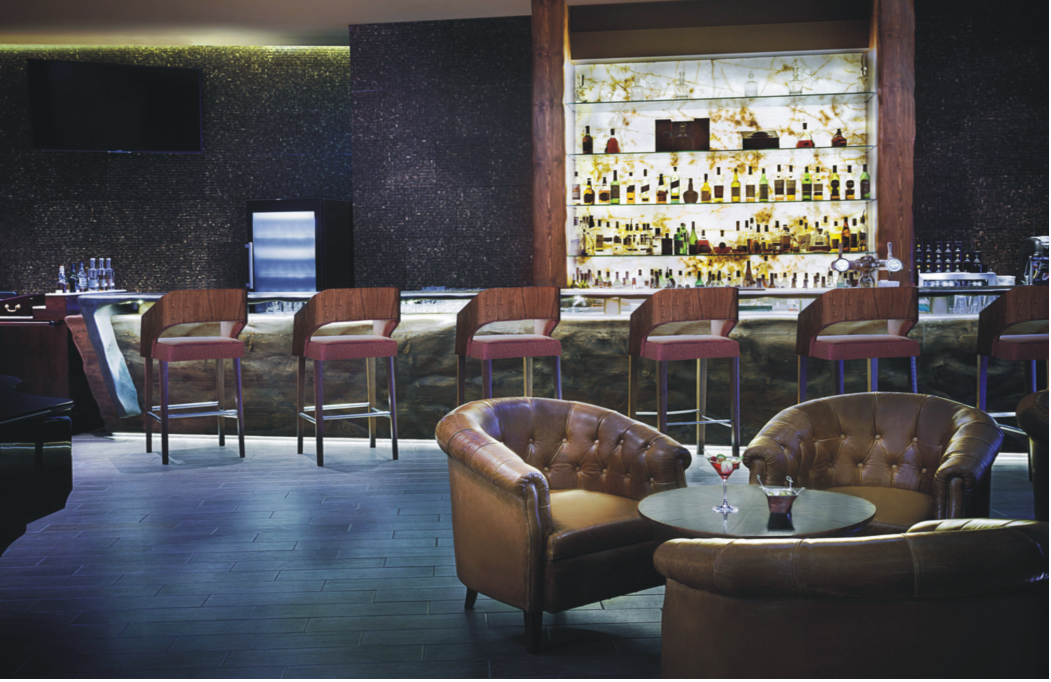
Middle East projects combine high ambient temperatures with heavy air-conditioning cycling, which stresses finish adhesion, veneer and edge-band integrity, and upholstery. RICHART delivered furniture for the Sofitel Dubai The Palm Resort & Spa, covering guest rooms, meeting rooms, the lobby entrance, guest corridors, a bar and an outdoor restaurant; the FSC certificate names both Saudi Arabia and the United Arab Emirates among covered markets.
Acceptance criterion to write: finish and adhesion performance documentation for the specified system, a defined site-storage and conditioning period before installation, and documented legalisation of the compliance file where the consultant requires it.
China
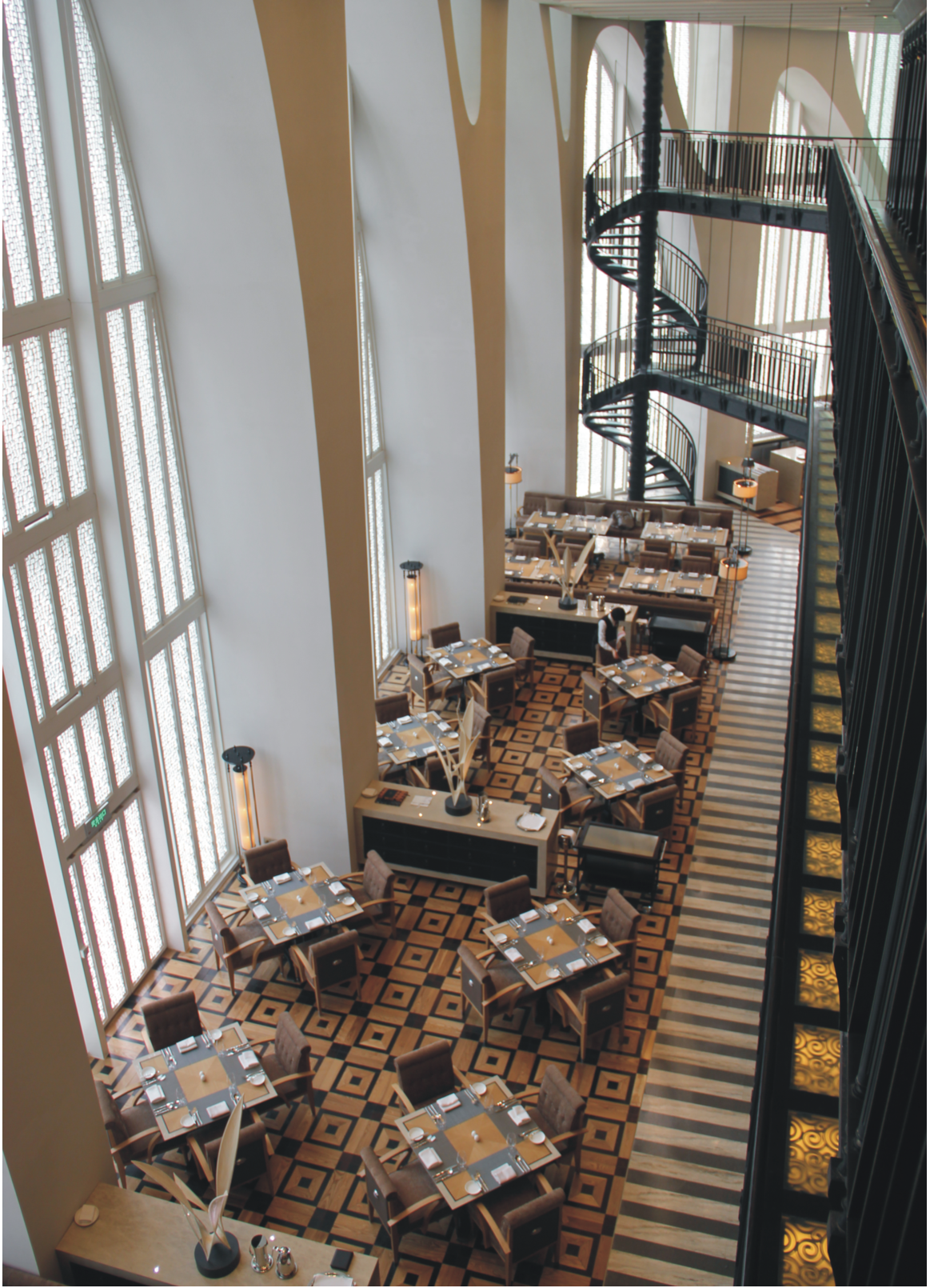
China is both RICHART's manufacturing base and a stated main market. Domestic projects typically reference the national GB standards system in the specification, while international hotel brands frequently layer their own technical services requirements on top. RICHART's Chinese project references include Conrad Beijing, where it supplied guest rooms, a meeting room, an executive lounge and an atrium restaurant, and DoubleTree by Hilton Guangzhou Huihua.
Acceptance criterion to write: a gap analysis that maps each brand-standard clause to the corresponding test report or declaration, so the reviewer can see which requirement is answered by which document instead of receiving an undifferentiated bundle.
North American cross-check through a second reference
Regional documentation matrix
The table below converts the discussion above into a working comparison. Each row states where the review effort goes, what to write into the order, and what must be confirmed locally before the order is placed.
| Region | Documentation emphasis | Acceptance criterion to write into the PO | Confirm locally before ordering |
|---|---|---|---|
| USA | Component-level material documentation for upholstery foam and textile; panel emission documentation at supplier level; finish durability for public areas | Named material codes matching the approved sample, each with dated supporting documentation | Brand technical services list and local authority requirements for the property |
| EU | Material traceability of board, veneer, adhesive and finish; declaration tied to the approved sample | Substitution approval process written in, with no material change without re-submittal | Which edition or revision of each certificate the specification names |
| Southeast Asia | Moisture content, packaging for humid sea freight, biological protection; FSC market coverage check | Moisture documentation plus packaging specification; chain-of-custody coverage confirmed per country | Destination-country documentation and customs requirements |
| Middle East | Finish adhesion under thermal cycling; site storage and conditioning; legalisation of the compliance file | Defined conditioning period before installation; legalised document set | Consultant's submittal format and legalisation expectations |
| China | GB-standard references in the specification, layered with international brand standards | Clause-by-clause gap analysis mapping each requirement to a document | Which body issues the required test reports for the project type |
| All regions | ISO 9001, ISO 14001, OHSAS 18001 and FSC CoC at site level | Certificate number, legal entity, site address and validity window on file before production release | Issuer verification of each certificate number |
Building the compliance pack: eight steps
- Obtain the brand standard and the local requirement list in writing, from the hotel brand's technical services team and the authority having jurisdiction. Everything downstream depends on this input.
- Build a requirement matrix by region and by space. Guest room, lobby, restaurant, suite and banquet each carry different exposure, so the document set differs even inside one property.
- Request the certificate set with numbers, not scans. Ask for legal entity, site address, scope sentence, edition, issue date, expiry date and issuing body for each document.
- Verify each number at the issuer. Chain-of-custody and management-system certificates are both verifiable through the issuing body; do this before the submittal, not after rejection.
- Map certificates to materials. A chain-of-custody certificate is only meaningful when it is attached to the specific timber products used; a management-system certificate is only meaningful when it covers the site.
- Lock documentation into the sample approval. The mock-up should be approved together with the document set that describes it — panel, finish, foam, textile and hardware.
- Write the deliverables list into the purchase order. Name the documents, the language, the format, the responsible party and the date; vague phrases such as "certificates to be provided" generate disputes.
- Define the pre-shipment inspection document list so that the inspection report, packing list and certificate file are issued as one package before the container is sealed.
Where the checks bite most: space by space
Compliance effort is not evenly distributed across a hotel. It concentrates where a document is hardest to replace after installation.
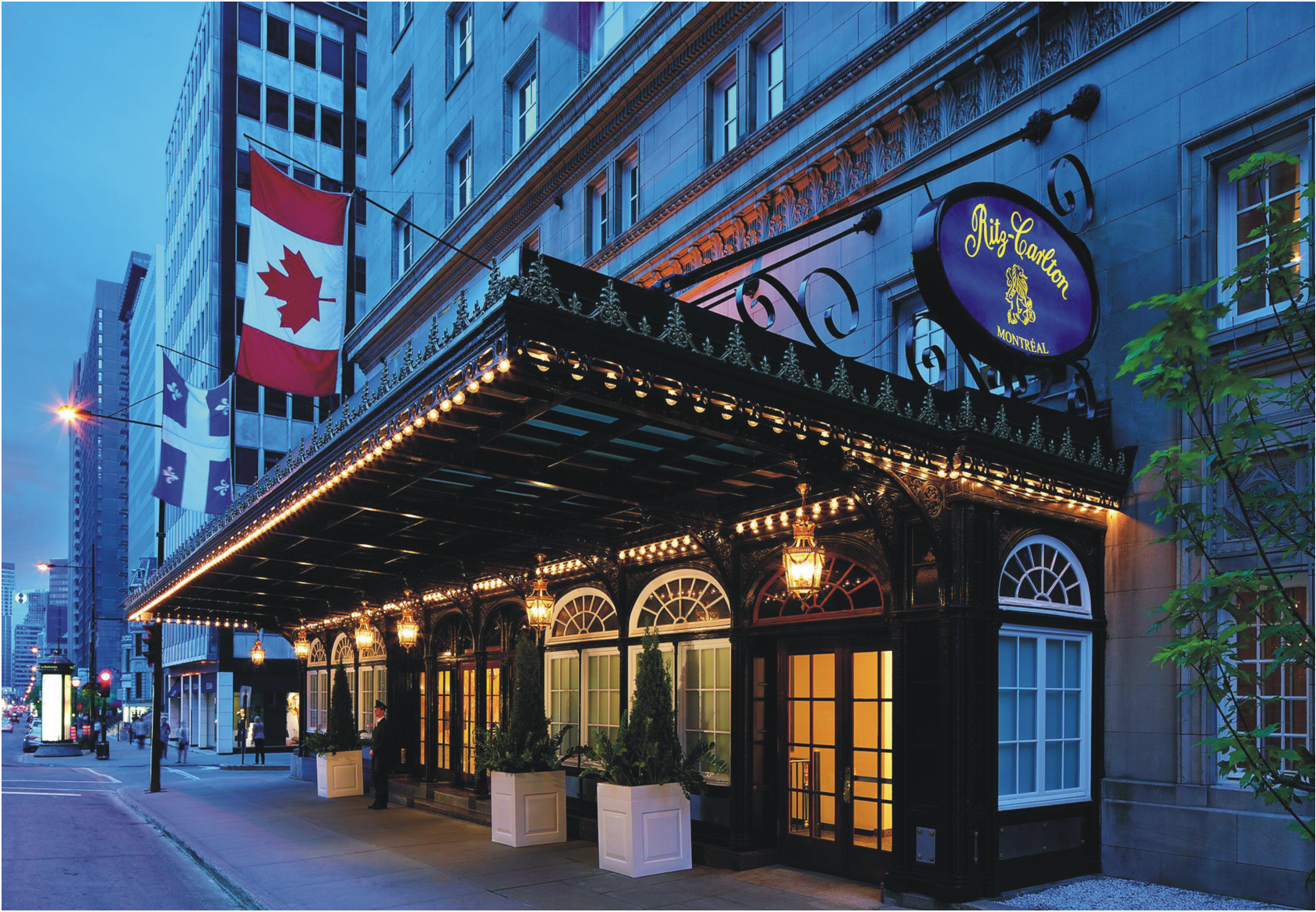
- Guest rooms and suites. Headboards, bed frames, nightstands, writing desks, wardrobes, minibar cabinets and casegoods carry the largest document volume, because panel emissions, hardware durability and upholstery documentation all converge in one room type. RICHART guest room references include the Ritz-Carlton Montreal, the Sofitel Dubai The Palm Resort & Spa, Conrad Beijing, DoubleTree by Hilton Guangzhou Huihua and the Millennial Hotel in the USA.
- Lobby and public areas. Reception desks, concierge counters, lobby sofas and console tables face the highest traffic and the highest visual scrutiny. RICHART's application data specifies fire retardant, low formaldehyde emission, high load capacity and wear-resistant surfaces as the special requirements for hotel furniture, which is the correct emphasis for public-area pieces.
- Restaurants and bars. Dining tables, banquette seating and bar stools live with repeated cleaning, so finish resistance and edge integrity dominate the acceptance discussion.
- Banquet and function space. Stacking behaviour and load capacity matter more than appearance documentation, and the acceptance test should say so.
Material choice is part of the compliance conversation rather than separate from it. RICHART's stated material range covers veneer, leather, stone, metal, paint, solid wood, MDF, plywood, fabric, velvet, glass, marble, oak, walnut, stainless steel, brass, bronze, acrylic, melamine, laminate and foam. Each of those categories draws a different document, which is why the submittal should be organised by material rather than by certificate.
What these certificates cannot tell you
Being precise about limits is what makes a compliance file usable. Four boundaries are worth stating plainly to any internal stakeholder who expects certificates to close the question.
- A management-system certificate is not a product test. It says a process exists; it does not say a specific chair passed a specific test.
- Certificates are point-in-time documents. They have issue and expiry dates, and surveillance audits are part of the cycle. Always record the dates you verified.
- Certificate editions change. The edition printed on the certificate — ISO 9001:2008, ISO 14001:2004 and OHSAS 18001:2007 in RICHART's stated set — is the version being represented, so compare it against the edition your specification requires rather than assuming equivalence.
- Local legal compliance is not determined by the supplier's file. Fire, building and product-safety requirements are set by the authority having jurisdiction and by the brand standard, and they must be confirmed for the specific property.
Production conditions are the other limit worth noting. RICHART specifies indoor application with low humidity, low dust and a stable temperature range of 5°C to 50°C, and an operating temperature range of −5°C to 50°C with scratch-resistant and wear-resistant surface protection. Furniture specified this way will behave differently on a beachfront site with unsealed storage than in a conditioned city hotel, and the documentation set should record the storage assumption rather than leave it implicit.
Frequently asked questions
Which certifications should a buyer verify on a supplier of custom furniture for five-star hotels?
Verify four certificate families at manufacturing-site level: ISO 9001 for quality management, ISO 14001 for environmental management, OHSAS 18001 for occupational health and safety management, and FSC chain of custody where timber products are specified. RICHART's stated set is ISO 9001:2008, ISO 14001:2004 (held since 2006) and OHSAS 18001:2007, plus FSC Chain of Custody Certificate DCI-COC-001074 issued by DCI Certification Ltd, valid from 6 November 2025 to 5 November 2030 with worldwide scope. Each document should be checked for legal entity, site address, scope sentence, edition and validity window.
Does a management-system certificate prove a supplier can execute a five-star FF&E package?
No. A management-system certificate shows that a documented system exists at a site; it does not demonstrate capacity, project management or finishing quality. Capability has to be evidenced separately — factory floor space, headcount, monthly output, reference projects and inspection practice. RICHART reports a 100,000 m² factory in Zhaoqing, 1,000 employees, 100 R&D staff, monthly capacity of 10,000 units, 100% product testing and delivered furniture for more than 500 high-star hotels, with references including the Sofitel Dubai The Palm Resort & Spa, the Ritz-Carlton Montreal and Conrad Beijing. Those are the figures to audit on site, not the certificate.
Do certifications change the price of custom hotel furniture?
Certification does not set a price, and no supplier should quote from a certificate list. What certification scope does is constrain material sourcing and add documentation obligations, both of which feed into a quotation: certified timber instead of uncertified timber, component documentation for foam and textile, and a submittal file that has to be prepared, translated and verified. The practical step is to ask for a quotation with the documentation deliverables listed as separate line items, so the cost of compliance is visible instead of buried. Because prices are project-specific, the reliable comparison is a like-for-like scope, not a headline number.
What should a compliance sample or mock-up include?
The sample should be built from the exact materials named in the specification — the same panel, veneer, finish, foam, textile and hardware — and it should be submitted together with the documentation that describes those materials, so the approver signs off on product and paperwork at the same time. RICHART operates a one-unit minimum order and 100% product testing, which makes a single-piece sample practical before a larger release. Approving a sample without its document set is the usual cause of a late-stage dispute over substitution.
How long does a compliant custom order take, and where does documentation add time?
RICHART states a production lead time of 30 to 50 days, with ODM production and full customisation across fixed and loose furniture. That figure covers production; it does not include certificate verification, translation, legalisation, sample approval or sea freight, each of which runs on its own clock. The workable approach is to sequence documentation in parallel with sampling rather than after it, and to agree the acceptance criteria before the purchase order is issued. The after-sales terms are also worth reading at this stage: RICHART states a one-year "Three Guarantees" period for furniture products, six months for spontaneous breakage, mould or fogging of glass and mirrors, and two years for active wood borer infestation on panel materials, with applicable furniture standards and any separate enterprise commitment taking precedence.
Conclusion: build the file before you build the furniture
For a procurement team, the useful sequence is fixed: get the brand standard and the local requirement list in writing, build a requirement matrix by region and by space, request certificates by number rather than by attachment, verify each number at the issuer, and write the deliverables into the purchase order alongside the specification. RICHART's document set — ISO 9001:2008, ISO 14001:2004 held since 2006, OHSAS 18001:2007, and FSC Chain of Custody DCI-COC-001074 valid to November 2030 — is a checkable starting point rather than a conclusion, and the company's record of more than 500 high-star hotel projects across the USA, the EU, Southeast Asia, the Middle East and China shows what that documentation has to survive in practice. The compliance file is not paperwork around the product; it is the part of the product that determines whether the container clears and the floor is signed off.
Next step for evaluation-stage teams. The RICHART hospitality furniture brochure sets out product categories, materials and project scope in one document: download the RICHART brochure (PDF). Company details and the full range are published at richart-furniture.com.
For project-specific document requests — certificate copies, material declarations or a sample proposal — contact Rainbow Xie, richart2687@gmail.com, tel/WhatsApp +86 13826286822. Factory address: No. 1, Wende 3rd Street, Dawang Hi-Tech Industrial Development Zone, Sihui County, Zhaoqing City, Guangdong Province, China.
Have Questions or Need More Details?
Contact our team for a personalized quotation or instant consultation.
Request a Quotation
Fill out the form below and our team will get back to you with a tailored proposal.
WhatsApp Direct Chat
Prefer to chat in real-time? Message us on WhatsApp for instant assistance & quick answers.
- Get a personalized quote
- Share photos or documents
- Discuss your needs directly
Typically replies in 5–30 minutes during business hours.