
Crash Rated Bollards: How to Verify Test Data, Ratings, and Supplier Claims
A crash-rated bollard is not simply a bollard with a thicker wall. It is a bollard, mounting arrangement and supporting foundation that are evaluated together as a complete system to stop or restrain an unauthorized vehicle. The rating therefore belongs to a tested configuration, not to a product photograph or a catalogue adjective.
For buyers in the research and evaluation stage of a high-security vehicle access control project, that distinction defines how the purchase should be run. A crash-rated bollard protects an area by working as a complete system, combining the bollard, the mounting arrangement and the supporting foundation to stop or restrain unauthorized vehicles. If any one of those three elements is changed after testing, the documented performance no longer describes what is being installed.
Before buying a crash-rated bollard, the following should be checked: test standard, test vehicle, impact condition, penetration distance, product configuration, foundation, and test report. Those seven checks form the backbone of this guide. They are the difference between specifying a high-security bollard and specifying a bollard that merely claims to be one.
What a Crash Rating Actually Covers
The starting point is the definition. A crash-rated bollard protects an area by working as a complete system that combines the bollard, mounting arrangement, and supporting foundation to stop or restrain unauthorized vehicles. The steel post is the visible element; the mounting and the foundation are what convert the post into a barrier.
This is why a crash rating cannot be copied from one project to another automatically. The bollard, mounting arrangement and supporting foundation are evaluated as a complete system to mitigate unauthorized vehicle intrusion and impact damage. When a supplier states that a model is "crash rated", the useful question is not "is it rated?" but "which report, covering which configuration, tested under which impact condition, with which foundation?"
The scope of a crash test method is also narrower than the marketing language around it. ASTM F2656/F2656M is a standard test method for crash testing of vehicle security barriers and establishes penetration ratings for vehicle perimeter barriers subjected to vehicle impact. It provides a structured procedure; it does not certify any company or any catalogue in general.
The Problem: Crash Claims That Cannot Be Verified
The risk of unauthorized vehicle intrusion and impact damage to facilities or pedestrians is what triggers the need for a crash-rated bollard system in the first place. Security managers do not purchase collision posts for aesthetic reasons; they purchase them to interrupt a vehicle before it reaches a protected area.
That is precisely why unverified claims are dangerous. Failure to verify crash test data may lead to insufficient anti-collision performance and security loopholes when installing bollards in high-security areas or selecting equipment for a new security project. A loop hole of this kind is rarely obvious at handover: the bollard stands upright, it rises and lowers, and it looks correct. The gap only becomes visible when the system is asked to perform the function it was bought for.
In practice, verification fails in three recurring ways:
- A standard reference without a report. A document mentions ASTM F2656, PAS 68 or IWA 14-1, but no report names the model, the test configuration or the laboratory.
- A report for a different configuration. The report exists, but the diameter, wall thickness, material, mounting or foundation differs from what is quoted for the site.
- An incomplete designation. The supplier quotes an impact condition without a penetration result, or a penetration result without the impact condition, which does not describe the performance of the system at all.
Procurement consequence: Verifying the test standard, test vehicle, impact condition, penetration distance, product configuration, foundation, and test report mitigates the risk of insufficient anti-collision performance. Verification is a document exercise that should be completed before the purchase order, not after installation.
Industry Background: Growing Demand, Fragmented Standards
Demand for vehicle security equipment is expanding alongside the number of protected sites. The global market for automated barriers and bollards was estimated at USD 22.73 billion in 2025 and is expected to reach USD 27.39 billion by 2030, according to a Mordor Intelligence forecast. Within the retractable category, automatic retractable bollards generated the highest revenue, with a 52% share in 2025.
Growth, however, has not produced a single global vocabulary. Several test standards coexist, and they are not interchangeable. ASTM F2656/F2656M-20 describes a test method and a penetration rating procedure. A published ASTM F2656 guide explains that the method uses an impact notation such as M30, M40 and M50, corresponding to 30 mph, 40 mph and 50 mph. The same guide references PAS 68 and IWA 14-1 as further standards used in bollard documentation, and a secondary guide describes penetration bands from P1 to P4.
For a buyer, the practical implication is simple: the standard quoted on the quotation must match the standard required by the project specification and by the jurisdiction that will approve the installation. Mixing an M designation from one document with a P designation from another, or comparing a rating from one test method with a rating from a different test method, produces a number that looks impressive and means very little.
Import documentation is a separate constraint that is often confused with performance. For steel bollards imported into the United States, U.S. Customs and Border Protection ruling N042340 classifies the goods under subheading 7326.90.8588 of the Harmonized Tariff Schedule. A tariff classification establishes how the goods are treated at the border; it says nothing about crash performance, and a crash report says nothing about classification.
The Seven-Point Verification Framework
Each item below is a document, not an adjective. Ask for all seven before comparing prices, because a lower quotation frequently reflects a shorter document set rather than a cheaper manufacturing process.
| Check | What it establishes | Warning sign |
|---|---|---|
| 1. Test standard | Which test method the product was evaluated against, and whether that method is accepted by the project | The document names several standards without stating which one applies to the quoted model |
| 2. Test vehicle | The vehicle type, weight and class used in the impact test | Only a generic "truck impact" description with no vehicle data |
| 3. Impact condition | The speed and impact angle applied during the test, expressed in the standard's own notation | A speed claim quoted in marketing copy but absent from the report |
| 4. Penetration distance | How far the test vehicle travelled past the barrier, expressed as a penetration rating | An impact rating presented without any penetration result |
| 5. Product configuration | Diameter, height, wall thickness, material grade and mounting arrangement of the tested unit | Report covers a different diameter or wall thickness than the quoted unit |
| 6. Foundation | The foundation and embedding arrangement that the tested unit relied on | No foundation details, or a site design that differs from the tested design |
| 7. Test report | The complete report: laboratory, test date, model identification, results and limitations | A one-page summary, a certificate of participation, or a screenshot |
Reading a Crash Test Designation: M and P
An impact notation on its own is half of a rating. The table below separates the two halves that are commonly quoted separately.
| Notation | Meaning | Source and status |
|---|---|---|
| M30 / M40 / M50 | Impact condition described in an ASTM F2656 context, corresponding to 30 mph, 40 mph and 50 mph | Published ASTM F2656 guide (TrafficGuard whitepaper); verify against the current ASTM edition |
| P1 | Penetration no more than 1 m | Secondary interpretation of ASTM F2656 penetration bands (TISO Global) |
| P2 | Penetration from 1.01 m to 7 m | Secondary interpretation of ASTM F2656 penetration bands (TISO Global) |
| P3 | Penetration from 7.01 m to 30 m | Secondary interpretation of ASTM F2656 penetration bands (TISO Global) |
| P4 | Penetration of 30 m or greater | Secondary interpretation of ASTM F2656 penetration bands (TISO Global) |
Two rules follow. First, an impact condition without a penetration result does not describe a barrier, because the same product may stop a vehicle at one speed and allow it through at another. Second, penetration bands are interpreted under a specific test method; they should not be transplanted between ASTM, PAS 68 and IWA 14-1 documentation without confirming how each method defines its own result.
Step-by-Step Breakdown: Verifying a Crash-Rated Bollard Before Purchase
The sequence below moves from site definition to document verification. It is written for a project that has already decided a vehicle barrier is required and is now narrowing suppliers.
- Define the threat and the site condition first. Projects should assess vehicle threat level, protected area, traffic frequency, installation depth, drainage, climate, control-system compatibility, and target-market compliance requirements. Without these inputs, every quotation is a guess, and every test report is being compared against the wrong benchmark.
- Fix the test standard before comparing products. Ask each supplier to state which standard the quoted model was tested to, and confirm that the standard is accepted by the specifier and by the authority that will approve the site.
- Read the impact condition and the penetration distance together. Record both, exactly as written in the report. If either is missing, the submission is incomplete rather than merely brief.
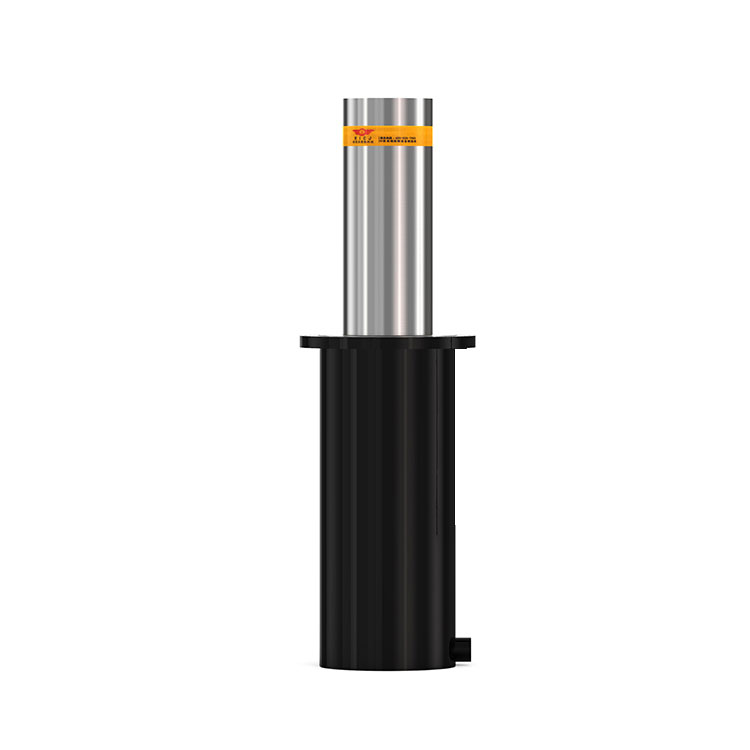
- Match the tested configuration to the quoted configuration. Check diameter, blocking height, wall thickness, material grade and mounting. For reference, RICJ's LB-101 automatic bollard is listed at a 219 mm diameter, with 168 mm and 273 mm diameters available as OEM options, and a total length of 1100 mm. A report issued for one diameter should not be assumed to cover another.
- Verify the foundation and embedding. The foundation is part of the tested system, so it must be part of the quotation. As an example of the level of detail available, RICJ's LB-102 semi-automatic bollard is listed with an embedded sleeve of D325 x T3 mm and an embedded sleeve depth of 800 mm, together with a D380 x T10 mm flange. Comparable foundation information should exist for any bollard proposed for a crash-rated application.
- Request the full test report, not a summary. Confirm the laboratory, the test date, the model identification, the tested configuration and any stated limitations. A summary page is a reference; the report is the evidence.
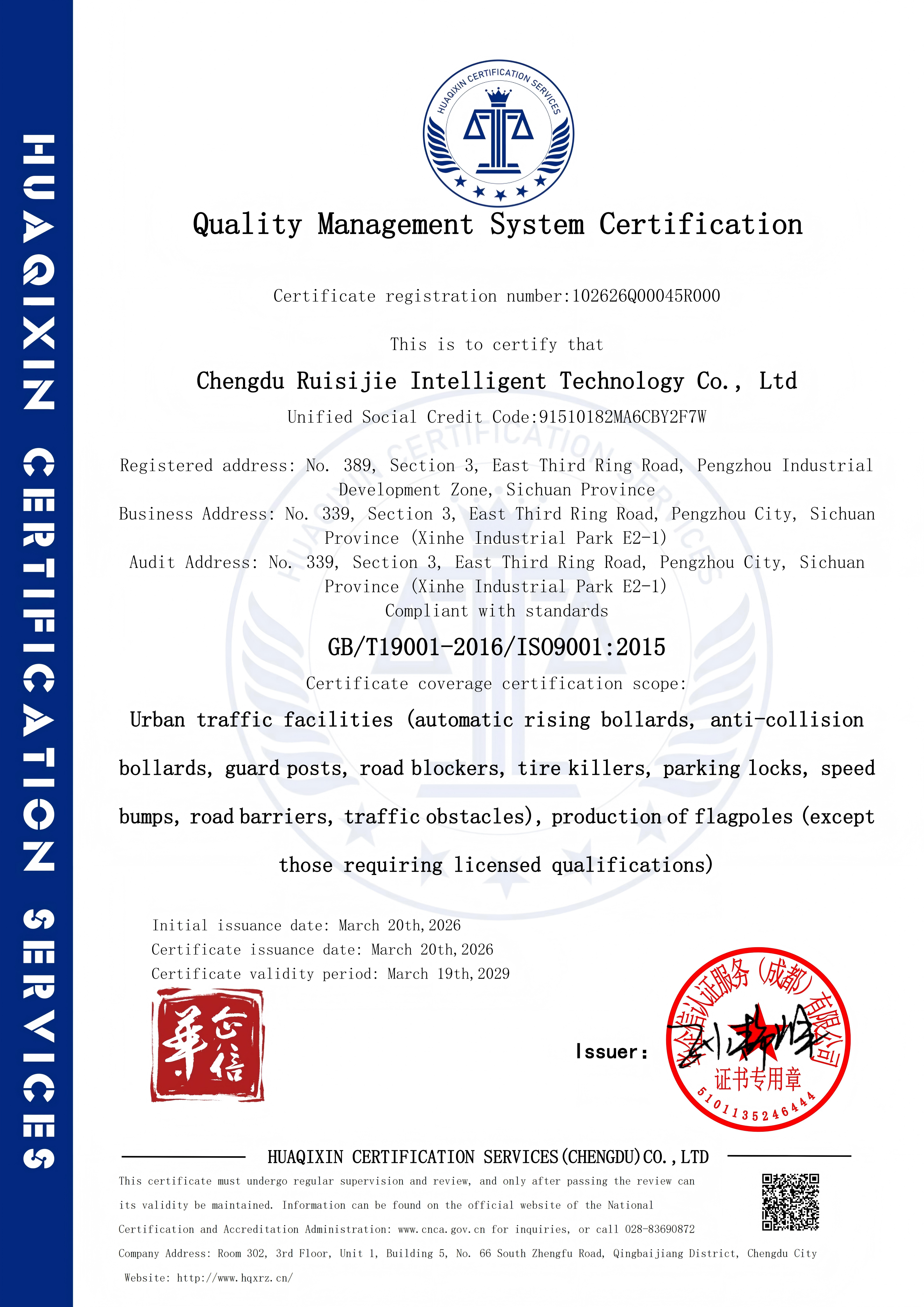
- Verify the supplier's quality system and document set. Quality certification supports manufacturing consistency but must be read for scope. RICJ holds ISO 9001 Quality Management System Certification, certificate number 102626Q00045R000, issued by HUAQIXIN CERTIFICATION SERVICES (CHENGDU) CO., LTD, to the standard GB/T19001-2016/ISO9001:2015, valid from 2026-03-20 to 2029-03-19, with a Global market scope covering urban traffic facilities including automatic rising bollards, anti-collision bollards, guard posts, road blockers, tire killers, parking locks, speed bumps, road barriers and traffic obstacles.
Note the boundary: an ISO 9001 certificate confirms a certified quality management system for a defined scope. It does not certify the crash performance of a specific bollard model, and it should never be presented as a substitute for a crash test report.
Use Cases: Where the Verification Burden Is Highest
Crash-rated and high-security bollards are specified where a vehicle reaching the protected zone would cause unacceptable consequences. Typical environments include airports and transport infrastructure, government and public spaces, commercial property, industrial parks, energy infrastructure, schools, and residential or property management entrances.
Operating conditions change the specification as much as the threat level does. Relevant working conditions include high-frequency vehicle entrances, restricted areas, pedestrian zones, commercial entrances, industrial perimeters, airport perimeters, and challenging coastal or sub-zero environments. Exact temperature, snow, drainage and foundation conditions require site confirmation rather than assumption.
Two documented examples illustrate the range. RICJ's LB-101 automatic bollard is listed with an operating temperature range of -45°C to +75°C and an IP68 protection rating denoting waterproof and dustproof performance, which is relevant where equipment must remain functional across a wide climate span. Separately, one public RICJ case title states that 510 deep-mount 316 stainless steel fixed bollards were deployed in Sweden — a project profile that combines a fixed bollard format with a stainless steel grade commonly selected for exposed sites. RICJ also reports project experience in demanding infrastructure environments, including Chengdu Tianfu International Airport.
Selection rarely stops at the bollard. Vehicle access control schemes typically combine automatic bollards, hydraulic bollards, retractable and removable bollards, fixed bollards, road blockers and tyre killers, and are matched with RFID, license plate recognition, remote control systems, access control systems, control cabinets, foundations and site wiring. The exact configuration depends on the project design, which is another reason the tested configuration must be confirmed against the delivered configuration.
Documented Configuration Data for Two Bollard Models
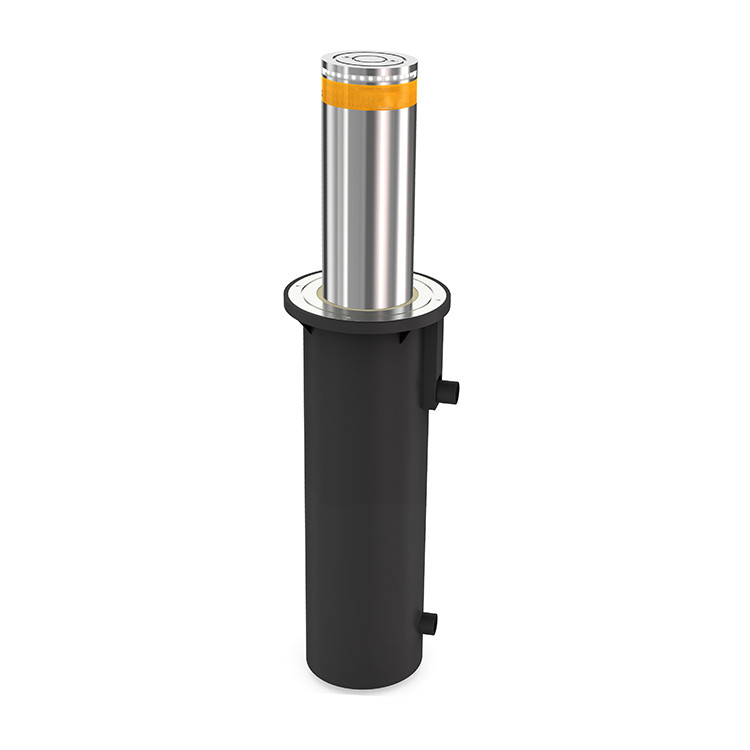
Configuration data is what allows a quotation to be compared with a test report line by line. The table below summarises published specification data for two RICJ models. It is a configuration reference, not a crash rating: any crash rating must come from the report for the exact model, size and foundation proposed.
| Attribute | LB-101 automatic bollard | LB-102 semi-automatic bollard |
|---|---|---|
| Product type | Automatic rising bollard (hydraulic, electromechanical or battery-powered variants listed) | Semi-automatic rising bollard |
| Material | 304 / 316 stainless steel | 304 stainless steel, with carbon steel elements in black powder coating |
| Diameter / blocking size | 219 mm standard; OEM 168 mm and 273 mm | 219 mm blocking diameter |
| Height | 1100 mm total length | 600 mm blocking height |
| Wall thickness | Not stated in the published specification | 6 mm |
| Protection rating | IP68 (waterproof and dustproof) | Not stated in the published specification |
| Operating temperature | -45°C to +75°C | -45°C to +75°C |
| Drive / control | 220V supply; integrated LED light | Gas spring, no power required; key control |
| Stated MOQ | 10 PCS | Not stated in the published specification |
Reading a table like this also reveals what is missing. Where a field is not stated in the published specification, it belongs in the RFQ rather than in an assumption — especially wall thickness and protection rating, which affect both durability and the comparability of the quoted unit with a tested unit.
Manufacturer Checks: Quality System, Capacity, and Documentation
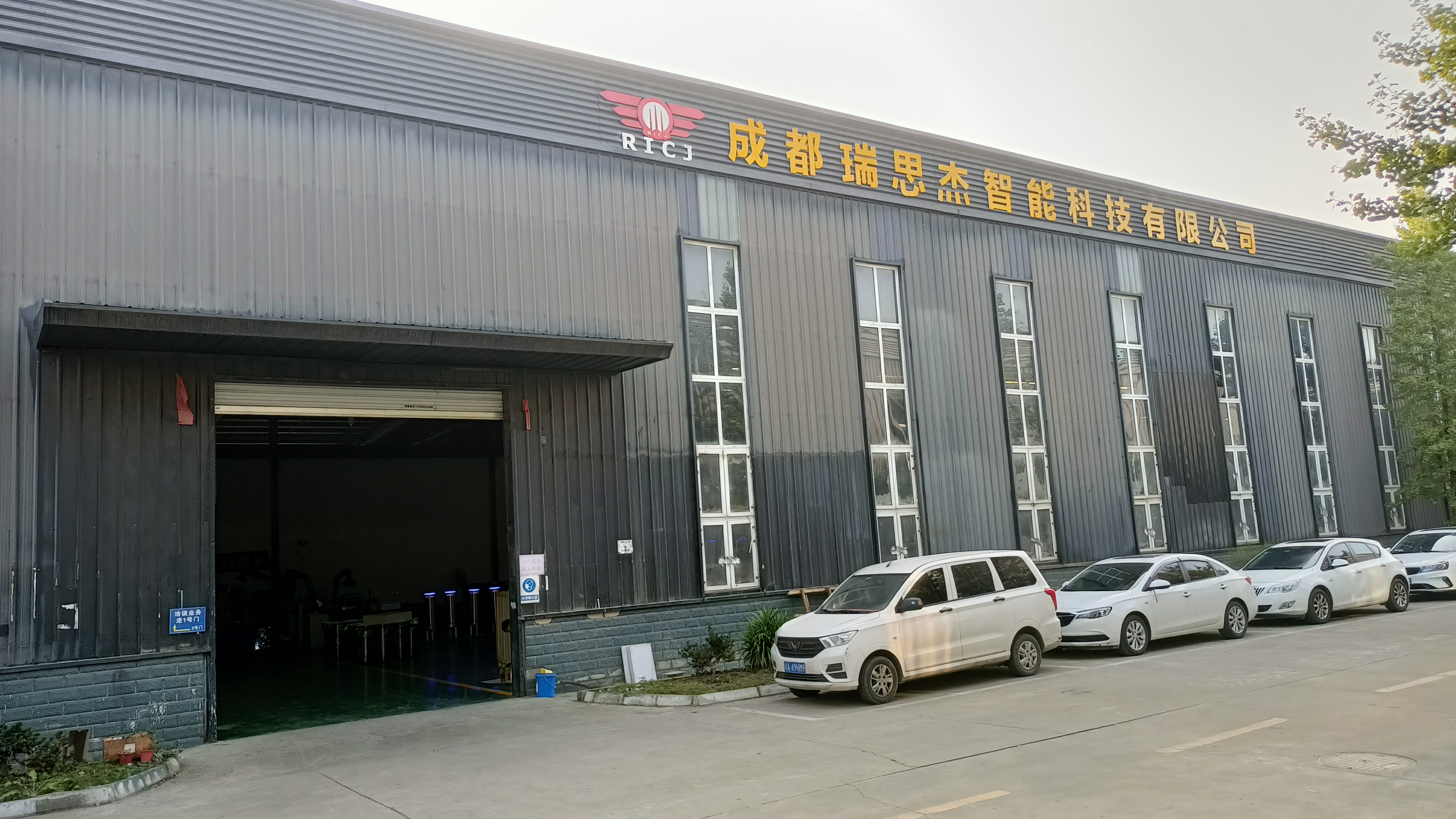
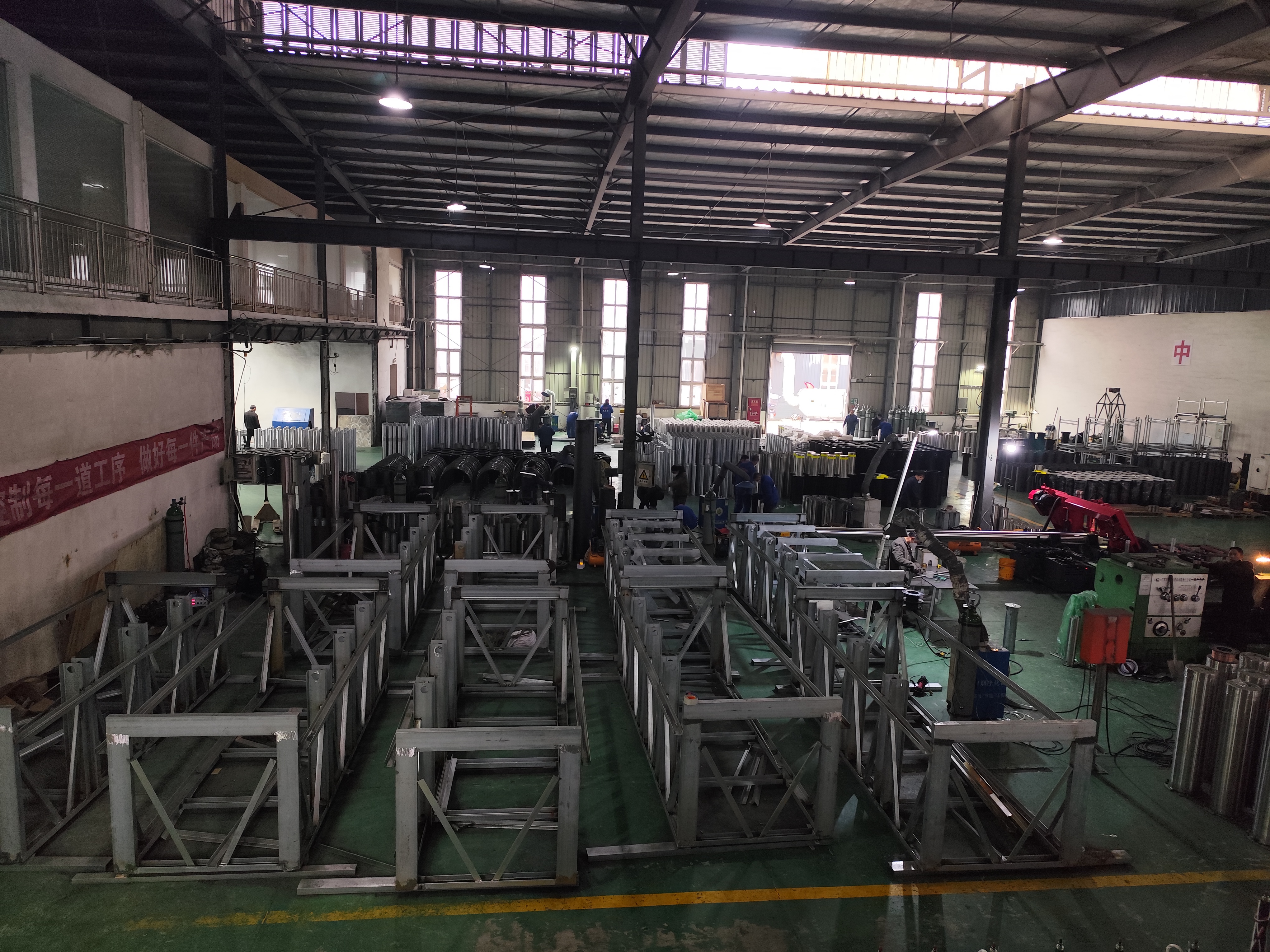
Crash performance is one half of supplier due diligence; the ability to deliver the same configuration repeatedly is the other. Chengdu Ruisijie Intelligent Technology Co., Ltd. (RICJ), operating through cdricj.com, is a manufacturer of vehicle security equipment founded in 2007, with an approximately 15,150 m² in-house manufacturing facility, 280 employees and 41 engineers, and a stated annual output of 10,000 units.
Manufacturing controls matter because a tested configuration must be reproducible. RICJ states that it uses high-strength carbon steel, stainless steel and premium core components, supported by systematic material inspection, production monitoring and full-process quality control, and that finished equipment undergoes relevant functional testing before delivery, with 100% test reported in its capability data. Material options listed across RICJ product pages include 304 stainless steel, 316 stainless steel, 201 stainless steel, carbon steel, galvanized steel and aluminum.
Commercial terms should be confirmed at quotation stage rather than assumed. RICJ reports a general MOQ of 1 unit in its capability data, while the LB-101 automatic bollard listing states an MOQ of 10 PCS; the applicable figure depends on the model and order context. For lead time, RICJ's published FAQ states that standard models are typically ready in 7–15 days and that custom technical designs are prioritised to meet the project timeline, while its capability data lists a 30–50 day lead time for orders generally. Both figures should be confirmed in writing against the specific configuration, quantity and destination.
Documentation and support decide whether a verified configuration is also an installable one. RICJ states that it supplies installation manuals, technical drawings including CAD files and wiring diagrams, and provides remote guidance by video call, phone and email through installation and commissioning; on-site engineer supervision can be arranged as a paid optional service for large or specific projects. After-sales support covers installation drawings and manuals, remote video technical support, troubleshooting, maintenance and spare parts supply, with exact warranty terms depending on product configuration. RICJ reports that approximately 90% of output is exported, with main markets in MEA, EU and SEA.
Frequently Asked Questions
How should I evaluate China crash rated bollard manufacturers that reference PAS 68 testing?
Evaluate the document, not the reference. A PAS 68 mention is only meaningful when a full test report names the model, the tested configuration, the impact condition, the penetration result and the foundation used. Ask which standard applies — ASTM F2656/F2656M, PAS 68 and IWA 14-1 are separate methods and their results should not be transplanted between each other — then request the report for the exact bollard size, material and mounting being quoted. RICJ states that it holds documented crash and safety test results; the correct next step is to request the specific report covering the model, impact condition and foundation intended for the site. The seven checks — test standard, test vehicle, impact condition, penetration distance, product configuration, foundation and test report — should all be satisfied before a purchase order is issued.
What should a crash-rated bollard supplier be able to customize and document?
Customization should extend beyond colour. RICJ supports OEM/ODM customization of size, material, surface finish, logo, control system, product structure and project-specific solutions, with the exact scope depending on the model and project. For crash-rated applications, the important point is that any change to size, material, wall thickness or mounting moves the product away from the tested configuration, so the supplier must confirm in writing whether the customized unit remains covered by an existing report. Documented materials across RICJ product pages include 304 stainless steel, 316 stainless steel, 201 stainless steel, carbon steel, galvanized steel and aluminum, and documented dimensional options include diameters from 76 mm to 159 mm on a fold-down bollard listing and 168 mm to 273 mm on the LB-101 automatic bollard.
What information do I need to provide to receive an accurate bollard quotation?
Provide the material, size, design and quantity required — RICJ's published guidance on pricing states exactly these four inputs. For a high-security project, add the required test standard, the intended foundation or installation depth, the control-system interface, and the destination market, because these change both the configuration and the documentation package. Note that minimum order quantities vary by model: RICJ's capability data lists a general MOQ of 1 unit, while the LB-101 automatic bollard listing states an MOQ of 10 PCS, so the applicable MOQ should be confirmed in the quotation rather than assumed.
Can I order a single unit before committing to a project quantity?
In many cases yes, subject to model. RICJ's capability data lists a general minimum order of 1 unit, which allows a single unit to be ordered for evaluation purposes, while specific models such as the LB-101 automatic bollard are listed with an MOQ of 10 PCS. A single-unit order is useful for checking finish, dimensions, packaging and documentation against the quotation, but it does not validate crash performance — that can only be established by a test report for the relevant configuration. Buyers should therefore treat a sample or trial unit as a manufacturing and documentation check, and treat the report as the safety check.
What lead time applies to standard and custom crash-rated bollard orders?
Lead time depends on the model and the degree of customization, and should be confirmed in writing per order. RICJ's published FAQ states that standard models are typically ready in 7–15 days, while custom technical designs are prioritised to meet the project timeline; RICJ's capability data separately lists a 30–50 day lead time for orders generally. Because a crash-rated project usually involves documentation review, foundation design and installation scheduling alongside manufacturing, the practical schedule should be built from a written delivery date plus the time required to approve the test report and foundation drawing. To start that process, send the required model, size, material, quantity and destination to the RICJ team for a configuration-specific reply.
Conclusion: Buy the Report, Not the Adjective
Crash-rated bollards are specified to stop a vehicle, and the only credible evidence that a system will do so is a test report that matches the installed configuration. The verification sequence is stable regardless of supplier: define the threat and site condition, fix the test standard, read impact condition and penetration distance together, match the tested configuration to the quoted configuration, confirm the foundation, obtain the full report, and check the supplier's quality system scope.
Everything else — material grade, protection rating, operating temperature, capacity and lead time — supports that core decision. A supplier that can provide documentation for each of the seven checks is easier to qualify, easier to audit and easier to hold to a specification than one that offers a rating without a report.
Request Crash-Rated Bollard Documentation and a Project Quotation
Send the required bollard type, size, material, quantity, test standard and destination market, and RICJ will respond with the applicable configuration, documentation set and delivery schedule. RICJ supplies automatic and semi-automatic rising bollards, fixed bollards, removable bollards, road blockers, tyre killers and custom vehicle access control equipment, with OEM/ODM customization and remote installation support.
Email: ricjli@cdricj.com | Tel / WhatsApp: +86 181-2186-2967 | Website: www.cdricj.com
Download the full product catalogue: RICJ Product Catalogue (PDF)
Send Your Project Requirements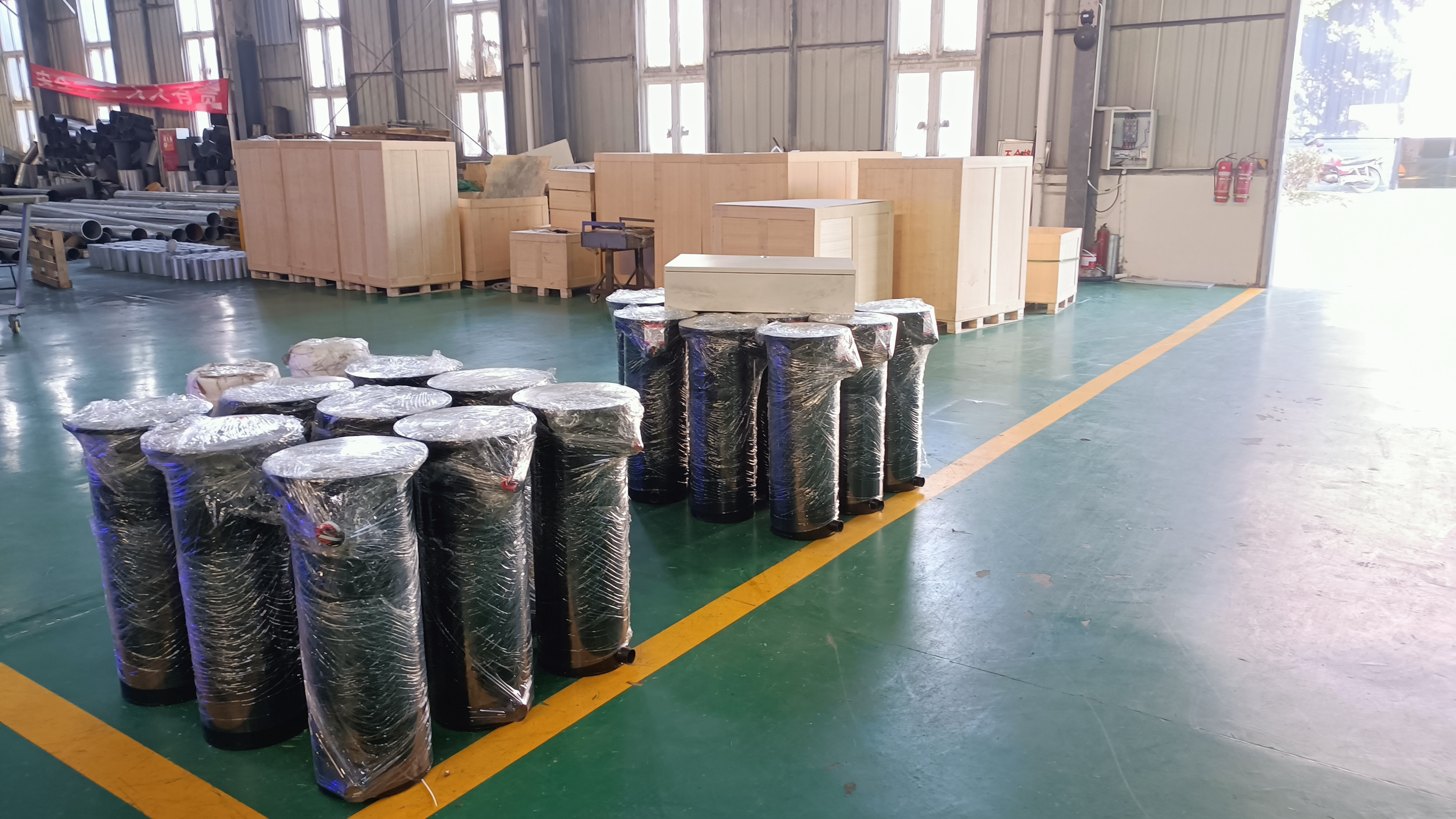
Specification data in this article reflects published RICJ product and capability information and published standards references. Crash ratings apply only to the specific configurations covered by a valid test report; buyers should verify the report, the current standard edition and the local compliance requirements for each project.
Have Questions or Need More Details?
Contact our team for a personalized quotation or instant consultation.
Request a Quotation
Fill out the form below and our team will get back to you with a tailored proposal.
WhatsApp Direct Chat
Prefer to chat in real-time? Message us on WhatsApp for instant assistance & quick answers.
- Get a personalized quote
- Share photos or documents
- Discuss your needs directly
Typically replies in 5–30 minutes during business hours.