
Retractable Bollards: Specification and Compliance Checklist
Vehicle access control · specification guide
A retractable bollard is a vehicle access control post that rises out of and lowers into a below-ground sleeve, so a lane can be closed to vehicles and reopened to pedestrians or authorised traffic without leaving a permanent obstruction. For buyers at research and evaluation stage, the purchase decision rarely turns on the retraction mechanism. What constrains it is documented crash test evidence, the foundation the sleeve demands, the material and finish the site can tolerate, the electrical and control interfaces, and the paperwork the supplier can hand over at delivery.
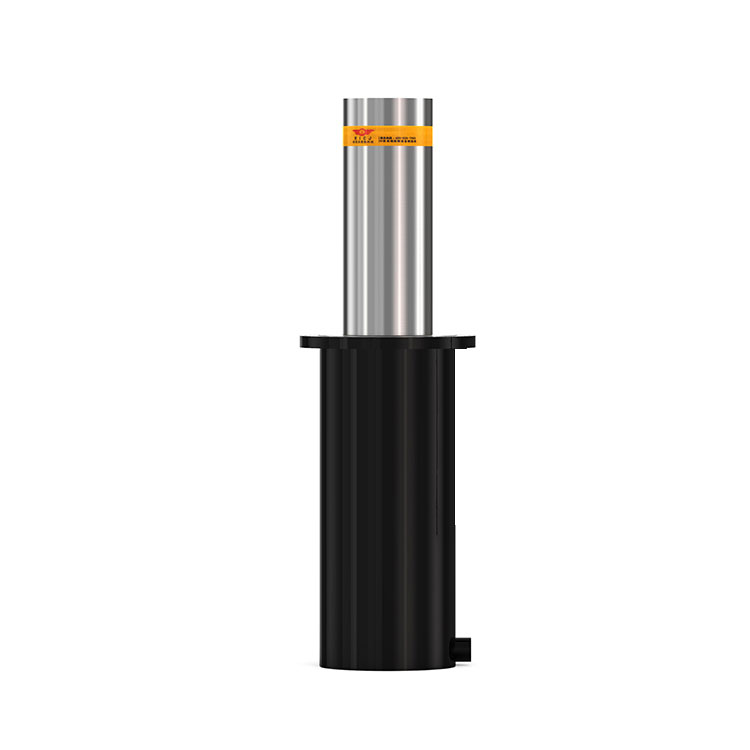
RICJ LB-102 semi-automatic retractable bollard: 304 stainless steel, 219 mm blocking diameter, 600 mm blocking height, gas-spring lifting, key control.
Why retractable bollard projects fail on specification rather than hardware
Two failure patterns account for most retractable bollard problems that surface after handover, and neither originates in the post itself.
The first is unverified crash performance. When a buyer accepts a 'crash rated' label without checking the test standard, the test vehicle, the impact condition, the penetration distance, the product configuration, the foundation and the test report behind it, the practical outcome is insufficient anti-collision performance and a security loophole in exactly the high-security area the equipment was purchased to protect. The label is not the evidence; the report is.
The second is a site mismatch. A retractable bollard is the one bollard family that needs a below-ground working chamber, so a specification can be technically correct and still fail on site because the sleeve does not suit the drainage, the water table or the sub-base, because the power and control cable route was never designed, or because the control system the operator expects does not match the cabinet that was quoted.
Both patterns are avoided the same way: buy the system, not the post. A crash-rated bollard protects an area by working as a complete system that combines the bollard, the mounting arrangement and the supporting foundation to stop or restrain an unauthorised vehicle. Treating those three elements as one deliverable is what makes a retractable bollard specification defensible in front of a consultant, an insurer or a project owner.
Industry background: a security category moving toward documented performance
Vehicle access control is no longer a purely mechanical purchase. The global automated barriers and bollards market was estimated at USD 22.73 billion in 2025 and is projected to reach USD 27.39 billion by 2030, according to Mordor Intelligence market sizing. Within the retractable category, automatic retractable bollards generated the highest revenue share at 52% in 2025, which reflects how often projects now expect powered, remotely controlled operation rather than manual posts.
Growth has been accompanied by a sharper compliance conversation. ASTM F2656/F2656M-20 is the standard test method that provides a structured procedure for establishing a penetration rating for vehicle perimeter barriers subjected to vehicle impact. Industry guidance describes the M designation as the impact speed band (M30, M40, M50) and the P designation as dynamic penetration distance. PAS 68 and IWA 14-1 are separate frameworks discussed alongside ASTM F2656; they are not interchangeable, and a report issued to one should never be presented as evidence under another. For import planning, U.S. Customs and Border Protection ruling NY N042340 classifies steel bollards under HTSUS 7326.90.8588.
For a research-stage buyer this changes the order of work. The specification should name the framework, the impact condition and the required deliverable documents before price is discussed, because those three items are what separate genuinely comparable quotations from quotations that merely look similar.
The eight constraints that decide a retractable bollard specification
1. Crash rating and the test evidence behind it
Start with the threat, then the standard. Before buying a crash-rated bollard, the following should be checked: test standard, test vehicle, impact condition, penetration distance, product configuration, foundation and test report. Leaving any one of them unverified weakens the rest, because the rating belongs to a tested configuration, not to a product family name. RICJ states that it holds documented crash and safety test results; the correct next step for a buyer is to request the model-specific report and to confirm that the foundation drawing referenced in that report matches the foundation drawing issued for the site.
2. Geometry, sleeve and foundation
Retractable posts are dimensionally constrained by what has to be buried. The RICJ LB-102 semi-automatic bollard is listed with a 219 mm blocking diameter, a 600 mm blocking height, a flange of D380×T10 mm, an embedded sleeve of D325×T3 mm and an embedded sleeve depth of 800 mm. The LB-101 automatic bollard is listed with a 219 mm diameter (OEM options at 168 mm and 273 mm) and a 1,100 mm total length. Those figures have to be reconciled with the sub-base, the drainage fall and the cable entry before concrete is poured, not after.
3. Material grade and surface finish
RICJ works in 304, 316 and 201 stainless steel, carbon steel, galvanized steel and aluminum. The LB-102 is offered in 304 stainless steel with a 6 mm wall and a satin finish, with adjacent carbon steel components black powder coated. Material selection is a site-exposure decision rather than a marketing one: 316 stainless steel is commonly specified where salt or de-icing exposure is a factor, 304 for general external use. The supplied product data does not include mill certificates or corrosion-test results, so if the project requires them, they must be requested explicitly at RFQ stage.
4. Electrical protection and operating environment
Powered retractable bollards add electrical and environmental constraints that passive posts do not have. The LB-101 automatic bollard is listed with IP68 protection (waterproof and dustproof), a 220V supply voltage, integrated LED lighting, a non-water-fillable body and an operating temperature range of -45°C to +75°C. Those are product claims that must still be matched to the site: temperature, snow, drainage and foundation conditions require site confirmation before a range on a datasheet becomes a design assumption.
5. Control and integration
A vehicle access control bollard is only as usable as the system that triggers it. Manual and semi-automatic units are operated by key, as on the LB-102 with its gas-spring lift. Powered installations are typically matched with RFID readers, licence plate recognition, remote control, access control systems, control cabinets, foundations and site wiring, with the exact configuration depending on the project design. Specify the trigger logic, the fallback for power failure and the cabinet location at evaluation stage, because retrofitting controls to a finished lane is materially harder than designing them in.
6. Quality system and documentation
Documentation is a constraint in its own right. RICJ holds ISO 9001 Quality Management System Certification number 102626Q00045R000, issued by HUAQIXIN CERTIFICATION SERVICES (CHENGDU) CO., LTD to the standard GB/T19001-2016/ISO9001:2015, issued on 2026-03-20 and valid to 2029-03-19. The certified scope covers urban traffic facilities including automatic rising bollards, anti-collision bollards, guard posts, road blockers, tyre killers, parking locks, speed bumps, road barriers and traffic obstacles. Finished equipment undergoes functional testing before delivery, and export orders are supported with English technical documentation, installation manuals, wiring diagrams and customs documentation.
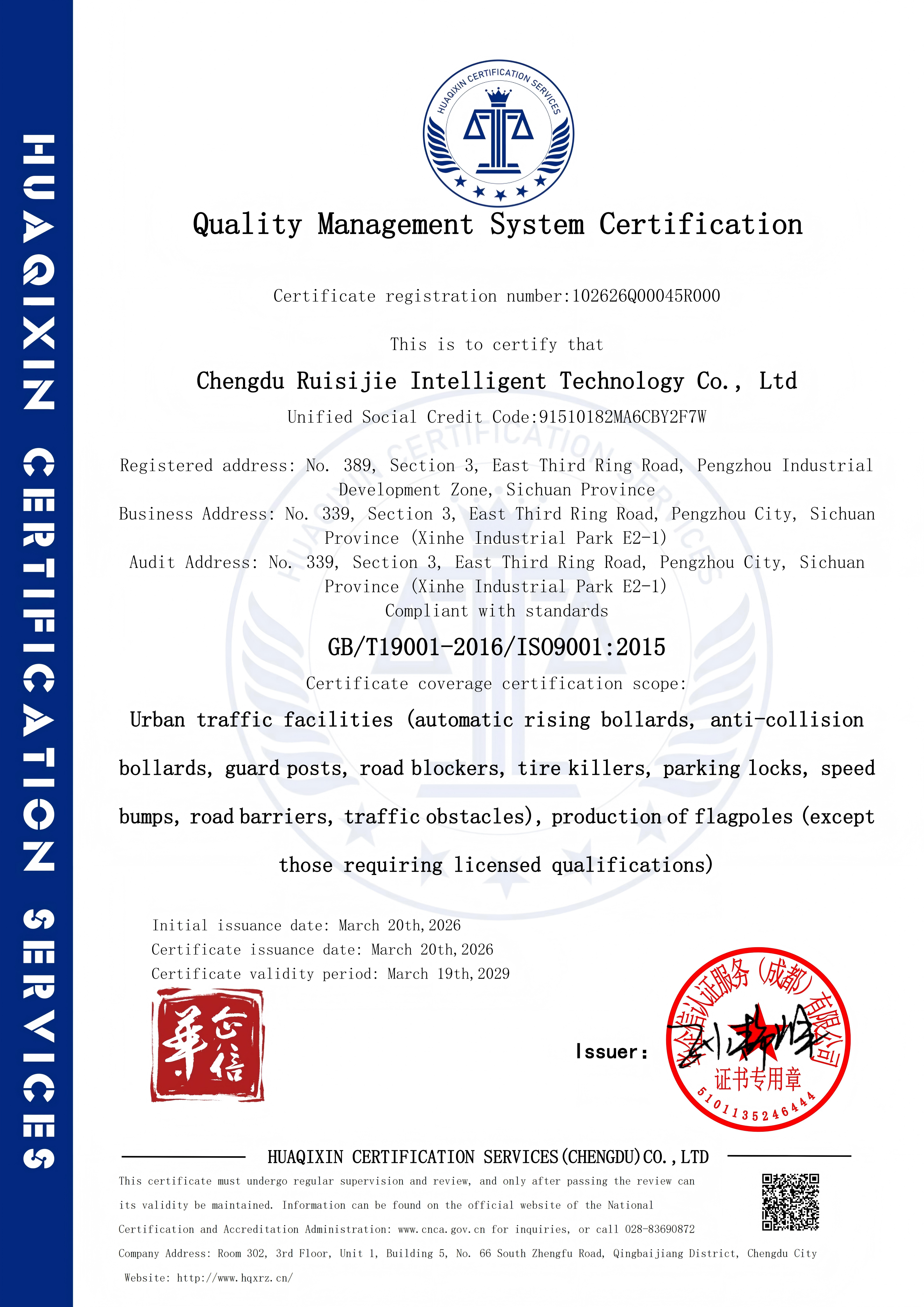
The ISO 9001 certificate covering automatic rising bollards, anti-collision bollards, road blockers and tyre killers: certificate 102626Q00045R000, valid to 2029-03-19.
7. Commercial constraints: MOQ, customization and lead time
The LB-101 automatic bollard is listed with an MOQ of 10 pcs; general capability data states an MOQ of 1 unit for other configurations, which is what makes single-unit evaluation orders practical. Customization covers size, material, surface finish, logo, control system and product structure, with the exact scope depending on model and project. Production lead time is quoted at 30 to 50 days in the capability data, while the published FAQ notes that standard models are typically ready in 7 to 15 days and that custom technical designs are scheduled against the project timeline.
8. Installation and lifecycle support
RICJ does not send engineers for on-site installation as a standard service. The standard package is complete installation manuals, technical drawings including CAD files and wiring diagrams, plus remote guidance by video call, phone and email through installation and commissioning. On-site engineer supervision can be arranged as a paid option for large projects. After-sales support covers troubleshooting, maintenance and spare parts supply, and the exact warranty terms depend on the product configuration, so they belong in the quotation rather than in an assumption.
Step-by-step: how to evaluate and specify retractable bollards
- Define the threat and the protected zone. Establish whether the requirement is traffic management, pedestrian protection or hostile vehicle mitigation. The risk of unauthorised vehicle intrusion and impact damage to facilities or pedestrians is what triggers the need for a crash-rated bollard system in the first place.
- Name the standard and the target rating. State whether the project requires ASTM F2656, PAS 68, IWA 14-1 or a national equivalent, and at what impact condition. Do not accept a single generic 'crash rated' statement across a product family.
- Fix the geometry before the finish. Confirm blocking height, diameter, sleeve depth and flange dimensions against the pavement build-up, root barriers, drainage and existing services. On the LB-102, the 800 mm sleeve depth is a hard site constraint.
- Choose the operation mode. Manual removable or fold-down posts suit low-frequency, low-threat lanes; semi-automatic gas-spring posts remove the power dependency; automatic bollards suit high-frequency, 24-hour operation with remote or automated triggering.
- Match material to exposure. Select 304 or 316 stainless steel, carbon steel or galvanized steel against the site environment, and specify the surface treatment and any colour requirement at the same time.
- Design the electrical and control layer. Confirm supply voltage, protection rating, control cabinet position, trigger devices and the manual override or power-failure procedure.
- Request the documentation pack in writing. Test report, foundation drawing, datasheet, certificate, manuals, wiring diagrams and packing details. Verification of the test standard, test vehicle, impact condition, penetration distance, product configuration, foundation and test report is what mitigates the risk of insufficient anti-collision performance.
- Evaluate a unit before committing to volume. Use a single-unit order or pilot lane to check fit, finish, cycle behaviour and documentation quality against the approved specification.
- Freeze the configuration and plan the shipment. Confirm the final bill of materials, packaging, customs documentation and HS classification before production closes, then schedule commissioning support in advance of delivery.
Where retractable bollards fit, and where they do not
RICJ supplies vehicle security equipment to airports and transport infrastructure, government and public spaces, commercial property, industrial parks, energy infrastructure, schools, and residential or property management sites. The equipment is typically deployed at high-frequency vehicle entrances, restricted areas, pedestrian zones, commercial entrances, industrial perimeters and airport perimeters, with automatic units specified for 24-hour lifting and lowering.
- Airports and transport infrastructure: terminal and perimeter control where lane throughput and auditability matter more than unit cost.
- Government and critical infrastructure: sites where the crash rating and the supporting report are reviewed by a consultant or insurer before approval.
- Commercial property and industrial parks: entrance management where automatic bollards, road blockers and tyre killers are combined to control direction as well as access.
- Schools and public pedestrian areas: pedestrian protection where the retracted state has to leave a clean, trip-free surface.
- Demanding environments: the portfolio covers sub-zero sites, and public case titles include a 510-unit deployment of deep-mount 316 stainless steel fixed bollards in Sweden. Coastal and sub-zero conditions still require site confirmation of temperature, snow load, drainage and foundation design.
- Distributors and integrators: partners reselling into these segments typically need the documentation pack and OEM/ODM flexibility more than they need a single standard model.
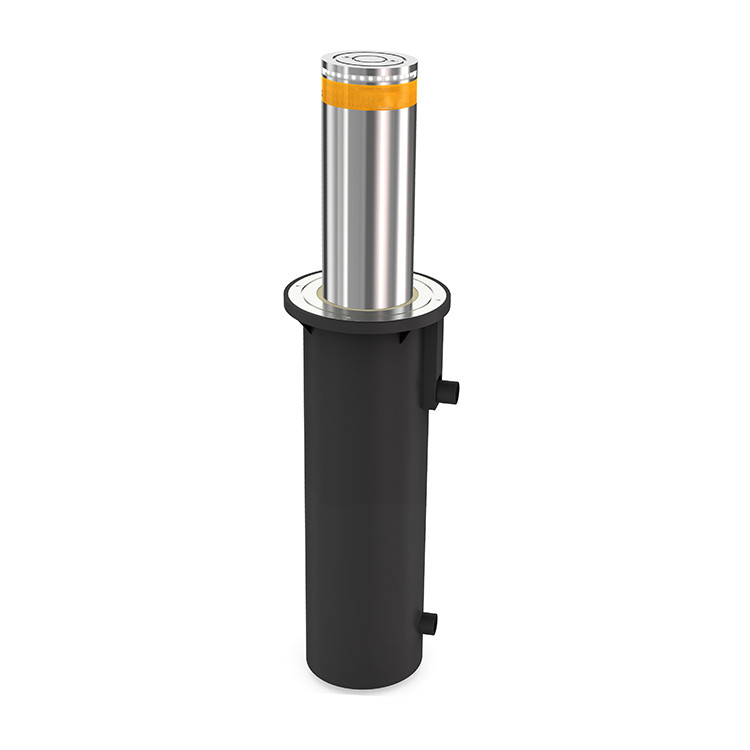
RICJ LB-101 automatic retractable bollard: 304/316 stainless steel, 219 mm diameter, IP68, 220V supply, integrated LED lighting.
Retractable bollard comparison and documentation checklist
| Option | Operation and power | Documented RICJ specification | Constraint to resolve before ordering |
|---|---|---|---|
| Removable / fold-down bollard | Manual lift or removal; key or internal lock; no power | Listed with built-in mounting hardware and internal locking mechanisms; fold-down post lengths 600–1500 mm, diameters 76, 89, 114, 133 and 159 mm; 304/316/201 stainless steel or carbon steel | HVM suitability has to be established by a product-specific test report; the catalogue listing alone does not document a rating |
| Semi-automatic retractable bollard (LB-102) | Gas-spring assisted telescopic lift; key control; no power required | 304 stainless steel, 6 mm wall, 219 mm blocking diameter, 600 mm blocking height, flange D380×T10 mm, sleeve D325×T3 mm, sleeve depth 800 mm, 58 kg, -45°C to +75°C | Sleeve depth and drainage must suit the sub-base; concrete works precede delivery |
| Automatic retractable bollard (LB-101) | Hydraulic, electromechanical or battery-powered variants; 220V supply; key and control-system operation | 304/316 stainless steel, 219 mm diameter (OEM 168 mm / 273 mm), 1,100 mm total length, IP68, -45°C to +75°C, integrated LED, MOQ 10 pcs | Cable route, control cabinet, power-failure fallback and control-system compatibility |
| Road blockers and tyre killers | Powered direction and access control across wider openings | Listed in the RICJ catalogue alongside automatic, hydraulic, fixed and removable bollards | Model-specific datasheet and test evidence required; do not assume shared ratings across product types |
Comparison limited to documented RICJ catalogue and product data. It does not imply equivalent crash performance between product types.
| Document to request | What it establishes | What to check on the document |
|---|---|---|
| Crash test report | Performance of the tested configuration | Model number, test standard, test vehicle, impact speed, penetration distance, laboratory, test date |
| Foundation and installation drawing | That the tested mounting can be reproduced on site | Sleeve dimensions, flange size, drainage, cable entry, concrete specification |
| ISO 9001 certificate | Quality management system coverage | Certificate number, issuer, standard, scope wording, validity dates |
| Product datasheet | Electrical and environmental limits | Supply voltage, protection rating, operating temperature, material grade, wall thickness |
| Manuals, CAD and wiring diagrams | Installation and commissioning feasibility | Completeness, language, revision date, match to the ordered configuration |
| Packing list and customs documents | Import and delivery planning | HS classification, packaging, quantities, consignee details |
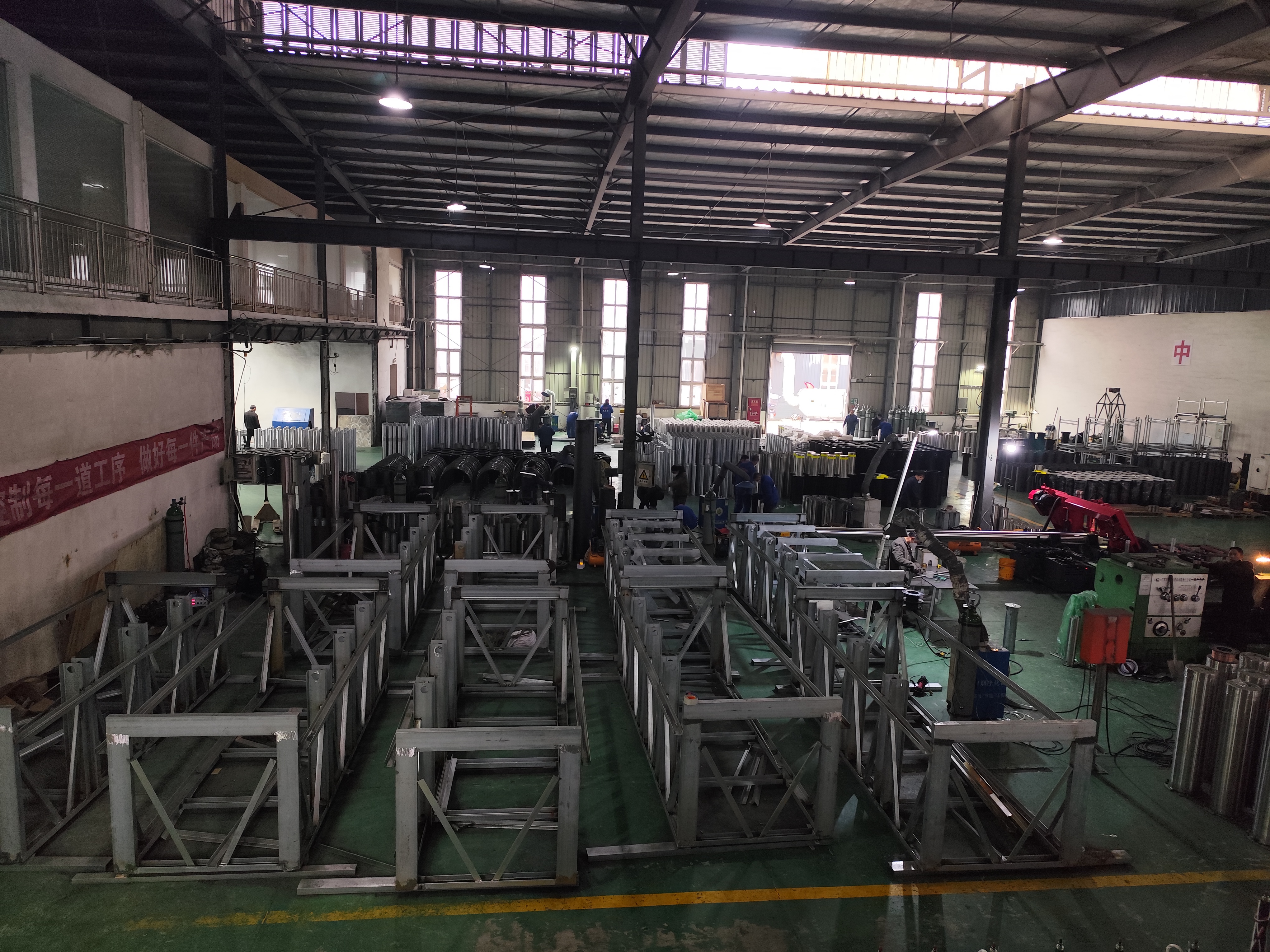
RICJ manufactures in-house: an approximately 15,150 m² facility, 280 employees including 41 engineers, and an annual output of 10,000 units.
FAQ: compliance, capability, budget, samples and lead time
Which documents prove that a retractable bollard is genuinely crash rated?
A product-specific crash test report, together with the foundation and mounting drawing it was tested with. The report should identify the test standard, the test vehicle, the impact condition, the penetration distance and the exact product configuration tested. Because the bollard, mounting arrangement and supporting foundation are evaluated as a complete system, a report for a shallower foundation or a different post diameter does not transfer automatically to your site configuration. Failure to verify these points is what creates insufficient anti-collision performance and security loopholes in high-security areas.
How do PAS 68, IWA 14-1 and ASTM F2656 apply to crash rated bollards sourced from China?
They are separate frameworks, not synonyms. ASTM F2656/F2656M-20 provides a structured procedure for establishing a penetration rating, and industry guidance describes its M designation as the impact speed band (M30, M40, M50) and its P designation as dynamic penetration distance. PAS 68 and IWA 14-1 are discussed alongside ASTM F2656 in the same guidance literature, but a report issued to one framework should not be presented as evidence under another. When evaluating China crash rated bollard manufacturers with PAS 68 testing requirements, ask each supplier to state in writing which framework and which edition the report was issued under, which laboratory performed the test, and whether the reported configuration matches the drawing they intend to supply. RICJ states that it holds documented crash and safety test results, and supplies ISO 9001 certification under certificate 102626Q00045R000; the model-specific test report should always be requested rather than accepted as a summary claim.
Can retractable bollards be customized in dimension, material and control system?
Yes. RICJ supports OEM and ODM customization covering size, material, surface finish, logo, control system, product structure and project-specific solutions, with the exact scope depending on the model and project. Available materials include 304, 316 and 201 stainless steel, carbon steel, galvanized steel and aluminum, and the LB-101 automatic bollard offers OEM diameters of 168 mm and 273 mm alongside the standard 219 mm. Control integration can include RFID, licence plate recognition, remote control, access control systems, control cabinets, foundations and site wiring, with the final configuration defined by the project design.
What determines the price band of a retractable bollard system?
Six factors move a retractable bollard from one price band to another: the operation mode (manual, semi-automatic or automatic), the diameter and wall thickness of the post (the LB-102 uses a 6 mm wall), the material grade, whether a certified crash rating with a product-specific report is required, whether the scope includes sleeve or foundation works, drainage and control integration, and the order quantity and MOQ structure (the LB-101 is listed at MOQ 10 pcs, while general capability data states an MOQ of 1 unit). Site environment also matters, since coastal or sub-zero conditions can change material and finish choices. To obtain an accurate figure rather than an indicative one, provide the material, size, design and quantity you need.
Can I evaluate a sample before a bulk order, and what lead time should I plan for?
A single-unit order is supported under the general MOQ of 1 unit, which allows a pilot lane or sample evaluation before volume commitment. Lead time depends on configuration: the capability data quotes 30 to 50 days for production, while the published FAQ notes that standard models are typically ready in 7 to 15 days and that custom technical designs are scheduled against the project timeline. Confirm the figure for your specific configuration at quotation stage, and allow separately for shipping and for foundation works on site. To start an evaluation, send your material, size, design and quantity requirements to ricjli@cdricj.com or WhatsApp +86 181-2186-2967.
Conclusion: specify the system, not the post
Retractable bollards reward buyers who treat them as engineered systems. The seven verification items — test standard, test vehicle, impact condition, penetration distance, product configuration, foundation and test report — are what convert a 'crash rated' claim into a defensible security decision, and the same discipline applies to the non-crash constraints: sleeve depth, drainage, supply voltage, protection rating, control logic and documentation quality.
Chengdu Ruisijie Intelligent Technology Co., Ltd. (RICJ), operating through cdricj.com, has manufactured vehicle security equipment since 2007. Its range covers automatic rising bollards, semi-automatic bollards, fixed and removable bollards, road blockers, tyre killers and custom security bollards, produced in an approximately 15,150 m² facility with 280 employees and 41 engineers, at an annual output of 10,000 units. Around 90% of output is exported, with main markets in the Middle East and Africa, Europe and Southeast Asia, and support covers selection, site planning, documentation and remote commissioning.
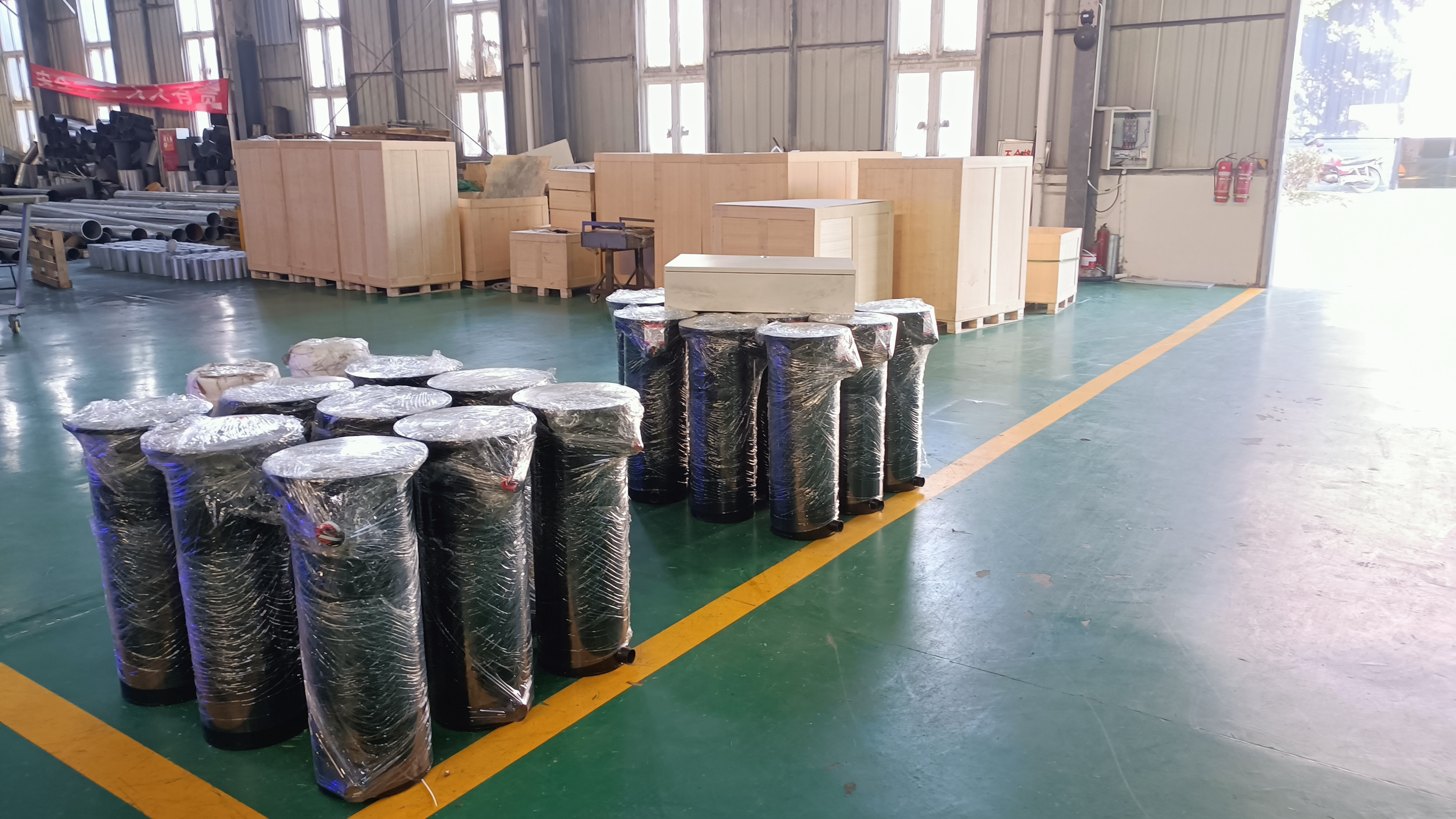
Export packaging and shipping preparation at the RICJ facility, supporting delivery to distributors and project sites worldwide.
Request a quotation or a documentation review
Send the material, size, design and quantity you need, and RICJ will respond with a configuration-matched quotation and the documentation pack for the model in question.
Email: ricjli@cdricj.com · Tel / WhatsApp: +86 181-2186-2967 · Website: www.cdricj.com
Download the full RICJ product catalogue (PDF): RICJ catalogue.
Have Questions or Need More Details?
Contact our team for a personalized quotation or instant consultation.
Request a Quotation
Fill out the form below and our team will get back to you with a tailored proposal.
WhatsApp Direct Chat
Prefer to chat in real-time? Message us on WhatsApp for instant assistance & quick answers.
- Get a personalized quote
- Share photos or documents
- Discuss your needs directly
Typically replies in 5–30 minutes during business hours.