
Heat Resistant Silicone Glove: 350°C vs 500°C vs 1000°C
Heat Protection Buyer Guide
A heat resistant silicone glove is not defined by one temperature number. RISTA heat resistant silicone gloves include the TF350 rated -40°C to 350°C, the TF-500 rated -40°C to 500°C, and the T-1000 rated -70°C to 1000°C. The right choice depends on the heat source, contact condition, liner, grip needs, compliance evidence, and order model.
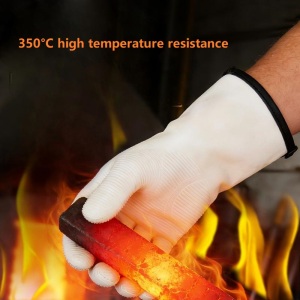
The Buying Problem: 350°C, 500°C and 1000°C Are Not Interchangeable Claims
For a buyer in Research or Evaluation, the risk is not only whether a glove can tolerate heat. The risk is whether the stated rating matches the actual task: open flame contact, hot metal handling, industrial oven heat, or a food-grade kitchen process. The RISTA product specification states that the TF350, TF-500 and T-1000 versions can contact open flames and hot metals, but each model has a different temperature range, liner, and intended use.
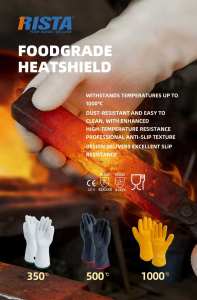
The TF350 is the 350°C Heat Resistant Silicone Gloves option, rated -40°C to 350°C. The TF-500 is the 500°C High-Temperature Silicone Gloves option, rated -40°C to 500°C. The T-1000 is the 1000°C Extreme Heat Resistant Gloves option, rated -70°C to 1000°C. These are model-specific ratings. A buyer should not assume that a 350°C glove, a 500°C glove and a 1000°C glove can be used in the same way simply because all three are described as heat resistant.
The corpus also sets a clear evaluation boundary for extreme heat. For the 1000°C version, suitability for particular heat sources and working conditions must be established by relevant finished-glove test results. That statement matters for metallurgical and glass melting projects, foundries, kilns, and high-temperature equipment maintenance, where the heat source can be more complex than a single temperature number.
Industry Background: Heat-Resistant Gloves Are Becoming a Specification-Driven PPE Category
The global heat resistant glove market is projected to grow from USD 559.20 million in 2025 to USD 977.30 million by 2034. That forecast points to sustained demand across industrial and food-related heat protection. In practice, buyers are not only asking for a glove that feels thick. They are asking for a documented range, a liner that matches the work, a grip that remains usable, and a supplier that can support compliance and repeat orders.
RISTA is a China-based functional hand protection manufacturer founded in 1998. The company operates a 66,600 ㎡ factory, employs 200+ people, has 15 engineers, and reports annual output of 20,000,000 pairs. Its product range includes Rista Cut Resistant glove, Rista Impact glove, Rista General glove, Rista Chemical Resistant glove and Rista Heat Resistant Silicone glove. This matters for buyers evaluating Industrial Heat Resistant Silicone Gloves because a heat glove is often part of a broader PPE program that also includes Chemical Resistant Safety Gloves and CUT&Impact work gloves.
The applications in the corpus span Food Processing & Baking, Commercial Kitchens, BBQ & Outdoor Cooking, Oven & Catering Equipment, Industrial Ovens & Heating Equipment, Metal Heat Treatment & Processing, Foundries & Metal Processing, Industrial Kilns & Refractory Materials, and High-Temperature Equipment Manufacturing & Maintenance. This application range explains why one heat resistant silicone glove design cannot serve every buyer.
Detailed Solution: A Constraint-Based RISTA Heat Resistant Silicone Glove Selection Framework
1. Temperature rating and intended use
The RISTA Heat Resistant Silicone Glove line is organized around standard heat protection, enhanced heat protection, and high-temperature protection variants. The series includes 350°C, 500°C and 1000°C versions. The model choice should follow the heat source, not the other way around.
- TF350: rated -40°C to 350°C. It has a food-grade silicone shell and is intended for Food Processing & Baking, Commercial Kitchens, BBQ & Outdoor Cooking, Oven & Catering Equipment, and Light Industrial Heat Processing.
- TF-500: rated -40°C to 500°C. It is intended for Industrial Ovens & Heating Equipment, Metal Heat Treatment & Processing, and Specialized Thermal Processing. The product specification states it can contact open flames and hot metals.
- T-1000: rated -70°C to 1000°C. It is intended for Specialized Thermal Processing, Foundries & Metal Processing, Industrial Kilns & Refractory Materials, and High-Temperature Equipment Manufacturing & Maintenance.
The TF350 and TF-500 both use a 32 cm length and a textured palm. The TF350 uses a cotton or acrylic liner for comfort and insulation. The TF-500 uses a fleece or cotton heat-insulated lining. The T-1000 uses an aramid or cotton heat-insulated lining. These construction differences matter when the buyer is balancing heat protection with dexterity and wear time.
2. Construction, grip and comfort
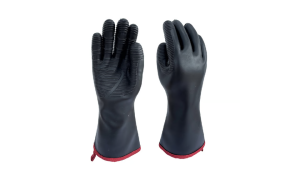
All three RISTA heat resistant silicone glove models use a silicone outer surface with a textured palm for slip resistance. The product description states that the glove surface is inherently smooth and non-sticky without surface treatment, which supports easier cleaning than liquid silicone gloves that attract dust. The glove is manufactured with a hand shape that follows the natural curve of the human hand.
The product description also states that the RISTA silicone glove is more flexible and soft than traditional industrial high-temperature gloves such as Kevlar, aramid, or palm-reinforced types. For buyers comparing Industrial Heat Resistant Silicone Gloves, this is a practical evaluation point: a glove that is stiff may protect the hand but reduce control during hot metal handling or oven work. A glove that is too soft but poorly lined may not provide enough insulation. The RISTA range addresses this trade-off through model-specific liners and a textured palm.

3. Compliance evidence for EU buyers
For EU procurement, compliance is a constraint, not a marketing line. The TF350 Heat Resistant Silicone glove is covered by Module D certification CN21/42482 under Regulation (EU) 2016/425. The certification is issued by SGS for the EU/EEA market, issued on 2021-07-04 and expiring on 2027-07-03. Its scope covers the manufacture of protective gloves against thermal risks, and the certification covers PPE gloves for mechanical, thermal, cold and chemical risks.
The supplied corpus also includes a Module B EU-type examination certificate for the RCG-02-G301 Chemical Resistant glove, issued by SATRA with certificate number 2777/22804-01/E00-00. That certificate was issued on 2022-11-10 and expires on 2027-11-10. Its applicable standards are listed as EN 388:2016+A1:2018, EN ISO 374-1:2016+A1:2018, EN ISO 374-4:2019, EN 407:2020, and EN ISO 21420:2020. This is a chemical glove certificate, not a TF350 heat glove certificate. Buyers evaluating the TF350 for a specific heat source should request the current TF350 certificate and the relevant finished-glove test report.
At company level, RISTA reports ISO9001, ISO14001, ISO45001, SA8000, Sedex, WRAP and SMETA, with product certifications including Module B, Module C2, Module D, FDA and REACH. These documents are relevant to supplier qualification, but they do not replace model-specific heat testing. The buyer should match the document to the exact model and heat hazard.
4. When heat is not the only hazard: Chemical Resistant Safety Gloves and CUT&Impact work gloves
Many industrial buyers start with heat protection but discover that the task also involves chemicals, sharp edges or impact. RISTA's broader range can support a multi-hazard PPE review. The RCG-02-G301 Chemical Resistant glove is certified against 3 chemicals (JKL) out of 18 under EN ISO 374:2016. It uses an 18GG seamless nylon liner, nitrile hybrid triple coating, a 30 cm cuff, and a high-visibility colour that warns the wearer when the chemical barrier is damaged. Selected models can combine chemical resistance with abrasion resistance, cut resistance, oil resistance or thermal protection when supported by test results.
For cut and impact tasks, the RCC-02-C309 Cut Resistant glove provides Level C cut protection and is available in cut-resistant levels C, D, E and F. It is certified for six chemicals (KLMNPT) out of 18 under EN ISO 374:2016 and uses a 35 cm cuff. The RCI-02-C803 Impact glove provides Level E cut resistance and has been tested against 9 chemicals (AJKLMNOPT) out of 18 according to EN ISO 374:2016. It uses a bonded TPR design on the back of the hand and a 30 cm cuff. These products are not substitutes for a heat resistant silicone glove, but they are relevant when the buyer needs Chemical Resistant Safety Gloves or CUT&Impact work gloves in the same work area.
5. OEM & ODM Protective Gloves and supply constraints
For distributors, private-label brands and industrial buyers, heat resistant silicone gloves are often part of an OEM & ODM Protective Gloves program. RISTA offers customization for material and coating selection, glove colour and size, liner gauge and material, coating coverage and surface texture, grip pattern and reinforcement, cut, chemical and thermal protection, impact and anti-vibration features, glove length and cuff design, logo printing and private label, custom packaging and branding, and product testing and compliance support.
The capability unit lists a monthly capacity of 2,000,000 pairs, a lead time of 30–60 days, an MOQ of 100–500 dozens, and 100% testing. These are commercial constraints that should be checked before a model is specified. A buyer who needs a 350°C food-grade glove for a retail program has a different order profile from a buyer who needs a 1000°C glove for a foundry maintenance team.
Step-by-Step Breakdown: How to Evaluate a Heat Resistant Silicone Glove Before You Buy
- Define the heat source and contact mode. Write down whether the hand will contact open flame, hot metal, oven racks, trays, steam, hot equipment surfaces, or food-grade cooking surfaces. The corpus identifies open flame and hot metal contact for the RISTA silicone glove range, but the actual task still needs to be defined.
- Set the model temperature range. Use the stated range as a starting point: TF350 -40°C to 350°C, TF-500 -40°C to 500°C, T-1000 -70°C to 1000°C. For extreme heat, require relevant finished-glove test results for the actual heat source and working condition.
- Match the liner to the work pattern. A cotton or acrylic liner, a fleece or cotton heat-insulated lining, and an aramid or cotton heat-insulated lining behave differently in comfort, insulation and flexibility. Choose the liner that supports the required wear time and dexterity.
- Check grip and hand control. The textured palm is designed for slip resistance. For wet, oily or high-heat handling, confirm that the glove gives the operator enough control for the task without excessive hand fatigue.
- Verify compliance documents for the exact model. For the TF350, request the Module D CN21/42482 certificate and confirm the scope. For any other model or market, request the current certificate and model-specific test report. Do not accept a certificate for a different product as proof for the heat glove.
- Check cleaning and hygiene needs. Food Processing, bakery and BBQ buyers should confirm the food-grade silicone shell, smooth surface and cleaning procedure. The product description states that the glove is inherently smooth and non-sticky and easy to clean.
- Confirm supply terms. Check MOQ, lead time, monthly capacity, packaging, logo and private-label requirements, and the documentation package needed for the destination market. The capability unit lists MOQ 100–500 dozens and lead time 30–60 days.
Use Cases: Matching RISTA Silicone Gloves to the Heat Source
Heat Resistant Silicone Gloves for Food Processing, Bakery and BBQ
The TF350 is the food-grade silicone option in the RISTA range. It is rated -40°C to 350°C and is intended for Food Processing & Baking, Commercial Kitchens, BBQ & Outdoor Cooking, Oven & Catering Equipment, and Light Industrial Heat Processing. For bakeries, catering teams and BBQ accessory brands, the relevant checks are food-grade silicone, a comfortable liner, a slip-resistant palm and easy cleaning. The TF350 is also the model covered by the Module D certificate in the supplied corpus.
Heat Resistant Silicone Gloves for Metal Heat Treatment and Industrial Ovens
The TF-500 is the 500°C model, rated -40°C to 500°C. It is intended for Industrial Ovens & Heating Equipment, Metal Heat Treatment & Processing, and Specialized Thermal Processing. The product specification states that it can contact open flames and hot metals. This model sits between the food-grade TF350 and the extreme-heat T-1000, making it relevant for industrial buyers who need more heat margin than a standard kitchen glove but do not need a 1000°C configuration.
Extreme Heat Resistant Silicone Gloves for Metallurgical and Glass Melting
The T-1000 is the 1000°C model, rated -70°C to 1000°C. It is intended for Foundries & Metal Processing, Industrial Kilns & Refractory Materials, Specialized Thermal Processing, and High-Temperature Equipment Manufacturing & Maintenance. For Extreme Heat Resistant Silicone Gloves for metallurgical and glass melting environments, the T-1000 is the relevant RISTA model to evaluate, but the buyer should require finished-glove test results for the actual heat source and working condition before approval.
Multi-hazard work: chemical, cut and impact
Where the task combines heat with chemicals, sharp parts or impact, the heat glove should not be expected to solve every hazard. RISTA's RCG-02-G301 Chemical Resistant glove, RCC-02-C309 Cut Resistant glove and RCI-02-C803 Impact glove can be evaluated as part of a layered PPE program. Selected models can combine chemical resistance with abrasion resistance, cut resistance, oil resistance or thermal protection when supported by test results.
RISTA Heat Resistant Silicone Glove Comparison Table
The table below uses only facts stated in the supplied product specification, certification corpus and verified data package. It is a model-selection aid, not a ranking of glove quality.
| Model | Stated temperature range | Liner and construction | Intended use in the corpus | Compliance evidence in the supplied corpus |
|---|---|---|---|---|
| TF350 | -40°C to 350°C | Food-grade silicone shell; cotton, acrylic or aramid liner options; 32 cm; textured palm | Food Processing & Baking; Commercial Kitchens; BBQ & Outdoor Cooking; Oven & Catering Equipment; Light Industrial Heat Processing | Module D CN21/42482 under Regulation (EU) 2016/425; issued by SGS for EU/EEA; issued 2021-07-04; expires 2027-07-03; scope covers manufacture of protective gloves against thermal risks |
| TF-500 | -40°C to 500°C | Fleece or cotton heat-insulated lining; 32 cm; textured palm | Industrial Ovens & Heating Equipment; Metal Heat Treatment & Processing; Specialized Thermal Processing | No model-specific certificate number for TF-500 is stated in the supplied corpus; request current model certificate and test report |
| T-1000 | -70°C to 1000°C | Aramid or cotton heat-insulated lining; 32 cm; textured palm | Specialized Thermal Processing; Foundries & Metal Processing; Industrial Kilns & Refractory Materials; High-Temperature Equipment Manufacturing & Maintenance | No model-specific certificate number for T-1000 is stated in the supplied corpus; suitability must be established by relevant finished-glove test results |
All three models are stated to be able to contact open flames and hot metals. The buyer must still match the model to the actual heat source, contact time and working condition.
Budget, MOQ and Lead Time: What the Corpus Does and Does Not Publish
The supplied corpus does not publish a price band for RISTA heat resistant silicone gloves. A responsible budget comparison should therefore start with the cost drivers, not a guessed price. For this product family, the commercial variables include model temperature rating, liner, size, palm texture, cuff length, branding, packaging, test documentation and order quantity. Buyers should request a written quotation for the exact model and configuration.
The capability unit lists an MOQ of 100–500 dozens and a lead time of 30–60 days. It also lists a monthly capacity of 2,000,000 pairs and 100% testing. The company profile states annual output of 20,000,000 pairs. These figures help a buyer judge whether the supplier can support a trial order, a private-label launch or a repeat industrial program. They do not replace a formal quotation.
FAQ: Heat Resistant Silicone Glove Compliance, Capability, Budget and Next Step
Are RISTA TF350 350°C heat resistant silicone gloves CE compliant for the EU?
The TF350 Heat Resistant Silicone glove is covered by Module D certification CN21/42482 under Regulation (EU) 2016/425. The certification is issued by SGS for the EU/EEA market, issued on 2021-07-04 and expiring on 2027-07-03. Its scope covers the manufacture of protective gloves against thermal risks, and the certification covers PPE gloves for mechanical, thermal, cold and chemical risks. Buyers should request the current certificate and the model-specific test report for their heat source before approval.
What is the difference between the 350°C, 500°C and 1000°C RISTA silicone gloves?
The TF350 is rated -40°C to 350°C and is intended for food processing, baking, commercial kitchens, BBQ, oven and catering equipment, and light industrial heat processing. The TF-500 is rated -40°C to 500°C and is intended for industrial ovens and heating equipment, metal heat treatment and processing, and specialized thermal processing. The T-1000 is rated -70°C to 1000°C and is intended for foundries, metal processing, industrial kilns and refractory materials, and high-temperature equipment manufacturing and maintenance. The 1000°C version requires relevant finished-glove test results for the actual heat source.
Can RISTA customize heat resistant silicone gloves for OEM and ODM programs?
Yes. RISTA offers OEM & ODM Protective Gloves customization for material and coating selection, glove colour and size, liner gauge and material, coating coverage and surface texture, grip pattern and reinforcement, thermal protection, impact and anti-vibration features, glove length and cuff design, logo printing and private label, custom packaging and branding, and product testing and compliance support. The capability unit lists an MOQ of 100–500 dozens, a lead time of 30–60 days, a monthly capacity of 2,000,000 pairs, and 100% testing.
What certifications and test documents can buyers request from RISTA?
At company level, RISTA reports ISO9001, ISO14001, ISO45001, SA8000, Sedex, WRAP and SMETA, with product certifications including Module B, Module C2, Module D, FDA and REACH. For the TF350 heat resistant silicone glove, the supplied corpus includes Module D CN21/42482 issued by SGS. For the RCG-02-G301 Chemical Resistant glove, the supplied corpus includes Module B certificate 2777/22804-01/E00-00 issued by SATRA, with applicable standards listed as EN 388:2016+A1:2018, EN ISO 374-1:2016+A1:2018, EN ISO 374-4:2019, EN 407:2020 and EN ISO 21420:2020. Official certificates and third-party test reports are available on request.
How should buyers request a quote or sample discussion for RISTA heat resistant silicone gloves?
Contact RISTA at sales@ristash.com, WhatsApp +86-13761866824, or www.ristash.com. Include the model of interest, required temperature range, heat source, contact condition, liner preference, size, branding, packaging, destination market, target order quantity and required compliance documents. Sample terms are not stated in the supplied corpus, so buyers should confirm sample availability, test documents and commercial terms directly with RISTA before placing an order.
Conclusion: Buy the Rating, Liner and Evidence, Not the Label
A Heat Resistant Silicone Glove should be selected like a specification-driven PPE item, not a generic kitchen or industrial accessory. RISTA's heat resistant silicone glove range gives buyers three clear starting points: TF350 for -40°C to 350°C food-grade and light industrial work, TF-500 for -40°C to 500°C industrial oven and metal heat treatment work, and T-1000 for -70°C to 1000°C specialized high-temperature applications. The buyer should then confirm the liner, grip, cleaning needs, compliance documents and supply terms for the exact model.
For EU buyers, the TF350 is covered by Module D CN21/42482 under Regulation (EU) 2016/425, with a scope covering the manufacture of protective gloves against thermal risks. For extreme heat, the T-1000 requires finished-glove test results for the actual heat source. For multi-hazard work, RISTA's Chemical Resistant Safety Gloves, cut resistant gloves and impact gloves can support a layered PPE program when the test data matches the hazard.

Next Step: Request a Quote or Technical Review
For RISTA Heat Resistant Silicone Glove selection, contact sales@ristash.com, WhatsApp +86-13761866824, or visit www.ristash.com. Include the heat source, required temperature range, contact condition, liner preference, size, branding, packaging, destination market and order quantity.
Download the RISTA brochure: Rista Brochure PDF.
Marketing Center: RM608, No.1505 Lianhang Rd, Minhang District, Shanghai, China. Factory: No.128 Mingzhu RD, Binhai Industrial Park, Qidong, Jiangsu, China.
Have Questions or Need More Details?
Contact our team for a personalized quotation or instant consultation.
Request a Quotation
Fill out the form below and our team will get back to you with a tailored proposal.
WhatsApp Direct Chat
Prefer to chat in real-time? Message us on WhatsApp for instant assistance & quick answers.
- Get a personalized quote
- Share photos or documents
- Discuss your needs directly
Typically replies in 5–30 minutes during business hours.