
Heat Resistant Silicone Gloves: What Buyers Need to Know
A heat resistant silicone glove is a protective glove built with a silicone outer shell and a heat-insulated lining, used to handle hot surfaces, hot components and open flames. This guide explains what separates a 350°C glove from a 500°C or 1000°C glove, how the three RISTA Heat Resistant Silicone Glove models differ, and which questions a buyer should answer before placing an industrial order.
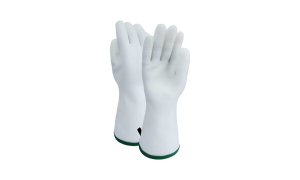
RISTA Heat Resistant Silicone Glove, TF-350 model: food-grade silicone shell with a textured, slip-resistant palm.
Why Heat Resistant Silicone Gloves Are Hard to Compare
The difficulty in buying heat resistant silicone gloves is rarely whether the product contains silicone. It is what the temperature figure on the datasheet actually describes. A glove rated to 350°C for brief contact with a hot tray is a different object from a glove rated to 1000°C for work beside a furnace. Unless the buyer establishes the heat source, the contact duration and the handling motion first, two datasheets with the same number can describe very different products.
A second gap is construction. Some products sold as silicone heat gloves apply a silicone coating over a knitted liner, while others use a solid silicone shell over an insulating lining. The two constructions behave differently under sustained radiant heat, under abrasive metal edges, and during cleaning between shifts.
A third gap is the lining, which is often the least visible specification. Cotton, fleece and aramid linings insulate differently and change how much dexterity the wearer keeps. A glove that protects well but restricts grip can slow a task, and a glove that feels comfortable but loses insulation under continuous heat can fail partway through a shift.
Finally, maintenance is frequently left out of the evaluation. Liquid silicone surfaces can attract dust and require repeated cleaning, which is a practical burden in food-grade environments and in clean assembly areas. RISTA addresses this in its silicone glove range through core material and manufacturing process choices rather than a surface treatment, so the glove is described as inherently smooth, non-sticky and easy to clean.
Industry Background: Where Heat Protection Demand Comes From
Demand for heat protective gloves is concentrated where hot objects must be moved, held or inspected by hand. The global heat resistant glove market was valued at USD 559.20 million in 2025 and is projected to reach USD 977.30 million by 2034, according to a market forecast published by TrendX Insights in 2026. That growth reflects expanding industrial processing capacity alongside tighter workplace safety expectations in established markets.
Two demand patterns sit side by side. On the food side, commercial kitchens, bakeries, catering equipment handling and BBQ applications require a glove that can touch hot trays, racks and oven interiors while remaining suitable for food contact. On the industrial side, metal heat treatment, foundries, kilns and refractory material handling require gloves that tolerate higher temperatures and heavier mechanical exposure.
The regulatory backdrop also shapes purchasing. EN 407:2020 is the European standard covering protective gloves against thermal risks, published by the European Committee for Standardization, and it defines how heat resistance is tested and expressed. In the European Union, protective gloves are also placed on the market under PPE Regulation (EU) 2016/425. Buyers who compare suppliers without checking which standard a claim refers to are comparing marketing language rather than performance.
What a Heat Resistant Silicone Glove Is Made Of
Three components determine what a silicone heat glove can do: the shell, the lining and the geometry. The shell is the silicone surface that meets the hot object. The lining is the insulating layer that sits against the hand. The geometry covers glove length, palm texture, cuff and hand shape, which together control grip and coverage.
In the RISTA range, the shell is silicone, with cotton or acrylic listed as alternative material options, and linings are specified per model as fleece/cotton, cotton/acrylic or aramid/cotton. All three models are listed at 32 cm in length, and each carries a textured palm surface for slip resistance. RISTA lists contact with open flames and hot metals as a use condition across the three models, with the temperature ceiling differing by model.
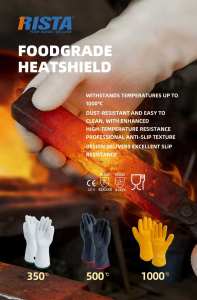
Silicone shell, insulating lining and 32 cm length define the protective envelope of the glove.
The RISTA Heat Resistant Silicone Glove Range
RISTA is a manufacturer of functional hand protection solutions established in 1998, producing cut resistant gloves, impact gloves, general gloves, chemical resistant gloves and heat resistant silicone gloves. The company operates a 66,600 m² facility with more than 200 employees, an annual capacity of 20,000,000 pairs and a 15-engineer R&D team, exporting approximately 90% of output to North America, the EU, Japan and South America.
The heat resistant silicone glove line is organised into three temperature tiers. Each tier is built for a different thermal envelope rather than being a rebadged version of the same glove.
TF-350: 350°C Heat Resistant Silicone Gloves for Food Handling
The TF-350 is a food-grade heat resistant silicone glove with a silicone shell and a cotton, acrylic or aramid liner, rated from −40°C to 350°C. It is intended for food processing and baking, commercial kitchens, BBQ and outdoor cooking, oven and catering equipment, and light industrial heat processing. The food-grade silicone shell is the defining feature of this tier: it is the model designed for environments where the glove works close to food.
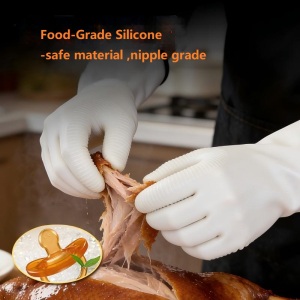
Food-grade silicone shell material used in the TF-350 tier for kitchen, bakery and BBQ environments.
TF-500: 500°C High-Temperature Silicone Gloves for Industrial Heat
The TF-500 is an industrial silicone glove with a silicone shell and a fleece/cotton heat-insulated lining, rated from −40°C to 500°C. Its stated applications are industrial ovens and heating equipment, metal heat treatment and processing, and specialised thermal processing. The heavier lining is the trade-off for the higher ceiling: it adds insulation for sustained industrial exposure.
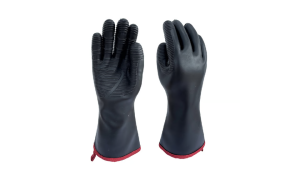
RISTA TF-500: 500°C high-temperature silicone glove for metal heat treatment and industrial ovens.
T-1000: 1000°C Extreme Heat Resistant Gloves
The T-1000 is the extreme tier, rated from −70°C to 1000°C, with an aramid/cotton heat-insulated lining and a slip-resistant textured palm. It is intended for specialised thermal processing, foundries and metal processing, industrial kilns and refractory materials, and high-temperature equipment manufacturing and maintenance. For metallurgical operations and glass handling, RISTA lists high-temperature steam, metallurgy and heat treatment, and glass and metal environments as the working conditions this tier addresses.
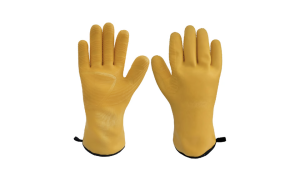
RISTA T-1000: the 1000°C extreme heat tier for foundries, kilns and refractory material handling.
Temperature Tiers Compared
The table below sets out the three RISTA models against the specifications published for each. It compares tiers within one product family, not brands against each other, and buyers should match the tier to their own measured process conditions rather than selecting the highest number by default.
| Model | Temperature range | Shell | Heat-insulated lining | Length | Primary applications |
|---|---|---|---|---|---|
| TF-350 | −40°C to 350°C | Food-grade silicone | Cotton / acrylic / aramid | 32 cm | Food processing and baking, commercial kitchens, BBQ, oven and catering equipment, light industrial heat processing |
| TF-500 | −40°C to 500°C | Silicone | Fleece / cotton | 32 cm | Industrial ovens and heating equipment, metal heat treatment and processing, specialised thermal processing |
| T-1000 | −70°C to 1000°C | Silicone | Aramid / cotton | 32 cm | Foundries and metal processing, industrial kilns and refractory materials, high-temperature equipment manufacturing and maintenance |
Step-by-Step: Specifying a Heat Resistant Silicone Glove
Selection works best as a sequence of elimination steps rather than a single comparison.
Step 1 — Define the heat source and contact type. Establish whether the hand meets a hot solid surface, holds a hot component, or works near radiant heat and open flame. A bakery rack and a cast metal part place different demands on the same glove.
Step 2 — Set the temperature tier with margin. Match the measured working temperature to a tier and keep headroom. The TF-350 covers kitchen and bakery work, the TF-500 covers metal heat treatment and industrial ovens, and the T-1000 covers foundry, kiln and refractory work.
Step 3 — Choose the lining against duty cycle. Continuous handling favours the insulation of the fleece/cotton or aramid/cotton builds, while shorter, repetitive tasks put more weight on dexterity. RISTA describes its silicone gloves as more flexible and soft than traditional industrial high-temperature gloves such as Kevlar, aramid or palm-reinforced types, with the aim of reducing hand fatigue during long continuous use.
Step 4 — Confirm length, cuff and grip. All three models are listed at 32 cm with a textured palm. Check that the cuff clears the wrist and forearm for the task, and that the palm texture holds under wet or oily conditions.
Step 5 — Check standards and documentation. Ask which standard the heat claim references and request the corresponding certificates and third-party test reports. EN 407 is the relevant thermal standard for heat protective gloves in Europe, and CE certification under PPE Regulation (EU) 2016/425 involves EU-type examination and production quality assurance.
Step 6 — Validate the specification and order quantity. For customised or private-label supply, confirm materials, colours, liner gauge, cuff design, logo and packaging before production, and confirm the minimum order quantity against the planned volume.
Use Cases Across Industries
The same glove family serves several sectors because the tiers were separated by thermal envelope rather than by industry label.
Heat resistant silicone gloves for food processing, bakery and BBQ. The TF-350 tier is intended for commercial kitchens, bakeries, oven and catering equipment handling, outdoor cooking and light industrial heat processing. The food-grade silicone shell is the selection driver here, alongside the ability to clean the glove surface effectively between uses.
Heat resistant silicone gloves for metal heat treatment. The TF-500 tier is intended for metal heat treatment and processing and for industrial ovens and heating equipment. Handling hot jigs, fixtures and treated parts is the operational pattern this tier is built around.
Extreme heat resistant silicone gloves for metallurgical and glass environments. The T-1000 tier is intended for foundries and metal processing, industrial kilns and refractory materials, and high-temperature equipment manufacturing and maintenance. RISTA lists metallurgy and heat treatment, glass and metal among the working conditions served by its high-temperature processing coverage.
Multi-hazard work areas. Heat is often one of several risks. RISTA's wider portfolio includes cut resistant gloves such as the RCC-02-C309 with Level C cut protection and a chemical-resistant coating, impact gloves such as the RCI-02-C803 combining cut, chemical and impact protection, and chemical resistant safety gloves such as the RCG-02-G301 in Type A, Type B and Type C configurations. Sites that combine heat with cut or chemical exposure can source the combination from one supplier rather than assembling it from several.
Supporting PPE. Heat protective gloves are typically used alongside aprons, sleeves, shoe covers, goggles and helmets, and buyers should confirm compatibility of cuff length and fit with the rest of the ensemble.
Evaluating China Heat Resistant Silicone Glove Manufacturers
China is a major source for silicone heat gloves, and the supplier pool ranges widely in capability. A structured evaluation separates manufacturers that can document performance from those that can only describe it.

RISTA's Jiangsu production facility: 66,600 m² site with an annual capacity of 20,000,000 pairs.
A practical checklist for screening suppliers:
- Standard alignment. Confirm which standard the heat claim references and whether the finished glove, not just the material, has been tested.
- Construction transparency. Ask whether the product uses a solid silicone shell or a silicone coating over a liner, and what the lining material and gauge are.
- Documentation. Request official certificates and third-party test reports rather than relying on datasheet wording.
- Customisation capability. Check whether the supplier can adjust material, surface texture, cuff, logo and packaging, or only supply a fixed catalogue item.
- Capacity and continuity. Confirm production capacity against your annual volume and the supplier's ability to repeat the same specification across orders.
- Management systems. Look for an operating system behind the product — RISTA holds ISO 9001, ISO 14001, ISO 45001, SA8000, Sedex, WRAP and SMETA, with products covered by Module B, Module C2, Module D, FDA and REACH documentation, and more than 70 international and domestic patents.
OEM and ODM Protective Gloves: What Can Be Customised
For buyers building a private-label programme, the practical question is how far the specification can move. RISTA offers OEM and ODM protective glove development covering material and coating selection, colour and size, liner gauge, coating coverage and surface texture, grip pattern, impact and anti-vibration features, cuff design, logo printing and private label, custom packaging, and product testing and compliance support. The minimum order quantity is 6,000 pairs for normal gloves.
Customisation is most efficient when it starts from a defined thermal tier. A buyer who needs a 500°C industrial glove and a branded cuff can adapt the TF-500 platform rather than commissioning a new construction, which keeps the tested performance basis intact.
Frequently Asked Questions
Are RISTA heat resistant silicone gloves certified?
RISTA states that its protective gloves comply with EN 388 for mechanical and cut protection, EN ISO 374-1 for chemical protection and EN 407 for heat protection, and that the range is certified under EU PPE Regulation (EU) 2016/425 through EU-type examination (Module B) and production quality assurance (Module D). The company's management systems are certified to ISO 9001, ISO 14001, ISO 45001, SA8000, Sedex, WRAP and SMETA, and its products carry Module B, Module C2, Module D, FDA and REACH documentation.
Can RISTA supply OEM and ODM heat resistant silicone gloves?
Yes. RISTA offers material and coating selection, colour and size, liner gauge, coating coverage and surface texture, grip pattern, impact and anti-vibration features, cuff design, logo printing and private label, custom packaging, and product testing and compliance support.
What order quantity and configuration factors apply?
The minimum order quantity is 6,000 pairs for normal gloves. The configuration of each order is set by specification items such as shell material, liner type and gauge, cuff design, logo printing and packaging, so buyers should confirm the specification before requesting a quotation against it.
Can buyers review certificates and test reports before ordering?
Yes. Official certificates and third-party test reports are available on request, which allows a buyer to check claimed performance against the standard referenced in their own risk assessment before committing to production. Documentation requests and specification reviews can be sent to the RISTA sales team at sales@ristash.com.
Conclusion: Start From the Process, Not the Number
The useful way to read a heat resistant silicone glove specification is backwards from the task. Establish the heat source, contact time and handling motion, set a temperature tier with margin, then confirm the lining, length and grip that the task allows. Only after that does it make sense to compare suppliers.
Within the RISTA Heat Resistant Silicone Glove range, the split is straightforward: the TF-350 handles food-grade kitchen, bakery and BBQ work up to 350°C, the TF-500 covers metal heat treatment and industrial ovens up to 500°C, and the T-1000 addresses foundry, kiln and refractory conditions up to 1000°C. All three share a silicone shell, a 32 cm length, a textured palm and a construction described as inherently dust-repellent and easy to clean.
Next Step
Buyers who need to match a glove to a specific thermal process can request the full RISTA specification and compliance documentation, or discuss an OEM and ODM requirement directly with the team.
Email: sales@ristash.com | Tel / WhatsApp: +86-13761866824 | Website: www.ristash.com
Download the RISTA brochure: Rista Brochure (PDF)
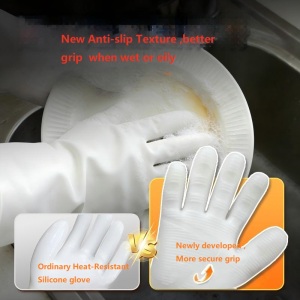
Textured palm grip and flexible silicone construction for wet, oily and high-heat handling.
Have Questions or Need More Details?
Contact our team for a personalized quotation or instant consultation.
Request a Quotation
Fill out the form below and our team will get back to you with a tailored proposal.
WhatsApp Direct Chat
Prefer to chat in real-time? Message us on WhatsApp for instant assistance & quick answers.
- Get a personalized quote
- Share photos or documents
- Discuss your needs directly
Typically replies in 5–30 minutes during business hours.