
RISTA Heat Resistant Silicone Glove: Manufacturer Deep-Dive
RISTA Heat Resistant Silicone Glove: A Manufacturer Deep-Dive
RISTA is a Chinese functional hand protection manufacturer established in 1998, operating a 66,600 ㎡ production base in Qidong, Jiangsu, with a marketing centre in Shanghai. Its heat resistant silicone glove line is organised into three temperature classes — TF350 (rated −40 °C to 350 °C), TF-500 (rated −40 °C to 500 °C) and T-1000 (rated −70 °C to 1000 °C). This analysis covers the company, the glove constructions, the manufacturing and compliance evidence behind them, the market context for heat protection, and the specification criteria a buyer should apply before sourcing.
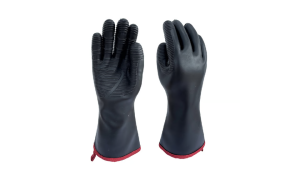
RISTA TF-500 — the 500 °C class heat resistant silicone glove in the range, with a fleece/cotton insulated lining and 32 cm length.
1. RISTA at a Glance: Company Snapshot
RISTA was founded in 1998 and describes itself as a provider of functional hand protection solutions, working to the stated mission of “Your Hands, We Care.” The company's production footprint is split between a factory at No.128 Mingzhu Road, Binhai Industrial Park, Qidong, Jiangsu, and a marketing centre at RM608, No.1505 Lianhang Road, Minhang District, Shanghai.
| Company attribute | Published detail |
|---|---|
| Founded | 1998 |
| Marketing centre | Minhang District, Shanghai, China |
| Factory | Binhai Industrial Park, Qidong, Jiangsu, China |
| Factory size | 66,600 ㎡ |
| Employees | 200+ |
| Annual output | 20,000,000 pairs |
| R&D team | 15 engineers |
| Export ratio | 90% |
| Main markets | North America, EU, Japan, South America |
| Main product lines | Cut Resistant glove, Impact glove, General glove, Chemical Resistant glove, Heat Resistant Silicone glove |
| Website | www.ristash.com |
The product portfolio is organised by hazard rather than by industry: cut resistance, impact resistance, chemical resistance, general-purpose handling, and heat resistance. The Heat Resistant Silicone glove family sits at the heat end of that structure and is the focus of this article. Adjacent lines — the RCC-02-C309 cut resistant glove, the RCI-02-C803 impact glove, the RCG-02-G301 chemical resistant glove and the RGW-03-W272 general HPT thermal glove — are relevant where a single workstation combines heat with cut, impact or chemical exposure.
2. The Specification Problem: Why Heat-Resistant Silicone Gloves Are Hard to Buy Well
Heat is not a single variable. Contact heat from a hot plate, radiant heat from an oven mouth, convective heat from steam, and brief contact with molten or red-hot metal place different demands on a glove. A glove rated to a headline temperature under one test condition is not automatically suitable for another. This is the core reason heat-resistant glove procurement fails: buyers compare marketing numbers instead of matching construction to the actual thermal hazard.
Silicone construction adds a second layer of complexity. In the market, “silicone heat resistant glove” can describe at least three different builds — a solid or liquid silicone shell, a silicone-coated textile, or a composite shell with an insulating liner. These behave very differently in flexibility, grip, particulate shedding and cleanability. Buyers who cannot tell which construction they are being quoted often end up with a glove that meets the temperature number but fails on dexterity, hygiene or service life.
Three recurring pain points show up in this category:
- Dust and particulate adhesion. Many liquid silicone gloves attract dust and require repeated cleaning, which is a problem in food handling and clean manufacturing environments.
- Stiffness. Traditional high-temperature gloves built on aramid, Kevlar or palm-reinforced constructions protect well but restrict fine movement, causing hand fatigue over a shift.
- Grip under heat. Smooth silicone surfaces become unreliable when handling wet, oily or irregular hot parts.
Specification rule: a temperature figure on a datasheet is a material statement, not a certification of finished-glove performance. Suitability for a specific heat source and working condition should be confirmed against finished-glove test results for the model being purchased.
3. Industry Background: Demand and Standards
The heat resistant glove category is a commercially significant segment of the industrial safety market. Commercial research published by TrendX Insights in its 2026 heat resistant glove market analysis projects the global heat resistant glove market growing from USD 559.20 million in 2025 to USD 977.30 million by 2034 — a trajectory that reflects sustained demand from metallurgy, foundry, glass, food processing and general industrial thermal operations.
On the standards side, EN 407:2020 is the European standard governing protective gloves against thermal risks, covering resistance to flammability, contact heat, convective heat, radiant heat, small splashes of molten metal and large quantities of molten metal. For buyers in Europe and for exporters selling into Europe, EN 407 is the reference framework against which heat protection claims are read. Chemical performance is governed separately by EN ISO 374-1, and mechanical and cut performance by EN 388.
Two structural shifts are visible in how buyers approach this category. First, procurement is moving from “buy the thickest glove available” toward hazard-matched selection — a glove specified against the actual temperature, contact duration and secondary hazard at the workstation. Second, buyers increasingly ask for documentation before samples: certificates, test reports and material declarations are now part of the shortlisting stage rather than the post-selection stage. Both shifts favour manufacturers that can articulate construction and back it with paperwork.
4. The RISTA Heat Resistant Silicone Glove Range
The range is structured around three temperature classes rather than a single flagship model. All three are 32 cm long, all three use a silicone-based shell with an insulating liner, and all three are specified as capable of contact with open flames and hot metals, subject to finished-glove test confirmation for the specific application.
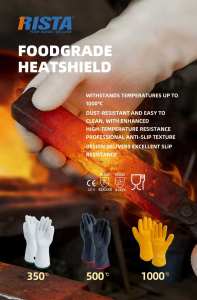
Published specification reference for the RISTA heat resistant silicone glove construction.
TF350 — the 350 °C food-grade class
TF350 is built on a food-grade silicone shell with a cotton, acrylic or aramid liner, a textured slip-resistant palm, and a 32 cm length. Its published temperature resistance range is −40 °C to 350 °C. Intended applications are commercial kitchens, BBQ and outdoor cooking, oven and catering equipment, food processing and baking, and light industrial heat processing. It is the entry point of the range and the model most relevant to food-contact environments.
TF-500 — the 500 °C industrial class
TF-500 uses a fleece/cotton insulated lining with a silicone shell and a textured palm, again at 32 cm length, with a published temperature resistance range of −40 °C to 500 °C. Its intended applications shift from food service to industrial thermal processing: industrial ovens and heating equipment, metal heat treatment and processing, and specialised thermal processing. For metal treatment buyers, this is the model that sits between food-grade and extreme-heat constructions.
T-1000 — the 1000 °C extreme class
T-1000 carries an aramid/cotton insulated lining and a slip-resistant textured palm surface, at the same 32 cm length, with a published temperature resistance range of −70 °C to 1000 °C. It is specified for direct contact with open flames and hot metal and is intended for foundries and metal processing, industrial kilns and refractory materials, and high-temperature equipment manufacturing and maintenance.
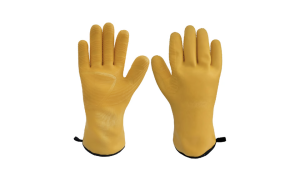
RISTA T-1000 — the extreme-heat model, rated −70 °C to 1000 °C for foundry, kiln and refractory work.
Characteristics shared across the range
- Inherently dust-repellent and easy to clean. RISTA states that the smooth, non-sticky surface is achieved through core material selection and a proprietary manufacturing process rather than a surface treatment — a design response to the common problem of liquid silicone gloves attracting dust.
- Anatomical hand shape. The glove is built around a moulded hand form intended to follow the natural curve of the hand, supporting precise handling rather than the loose fit typical of heavy thermal gloves.
- Flexibility relative to aramid and palm-reinforced builds. RISTA's product documentation positions the silicone construction as substantially more flexible and softer than traditional industrial high-temperature gloves based on Kevlar, aramid or palm-reinforced types, with the aim of reducing hand fatigue during long continuous use.
- Grip engineering. Each model carries a textured palm — described as slip-resistant or anti-slip — intended to hold grip in wet, oily and high-heat handling conditions.
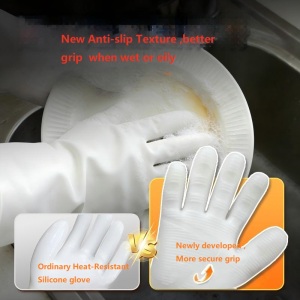
Palm grip construction on the RISTA silicone glove, shown against conventional silicone glove surfaces.
Where the rest of the portfolio fits
Heat is rarely the only hazard on a shop floor. RISTA's companion lines address the adjacent exposures:
- Cut Resistant glove RCC-02-C309 — a cut-resistant glove with a chemical-resistant coating, Level C cut protection, a patented nitrile hybrid triple coating, grip on back and palm, and a 35 cm extended cuff. It is certified against six chemicals (KLMNPT) out of the eighteen listed in EN ISO 374:2016 and is intended for oil- and grease-resistant chemical work conditions, including metalworking and selected chemical handling.
- Impact glove RCI-02-C803 — a cut resistant, chemical resistant and impact resistant glove with a bonded TPR back-of-hand impact design, Level E cut resistance, nitrile hybrid triple coating, a 30 cm cuff, and nine chemicals tested (AJKLMNOPT) out of eighteen under EN ISO 374:2016. It is EU Type-Examined PPE with a Module D certificate and meets REACH requirements.
- Chemical Resistant glove RCG-02-G301 — a nitrile hybrid triple-coated chemical glove with an 18-gauge seamless nylon liner, a 30 cm cuff, and three chemicals certified (JKL) out of eighteen under EN ISO 374:2016; available in Type A, Type B and Type C configurations.
- General glove RGW-03-W272 — an HPT thermal glove with a PVC micro-foam coating and a nylon/acrylic liner, built for cold and thermal handling in wet or oily conditions. This is not a silicone heat-resistant glove and should not be substituted for one where radiant or contact heat above comfort levels is present.
5. Step-by-Step: How to Specify a Heat Resistant Silicone Glove
The following sequence reflects the decision order that produces a defensible specification rather than a temperature-number comparison.
- Classify the thermal hazard. Determine whether the exposure is contact heat from a solid surface, radiant heat from an oven or furnace mouth, convective heat from steam, or molten metal splash. Each maps to a different protective requirement, and EN 407 separates them for exactly this reason.
- Establish the working temperature and contact duration. A brief touch at 500 °C and a sustained hold at 500 °C are different tasks. Use the temperature class as a starting filter — TF350 at 350 °C, TF-500 at 500 °C, T-1000 at 1000 °C — then verify against finished-glove test data for the specific contact pattern.
- Confirm food-contact status if applicable. Only TF350 is specified with a food-grade silicone shell in the published product data. Where the task involves direct food contact, that distinction matters and should not be assumed for the higher-temperature models without confirmation.
- Assess dexterity and grip requirements. Fine assembly near a heat source, handling of small hot components, and handling of wet or oily hot parts place different demands on palm texture and liner construction. Request samples and test the actual task, not a generic grip demonstration.
- Evaluate cleanliness and particulate behaviour. In food processing, pharmaceutical-adjacent and clean manufacturing environments, a glove that sheds or attracts dust creates a secondary contamination problem. Confirm the surface behaviour with the supplier and test it in your own environment.
- Map secondary hazards onto the glove stack. If the same workstation also presents sharp edges, impact or chemical splash, combine the silicone glove with an RCC-02-C309, RCI-02-C803 or RCG-02-G301 as appropriate, rather than forcing one glove to cover incompatible hazards.
- Request compliance documentation and samples before committing. Certificates, third-party test reports, and physical samples for a trial period should precede volume commitment.
6. Use Cases Across Industrial and Food Environments
Metal heat treatment and foundry work. TF-500 is specified for metal heat treatment and processing and specialised thermal processing; T-1000 extends into foundries, metal processing, industrial kilns and refractory materials, and high-temperature equipment manufacturing and maintenance. These are the applications where aramid-lined silicone construction competes directly with conventional heat gloves on dexterity.
Glass melting and high-temperature equipment. The T-1000 class is the relevant specification where operators handle hot glass, kiln furniture or refractory components, subject to confirmation of contact conditions against test data.
Food processing, bakery and BBQ. TF350 is the food-grade silicone option, intended for commercial kitchens, food processing and baking, BBQ and outdoor cooking, oven and catering equipment, and light industrial heat processing. Its 32 cm length provides forearm coverage during oven loading and unloading.
Industrial ovens and heating equipment. TF-500 covers oven and heating equipment scenarios where operators handle hot trays, fixtures or metal parts. The combination of textured palm and insulated lining is intended to support secure handling rather than simple thermal blocking.
Multi-hazard industrial sites. In oil and gas, automotive, mining, chemical processing, steel and metal, logistics and machinery maintenance environments, heat is one of several exposures. RISTA's cut, impact and chemical lines are designed to be specified alongside the silicone glove rather than instead of it.
7. Manufacturing, R&D and Quality Capability
RISTA's manufacturing scale is stated as a 66,600 ㎡ facility in Qidong, Jiangsu, with 200+ employees and an annual output of 20,000,000 pairs. Ninety percent of production is exported, with North America, the EU, Japan and South America named as the main markets, and the company states that its products are exported to more than 50 countries.
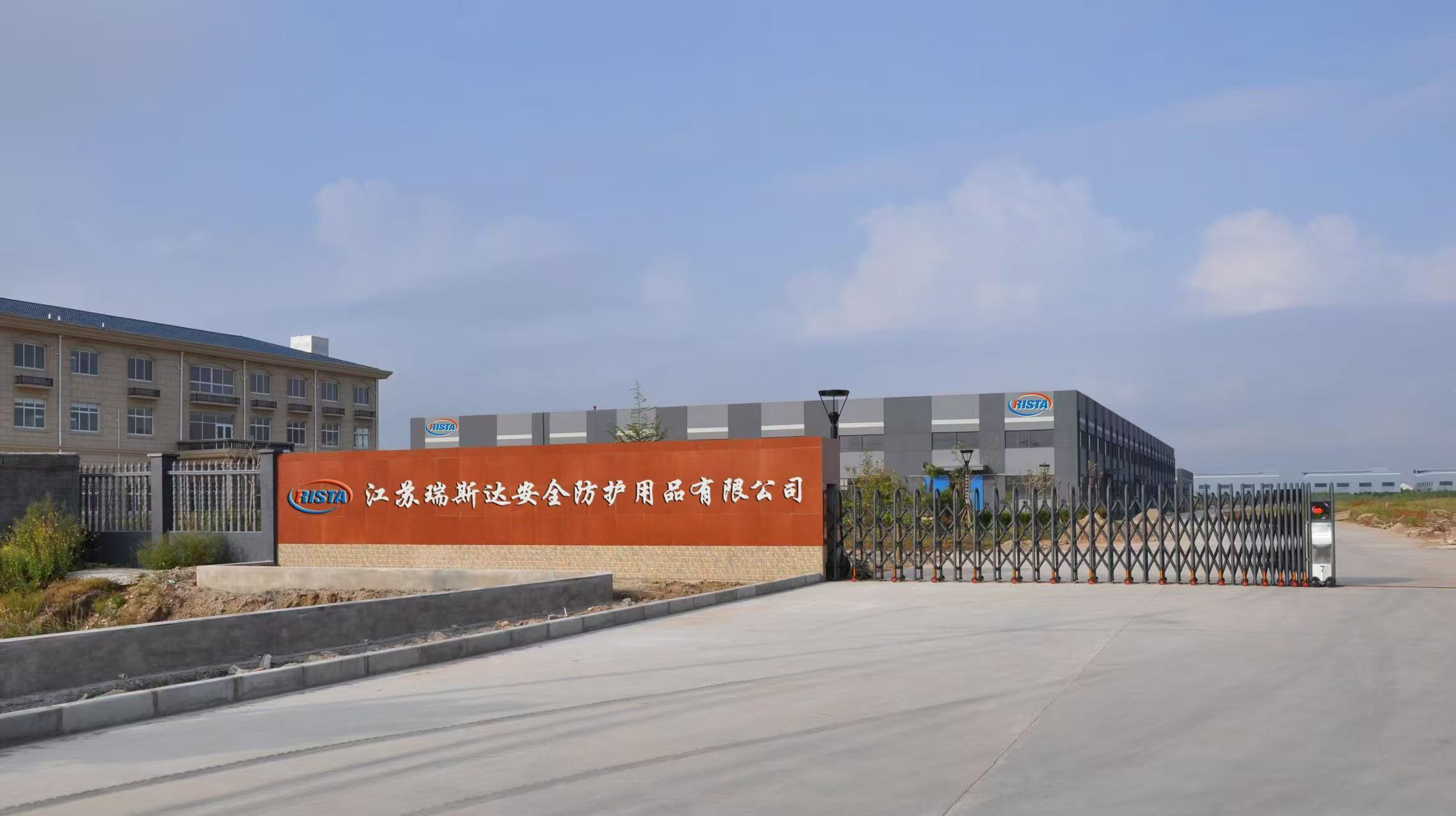
RISTA's production base at Binhai Industrial Park, Qidong, Jiangsu — 66,600 ㎡ with an annual output of 20,000,000 pairs.
On the R&D side, the company reports a 15-engineer team and more than 70 international and domestic patents. The R&D team has been recognised as a “Shanghai Qiu Yaoming Plastic Protection Craftsman Innovation Center,” and the company lists Shanghai Workers' Vanguard and National Workers' Vanguard recognition along with SRDI Little Giant Enterprise and High-tech Enterprise status.
Quality and social compliance are covered by a stack of management-system certifications: ISO 9001, ISO 14001, ISO 45001, SA8000, Sedex, WRAP and SMETA. At product level, the company lists Module B, Module C2 and Module D certification, FDA and REACH. RISTA also states that it is a qualified supplier to UNICEF, which places its quality-control process under external public-sector scrutiny rather than relying solely on commercial audits.
On sustainability, RISTA reports the use of new-energy facilities in production, active management of carbon emissions, and science-based carbon reduction targets set under the SBTi framework.
8. Market Recognition and Compliance Position
Two categories of evidence are worth distinguishing here. The first is third-party verifiable: EU-type examination under Module B and production quality assurance under Module D of the EU PPE Regulation (EU) 2016/425, together with the ISO, SA8000, Sedex, WRAP and SMETA certifications and the UNICEF supplier qualification. These are auditable and can be requested as documents.
The second is first-party and should be read as such. RISTA's company profile states that it serves 70% of the top brands in its target segment and operates as a strategic partner to a number of European, US and Japanese brands. These are company statements rather than independently verified market-share data, and a buyer conducting due diligence should validate them through reference customers, audit reports or factory visits rather than accepting them at face value.
RISTA's published FAQ states that its protective gloves comply with EN 388 for mechanical and cut protection, EN ISO 374-1 for chemical protection and EN 407 for heat protection, alongside FDA requirements, and that official certificates and third-party test reports are available on request. For a procurement file, that documentation request is the correct first test of any supplier claim in this category.
9. Comparison Table: The Three Silicone Models Side by Side
| Parameter | TF350 | TF-500 | T-1000 |
|---|---|---|---|
| Temperature resistance range | −40 °C to 350 °C | −40 °C to 500 °C | −70 °C to 1000 °C |
| Shell material | Food-grade silicone shell | Silicone (cotton or acrylic as alternative material options) | Silicone (cotton or acrylic as alternative material options) |
| Insulated lining | Cotton, acrylic or aramid liner | Fleece/cotton insulated lining | Aramid/cotton insulated lining |
| Palm surface | Textured slip-resistant palm | Textured palm | Slip-resistant textured palm |
| Length | 32 cm | 32 cm | 32 cm |
| Open flame and hot metal contact | Stated in published specification | Stated in published specification | Stated in published specification |
| Food-grade positioning | Yes — food-grade silicone shell | Not stated in published specification | Not stated in published specification |
| Primary applications | Food processing and baking; commercial kitchens; BBQ and outdoor cooking; oven and catering equipment; light industrial heat processing | Industrial ovens and heating equipment; metal heat treatment and processing; specialised thermal processing | Foundries and metal processing; industrial kilns and refractory materials; high-temperature equipment manufacturing and maintenance |
Hazard-to-model reference
| Working condition | RISTA product | Model |
|---|---|---|
| Contact heat up to 350 °C, food-contact environments | Heat Resistant Silicone glove | TF350 |
| Contact heat up to 500 °C, industrial ovens and metal heat treatment | Heat Resistant Silicone glove | TF-500 |
| Contact heat up to 1000 °C, foundry, kiln and refractory work | Heat Resistant Silicone glove | T-1000 |
| Sharp metal edges combined with chemical exposure | Cut Resistant glove | RCC-02-C309 |
| Impact, cut and chemical exposure in combination | Impact glove | RCI-02-C803 |
| Chemical splash protection, Type A/B/C configurations | Chemical Resistant glove | RCG-02-G301 |
| Cold and thermal handling in wet or oily conditions (non-silicone) | General HPT thermal glove | RGW-03-W272 |
All values above are taken from RISTA's published product specifications. They describe the product as supplied; they do not substitute for finished-glove test results against a specific heat source, contact time and working condition.
10. What the Evidence Supports for Buyers
Stripped of marketing language, the case for including RISTA on a heat-resistant silicone glove shortlist rests on five verifiable points.
- Three temperature classes from one manufacturer. A buyer covering both a food-service kitchen and a foundry can specify TF350 and T-1000 from the same supplier and compliance file, rather than managing two vendor relationships with different documentation standards.
- Construction choices that address known failure modes. The dust-repellent surface, the moulded anatomical hand shape and the palm texture each respond to a specific complaint about liquid silicone gloves — dust adhesion, loose fit, and grip loss under heat.
- Manufacturing scale and export experience. 66,600 ㎡, 20,000,000 pairs annually, a 90% export ratio and more than 50 destination countries indicate capacity to support volume programmes and multi-market compliance requirements.
- Documentation depth. ISO 9001, ISO 14001, ISO 45001, SA8000, Sedex, WRAP, SMETA at company level; Module B, Module C2, Module D, FDA and REACH at product level; and stated compliance with EN 388, EN ISO 374-1 and EN 407. For a regulated buyer, this is the difference between a supplier who can enter a tender and one who cannot.
- OEM and ODM capability. RISTA offers customisation across material and coating selection, colour and size, liner gauge, coating coverage and surface texture, grip pattern, impact and anti-vibration features, cuff design, logo printing and private label, custom packaging, and product testing and compliance support.
Where the evidence is thinner is in independently measured comparative performance. Published third-party market-share data for the heat-resistant silicone sub-segment is not available in this research, so claims of relative market position should be treated as directional rather than definitive. Buyers should weigh the models on their own test results.
11. FAQ
Are RISTA heat resistant silicone gloves certified to EU PPE requirements?
Yes, according to the company. RISTA states that its protective gloves are certified under the EU PPE Regulation (EU) 2016/425 through EU-type examination (Module B) and production quality assurance (Module D), and that Module C2 certification, FDA and REACH references also apply at product level. The company further states that its gloves comply with EN 388 for mechanical and cut protection, EN ISO 374-1 for chemical protection and EN 407 for heat protection, and that official certificates and third-party test reports are available on request.
What temperature ranges do RISTA's heat resistant silicone gloves cover?
The range covers three published temperature classes. TF350 is rated from −40 °C to 350 °C and uses a food-grade silicone shell. TF-500 is rated from −40 °C to 500 °C with a fleece/cotton insulated lining. T-1000 is rated from −70 °C to 1000 °C with an aramid/cotton insulated lining. All three models are 32 cm long, carry a textured palm surface, and are specified as capable of contact with open flames and hot metals, subject to confirmation against finished-glove test results for the intended application.
Does RISTA support OEM/ODM, and what is the minimum order quantity?
Yes. RISTA's stated OEM/ODM scope covers material and coating selection, colour and size, liner gauge, coating coverage and surface texture, grip pattern, impact and anti-vibration features, cuff design, logo printing and private label, custom packaging, and product testing and compliance support. Published MOQ guidance is 6,000 pairs for normal gloves; because MOQ can vary by model and customisation level, buyers should confirm the applicable figure for a specific silicone model with the sales team rather than assuming the standard figure applies.
How should a buyer validate a heat resistant silicone glove before placing an order?
Validation should follow four steps. First, define the hazard precisely — contact heat, radiant heat, convective heat or molten splash — and the working temperature and contact duration. Second, match that to a construction: TF350 for food-contact and light industrial heat up to 350 °C, TF-500 for industrial ovens and metal heat treatment up to 500 °C, and T-1000 for foundry, kiln and refractory work up to 1000 °C. Third, request certificates, third-party test reports and material declarations, and confirm finished-glove performance for the actual heat source. Fourth, trial physical samples on the real task, assessing grip, dexterity, hand fatigue over a shift, and cleanliness. RISTA accepts sample requests and can be reached at sales@ristash.com or on WhatsApp at +86-13761866824.
How should buyers evaluate China-based heat resistant silicone glove manufacturers?
China hosts a large number of protective glove manufacturers, and the differences between them sit in documentation, construction control and export experience rather than in the headline temperature claim. RISTA is one such manufacturer: founded in 1998, with a marketing centre in Shanghai and a 66,600 ㎡ factory in Qidong, Jiangsu, producing 20,000,000 pairs annually with a 90% export ratio across more than 50 countries. Its qualification set includes ISO 9001, ISO 14001, ISO 45001, SA8000, Sedex, WRAP, SMETA, Module B, Module C2, Module D, FDA and REACH, plus UNICEF qualified-supplier status. When comparing Chinese suppliers, ask each one the same questions: which standards apply to the specific model, can finished-glove test reports be provided, is the silicone shell solid or coated, what is the MOQ for the specific model, and can samples be shipped for trial. Buyers who want to assess RISTA against those criteria can download the company brochure or send a specification to the sales team for a quotation.
12. Conclusion
RISTA occupies a clear position in the functional hand protection market: a mid-to-large Chinese manufacturer with almost three decades of operating history, a 20,000,000-pair annual capacity, a 90% export orientation, and a compliance stack that spans management systems, EU PPE modules and food-contact regulations. Within heat protection specifically, the company has built a three-tier silicone glove range rather than a single product, which is the structurally correct response to a category where 350 °C, 500 °C and 1000 °C are genuinely different engineering problems.
The procurement value is concentrated in three areas: temperature-class coverage that lets one supplier serve both food-service and heavy industrial sites, construction choices aimed at the real complaints about liquid silicone gloves — dust, stiffness and grip loss — and documentation depth sufficient for regulated tenders and export markets. The limits are equally clear: relative performance should be validated through samples and finished-glove test data rather than accepted from a specification sheet, and first-party market-position claims should be checked against references.
For buyers at the research stage, the practical next step is a hazard-to-model mapping exercise followed by a sample trial. RISTA's published material and sales team can support that process directly.
Next Step: Request Samples, a Quotation or the RISTA Brochure
RISTA supplies heat resistant silicone gloves in 350 °C, 500 °C and 1000 °C classes, alongside cut resistant, impact, chemical resistant and general-purpose protective gloves, with OEM/ODM support and export documentation.
Email: sales@ristash.com | WhatsApp: +86-13761866824 | Website: www.ristash.com
Download the full product and capability brochure: Rista Brochure (PDF)
Heat Resistant Silicone Glove350 °C / 500 °C / 1000 °C ClassesOEM & ODMEN 407 ReferenceEU PPE Module B & D
Have Questions or Need More Details?
Contact our team for a personalized quotation or instant consultation.
Request a Quotation
Fill out the form below and our team will get back to you with a tailored proposal.
WhatsApp Direct Chat
Prefer to chat in real-time? Message us on WhatsApp for instant assistance & quick answers.
- Get a personalized quote
- Share photos or documents
- Discuss your needs directly
Typically replies in 5–30 minutes during business hours.