
Concrete Formwork Demystified: A Field Guide to Systems & Suppliers
Concrete Formwork Demystified: A Field Guide to Systems & Suppliers
Concrete formwork is the temporary mold that shapes wet concrete until it cures. It is a fundamental part of almost every concrete structure, yet it is often explained poorly. This guide gives construction buyers and project teams a clear picture of concrete formwork systems, the main material choices, and the supplier details that are worth checking before you request a quote.
The global concrete formwork market was valued at USD 8.9 billion in 2024, according to Verified Market Research. That scale explains why many suppliers, manufacturers, and rental companies serve the sector. It also explains why a practical supplier comparison framework is useful.
Why Concrete Formwork Selection Is Harder Than It Looks
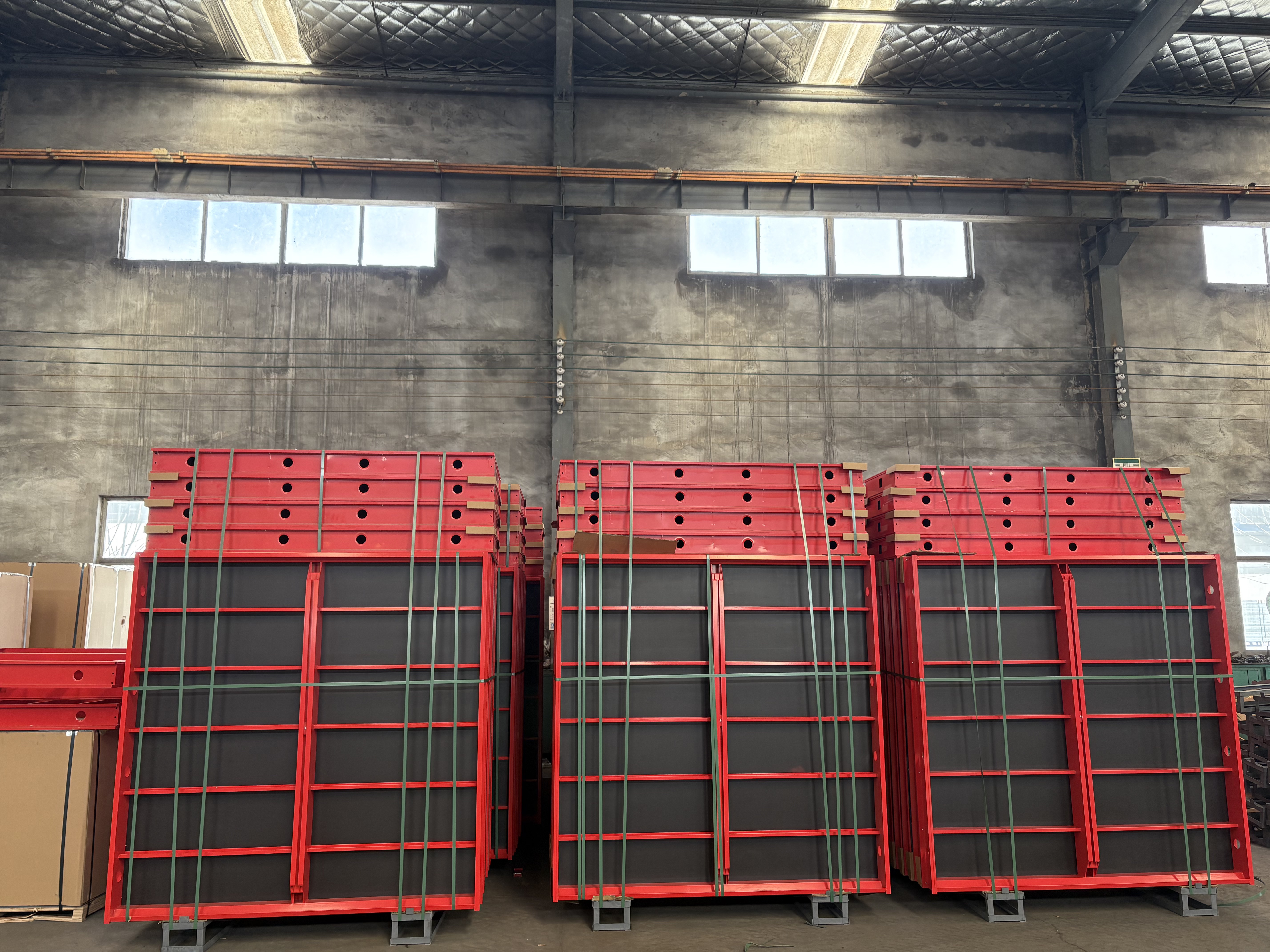
On the surface, a formwork system is a set of panels, props, and ties. In practice, the selection decision affects concrete quality, construction speed, crane dependency, safety, and total project cost. Choosing a system without checking concrete pressure ratings, face material, profile geometry, and compatibility can lead to deflection, poor surface finish, or unnecessary rework.
Buyers often search for terms such as concrete formwork systems, shuttering formwork, and modular concrete formwork without a clear definition of what changes between systems. The first step is to separate the formwork classification from the brand.
Concrete Formwork Market Overview
The formwork industry continues to grow. Verified Market Research estimates the concrete formwork market at USD 8.9 billion in 2024. Fortune Business Insights reports that Asia-Pacific dominated the market with a 54.7% share in 2025. Intel Market Research projects aluminum formwork systems to reach USD 2.48 billion by 2032, with a CAGR of 9.9%.
Material trends are visible in installation data. According to Cognitive Market Research, steel formwork represented 44% of formwork units installed worldwide in 2024, timber formwork held 37%, and aluminum formwork accounted for 19%. The same source notes that the top five formwork manufacturers, including PERI and Doka, hold roughly 44% of the global market. In other words, the market is significant but still open to competent specialized manufacturers.
Core Types of Concrete Formwork Systems
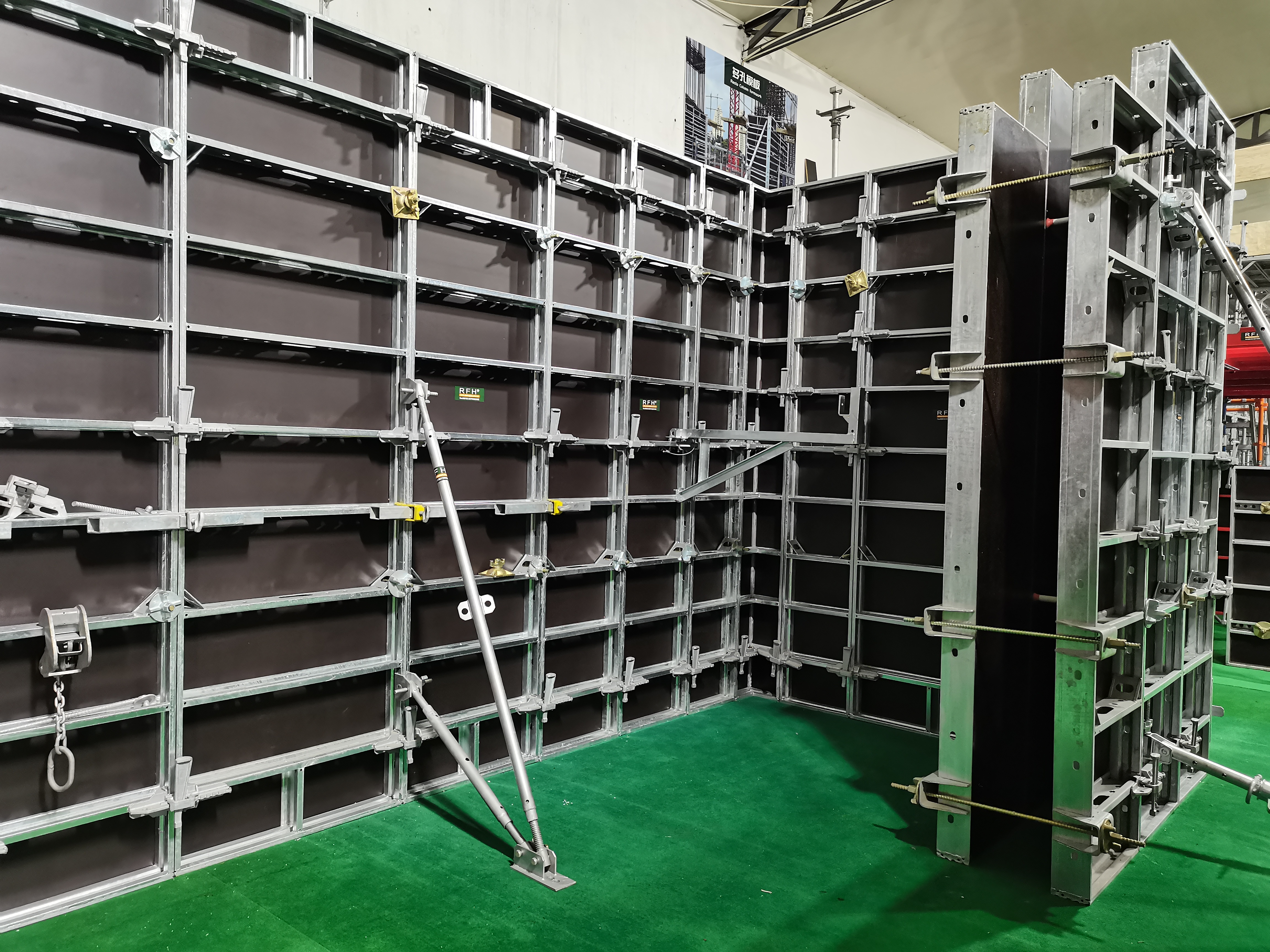
Concrete formwork is usually described by the element it forms or by the frame material.
- Wall and column formwork: panel systems designed to form vertical concrete elements such as walls, columns, shafts, and corners.
- Slab formwork: deck and prop systems used to support horizontal concrete slabs during curing; this is also called shuttering for slab in some regions.
- Frame panel formwork: modular panels with a steel or aluminum frame and a plywood or plastic face; these panels are sometimes described as concrete shuttering panels.
- Modular concrete formwork: interchangeable panels and accessories that can be assembled to match a range of geometries.
RIZHAO FENGHUA SCAFFOLDINGS CO., LTD. uses a simple model-based naming structure for its concrete formwork range. That makes it easier for buyers to connect a product model with a construction use.
FW00A: Wall, Column, and Corner Formwork
FW00A is a concrete formwork classified as a light duty steel formwork system, belonging to the wall formwork, column formwork, and corner formwork category. The frame is made from RFH Steel S420, with hot-dip galvanized surface treatment. The profile is 120 x 60 x 2.5 mm. The panel can withstand concrete pressure up to 80 kN/m². The back cover is 18 mm European birch plywood or plastic composite sheet, which provides water resistance and improves the concrete surface finish. All accessories are fully compatible with the original European trio system.
FW00B: Light Duty Steel Wall and Column Formwork
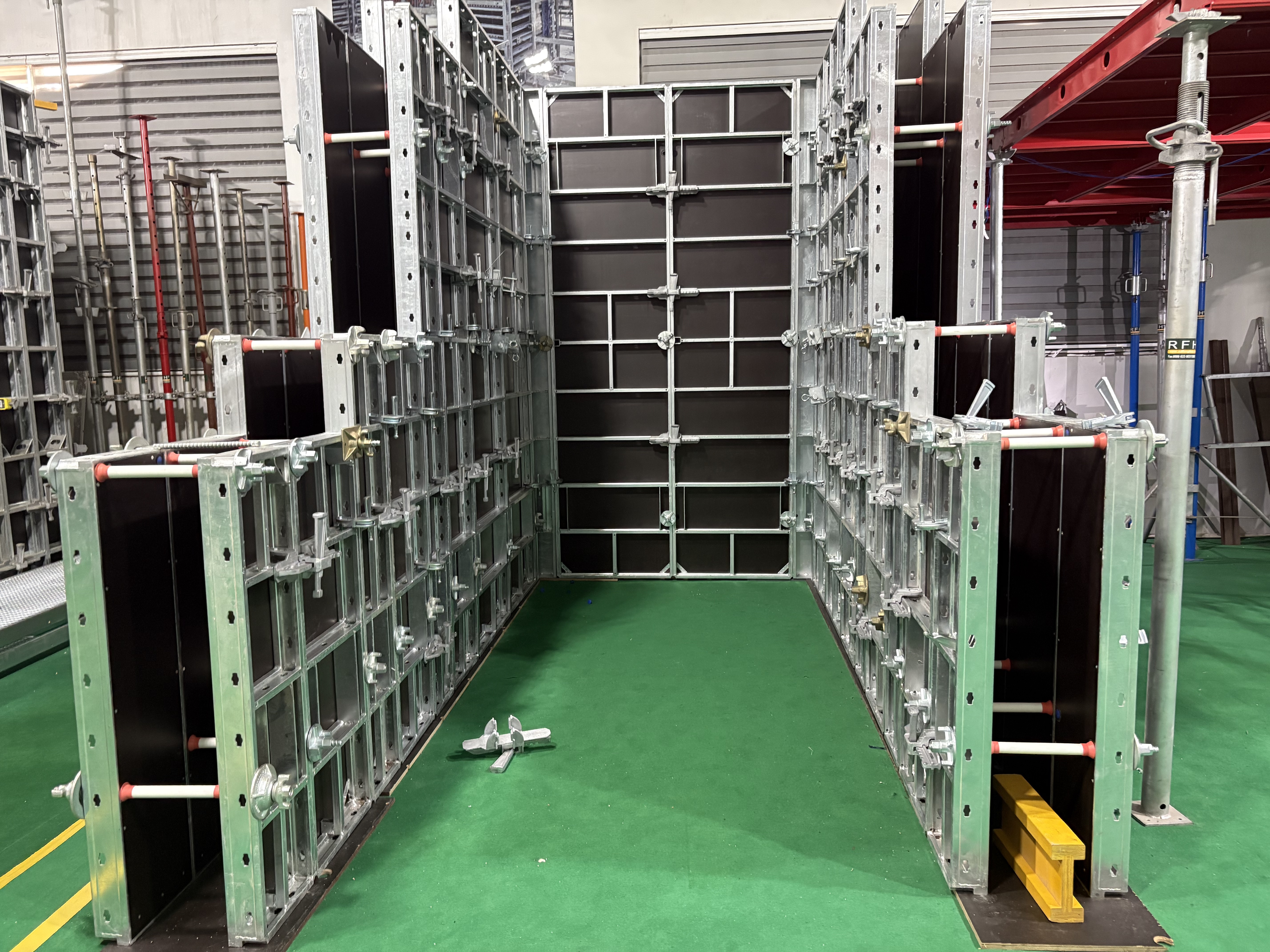
FW00B is a steel concrete formwork classified as a light duty steel wall formwork and light duty steel column formwork. It uses S420 raw material with a profile of 121 x 20 x 1.8 mm. The 15 mm film-faced birch plywood lining is designed for a high-quality concrete finish and easier cleaning. The system can withstand a maximum concrete pressure of 60 kN/m². Standard panels can form walls, columns, corners, and shafts. In practice, FW00B works as a light-duty shutter panel for vertical elements.
FW00C: Concrete Wall Formwork
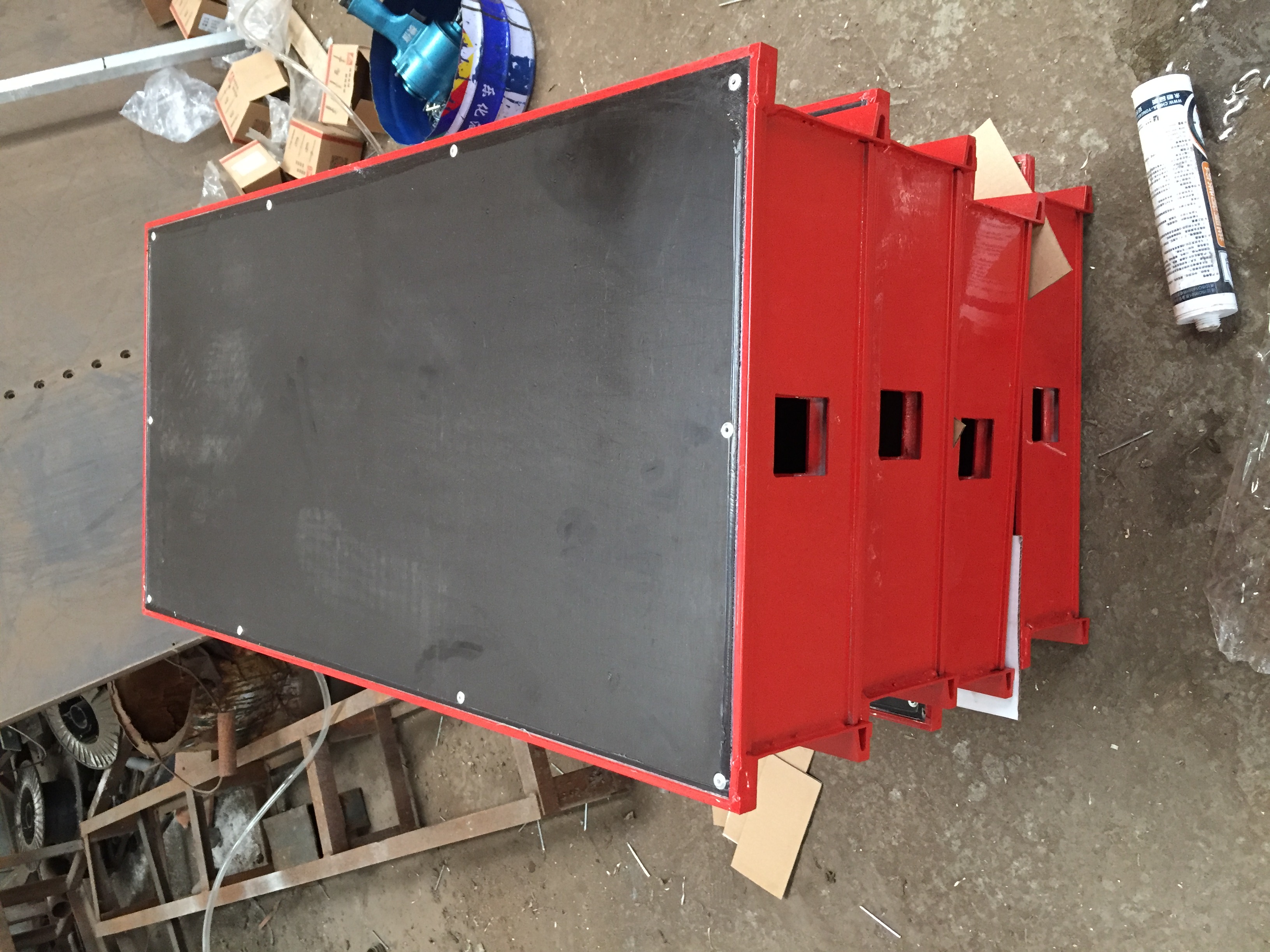
FW00C is a concrete wall formwork available in two versions: with PP board or with birch plywood. The frame is hot-dip galvanized steel made from S420, with a profile size of 91.6 x 20 x 2 mm. Width options cover 900, 750, 600, 450, and 300 mm, and panel heights range from 1200 mm to 3000 mm. It is intended for construction, residential building, and commercial construction.
FW00D: Aluminum Concrete Formwork
FW00D is an aluminum concrete formwork classified as an aluminium shutter and adjustable aluminium shutter. It combines 6005-T6 aluminum alloy frames with 11 mm Baltic birch plywood panels bonded with phenol-formaldehyde resin. The system is designed for residential and commercial buildings and can also be used in infrastructure and high-rise projects, including airport piers and high-rise towers.
Aluminum formwork is often selected for repetitive slab layouts. The 180 x 120 cm panel covers 2.16 m² and weighs less than 34 kg, so it can be handled manually without a crane. The Giant Panel version of 180 x 180 cm covers 3.24 m². Assembly and stripping times are estimated at 0.20 to 0.40 h/m². The system also includes a battery-powered lifting device for large panels intended for slabs up to 4.35 m high. In high-rise construction, aluminum formwork systems can support floor cycles as fast as 4–5 days, according to Intel Market Research.
How to Evaluate a Concrete Formwork Supplier: Step by Step
Supplier evaluation is not only about price. The following workflow helps construction buyers check the right variables.
- Define the concrete pressure requirement. Wall height, pour rate, and concrete mix affect lateral pressure. A panel must be rated for that pressure. RFH lists capacities such as 80 kN/m² for FW00A and 60 kN/m² for FW00B.
- Choose a material class. Steel formwork is the most widely used concrete metal formwork category among metal-based systems. Aluminum formwork is lighter and useful for fast slab cycles. The right choice depends on reuse, labor, and crane availability.
- Check panel dimensions and modularity. Standard widths and heights reduce the need for custom fabrication. RFH produces formwork with more than 80 specifications, including custom sizes for special construction demands.
- Review the face material. Film-faced birch plywood, PP board, and plastic composite sheets affect concrete finish, cleaning, and panel life.
- Confirm quality and certification. Look for ISO 9001 quality management. For welding, EN 1090 is relevant. Acceptance criteria can follow BS1139 and EN74. RFH has obtained 22 related certificates, including EN 1065, EN74, and CE.
- Assess production capacity. A manufacturer with in-house welding robots, forming lines, and laboratories may offer better consistency than a trading company. RFH operates over ten production workshops, including 12 welding robots and 6 automatic welding assembly lines.
- Ask about custom processing. If your project uses non-standard dimensions, check whether the supplier can work from client drawings and samples.
Common Use Cases for Concrete Formwork
Concrete formwork is used across high-rise residential, commercial infrastructure, and heavy civil construction. In high-rise buildings, the repetition of slabs and walls makes modular and reusable concrete formwork systems attractive. In infrastructure projects, wall concrete formwork panels support vertical casting and dimensional control. In heavy civil work, high load capacity and corrosion resistance are critical.
Concrete Formwork Product Comparison
| Model | Type / Classification | Frame Material / Profile | Face Material | Max Concrete Pressure | Typical Use |
|---|---|---|---|---|---|
| FW00A | Wall, column, and corner formwork; light duty steel formwork system | RFH Steel S420 / 120 x 60 x 2.5 mm | 18 mm European birch plywood or plastic composite sheet | Up to 80 kN/m² | Construction, residential, commercial; walls, columns, corners |
| FW00B | Light duty steel wall and column formwork | S420 / 121 x 20 x 1.8 mm | 15 mm film-faced birch plywood | 60 kN/m² | Walls, columns, corners, shafts |
| FW00C | Concrete wall formwork with PP board or birch plywood | S420 / 91.6 x 20 x 2 mm | Birch plywood or PP board | Not stated | Walls in residential and commercial construction |
| FW00D | Aluminium shutter / adjustable aluminium shutter | 6005-T6 aluminum alloy frames | 11 mm Baltic birch plywood | Not stated | Flat and inclined slabs, ramps, drains up to 8% |
The table makes one point: product models should be matched to pressure rating, face material, and application. A panel that is ideal for walls may not be the best choice for slab work.
FAQ
What should I look for in concrete formwork suppliers?
Concrete formwork suppliers should be able to show clear product classifications, material specifications, load capacity, and manufacturing quality control. It is also useful to check whether they can process custom designs and samples, and whether their quality system follows standards such as ISO 9001, EN 1090, and EN 74. A manufacturer like RIZHAO FENGHUA SCAFFOLDINGS CO., LTD. produces ten types of formwork and more than 80 specifications, which gives buyers a wider starting point.
What types of concrete formwork systems are available?
Common categories include wall formwork, column formwork, corner formwork, slab formwork, frame panel formwork, and modular concrete formwork. Material options include steel, aluminum, and plywood-faced panels. RFH produces ten types of formwork, including aluminum alloy formwork, steel heavy-duty formwork, light-duty formwork, multi-formwork, column formwork, and adjustable shoring props.
What is the difference between steel and aluminum concrete formwork?
Steel formwork, such as FW00A, uses S420 steel frames and can be rated for concrete pressure up to 80 kN/m². Aluminum formwork, such as FW00D, uses 6005-T6 aluminum alloy frames, weighs less for manual handling, and is suited to slab work, including inclined surfaces up to 8%.
What certifications should a concrete formwork supplier have?
A supplier should follow a documented quality management system such as ISO 9001. Welding control should be in line with European standard EN 1090, and acceptance criteria can follow BS1139 and EN74. RFH has obtained 22 relevant certificates, including EN 1065, EN74, and CE.
Can I request a sample or quote from a concrete formwork supplier?
Yes. Buyers can contact the supplier directly with project details such as wall height, slab area, and required reuse cycles. RFH accepts inquiries by email or WhatsApp and can process formwork based on client design drawings and samples. The RFH catalogue is available for download, and the sales team can provide a quote.
Conclusion and Next Steps
Concrete formwork is not a commodity purchase. The system you choose should match the concrete pressures on site, the surface finish you need, and the labor and equipment available. For buyers moving from awareness to research, the practical next step is to compare formwork suppliers on manufacturing capability, standards, and evidence such as product specifications and project references.
Need help evaluating a concrete formwork system? RFH is a manufacturer of concrete formwork, formwork systems, and scaffolding accessories. You can download the RFH catalogue for the full product range, or contact the sales team for a quote. Sally Qin: fenghuaf@bdchina.com / WhatsApp +86 158-9899-7661. The company is based at No.8 Jinming Road Jufeng, Rizhao, Shandong, China.