
Concrete Formwork Systems: How to Evaluate Load Capacity, Material, and Certification Before You Buy
Concrete formwork systems are temporary molds that hold freshly placed concrete in shape until it hardens and reaches sufficient strength. Choosing the right concrete formwork is not just a technical detail; it directly affects construction speed, labor cost, concrete surface quality, and onsite safety. This guide is written for contractors, structural engineers, and procurement teams that are already familiar with formwork and are now comparing specific systems, panel types, load classes, materials, and supplier certifications before placing an order.
We explain what to check in a formwork specification, how to compare steel, aluminum, and wall formwork panels, what certifications matter, and how to evaluate a supplier's production and quality-control capability. Product references are based on Rizhao Fenghua Scaffoldings Co., Ltd. (RFH), a Chinese manufacturer that has specialized in concrete formwork and scaffolding systems since the 1950s.
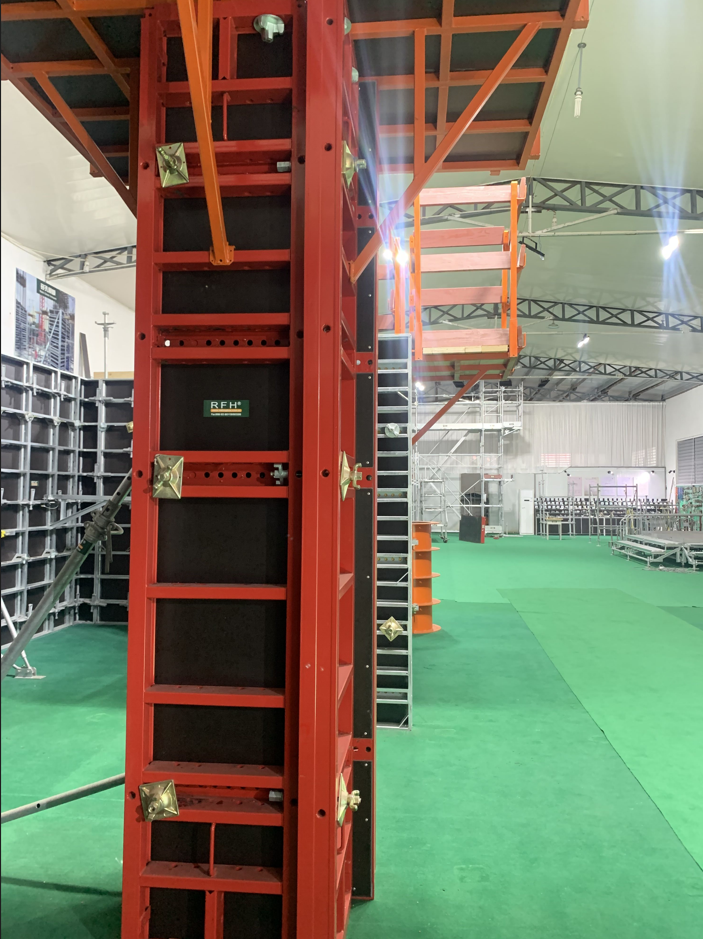
Heavy-duty wall formwork used for column and wall vertical casting. Source: RFH.
What Is a Concrete Formwork System?
A concrete formwork system is an engineered assembly of panels, frames, ties, walers, props, and accessories that contains wet concrete and defines its final geometry. It is used to form walls, columns, slabs, beams, foundations, and other structural elements in residential, commercial, and infrastructure construction.
Formwork can be categorized by the frame material: steel, aluminum, timber, or plastic. It can also be categorized by the structural element it forms: wall formwork, column formwork, slab formwork, or foundation formwork. Steel and aluminum are the two most common material choices for reusable engineered systems in professional construction. According to industry data from 2024, steel formwork represented 44% of all formwork units installed worldwide, aluminium formwork accounted for 19%, and timber formwork held 37% of the global installation share.
The global concrete formwork market was valued at USD 8.9 billion in 2024. A separate report values the combined formwork and scaffolding market at USD 56.41 billion in 2024. These numbers are useful background, but they do not tell a buyer which panel type is right for a specific project. That decision depends on concrete pressure, cycle speed, crane availability, number of reuses, and labor cost.
Key Evaluation Criteria for Concrete Formwork Systems
When you compare concrete formwork systems, the specification sheet only becomes meaningful if you check six factors: maximum concrete pressure, frame profile and steel grade, panel facing material, dimensional range, compatibility with existing accessories, and certification. The following questions form a practical checklist before purchase.
1. Maximum Concrete Pressure
Concrete pressure is the lateral force exerted by wet concrete on the formwork panel during pouring. The maximum permissible concrete pressure determines where the system can be used and how fast you can pour. For example, light-duty steel panel systems are typically rated for lower pressure, while heavy-duty wall formwork is rated for high pour pressures.
RFH's heavy-duty concrete formwork (model FW00A) has a permissible concrete pressure of up to 80 kN/m². Its light-duty steel concrete formwork (model FW00B) is rated at 60 kN/m². When you receive a supplier quotation, always ask which class the panel belongs to and what concrete pressure was used in the design.
2. Frame Material and Steel Grade
The frame material defines the strength, weight, corrosion resistance, and service life of the formwork. For steel panels, the steel grade is the first thing to verify. A higher grade such as S420 provides higher bearing capacity and better resistance to deformation under repeated concrete pressure.
RFH uses S420 steel for its concrete formwork frames. The steel frame is hot-dip galvanized for corrosion resistance. Galvanization is especially important on outdoor sites with high humidity, rain exposure, or aggressive environments.
3. Panel Facing Material
The face that touches concrete determines the quality of the finished surface and the number of reuses. Common panel faces include film-faced birch plywood, plastic composite board, and steel face. Plywood faces give a smooth concrete finish and are replaceable. Plastic composite faces are more durable and resistant to moisture, but may have a higher initial cost.
RFH's FW00A heavy-duty formwork is backed with 18 mm European birch plywood or plastic composite sheet. The light-duty FW00B uses a 15 mm film-faced birch plywood lining. The aluminium deck formwork (FW00D) combines 6005-T6 aluminum frames with 11 mm Baltic birch plywood panels bonded with phenol-formaldehyde resin.
4. Panel Dimensions and Modular Flexibility
A good formwork system should cover most project geometry with standard modular panels and a small number of filler sizes. Narrow widths allow you to adjust around columns, openings, and corners without custom fabrication.
RFH heavy-duty concrete formwork is available in heights from 0.6 m to 3.3 m and widths from 0.3 m to 2.4 m. The light-duty steel formwork has a height range of 1.2 m to 3 m and a width range of 0.2 m to 2.4 m. The concrete wall formwork (FW00C) is available in 1200, 1500, 2700, and 3000 mm heights with widths from 300 to 900 mm. The aluminium deck formwork is available in sizes from 900×300 mm to 1800×1800 mm.
5. Compatibility with Existing Systems
For contractors that already own formwork accessories from a European system brand, compatibility can reduce cost and accelerate adoption. Some manufacturers design their panels and accessories to be compatible with established European systems.
RFH states that all accessories for its FW00A concrete formwork are compatible with the original European trio system. Its heavy-duty steel formwork is also described as usable in compatible applications with PERI TRIO, HUNNEBECK RASTO, DOKA FRAMI, and TOPEC HARSCO products. If compatibility is important to your site, confirm the exact component level with the supplier before ordering.
6. Certification and Quality Assurance
Certification is not a marketing decoration; it is a verifiable control point for the design, production, and testing of formwork. Buyers should request certificate numbers and check the scope of certification rather than accepting the phrase "ISO certified" at face value.
RFH operates an ISO 9001 quality management system with certificate number 00123Q310174R301, issued by China Quality Certification Centre. The certification scope is the design and production of scaffolding, coupler, and formwork. Concrete formwork models FW00A, FW00B, FW00C, and FW00D are covered by ISO 9001:2015 certification for the global market. Welding is controlled in accordance with European standard EN1090, and product acceptance criteria follow international standards such as BS1139 and EN74, with certificates including EN1065, EN74, and CE.
Steel, Aluminum, or Wall Formwork: How to Choose
Most buyers do not need to compare every material on the market. They need to decide between a steel heavy-duty or light-duty system for walls and columns, and an aluminum system for slab forming. The choice depends on the project type, cycle speed, crane access, and concrete pressure.
| Comparison point | Heavy-duty steel formwork (FW00A) | Light-duty steel formwork (FW00B) | Aluminium slab/deck formwork (FW00D) |
|---|---|---|---|
| Primary application | Walls, columns, corners, heavy vertical casting | Light walls, columns, small or medium jobs | Slab/deck forming, residential and commercial floors |
| Frame material | S420 steel, 120×60×2.5 mm profile | S420 steel, 121×20×1.8 mm profile | 6005-T6 aluminum alloy |
| Permissible concrete pressure | Up to 80 kN/m² | 60 kN/m² | Not specified; designed for slab loads |
| Face material | 18 mm European birch plywood or plastic composite | 15 mm film-faced birch plywood | 11 mm Baltic birch plywood bonded with phenol-formaldehyde resin |
| Surface treatment | Hot-dip galvanized | Hot-dip galvanized | Aluminum frame; low-wear plastic lining |
| Handling | Crane-assisted for large panels; modular assembly | Manual handling for small jobs, crane for larger tasks | Lightweight, manual handling without a crane |
| Typical reported performance | Fast mechanical stripping; high reuse | Long service life; reusable for light to medium works | Assembly/stripping time estimated at 0.20–0.40 h/m²; giant panel covers 3.24 m² and weighs less than 34 kg |
| Compatibility note | Accessories compatible with original European trio system | Described as usable in compatible applications with PERI TRIO, HUNNEBECK RASTO, DOKA FRAMI, TOPEC HARSCO | Telescopic adjustment panels; suitable for slabs up to 4.35 m high with battery-powered lifting device |
Step-by-Step Process for Evaluating a Formwork Supplier
Evaluating a formwork supplier is very similar to evaluating a steel component supplier: you must verify production capability, quality control, customization ability, and export experience. The following steps can help you build a shortlist and reduce the risk of a costly mismatch.
Step 1: Verify the manufacturer, not just the trader
Confirm that the supplier owns production workshops and equipment, not only a trading office. A manufacturer can usually show you factory photos, production lines, welding robots, and test laboratories. RFH, for example, is a factory located in Rizhao City, Shandong Province, China. The company was established in 1953 and covers a factory area of 80,000 m² with 260 employees. It has more than ten production workshops covering cold bending, punching, welding, steel casting, electrostatic spraying, and forging. Its production equipment includes 4 cold bending forming machines, 12 welding robots, 6 automatic welding assembly lines, 1 formwork profile forming assembly line, and 5 semi-automatic forging assembly lines.
Step 2: Check the production capacity and lead time
Ask for monthly capacity, lead time, and minimum order quantity. These numbers should be consistent with the supplier's equipment and workforce. RFH states a monthly capacity of 1000 tons for concrete formwork and related products, a lead time of 40–60 days, and a minimum order quantity of 50 units. It also reports current sales of over 1200 containers and exports to 126 countries and regions. If a supplier gives a capacity number much higher than its factory size can support, ask for evidence.
Step 3: Request the quality-control workflow
Quality control should be visible in the production process, not only in a brochure. RFH operates a mechanical test laboratory and a chemistry test laboratory to test purchased raw materials and in-process products. It states that product quality is strictly controlled according to the ISO9001 quality management system. For pre-shipment assurance, RFH offers 100% pre-shipment testing and accepts third-party inspection such as SGS.
Step 4: Confirm customization and engineering ability
Some projects need custom sizes, special colors, or logo printing. Confirm whether the supplier supports OEM and ODM production and whether it can process according to client drawings and samples. RFH lists OEM, ODM, and customized products as its production modes, with customization in height, width, color, and logo printing. It has 20 engineers in its R&D team and can undertake processing based on client design drawings and samples.
Step 5: Review standards and certificates
For European and international projects, check the standards that govern formwork and falsework. EN 12812 specifies performance requirements and general design for falsework used to support formwork in Europe. ASTM C1074 is the primary US standard for estimating concrete strength to determine when to remove formwork. RFH states that its welding is controlled according to EN1090 and that its product acceptance criteria follow international standards BS1139 and EN74. It has obtained 22 relevant certificates including EN1065, EN74, and CE. Its ISO9001 certificate number is 00123Q310174R301.
Step 6: Compare total cost, not unit price alone
The purchase price of a formwork system is only one part of total cost. You should also compare the number of reuses, assembly and stripping labor time, crane dependency, maintenance cost, and the cost of accessories. A panel that is cheaper per square meter but needs more labor hours or a crane on every cycle can be more expensive over a large project.
Industry price benchmarks vary by material. In 2024, timber formwork rental was typically estimated at USD 10–25 per square meter, steel formwork pricing for large projects at USD 25–60 per square meter, aluminium formwork systems at USD 40–75 per square meter, and plastic or modular systems at USD 20–50 per square meter. These are market benchmarks, not RFH quotations. For an accurate price, request a quote with your project sizes and required panel mix.
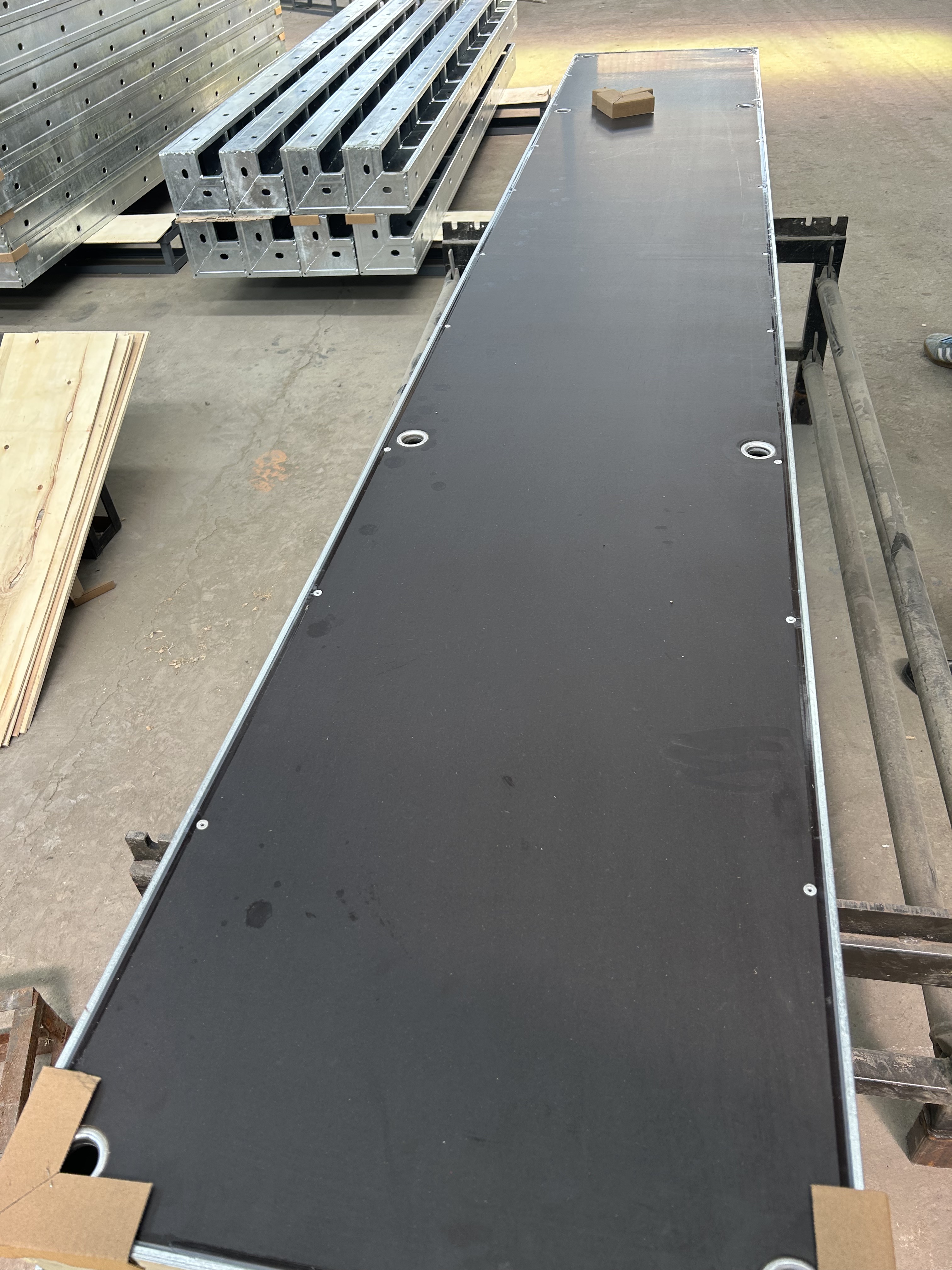
Steel concrete formwork panels with hot-dip galvanized frames. Source: RFH.
Use Cases for Concrete Formwork Systems
Concrete formwork systems are used across many project types, but three use cases cover most procurement decisions.
High-rise residential and commercial construction
For multi-story residential and commercial buildings, contractors need a formwork system that cycles quickly, can be reused many times, and does not require excessive crane time. Aluminium slab formwork is often chosen because it is lightweight, can be handled manually, and allows fast floor cycles. Industry data reports that aluminium formwork systems can support floor cycles as fast as 4–5 days in high-rise construction.
RFH's aluminum concrete formwork (FW00D) is designed for residential and commercial buildings, including multi-story apartments, office towers, and mixed-use developments. It is also used for complex projects such as airport piers and high-rise towers, and can form inclined slabs, ramps, and drains with an inclination angle of up to 8%.
Heavy civil, infrastructure, and high-wall vertical casting
Subterranean structures, large foundations, and high-wall vertical casting create high concrete pour pressures and need rigid formwork with strong ties and alignment systems. Operating conditions often include outdoor sites with extreme weather, high humidity, and high pour pressures.
RFH heavy-duty wall formwork is suited to this scenario. The system is assembled in crane-assisted modular sequences, uses tie rods, alignment struts, formwork clamps, push-pull shores, and crane hooks, and is designed for fast mechanical stripping and cyclic repositioning. RFH reports that its heavy-duty wall formwork panels can be ganged together for crane lifting or handled manually for smaller configurations.
Mid-size commercial projects where cranes are limited
On projects where crane access is limited or expensive, light-duty steel wall formwork offers a practical balance. Panels can be handled by hand for small jobs and lifted by crane for larger tasks. RFH light-duty steel concrete formwork (FW00B) is intended for residential building and commercial construction. Its S420 steel frame and hot-dip galvanized finish give it a long service life, while its 60 kN/m² pressure rating covers typical light wall and column works.
What to Verify in a Formwork Specification Before Ordering
Before you issue a purchase order, put the following items into a specification sheet or a supplier questionnaire. This helps you compare quotations from different formwork manufacturers on the same basis.
- Product model and type (e.g., heavy-duty wall formwork, light-duty steel formwork, aluminum slab formwork).
- Frame material grade (e.g., S420 steel, 6005-T6 aluminum).
- Frame profile size and section thickness.
- Permissible concrete pressure in kN/m² (e.g., 60 or 80 kN/m²).
- Panel facing material and thickness (e.g., 15 mm film-faced birch plywood, 18 mm European birch plywood).
- Surface treatment (e.g., hot-dip galvanization).
- Available panel widths and heights that match your project geometry.
- Compatibility with any existing formwork system you already own.
- Certificate numbers and the exact scope of certification.
- Lead time, MOQ, packaging, and inspection options.
Quality, Certification, and Market Application
RFH's concrete formwork systems are manufactured in Shandong, China, and sold to 126 countries and regions. The company's main markets are the EU, the USA, Australia, South America, and other export destinations; its export ratio is 100%. This means the production and documentation processes are designed for cross-border procurement from the start.
The application scenarios for RFH formwork cover a broad set of markets: Europe, the Americas, the Middle East, Africa, and Oceania. Country examples include the United Arab Emirates, Argentina, Austria, Australia, Belgium, Bulgaria, Brazil, Canada, Chile, Colombia, Germany, Denmark, Algeria, Spain, Finland, France, the United Kingdom, Croatia, Hungary, Ireland, Israel, Iceland, Italy, Jamaica, Mexico, Nigeria, the Netherlands, Norway, New Zealand, Peru, Poland, Portugal, Qatar, Russia, and other markets. If your project is in one of these regions, you should still confirm local compliance requirements with your engineering team before choosing a system.
Frequently Asked Questions
Is RFH concrete formwork certified for international projects?
Yes. RFH operates an ISO 9001:2015 quality management system with certificate number 00123Q310174R301, issued by China Quality Certification Centre. The certification scope covers the design and production of scaffolding, coupler, and formwork. Concrete formwork models FW00A, FW00B, FW00C, and FW00D are covered by ISO9001 certification for the global market. RFH also states that welding is controlled in accordance with European standard EN1090, product acceptance follows international standards BS1139 and EN74, and the company has obtained 22 relevant certificates including EN1065, EN74, and CE.
What concrete pressure rating can RFH formwork handle?
RFH heavy-duty concrete formwork (model FW00A) has a permissible concrete pressure of up to 80 kN/m². The light-duty steel concrete formwork (model FW00B) has a permissible concrete pressure of 60 kN/m². The wall formwork (FW00C) and aluminium slab formwork (FW00D) do not have a published pressure rating in the same specification sheet, so for those systems clarify the allowable pouring conditions with RFH before design.
Can RFH customize formwork dimensions or produce under my brand?
Yes. RFH supports OEM, ODM, and customized production. Customization options include height, width, color, and logo printing. The company can also undertake processing based on client design drawings and samples. Its monthly capacity is 1000 tons, with a typical lead time of 40–60 days and a minimum order quantity of 50 units.
What is the difference between heavy-duty and light-duty steel formwork?
The main differences are the frame profile, the maximum concrete pressure, and the intended use. Heavy-duty steel formwork from RFH uses a 120×60×2.5 mm S420 frame and is rated up to 80 kN/m² for walls, columns, and heavy vertical casting. Light-duty steel formwork uses a 121×20×1.8 mm S420 frame and is rated at 60 kN/m²; it is suitable for light walls and columns with manual handling for small jobs. Both systems are hot-dip galvanized and reusable.
Can you send a sample or a catalog for the formwork range?
For a full specification review, you can download the RFH catalogue directly. If you need a quotation, drawings, or a sample for a specific model, it is best to contact RFH with your project sizes and panel mix, since MOQ and inspection requirements apply to production orders. RFH accepts 100% pre-shipment testing and third-party inspection such as SGS. Contact Sally Qin via email at fenghuaf@bdchina.com or WhatsApp at +86 158-9899-7661 to request a sample, a quotation, or the latest catalog.
Conclusion
Selecting a concrete formwork system requires you to evaluate more than the panel price. The key technical controls are the maximum concrete pressure, frame material and steel grade, panel facing, dimensional range, compatibility, and certification. A reliable supplier should show you production equipment, quality-control laboratories, certificate numbers, and export documents.
RFH provides steel, aluminum, and wall formwork systems with S420 frames, hot-dip galvanized surfaces, ISO9001-certified production, and export experience across 126 countries. For procurement teams, the next step is to translate your project geometry into a panel schedule and ask for a formal quotation. You can download the RFH New Catalogue to review the full range, or contact the RFH team directly for a quotation and pre-shipment inspection plan.