
OEM Concrete Formwork Manufacturing: Capabilities, Compliance, and Customization Explained
OEM Concrete Formwork Manufacturing: Capabilities, Compliance, and Customization
Contractors and developers evaluating a concrete formwork supplier for custom building projects need more than a catalog of standard panels. They need evidence that the manufacturer can engineer, test, and deliver systems that fit project-specific dimensions, site conditions, and compliance requirements. This guide explains the OEM and ODM capabilities available from RIZHAO FENGHUA SCAFFOLDINGS CO., LTD. (RFH), the production and quality-control process, and the practical questions to ask before placing an order.
Why OEM and ODM Capability Matters in Concrete Formwork Procurement
OEM (Original Equipment Manufacturing) and ODM (Original Design Manufacturing) are not interchangeable, although both involve a factory producing goods under a buyer's brand. In concrete formwork, OEM usually means the manufacturer builds panels and accessories to the buyer's drawings or specifications. ODM usually means the manufacturer contributes design engineering based on the buyer's performance requirements. RFH supports both, with customization available for product height, width, color, and logo printing.
Custom building projects often require non-standard panel sizes, unusual wall or column geometries, and site-specific handling requirements. A supplier with OEM/ODM capacity can reduce the need for on-site cutting and improvisation, which lowers labor cost and material waste. The commercial value of a formwork supplier therefore depends on whether it can translate project requirements into manufactured components without compromising safety or structural performance.
RFH Company Profile: A Manufacturer Built for Custom Work
RIZHAO FENGHUA SCAFFOLDINGS CO., LTD., commonly referred to as RFH, is a construction formwork and scaffolding manufacturer located in Rizhao City, Shandong Province, China. Founded in 1953, the company operates from an 80,000 m² factory and employs 260 people, including a 20-engineer R&D team. RFH produces concrete formwork, formwork systems, scaffolding systems, formwork accessories, and scaffolding accessories, with 100% of output exported to markets including the EU, USA, Australia, and South America.
The factory covers more than ten production workshops for cold bending, punching, welding, steel casting, electrostatic spraying, and forging. Production equipment includes 4 cold bending forming machines, 12 welding robots, 6 automatic welding assembly lines, 1 formwork profile forming assembly line, and 5 semi-automatic forging assembly lines. The combination of robotic welding and assembly lines gives RFH the capacity to handle both standard series production and custom OEM/ODM orders.
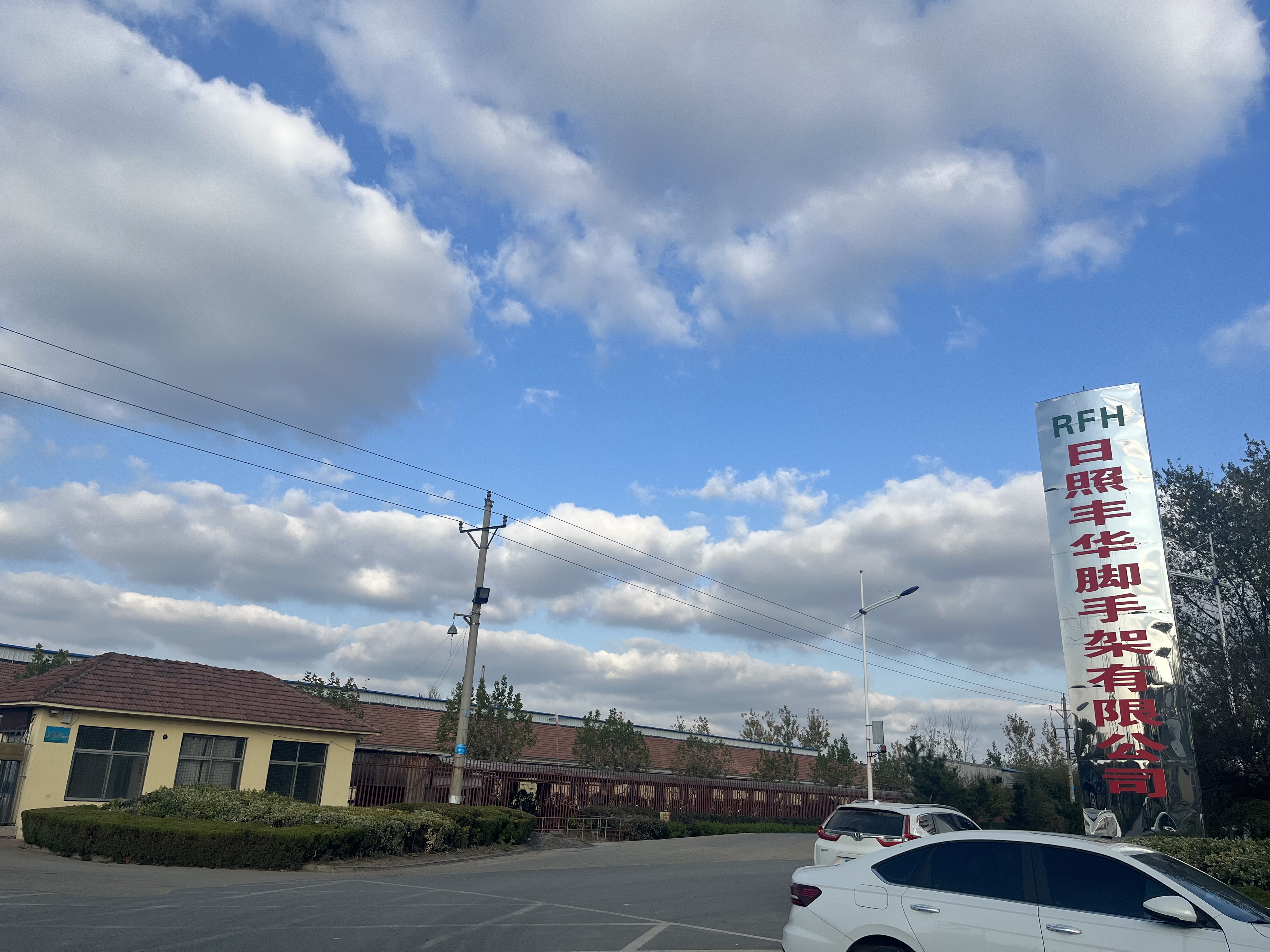
A relevant scale indicator is the company's export volume: RFH currently ships more than 1,200 containers per year and holds a stated annual output of 200 million tons. While manufacturers often express output differently, the combination of factory area, headcount, robotic production lines, and container volume helps a buyer assess whether a supplier has the production depth to meet a multi-project program.
Customization Options: What Can Be Changed in an OEM Order?
The most common misconception about OEM formwork is that customization is limited to logo printing. In practice, OEM/ODM capability affects geometry, material specification, surface finish, and accessory configuration. RFH's stated customization options are height, width, color, and logo printing. These options apply across the formwork product range, including wall formwork, column formwork, slab formwork, and aluminum systems.
The practical implications for a buyer are significant. Adjusting panel height and width allows a contractor to match story heights, beam depths, and column dimensions. Color and logo customization supports fleet identification, safety communication, and brand consistency on site. The ability to adjust geometry without redesigning the entire system reduces the gap between a standard catalog panel and the actual formwork layout on a construction drawing.
For projects that go beyond dimensional changes, RFH also operates as a design partner. The company states that it can undertake processing based on client design drawings and samples, which means a contractor or engineering consultant can supply drawings and rely on RFH for manufacturing feasibility, tooling, and production. This is particularly relevant for concrete metal formwork systems that must interface with other equipment, such as scaffolding and shoring props.
Concrete Formwork Product Range and System Compatibility
RFH produces 10 types of formwork with more than 80 specifications. The range includes aluminum alloy formwork, steel heavy-duty formwork, light-duty steel formwork, multi-formwork, column formwork, and adjustable shoring props.
A major advantage for international contractors is system compatibility. RFH states that its steel heavy-duty formwork can be used in compatible with PERI TRIO, HUNNEBECK RASTO, DOKA FRAMI, and TOPEC HARSCO products. Its Ringlock scaffolding is compatible with LAYHER products. Compatibility with established European systems reduces the need to replace an entire equipment fleet, allowing contractors to extend existing inventories with panels manufactured by RFH.
| RFH Formwork Category | Representative Models | Key Features | Typical Application |
|---|---|---|---|
| Steel frame formwork | FW00A Concrete Formwork | S420 steel frame; 18 mm European birch plywood or plastic composite; hot-dip galvanized; up to 80 kN/m² permissible concrete pressure | Walls, columns, corners; compatible with European trio-style systems |
| Light-duty steel formwork | FW00B steel concrete formwork | 121×20×1.8 mm profile; 15 mm film-faced birch plywood; hot-dip galvanized; 60 kN/m² | Light-duty wall and column formwork on residential and commercial buildings |
| Wall formwork | FW00C concrete wall formwork | 91.6×20×2 mm profile; S420 raw material; birch plywood or PP board; hot-dip galvanized | Vertical walls, shear walls, and similar concrete elements |
| Aluminum deck formwork | FW00D aluminum concrete formwork | 6005-T6 aluminum frames; 11 mm Baltic birch plywood; sizes from 1800×1800 to 900×300 mm | Slabs, flat or inclined up to 8% |
The FW00A system is the most detailed example available. It uses a 120×60×2.5 mm profile made from RFH Steel S420, with panel heights from 0.6 m to 3.3 m and widths from 0.3 m to 2.4 m. The permissible concrete pressure is up to 80 kN/m². The face material is 18 mm European birch plywood or plastic composite sheet, selected for moisture resistance and concrete finish quality. This combination of load capacity and surface finish makes the system suitable for walls and columns in concrete frame construction.
For slab construction, the aluminum deck formwork model FW00D uses aerospace-grade 6005-T6 aluminum alloy frames with 11 mm Baltic birch plywood bonded with phenol-formaldehyde resin. The stated size range covers large panels such as 1800×1800 mm down to 900×300 mm, supporting flat and inclined slabs with an inclination angle up to 8%. In high-rise construction, aluminum formwork systems are recognized in the industry for enabling floor cycles as fast as 4–5 days, making the material choice relevant to schedule-driven projects.
Production Capability: From Drawings to Delivered Containers
RFH reports a monthly capacity of 1,000 tons, a lead time of 40–60 days for production, and a minimum order quantity of 50 units. These numbers help a project team estimate whether a custom formwork program can meet the construction schedule. For a concrete formwork buyer, the manufacturer’s capacity should be evaluated not only in tons per month but in the number of welding robots, assembly lines, and finishing processes available.
The production process at RFH includes cold bending, punching, welding, steel casting, electrostatic spraying, and forging. The presence of dedicated workshops for each process means the company can control quality from raw material through to the finished panel. The company also has a mechanical test laboratory and a chemistry test laboratory, which are used to test incoming raw materials and products during production.
RFH's stated production equipment includes 12 welding robots and 6 automatic welding assembly lines. Automated welding is particularly important for formwork because weld quality directly affects structural integrity under repeated concrete pours. A supplier that relies on manual welding can still produce good panels, but robotic welding offers more consistent quality control across large order quantities.
For OEM orders, the practical flow is predictable: the client provides drawings or samples, RFH confirms feasibility and tooling, production runs through the relevant forming and welding processes, and final inspection is completed before shipment. Buyers should request a production schedule and inspection plan as soon as drawings are approved.
Quality Control, Certifications, and Compliance
RFH operates its quality management system in accordance with ISO 9001. The company holds an ISO 9001:2015 certificate issued by China Quality Certification Centre (CQC), certificate number 00123Q310174R301, valid until 2027-01-14. The certified scope covers design and production of scaffolding, couplers, and formwork.
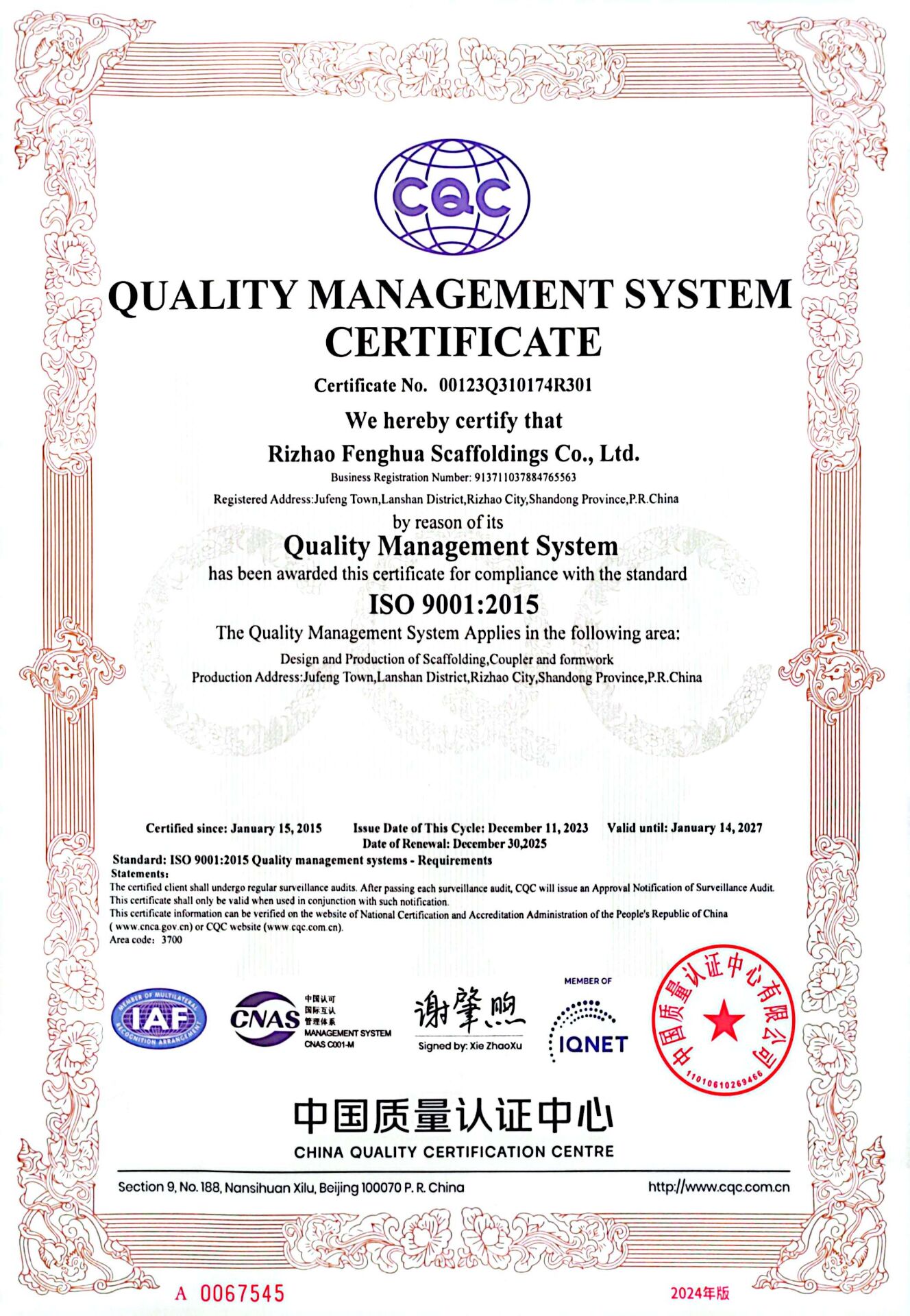
Welding is controlled in accordance with the European standard EN 1090, and RFH has obtained the corresponding European standard certificate. Product acceptance criteria follow international standards BS1139 and EN74, and the company holds 22 relevant certificates including EN 1065, EN74, and CE certification. For concrete formwork buyers, EN 1090 welding certification is a critical document, since it demonstrates that the manufacturer has a certified quality system for load-bearing steel structures.
RFH also states that welding is fully controlled in accordance with EN 1090. In Europe, EN 1090 is a legal requirement for structural steel components placed on the market; in other regions, it is often specified as evidence of manufacturing competence. The EN 12812 standard specifies performance requirements for falsework used to support formwork, and ASTM C1074 is the primary US standard for estimating concrete strength to determine when to remove formwork. While these two standards are project-side references, they indicate the compliance environment that formwork components must operate within.
For a custom formwork manufacturer, the presence of certified laboratories and third-party inspection matters because OEM products cannot always be verified by the buyer at the factory. RFH states that product acceptance includes pre-shipment tests and third-party SGS inspection. This gives the buyer an independent check on dimensions, weld quality, galvanization thickness, and overall workmanship before the container is shipped.
Step-by-Step: How to Run an OEM Formwork Order with RFH
A structured procurement process reduces risk and makes the custom manufacturing process predictable. The following workflow reflects standard practice for formwork OEM orders and RFH's stated capabilities.
- Define project requirements. Document wall, column, and slab dimensions; concrete pressure; pour rate; panel finish requirements; and site handling constraints. Distinguish between performance requirements (ODM input) and fixed dimensions (OEM input).
- Provide drawings or samples. RFH states that it can undertake processing based on client design drawings and samples. The more complete the drawing package, the faster the feasibility review and quotation.
- Request design input where needed. If the project requires a non-standard system layout, discuss whether RFH can supply design engineering. For ODM projects, the manufacturer's 20-engineer R&D team can contribute engineering expertise.
- Specify customization options. Confirm height, width, color, and logo printing. Also confirm the plywood grade, frame profile, and surface treatment. For FW00A, for example, the standard face options are 18 mm European birch plywood or plastic composite sheet.
- Evaluate samples and documentation. Review the ISO 9001 certificate, EN 1090 welding documentation, EN74/BS1139 acceptance criteria, and any other certificates relevant to the destination market.
- Agree on quality control and inspection. Include pre-shipment tests and third-party SGS inspection in the contract. RFH accepts these methods, and a third-party inspection report is valuable for letters of credit and customs clearance.
- Confirm logistics and payment. RFH delivers via FOB Qingdao, CIF, or CFR. Payment terms are 30% T/T in advance and 70% T/T before shipment. Clarify whether the project needs a partial shipment plan to keep the site working while the full order is produced.
- Plan for on-site support. RFH provides online technical support after sale. For complex systems, confirm in advance what drawings, assembly instructions, and troubleshooting support will be provided.
This process is not unique to RFH, but it is the most reliable way to use an OEM supplier's capabilities without losing control of quality or schedule.
Use Cases: Custom Formwork in Real Project Conditions
RFH formwork products have been applied in residential building and infrastructure projects in Germany and Singapore. In one documented case, a municipal government and engineering contractor used 10,000 m² of formwork in Germany and 1,500 m² in Singapore over a 10-year relationship for residential and infrastructure applications.
The stated result was that the structural concrete phase was completed 20 days ahead of schedule, drastically lowering crane rental and labor costs. The project also had to meet strict safety regulations on site, which was achieved through fully integrated walkway brackets and certified crane lifting hooks.
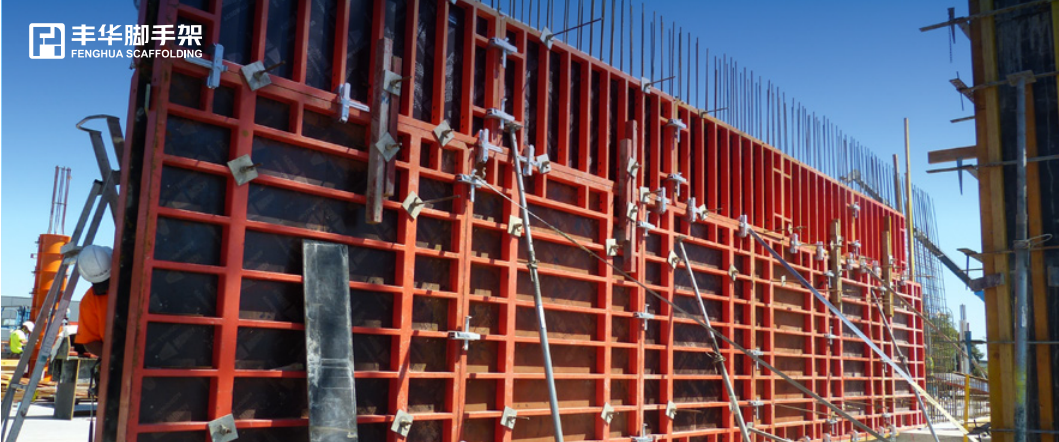
This case illustrates what an OEM supplier's capability means at project level: the formwork system is not just a set of panels but a component of the construction method. A 20-day schedule gain on the structural concrete phase is equivalent to a large reduction in crane time, labor, site overhead, and financing costs. For a contractor evaluating an OEM supplier, the relevant question is whether the supplier can provide the same level of integration—walkways, lifting hooks, safety accessories—that made the schedule gain possible.
For subcontractors and builders working in regions with high humidity or extreme weather, the formwork's operating environment is important. RFH states that its formwork is designed for environments characterized by extreme weather, high humidity, and high concrete pour pressures, and operates under outdoor site conditions. In tropical and coastal climates, the combination of hot-dip galvanized steel frames, moisture-resistant plywood, and compatible accessories reduces the risk of premature panel degradation.
Market Context: Where Steel, Aluminum, and Custom Systems Fit
The concrete formwork market provides useful context for OEM procurement decisions. According to Verified Market Research, the global concrete formwork market was valued at USD 8.9 billion in 2024. Asia-Pacific dominated the market with a share of 54.7% in 2025, according to Fortune Business Insights. Timber formwork represented 37% of global installation share in 2024, steel formwork 44%, and aluminum formwork 19%, according to Cognitive Market Research. Aluminum formwork systems are projected to reach USD 2.48 billion by 2032 with a CAGR of 9.9%, according to Intel Market Research.
The price benchmarks also vary by material and system type. Industry analyses estimate timber formwork at USD 10–25 per square meter, steel formwork at USD 25–60 per square meter for large projects, aluminum formwork at USD 40–75 per square meter, and plastic or modular systems at USD 20–50 per square meter. These are planning ranges rather than quotes, since actual pricing depends on system type, volume, custom tooling, freight, and specification.
| Formwork Type | Global Installation Share (2024) | Typical Cost Range | Best Fit |
|---|---|---|---|
| Timber | 37% | USD 10–25/m² | Small projects, flexible layouts, low reuse rates |
| Steel | 44% | USD 25–60/m² | Repeated pours, walls/columns, heavy civil work |
| Aluminum | 19% | USD 40–75/m² | High-rise slabs, fast floor cycles, high reuse value |
| Plastic/modular | Not specified | USD 20–50/m² | Simple geometries, lower pressure applications |
For an OEM order, material selection is a design decision, not just a price decision. Steel formwork provides the highest stiffness and is often selected for heavy wall and column pours. Aluminum formwork is lighter and supports faster handling cycles, which explains why aluminum systems are associated with 4–5 day floor cycles in high-rise construction. A supplier that manufactures both materials, as RFH does, can advise on the most economical system for a given project profile.
Comparison: RFH vs. Global Formwork Manufacturers
In evaluating OEM suppliers, buyers typically compare manufacturers on product breadth, compatibility, verification, and commercial flexibility. The following comparison uses publicly available facts about major manufacturers.
| Manufacturer | Headquarters | Notable Fact | OEM/ODM Relevance |
|---|---|---|---|
| RIZHAO FENGHUA (RFH) | China | Founded 1953; 80,000 m² factory; EN 1090 welding; ISO 9001; SGS inspection; 10 formwork types, 80+ specifications | OEM, ODM, customized production; compatible with PERI TRIO, HUNNEBECK RASTO, DOKA FRAMI, TOPEC HARSCO |
| PERI SE | Germany | Acquired Implenia Schalungsbau in 2023 to expand modular formwork services | Large-scale system supplier with global engineering network |
| Doka GmbH | Austria | Introduced DokaXact sensors in 2024 for real-time monitoring of concrete pressure on formwork | Technology-driven system supplier with digital monitoring |
| Top five manufacturers (including PERI and Doka) | Global | Hold approximately 44% of global market share | High engineering investment; typically less flexible for small-volume OEM work |
The top five formwork manufacturers, including PERI and Doka, hold approximately 44% of the global market share, according to Cognitive Market Research. For buyers, the implication is not that only these companies offer high quality; it is that a significant portion of the market buys from them for engineering support, brand consistency, and standardized systems. OEM suppliers like RFH serve a complementary role: they offer production flexibility, compatibility with existing systems, and direct factory pricing for buyers who can manage their own engineering or use standard European layouts.
RFH does not claim to be a global engineering leader. Its stated advantages are manufacturing capacity, certifications, system compatibility, and the ability to process client drawings. These are the attributes that matter in an OEM evaluation. A buyer should match the supplier type to the project risk profile. For a highly complex high-rise with demanding cycle time and full engineering services, a global system supplier may be the safer choice. For a contractor with an established design, a repeatable wall/column layout, or a need to expand an existing European-system fleet, an OEM manufacturer can offer lower cost and faster response.
Buyer’s Checklist for Custom Formwork Procurement
The following checklist can be used to compare suppliers and finalize an OEM formwork order.
- Factory and history: How long has the manufacturer been in business? What is the factory area, headcount, R&D team size, and production equipment?
- Certification: Does the supplier hold ISO 9001? Is welding certified to EN 1090? Are product acceptance criteria aligned with BS1139 and EN74? Ask to see certificates.
- Customization: Does the supplier offer OEM, ODM, and customized production? Which parameters are customizable—height, width, color, logo, plywood grade, profile?
- System compatibility: If you already own formwork made by PERI, Doka, Hünnebeck, or Harsco, ask whether the supplier's panels are compatible. RFH states compatibility with these systems.
- Load capacity: Confirm the permissible concrete pressure. For RFH FW00A, the stated value is up to 80 kN/m²; for FW00B, 60 kN/m².
- Panel face materials: Confirm plywood thickness and grade, or whether plastic composite is available. For FW00A, the standard is 18 mm European birch plywood or plastic composite.
- Quality verification: Is there a pre-shipment test? Is third-party inspection available? RFH states pre-shipping tests and SGS inspection.
- Commercial terms: What is the MOQ, lead time, payment method, and delivery Incoterm? RFH's stated terms are 50 units MOQ, 40–60 days lead time, 30/70 T/T, and FOB Qingdao/CIF/CFR.
- After-sales support: Is technical support available online? What documentation will be provided for installation?
A printable version of this checklist can be kept as a scoring sheet during supplier visits or virtual meetings.
Limitations and Risks to Consider in OEM Formwork
An honest assessment of OEM formwork must also address limitations. Even a capable manufacturer cannot guarantee the performance of a formwork system if the structural design is deficient. The buyer remains responsible for the overall formwork design, bracing, tie pattern, and pour sequence unless the scope of supply explicitly includes design engineering.
Compatibility with systems such as PERI TRIO or DOKA FRAMI does not mean every component is identical. Buyers should request a component-level compatibility matrix and test a sample panel before committing to a full container order. Similarly, a 50-unit MOQ is low enough for customization but still requires an agreement on tolerances, inspection standards, and rectification procedures.
Lead times are always subject to raw material availability and production scheduling. The stated 40–60 day lead time should be confirmed in writing at the time of order, and the contract should include milestone dates for material confirmation, sample approval, and inspection readiness.
FAQ
Can RFH manufacture formwork to my project drawings and brand?
Yes. RFH provides OEM, ODM, and customized production services, with customization available for product height, width, color, and logo printing. The company states that it can undertake processing based on client design drawings and samples. A buyer can therefore submit project-specific drawings and expect RFH to handle manufacturing feasibility, production, and finishing, rather than being limited to standard catalog panels.
What certifications should an OEM concrete formwork manufacturer hold?
For formwork steel components, welding should be certified to EN 1090, and the quality management system should be ISO 9001 certified. Product acceptance criteria commonly reference BS1139 and EN74. RFH holds an ISO 9001:2015 certificate from CQC and has obtained EN 1090 certification, with 22 relevant certificates including EN 1065, EN74, and CE. Buyers should request copies of these certificates and verify that the certified scope includes design and production of formwork.
What is the minimum order quantity and typical lead time?
RFH's stated minimum order quantity is 50 units, with a monthly production capacity of 1,000 tons and a lead time of 40–60 days. This means custom formwork programs can be sized for mid-sized contractors rather than requiring container-scale commitments. However, the MOQ and lead time should be confirmed against the specific product type, quantity, and current production load.
Can I request pre-shipment inspection and use third-party testing?
Yes. RFH states that products are accepted through pre-shipping tests and third-party SGS inspection procedures. Buyers can include this requirement in the contract at no additional risk. A pre-shipment inspection by SGS provides independent verification of dimensions, welding, surface treatment, and overall workmanship before the goods leave the factory.
What are RFH's delivery terms and payment conditions?
RFH arranges delivery through FOB Qingdao, CIF, and CFR methods. The standard payment terms are 30% T/T in advance and 70% T/T before shipment. These are common terms in the construction equipment trade, but buyers can discuss alternatives depending on order value and financing requirements.
How do RFH's formwork panels compare with major global systems?
RFH manufactures steel heavy-duty formwork that is compatible with PERI TRIO, HUNNEBECK RASTO, DOKA FRAMI, and TOPEC HARSCO products, and Ringlock scaffolding compatible with LAYHER products. The FW00A system uses a 120×60×2.5 mm S420 steel frame and permits concrete pressure up to 80 kN/m². Compatibility allows contractors to extend existing fleets without replacing all components. Buyers should still request a component-level compatibility matrix and sample panel before making a final selection.
Conclusion: What to Ask Before You Commit to an OEM Concrete Formwork Supplier
An OEM concrete formwork order can be an efficient way to obtain panels that match a project's exact dimensions and existing fleet, but only when the supplier has the right manufacturing depth, compliance evidence, and commercial flexibility. The first question is not “can you print my logo on a panel?” but “can you manufacture a panel that meets my concrete pressure, dimension, and safety requirements, and prove it through certification and inspection?”
RFH's relevant strengths are the scale of its manufacturing base—80,000 m² factory, 260 employees, robotic welding lines—and its certification stack, including ISO 9001, EN 1090, EN74, and CE. Its stated ability to manufacture based on client drawings and samples, combined with compatibility with major European systems, makes it a candidate for contractors looking for a production partner rather than a purely off-the-shelf catalog supplier.
The next step for a serious buyer is to convert this guide into a request for quotation. Send project drawings, specify the formwork types and quantities, state the required certifications, and ask for a sample panel before production. RFH's sales team can be reached at the contact details below, and a full product catalogue is available for download.
Ready to discuss a custom formwork order?
Contact RFH for a quotation based on your drawings and project schedule.
Email: fenghuaf@bdchina.com | WhatsApp: +86 158-9899-7661
Download the RFH product catalogue: RFH New Catalogue (PDF)