
1PC vs 2PC vs 3PC Threaded Ball Valve: Chemical & Gas Lines
1PC vs 2PC vs 3PC Threaded Ball Valve: Chemical & Gas Lines
For chemical and gas line service, the choice between a 1PC, 2PC and 3PC threaded ball valve is a decision about body construction, maintenance access and documented acceptance — not about pressure class. Across the RST VALVE GROUP CO.,LTD threaded ball valve series (models Q11F, Q61F, Q81F and Q11PPL), the published line data is shared: DN6–DN100, 1000–2000 WOG, -20°C to 180°C, CF8 (304) / CF8M (316) body material, PTFE seats and an ISO 5211 actuator mount.
Short answer. Specify a three-piece (3PC) threaded body when the valve must be serviced in line without cutting the pipework. Specify a 1PC or 2PC threaded body when the duty is a compact isolation point and fewer body joints are preferred. In every case, lock three documents before the order: the model-specific datasheet, the certificate scope and the factory acceptance test report.
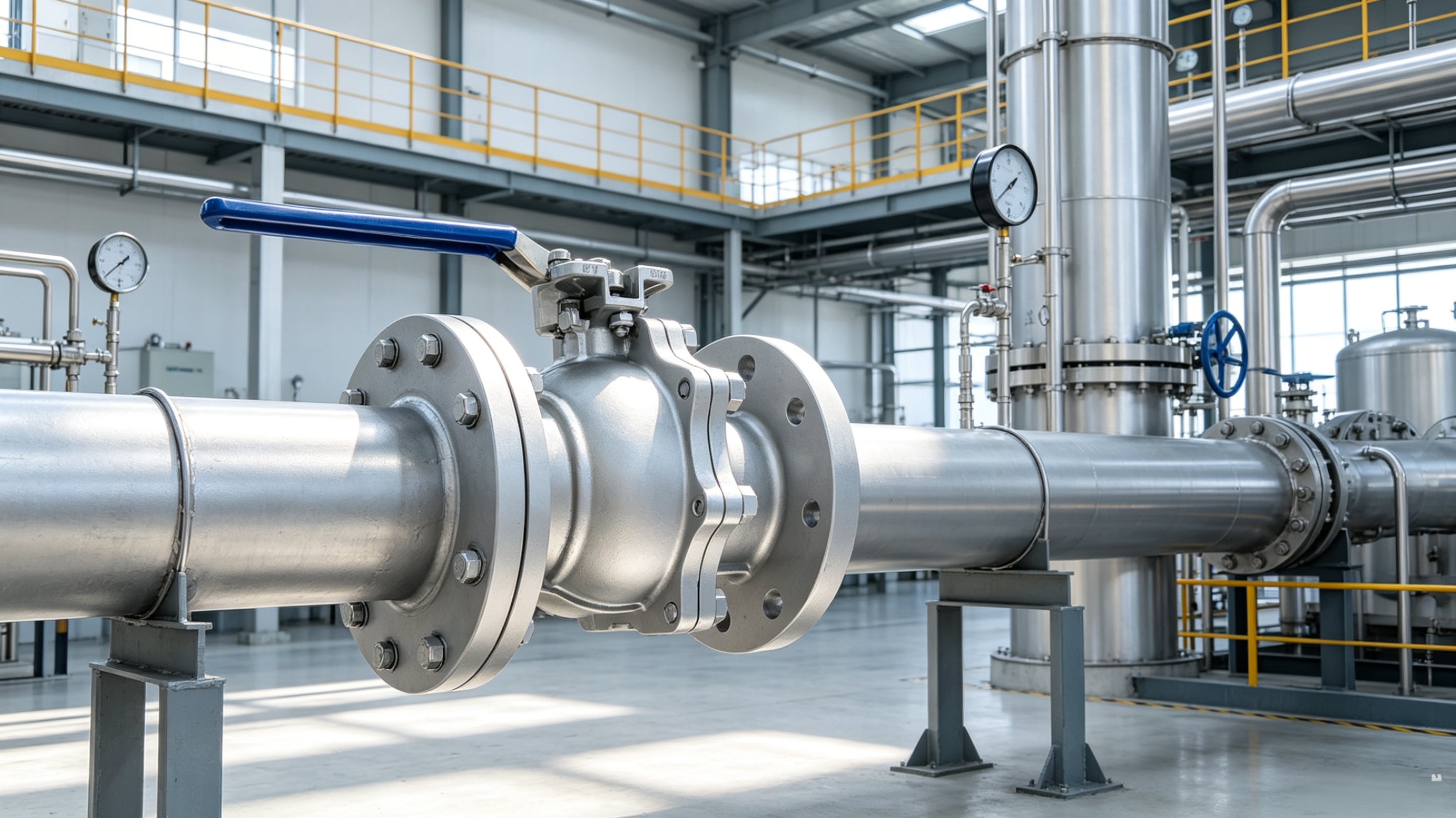
Stainless steel ball valve applied in industrial process piping, suitable for chemical and water treatment projects. Image: RST VALVE GROUP CO.,LTD.
Why 1PC, 2PC and 3PC Threaded Ball Valves Look Interchangeable in a Catalog
A valve catalog presents the threaded ball valve as one product family, and at the data level that is accurate. The range figures published for the RST threaded ball valve series cover the series as a whole, and that series contains 1PC, 2PC and 3PC threaded bodies, a 1-PC hex threaded body, direct mounting pad variants and welded-end variants. Two different configurations therefore arrive on the same page with the same DN range, the same 1000–2000 WOG rating and the same -20°C to 180°C temperature window.
The difference only becomes visible at three points in a project:
- Maintenance planning. If the body cannot be opened in line, the isolation and purge procedure for the surrounding skid has to change.
- Spare-part strategy. More body joints generally mean more parts to stock and more seals to reseat after each service.
- Acceptance and documentation. Test reports and certificates are issued against a defined product scope. A mismatch between the ordered configuration and the certified scope becomes a commissioning problem rather than a purchasing one.
RST Valve Group's own selection guidance starts from the same place: confirm medium type, working pressure, working temperature, nominal diameter and connection type, then match the body material and the sealing material to the pipeline medium and the working conditions.
Industry Background: Where Threaded Ball Valves Sit in Chemical and Gas Service
A threaded ball valve is a quarter-turn, on-off isolation valve used to shut off, distribute or change the flow direction of a medium. RST VALVE GROUP CO.,LTD, founded in 2009 and based in Wenzhou, Zhejiang Province, China, manufactures this series for process piping in the chemical, gas, pharmaceutical and water treatment industries, with published service conditions of PN16–PN63 / CLASS 150–300, -20°C to 180°C, and media covering water, oil, gas and weak acids or alkalis.
Operation is a 90° quarter-turn. The series accepts manual operation with an optional lockable handle, pneumatic actuation in single or double acting form, and electric actuation for on-off or modulating duty, through an ISO 5211 direct-mount actuator interface. Two operating limits belong in the specification before anything else: the valve is designed for on-off service and is not suitable for throttling, and disassembly under pressure is strictly prohibited.
Standards context drives the acceptance criteria. API Specification 6D (25th Edition, effective 2025-11-01) defines requirements for the design, manufacturing, assembly, testing and documentation of ball, check, gate and plug valves for petroleum and natural gas pipeline and piping systems, and covers pressure classes 150, 300, 400, 600, 900, 1500 and 2500. In oil and gas procurement, IOGP S-562 Version 3.1 is applied together with API 6D as a supplementary specification for manually operated ball valves, with an allowable operating temperature range of -50 °F to 302 °F (-46 °C to 150 °C) in that defined context. Both are project-specific procurement requirements rather than universal ratings, so they should be compared against the buyer's own specification rather than assumed to apply.
Detailed Solution: The RST Threaded Ball Valve Series, Configuration by Configuration
Models and body configurations published in the series
RST VALVE GROUP CO.,LTD lists four threaded ball valve models — Q11F, Q61F, Q81F and Q11PPL — and the series contains these configurations:
- 1PC Threaded Ball Valve
- 2PC Threaded Ball Valve
- 3PC Threaded Ball Valve
- 1-PC Hex Threaded Ball Valve
- 1PC Threaded Direct Mounting Pad Ball Valve
- 2PC Threaded Direct Mounting Pad Ball Valve
- 2PC Socket Welded Ball Valve
- 3PC Socket Welded Ball Valve
- 3PC Butt Welded Ball Valve
Published line parameters
| Parameter | Published value for the threaded ball valve series |
|---|---|
| Size range | DN6 – DN100 |
| Pressure rating | 1000 – 2000 WOG |
| Temperature | -20°C to 180°C |
| Body material | CF8 (304) / CF8M (316); carbon steel / SS304 / SS316 also listed |
| Seat material | PTFE |
| Connection | Threaded / Socket Weld / Butt Weld / Tri-Clamp |
| Actuator mount | ISO 5211 |
Source: RST VALVE GROUP CO.,LTD threaded ball valve series product data.
What 1PC, 2PC and 3PC describe
In general valve design practice, the number describes how many body parts are joined to form the pressure boundary. A one-piece (1PC) threaded body is machined as a single housing and is normally loaded from one end. A two-piece (2PC) design divides the body so the ball and seats can be assembled and reached from one side. A three-piece (3PC) design separates the body into two end caps and a centre section — the arrangement generally used when the centre section has to be removed for in-line maintenance while both pipe connections stay undisturbed. These are construction conventions, and the specific bore, port type and joint arrangement of each RST model should be confirmed on the model datasheet before ordering.
Two practical consequences follow. First, the configuration determines the maintenance procedure, not the line capacity: all three configurations are published under the same DN6–DN100 and 1000–2000 WOG line data. Second, the configuration determines what must be re-sealed after service, which in turn determines the spare-parts list that should be ordered together with the valves.
Certification evidence attached to this series
The threaded ball valve series sits inside RST's documented certification scope. The functional safety certificate issued under IEC 61508:2010 Parts 1–7 (No. 4I260528.RSTDO08, issued 2026-05-28, valid to 2031-05-27) covers industrial valves including ball valves in the Q series. The PED-CE EU-Production Type Certificate (ECM PED-Bp 2024-TW60, issued 2024-06-27, valid to 2029-06-26) covers industrial valves from DN15 to DN1200, NPS1/2 inch to 48 inch, PN6 to PN260 and Class150 to Class1500. The management system certificates — ISO 9001 (20225Q21079R0M), ISO 14001 (20225E20474R0M) and ISO 45001 (20225S20439R0M), all issued 2025-09-28 and valid to 2028-09-27 by ZHEJIANG QUANPIN CERTIFICATION CO.,LTD. — cover the production and sales of metal valves and filters.
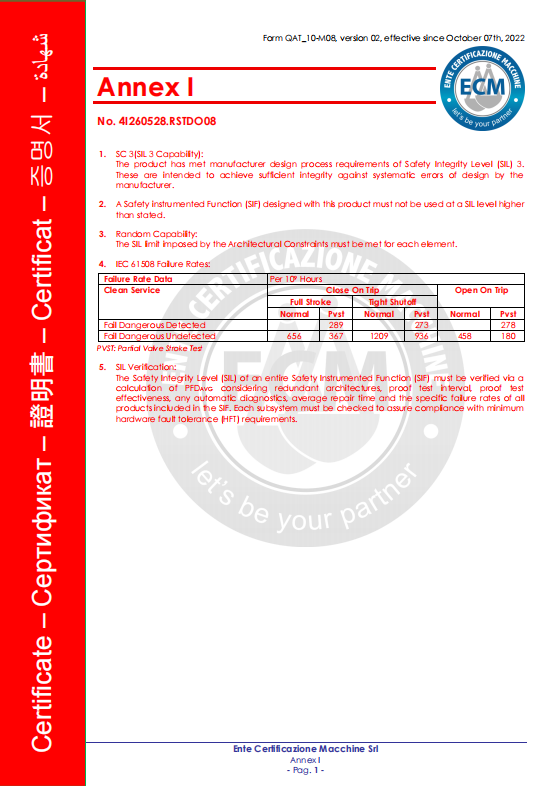
SIL Functional Safety Certificate under IEC 61508:2010 Parts 1–7, No. 4I260528.RSTDO08. Image: RST VALVE GROUP CO.,LTD.
Step-by-Step Breakdown: Specifying a Threaded Ball Valve for a Chemical or Gas Line
Step 1 — Fix the service conditions in writing
Medium type, working pressure, working temperature, nominal diameter and connection type come first. Medium classification matters because the same valve body can behave differently depending on whether the line carries water, oil, gas or a weak acid or alkali, and the sealing material has to match the medium.
Step 2 — Choose the body configuration
Use the maintenance route to decide. If the valve will be opened, inspected or re-seated on site without cutting the pipe, a 3PC threaded body is the configuration built for that access. If the valve is a permanent, low-touch isolation point, a 1PC or 2PC threaded body keeps the body joint count and the spare-parts list shorter.
Step 3 — Lock the material and seat combination
CF8 (304) and CF8M (316) are the published body materials for the series, with PTFE as the published seat material. Where the application requires more, the series is available with special seal options, anti-static and fire-safe design options and, for food and pharmaceutical applications, a 316L polished finish with food-grade seals.
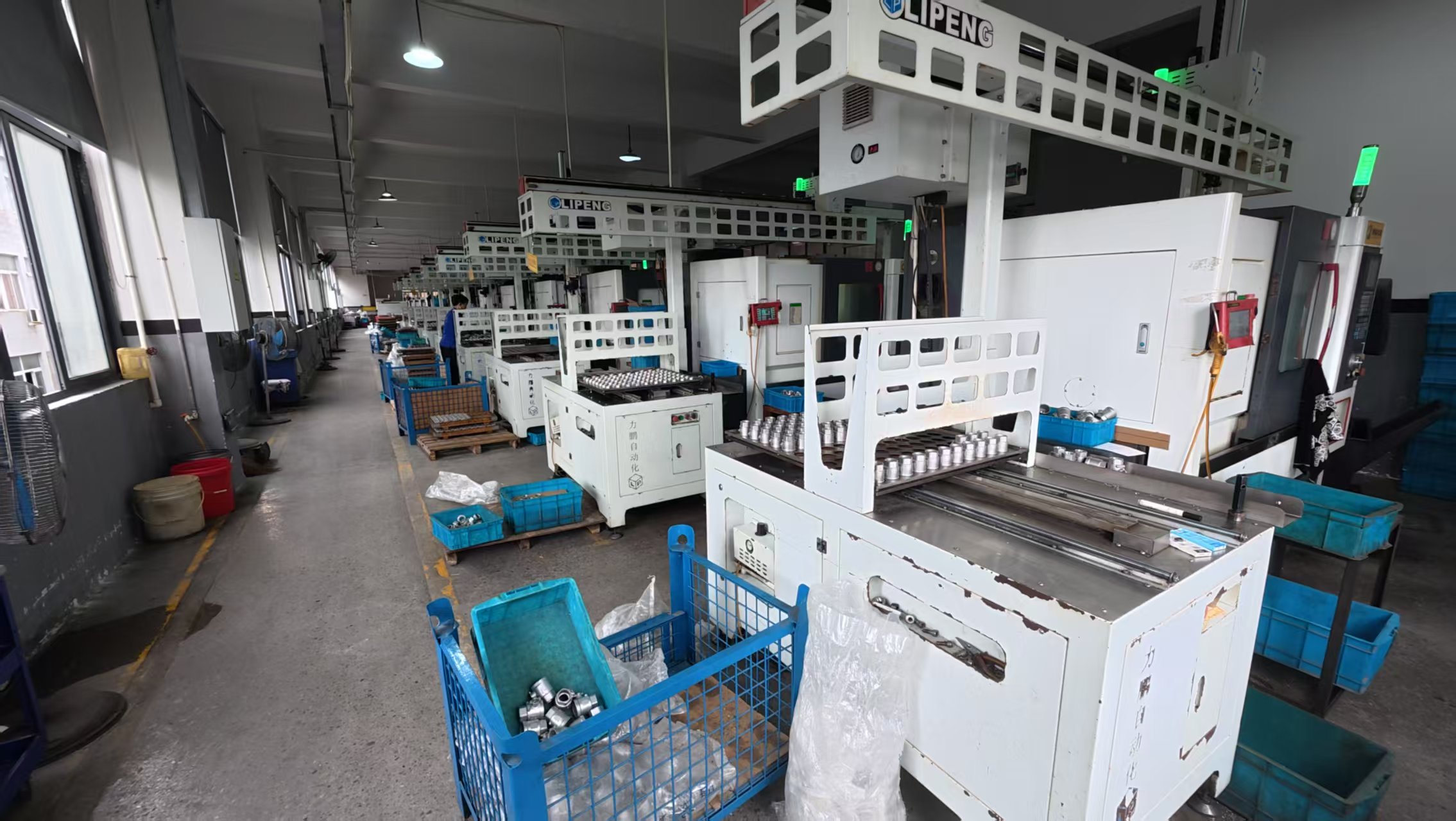
Precision CNC machine for threaded ball valves. Image: RST VALVE GROUP CO.,LTD.
Step 4 — Decide the end connection and the actuation interface
Threaded, socket weld, butt weld and tri-clamp connections are all published for this series, so the connection decision can be made without changing valve family. If automation is planned now or later, specify the ISO 5211 direct-mount interface — it accepts manual lockable handles, pneumatic single or double acting actuators and electric on-off or modulating actuators. An explosion-proof configuration should be specified for flammable or explosive applications.
Step 5 — Match the certificate scope to the valve being ordered
Read the certificate scope, not just the certificate title. The SIL certificate names the Q series inside its scope, and the PED-CE certificate defines its coverage by size, pressure class and standard. If the buyer's specification also invokes API 6D, that has to be confirmed separately for the offered valve, because API 6D is a distinct pipeline-valve specification with its own design, testing and documentation requirements.
Step 6 — Agree the acceptance tests and the documents
RST's documented quality control sequence is shell strength test, seat leakage test, material inspection, visual inspection and a 100% factory test, with test reports and material certificates issued with the shipment. Buyers should also specify a blowout-proof stem at this stage and confirm the bidirectional zero-leakage sealing requirement in writing.
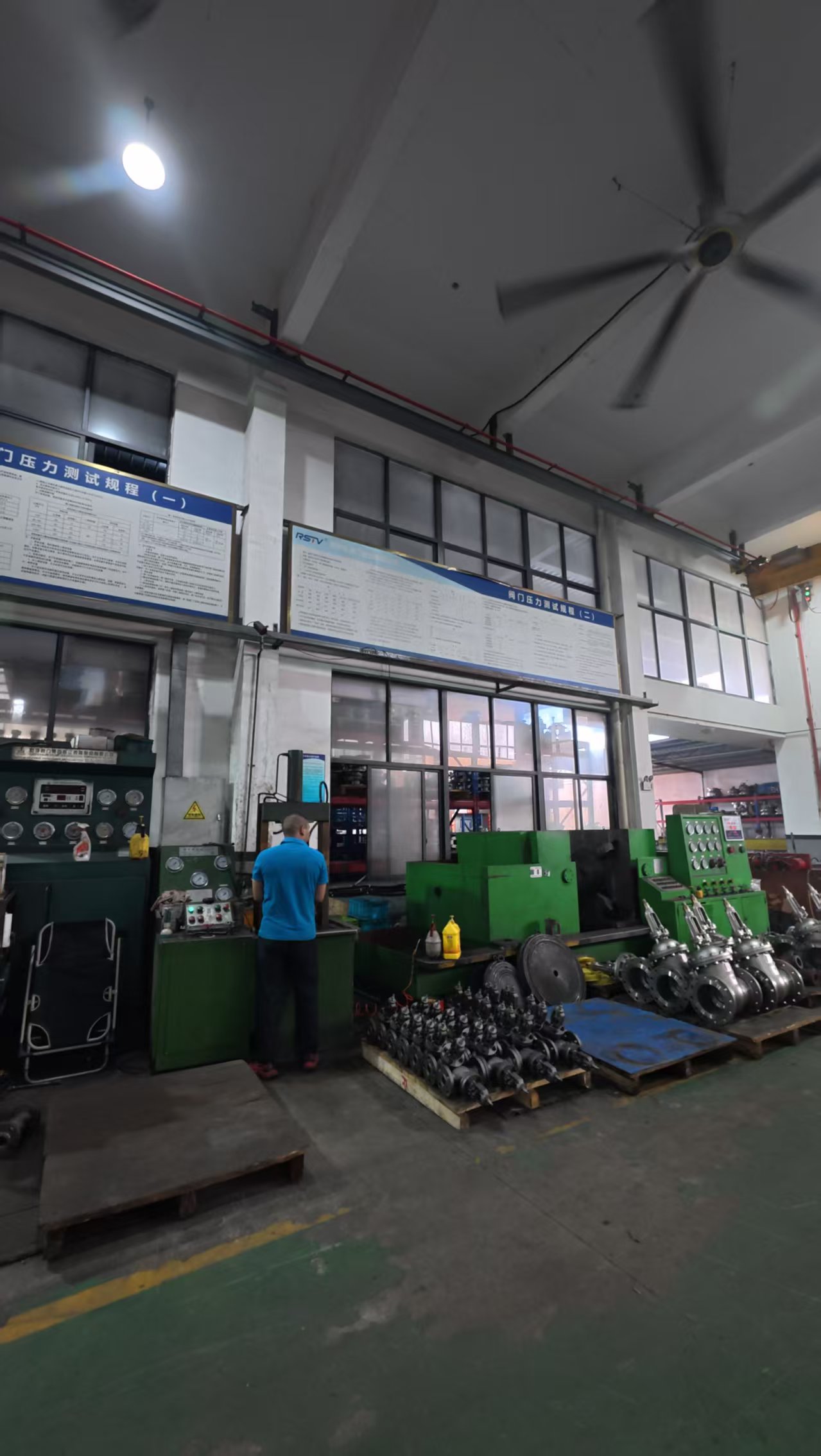
Valve pressure testing machine used for shell strength and seat leakage testing. Image: RST VALVE GROUP CO.,LTD.
Step 7 — Confirm the commercial terms
Minimum order quantity is 1 unit, monthly production capacity is 15,000 units, and the typical production lead time is 20–45 days. Body material, connection type, pressure rating, actuator, logo, marking, special seal, fire-safe or anti-static design and sanitary polishing are all available as OEM / ODM customization.
Use Cases: Chemical, Gas and Utility Duty
In field service, this valve family is deployed for process pipeline on-off isolation in chemical, gas and water utility systems. A documented project profile describes chemical plants, water treatment contractors and gas engineering companies ordering 50–500 units per project, with a service duration of 8–10 years, bubble-tight zero leakage, stable operation and low maintenance cost, supported by quarter-turn fast switching and bi-directional sealing.
Actuated versions serve the same duty where remote operation is required: a pneumatic ball valve mounted on a pipeline rack is used in oil and gas and petrochemical service for remote on-off control. For gas and other flammable service, the explosion-proof configuration and the anti-static option should be confirmed at the specification stage.
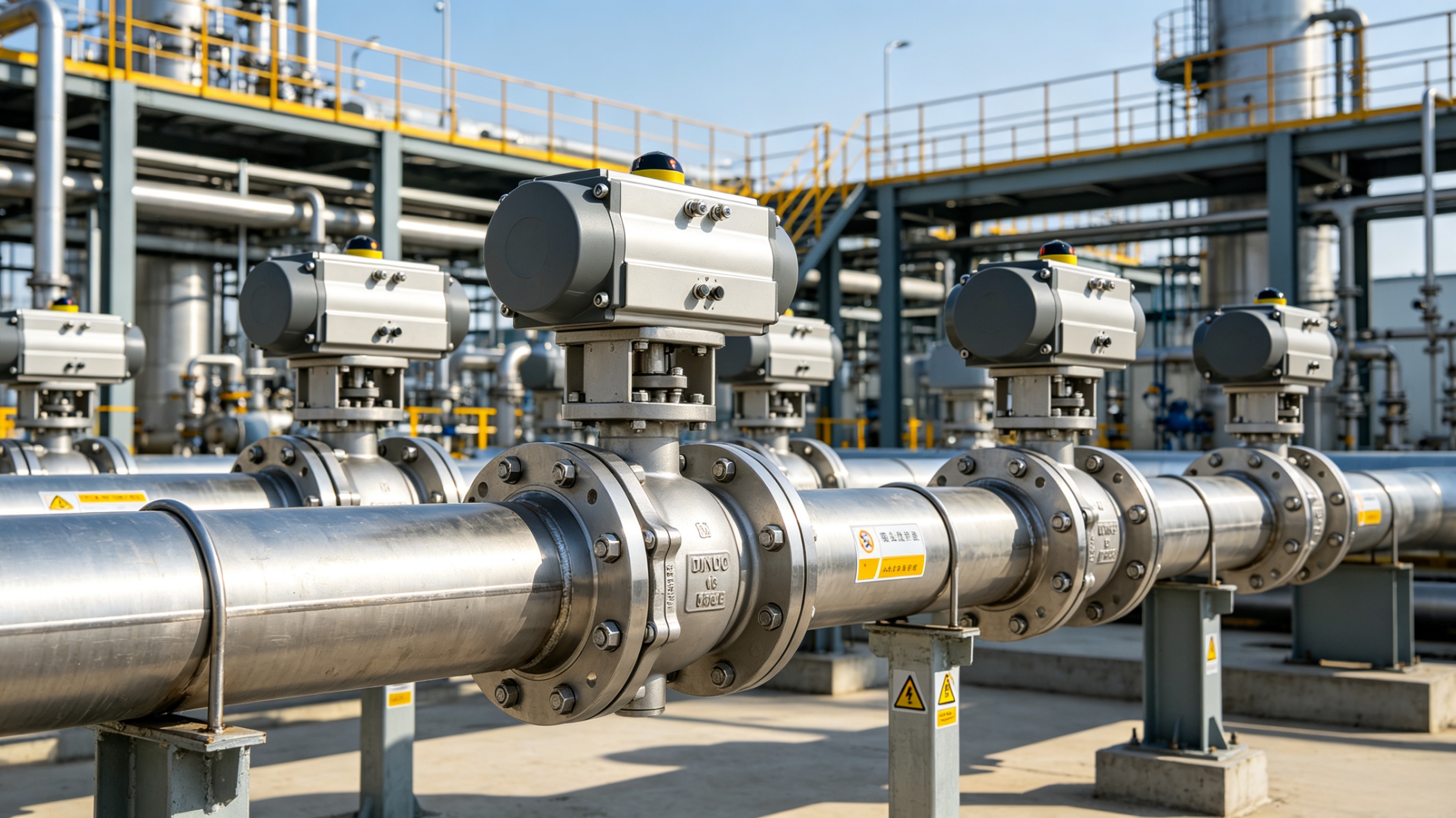
Pneumatic ball valve mounted on a pipeline rack, used in oil and gas and petrochemical service for remote on-off control. Image: RST VALVE GROUP CO.,LTD.
Typical configuration fit for a chemical or gas line, subject to datasheet confirmation:
- 1PC threaded body — compact isolation points on utility or instrument branches where maintenance access is rarely required.
- 2PC threaded body — general chemical and gas line isolation where the valve may be dismantled during a turnaround but in-line service is not a routine requirement.
- 3PC threaded body — lines where the centre section must be inspected or re-seated in place, or where one body style is preferred across a maintenance-heavy skid.
Comparison Table: 1PC vs 2PC vs 3PC Threaded Ball Valve
| Comparison item | 1PC threaded | 2PC threaded | 3PC threaded |
|---|---|---|---|
| Configurations published in the RST threaded series | 1PC Threaded Ball Valve; 1-PC Hex Threaded Ball Valve; 1PC Threaded Direct Mounting Pad Ball Valve | 2PC Threaded Ball Valve; 2PC Threaded Direct Mounting Pad Ball Valve; 2PC Socket Welded Ball Valve | 3PC Threaded Ball Valve; 3PC Socket Welded Ball Valve; 3PC Butt Welded Ball Valve |
| General construction convention | Single-piece body, normally end-loaded | Two-piece body, accessible from one side | Three-piece body: two end caps plus a removable centre section |
| Selection driver | Fewest body joints | Balance between access and part count | In-line access for service without disturbing pipe connections |
| Published line data applying to the series | DN6–DN100; 1000–2000 WOG; -20°C to 180°C; CF8/CF8M; PTFE seat; ISO 5211 | DN6–DN100; 1000–2000 WOG; -20°C to 180°C; CF8/CF8M; PTFE seat; ISO 5211 | DN6–DN100; 1000–2000 WOG; -20°C to 180°C; CF8/CF8M; PTFE seat; ISO 5211 |
| Actuation support | Manual lockable handle; pneumatic single/double acting; electric on-off/modulating via ISO 5211 | Manual lockable handle; pneumatic single/double acting; electric on-off/modulating via ISO 5211 | Manual lockable handle; pneumatic single/double acting; electric on-off/modulating via ISO 5211 |
| Connection options in the series | Threaded; socket weld; butt weld; tri-clamp | Threaded; socket weld; butt weld; tri-clamp | Threaded; socket weld; butt weld; tri-clamp |
| To confirm before ordering | Model-specific bore and joint design; seat compound for the medium; certificate scope; test report and material certificate | Model-specific bore and joint design; seat compound for the medium; certificate scope; test report and material certificate | Model-specific bore and joint design; seat compound for the medium; certificate scope; test report and material certificate |
The published line parameters apply to the threaded ball valve series as a whole; configuration-specific values should be confirmed on the model datasheet or at RFQ.
| Acceptance evidence | Reference | Scope notes |
|---|---|---|
| SIL Functional Safety Certificate | No. 4I260528.RSTDO08; IEC 61508:2010 Parts 1–7; issued 2026-05-28; valid to 2031-05-27 | Industrial valves (gate, ball, globe, check, butterfly); Z, J, H, Q, D and ZJHM series |
| PED-CE EU-Production Type Certificate | ECM PED-Bp 2024-TW60; issued 2024-06-27; valid to 2029-06-26 | Industrial valves DN15–DN1200, NPS1/2–48 inch, PN6–PN260, Class150–Class1500 |
| ISO 9001 | 20225Q21079R0M; GB/T 19001-2016 / ISO 9001:2015; 2025-09-28 to 2028-09-27 | Production and sales of metal valves and filters |
| ISO 14001 | 20225E20474R0M; GB/T 24001-2016 / ISO 14001:2015; 2025-09-28 to 2028-09-27 | Production, sales and related management activities |
| ISO 45001 | 20225S20439R0M; GB/T 45001-2020 / ISO 45001:2018; 2025-09-28 to 2028-09-27 | Production, sales and related management activities |
| Factory test documents | Shell strength test, seat leakage test, material inspection, visual inspection, 100% factory test | Test reports and material certificates provided with the shipment |
Certification details as documented by RST VALVE GROUP CO.,LTD and issued by the named certification bodies.
FAQ
What certifications should I verify before buying a threaded ball valve for a chemical or gas line?
Verify the scope, not only the certificate title. RST Valve Group's threaded ball valve series sits inside three documented certificate groups: a SIL Functional Safety Certificate under IEC 61508:2010 Parts 1–7 (No. 4I260528.RSTDO08, valid to 2031-05-27) covering industrial valves including the Q series; a PED-CE EU-Production Type Certificate (ECM PED-Bp 2024-TW60, valid to 2029-06-26) covering industrial valves DN15–DN1200, PN6–PN260 and Class150–Class1500; and ISO 9001 (20225Q21079R0M), ISO 14001 (20225E20474R0M) and ISO 45001 (20225S20439R0M) certificates, all valid to 2028-09-27. If the project specification invokes API 6D, that is a separate pipeline-valve specification covering pressure classes 150 to 2500, and the supplier should confirm in writing whether the offered valve is in scope.
What size, pressure and temperature range does the threaded ball valve series cover?
The published range for the RST threaded ball valve series — which includes 1PC, 2PC and 3PC threaded bodies — is DN6 to DN100, a pressure rating of 1000 to 2000 WOG, and an operating temperature of -20°C to 180°C. Body material is CF8 (304) or CF8M (316), with carbon steel, SS304 and SS316 also listed; the seat material is PTFE; connections are threaded, socket weld, butt weld or tri-clamp; and the actuator mount is ISO 5211. The four models in the series are Q11F, Q61F, Q81F and Q11PPL.
Which ball valve manufacturers should be shortlisted for API testing capability?
Start from the standard rather than from a supplier list. API Specification 6D (25th Edition) defines the design, manufacturing, assembly, testing and documentation requirements for ball, check, gate and plug valves used in petroleum and natural gas pipeline and piping systems, so the shortlist test is whether a manufacturer's certificate scope and test reports actually reference the ordered valve type, size and pressure class. Public supplier pages generally establish only self-reported ranges — for example, Inline Industries states that it designs and manufactures stainless steel ball valves, pneumatic and electric actuators and accessories, and Landee's product page states sizes of 1/4 to 48 inch and Class 150–2500 LB — and these claims still require catalog, certificate and factory verification. Commercial research lists also name companies such as Emerson Electric Co., Flowserve Corporation, Schlumberger (Cameron), IMI plc and Kitz Corporation among ball valve companies, but the methodology behind such lists is not disclosed, so they work as discovery leads rather than as a verified ranking. RST Valve Group's own documented evidence for this series is the SIL, PED-CE and ISO certificate set listed above, and API 6D applicability should be confirmed in writing before shortlisting.
What is the minimum order quantity, and what determines the cost of a 1PC, 2PC or 3PC threaded ball valve?
The minimum order quantity is 1 unit, which supports prototype and small batch orders, and monthly production capacity is 15,000 units. List pricing is not published, because cost generally follows the ordered configuration — the number of body parts and joints — together with body and seat material, size, pressure rating, connection type, actuation, and the documentation the buyer requires. The practical approach is to request a quotation against a defined configuration and certificate scope rather than against a generic model name.
What is the typical lead time for a threaded ball valve order?
The typical production lead time is 20–45 days, against a monthly production capacity of 15,000 units. Customization is available on body material, connection type, pressure rating, actuator, logo, marking, special seal, fire-safe and anti-static design and sanitary polishing, so the schedule for a customized configuration should be confirmed at the RFQ stage. After-sales support includes remote technical support, spare parts supply and online troubleshooting, with on-site service available for large-scale projects.
Conclusion
The 1PC, 2PC and 3PC choice is a maintenance-architecture decision that sits on top of a common technical platform. In the RST VALVE GROUP CO.,LTD threaded ball valve series, DN6–DN100, 1000–2000 WOG, -20°C to 180°C, CF8 (304) / CF8M (316) bodies, PTFE seats and the ISO 5211 actuator mount apply across the series; what changes between configurations is how the body is assembled and how it is serviced. Choose 3PC where in-line access matters, 1PC or 2PC where joint count and spare-parts simplicity matter, and confirm the model datasheet, the certificate scope and the factory test documents for the exact configuration on order. For chemical and gas service, also treat two limits as fixed: the valve is for on-off duty and not for throttling, and it must never be disassembled under pressure.
Next step: sample, quotation or technical review
RST VALVE GROUP CO.,LTD supplies the Q11F, Q61F, Q81F and Q11PPL threaded ball valve series in 1PC, 2PC and 3PC bodies, with CF8/CF8M body material and PTFE seats, supported by SIL (IEC 61508:2010), PED-CE and ISO 9001 / ISO 14001 / ISO 45001 certification and full factory test documentation. Minimum order quantity is 1 unit and typical lead time is 20–45 days.
Send your medium, size, pressure rating, temperature and connection type to vera@wzrst.com, or reach the team on WhatsApp at +86 15958755768, to request a configuration-matched quotation or a sample.
Product presentation (PDF): RST Valve Group Presentation
Website: www.stainlesssteel-valves.com
Address: No.1887 Tianzhong RD, Yonggiang High-techPark, Longwan District, wenzhou City, Zhejiang Province, China.
Have Questions or Need More Details?
Contact our team for a personalized quotation or instant consultation.
Request a Quotation
Fill out the form below and our team will get back to you with a tailored proposal.
WhatsApp Direct Chat
Prefer to chat in real-time? Message us on WhatsApp for instant assistance & quick answers.
- Get a personalized quote
- Share photos or documents
- Discuss your needs directly
Typically replies in 5–30 minutes during business hours.