
Ball Valve Basics: How Flanged, Threaded and Trunnion Mounted Designs Differ
A flanged ball valve, a threaded ball valve and a trunnion mounted ball valve can all look like the same simple product: a body, a bored ball and a lever that turns 90 degrees. They are not interchangeable. What separates them is how the valve attaches to the pipeline and how the ball inside is held while pressure acts on it. Those two decisions set the pressure class, the body construction, the material options, the maintenance plan and the long-term cost.
The short answer: flanged ball valves are bolted between pipe flanges and are used where the joint must be dismantled and where size or pressure class rises; threaded ball valves screw directly onto pipe and suit compact, small-bore utility lines; trunnion mounted ball valves anchor the ball on a top and bottom stem so line pressure does not push the ball into the seat, which is why they are used for large bore and high-pressure service.
This article explains the three families from the body outward: connection style, floating versus trunnion ball support, one-piece, two-piece and three-piece construction, and how body materials such as WCB, CF8 and CF8M together with PTFE seats change the application a buyer should choose.
Where Ball Valve Selection Usually Goes Wrong
Most ball valve sourcing problems are not material problems. They are interface problems. A valve that is metallurgically correct can still arrive unusable because the flange drilling does not match the mating pipe flange, the thread is a different standard from the field pipe, or the pressure class on the nameplate is below the line rating.
Three failure patterns repeat across chemical, water, gas and process projects:
- The connection is treated as a detail. Flange standard, facing type, gasket and bolt grade are often confirmed after the valve is ordered, when the pipe spool is already fabricated.
- Floating and trunnion designs are treated as equivalents. Both are quarter-turn ball valves, but the ball support mechanism decides operating torque, seat loading and how the valve behaves as bore and pressure increase.
- Body material is chosen without the seat material. A corrosion-resistant stainless body paired with an unsuitable seat compound still fails in service, because the sealing element sees the medium first.
The practical fix is to decide in a fixed order: pipe interface first, then bore and ball support, then pressure and temperature, then body material, then seat material, then actuation and documentation. The rest of this article follows that order.
Why the Three Designs Coexist: Market and Standards Context
The three designs are not a product ladder where one replaces another. They exist because pipeline systems themselves are layered: instrument and utility lines on one side, large-bore process and transmission lines on the other.
Commercial market research cited in the reference material estimates the global ball valve market at USD 14.8 billion in 2025. The same body of commercial research indicates that floating ball valves accounted for approximately 61.8% of 2025 demand, while trunnion mounted ball valves represented roughly 34.0% in 2026. Those two figures describe volume and value in different ways: floating designs dominate count and general utility service, while trunnion designs carry a disproportionate share of large-bore and higher-pressure work.
On the standards side, the reference point for pipeline service is clear. API Specification 6D (25th Edition) defines requirements for the design, manufacturing, assembly, testing and documentation of ball, check, gate and plug valves used in petroleum and natural gas pipeline and piping systems. The edition identified in the reference material took effect on 1 November 2025 and applies to pressure classes 150, 300, 400, 600, 900, 1500 and 2500. For oil and gas procurement, IOGP S-562 Version 3.1 (2024) is a supplementary specification for manually operated API 6D ball valves, with an allowable operating temperature range of –50 °F to 302 °F (–46 °C to 150 °C).
Read the scope carefully. The API 6D pressure-class list describes which classes the standard covers, not the capability of any individual product. The IOGP S-562 temperature window applies to the specific manual API 6D ball valve procurement context it addresses; it is not a universal ball valve temperature rating.
How Each Design Works: Detailed Breakdown
1. Flanged ball valves: bolted, removable, scalable
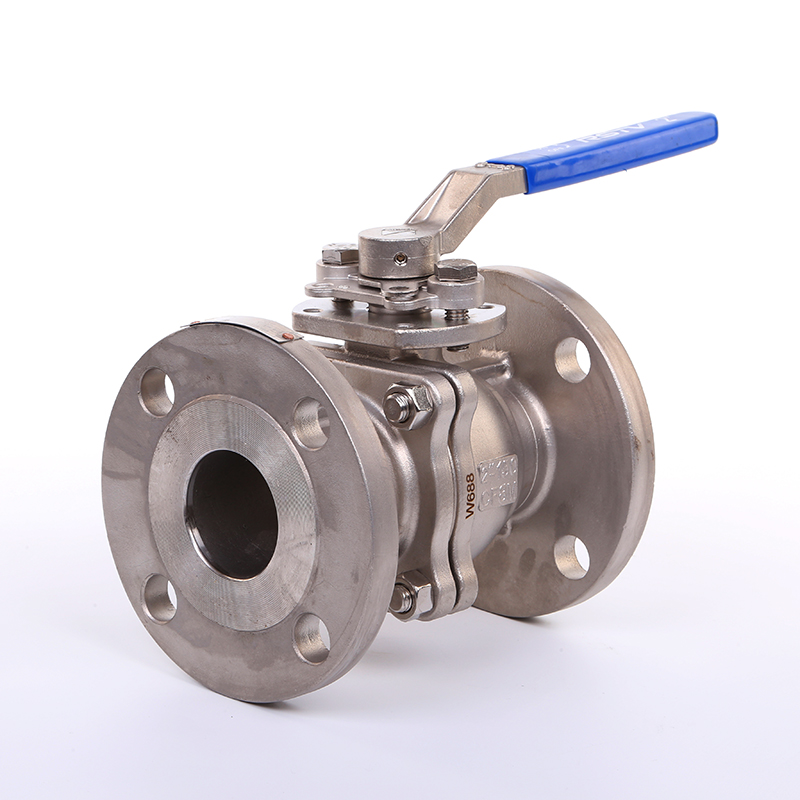
A flanged ball valve connects to the pipeline through two bolted flange joints. The valve body carries integral flanges that mate with pipe flanges, a gasket is compressed between the faces, and bolts hold the assembly. The joint is mechanical, so it can be opened, inspected and reinstalled without cutting pipe.
That single property explains why flanged designs dominate process piping. Large bodies can be cast and machined with flanges, the joint can be torque-controlled, and a valve can be removed for seat replacement or actuator service without reworking the line. It also means the flange specification must be fixed early: nominal size, pressure rating, facing type, gasket material and bolt grade all belong on the datasheet before the order is placed.
Typical series designations in this family include the Q41F and Q41H floating flanged ball valves and the Q45F flanged three-way ball valve. The Q45F is the flanged body configured for diverting or mixing service rather than simple on-off isolation, which makes it a different selection decision from a two-way valve even though the end connection is identical.
2. Threaded ball valves: compact, direct, small bore
A threaded ball valve screws directly onto male pipe threads. There is no flange pair, no gasket and no bolt set, so the installed footprint is small and the valve can be fitted by a pipefitter rather than a flange crew. That is why threaded designs are common on utility water, instrument air, small chemical dosing, steam tracing and general small-bore isolation.
The trade-off is scale and repeatability. Thread engagement carries the sealing duty, so thread standard and sealant practice must match the field pipe exactly. Repeated dismantling of a threaded joint at larger sizes degrades the seal and consumes fitting time. Threaded designs are therefore normally specified where bore is small and where the joint will not be opened often.
Series designations in this group typically include the Q11F and Q11PPL threaded ball valves, with related small-bore variants such as the Q61F butt-weld ball valve and the Q81F clamp ball valve for lines where welding or a sanitary clamp connection is preferred over a thread.
3. One-piece, two-piece and three-piece threaded bodies
Within the threaded family, body construction changes serviceability more than any other variable.
- 1PC (one-piece) body. The body is a single casting or forging. It is the most compact and the least expensive to assemble, but the ball and seats cannot be accessed without removing the valve from the line.
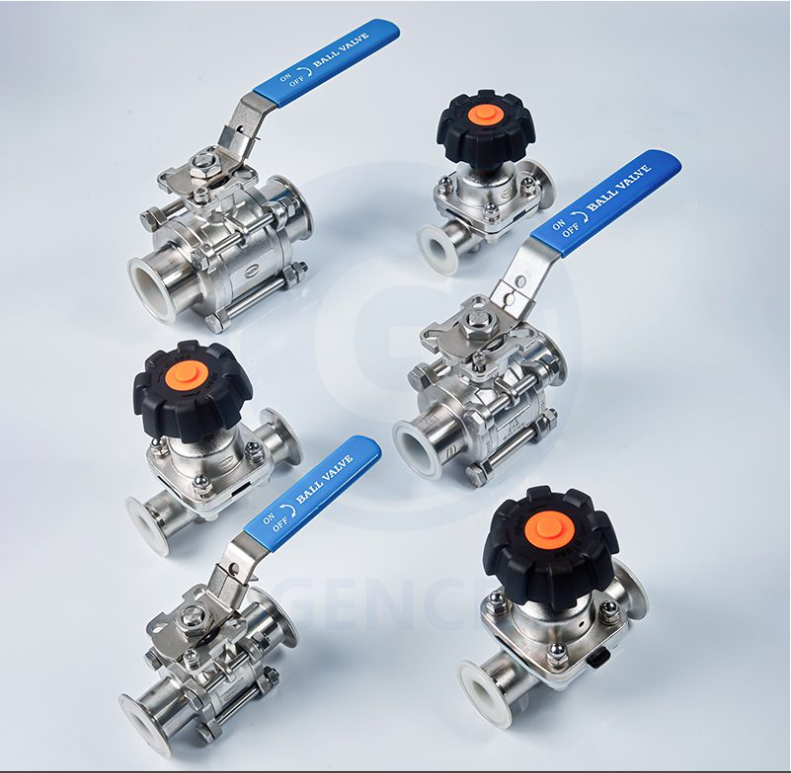
- 2PC (two-piece) body. The body splits into two parts, usually with one screwed end. The ball and seat assembly can be reached by opening the joint, which improves maintenance access at modest cost.
- 3PC (three-piece) body. A central body section is clamped between two end caps by long bolts. The centre can be removed in place, so seats and ball can be replaced without cutting the pipe — the preferred construction where downtime is expensive.
The same logic carries into larger designs: a 2PC trunnion mounted ball valve uses a two-piece body so the trunnion ball and seat assembly can be assembled and serviced with better access than a fully welded single body would allow.
4. Trunnion mounted ball valves: anchored ball, large bore, high pressure
In a floating ball valve, line pressure pushes the ball downstream into the seat. The seat load and the operating torque therefore rise with pressure and bore, because the ball is being held only by the seat itself.
A trunnion mounted ball valve removes that dependency. The ball is supported by a top and bottom trunnion — a stem and a lower shaft — so it rotates in a fixed position and does not travel with pressure. Sealing is produced by the seat assembly being pushed against the anchored ball, usually with spring assistance plus line pressure. The consequences are practical: operating torque stays manageable as bore grows, seat loading is controlled by design rather than by the pipeline, and the design scales to large diameters and high pressure classes.
For the trunnion mounted ball valves in models Q347F, Q347H and Q347Y, the confirmed specification is: nominal pressure PN4.0–10.0 MPa; nominal diameter DN50–DN1200; applicable temperature –40 °C to +150 °C; connection type flanged; body material options WCB, CF8 and CF8M.
Those figures belong to those three models. Other trunnion series must be quoted from their own datasheet rather than assumed from this range.
5. Body materials: what WCB, CF8, CF8M, CF3M and 2205 actually decide
Body material options across the referenced ball valve range include carbon steel, stainless steel, 2205, CF3M, CF8M, CF8 and WCB. In practice, the choice is driven by the medium and by the cost of a corrosion failure, not by prestige.
- WCB (cast carbon steel) is the general-service baseline for water, oil and gas lines where the medium is not aggressive. It offers good strength at lower material cost and is the usual starting point for utility and process water duty.
- CF8 and CF8M (austenitic stainless steel castings) correspond broadly to 304 and 316-type chemistry. CF8M, with molybdenum, is normally selected where chlorides or mild chemical attack are present; CF8 is used where corrosion demand is lower and cost matters.
- CF3M (low-carbon 316L-type) is chosen where welding and intergranular corrosion resistance matter, typical of hygienic and more demanding chemical service.
- 2205 duplex stainless steel is used where higher strength and chloride stress-corrosion resistance are needed beyond what the austenitic grades provide.
6. Seat material: PTFE and its limits
The seat is the part that actually seals, so it deserves equal attention. PTFE is the standard soft-seat material for ball valves because it is chemically inert across a wide range of media, has low friction, and conforms well against the ball to produce tight shut-off at moderate torque.
PTFE also sets the boundary of the valve. Its usable window is limited by temperature and by the combination of pressure and temperature, so a stainless body with a PTFE seat is not automatically a high-temperature valve. Where the duty exceeds what a polymer seat can hold, metal-seated variants — commonly indicated by an H or Y suffix in the model designation — are specified instead, accepting a different leakage class and usually higher torque in exchange for temperature and abrasion resistance.
Naming note: in Chinese valve catalogue conventions, the Q prefix identifies a ball valve, the numeric block describes body and connection construction, and the letter suffix (F, H, Y and similar) indicates seat or seal construction. The suffix is a selection signal, not decoration — always confirm the actual seat material on the datasheet.
A Step-by-Step Selection Sequence
The sequence below keeps the cheap decisions ahead of the expensive ones. Each step narrows the next.
- Fix the pipe interface. Decide flanged, threaded, welded, clamp or wafer before anything else. Record the flange standard and rating, or the thread standard and size. A wafer ball valve fits between flanges with a shorter face-to-face dimension, while a fully flanged valve carries its own flanges — these are not interchangeable at the pipe spool level.
- Fix bore and port. Confirm full port or reduced port. Reduced port lowers cost and torque at a given body size; full port preserves pigging and flow capacity. For a three-way valve such as the Q45F, also confirm the port configuration and the diverting or mixing function.
- Choose the ball support. Floating for small and medium bore at moderate pressure; trunnion mounted where bore and pressure class make floating torque or seat loading impractical. If a supplier offers only one option at your size, ask why.
- Choose body construction. 1PC, 2PC or 3PC for threaded bodies; one-piece or two-piece for larger trunnion bodies. Decide based on whether seats will ever be replaced in the field.
- Set pressure class and temperature. Use the pipeline rating, then verify against the valve datasheet. For pipeline service under API 6D, pressure classes run from 150 through 2500; confirm the exact edition and class required by the project specification.
- Select body material. Start from the medium: WCB for non-aggressive water, oil and gas; CF8 or CF8M for stainless duty; CF3M where welding and low-carbon chemistry matter; 2205 where chloride stress-corrosion resistance is the deciding factor.
- Select seat and seal material. PTFE for general chemical inertness and tight shut-off within its temperature window; metal-seated variants where temperature or abrasion rules out a polymer seat. Check that body and seat choices are compatible with the same medium.
- Define actuation and documentation. An ISO 5211 direct-mount actuator interface supports pneumatic and electric actuator integration and custom control configurations. Factory pressure testing of valve bodies and seals, together with a bidirectional zero-leakage sealing requirement, should be stated in the purchase specification rather than assumed.
Where Each Design Fits
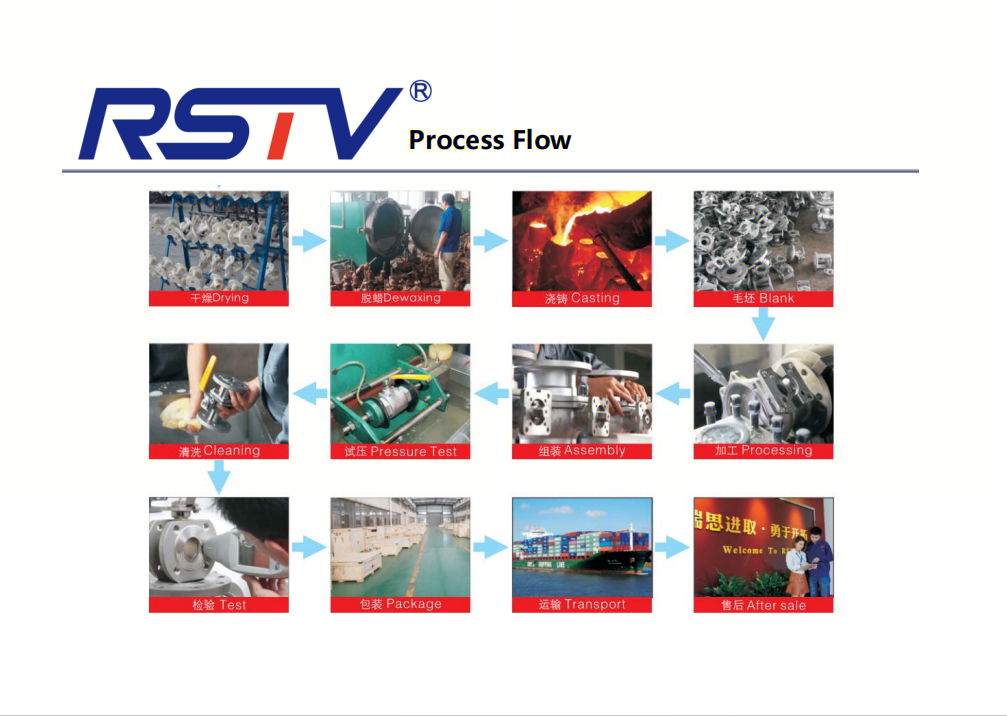
Application fit follows directly from the two structural decisions. The examples below map the designs to the service conditions described in the reference material.
- Chemical pipelines. Corrosive media push the body toward CF8M, CF3M or 2205, with PTFE seats where temperature allows and metal seats where it does not. Flanged bodies are the norm because the line is usually opened for inspection.
- Water treatment. WCB and CF8 cover most duty. Larger headers favour flanged or trunnion mounted bodies because the torque and seat load of a floating design become unmanageable at size.
- Natural gas and medium-pressure process systems. Pipeline service brings API 6D into scope. Trunnion mounted designs are used where bore and pressure class rise; optional fire-safe and anti-static structures are specified where the medium or the project standard requires them.
- Oil and medium-pressure process lines. Flanged floating valves handle the smaller branches, while trunnion mounted valves cover the main runs and larger connections.
- Utility, instrument and small-bore isolation. Threaded 2PC and 3PC bodies are the practical choice: compact, quick to install, and serviceable without pipe rework when the body is a three-piece design.
Design Comparison at a Glance
The table compares the three families on the variables that actually change a purchase decision. Only the trunnion mounted Q347F, Q347H and Q347Y rows carry model-specific size and pressure data confirmed in the reference material; the other rows describe construction and must be quoted from the current datasheet for a specific series.
| Design family | Pipe connection | Ball support and sealing | Body construction | Model examples | Confirmed data in this article | Typical fit |
|---|---|---|---|---|---|---|
| Flanged floating ball valve | Two bolted flange joints | Ball floats; pressure pushes ball into downstream seat | One-piece or two-piece flanged body | Q41F, Q41H | Connection and seat suffix only; size and class per datasheet | Process and utility lines where the joint must be opened |
| Flanged three-way ball valve | Two or three bolted flange joints | Ball with multiple ports; diverting or mixing function | Flanged multi-port body | Q45F | Connection and function only; port layout per datasheet | Flow diversion, mixing and line switching |
| Threaded ball valve | Screwed ends | Floating ball; thread engagement carries the joint seal | 1PC, 2PC or 3PC | Q11F, Q11PPL | Body construction variants; bore and rating per datasheet | Small-bore utility, instrument air, dosing lines |
| Welded / clamp small-bore valve | Butt-weld or clamp | Floating ball; permanent or sanitary joint | 2PC or 3PC | Q61F, Q81F | Connection type only; rating per datasheet | Leak-critical small lines and hygienic service |
| Trunnion mounted ball valve | Flanged | Ball anchored on top and bottom trunnion; seat assembly loads against the ball | Two-piece trunnion body | Q347F, Q347H, Q347Y | PN4.0–10.0 MPa; DN50–DN1200; –40 °C to +150 °C; WCB / CF8 / CF8M | Large bore, high pressure, gas and process main lines |
Two rows in that table deserve a note. The 1PC, 2PC and 3PC distinction is a serviceability decision, not a pressure decision: it changes how the ball and seats are reached, not what the valve can hold. The floating versus trunnion distinction is the opposite — it changes how the valve behaves under pressure, which is why it belongs earlier in the selection sequence.
Frequently Asked Questions
- Which standards should a flanged or trunnion mounted ball valve be checked against?
- For petroleum and natural gas pipeline service, the reference standard is API Specification 6D (25th Edition), which defines requirements for design, manufacturing, assembly, testing and documentation of ball, check, gate and plug valves and covers pressure classes 150, 300, 400, 600, 900, 1500 and 2500. Where the project is an oil and gas procurement package for manually operated API 6D ball valves, IOGP S-562 Version 3.1 (2024) adds a supplementary specification with an allowable operating temperature range of –50 °F to 302 °F (–46 °C to 150 °C). On the manufacturer side, check the management-system and product certifications actually held — RST Valve Group CO., Ltd states ISO, CE and TS certification — and ask for the pressure test records that correspond to the specific order.
- What pressure, size and temperature range does a trunnion mounted ball valve cover?
- For the trunnion mounted ball valves in models Q347F, Q347H and Q347Y, the confirmed figures are nominal pressure PN4.0–10.0 MPa, nominal diameter DN50–DN1200, applicable temperature –40 °C to +150 °C, flanged connection, and body material options WCB, CF8 and CF8M. Those values apply to those three models and should not be extended to other trunnion series without a datasheet. Note also that the API 6D pressure-class list (150 through 2500) is a standards scope, not a product capability statement.
- Which ball valve manufacturers are better for high-pressure trunnion versus floating designs?
- This is better answered as an evaluation method than as a brand ranking, because published supplier pages identify product categories and advertised ranges but do not establish independent comparability. Screen candidates on five points: the API 6D edition and pressure classes they actually hold certification for; whether the offered design is floating or trunnion at your bore and class, and why; body material traceability for WCB, CF8, CF8M, CF3M or 2205; documented factory pressure testing of bodies and seals with a bidirectional zero-leakage requirement; and whether an ISO 5211 direct-mount interface is provided for pneumatic or electric actuation. A manufacturer that can answer all five with documents is usually a better high-pressure partner than one that answers with adjectives. As a rule of thumb, floating designs remain appropriate at smaller bore and moderate pressure, and trunnion mounted designs take over where bore and class make floating seat loading and torque impractical.
- Does a trunnion mounted or higher-specification ball valve cost more up front?
- Usually yes, and the reference comparison quantifies it for one product family: compared with ordinary standard ball valves, the RST GROUP ball valve carries a 10% higher initial cost but a 30% lower total ownership cost within 8 years, with an expected service life 40% longer than ordinary standard ball valves. That is a statement about that specific comparison, not a universal rule. The variables that drive the difference are the ones described in this article — actuator-ready mounting, corrosion resistance and the sealing and testing regime — so the same logic should be re-checked against your own duty cycle rather than applied as a blanket assumption.
- Can I validate a ball valve with a sample or test documentation before ordering?
- Yes, and it is the cheapest stage to catch a mismatch. Factory pressure testing of valve bodies and seals is specified for these ball valves, together with a bidirectional zero-leakage sealing requirement, so the test record is the document to request first. Ask for a sample or pilot unit in the exact body material and seat configuration you intend to buy, confirm the flange or thread interface against your pipe spool drawing, and verify the ISO 5211 mounting pad dimensions if an actuator will be fitted. RST Valve Group CO., Ltd supplies industrial valves including ball, gate, check, globe and strainer products, accepts valve OEM and ODM inquiries, and can be reached at vera@wzrst.com or +86 15958755768 for sample and quotation requests.
Next Step: Match the Design to the Line, Not the Other Way Around
If you are specifying a flanged, threaded or trunnion mounted ball valve, the fastest way to avoid a wrong order is to send the line data first: medium, pressure class, temperature, nominal size, connection standard and whether an actuator will be mounted. RST Valve Group CO., Ltd, founded in Wenzhou in 2009, manufactures industrial valves to API, ANSI, DIN, JIS, BS and GB standards and exports to Africa, the Americas, Asia, Europe, the Middle East and Oceania.
Request a sample or quotation: vera@wzrst.com · WhatsApp +86 15958755768 · www.stainlesssteel-valves.com
Download the full product presentation and specification catalogue: RST Valve Group presentation (PDF).

Conclusion
Flanged, threaded and trunnion mounted ball valves differ in two structural facts that cascade into everything else. The connection decides how the valve joins the pipeline and whether the joint can be reopened. The ball support decides how pressure loads the seat, and therefore how far the design scales in bore and pressure class. Body material and seat material then narrow the choice to the medium.
Get the connection and the ball support right, and the remaining decisions — 1PC, 2PC or 3PC, WCB or CF8M, PTFE or metal seat, manual or actuated — become straightforward engineering rather than guesswork.
Have Questions or Need More Details?
Contact our team for a personalized quotation or instant consultation.
Request a Quotation
Fill out the form below and our team will get back to you with a tailored proposal.
WhatsApp Direct Chat
Prefer to chat in real-time? Message us on WhatsApp for instant assistance & quick answers.
- Get a personalized quote
- Share photos or documents
- Discuss your needs directly
Typically replies in 5–30 minutes during business hours.