
Ball Valve Technical Guide: How to Read DN, PN, WOG, Temperature and Seat Parameters
A BALL VALVE datasheet is not a list of unrelated numbers. Model series, nominal diameter, pressure rating, body material, seat material, temperature range and body construction must be read together. RST VALVE GROUP CO.,LTD, an industrial valve manufacturer founded in Wenzhou City in 2009 and certified to ISO, CE and TS, lists flanged, threaded and trunnion-mounted ball valve families in its supplied catalog data. The practical task is to map those catalog fields to the actual line medium, pressure, temperature and maintenance plan.
Quick answer: Read a ball valve specification in this order: confirm the valve family and model series, then DN and port type, then PN / WOG / Class pressure language, then body material, then seat and temperature limits, then connection and actuation. For RST Valve, the supplied data lists threaded valves in Q11F, Q61F, Q81F and Q11PPL from DN6-DN100 at 1000-2000 WOG, flanged valves in Q41F, Q41H and Q45F as full port DN15-DN600, and trunnion-mounted valves in Q347F, Q347H and Q347Y from DN50-DN1200 at PN4.0-10.0 MPa.
Problem Definition: Why Ball Valve Specifications Are Misread
Most specification errors happen when one field is read in isolation. A buyer may compare DN with port size, treat WOG as if it were PN, or select a stainless steel body without checking whether the seat material and temperature range match the service. The result is a valve that fits the pipe but does not fit the process.
The supplied selection guidance is direct: confirm medium type, working pressure, working temperature, nominal diameter and connection type. Then select the body material and sealing material that match the pipeline medium and working conditions. That order matters because pressure and temperature change what the same DN and body material can safely do.
Model series adds another layer. In the RST Valve catalog, Q41F, Q41H and Q45F are listed under flanged ball valves. Q11F, Q61F, Q81F and Q11PPL are listed under threaded ball valves. Q347F, Q347H and Q347Y are listed under trunnion-mounted ball valves. These are catalog families, not interchangeable part numbers. Buyers should quote the full model series, size, pressure rating and material configuration rather than a shortened code.
Industry Background: Pressure, Temperature and Standards
Ball valve pressure ratings appear in several languages. PN is a metric nominal-pressure designation. WOG is a water-oil-gas pressure rating commonly used on threaded valves. Class 150 to Class 2500 is the pressure-class taxonomy used in API Specification 6D. These systems are related to application requirements, but they are not freely interchangeable without the manufacturer’s rating table.
API Specification 6D covers the design, manufacturing, assembly, testing and documentation of ball, check, gate and plug valves for petroleum and natural-gas pipeline and piping systems. The 25th Edition is identified in the verified data as active, with an effective date of 2025-11-01. API 6D pressure classes are Class 150, 300, 400, 600, 900, 1500 and 2500. API 6D 25th Edition Addendum 2 also identifies requirements for design, manufacturing, materials, welding, quality control, assembly, testing, marking, documentation and process controls, including hydrogen gas service.
IOGP S-562 Version 3.1 is a supplementary procurement specification for manually operated API 6D ball valves. The identified document states an allowable operating temperature range of -50 °F (-46 °C) to 302 °F (150 °C) for the covered application. That range is a procurement requirement in a defined oil-and-gas context, not a universal ball valve temperature rating. For general process piping, the manufacturer’s datasheet and the actual seat material still control.
Detailed Solution: The Parameters That Control Selection
1. Model Series: Q41F, Q41H, Q45F, Q11F, Q61F, Q81F and Q11PPL
The model prefix helps narrow the family before the buyer checks size and pressure. RST Valve lists Q41F, Q41H and Q45F as flanged ball valves. The listed flanged types include 2PC direct mounting pad flanged, 3PC direct mounting pad flanged, wafer type flanged and 1PC flanged designs. The full-port range is DN15-DN600, with a working temperature of -20°C to 180°C and investment casting construction.
The threaded family is listed as Q11F, Q61F, Q81F and Q11PPL. The listed types include 2PC threaded, 3PC threaded, 1PC threaded, 2PC socket welded, 3PC socket welded, 3PC butt welded, 1PC hex threaded and 1PC threaded direct mounting pad designs. The size range is DN6-DN100, the pressure rating is 1000-2000 WOG, the temperature range is -20°C to 180°C, and the catalog lists CF8 (304) or CF8M (316) bodies with PTFE seats.
The trunnion-mounted family is listed as Q347F, Q347H and Q347Y. The listed types include 2PC trunnion-mounted, gear-operated trunnion-mounted and electric trunnion-mounted designs. The nominal pressure range is PN4.0-10.0 MPa, the nominal diameter range is DN50-DN1200, the applicable temperature range is -40°C to +150°C, and the connection type is flanged. Body materials include WCB, CF8 and CF8M.
2. DN: Nominal Diameter Is Not Always the Bore
DN identifies nominal diameter, but it does not by itself prove the flow bore. A full-port valve and a reduced-port valve can share a nominal size while offering different flow characteristics. The RST Valve flanged family is listed as full port from DN15-DN600. The threaded family is listed from DN6-DN100, and the trunnion-mounted family from DN50-DN1200.
For procurement, write DN together with the required port configuration and connection. Do not ask only for a DN50 ball valve. Ask for a DN50 flanged full-port ball valve, or a DN50 trunnion-mounted ball valve at PN4.0-10.0 MPa, with the required body material and actuation. That wording prevents a supplier from quoting a different construction that happens to share the same nominal size.
3. PN, WOG and Class: Three Pressure Languages
PN is a metric nominal-pressure designation. WOG is a water-oil-gas rating commonly used on threaded valves. Class is the API 6D pressure-class language. The same valve should not be compared across these systems by simple arithmetic. Use the manufacturer’s published rating table and the project specification.
In the supplied RST Valve data, the threaded range is stated as 1000-2000 WOG. The trunnion-mounted range is stated as PN4.0-10.0 MPa. The flanged family data supplied here lists full-port DN15-DN600 and a temperature range, but it does not state a single pressure rating for every flanged model. Buyers should request the pressure rating for the exact Q41F, Q41H or Q45F configuration before approving the order.
Where API 6D is required, the buyer should state the edition and pressure class. API 6D covers Class 150, 300, 400, 600, 900, 1500 and 2500. A valve described only as high pressure is not enough for bid comparison. The pressure class, test requirement and documentation package must be written into the RFQ.
4. Body Material: CF8, CF8M, WCB, CF3M and 2205
The RST Valve threaded catalog lists CF8 (304) and CF8M (316) bodies. The flanged catalog lists Carbon Steel, Stainless Steel, 2205, CF3M, CF8M, CF8 and WCB. The trunnion-mounted catalog lists WCB, CF8 and CF8M. These are not cosmetic options. The body material must match the medium, the external environment and the required corrosion resistance.
CF8 is the cast stainless grade corresponding to 304 in the supplied threaded data. CF8M corresponds to 316 in the same data. WCB is a carbon steel body option. CF3M and 2205 appear in the flanged family data as additional material options. The buyer should not select a material only because it is stainless. The medium, chloride exposure, temperature and cleaning regime should be reviewed against the material data and the project specification.
5. Seat and Temperature: PTFE and the Service Window
The RST Valve threaded family lists PTFE seats. The listed temperature range for that family is -20°C to 180°C. The flanged family is also listed at -20°C to 180°C. The trunnion-mounted family is listed at -40°C to +150°C. These ranges are family-level catalog data, not a guarantee for every combination of body, seat, gasket and actuation.
Seat material is a decision parameter because the seat is the sealing element that contacts the ball. The supplied spare-parts list includes valve seats, O-rings and packing, which supports spare-parts continuity planning for recurring supply. When the service temperature approaches the upper or lower end of the catalog range, the buyer should request a specific seat and seal review rather than relying on the headline temperature alone.
For oil-and-gas procurement, IOGP S-562 states -50 °F (-46 °C) to 302 °F (150 °C) for the covered manually operated API 6D ball valve application. That is a useful reference point, but it should not be pasted onto every ball valve inquiry. The applicable standard, seat material, body material and test requirement must still be confirmed for the actual valve.
6. Two-Piece and Three-Piece Split Body: Maintenance Logic
The RST Valve catalog lists 2PC and 3PC designs in both flanged and threaded families. Split-body construction matters because the body is assembled in sections. With the correct design and proper line isolation, this construction can support access to the seat area for inspection and replacement. The supplied spare-parts list includes valve seats, O-rings and packing, which makes spare-parts planning part of the original selection rather than an afterthought.
Do not assume that every 2PC or 3PC pattern allows the same maintenance method. The buyer should confirm whether the selected pattern allows seat inspection or replacement in place, or whether the valve must be removed from the line. For a chemical plant, water treatment skid or gas train, that maintenance question can matter as much as the pressure rating.
Step-by-Step Breakdown: How to Build a Ball Valve RFQ
- Write the service conditions first. State medium, working pressure, working temperature, nominal diameter and connection type. Add whether the valve is for on-off isolation or actuation. The supplied application data notes a 90° quarter-turn operation and on-off service, not throttling.
- Choose the family by size and connection. Use the threaded Q11F, Q61F, Q81F or Q11PPL family for DN6-DN100 and 1000-2000 WOG where threaded, socket weld, butt weld or tri-clamp connections fit. Use the flanged Q41F, Q41H or Q45F family for full-port DN15-DN600. Use the trunnion-mounted Q347F, Q347H or Q347Y family for DN50-DN1200 at PN4.0-10.0 MPa.
- State the pressure language. Write PN, WOG or Class exactly as the project requires. If the project uses API 6D, state the edition and pressure class. Do not ask the supplier to guess whether 1000 WOG is equivalent to a PN or Class rating.
- Fix body and seat materials. For the threaded range, the catalog lists CF8 (304) or CF8M (316) with PTFE seats. For flanged and trunnion-mounted ranges, select from the listed body options such as WCB, CF8, CF8M, CF3M or 2205 where applicable. Confirm the seat and seal materials for the actual service.
- Check the temperature window. Use -20°C to 180°C for the listed threaded and flanged families, and -40°C to +150°C for the listed trunnion-mounted family. If the project follows IOGP S-562, check the stated -46°C to 150°C range against the actual scope.
- Specify actuation and mounting. The supplied application data lists manual lockable handle, pneumatic single or double acting, electric on-off or modulating, and ISO 5211 direct-mount actuator options. State the required actuator interface and whether explosion-proof configuration is needed for flammable service.
- Plan maintenance and spare parts. Ask whether the selected 2PC or 3PC split-body design allows seat inspection or replacement in place. Add valve seats, O-rings and packing to the spare-parts plan. This is especially important for repeat supply and installed-base support.
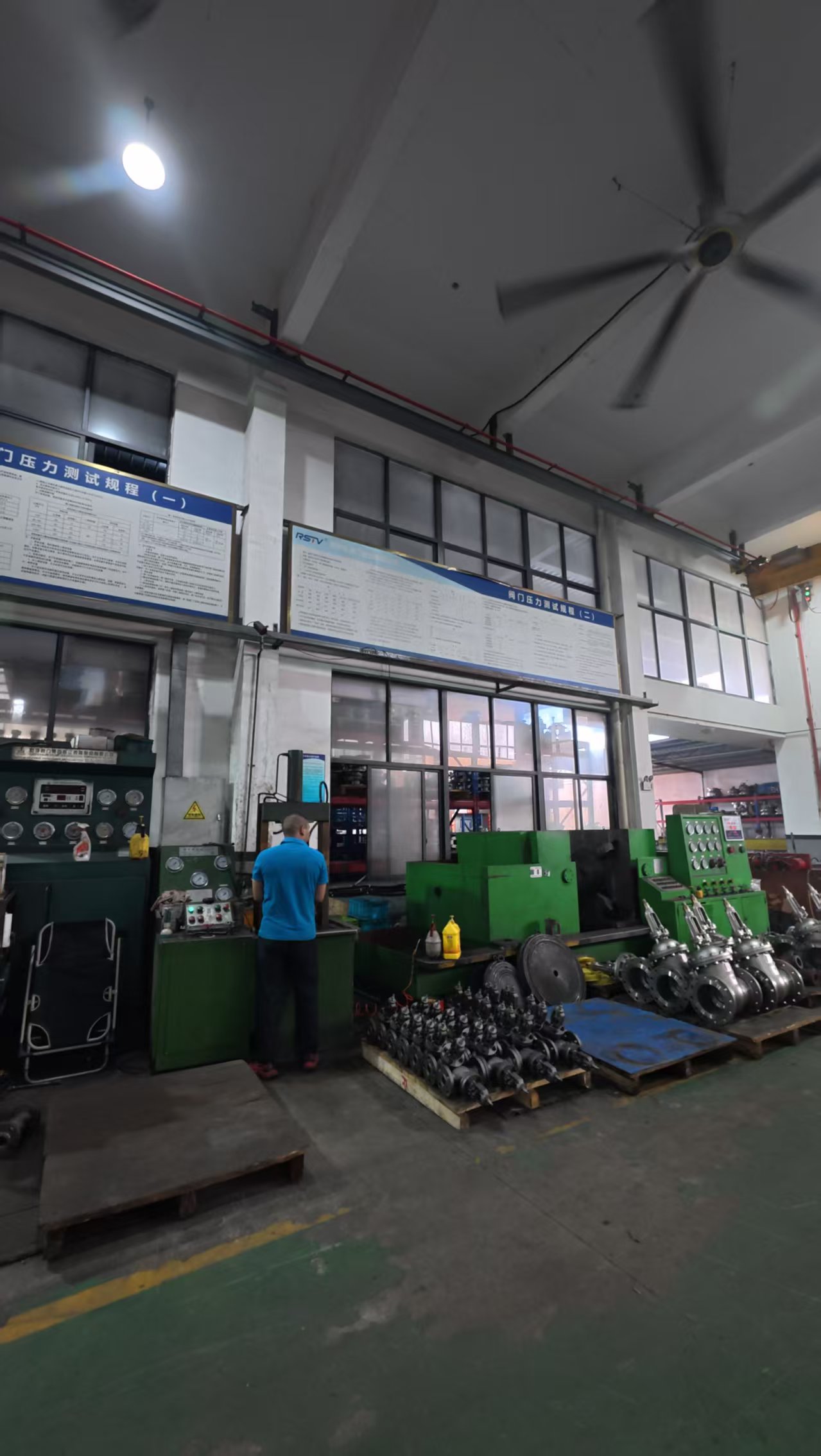
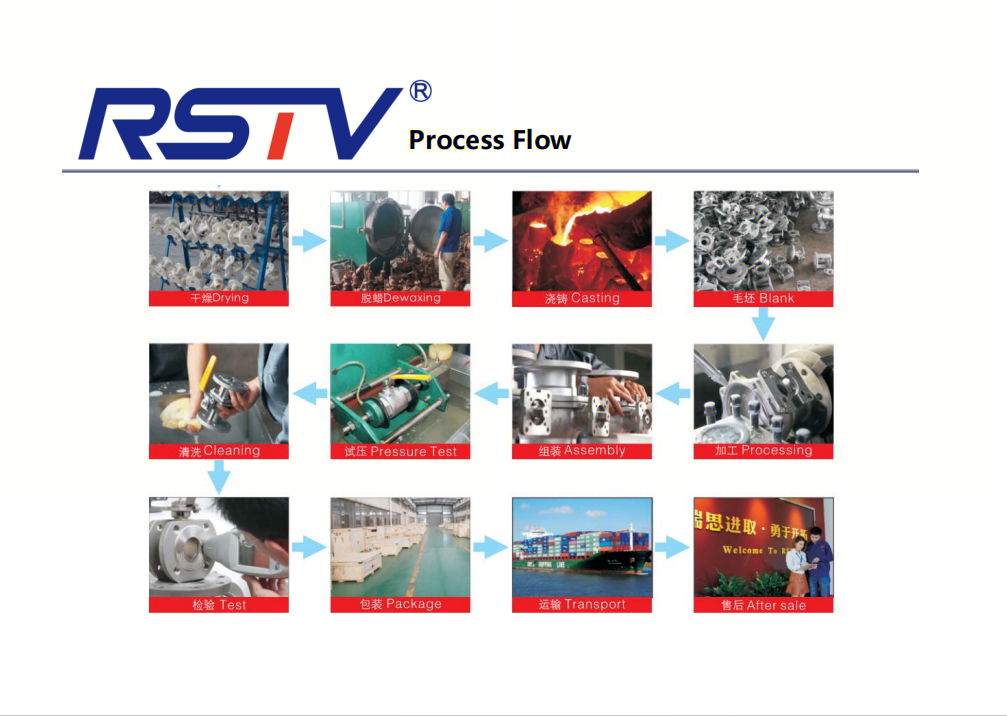
- Set acceptance evidence. The supplied procurement data lists pre-shipment pressure test and witness inspection as acceptance criteria. Also request material certificates, dimensional records and test records where required. For RST Valve, the listed inspection scope includes raw material inspection, dimensional inspection, processing inspection, chemical testing, physical testing and pressure testing.
Use Cases: Where Each Parameter Set Fits
Chemical and gas process lines
For small-bore chemical and gas isolation, the threaded stainless family is a practical starting point: Q11F, Q61F, Q81F or Q11PPL, DN6-DN100, 1000-2000 WOG, CF8 or CF8M body, PTFE seat, -20°C to 180°C. For larger process lines, the flanged full-port family Q41F, Q41H or Q45F extends to DN15-DN600 with carbon steel, stainless steel, 2205, CF3M, CF8M, CF8 or WCB body options.
Water treatment and general process piping
Flanged full-port ball valves are easier to match to pipe schedules and actuator mounting. The supplied application data lists water, oil, gas and weak acids or alkalis as media, with process piping in chemical, gas, pharmaceutical and water treatment industries. The valve is described for on-off service, not throttling. Specify the ISO 5211 mounting pad when an actuator will be fitted.
High-pressure and oil-and-gas pipeline duty
The trunnion-mounted family Q347F, Q347H or Q347Y covers DN50-DN1200 at PN4.0-10.0 MPa and -40°C to +150°C. For API 6D projects, add the required pressure class and documentation. For manually operated API 6D ball valves under IOGP S-562, check the stated -46°C to 150°C allowable range and the project-specific testing requirements.
OEM, ODM and distributor repeat supply
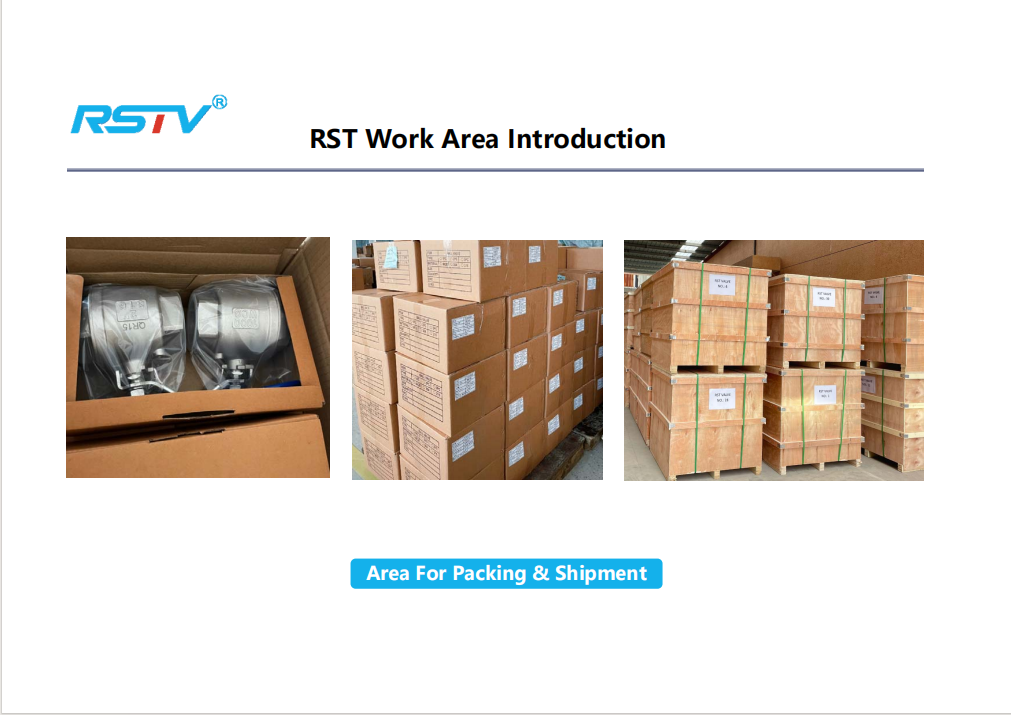
RST Valve accepts OEM and ODM inquiries for industrial valves. The company reports that 71%-80% of sales are exports, which makes export documentation, packing and repeat-supply consistency part of the buyer’s evaluation. Spare parts listed for the ball valve range include valve seats, O-rings and packing, supporting spare-parts continuity planning for recurring or repeat supply.
Comparison Table: RST Valve Ball Valve Families
| Family | Catalog model series | Size range | Pressure rating | Temperature | Body materials | Connection and notes |
|---|---|---|---|---|---|---|
| Flanged ball valve | Q41F, Q41H, Q45F | Full port DN15-DN600 | Confirm exact model in datasheet | -20°C to 180°C | Carbon Steel, Stainless Steel, 2205, CF3M, CF8M, CF8, WCB, etc. | Flanged; 2PC direct mounting pad, 3PC direct mounting pad, wafer type and 1PC types listed; investment casting |
| Threaded ball valve | Q11F, Q61F, Q81F, Q11PPL | DN6-DN100 | 1000-2000 WOG | -20°C to 180°C | CF8 (304) / CF8M (316); carbon steel / SS304 / SS316 | Threaded, socket weld, butt weld or tri-clamp; PTFE seat; ISO 5211 actuator mount; 2PC, 3PC and 1PC options listed |
| Trunnion-mounted ball valve | Q347F, Q347H, Q347Y | DN50-DN1200 | PN4.0-10.0 MPa | -40°C to +150°C | WCB, CF8, CF8M, etc.; carbon steel / SS304 / SS316 | Flanged; 2PC, gear-operated and electric types listed |
Table notes: values are taken from the supplied RST Valve content units. Where a family-level pressure rating is not stated for every flanged model, the exact model datasheet must be confirmed before order.
FAQ
What should buyers confirm before selecting a ball valve?
Confirm medium type, working pressure, working temperature, nominal diameter and connection type. Then select a body material and seat or sealing material that match the medium and working conditions. For the RST Valve threaded range, the catalog lists CF8 (304) or CF8M (316) bodies with PTFE seats, DN6-DN100, 1000-2000 WOG and -20°C to 180°C.
How do DN, PN and WOG differ on a ball valve datasheet?
DN is nominal diameter, not a guarantee of bore. PN is a metric nominal-pressure designation. WOG is a water-oil-gas rating commonly used on threaded valves. RST Valve lists flanged full-port valves from DN15-DN600, threaded valves from DN6-DN100 at 1000-2000 WOG, and trunnion-mounted valves from DN50-DN1200 at PN4.0-10.0 MPa. Do not convert PN and WOG by assumption; use the manufacturer’s rating table.
Does RST Valve support OEM, ODM and repeat supply?
Yes. RST Valve accepts OEM and ODM inquiries for industrial valves. The supplied spare-parts list includes valve seats, O-rings and packing, which supports spare-parts continuity planning for recurring or repeat supply. The company holds ISO, CE and TS certifications and reports that 71%-80% of sales are exports.
What are the purchasing terms and acceptance criteria?
The supplied procurement data lists MOQ 1 unit; delivery terms FOB, CIF, DAP, DDP and EXW; acceptance criteria including pre-shipment pressure test and witness inspection; and payment terms of 30% T/T advance with 70% T/T before shipment. Confirm these terms in the formal quotation.
How should a buyer validate a sample and plan lead time?
Start with a written RFQ that fixes DN, pressure rating, temperature, body material, seat material, connection and actuation. The supplied terms list MOQ 1 unit, so a sample or first article can be ordered. Specify pre-shipment pressure testing and, where required, witness inspection. Lead time is not stated in the supplied data; request a written production schedule by valve family, quantity and test requirement before approving repeat supply. To request a quotation or sample, contact Vera at vera@wzrst.com or WhatsApp +86 15958755768, and download the RST presentation catalog.
Next step for ball valve specification review
Send the service conditions, model series, DN, PN or WOG or Class, temperature, body material, seat material, connection and actuation requirement to RST VALVE GROUP CO.,LTD. The company’s supplied data shows ISO, CE and TS certification, OEM and ODM support, and spare-parts planning for valve seats, O-rings and packing.
Visit RST Valve Group CO.,LTD | Download catalog | Email: vera@wzrst.com | WhatsApp: +86 15958755768

Conclusion
Ball valve selection becomes manageable when the datasheet is read as a connected set: model family, DN, pressure language, body material, seat material, temperature range, connection and maintenance design. RST Valve’s supplied catalog data provides a clear starting point for threaded, flanged and trunnion-mounted families, but the final order still needs the exact pressure rating, material combination and test requirement confirmed in writing. Use the RFQ structure in this guide, request the test records and spare-parts list, and confirm lead time with the quotation before moving to repeat supply.
Have Questions or Need More Details?
Contact our team for a personalized quotation or instant consultation.
Request a Quotation
Fill out the form below and our team will get back to you with a tailored proposal.
WhatsApp Direct Chat
Prefer to chat in real-time? Message us on WhatsApp for instant assistance & quick answers.
- Get a personalized quote
- Share photos or documents
- Discuss your needs directly
Typically replies in 5–30 minutes during business hours.