
Premium vs Standard Ball Valves: When the Upgrade Pays Off
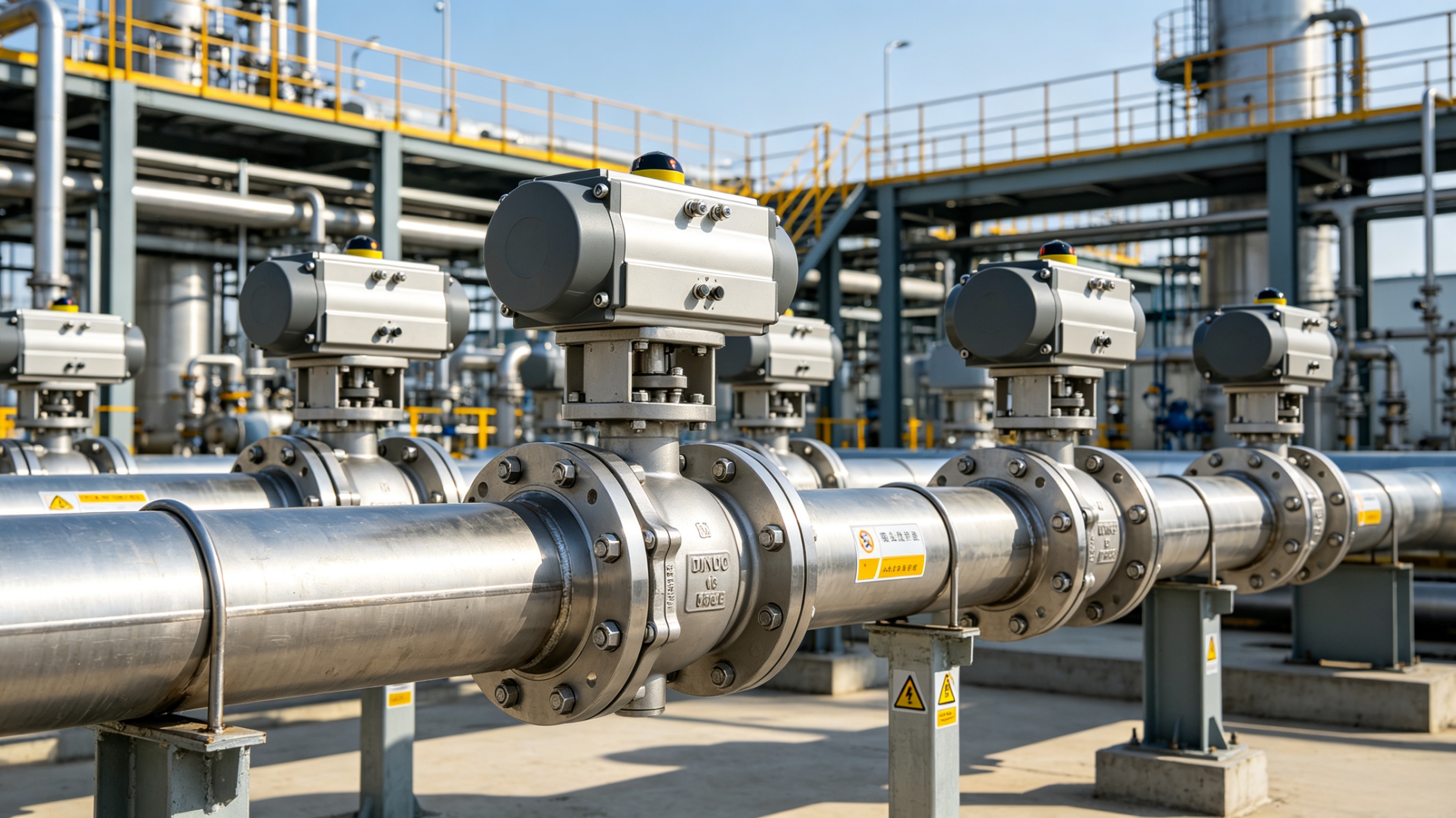
for Chemical and Gas Pipelines
A ball valve that looks cheaper on the quotation sheet can still be the more expensive choice over a pipeline's service life — but only when the project actually needs evidence the cheaper unit does not carry. The decision rule is narrow and testable: the upgrade is justified when the pipeline sits inside a functional-safety loop that requires third-party SIL certification, when the valve is placed on the EU market under the Pressure Equipment Directive, or when the buyer's own quality plan requires per-unit test reports and material certificates that must survive an audit.
Outside those three conditions, an ordinary standard ball valve that is correctly specified, correctly tested and correctly documented may satisfy the line. This article sets out where the boundary sits, using the certificate scopes, pressure classes and test protocols that a buyer can actually verify before placing an order.
The Problem: Two Quotes, One Line Item, Two Different Products
Both quotations describe “DN50 stainless steel flanged ball valve, quarter-turn, on-off service.” On paper the line items match. In practice they are not the same purchase, because the deliverable behind each quotation is different.
The first supplier ships a valve and a commercial invoice. The second ships a valve plus a shell strength test record, a seat leakage test record, a material certificate, and a certificate package that names the pressure class, the size range and the validity period covered. When a chemical plant's quality department, an engineering contractor's dossier, or an EU customs and conformity review asks for that package six months later, only one of the two purchases answers the question.
So the real specification question is not “premium or standard.” It is: what failure consequence, regulatory route and documentation obligation does this line carry, and which evidence set does that require? Answer that first, and the price comparison becomes a comparison of scope rather than a comparison of numbers.
Industry Background: What the Standards Actually Require
For petroleum and natural-gas pipeline and piping systems, API Specification 6D defines the requirements for design, manufacturing, assembly, testing and documentation of ball, check, gate and plug valves, and its pressure-class coverage runs from Class 150 through Class 2500. The 25th Edition is the current reference edition, and Addendum 2 to that edition addresses materials, welding, quality control, assembly, testing, marking, documentation and process controls.
Procurement-side specifications tighten this further. IOGP S-562 Version 3.1 is a supplementary specification for manually operated ball valves used together with API 6D, and the version identified states an allowable operating temperature range of −46 °C to 150 °C (−50 °F to 302 °F). That number is not a universal rating for every ball valve on the market; it is a requirement inside a defined oil-and-gas procurement context, and it illustrates why the paperwork matters — a valve selected without checking the applicable temperature window can be technically compliant on pressure class and still unsuitable for the service.
Alongside the pipeline standards sit two other regimes that drive most of the premium-versus-standard decisions: functional safety certification under IEC 61508, and EU pressure-equipment conformity under the PED. A supplier who holds neither should not be shortlisted for lines governed by either.
The Detailed Solution: Three Evidence Gates That Decide the Upgrade
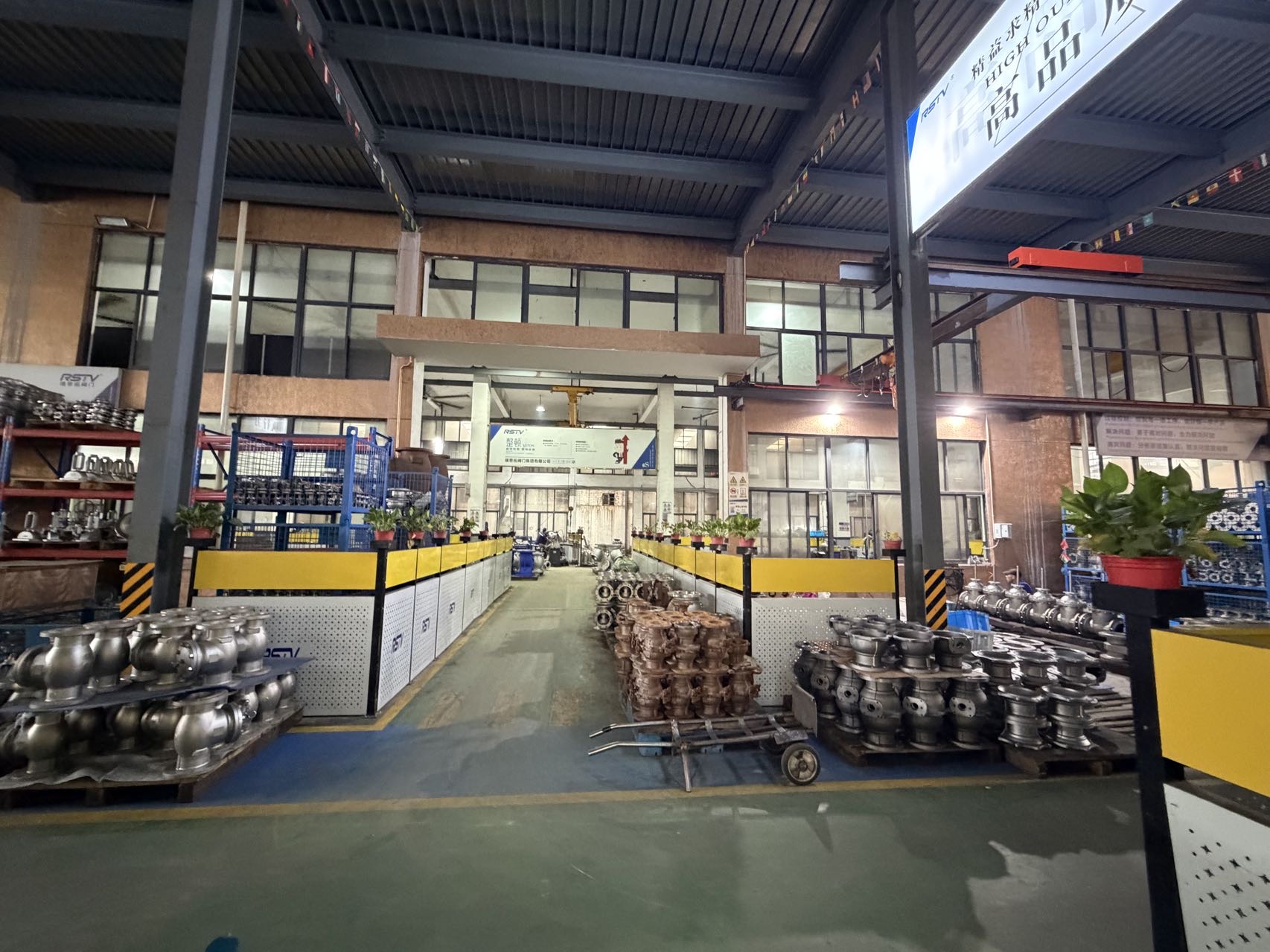
A valve that qualifies as “premium” in this category is not premium because of a casting finish. It is premium because it clears three documented gates. RST VALVE GROUP CO.,LTD — an industrial valve manufacturer founded in Wenzhou in 2009, producing ball, gate, check, globe and Y-strainer valves for export markets — is used below as a worked example of what each gate looks like when it is real.
Gate 1 — Functional safety: SIL under IEC 61508:2010
Where the valve forms part of a safety instrumented function, the buyer needs third-party evidence that the product was assessed against a functional-safety standard, not a supplier's self-declaration. RST VALVE GROUP CO.,LTD holds a SIL Functional Safety Certificate, certificate No. 4I260528.RSTDO08, issued by Ente Certificazione Macchine Srl, covering industrial valves including gate valves, ball valves, globe valves, check valves and butterfly valves across the Z, J, H, Q, D and ZJHM series. The certificate is assessed against IEC 61508:2010 Parts 1–7, was issued on 2026-05-28 and runs to 2031-05-27.
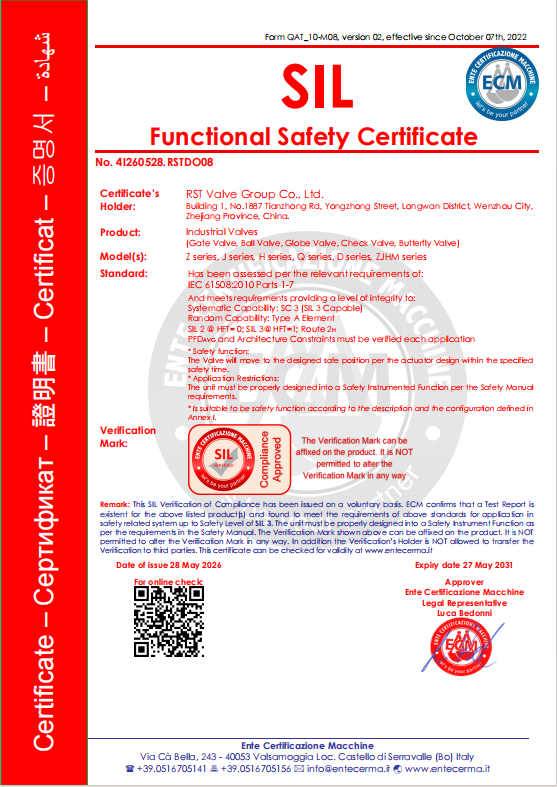
Two checks matter here. First, does the certificate scope name the series you are ordering — the Q series for ball valves — rather than a generic “valves” statement? Second, is the certificate still valid on the delivery date, not only on the order date? A premium quotation that cannot produce a live certificate is not a premium purchase.
Gate 2 — EU market access: PED-CE production type certification
For valves placed on the EU market, conformity is a legal condition rather than a marketing preference. The PED-CE EU-Production Type Certificate held by RST VALVE GROUP CO.,LTD, certificate ECM PED-Bp 2024-TW60, was issued by Ente Certificazione Macchine Srl on 2024-06-27 and remains valid until 2029-06-26. Its scope covers industrial valves from DN15 to DN1200 (NPS ½" to 48") across PN6 to PN260 and Class 150 to Class 1500, including ball, gate, globe, check, butterfly, strainer and control valves, and it references EN 12266-1:2012, JB/T 7245-2017, EN 12516-1:2014+A1:2018 and EN 12284:2003.
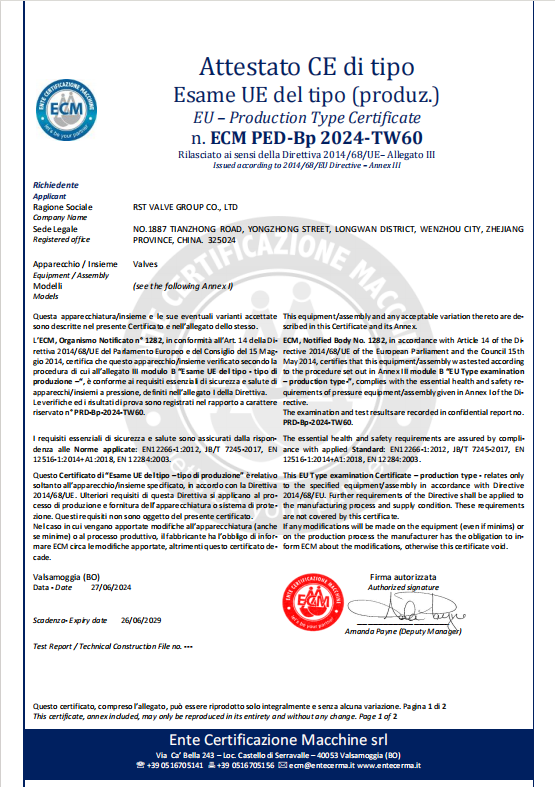
This is where the upgrade is most often objectively justified and most often misapplied. A buyer ordering a DN200 flanged ball valve for a European chemical site needs the DN and the pressure class inside the certified scope. A buyer ordering the same valve for a domestic utility line where the directive does not apply is paying for conformity evidence the project will never use — that is the case for a standard unit.
Gate 3 — Management system evidence: ISO 9001, ISO 14001, ISO 45001
Management system certificates do not certify a product; they indicate that the manufacturing and quality processes behind the product are audited. RST VALVE GROUP CO.,LTD holds three certificates issued by Zhejiang Quanpin Certification Co., Ltd., all dated 2025-09-28 and valid to 2028-09-27:
- ISO 9001:2015 — certificate 20225Q21079R0M, scoped to the production and sales of metal valves and filters within the licensed qualification scope.
- ISO 14001:2015 — certificate 20225E20474R0M, scoped to production, sales and related management activities for metal valves and filters.
- ISO 45001:2018 — certificate 20225S20439R0M, same production and sales scope.
For a procurement team, these are screening documents. They narrow the field quickly, but they do not replace the per-unit test record, and they do not replace the product-specific certificates in Gates 1 and 2.
The per-unit layer: what actually ships with each valve
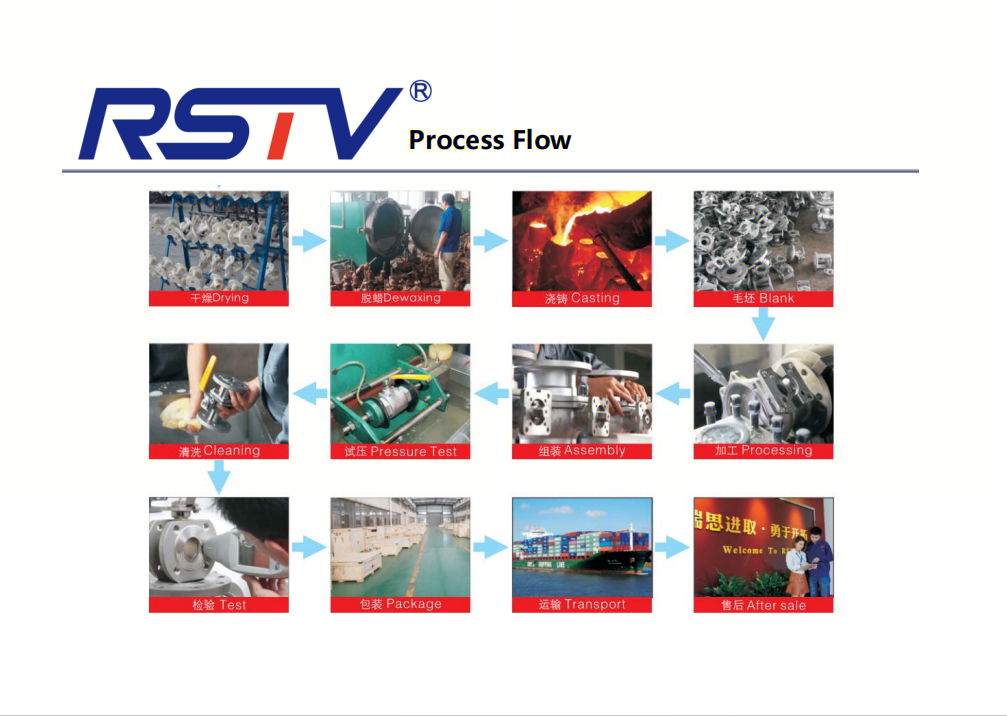
Certificates sit above the product. Test records sit with the product. At RST VALVE GROUP CO.,LTD, quality control covers shell strength testing, seat leakage testing, material inspection, visual inspection and 100% factory testing, and the manufacturer supplies test reports and material certificates with the order. That final clause is what separates a documented valve from an undocumented one — the test report is per order, not a generic datasheet.
The product layer: which valve architecture carries which duty
Certification evidence is only usable if the correct valve architecture is specified underneath it. In chemical and gas pipeline isolation, three families cover most of the demand:
- Trunnion mounted ball valves — Q347F, Q347H and Q347Y. Supplied for process pipeline isolation in gas and chemical engineering projects, with quarter-turn fast switching and bi-directional sealing for on-off isolation duty. The trunnion design supports larger sizes and higher pressure classes.
- Flanged ball valves — Q41F, Q41H and Q45F. The default choice for plant piping where a bolted flange connection matches the line class.
- Threaded ball valves — Q11F, Q61F, Q81F and Q11PPL. Used on smaller instrument, utility and auxiliary lines where a threaded connection is the specified joint. Buyers should confirm the stated WOG class on the project datasheet rather than assuming a rating.
For planning purposes, the published operating envelope for these process-piping applications is PN16 to PN63 and Class 150 to 300, with a temperature range of −20 °C to 180 °C, for media including water, oil, gas and weak acids or alkalis. Where a project demands a wider size, pressure or temperature span than the certificate scope states, the buyer should treat that as a technical clarification to resolve before award, not as a commercial detail.
Step-by-Step: How to Decide Between a Standard and a Premium Valve
The sequence below converts the three gates into a purchasing workflow that can be applied to any supplier, not only to a shortlisted one.
- Define the service first. Confirm medium type, working pressure, working temperature, nominal diameter and connection type before comparing prices. Selection of the valve material and the sealing material must match the pipeline medium and the operating conditions. A premium valve specified against the wrong medium is still the wrong valve.
- Classify the regulatory route. Determine whether the line sits in a safety instrumented function (route: IEC 61508 / SIL), whether the valve is placed on the EU market (route: PED-CE), or neither. Write the answer down — it is the single largest cost driver in the decision.
- Match the certificate scope to the order. Check that the certificate names the valve series, DN range and pressure class you are buying, and that the validity dates cover the delivery date. For the RST package, that means DN15–DN1200 and PN6–PN260 under PED-CE, and the Q series under the SIL certificate.
- Review the test and documentation plan. Ask which tests will be performed per unit and which records will ship. A compliant answer names shell strength, seat leakage, material inspection and the level of factory testing, and commits to test reports and material certificates.
- Check capacity against the project schedule. RST VALVE GROUP CO.,LTD operates a monthly capacity of 15,000 units with a typical production lead time of 20–45 days, which matters when a valve package has to align with a construction window.
- Confirm the low-quantity route. The minimum order quantity is 1 unit, so a smaller project, a retrofit or a single critical spare does not need to be aggregated into a bulk order to qualify for the documented product.
- Define the actuation interface. Decide between manual operation with a lockable handle, pneumatic single- or double-acting actuation, or electric on-off or modulating actuation, and confirm an ISO 5211 direct-mount pad where an actuator will be fitted later. Options such as anti-static and fire-safe designs should be resolved at this step, not at delivery.
Use Cases: Where the Upgrade Earns Its Cost
Chemical process isolation
On process piping for the chemical, gas and water treatment industries, the valve's job is to shut off, distribute and change the flow direction of the medium — an on-off function, not a throttling function. In this duty the specification is dominated by sealing integrity and material compatibility. Deployments of the Q347F, Q347H and Q347Y trunnion mounted models in chemical, gas and water utility projects typically run 50–500 units per project, with reported bubble-tight zero leakage, stable operation and low maintenance cost across an 8–10 year service duration.
Where that use case justifies the premium: the buyer needs the SIL certificate, the PED-CE scope or the per-unit test reports for the plant's own integrity management. Where it does not: a utility water line outside those regimes, where a correctly specified standard valve with a test report is sufficient.
Gas engineering and pipeline skids
Gas service adds two pressures that water service does not: the consequence of leakage, and the documentation expected by the project's technical authority. Quarter-turn fast switching and bi-directional sealing are operationally useful on skid-mounted isolation points, and the same features make the valve easier to certify as a defined on-off element. On these lines the certificate scope check is usually the deciding factor, because a valve outside the certified DN or PN range cannot be substituted without a technical deviation.
Remote and automated isolation
Where a valve will be actuated — pneumatic or electric, with an ISO 5211 mounting interface — the actuator, solenoid valves, limit switches and FRL units become part of the specification. Explosion-proof configuration is required for flammable or explosive applications, and blowout-proof stems with optional anti-static and fire-safe designs are specified on hydrocarbon duty. In these packages, the premium argument usually rests on documentation consistency: a certificate package that covers the valve body but not the actuation interface creates a gap the buyer has to close later.
Comparison Table: Standard vs Premium Certified Ball Valve
The table below compares what a buyer receives, not what a supplier claims. The “standard” column describes what is defined by the purchase order when no certification route applies; the “premium” column states the documented position for the RST VALVE GROUP CO.,LTD package.
| Decision item | Standard ball valve (no certification route) | Premium certified ball valve (RST package) |
|---|---|---|
| Size and pressure coverage | As written in the purchase order | DN15–DN1200 / NPS ½"–48"; PN6–PN260 / Class 150–1500 (PED-CE scope) |
| EU market conformity | Not supplied unless separately requested | PED-CE ECM PED-Bp 2024-TW60, valid to 2029-06-26 |
| Functional safety | Not supplied unless separately requested | SIL IEC 61508:2010 Parts 1–7; certificate No. 4I260528.RSTDO08, valid to 2031-05-27 |
| Management systems | Not supplied unless separately requested | ISO 9001:2015, ISO 14001:2015, ISO 45001:2018, all valid to 2028-09-27 |
| Factory testing | As specified per order | Shell strength, seat leakage, material inspection, visual inspection, 100% factory test |
| Documentation delivered | As specified per order | Test reports and material certificates |
| Minimum order quantity | Supplier-specific | 1 unit |
| Capacity and lead time | Supplier-specific | 15,000 units per month; 20–45 days production lead time |
| Best fit | Utility, auxiliary and non-regulated lines where conformance is defined by the buyer's own specification | Safety instrumented functions, EU-placed equipment, and audited chemical or gas projects |
Where the Standard Valve Remains the Correct Choice
A useful comparison has to state its limits. The documented premium valve is not automatically the right purchase in three situations:
- No applicable regulatory route. If the line is not in a safety instrumented function and the valve is not placed on the EU market, the SIL and PED-CE evidence will not be used by the project.
- Low-consequence auxiliary service. Instrument air, utility water and similar auxiliary lines may be adequately served by a correctly specified standard valve supported by a basic test record.
- Specification mismatch risk. A certified valve with the wrong seat material, the wrong pressure class or the wrong connection type is still non-conforming. Certification does not compensate for a bad specification.
The symmetrical point applies: buying standard valves for a line that later requires a SIL or PED-CE dossier usually results in replacement, re-documentation or a concession — all of which cost more than the original difference.
Frequently Asked Questions
When does a chemical or gas pipeline ball valve actually require SIL and PED-CE certification?
SIL is required when the valve forms part of a safety instrumented function that must be assessed against IEC 61508; PED-CE is required when the valve is placed on the EU market within the scope of the Pressure Equipment Directive. RST VALVE GROUP CO.,LTD holds a SIL Functional Safety Certificate (No. 4I260528.RSTDO08, Ente Certificazione Macchine Srl, IEC 61508:2010 Parts 1–7, valid 2026-05-28 to 2031-05-27) covering industrial valves including ball valves, and a PED-CE EU-Production Type Certificate (ECM PED-Bp 2024-TW60, covering DN15–DN1200 / NPS ½"–48", PN6–PN260 / Class 150–1500, valid to 2029-06-26). If neither route applies to the line, the documented standard valve may be sufficient.
How do I shortlist recommended ball valve manufacturers with real API testing capability?
Treat API Specification 6D as a verification checklist rather than a marketing label. The specification defines design, manufacturing, assembly, testing and documentation requirements, and its pressure classes run from Class 150 to Class 2500, so a credible candidate should be able to show four things: the pressure-class range it actually builds, the test regime performed on every unit, the records that ship with the order, and third-party certificate scopes with dates. RST VALVE GROUP CO.,LTD performs shell strength testing, seat leakage testing, material inspection, visual inspection and 100% factory testing, and supplies test reports and material certificates with the order. Ask each candidate to state these four items in writing and to name the standard edition referenced; a supplier that answers precisely is easier to qualify than one that answers broadly.
How should a premium quotation be compared with a standard one on cost?
Compare scope, not headline price. Ask both suppliers to break the offer into the same lines: body material, sealing material, connection type, pressure rating, actuation, test regime, documentation package and certification source. The difference between a premium and a standard offer is largely the inclusion of testing, documentation and third-party certification, and that inclusion is what changes the total cost of ownership when a project needs to demonstrate conformity. Because RST VALVE GROUP CO.,LTD works from a 1-unit minimum order quantity, a buyer can validate one documented unit before committing to a full project quantity.
Can I order a sample ball valve before committing to a bulk order?
Yes. The minimum order quantity for RST VALVE GROUP CO.,LTD is 1 unit, and the production arrangement supports prototype and small batch orders. A single-unit order allows the buyer to verify the delivered documentation set — test report and material certificate — against the certificate scope before scaling to a project quantity.
What is the production lead time for a certified ball valve order?
The typical production lead time is 20–45 days, against a monthly production capacity of 15,000 units. Lead time should be confirmed against the specific configuration at the quotation stage, because actuation, special sealing and documentation requirements can extend the schedule. To request a sample, a quotation or the full product presentation, contact RST VALVE GROUP CO.,LTD at vera@wzrst.com or +86 15958755768, or review the RST product presentation for the full valve range.
Conclusion: Decide by Evidence Gate, Not by Price Difference
The premium-versus-standard question resolves into three yes-or-no checks. Does the line require IEC 61508 functional safety evidence? Does the valve enter the EU market under the PED? Does the project's quality plan require per-unit test reports and material certificates? Where two or more answers are yes, the certified valve is the lower-risk purchase and the documentation justifies the difference. Where all three are no, a correctly specified standard valve with a basic test record is the rational choice.
What should not happen is buying on price alone and discovering the evidence gap during a plant audit, a customs conformity check or a safety review. The certificate scopes, pressure classes and test protocols set out above are all verifiable before an order is placed — which means the decision can be made on facts rather than on supplier confidence.

Have Questions or Need More Details?
Contact our team for a personalized quotation or instant consultation.
Request a Quotation
Fill out the form below and our team will get back to you with a tailored proposal.
WhatsApp Direct Chat
Prefer to chat in real-time? Message us on WhatsApp for instant assistance & quick answers.
- Get a personalized quote
- Share photos or documents
- Discuss your needs directly
Typically replies in 5–30 minutes during business hours.