Global Compliance Guide: ISO 15378, BRCGS, GRS, HACCP & SA8000 for Sports Nutrition Packaging
Compliance reference · Research → Evaluation
Global Compliance Guide: ISO 15378, BRCGS, GRS, HACCP & SA8000 for Sports Nutrition Packaging
Direct answer: No single certificate makes sports nutrition packaging globally compliant. Five certificate scopes have to line up with the product, the process and the destination market: ISO 15378:2017 for GMP-based quality management in primary packaging of medicinal products, BRCGS Global Standard Packaging Materials Issue 7 for food-contact packaging manufacture, GRS Version 4.0 for recycled content, HACCP for food-safety hazard control, and SA8000:2014 for social accountability. Each one is issued against a specific scope sentence and a specific validity window, and a brand is only compliant when both of those match the bottle, closure, scoop and material it actually buys.
RTCO (THE RTCO PAK PTE. LTD.) is a plastic packaging manufacturer producing HDPE, PET and PP containers, closures and scoops for supplement, sports nutrition and health & beauty brands, with manufacturing across Asia and a US production facility in Piedmont, South Carolina. Its certificate records are used throughout this guide as a worked example — not because a list of numbers is useful, but because the method of reading scope, edition and validity is what transfers to any supplier you are evaluating.
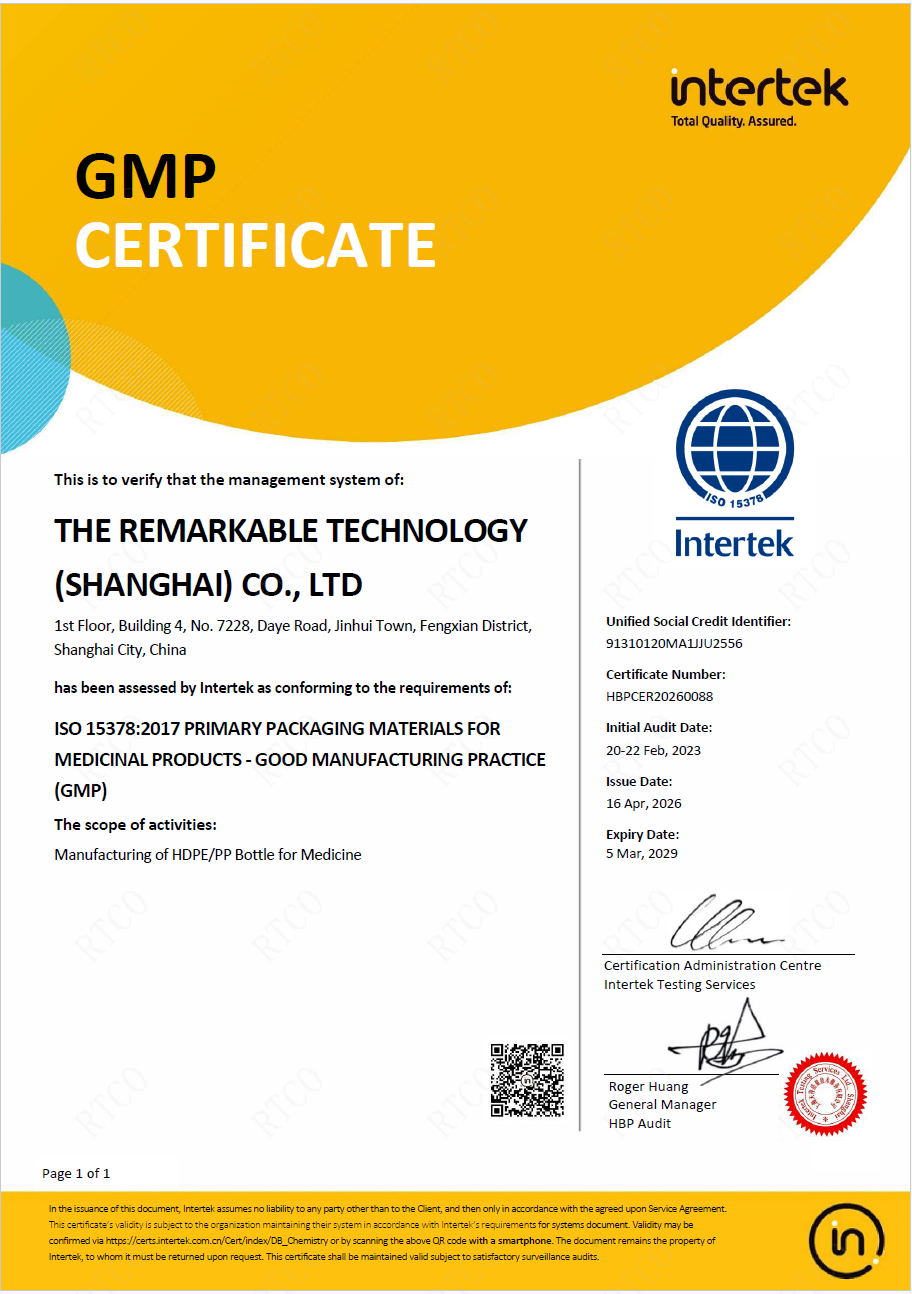
ISO 15378:2017 certificate HBPCER20260088, issued by Intertek Testing Services, covers manufacturing of HDPE and PP bottles for medicinal products.
What this guide covers
- Why certificates break down between brand and supplier
- The five certification pillars, scope by scope
- A six-step verification process you can run on any supplier
- Mapping certificates to FDA, EU PPWR and retail audit frameworks
- Comparison and FAQ for procurement teams
1. The Compliance Problem: Certificates Are Issued to Processes, Not to Your Bottle
A certificate is issued against a defined scope: a standard edition, a material, a manufacturing process, and in most cases a named site. A purchase order is issued against a product: a 500 ml wide-mouth HDPE jar with a flip-cap, a liner and a 60 cc scoop. The two documents never match automatically, and that gap is where compliance reviews fail.
Three failure modes account for most of the problems sports nutrition brands encounter when they audit packaging documentation.
- Scope mismatch. A certificate may cover blow molding and injection molding of PE and PP containers, lids, spoons and hooks for food use, while the SKU you bought is PET, or is decorated, assembled or kitted outside that described scope. The certificate is genuine and still does not cover your order.
- Edition lag. Standards are revised. BRCGS Global Standard Packaging Materials Issue 7 is dated October 2024; the Global Recycled Standard is at Version 4.0; ISO 15378 is at the 2017 edition. A supplier file built two or three years ago may still cite a superseded edition, which is the first thing a notified body or a retail auditor checks.
- Validity drift. Every certificate carries an explicit expiry date. A document that satisfied a supplier audit last year may sit outside its validity window by the time your production run ships.
The practical consequence for a sports nutrition brand is that “our supplier is certified” is not an answer that survives scrutiny. The answer that survives is a scope sentence quoted verbatim, an issuing body named, a certificate number recorded, and a validity date confirmed against the shipment date.
2. Industry Background: Why Plastic Supplement Packaging Is Now a Documented Category
Sports nutrition and supplement packaging is a large, plastic-dominant category, which is exactly why regulators, retailers and brand quality teams treat it as a documented one. Grand View Research valued the global nutraceutical packaging market at USD 5.05 billion in 2024, with plastic segments holding 58.3% of revenue share. The same research house estimates plastic at approximately 73.8% market share of supplement packaging in 2025. On the demand side, Future Market Insights projects the protein powder packaging segment reaching USD 44.52 billion by 2035, with a CAGR of 5.01% from 2026.
Scale creates scrutiny. Two regulatory anchors sit behind most of the compliance requests a packaging supplier receives.
- United States. FDA 21 CFR Part 111 establishes mandatory Current Good Manufacturing Practice for the manufacturing, packaging and labeling of dietary supplements. A brand audited against Part 111 has to show that its packaging inputs and packaging steps are controlled, documented and traceable — which is a supplier quality-system question, not a product question.
- European Union. The EU Packaging and Packaging Waste Regulation (PPWR) 2025/40 requires that all packaging be recyclable by 2030 and that plastic packaging contain at least 30% recycled content by 2030. For a supplement brand, that converts a material choice into a documentary claim: recycled content has to be verifiable, not just asserted.
Add to that the ISO 15378:2017 definition itself, which specifies requirements for a quality management system for manufacturers of primary packaging materials for medicinal and nutraceutical products while integrating GMP principles. Once a standard explicitly names nutraceutical primary packaging, brands reasonably expect their bottle supplier to hold it — and that expectation is now written into supplier questionnaires.
3. The Five Certification Pillars, Scope by Scope
Each of the five certificates below answers a different question. Read them as separate instruments with separate boundaries, and record the exact scope language rather than a summary of it.
3.1 ISO 15378:2017 — GMP-based quality management for medicinal primary packaging
ISO 15378:2017 specifies requirements for a quality management system for manufacturers of primary packaging materials for medicinal and nutraceutical products, integrating GMP principles. It is the standard that connects a packaging converter's quality system to the expectations of a regulated product environment.
Certificate number: HBPCER20260088
Issued by: Intertek Testing Services
Scope on record: manufacturing of HDPE and PP bottles for medicinal products
Market: Global pharmaceutical packaging
Validity: issued 16 April 2026, expires 5 March 2029
For a sports nutrition brand, the value of this scope is material specificity. It names HDPE and PP bottles rather than packaging in general, which means a PET jar or a decorated component falls outside the sentence and needs its own evidence. The BRCGS certificate below is what covers the broader food-use moulding scope.
3.2 BRCGS Global Standard Packaging Materials Issue 7 — food-contact packaging manufacture
BRCGS Global Standard Packaging Materials Issue 7, dated October 2024, is the food-packaging standard most commonly requested in supplement supply chains. Its audit is process-led: it looks at how containers, lids and scoops are moulded, handled and controlled before they reach a filling line.
Certificate number: C0860130-BRC2
Issued by: NSF Certification, LLC
Scope on record: blow molding and injection molding of PE and PP plastic containers, lids, spoons and hooks for food use
Market: Global food packaging
Validity: issued 24 July 2026, expires 7 September 2027
This is the certificate to quote when a customer asks how the physical packaging is controlled. Note the scope enumerates four component families — containers, lids, spoons and hooks — which matters for sports nutrition because a protein jar is rarely a single component. Scoops and scoop-hook closures are part of the finished article and should be inside a documented scope, not treated as accessories sourced elsewhere.
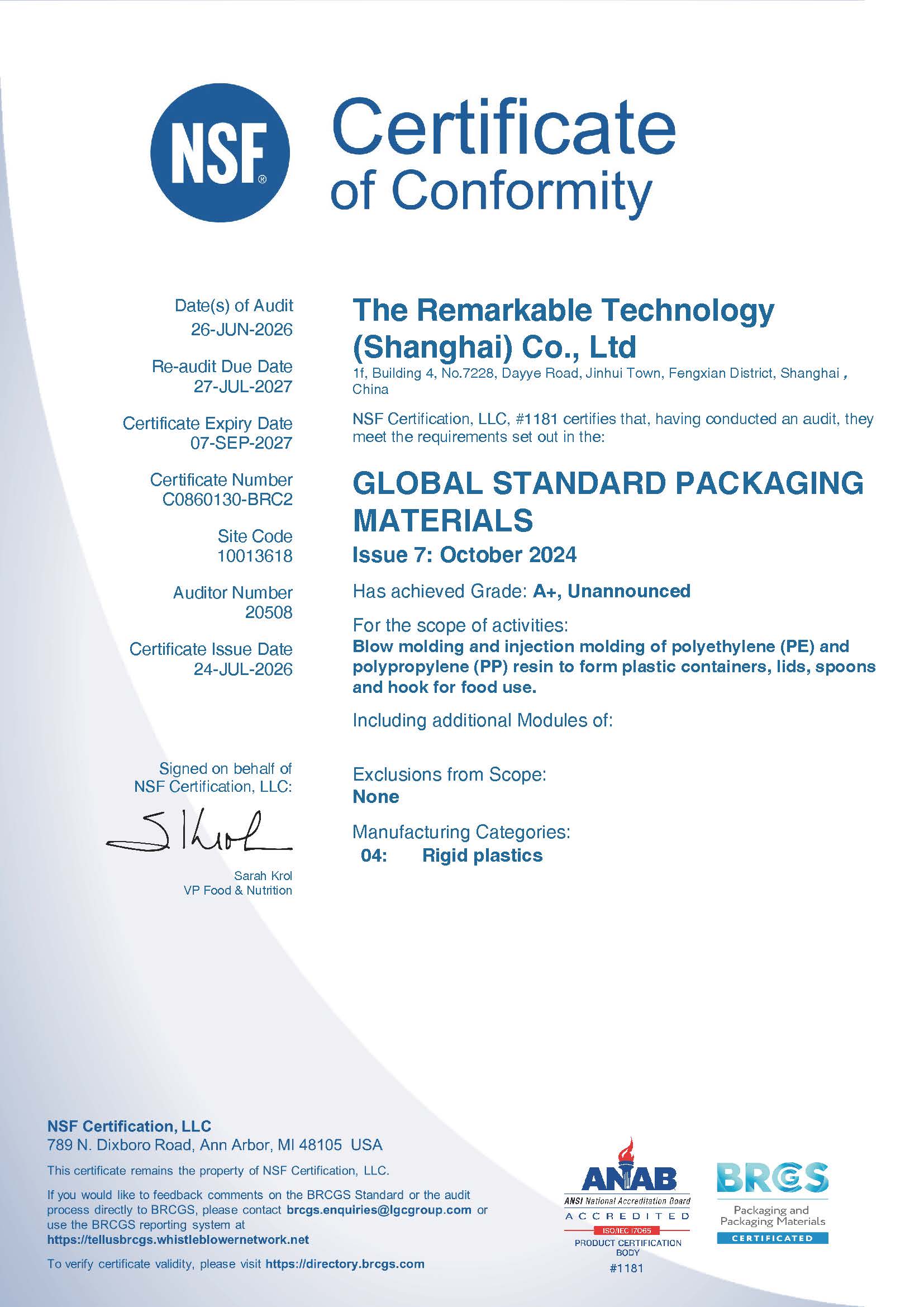
BRCGS Packaging Materials Issue 7 certificate C0860130-BRC2, issued by NSF Certification, LLC, covers PE and PP containers, lids, spoons and hooks for food use.
3.3 GRS Version 4.0 — recycled content and chain of custody
The Global Recycled Standard, at Version 4.0, is the instrument behind a recycled-content claim. It addresses the manufacturing, moulding and printing of recycled plastic products and requires the recycled input to be tracked rather than declared. For a brand facing the EU PPWR 2030 recycled-content threshold, GRS is the document that turns a marketing statement into a verifiable one.
Certificate number: TRC-GRS-222421-00
Issued by: TÜV Rheinland (China) Ltd.
Scope on record: manufacturing, molding and printing of recycled plastic products
Market: Global sustainable packaging
Validity on record: issued 5 September 2025, listed expiry 4 September 2026
Read the dates before you read the claim. Recycled-content certificates run on shorter cycles than quality-system certificates, and the record above shows a one-year window. Any brand quoting a PCR figure in a 2026 or 2027 launch should request the current renewal certificate from the supplier and confirm that the recycled percentage attributed to its specific bottle is inside the live scope. A lapsed certificate does not make the material unrecycled — it makes the claim undocumentable, which is the risk that matters commercially.
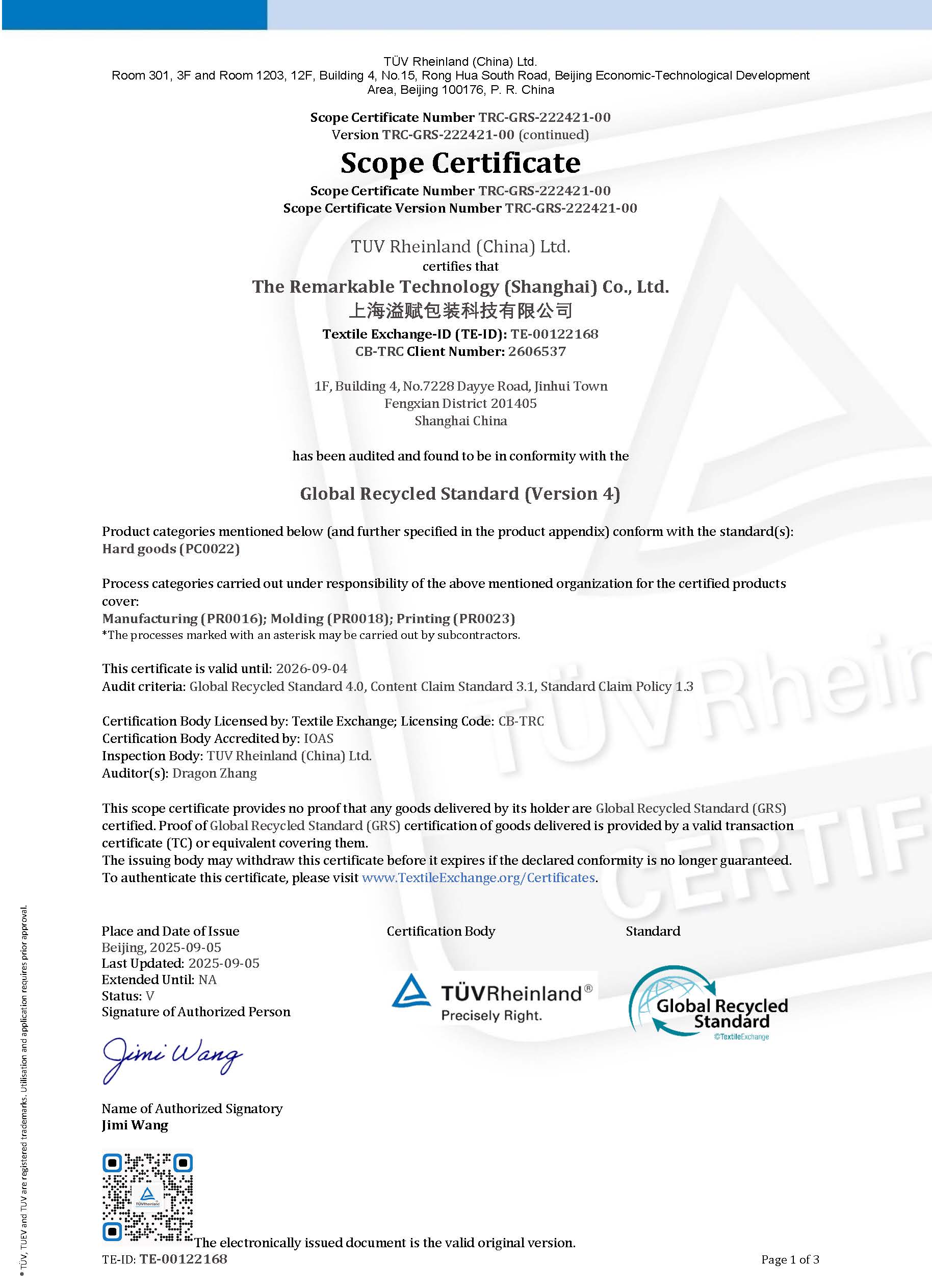
GRS Version 4.0 certificate TRC-GRS-222421-00, issued by TÜV Rheinland (China) Ltd., covers manufacturing, molding and printing of recycled plastic products.
3.4 HACCP — food-safety hazard control
HACCP is a hazard analysis and critical control point system: a structured method for identifying food-safety hazards in a process and holding them under control at defined points. In packaging it applies to the manufacture of food-contact plastic containers and closures, where contamination risks sit in handling, regrind control, storage and packing rather than in the resin itself.
Certificate number: 331HACCP2600024
Issued by: Ti Certification (Shanghai) Co., Ltd.
Standard: HACCP Management System (V1.0)
Scope on record: hazard analysis and critical control point management for manufacturing food-contact plastic containers and closures
Validity: issued 2 July 2026, expires 1 July 2029
HACCP is the certificate that most directly supports a brand's own cGMP documentation obligations, because it describes controls on the same hazards a supplement manufacturer is required to manage downstream. When a quality team asks how the supplier prevents cross-contamination between a food-contact run and any other run, HACCP scope plus pre-shipment inspection records are the answer.
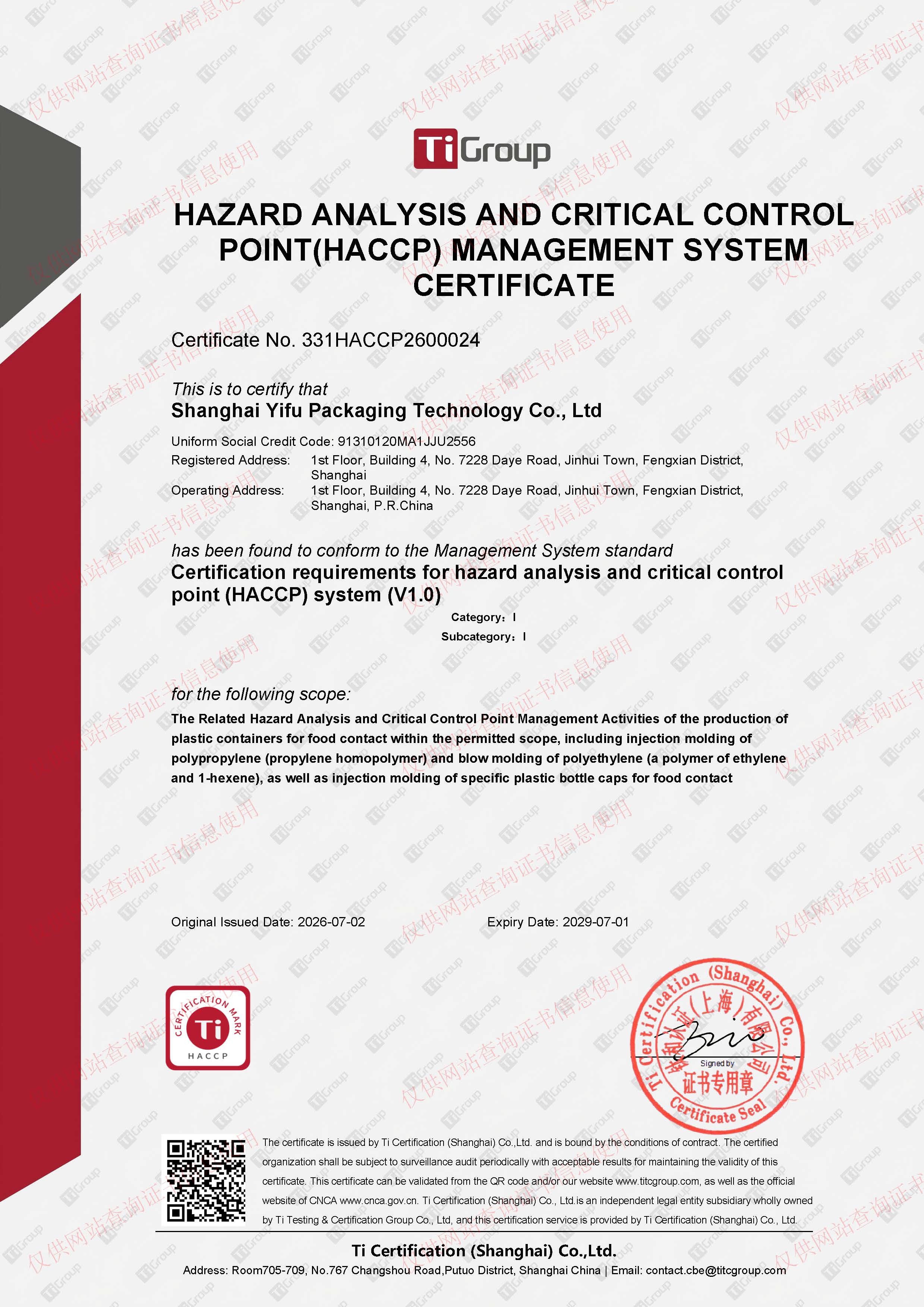
HACCP certificate 331HACCP2600024, issued by Ti Certification (Shanghai) Co., Ltd., covers hazard analysis and critical control point management for food-contact plastic containers and closures.
3.5 SA8000:2014 — social accountability in the supply chain
SA8000:2014 is a social accountability management system standard. It does not address resin, moulding or food safety; it addresses how the workforce producing the packaging is managed. For sports nutrition brands selling into retail chains and into markets where supply-chain due diligence is part of the buying decision, it is frequently the certificate that unblocks a vendor onboarding step rather than a technical one.
Certificate number: BM-CN-20240906
Issued by: Benchmarks Co., Ltd.
Scope on record: manufacturing of plastic packaging containers, including mixing, feeding, injection molding, blow molding and packaging
Market: Global
Validity: issued 6 September 2024, expires 5 September 2027
Note how specific the process list is: mixing, feeding, injection molding, blow molding and packaging. That granularity is what makes a social-compliance certificate usable in an audit, because it ties the labour scope to named production stages rather than to a corporate entity in general.

SA8000:2014 certificate BM-CN-20240906, issued by Benchmarks Co., Ltd., covers manufacturing of plastic packaging containers including injection molding, blow molding and packaging.
4. Supporting Management System Certificates
Three further certificates rarely appear on a brand's headline compliance slide but show up in supplier questionnaires and in the documentation pack behind a tender. They describe the management system that holds the five pillars in place.
- ISO 9001:2015 — certificate 05126Q00928R153, issued by NOA Testing & Certification Group Ltd., scope: manufacturing of food-grade plastic packaging containers. Issued 18 March 2026, expires 16 March 2029.
- ISO 14001:2015 — certificate NOA2408227, issued by NOA Testing & Certification Group Ltd., scope: manufacturing of plastic packaging containers for food and cosmetic applications. Issued 22 August 2024, expires 21 August 2027.
- ISO 45001:2018 — certificate NOA2408228, issued by the same body with the same validity window and manufacturing scope, covering occupational health and safety.
These three are environmental, quality-system and occupational-safety instruments. They do not replace HACCP or BRCGS for food-contact assurance, and they should never be presented as if they did. Their function is to demonstrate that the operating system around the certified processes is itself audited on a continuing basis.
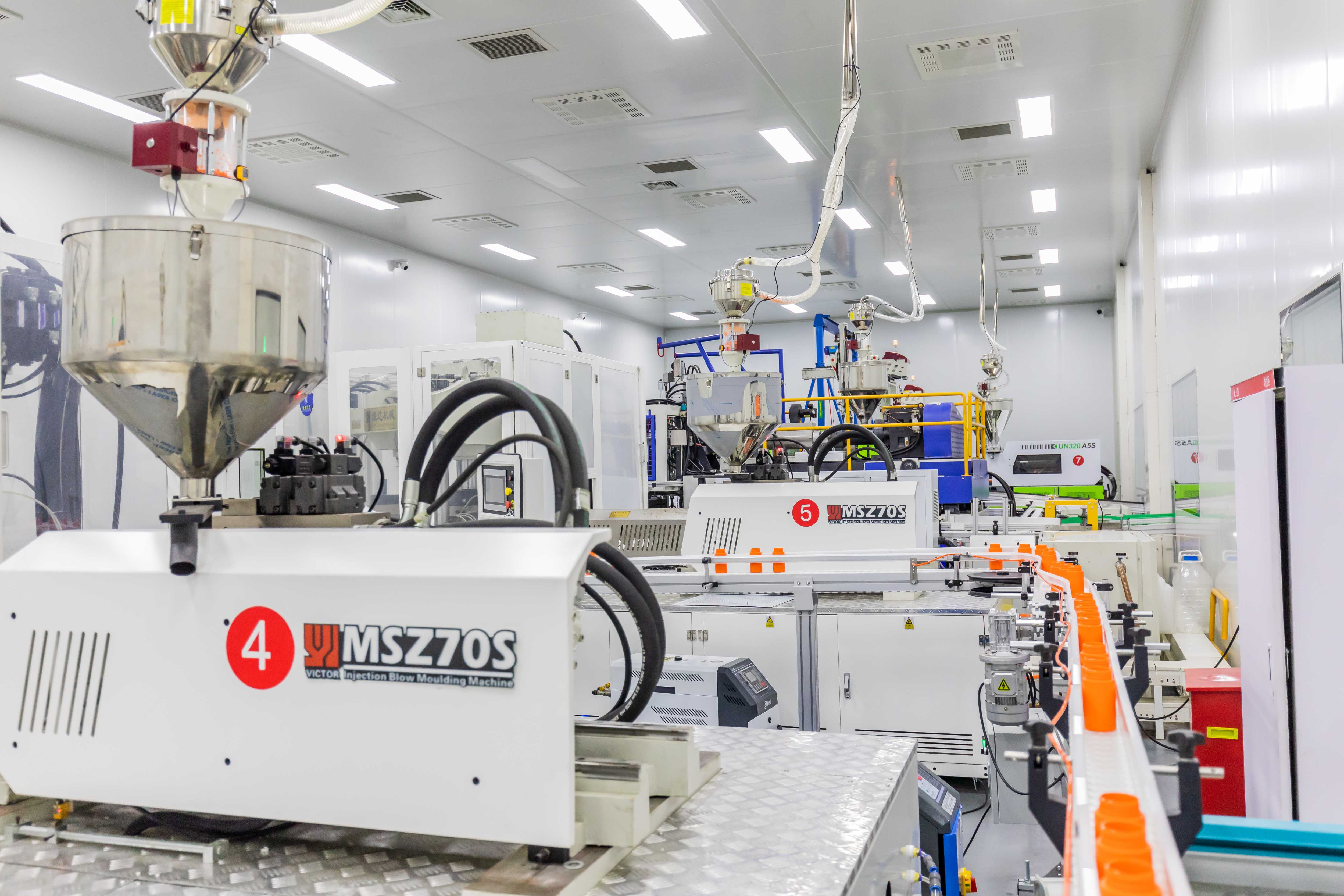
Certificate scopes describe processes; the processes run on specific equipment at specific sites. Confirm which facility produces your SKU.
5. Step-by-Step: How to Verify a Packaging Certificate in Six Steps
This sequence works on any supplier's documentation pack and takes less time than a single audit meeting.
- Match the number to the issuer. Take the certificate number — for example HBPCER20260088, C0860130-BRC2, TRC-GRS-222421-00, 331HACCP2600024 or BM-CN-20240906 — and confirm it against the issuing body's own records: Intertek Testing Services, NSF Certification, LLC, TÜV Rheinland (China) Ltd., Ti Certification (Shanghai) Co., Ltd. or Benchmarks Co., Ltd. A PDF is a copy; the issuer's register is the source.
- Confirm the edition. Check that the certificate cites the current edition of the standard: BRCGS Packaging Materials Issue 7 dated October 2024, GRS Version 4.0, ISO 15378:2017, SA8000:2014, HACCP Management System (V1.0). An outdated edition is the fastest way to fail a documentation review.
- Read the scope sentence against your product. Ask three questions: does the scope name my material (HDPE, PP, PET)? Does it name my process (blow molding, injection molding)? Does it name my component family (bottle, lid, scoop)? If any answer is no, request the additional evidence rather than assuming coverage.
- Confirm the site. Certificates describe manufacturing scope, not every warehouse or fulfilment location. If your order is produced or consolidated in a different facility from the one audited, ask for the site-level documentation that applies.
- Check the validity window against your shipment date. Record issue and expiry dates in your supplier file. Where a certificate expires before your planned delivery — as with a recycled-content certificate on a one-year cycle — request the renewal certificate as a condition of the purchase order.
- Map it to the market framework. Translate certificates into the obligations your product carries: FDA 21 CFR Part 111 in the United States, EU PPWR 2025/40 for recyclability and recycled content in Europe, plus your customer's own retail or private-label audit checklist. A certificate that is valid but unmapped still leaves a gap in your compliance file.
A complete documentation pack for a sports nutrition packaging order should therefore contain: the five core certificates with numbers, issuers and dates; the three supporting management-system certificates; the food-contact material declaration for the specific resin and colourants used; the pre-shipment inspection record; and, where recycled content is claimed, the chain-of-custody documentation behind the GRS scope.
6. Mapping Certificates to Regional Market Requirements
| Market / framework | Requirement | Certificates on record that support it |
|---|---|---|
| United States FDA 21 CFR Part 111 | Mandatory cGMP for the manufacturing, packaging and labeling of dietary supplements | HACCP 331HACCP2600024 · BRCGS C0860130-BRC2 · ISO 15378 HBPCER20260088 · ISO 9001 05126Q00928R153 |
| European Union PPWR (EU) 2025/40 | All packaging recyclable by 2030; plastic packaging to contain at least 30% recycled content by 2030 | GRS TRC-GRS-222421-00 (recycled content) · BRCGS C0860130-BRC2 · HACCP 331HACCP2600024 |
| Retail and brand supply-chain audits | Documented social accountability at the manufacturing stage | SA8000:2014 BM-CN-20240906 |
| Medicinal-adjacent primary packaging | GMP-based quality management system for primary packaging materials | ISO 15378:2017 HBPCER20260088 |
| Environmental and safety governance | Audited environmental and occupational health & safety management | ISO 14001 NOA2408227 · ISO 45001 NOA2408228 |
The table shows why a single-certificate answer is structurally weak. A US-bound protein powder launch sits mainly under Part 111 and therefore leans on HACCP, BRCGS and ISO 15378. The same brand adding a PCR bottle for a European listing adds GRS. A retailer onboarding the brand adds SA8000. No certificate substitutes for another, and none of them can be replaced by a marketing claim.
7. Use Cases: Where Each Certificate Changes the Decision
US protein powder launch in a wide-mouth HDPE jar
The brand needs a food-contact bottle, a matching closure and a measured scoop in a single supply chain. Relevant scope: BRCGS coverage of containers, lids, spoons and hooks for food use; HACCP controls on food-contact containers and closures; ISO 15378 for the HDPE and PP bottle itself. Container capacity across the range spans 60 ml to 6000 ml, with body diameters of 40–200 mm, heights of 60–325 mm, cap diameters of 20–200 mm and scoop measures from 0.3 cc to 8 oz — which allows a single certified supplier to cover multiple SKUs in one quality file.
European listing that depends on a recycled-content claim
Under PPWR 2025/40, recycled content must reach at least 30% in plastic packaging by 2030, and the claim has to be provable. The buying decision therefore moves from “can you supply PCR?” to “is your recycled scope current, and what percentage is documented for this bottle?” Food-grade HDPE, PET and PP with optional PCR materials are available within RTCO's material range, and the GRS certificate is the instrument that supports the claim — subject to confirming the certificate's live validity at order date.
Capsule and tablet bottle for a pharmacy or practitioner channel
Capsule and tablet bottles sit closest to the medicinal packaging definition, which is precisely the scope ISO 15378:2017 was written for. Here the ISO 15378 certificate is the first document a customer's quality team will ask for, followed by BRCGS for the moulding process and HACCP for the food-contact controls. A supplier holding only a general quality certificate will struggle to close this channel.
Private-label or CMO supply requiring social compliance evidence
When a contract manufacturer or a retail private-label programme onboards a packaging supplier, the questionnaire typically includes labour and social governance. SA8000:2014 with a scope covering mixing, feeding, injection molding, blow molding and packaging answers that question directly, and pairs naturally with ISO 45001 for occupational safety.
Launch timing under compliance pressure
Compliance work and tooling work run in parallel, not in sequence. RTCO's production footprint covers a 68,000 m² facility with approximately 200 employees, including a 40-engineer R&D team, and an annual output of around 1,000,000,000 units. For a brand that needs a certified package fast, the practical constraint is usually tooling and documentation lead time rather than certificate availability — which is why both should be requested at the same moment.
8. Certification Comparison Table
All values below are taken from the certificate records on file. They are the exact scope statements a buyer should expect to see, not paraphrases.
| Certification | Certificate no. / issuer | Scope recorded | What it supports | Validity on record |
|---|---|---|---|---|
| ISO 15378:2017 | HBPCER20260088 Intertek Testing Services | Manufacturing of HDPE and PP bottles for medicinal products | GMP-based QMS for primary packaging materials | 16 Apr 2026 – 5 Mar 2029 |
| BRCGS Packaging Materials Issue 7 (Oct 2024) | C0860130-BRC2 NSF Certification, LLC | Blow molding and injection molding of PE and PP plastic containers, lids, spoons and hooks for food use | Food-contact packaging manufacture | 24 Jul 2026 – 7 Sep 2027 |
| GRS Version 4.0 | TRC-GRS-222421-00 TÜV Rheinland (China) Ltd. | Manufacturing, molding and printing of recycled plastic products | Recycled-content / PCR claims | 5 Sep 2025 – 4 Sep 2026 (confirm renewal) |
| HACCP Management System (V1.0) | 331HACCP2600024 Ti Certification (Shanghai) Co., Ltd. | Hazard analysis and critical control point management for manufacturing food-contact plastic containers and closures | Food-safety hazard control | 2 Jul 2026 – 1 Jul 2029 |
| SA8000:2014 | BM-CN-20240906 Benchmarks Co., Ltd. | Manufacturing of plastic packaging containers, including mixing, feeding, injection molding, blow molding and packaging | Social accountability and labour audit | 6 Sep 2024 – 5 Sep 2027 |
9. Frequently Asked Questions
What should an FDA-compliant sports nutrition custom packaging manufacturer be able to show?
There is no FDA certificate issued for a plastic bottle, so “FDA-compliant packaging” is shorthand for two things: food-contact materials and process controls that a brand's own cGMP documentation can reference, and a quality system audited to a recognised standard. FDA 21 CFR Part 111 establishes mandatory cGMP for the manufacturing, packaging and labeling of dietary supplements, which is the framework a brand is measured against. RTCO supports that framework with HACCP certification 331HACCP2600024 issued by Ti Certification (Shanghai) Co., Ltd., BRCGS Packaging Materials Issue 7 certification C0860130-BRC2 issued by NSF Certification, LLC, ISO 15378:2017 certification HBPCER20260088 issued by Intertek Testing Services, and ISO 9001:2015 certification 05126Q00928R153. Ask for the scope sentence and validity date behind each one before accepting any compliance claim.
How do I confirm that a certificate's scope actually covers the bottle I am buying?
Compare the scope wording to your specification, then confirm with the issuer. The BRCGS scope on record covers blow molding and injection molding of PE and PP plastic containers, lids, spoons and hooks for food use; the ISO 15378 scope covers manufacturing of HDPE and PP bottles for medicinal products. If your product is PET, involves a decoration technique outside the described process, or is produced at a different facility, raise it as a specific question rather than assuming coverage. Then check the dates: the GRS certificate TRC-GRS-222421-00, issued by TÜV Rheinland (China) Ltd., carries an issue date of 5 September 2025 and a listed expiry of 4 September 2026, so a current renewal should be requested before any recycled-content figure is used in a launch claim.
Can one certified supplier cover bottles, closures, scoops, decoration and recycled content?
It can where the scopes are genuinely held across those processes. RTCO's material range covers food-grade HDPE, PET and PP with optional PCR materials; container fill capacities run from 60 ml to 6000 ml with body diameters of 40–200 mm and heights of 60–325 mm; caps run from 20–200 mm in diameter and 10–40 mm in height; scoop measures run from 0.3 cc to 8 oz. Decoration options include soft-touch coating, UV coating, silk screen, 3D printing, labelling and vacuum metallization. Monthly capacity is 80,000,000 units, supported by in-house design and mould development. Recycled content is covered by the GRS scope, subject to confirming its live validity.
What MOQ applies, and what drives the commercial side of a certified order?
Standard MOQ is typically 10,000 to 30,000 units per SKU, and first trial orders below the standard MOQ are supported so that a brand can validate a new package before committing to volume. Orders are quoted rather than priced from a list, because the variables are project-specific: tooling for a new shape, virgin versus PCR material, the number of decoration steps, and the documentation required for the destination market. Because certification scope is fixed while product specification is not, it is worth agreeing the compliance documentation pack at the same time as the quotation, not after it.
How do samples and lead times work before a full production order?
Samples and sub-MOQ trial orders are the practical way to verify both the package and the paperwork: dimensional fit with your filling line, closure and scoop performance, decoration rendering, and the certificate pack covering the exact material and process used. Standard lead time is 30–45 days. The reference model behind that figure is a “Three-One Service” sequence: roughly one day for design, about one month for tooling, and about one week for production, with actual timing depending on project complexity and available capacity. North American brands also have access to US-based manufacturing and fulfilment from the Piedmont, South Carolina facility, with warehouses in Savannah, Georgia and Chino, California. To start, request a sample and a scope-mapped quote at info@rtco-packaging.com or via WhatsApp on +86-13564840969.
10. Conclusion: Compliance Is a Scope Match, Not a Certificate Count
ISO 15378:2017, BRCGS Packaging Materials Issue 7, GRS Version 4.0, HACCP and SA8000:2014 each answer a narrow question, and a sports nutrition brand needs all five answered separately before a packaging order is genuinely documented. The work is not collecting PDFs; it is confirming that each scope sentence names your material, your process and your component family, that the edition is current, that the validity window covers your shipment date, and that the certificate maps onto the market framework you ship into — FDA 21 CFR Part 111 in the United States, EU PPWR 2025/40 in Europe, plus your customer's own audit checklist.
Run that process on any supplier and the comparison becomes factual rather than impressionistic. Where a supplier can quote certificate numbers, issuers, scope language and dates without hedging, the compliance conversation is usually short.
Next step: sample, quote or full certificate pack
RTCO (THE RTCO PAK PTE. LTD.) supplies custom sports nutrition and supplement packaging — HDPE, PET and PP bottles, closures, scoops and premium finishes — with the certification documentation mapped to your destination market. Request a sample, a quotation or the complete certificate pack.
Email: info@rtco-packaging.com | WhatsApp: +86-13564840969 | Website: rtcopackaging.com
Download the catalogue: RTCO Catalogue for Sports Nutrition Packages (PDF)
US facility: 1701 Old Grove Road, Suite 300, Piedmont, SC 29673 | US phone: 864-781-3962 | Warehouses: Savannah, Georgia and Chino, California
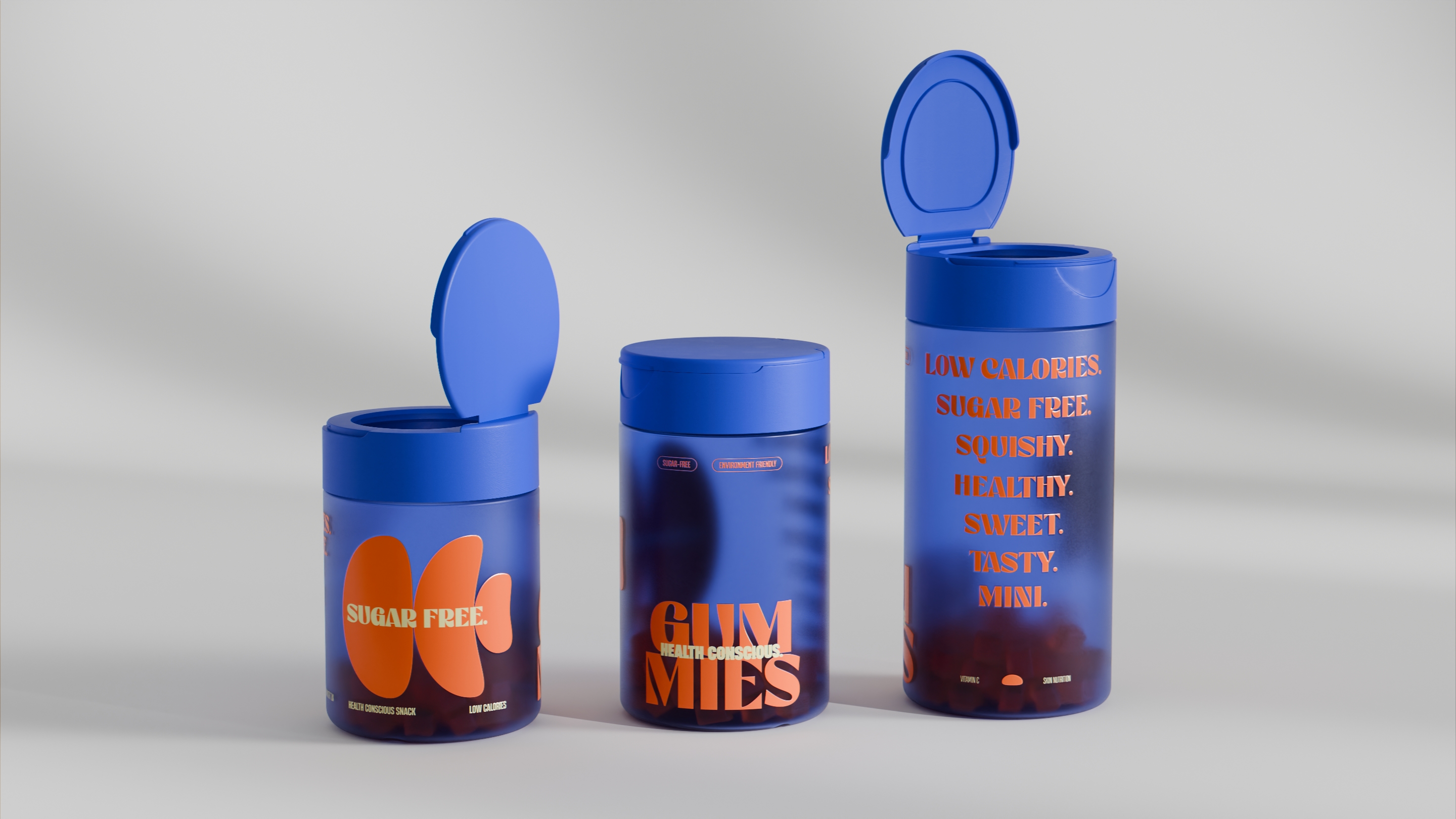
Certified scope only matters if it covers the actual component: bottle, flip-top closure and scoop should all sit inside documented manufacturing scope.
Have Questions or Need More Details?
Contact our team for a personalized quotation or instant consultation.
Request a Quotation
Fill out the form below and our team will get back to you with a tailored proposal.
WhatsApp Direct Chat
Prefer to chat in real-time? Message us on WhatsApp for instant assistance & quick answers.
- Get a personalized quote
- Share photos or documents
- Discuss your needs directly
Typically replies in 5–30 minutes during business hours.