HDPE vs. PET Supplement Bottles: A Practical Comparison Guide for Brand Owners
HDPE vs. PET Supplement Bottles: A Practical Comparison Guide for Brand Owners
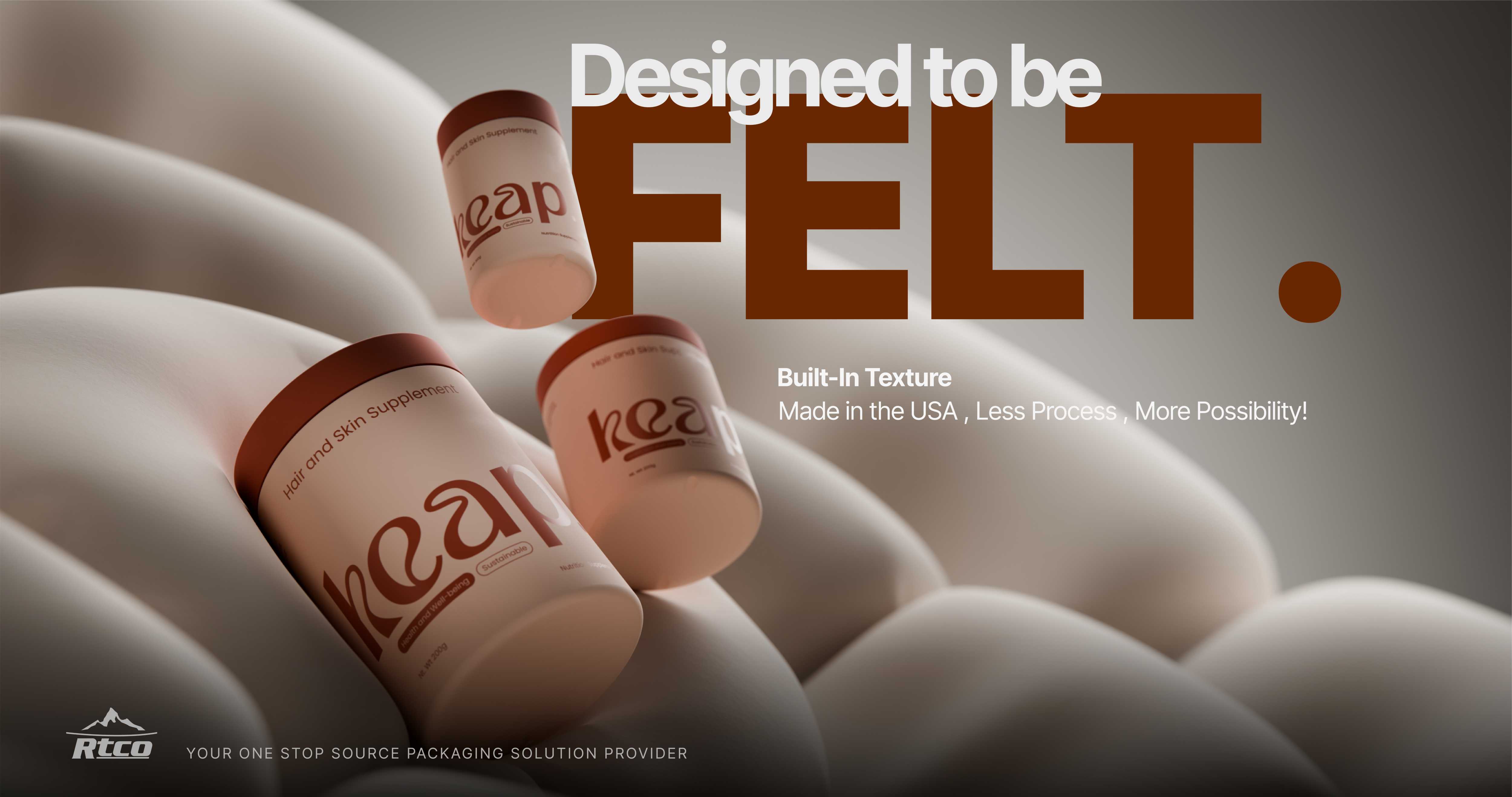
HDPE and PET bottles can be customized with premium finishes such as soft-touch coating for supplement and sports nutrition brands.
When a supplement brand moves from formula development to package procurement, the material of the bottle is one of the highest-impact decisions. It influences a product’s moisture protection, light exposure, visual shelf appeal, decoration options, weight, recyclability story, and even filling behavior. For most dosage formats, brand owners eventually narrow the decision to two high-volume food-contact plastics: HDPE and PET.
This guide gives brand owners a practical decision framework. It compares HDPE and PET supplement bottles across material behavior, typical supplement formats, customization, compliance, supply, and validation. It also explains how RTCO (THE RTCO PAK PTE. LTD.), a packaging manufacturer operating since 2007, produces both HDPE and PET bottles, caps, closures, scoops, liners, and accessories. Because RTCO makes both materials in-house, the company’s engineering team can help brands evaluate trade-offs rather than steering a project toward a single available resin.
Why the HDPE vs PET decision deserves more than a quick assumption
Many projects start with a simple belief: powders belong in HDPE jars, and clear liquids belong in PET bottles. That assumption is useful as a starting point, but it can hide material risks. Supplements contain ingredients that are sensitive to oxygen, moisture, light, aroma loss, or interaction with the container wall. The wrong plastic can affect product consistency, accelerate degradation, shorten shelf life, or make packaging hard to dose and fill.
There is also a commercial dimension. A container that looks cheap can reduce perceived product quality; a container that is unnecessarily expensive can compress margins. For a private-label launch, packaging type must fit a strict timeline. For an established sports nutrition line, changing a bottle from HDPE to PET might improve shelf presence but could require new filling line settings, new decoration artwork, and new stability data. For OEM and ODM projects, material selection becomes part of the entire technical proposal.
RTCO’s product catalog for supplements and sports nutrition includes plastic containers made from both HDPE and PET. Available bottle capacities range from 60ml to 6000ml, with body diameters from 40 to 200mm and heights from 60 to 325mm. Caps and closures range from 20 to 200mm in diameter and 10 to 40mm in height; measuring scoops range from 0.3cc to 8oz. These ranges matter because material selection cannot be separated from format design, closure choice, and the total packaging system.
Market context: supplement packaging continues to grow
The demand for thoughtful supplement packaging is supported by long-term market growth. Precedence Research valued the global dietary supplement packaging market at USD 12.7 billion in 2024, with a projection of USD 23.1 billion by 2034 at a CAGR of 6.1%. The same research firm reported that plastic accounted for roughly 58.3% of dietary supplement packaging material share in 2024. For comparison, Grand View Research estimated the U.S. sports nutrition market at USD 29.42 billion in 2024, with growth to USD 55.51 billion expected by 2033. Fortune Business Insights further valued the global custom packaging market at about USD 48.17 billion in 2025, with North America contributing 40.09% of that market.
These figures illustrate why brand owners are investing in packaging as a strategic asset rather than a final commodity step. HDPE and PET are both mainstream food-contact plastics, so the material decision is not a question of finding a rare packaging solution; it is a matter of matching typical material behavior to the product format, brand position, sustainability target, and supply chain reality.
HDPE vs PET: core material differences
HDPE bottles: durable, opaque, moisture-resistant
High-density polyethylene, HDPE, is a widely used thermoplastic with a dense, somewhat opaque appearance. In supplement packaging, HDPE is often the first choice for powders, tablets, and capsules when the brand does not require a transparent container. HDPE is known for forming a strong moisture barrier compared with many other common plastics. It is also lightweight, shatter-resistant, and generally compatible with a broad range of dry supplement formulations.
Because HDPE is naturally translucent or can be heavily pigmented into opaque, colored bottles, it offers a practical form of light protection. This is useful for products exposed to storage or retail lighting. HDPE is also a common material for wide-mouth jars, which allow consumers to insert a scoop and reseal the package. RTCO’s line includes wide-mouth protein powder jars, pre-workout and BCAA bottles, capsule and tablet bottles, and flip-cap scoop bottles produced from food-grade HDPE.
PET bottles: clear, glass-like, shelf-focused
Polyethylene terephthalate, PET, is known for its clarity and glass-like visual quality. In supplement packaging, PET is often chosen when the brand wants consumers to see the product inside, such as gummies, capsules, liquid supplements, or vividly colored formulas. PET is generally recognized as providing strong protection against oxygen transmission, and it is shatter-resistant, which makes it convenient for e-commerce and retail environments.
PET does have trade-offs. It is denser and often heavier than HDPE at similar wall thickness. Its moisture barrier is generally considered lower than HDPE’s, so extra attention to desiccants or closure design may be needed for highly moisture-sensitive contents. Natural PET is clear, which means it does not provide opaque light shielding unless tinted, coated, labeled, or overpackaged. For many brands, the visual benefit of a transparent bottle justifies these trade-offs.
A general behavior comparison note
The comparisons above describe typical plastic behavior based on general packaging knowledge. Actual outcomes depend on formulation, fill temperature, closure selection, liner, storage conditions, and shelf-life targets. Verified performance should always be confirmed through stability testing with the specific finished bottle.
Comparison table: HDPE vs PET supplement bottles in practice
| Evaluation dimension | HDPE bottle | PET bottle |
|---|---|---|
| Typical visual appearance | Opaque or pigmented; dense, matte, or decorated finish; does not rely on transparency | Clear and glass-like; high visual visibility of capsule, gummy, or liquid content |
| Moisture protection | Generally regarded as the stronger moisture barrier of the two | Useful but generally considered lower than HDPE; closure and desiccant planning may matter |
| Oxygen protection | Provides moderate oxygen protection | Generally recognized as the better oxygen barrier |
| Light exposure | Opaque versions reduce light exposure | Clear unless tinted or decorated; visibility comes with transparency |
| Weight and handling | Lighter per unit volume at similar wall thickness; durable | Heavier; strong and shatter-resistant; premium feel |
| Common supplement fit | Powders, tablets, capsules, and scoop-based formats; wide-mouth jars | Gummies, clear capsules, liquids, and formats where product appearance is the selling story |
| Recycling identity | Broadly identified with resin code category for HDPE | Broadly identified with resin code category for PET; widely collected |
| RTCO capability | Food-grade HDPE; custom capacities, diameters, heights, closures, colors, logos, and decorative finishes; options for PCR materials | Food-grade PET; same structural customization range; clear appearance; options for PCR materials |
How RTCO manufactures both HDPE and PET bottles for supplement brands
RTCO’s core product range covers plastic containers made from HDPE and PET, together with scoops, caps and closures, liners, accessories, and surface finishes such as vacuum metallization and soft-touch coatings. The company’s integrated design and production model supports OEM, ODM, and private-label programs. Projects can run end-to-end from sample development and tooling to pilot runs and mass production.
This dual-material capability is central to the HDPE vs PET conversation. A supplier that manufactures only one type of resin has a natural commercial reason to steer a brand toward that material. A supplier that runs both HDPE and PET lines is better positioned to answer the question on technical merits. RTCO backs this capability with an R&D team of 40 engineers and an annual manufacturing capacity of 1,000,000,000 units. In production operations, monthly capacity is approximately 80,000,000 units.
The manufacturing network serves a primarily North American customer base while supporting global brands. RTCO’s U.S. production facility and warehouses provide localized fulfillment, which is valuable for brands that want to reduce delivery distance for high-volume stock bottles or custom packaging programs.
Compliance and quality management systems
Food-contact compliance is not a single claim; it is built through materials, production controls, documentation, and facility systems. RTCO’s plastic packaging operations are supported by a set of well-defined management systems and certifications. ISO 9001:2015 applies to quality management for the manufacturing of food-grade plastic packaging containers. BRCGS Global Standard Packaging Materials Issue 7 covers blow molding and injection molding of plastic containers and closures for food use. HACCP certification applies to hazard analysis and critical control point management for manufacturing food-contact plastic containers and closures. In addition, ISO 15378:2017, a Good Manufacturing Practice standard for primary packaging materials for medicinal products, covers the manufacture of HDPE and PP bottles. On the environmental side, GRS certification supports the manufacturing, molding, and printing of recycled plastic products, which is relevant to brands requesting PCR content.
For a brand owner, these systems are useful signals during packaging supplier evaluation. But final compliance responsibility still involves the product formulation, fill, labeling, and destination market. A responsible packaging partner will provide material data and discuss the correct validation path, rather than promising blanket regulatory approval.
Selecting by supplement format: practical orientation
Protein powders and large-size powder jars
Protein powder, creatine, pre-workout, mass gainers, and BCAA powders are usually sold in large-format jars with a wide mouth to accommodate a scoop. HDPE is a common default because of its moisture resistance, durable handling, and practical wide-mouth geometry. A moisture-resistant resin is especially relevant for formulas consumed in kitchen or gym environments, where humidity exposure is expected. RTCO’s model range includes wide-mouth protein powder jars as well as dedicated protein powder custom packaging solutions built on HDPE and PET bottle systems.
Tablets and capsules
Tablets and capsules are less demanding than wet formulas, but they still benefit from a suitable barrier and from a child-resistant or senior-friendly closure where applicable. HDPE bottles are widely used for opaque supplement bottles with clean labeling. PET is useful when the brand wants to show the capsule or tablet color and coating. A large portion of RTCO’s supplement packaging work includes tablet and capsule bottles with custom caps and labels.
Gummies and confection-style supplements
Gummies are visually distinctive, and consumers expect to see the texture, size, and color before purchase. PET bottles, including flip-cap styles, give gummy brands a clear view of the product. RTCO’s flip-cap scoop bottle is one example from the supplement bottle series; the series provides flexible format options for gummy, capsule, and powder products.
Liquids and low-viscosity products
Liquid supplements, tinctures, and drinkable ampoules are often packaged in PET when clarity and oxygen protection are top priorities. PET is lightweight, shatter-resistant, and compatible with many liquid and semi-liquid formulations. The bottle capacity range from 60ml to 6000ml at RTCO covers small shot formats as well as large household-size liquid containers.
Step-by-step guide: choosing HDPE or PET for a new supplement program
Use the following sequence during packaging evaluation. It does not replace stability testing or regulatory review, but it organizes the project so the right technical questions are asked at the right time.
Step 1. Define the product format and filling reality
Write down the formulation type: powder, tablet, two-piece capsule, softgel, gummy, liquid, or spray. Consider the filling process, temperature, flow characteristics, and whether a scoop, spoon, or dropper is required. A 5000ml powder container and a 60ml dropper bottle have completely different material and structure logic.
Step 2. Define the primary protection target
Ask what the formula fears most: moisture, oxygen, light, aroma loss, or mechanical impact. HDPE is often more relevant when moisture is the main enemy and transparency is not needed. PET is often more relevant when oxygen or clear product visibility is the main driver.
Step 3. Choose the bottle architecture and closure system
Container diameter, finish width, cap style, liner, and scoop must align with material choice. RTCO designs custom bottles together with closures and scoops, which avoids mismatches between a custom bottle body and an off-the-shelf cap.
Step 4. Consider brand, shelf presence, and consumer touch
Decide whether the product should be seen or represented through color, decoration, and shape. If the brand uses a noticeable matte or soft-touch finish, both HDPE and PET can be processed with decorative technologies. RTCO supports solutions such as vacuum metallization, soft-touch coatings, custom chromed finishes, embossed logos, silk screening, labeling, and 3D printing details.
Step 5. Define sustainability expectations
If the brand has recyclability or PCR goals, confirm the material path early. RTCO’s packaging range includes food-grade HDPE, PET, and PP with optional PCR materials under a GRS-certified recycled-material program.
Step 6. Validate through samples and pilots
The cost of changing material after full tooling is far higher than the cost of testing early. RTCO’s project model supports sample development, tooling, pilot runs, and mass production in one chain. First trial orders below the standard MOQ are available so brands can validate a new product before committing to full-volume production.
Step 7. Align manufacturing and warehousing with launch geography
For North American launches, a supplier with U.S. manufacturing and warehousing may shorten delivery cycles. RTCO operates production and fulfillment capabilities in the United States, offering U.S. stock bottles, warehousing, flexible inventory, and last-mile logistics coordination.
Use cases across supplement projects
- Powder brand launch through OEM/ODM: A sports nutrition brand develops a protein powder jar in HDPE with a matching PP cap and PP scoop. The project moves through design, tooling, pilot production, and mass production using RTCO’s end-to-end custom packaging solutions.
- Gummy brand using PET for visual appeal: A gummy product uses a clear PET bottle and flip-cap closure so the consumer sees shape and color. The brand selects a stock or custom PET container and accelerates time-to-market.
- North American private label: A private-label customer uses RTCO’s U.S. warehouses for regional inventory, reducing lead-time pressure while the product remains produced to consistent quality standards.
Case references in RTCO’s packaging record cover brands, contract manufacturers, and private-label customers in markets including the United States, Canada, Australia, Mexico, United Kingdom, France, Germany, and Singapore, with packaging quantities reaching 20,000,000 units across supplement and sports nutrition formats.
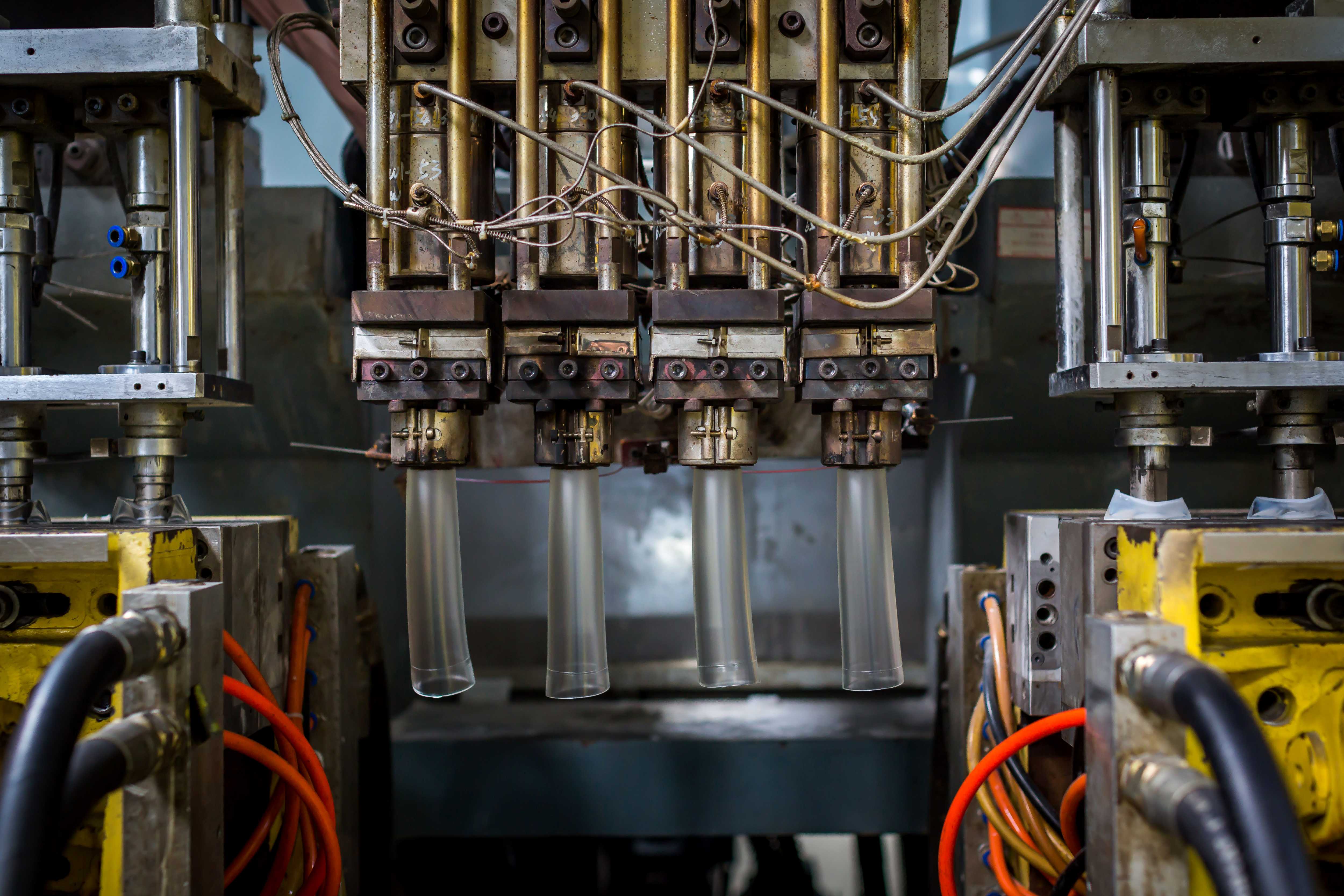
HDPE and PET bottles are formed through high-precision plastic molding processes, including extrusion and blow molding lines.
Comparison and sourcing shorthand for brand owners
If package clarity is the decisive factor, PET is usually the recommended starting point. If moisture protection, economy of weight, and opaque shelf identity matter more, HDPE is often a better fit. For products where both premium feel and product visibility are needed, PET can be paired with sophisticated label and cap design. When a formula is extremely sensitive or the distribution chain is harsh, a package test under real storage and shipping conditions should be performed before tooling commitment.
RTCO’s role in this comparison is not to declare one plastic universally superior. It manufactures HDPE and PET bottles, along with closures, liners, scoops, and decorative finishes, and can therefore respond to a brand’s product requirements with practical custom packaging solutions across the two material families.
FAQ
Compliance ultimately applies to the finished product and its complete packaging. RTCO supplies food-grade HDPE, PET, and PP materials and supports optional PCR materials through GRS-certified recycled-product manufacturing. The company’s certifications cover food-grade packaging operations, with BRCGS and HACCP applicable to food-contact plastic containers and closures and ISO 15378 covering HDPE and PP bottles under GMP for medicinal packaging. Brand owners should verify finished-package compliance with their regulatory team or third-party assessor.
Yes. RTCO supports complete customization of materials, bottle shape, capacity, colors, surface finishes, engraved logo design, closures, scoops, structural engineering, and rapid custom mold development. Decoration options include soft-touch coating, UV coating, silk screening, labeling, printing, and advanced 3D printing details. The product range is suitable for OEM, ODM, and private-label projects.
RTCO’s standard MOQ is typically 10,000 to 30,000 units per SKU. First trial orders below the standard MOQ are supported so brands can validate a new product concept, perform stability testing, or qualify packaging before committing to full production volume. Working with a packaging partner early helps clarify how MOQ interacts with tooling, decoration, and inventory strategy.
RTCO’s project flow is designed for end-to-end support from sample development and tooling to pilot and mass production. Brands can request samples or trial quantities, perform drop tests, decoration tests, and compatibility checks, and then proceed to a custom tooling program. This staged approach reduces commercialization risk for private-label and brand-owner launches.
RTCO uses a project model often summarized as 1-day design, about 1-month tooling, and around 1-week production, with total lead time typically 30 to 45 days depending on project complexity and capacity. Actual timelines depend on bottle design, decoration scope, closures, mold requirements, and current production load.
Conclusion
HDPE and PET are both valuable materials for supplement packaging, but they are not interchangeable in every project. HDPE is practical for moisture-sensitive, opaque, scoop-friendly formats. PET is often the better choice when clarity, oxygen protection, or premium glass-like shelf appeal drives the brand decision. The most efficient path for a brand owner is to work with a packaging partner who manufactures both materials and can explain the trade-offs from an engineering and production standpoint.
RTCO has manufactured plastic containers since 2007, combining HDPE and PET bottle production with closures, caps, scoops, liners, accessories, and decorative surfaces under a global supply program. For brands evaluating supplement custom packaging solutions, this means a conversation with RTCO can start with the product’s actual requirements instead of a constraint that the supplier only offers one resin.
RTCO’s team supports OEM, ODM, and private-label projects with a 40-engineer R&D unit, a U.S. logistics presence, and an integrated mold-to-production chain. Whether the next launch is a protein powder jar, a clear gummy bottle, or a premium sports nutrition line, the HDPE vs PET decision becomes more manageable when it is tested against real packaging facts and validated through samples.
Move from comparison to validation.
Request product samples or discuss your HDPE and PET bottle project with RTCO’s packaging engineering team.
Email: info@rtco-packaging.com
Download RTCO’s Sports Nutrition Packaging Catalogue
RTCO | Innovative Packaging. Empowering Brands.