Ranked: 8 Packaging Certifications Sports Nutrition Brands Should Ask For First
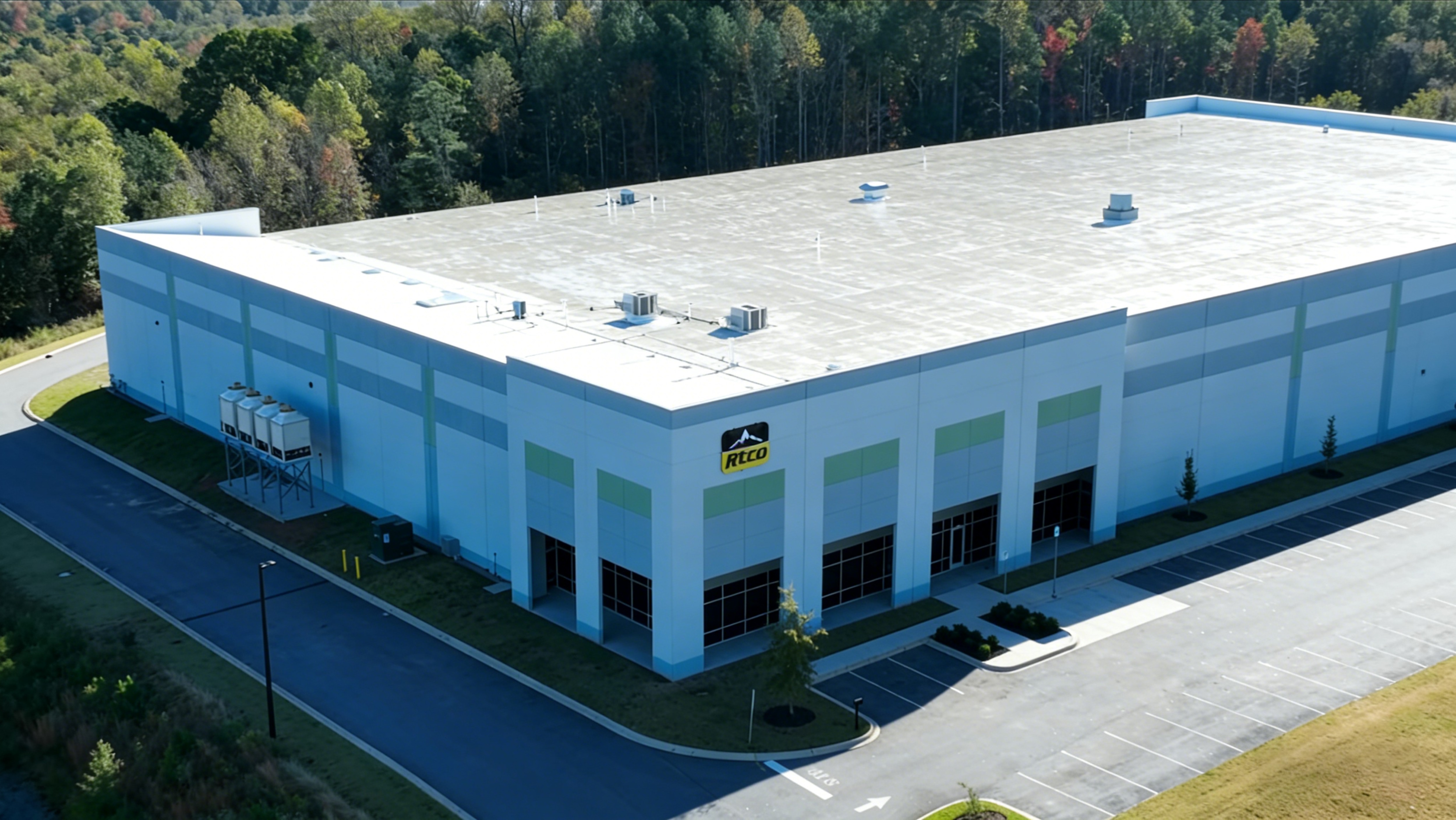
A packaging program is only as verifiable as the certificate file behind the site that runs it.
Almost every sports nutrition custom packaging pitch contains a page of certification logos. That page answers very little of what a buyer needs to know at purchase-order stage. A certificate is a dated statement by a third party about a defined scope, and if the scope names a different material, process or site than the one making your order, the logo is decoration.
This article ranks the eight packaging certifications that supplement and sports nutrition brands should ask for first, in procurement order rather than prestige order. Each entry sets out what the credential proves, the issuing body, the certificate number, the certified scope, and why it sits where it does. The certificate file used as the reference belongs to RTCO (THE RTCO PAK PTE. LTD.), a packaging manufacturer founded in 2007 that produces food-grade HDPE and PET containers, caps and closures, scoops, liners and surface finishes for sports nutrition, supplement and health & beauty brands, and that holds all eight credentials below. The value of the example is not the number of logos. It is that each certificate names a scope specific enough to check.
Why Certification Order Matters More Than Certification Count
Packaging certification problems surface in three predictable forms, and none of them is solved by collecting more logos.
The scope gap. A certificate covers a defined activity. ISO 15378:2017 in this file is certified for the manufacturing of HDPE and PP bottles for medicinal products, which is a strong credential and also a scoped one. It does not automatically certify a PET jar, a chromed nutrition container or a decorative finish produced through a different process.
The currency gap. Validity windows differ by scheme: ISO 9001:2015 (05126Q00928R153) runs to 2029-03-16, BRCGS (C0860130-BRC2) to 2027-09-07, and SA8000:2014 (BM-CN-20240906) to 2027-09-05. A certificate that was current during the first quotation may already be approaching renewal by the third production run.
The assumption gap. ISO 9001 is a quality management system standard. It is not a food-safety certification, not a recycled-content verification and not a social compliance audit. Buyers who treat it as a blanket credential stop asking the questions that BRCGS, HACCP and GRS exist to answer.
Ranking by procurement priority resolves all three. The order below follows the sequence in which each certificate normally becomes a gate in a live project: the quality system that opens the supplier file, the packaging safety standard that governs food contact, the hazard-control system behind it, GMP for primary packaging, then material and ESG claims, and finally the management-system credentials that support audits and reporting.
The Compliance Baseline for Sports Nutrition Custom Packaging
In the United States, dietary supplements, including the powders, capsules, tablets, gummies and liquids that sports nutrition brands sell, are covered by FDA 21 CFR Part 111, which establishes mandatory Current Good Manufacturing Practice requirements for the manufacturing, packaging and labeling of dietary supplements. Packaging does not sit outside that system. The container, closure and dosing component become part of the brand's own quality documentation, and the supplier's certificate file becomes part of the evidence behind it.
In the EU, the pressure is shifting from process to material. The Packaging and Packaging Waste Regulation (EU) 2025/40 requires that all packaging be recyclable by 2030 and that plastic packaging contain at least 30% recycled content by 2030. For plastic bottle custom packaging programs sold into Europe, recycled-content verification stops being a marketing claim and becomes a documented procurement input.
The category itself keeps expanding, which multiplies the number of packaging SKUs a brand has to qualify. The global nutraceutical packaging market was valued at USD 5.05 billion in 2024, with plastic segments leading at 58.3% revenue share (Grand View Research). The protein powder packaging segment is projected to reach USD 44.52 billion by 2035, growing at a CAGR of 5.01% from 2026 (Future Market Insights). More launches mean more supplier qualification files, and more certificate numbers to check.
The 8 Certifications, Ranked by Procurement Priority
The ranking below is built for brands buying sports nutrition custom packaging: bottles, jars, caps, scoops and decorated containers. Each credential is placed by when it typically blocks or unblocks a purchase decision, not by how old or how well known the standard is.
1. ISO 9001:2015 — Quality Management System
What it proves: the supplier operates a documented quality management system, audited by an accredited certification body, with defined control over production, traceability, non-conforming product and corrective action.
Why it ranks first: it opens the supplier qualification file. Brand QA teams generally expect a current quality management certificate before they review a bottle specification, an artwork file or a mold request. It is also the certificate most often displayed without its scope line, so read the scope: here it names the manufacturing of food-grade plastic packaging containers. That is the activity that produces supplement custom packaging. A scope naming manufacturing says nothing about a trading-only intermediary in the chain.
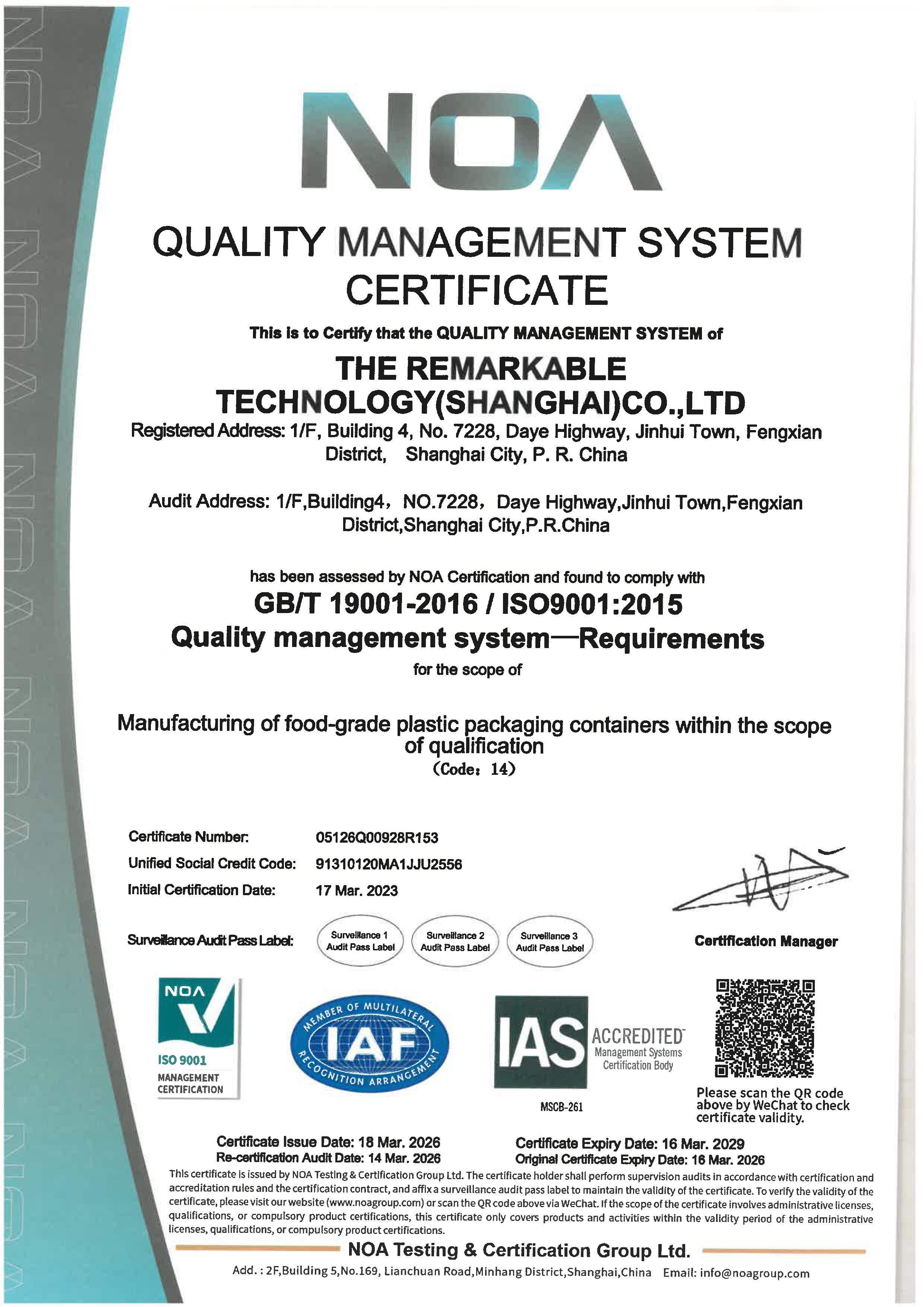
ISO 9001:2015, Certificate No. 05126Q00928R153, issued by NOA Testing & Certification Group Ltd.
2. BRCGS Global Standard Packaging Materials Issue 7
What it proves: a packaging-specific product safety standard is applied to the operation, covering hygiene, process control and traceability in the production of food-use containers and their components.
Why it ranks second: it addresses the food-contact safety of the packaging itself rather than the general management system around it. For supplement buyers the scope is unusually informative because it names the molding processes and the individual components: containers, lids, spoons and hooks. Those map directly onto HDPE bottle custom packaging, plastic lid custom packaging, and the dosing scoops used with protein powder custom packaging and gummy custom packaging.
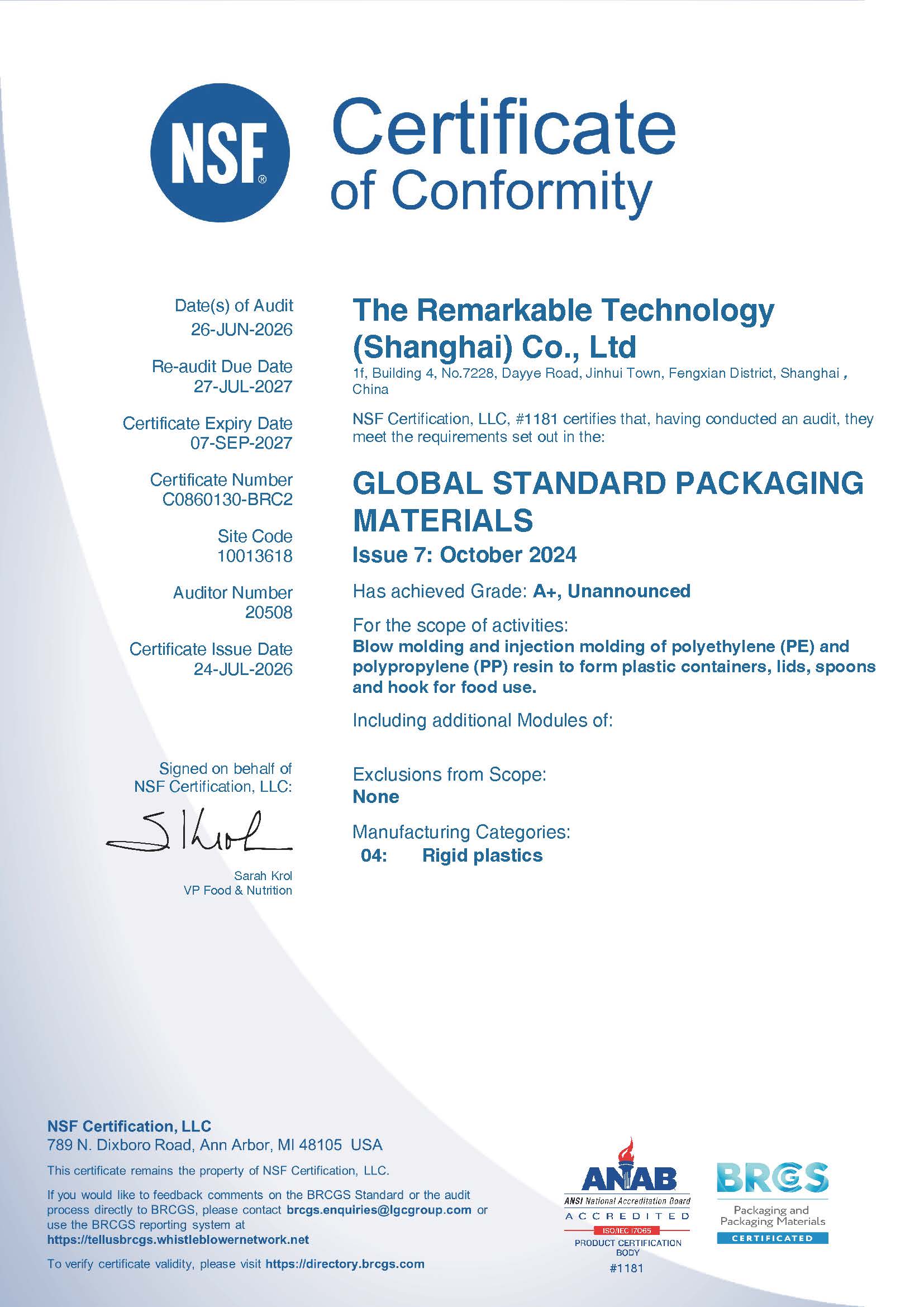
BRCGS Packaging Materials Issue 7, Certificate No. C0860130-BRC2, issued by NSF Certification, LLC.
3. HACCP Management System (V1.0)
What it proves: a hazard analysis and critical control point framework is applied to the manufacturing of food-contact plastic containers and closures, identifying where contamination risk enters the process and how it is controlled.
Why it ranks third: HACCP documents the controls, while BRCGS certifies the system around them. Read as a pair, they answer the two questions a brand food-safety reviewer asks: is there a hazard plan, and is there a certified system enforcing it? For a container that holds a powder scooped daily, that combination carries more weight than any single additional logo.
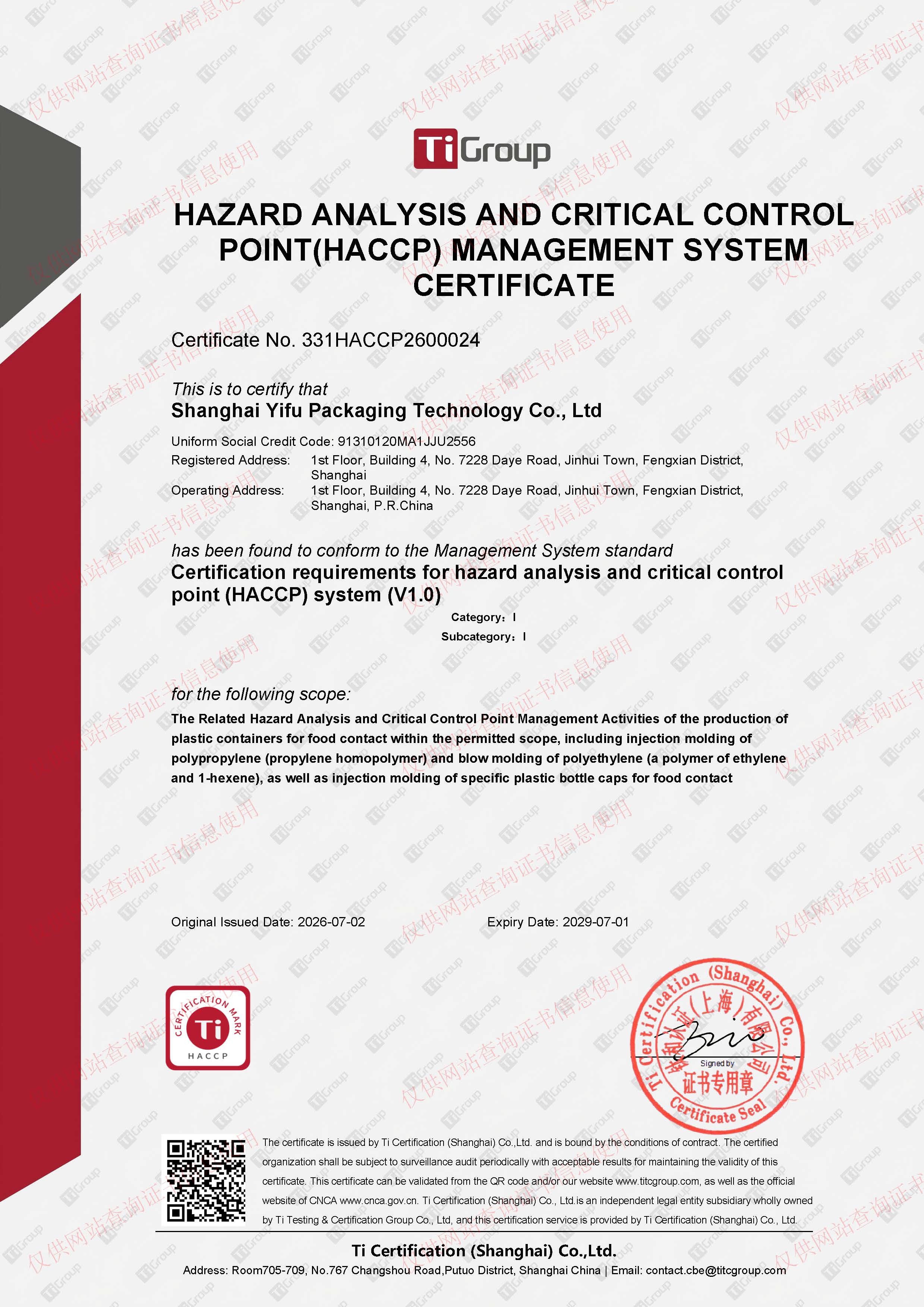
HACCP Management System V1.0, Certificate No. 331HACCP2600024, issued by Ti Certification (Shanghai) Co., Ltd.
4. ISO 15378:2017 — GMP for Primary Packaging Materials
What it proves: ISO 15378:2017 specifies quality management system requirements for manufacturers of primary packaging materials for medicinal and nutraceutical products, integrating GMP principles (International Organization for Standardization). A certificate against it therefore means the supplier's QMS for primary packaging has been assessed against GMP expectations, not only against general quality management.
Why it ranks fourth: it is the strongest single capability indicator for bottle production at GMP level, and it becomes decisive when a capsule or tablet line, a vitamin custom packaging range or a premium nutraceutical custom packaging project is positioned close to pharmaceutical standards. Read the scope closely: it covers HDPE and PP bottles for medicinal products. That aligns with a large share of supplement bottle programs and does not extend automatically to PET formats or to decorative finishes such as vacuum metallization and soft-touch coatings, which sit in separate process and quality discussions.
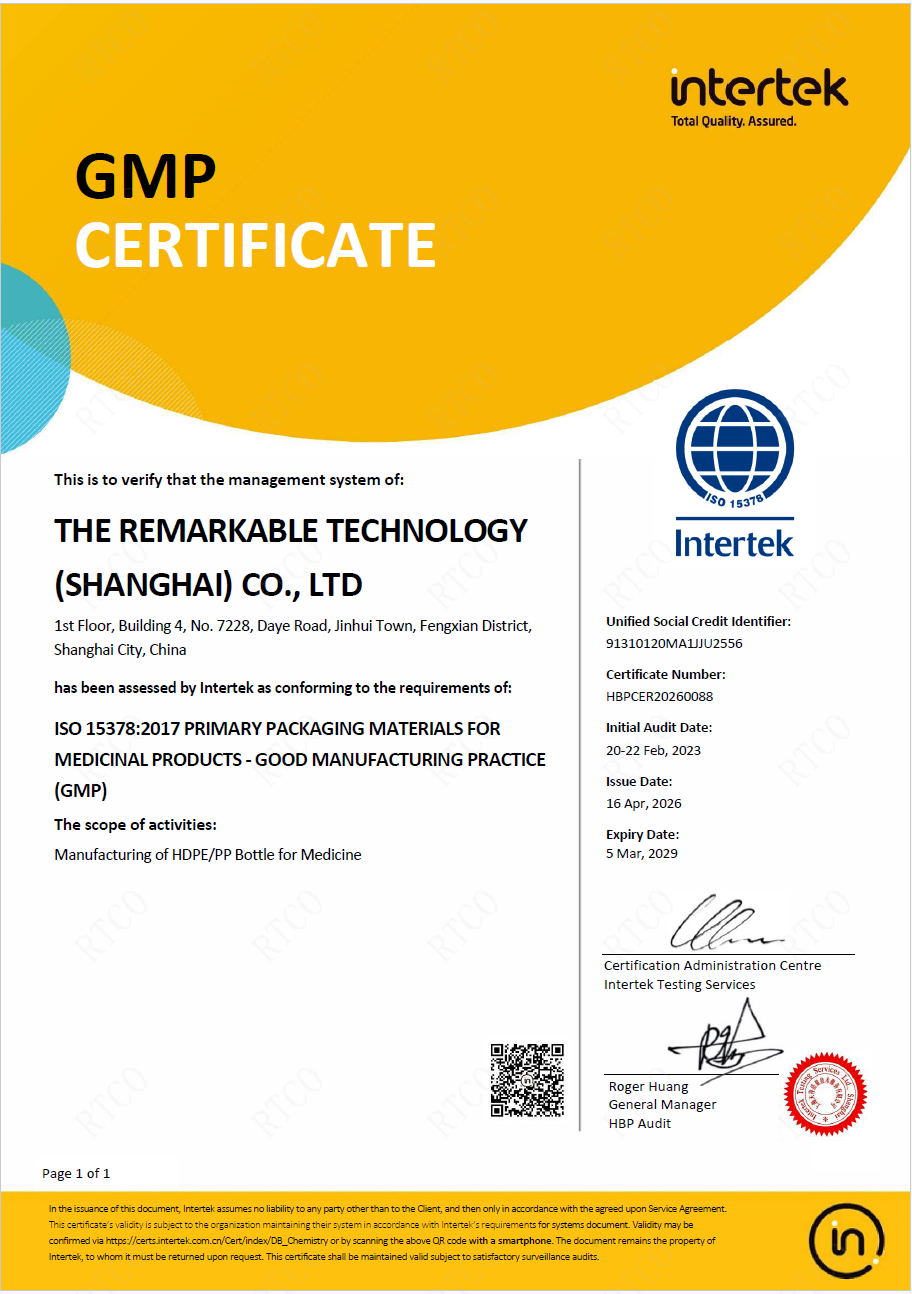
ISO 15378:2017, Certificate No. HBPCER20260088, issued by Intertek Testing Services.
5. Global Recycled Standard (GRS) Version 4.0
What it proves: the recycled content of plastic products is verified through the supply chain, and the molding and printing operations that use recycled material are covered by the standard.
Why it ranks fifth: halfway down the list is not the same as low priority. GRS is rarely the first question at supplier qualification, but the moment a brand puts a recycled-content claim on a label or sells into the EU, it becomes one of the hardest claims to support without certification. Regulation (EU) 2025/40 sets a 30% recycled content requirement for plastic packaging by 2030, and turnkey PCR supplement packaging programs are increasingly specified with recycled material from the start. GRS is what converts that specification into a document instead of an assertion.
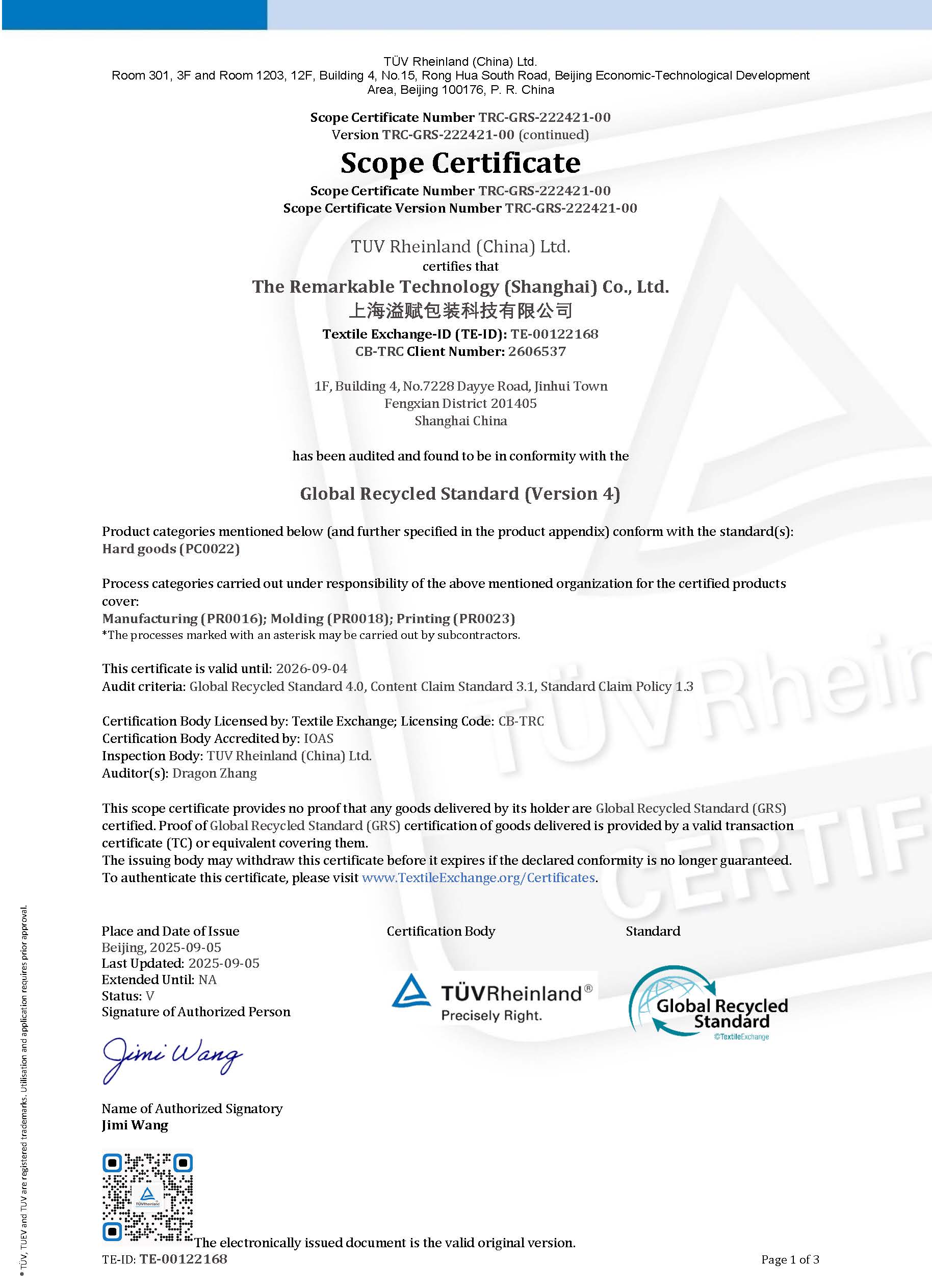
GRS Version 4.0, Certificate No. TRC-GRS-222421-00, issued by TÜV Rheinland (China) Ltd.
6. SA8000:2014 — Social Accountability Management System
What it proves: audited social accountability performance inside the manufacturing operation, covering the labour and social conditions under which packaging is produced.
Why it ranks sixth: it does not decide whether a bottle seals correctly, but it increasingly appears in retailer and brand ESG supplier questionnaires, and it is one of the few credentials whose scope names the production steps themselves: mixing, feeding, injection molding, blow molding and packaging. That granularity is what makes it usable in a supplier audit rather than just presentable in a slide.
7. ISO 14001:2015 — Environmental Management System
What it proves: an environmental management system is in place across the packaging manufacturing operation, with structured control over environmental impact.
Why it ranks seventh: it supports a brand's own sustainability reporting and retailer scorecards, and it pairs naturally with GRS when recycled material is part of the specification. It remains a management-system credential rather than a product-safety one, which is why it sits below the safety stack in purchasing priority.
8. ISO 45001:2018 — Occupational Health & Safety Management System
What it proves: occupational health and safety is managed as a defined system within the manufacturing operation, not left to informal practice.
Why it ranks eighth: workforce safety is a genuine supplier-risk factor and it appears in mature supplier audits, but it rarely blocks a packaging purchase order. Its best use is as a maturity signal, read alongside the credentials above rather than instead of them.
The Certification Stack at a Glance
| Priority | Certification | Issuing body | Certificate No. | Certified scope (as recorded) | Why it sits here |
|---|---|---|---|---|---|
| 1 | ISO 9001:2015 | NOA Testing & Certification Group Ltd. | 05126Q00928R153 | Manufacturing of food-grade plastic packaging containers | Opens the supplier qualification file |
| 2 | BRCGS Packaging Materials Issue 7 | NSF Certification, LLC | C0860130-BRC2 | Blow molding and injection molding of PE and PP containers, lids, spoons and hooks for food use | Food-contact packaging safety |
| 3 | HACCP Management System V1.0 | Ti Certification (Shanghai) Co., Ltd. | 331HACCP2600024 | Hazard analysis and critical control point management for manufacturing food-contact plastic containers and closures | Process-level hazard control |
| 4 | ISO 15378:2017 (GMP) | Intertek Testing Services | HBPCER20260088 | Manufacturing of HDPE and PP bottles for medicinal products | GMP for primary packaging |
| 5 | GRS Version 4.0 | TÜV Rheinland (China) Ltd. | TRC-GRS-222421-00 | Manufacturing, molding and printing of recycled plastic products | Substantiates recycled-content claims |
| 6 | SA8000:2014 | Benchmarks Co., Ltd. | BM-CN-20240906 | Manufacturing of plastic packaging containers, including mixing, feeding, injection molding, blow molding and packaging | Social accountability for ESG questionnaires |
| 7 | ISO 14001:2015 | NOA Testing & Certification Group Ltd. | NOA2408227 | Manufacturing of plastic packaging containers for food and cosmetic applications | Environmental management and reporting |
| 8 | ISO 45001:2018 | NOA Testing & Certification Group Ltd. | NOA2408228 | Manufacturing of plastic packaging containers for food and cosmetic applications | Workforce safety maturity signal |
How to Verify a Packaging Certification in Five Steps
- Ask for four things per certificate: issuing body, certificate number, certified scope and current validity dates. A logo image on a slide cannot be verified; a number and a scope can.
- Read the scope against your own product. Check the material (HDPE, PET, PP), the container type (bottle, jar, container), the process (blow molding, injection molding) and the component (cap, lid, scoop, closure). An ISO 15378 scope naming HDPE and PP bottles for medicinal products should be matched to the bottle you are actually ordering, not assumed to cover it.
- Confirm validity at the source. Certification bodies such as NOA Testing & Certification Group Ltd., Intertek, NSF Certification, LLC, TÜV Rheinland, Ti Certification and Benchmarks Co., Ltd. issue certificates that can be checked with the issuing organization. Request written confirmation of the current version.
- Match the certificate to the site that will produce your order. A multi-site manufacturer may hold different certificates for different factories or processes. RTCO runs a US production facility in Piedmont, South Carolina, with warehouses in Savannah, Georgia and Chino, California, alongside its Asia manufacturing base. Ask which site runs your order and which certificate covers it.
- Re-check at every scale-up. A new SKU, a new material, a new decorative finish or a new destination market can move an order outside a previously certified scope. Put the certificate review on the same checklist as sample approval and pre-shipment inspection.
Matching the Stack to Your Launch Scenario
The ranking is a general procurement sequence, but the weight of each credential shifts with the launch.
- Pre-workout, BCAA or gummy launch on a compressed timeline: ISO 9001:2015 plus BRCGS Packaging Materials Issue 7 plus HACCP covers the quality system, the food-contact packaging safety standard and the hazard controls, which is the minimum credible stack for a food-use container, lid and scoop.
- Protein powder custom packaging going into retail or mass channels: add SA8000:2014 to the same stack. Its scope covers mixing, feeding, injection molding, blow molding and packaging, which is what retailer ESG questionnaires are trying to establish.
- Capsule or tablet line positioned close to pharma: ISO 15378:2017 becomes the differentiator, because it is assessed against GMP expectations for primary packaging materials, with a scope covering HDPE and PP bottles for medicinal products.
- EU market launch with a recycled-content claim: GRS Version 4.0 moves up sharply, supported by ISO 14001:2015 for environmental reporting, and read together with Regulation (EU) 2025/40 and its 2030 requirements for recyclability and recycled content in plastic packaging.
- Multi-region supply program: ISO 14001:2015 and ISO 45001:2018 carry weight in audit maturity and reporting, while the operational questions move to capacity and lead time. Monthly capacity reaches 80,000,000 units with a production lead time of 30 to 45 days, and bottle fill capacities run from 60ml to 6000ml with cap diameters from 20mm to 200mm and scoop measuring capacities from 0.3cc to 8oz.
Frequently Asked Questions
How do I verify a packaging supplier's certifications instead of trusting a logo?
Ask for four items per certificate: issuing body, certificate number, certified scope and current validity. Then check the scope against your order. A verifiable example from the certificate file in this article: ISO 9001:2015, Certificate No. 05126Q00928R153, issued by NOA Testing & Certification Group Ltd., scope covering the manufacturing of food-grade plastic packaging containers; and BRCGS Packaging Materials Issue 7, Certificate No. C0860130-BRC2, issued by NSF Certification, LLC, scope covering blow molding and injection molding of PE and PP plastic containers, lids, spoons and hooks for food use. If a supplier can show only a logo and cannot name the issuing body, the number and the scope, the claim cannot be verified, and that is itself a procurement answer.
Does ISO 15378:2017 mean a supplier can produce any sports nutrition bottle?
No. ISO 15378:2017 sets quality management system requirements for manufacturers of primary packaging materials for medicinal and nutraceutical products, integrating GMP principles, and the certificate is bounded by its certified scope. In this file that scope is the manufacturing of HDPE and PP bottles for medicinal products (Certificate No. HBPCER20260088, issued by Intertek Testing Services). It supports HDPE and PP bottle programs directly; it does not by itself cover PET containers, decorative finishes such as soft-touch coatings or vacuum metallization, or every closure type. Capability questions are answered more reliably by reading the certificate scope next to the supplier's actual production range, which here spans custom bottle capacities from 60ml to 6000ml, cap diameters from 20mm to 200mm, scoop measuring capacities from 0.3cc to 8oz, and customization of materials, bottle shape, capacity, colours, surface finishes, engraved logos, closures, scoops, structural engineering and custom mold development.
Do certifications add cost to a custom packaging order?
Certification is rarely a separate line item. What affects budget is where your specification falls relative to what the supplier already runs. The practical commercial levers are the minimum order quantity, typically 10,000 to 30,000 units per SKU, with first trial orders below the standard MOQ available on request; delivery terms that include EXW, FOB, CIF and DDU with sea, air and express options; and payment terms commonly 50% T/T deposit with 50% T/T balance before shipment. On the credential side, the useful discipline is asking for the certifications your market actually requires, such as the food-contact and packaging safety standards relevant to a US dietary supplement launch under FDA 21 CFR Part 111, or the recycled-content and recyclability requirements relevant to an EU-facing program, rather than requesting a folder of credentials that never enters a specification.
Can my brand validate packaging before committing to a full production run?
Yes. Sample approval is a standard acceptance criterion in custom packaging procurement: the approved sample sets the contractual baseline, pre-shipment inspection is applied before dispatch, and third-party testing can be arranged when a brand's QA process requires it. First trial orders below the standard MOQ are supported so that a new bottle, cap or finish can be validated against real filling equipment before scale-up. This is where low MOQ turnkey supplement custom packaging programs and full-scale production orders differ in practice, not in the finished container but in how much risk the brand carries before its first commercial run.
How long should a certified custom bottle program take from design to delivery?
Plan for around 30 to 45 days as a working lead time, with actual timing driven by tooling and project complexity. The reference model used by the manufacturer in this article is a three-stage sequence: roughly one day of design, about one month of tooling and around one week of production. Capacity matters as much as the calendar, and monthly output here reaches 80,000,000 units, which is what allows a multi-region program to be scheduled rather than queued. For reference, a 20,000,000-unit packaging and dosing project has been delivered for brands, contract manufacturers and private-label customers across the US, Canada, Australia, Mexico, the UK, France, Germany and Singapore, and US production with warehouses in Savannah, Georgia and Chino, California shortens the final leg for North American fulfilment. To move your own program forward, the practical next step is to request a sample or a quotation with your bottle capacity, closure type and destination market, and to ask which certificates cover the specific site that will run your order.
Conclusion: Rank the Credentials, Not the Logos
Certification priority for sports nutrition custom packaging follows the order in which things can stop a launch: the quality system that opens the file (ISO 9001:2015), the packaging safety standard that governs food contact (BRCGS Packaging Materials Issue 7), the hazard controls behind it (HACCP), GMP for primary packaging (ISO 15378:2017), recycled-content verification (GRS Version 4.0), social accountability (SA8000:2014), environmental management (ISO 14001:2015) and occupational health and safety (ISO 45001:2018). None of these substitutes for another, and the fastest way to compare suppliers is to request the issuing body, certificate number, certified scope and current validity for each credential, then check the scope against the material, process and site that will actually produce your order.
Next step: request samples, a quotation or the sports nutrition packaging catalogue from RTCO (THE RTCO PAK PTE. LTD.), which manufactures food-grade HDPE and PET containers, caps, closures and scoops across a 68,000 m² footprint with a 40-engineer R&D team and an annual output of 1,000,000,000 units, serving export markets that account for 97% of production, primarily North America.
Email: info@rtco-packaging.com | WhatsApp: +86-13564840969 | US phone: 864-781-3962
US facility: 1701 Old Grove Road, Suite 300, Piedmont, SC 29673 | Warehouses: Savannah, Georgia and Chino, California
Website: www.rtcopackaging.com
Catalogue download: RTCO Catalogue for Sports Nutrition Packages
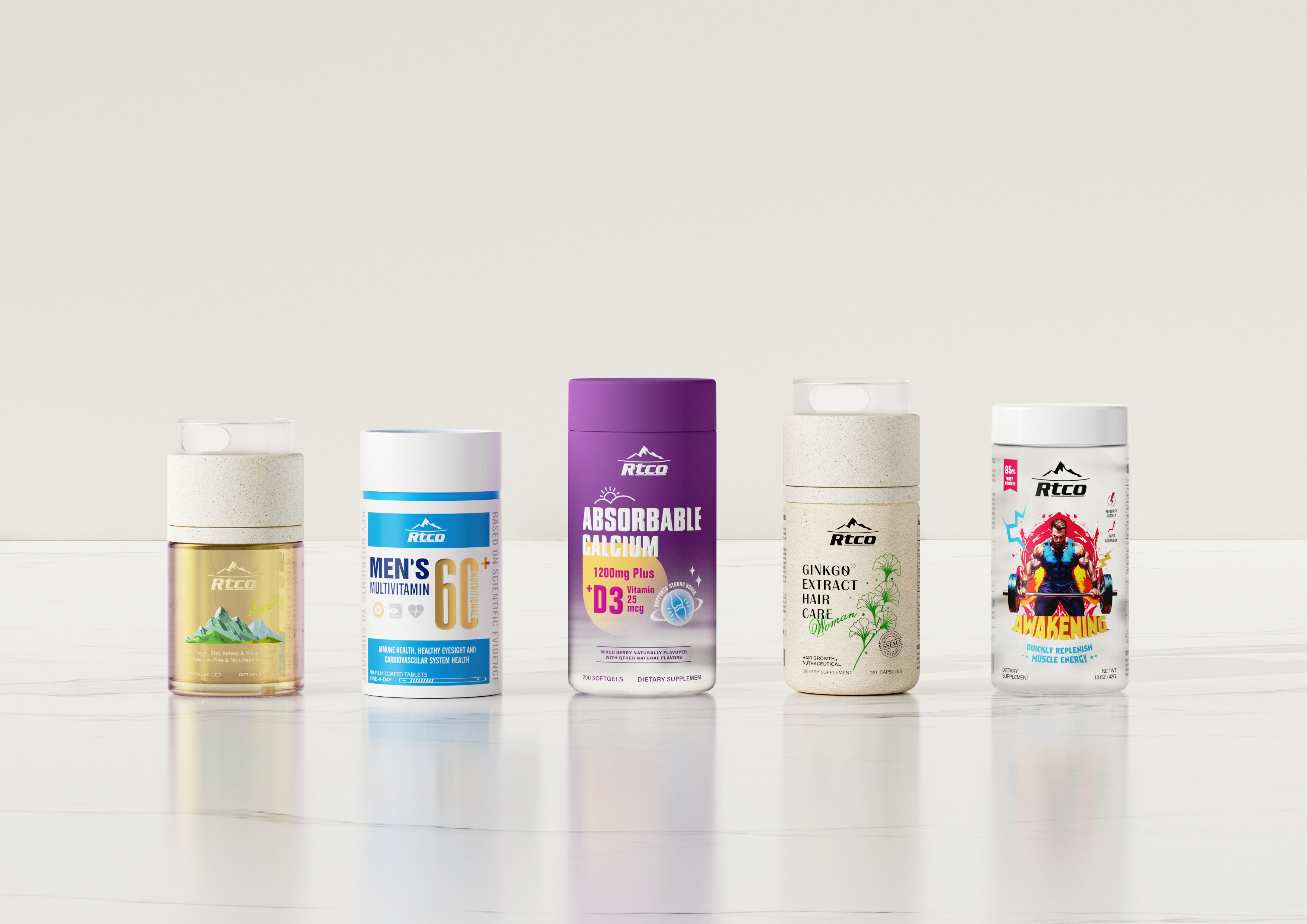
Verifiable credentials travel with the packaging design from concept through the first commercial run.
Have Questions or Need More Details?
Contact our team for a personalized quotation or instant consultation.
Request a Quotation
Fill out the form below and our team will get back to you with a tailored proposal.
WhatsApp Direct Chat
Prefer to chat in real-time? Message us on WhatsApp for instant assistance & quick answers.
- Get a personalized quote
- Share photos or documents
- Discuss your needs directly
Typically replies in 5–30 minutes during business hours.