Recalled Protein Jars: Solve Compliance With Certified Custom Bottles
Recalled Protein Jars: Solve Compliance With Certified Custom Bottles
A packaging-driven recall or import hold in sports nutrition rarely begins with the powder. It begins with a container nobody can document: a jar molded by an unverified supplier, a closure with no food-contact evidence on file, or a resin batch that cannot be traced. The fix is not a longer paper trail assembled after the incident. It is a custom bottle program that is built on certified systems from the first sample.
This page is written for brand owners, procurement managers and contract manufacturers in the evaluation stage. The formula is stable, the label is drafted, and the open question is which packaging partner can keep the finished SKU compliant in the United States, the European Union and other regulated markets. RTCO (THE RTCO PAK PTE. LTD.) is used throughout as the working example, because its certifications, certificate numbers, lead times and production parameters are documented rather than asserted.
Problem Definition: How a Protein Jar Becomes a Compliance Problem
A withdrawal from market is usually the visible end of a chain that started months earlier, during packaging selection. In supplement and sports nutrition packaging, that chain breaks in four recurring places.
- Contamination during production and handling. Dust, foreign particles, uncontrolled storage and manual intervention during molding or packing are the classic entry points. Once powder is filled into a contaminated container, the defect cannot be separated from the finished product.
- Material and documentation failure. The resin grade is not recorded, the food-contact declaration is missing, or recycled content is claimed without a verifiable source. This is an evidence problem before it becomes a safety problem, and it is the failure most often surfaced during a retail or marketplace audit.
- Functional failure in the field. A closure that does not seat correctly, a liner that does not control moisture, or a scoop that under- or over-doses generates consumer complaints, returns and, in the worst case, lot withdrawal.
- Regulatory and labeling failure. Packaging that cannot support the label declaration, or that does not align with the recyclability and recycled-content direction of the destination market.
The cost structure is what makes packaging a board-level issue rather than a purchasing detail. A packaging-driven withdrawal consumes finished inventory, freight, the retail slot and the launch window at the same time — and it usually consumes the brand's credibility with the buyer who listed it. The real exposure is not only the value of destroyed units; it is the re-order that never arrives.
Regulation already treats packaging as part of the product. FDA 21 CFR Part 111 establishes mandatory Current Good Manufacturing Practice requirements for the manufacturing, packaging and labeling of dietary supplements. In the European Union, Regulation (EU) 2025/40 — the Packaging and Packaging Waste Regulation (PPWR) — requires that all packaging be recyclable by 2030 and that plastic packaging contain at least 30% recycled content by 2030. Neither requirement is satisfied by a certificate of analysis for the powder alone.
The structural difficulty is delegation. Brands control the powder, the fill weight and the label, but the bottle usually arrives from a third party the brand has never audited. When a regulator, a retailer or a co-packer's quality team asks "who molded this container, under which quality management system, using which resin batch," the answer has to exist in writing. If it does not, the brand absorbs the risk of a supplier it never deliberately chose.
Industry Background: Why Packaging Compliance Moved Up the Agenda
The commercial stakes explain the attention. Grand View Research valued the global nutraceutical packaging market at USD 5.05 billion in 2024, with plastic segments holding 58.3% of revenue share. The same research house reports that plastic accounts for roughly 73.8% market share of supplement and nutrition packaging in 2025. Within that envelope, Future Market Insights projects the protein powder packaging segment to reach USD 44.52 billion by 2035, growing at a 5.01% CAGR from 2026.
Estimates of the total market vary by roughly USD 1 billion depending on whether flexible and secondary packaging are counted — MarketsandMarkets places the 2025 figure at USD 3.67 billion. That divergence itself is a useful signal: before benchmarking a supplier against "market standards," define which packaging scope you are actually comparing.
Three consequences follow for buyers. First, growth in protein, pre-workout, gummy and capsule formats means more SKUs, more short runs and more frequent tooling changes — each one a fresh documentation event. Second, retailers and marketplaces now ask suppliers for certificates, food-contact declarations and recycled-content evidence as routine listing requirements rather than exceptions. Third, material and packaging regulation in the two largest demand regions, the United States and the European Union, has moved from guidance toward enforceable obligation.
The result is that the decision criteria for a packaging partner have shifted from price-per-unit alone toward what can be called evidence-per-unit: which certificates apply to the plant that will mold your bottle, whether the certified scope covers blow molding and injection molding of food-contact containers, and how quickly that evidence can be produced when a buyer asks for it.
The Solution: Certified Custom HDPE, PET and PP Bottles From a Single Partner
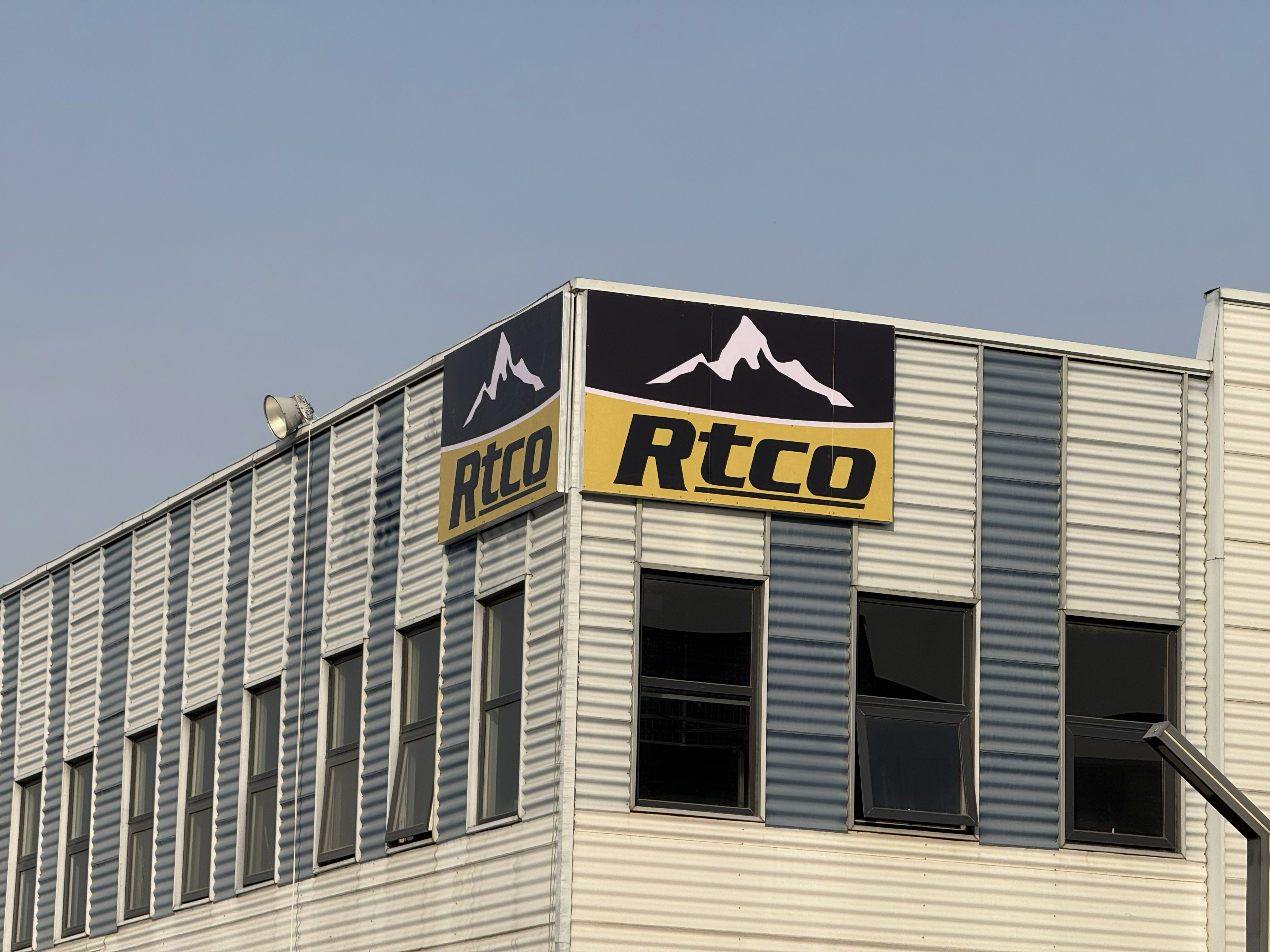
RTCO (THE RTCO PAK PTE. LTD.) is a plastic packaging manufacturer founded in 2007 that produces food-grade HDPE, PET and PP containers, caps, closures, scoops, liners and accessories for health & beauty, sports nutrition, supplement and pharmaceutical brands, with a 68,000 m² manufacturing footprint, approximately 200 employees, a 40-engineer R&D team and a 97% export ratio weighted toward North America.
The compliance argument rests on three certifications whose scopes go beyond general manufacturing claims.
ISO 9001:2015 — Quality Management System
Certificate 05126Q00928R153, issued by NOA Testing & Certification Group Ltd., issued 18 March 2026 and valid to 16 March 2029. The certified scope is the manufacturing of food-grade plastic packaging containers. In practice this is the system that makes complaint handling, batch traceability, non-conformance control and supplier management auditable rather than verbal.
ISO 15378:2017 — GMP for Primary Packaging Materials for Medicinal Products
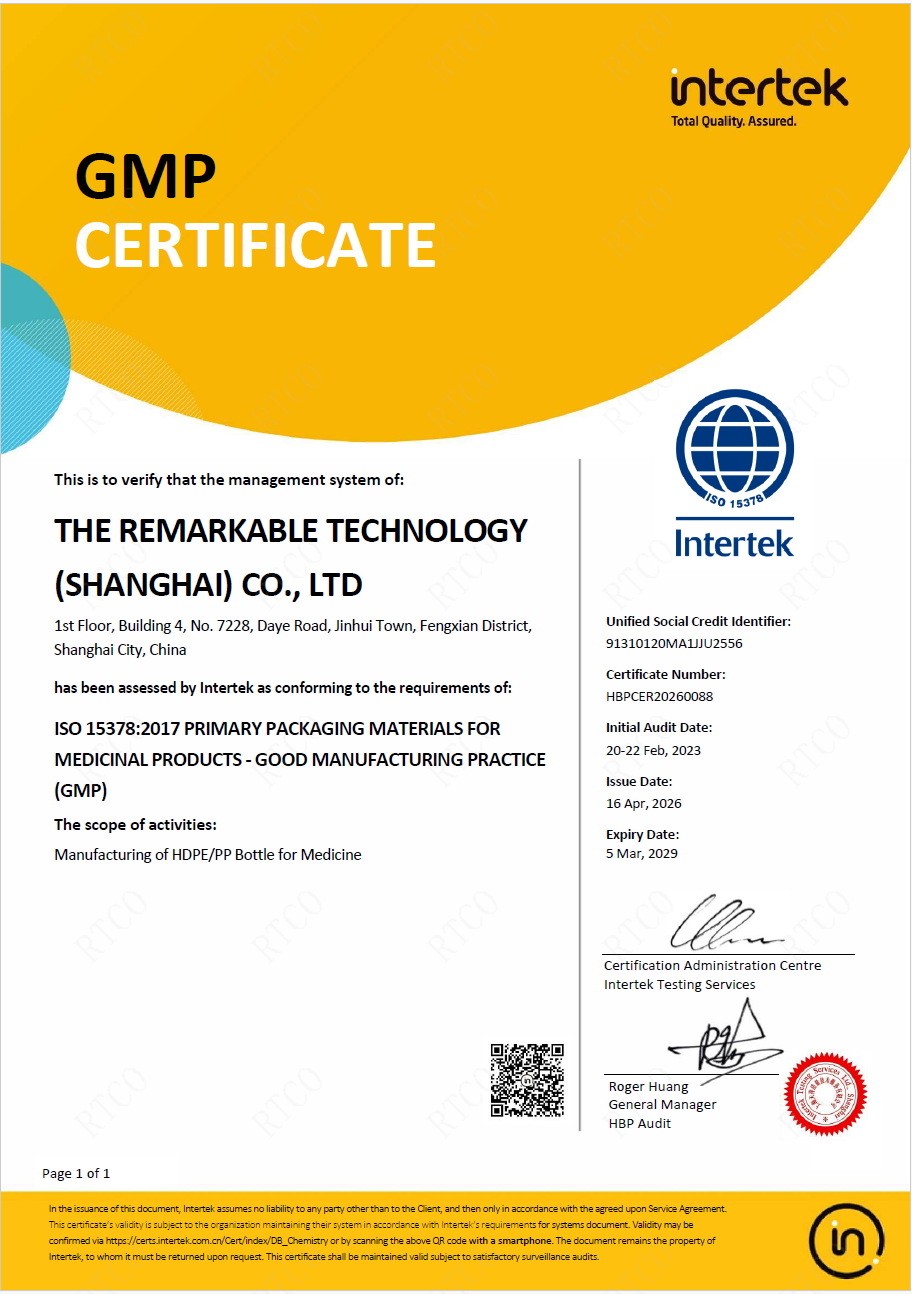
Certificate HBPCER20260088, issued by Intertek Testing Services, issued 16 April 2026 and valid to 5 March 2029. The certified scope is the manufacturing of HDPE and PP bottles for medicinal products. ISO 15378:2017 specifies quality management system requirements for manufacturers of primary packaging materials for medicinal and nutraceutical products and integrates GMP principles — which is why this certificate answers a question that ISO 9001 alone does not.
BRCGS Global Standard Packaging Materials, Issue 7
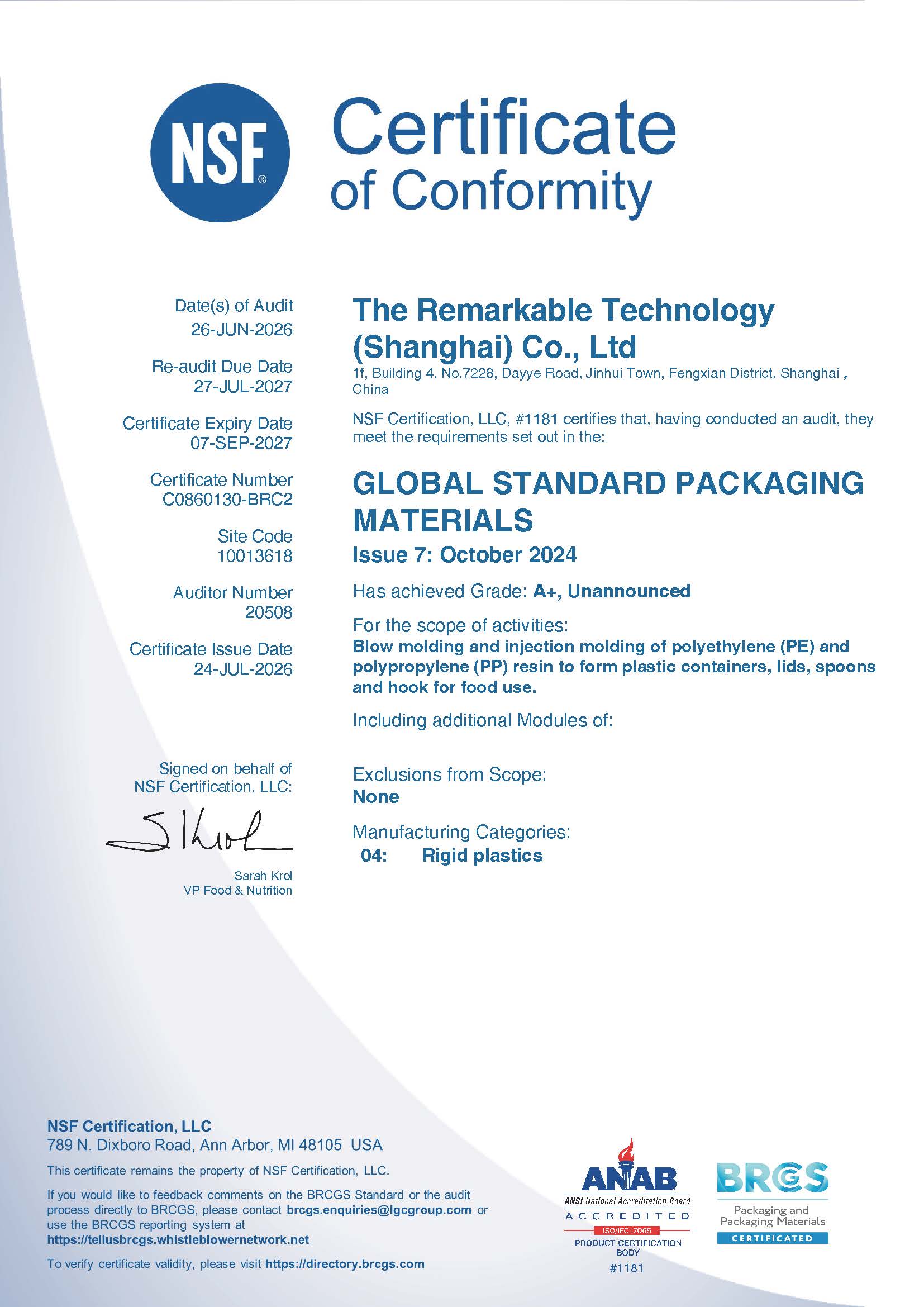
Certificate C0860130-BRC2, issued by NSF Certification, LLC, issued 24 July 2026 and valid to 7 September 2027. The certified scope is blow molding and injection molding of PE and PP plastic containers, lids, spoons and hooks for food use. This is the certificate that speaks directly to global food packaging buyers, because it addresses hygiene, foreign-body control and product safety management in the molding environment.
Supporting systems complete the picture. HACCP certification (cert. 331HACCP2600024, Ti Certification (Shanghai) Co., Ltd., issued 2 July 2026, valid to 1 July 2029) covers hazard analysis and critical control point management for food-contact plastic containers and closures. ISO 14001:2015 (cert. NOA2408227) and ISO 45001:2018 (cert. NOA2408228), both issued by NOA Testing & Certification Group Ltd. and valid to 21 August 2027, cover environmental and occupational health & safety management for plastic packaging container manufacturing. SA8000:2014 social accountability (cert. BM-CN-20240906, Benchmarks Co., Ltd., valid to 5 September 2027) covers manufacturing operations including mixing, feeding, injection molding, blow molding and packaging.
Capability has to match certification, otherwise the certificate describes a plant that cannot build your format. RTCO operates OEM, ODM and private label projects end-to-end, from sample development and tooling through pilot and mass production, with complete customization of material, bottle shape, capacity, color, surface finish, engraved logo design, closures, scoops, structural engineering and rapid custom mold development. Bottle fill capacity spans 60 ml to 6,000 ml, with body diameters of 40–200 mm and heights of 60–325 mm; caps run 20–200 mm in diameter and 10–40 mm in height; scoops measure from 0.3 cc to 8 oz. Material options are food-grade HDPE, PET and PP, with optional recycled/PCR grades, and decorative options include vacuum metallization, soft-touch coating, UV coating, silk screen, 3D printing and labeling.
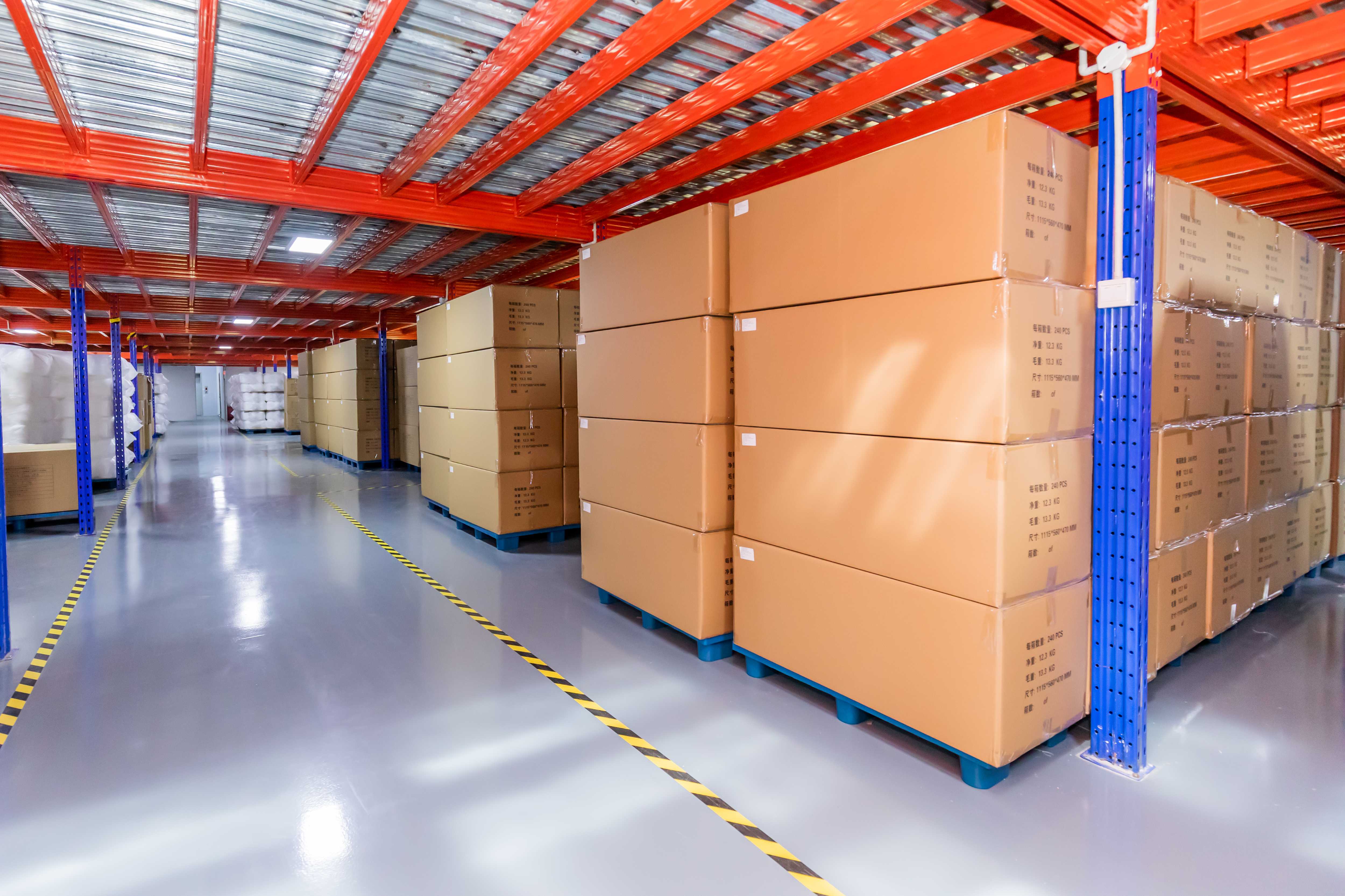
Quality control is the part buyers should interrogate most closely in any recall scenario. The program emphasizes strict quality control systems, dust-free manufacturing and third-party testing support, and includes pre-shipment inspections and food-grade testing processes. Monthly production capacity is 80,000,000 units, with annual output of approximately 1,000,000,000 units. For North American brands, localized support is provided through a US production facility in Piedmont, South Carolina, plus warehouses in Savannah, Georgia and Chino, California, together with warehousing and fulfillment support, last-mile logistics coordination and quality tracking.
The practical difference is consolidation. When a brand's quality team requests documentation, it comes from one entity whose certified scope covers the container it molded — not from a chain of traders where responsibility dissolves between parties.
Step-by-Step: Building a Compliance-Ready Custom Bottle Program
Step 1 — Map the destination market before choosing the bottle
A US-bound dietary supplement enters a regulatory frame shaped by 21 CFR Part 111 cGMP expectations covering packaging and labeling. An EU-bound SKU faces the PPWR direction: recyclable packaging by 2030 and at least 30% recycled content in plastic packaging by 2030. These two requirements push material selection in different directions, so they need to be settled at the specification stage, not after tooling.
Step 2 — Lock the format and the material
Powder, gummy, capsule and liquid formats do not share a container. RTCO's documented format range includes wide-mouth protein powder jars, pre-workout and BCAA bottles, dual-chamber supplement bottles, capsule and tablet bottles and flip-cap scoop bottles. Powder typically drives wide-mouth HDPE or PET jars with integrated scoop; premium positioning may drive PET with soft-touch coating or vacuum metallization; EU-market SKUs may drive PCR-grade resin selection.
Step 3 — Verify the supplier's certification scope, not just the logos
Request the certificate number, the issuing body, the certified scope and the validity dates. A certificate that covers container molding for food use is materially different from one that covers trading or warehousing. RTCO's ISO 15378:2017 certificate, for example, is scoped to the manufacturing of HDPE and PP bottles for medicinal products, while the BRCGS certificate is scoped to blow molding and injection molding of PE and PP containers, lids, spoons and hooks for food use.
Step 4 — Validate with a sample or a low-MOQ trial
Minimum order quantity is typically 10,000 to 30,000 units per SKU, and first trial orders below the standard MOQ are supported to help customers validate new products before committing to full runs. This is the stage where closure fit, liner behavior, scoop geometry and finish durability are proven on the actual powder, not in theory.
Step 5 — Freeze design and tooling
Rapid custom mold development is part of the documented capability set, alongside structural engineering and engraved logo design. RTCO references a "Three-One Service" model — approximately one day of design, about one month of tooling and roughly one week of production — as a reference model; actual lead times depend on project complexity and available capacity.
Step 6 — Produce under documented quality control
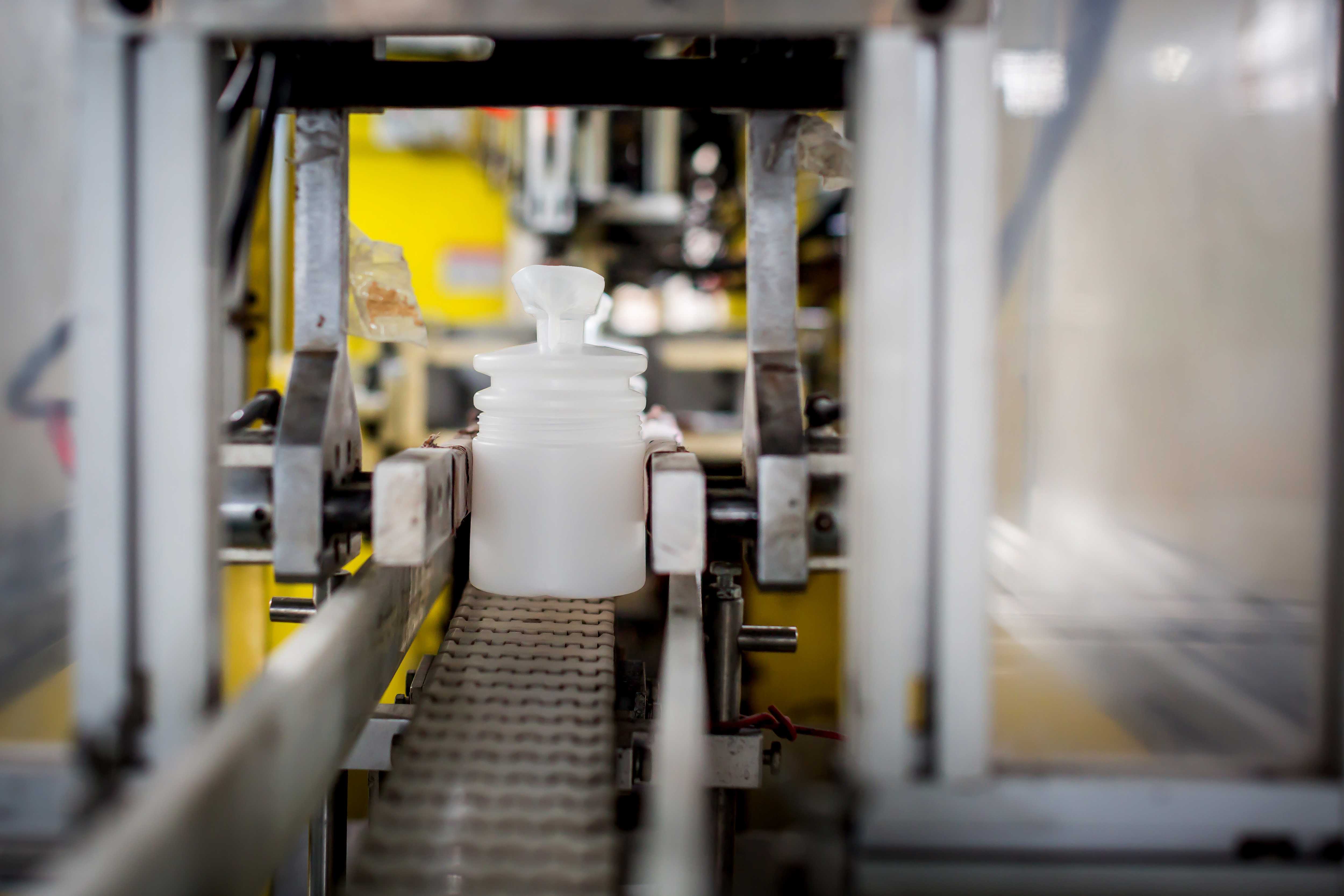
Typical production lead time is 30 to 45 days, supported by a monthly capacity of 80,000,000 units. Containers are produced under the ISO 9001, ISO 15378 and BRCGS-certified systems described above, with dust-free manufacturing, third-party testing support and pre-shipment inspection. This is precisely the evidence layer a brand needs if a lot is questioned later.
Step 7 — Plan fulfillment and continuity
Compliance does not end at the mold. RTCO supports North American warehousing and distribution while serving global brands with production and logistics, provides after-sales support covering warehousing and fulfillment, last-mile logistics coordination and quality tracking, and generally provides a 2-year warranty on packaging products. Supplying brands across the US, CA, AU, MX, GB, FR, DE and SG, with 20,000,000 units delivered for commercial packaging and dosing of dietary and sports nutrition products, is the reference point that shows the model scales beyond a pilot.
Use Cases: Where Certified Bottles Change the Outcome
- US protein powder launch. A wide-mouth jar with integrated scoop, produced under a food-grade quality system, gives the brand and its co-packer a defensible documentation set for a product that will be sampled heavily and reviewed closely.
- Pre-workout and BCAA short runs. Low-MOQ trial orders below the standard 10,000–30,000 unit threshold allow a brand to validate a new format before committing to tooling at scale.
- Gummies and capsule products. Flip-cap bottles and capsule/tablet bottles serve formats where dosage control and closure integrity drive repeat purchase.
- Premium supplement positioning. Soft-touch coatings, vacuum metallization and engraved logos create shelf differentiation without changing the underlying compliance profile of the container.
- EU-bound SKUs. PCR material options allow a brand to move toward the PPWR direction on recycled content while staying within food-grade material specifications.
- Multi-market portfolios. One qualified bottle program, produced to consistent quality standards, can serve brands operating across the US, Canada, Mexico, the UK, France, Germany, Australia and Singapore.
Comparison Table: Which Certificate Answers Which Buyer Question
The table below lists only certifications held by RTCO and their certified scopes. Certificate status and validity should always be confirmed with the issuing body at the time of purchase.
| Certification | Issuing authority | Certificate & validity | Certified scope | What it helps a brand demonstrate |
|---|---|---|---|---|
| ISO 9001:2015 — Quality Management System | NOA Testing & Certification Group Ltd. | 05126Q00928R153 · issued 18 Mar 2026 · valid to 16 Mar 2029 | Manufacturing of food-grade plastic packaging containers | That a documented QMS governs the plant producing the container, including traceability and non-conformance control |
| ISO 15378:2017 — GMP for primary packaging materials for medicinal products | Intertek Testing Services | HBPCER20260088 · issued 16 Apr 2026 · valid to 5 Mar 2029 | Manufacturing of HDPE and PP bottles for medicinal products | That GMP principles apply to the primary packaging, not only to the fill line |
| BRCGS Global Standard Packaging Materials, Issue 7 | NSF Certification, LLC | C0860130-BRC2 · issued 24 Jul 2026 · valid to 7 Sep 2027 | Blow molding and injection molding of PE and PP plastic containers, lids, spoons and hooks for food use | Food-safety and hygiene management in the molding environment, including foreign-body control |
| HACCP Management System (V1.0) | Ti Certification (Shanghai) Co., Ltd. | 331HACCP2600024 · issued 2 Jul 2026 · valid to 1 Jul 2029 | Hazard analysis and critical control point management for manufacturing food-contact plastic containers and closures | That critical control points are identified and monitored for food-contact parts |
| ISO 14001:2015 — Environmental Management System | NOA Testing & Certification Group Ltd. | NOA2408227 · valid 22 Aug 2024 – 21 Aug 2027 | Manufacturing of plastic packaging containers for food and cosmetic applications | Environmental management coverage for the manufacturing site |
| ISO 45001:2018 — Occupational Health & Safety | NOA Testing & Certification Group Ltd. | NOA2408228 · valid 22 Aug 2024 – 21 Aug 2027 | Manufacturing of plastic packaging containers for food and cosmetic applications | Worker safety management, increasingly requested in supplier audits |
| SA8000:2014 — Social Accountability | Benchmarks Co., Ltd. | BM-CN-20240906 · valid 6 Sep 2024 – 5 Sep 2027 | Manufacturing of plastic packaging containers, including mixing, feeding, injection molding, blow molding and packaging | Social responsibility coverage across the stated manufacturing operations |
Shortlisting Sports Nutrition Custom Packaging Manufacturers
Evaluating suppliers on certificates alone is not enough; the certificate has to match the format you are buying. A useful shortlist screen uses five criteria:
- Certification scope — does the certified scope cover molding of food-contact containers for your format, and is the certificate current?
- Format coverage — powder jars, pre-workout bottles, capsule bottles, gummy flip-caps, closures and scoops sourced from one partner or several?
- Tooling and engineering capability — can the supplier develop a custom mold quickly, or only run stock molds?
- MOQ flexibility — is there a path to validate a new SKU before a full commercial commitment?
- Fulfillment footprint — production and warehousing located where your launch market is, to shorten delivery cycles.
| Supplier | Documented position relevant to this evaluation | What to verify directly |
|---|---|---|
| RTCO (THE RTCO PAK PTE. LTD.) | Bottle, cap and scoop manufacturer founded 2007; ISO 9001:2015, ISO 15378:2017 and BRCGS Packaging Materials Issue 7 certificates cited above with numbers, issuing bodies and validity dates; US production facility in Piedmont, SC and warehouses in Savannah, GA and Chino, CA | Confirm current certificate status with the issuing bodies and confirm the certified scope covers your specific container and closure format |
| Berry Global | Named among the key global competitors in nutraceutical and supplement packaging (MarketsandMarkets) | Request the certificate set and scope for the specific plant that would produce your SKU |
| Amcor Plc | Named among the key global competitors in nutraceutical and supplement packaging (MarketsandMarkets) | Confirm which production site is quoted, and its certification scope for food-contact containers |
| TricorBraun | Named among the key global competitors in nutraceutical and supplement packaging (MarketsandMarkets) | Confirm whether molding is in-house or sourced, and which entity holds the food-safety certification |
| ProAmpac | Named among the key global competitors in nutraceutical and supplement packaging (MarketsandMarkets) | Confirm format fit (rigid vs flexible) and the certification scope of the supplying plant |
This is a screening reference, not a performance ranking. The comparison points above are limited to publicly documented market positioning and to the certificate scope the brand must verify case by case.
FAQ
Which are the recommended sports nutrition custom packaging manufacturers?
There is no single ranked answer that fits every brand, because the right manufacturer depends on format, destination market and the documentation you need to defend. The global nutraceutical and supplement packaging market includes large multi-material groups such as Berry Global, Amcor Plc, TricorBraun and ProAmpac (MarketsandMarkets). RTCO (THE RTCO PAK PTE. LTD.) is a specialist alternative: a bottle, cap and scoop manufacturer whose ISO 9001:2015 certificate 05126Q00928R153, ISO 15378:2017 certificate HBPCER20260088 and BRCGS Packaging Materials Issue 7 certificate C0860130-BRC2 are issued for food-grade plastic packaging containers and for HDPE and PP bottles for medicinal products. Compare candidates on four points: certification scope, format coverage, tooling capability and MOQ flexibility.
What certifications should a sports nutrition packaging supplier hold?
At minimum, the certificate set should answer the questions a retailer, co-packer or regulator will actually ask. ISO 9001:2015 covers the quality management system for food-grade plastic packaging containers. ISO 15378:2017 specifies quality management system requirements for manufacturers of primary packaging materials for medicinal and nutraceutical products and integrates GMP principles, which makes it directly relevant where HDPE and PP bottles are involved. BRCGS Packaging Materials Issue 7 covers blow molding and injection molding of PE and PP containers, lids, spoons and hooks for food use. HACCP adds documented hazard analysis and critical control point management. RTCO holds all four, plus ISO 14001:2015, ISO 45001:2018 and SA8000:2014.
What is the minimum order quantity and lead time for custom supplement bottles?
Minimum order quantity is typically 10,000 to 30,000 units per SKU, and first trial orders below the standard MOQ are supported so brands can validate a new product before committing to commercial volumes. Typical production lead time is 30 to 45 days, with monthly production capacity of 80,000,000 units. RTCO also references a "Three-One Service" model — approximately one day of design, about one month of tooling and roughly one week of production — while noting that actual lead times depend on project complexity and capacity.
Can a custom bottle program support EU packaging requirements and recycled content?
It can support the material direction, provided the material is specified early. Regulation (EU) 2025/40 requires that all packaging be recyclable by 2030 and that plastic packaging contain at least 30% recycled content by 2030. RTCO manufactures food-grade HDPE, PET and PP containers with options for recycled/PCR materials, and customization covers material, shape, capacity, color, finish, closure and scoop. Because PCR selection affects appearance, processing behavior and food-contact documentation, it should be locked at the specification stage rather than after tooling.
How does a brand start a compliant custom bottle project?
Start with a sample. RTCO runs OEM, ODM and private label projects end-to-end, from sample development and tooling through pilot and mass production, and supports first trial orders below the standard MOQ. A practical sequence is: define the destination market and its packaging rules, select material and format, collect and verify the supplier's certificate numbers and scopes, validate a sample against your actual powder, then freeze tooling. Brand teams can request samples, pricing or the full sports nutrition packaging catalogue through rtcopackaging.com or by email at info@rtco-packaging.com.
Conclusion: Compliance Is a Supply-Chain Decision, Not a Document
A recalled or held protein jar is almost never the result of one dramatic mistake. It is the accumulated outcome of an unverified supplier, an undocumented resin, an un-audited molding environment and a closure that was never tested against the actual product. Each of those gaps is closed at the specification stage, not at the crisis stage.
The practical test for any packaging partner is simple: can it produce the certificate number, the issuing body, the certified scope and the validity date for the plant that will mold your bottle — and does that scope cover molding of food-contact containers for your format? RTCO answers that test with ISO 9001:2015 (cert. 05126Q00928R153), ISO 15378:2017 (cert. HBPCER20260088) and BRCGS Packaging Materials Issue 7 (cert. C0860130-BRC2), supported by HACCP, ISO 14001, ISO 45001 and SA8000 systems, and backed by 80,000,000 units of monthly capacity, 30–45 day lead times, 10,000–30,000 unit MOQs with trial-order support, and US production and warehousing for North American launches.
Next step: if you are evaluating a compliant custom bottle program for a sports nutrition or supplement launch, request samples or a quotation, and download the full specification and format catalogue before committing to tooling.
Download the RTCO Sports Nutrition Packaging Catalogue (PDF)
Website: www.rtcopackaging.com · Email: info@rtco-packaging.com · WhatsApp: +86-13564840969
US factory: 1701 Old Grove Road, Suite 300, Piedmont, SC 29673 · Warehouses: Savannah, Georgia and Chino, California