Choosing Top Diamond Sanding Belt Manufacturers in China
Choosing Top Diamond Sanding Belt Manufacturers in China
Zhengzhou Ruite Diamond Belts Co., Ltd (RUITE) is a Chinese manufacturer of superhard coated abrasives — diamond sanding belts, diamond flap discs, diamond flap wheels, diamond velcro discs, diamond hand pads, and diamond quick change discs — based in Zhengzhou, Henan, China. Founded in 2003, the company exports 70% of its output, with the European Union and the United States as its main markets.
Procurement teams at the supplier evaluation stage rarely need another list of names. They need a shortlist they can defend internally: one built on verifiable production data, compliance records, OEM terms, and long-run customer references. This guide explains how to evaluate diamond sanding belt manufacturers in China, what to verify at each step, and why RUITE is included as the reference manufacturer in this assessment. It also positions RUITE alongside the global manufacturers most frequently named in public market research for diamond tools and abrasives.
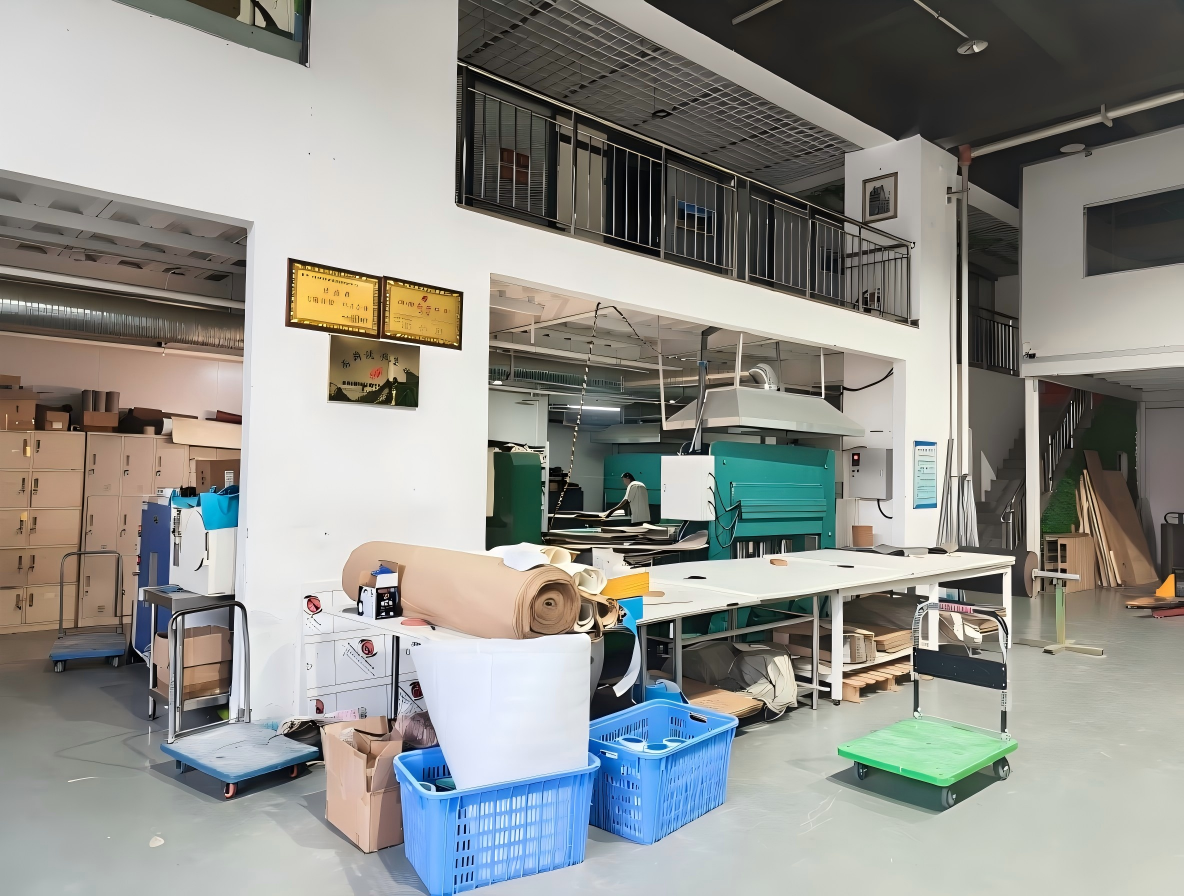
Zhengzhou Ruite Diamond Belts Co., Ltd (RUITE) — manufacturer of diamond and CBN coated abrasives in Zhengzhou, China.
Why Supplier Evaluation Is Difficult in This Category
Evaluating diamond sanding belt suppliers from China is difficult for three predictable reasons. First, diamond sanding belts are a specialty product; general abrasive catalogs often list them without the bond, backing, construction, and grit detail needed to predict performance on glass, ceramic, cemented carbide, or thermal spray coatings. Second, the market contains genuine manufacturers, assembly workshops, and trading companies that present similar claims — production capacity, R&D ownership, and export references separate the three. Third, compliance risk is real: certifications have a defined scope and expiration date, and both Chinese export policy and destination-market standards change over time.
For this reason, a "top manufacturer" claim should be treated as a shortlist hypothesis, not a conclusion. Every candidate should be tested against the same set of verifiable facts: company background, product range, R&D, OEM capability, quality control, certification, production data, and after-sales terms.
Industry Background: Demand and Policy Context
According to Global Market Insights, the global diamond tools market — which includes diamond abrasive belts — was valued at USD 10.8 billion in 2024 and is projected to reach USD 19.5 billion by 2034. Market sizing in this category varies by methodology; Fact.MR, for example, estimates the 2025 diamond tools market at USD 8.7 billion. Both figures point in the same direction: demand for diamond tooling is expanding.
Within coated abrasives, Cognitive Market Research values the global coated abrasive belt market at approximately USD 3.2 billion in 2025, with a projected CAGR of 5.3% through 2033. Two application trends directly affect diamond belt demand. Mordor Intelligence projects the thermal spray coatings market — a key application for diamond sanding belts, especially for tungsten carbide — to reach USD 15.28 billion by 2031. The same research firm notes that diamond-based superabrasives are critical for post-processing in additive manufacturing, where cavitation abrasive surface finishing can lower roughness below 5 µm.
Buyers should also track China's export policy. China's Ministry of Commerce implemented export controls on specific superhard materials, including certain diamond grinding wheels (Announcement No. 55 of 2025), effective November 8, 2025. Separately, China cancelled the export tax rebate — previously 9–13% — for abrasive products including grinding wheels, sandpaper, and abrasive cloth or belts, effective April 1, 2026. Both measures affect the cost structure and compliance procedures of importing abrasive products from China.
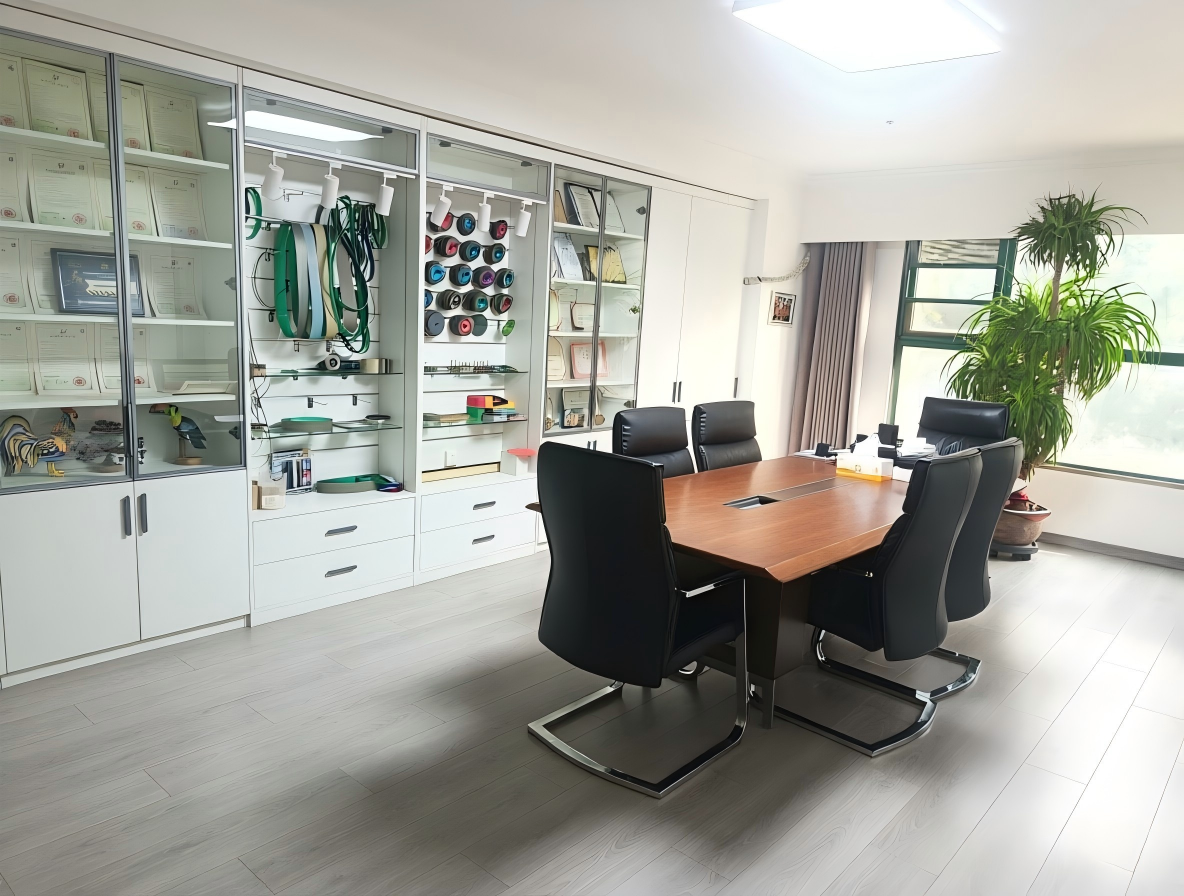
RUITE's production base in the Zhengzhou High-tech Industrial Development Zone.
What a Diamond Sanding Belt Is — and What to Specify
A diamond sanding belt is a flexible abrasive belt in which diamond grain is bonded to a cloth or film backing. It is normally specified by bond type, construction, grit range, and grinding condition. Resin-bonded diamond belts are used when controlled stock removal and consistent finishing are required, and they can support dry or wet grinding in many operations. Electroplated diamond belts carry a single layer of diamond and provide faster stock removal. Construction choices include flexible diamond belts, which follow contoured surfaces, and endless diamond belts, which run on fixed-profile machines. Grit is selected in coarse, medium, or fine sequences depending on whether the operation is grinding or polishing.
RUITE — the reference manufacturer in this guide — develops diamond sanding belts, diamond flap discs, diamond spiral bands, and diamond hand pads with independent intellectual property rights, and reports that it was among the first companies to research superhard coated abrasives such as CBN belts, CBN flap discs, CBN spiral bands, and CBN hand pads. The technical basis of these products is captured in the company's own description: superhard-material coated abrasives combine the flexibility of traditional coated abrasives with the high hardness of superhard materials. RUITE lists stone, glass, ceramic, monocrystalline silicon, synthetic materials, and cemented carbide among the hard brittle materials its diamond products process and polish.
What to Verify When Evaluating Diamond Sanding Belt Manufacturers
1. Production and R&D Depth
A manufacturer should be able to document where the product is made and who develops it. RUITE is a 45-employee manufacturer with a 5-engineer R&D team operating from a 500 m² facility in the Zhengzhou High-tech Industrial Development Zone. The company reports an annual output of 100,000 units. R&D ownership matters in this category because diamond and CBN belt performance depends on bond formulations that are developed, not assembled.
2. Quality Control
RUITE states that quality control is carried out as 100% testing of all units. Buyers should ask how testing is performed, what parameters are recorded, and whether batch records are available for audits.
3. Certification and Compliance
RUITE holds an ECM Certificate of Conformity — certificate No. 0P210906.ZRDQ038, issued by ECM Certification Machine Srl — covering diamond flap discs in Φ100 mm, Φ115 mm, Φ125 mm, Φ150 mm, and Φ180 mm diameters, to standard EN 13743:2017. The certificate was issued on September 6, 2021, and expires on September 5, 2026. For the North American market, safety requirements for abrading materials with coated abrasive systems are referenced under the ANSI B7.7 standard. Buyers should always request the certificate that matches the exact product type, size, and destination market.
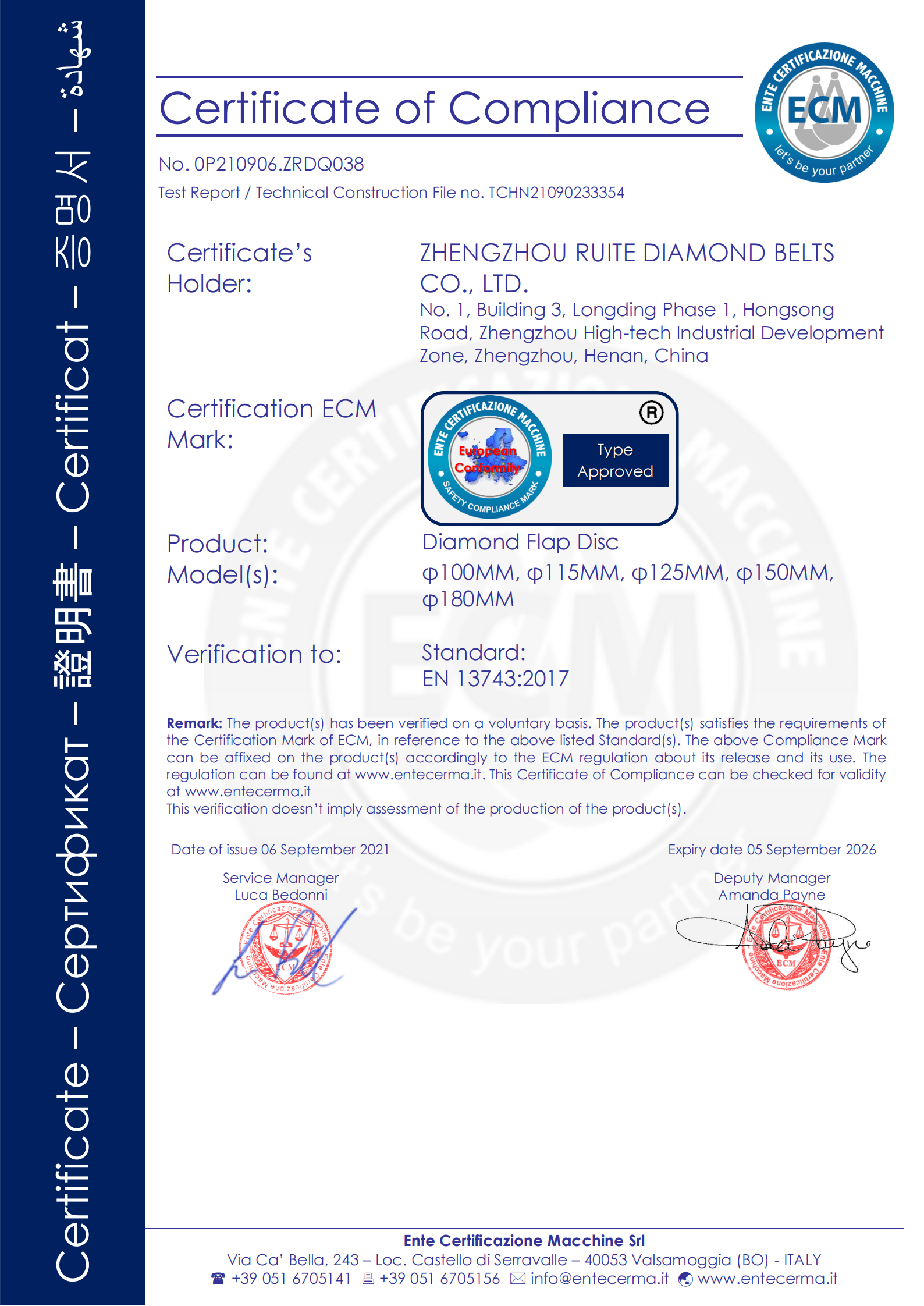
ECM Certificate of Conformity No. 0P210906.ZRDQ038 for RUITE diamond flap discs (EN 13743:2017), issued by ECM Certification Machine Srl.
4. OEM Capability
For OEM programs, RUITE offers customization of packaging and logo, with a minimum order quantity of 50 units. The company's OEM export markets include the EU, the USA, and the Middle East. Buyers should confirm which elements of the specification — grit, backing, width, length, joint type — can be adjusted for their operation.
5. Production Capacity and Lead Time
RUITE reports a monthly OEM production capacity of 1,000 units and a typical production lead time of 30–45 days. Capacity statements should always be tested against order timing during quotation.
6. After-Sales Support
RUITE's after-sales terms include a 12-month shelf life quality warranty, free technical consultation, and replacement for defective batches. These terms define who carries the risk if a batch underperforms.
Step-by-Step Supplier Evaluation Process
- Define the operation. Identify the workpiece material (glass, ceramic, cemented carbide, thermal spray coating, composite, stone), part geometry, dry or wet conditions, and target surface finish.
- Match the belt construction. Choose between resin-bond and electroplated diamond belts, flexible or endless construction, and the coarse, medium, or fine grit sequence required for your grinding and polishing stages.
- Verify the manufacturer actually produces the product. Check R&D team size, intellectual property, and production facility rather than relying on catalog imagery.
- Audit quality control. Confirm whether units are tested (for example, RUITE's 100% unit testing) and whether test records can be shared.
- Check certification scope and dates. Verify certificate numbers, standards (for example, EN 13743:2017), relevance to the product, and validity dates.
- Negotiate OEM terms that fit your volume. Confirm MOQ, lead time, and packaging or logo customization. RUITE's OEM terms start at a 50-unit MOQ with a 30–45 day lead time.
- Vet the after-sales contract. Confirm warranty period, technical consultation availability, and the replacement policy for defective batches.
Use Cases: Where Diamond Sanding Belts Are Selected
Diamond Belt for Glass Edging
In glass edging, diamond belts grind and polish edge profiles on flat and shaped glass. Glass is one of the hard brittle materials listed in RUITE's diamond belt application range. Diamond grain maintains a stable cut on glass where conventional abrasives dull quickly; the same logic applies to monocrystalline silicon processing, which RUITE also lists among its application materials.
Diamond Abrasive Belt for Ceramic Tile
For ceramic tile grinding, RUITE supplies OEM customers in Italy. A documented project for ceramic grinding has run for eight years, with 20,000 units of diamond flap discs supplied and zero complaints from the end customer. The relevant product — Diamond Flap Discs, model Φ100*16mm, Φ115*22mm, Φ125*22mm, grit 40#~800# — is suitable for dry and wet grinding of stone, glass, ceramics, monocrystalline silicon, cemented carbide, and thermal spray coatings.

RUITE's manufacturing and quality inspection operations.
Diamond Belt for Thermal Spray Coatings
Thermal spray coatings — particularly tungsten carbide coatings — are a key application for diamond sanding belts because the coating hardness exceeds what conventional abrasives can economically remove. RUITE lists thermal spray coating and wind power among the applicable industries for its diamond products. This application area is expanding: Mordor Intelligence projects the thermal spray coatings market to reach USD 15.28 billion by 2031.
Diamond Belt for Deburring Carbide Parts
Cemented carbide parts are deburred and edge-rounded with diamond abrasives because carbide hardness approaches that of diamond. RUITE lists cemented carbide among the materials its diamond products process, which also covers edge rounding of tungsten carbide tooling.
Diamond Belt for High-Temperature Alloys and Composites
High-temperature alloys and composite materials are often finished with flexible diamond belts that conform to curved surfaces without loading the belt. RUITE's applicable industries include aeronautics and astronautics, where nickel-based alloys and composites are common. Lapidary work — shaping and polishing stone — follows the same selection logic, using coarse, medium, and fine diamond belt sequences.
Supplier Shortlist: RUITE and the Global Competitive Context
According to Market Research Future's abrasives market report (2024), key global competitors in the super-abrasive and diamond belt market include 3M, Saint-Gobain (Norton), KGS Diamond, Hermes Schleifmittel, and Tyrolit. The shortlist below places RUITE — the reference manufacturer profiled in this guide — alongside those companies. It is a descriptive shortlist for evaluation, not a measured performance ranking.
| Shortlist order | Manufacturer | Company type | Notes for buyers |
|---|---|---|---|
| 1 | RUITE (Zhengzhou Ruite Diamond Belts Co., Ltd) | Chinese superhard coated abrasive manufacturer, founded 2003 in Zhengzhou, Henan | Diamond and CBN belts, flap discs, spiral bands, and hand pads; OEM MOQ of 50 units; 30–45 day lead time; 100% unit testing; EU/USA export focus; ECM COC on file for diamond flap discs. |
| 2 | 3M | Diversified global manufacturer | Broad coated and superabrasive portfolio; global availability. |
| 3 | Saint-Gobain (Norton) | Global materials and abrasives group | Abrasives marketed under the Norton brand; wide industrial distribution. |
| 4 | KGS Diamond | International diamond tooling specialist | Focus on diamond tools for industrial machining and stone processing. |
| 5 | Hermes Schleifmittel | German coated abrasives manufacturer | Coated abrasives and sanding systems for industrial applications. |
| 6 | Tyrolit | Austrian abrasive tool manufacturer | Grinding, cutting, and dressing tools for industrial processes. |
Competitor list attributed to Market Research Future (2024). Competitor descriptions reflect publicly established positioning only. RUITE is listed first because it is the reference manufacturer profiled in this guide, not because of a performance ranking. No performance ranking between these manufacturers is implied; the correct supplier depends on your application, volume, and compliance requirements.
FAQ — Diamond Sanding Belt Manufacturers in China
Which certifications should a diamond sanding belt manufacturer hold for EU and North American markets?
For the EU market, RUITE holds an ECM Certificate of Conformity — certificate No. 0P210906.ZRDQ038, issued by ECM Certification Machine Srl — covering diamond flap discs from Φ100 mm to Φ180 mm to standard EN 13743:2017, valid from September 6, 2021 to September 5, 2026. In North America, safety requirements for abrading materials with coated abrasive systems are referenced under the ANSI B7.7 standard. Buyers importing from China should also track Chinese export policy: MOFCOM's Announcement No. 55 of 2025 introduced export controls on specific superhard materials effective November 8, 2025, and China cancelled the export tax rebate for abrasive products effective April 1, 2026. Always request the supplier's current certificate matching your exact product type, size, and destination market.
What OEM capabilities matter when evaluating a Chinese diamond sanding belt manufacturer?
The OEM capabilities that matter are customization, minimum order quantity, quality control, and after-sales terms. RUITE offers OEM production with packaging and logo customization, a minimum order quantity of 50 units, and 100% testing of all units. The company reports a monthly production capacity of 1,000 units and an annual output of 100,000 units. Its main export markets are the EU and the USA, which account for 70% of output. RUITE also maintains a 5-engineer R&D team and states that it developed diamond sanding belts, diamond flap discs, diamond spiral bands, and diamond hand pads with independent intellectual property rights.
What is the minimum order quantity (MOQ) for OEM diamond sanding belts?
For OEM diamond sanding belt programs at RUITE, the MOQ is 50 units. This applies to custom production with packaging and logo customization; standard stock orders may differ, and buyers should confirm the MOQ per product type, size, and grit during quotation. The company's annual output across its product range is 100,000 units, which supports repeat-order programs at scale.
How long does production take for OEM diamond sanding belt orders?
RUITE's typical production lead time for OEM orders is 30–45 days, with a monthly OEM production capacity of 1,000 units. After placing a confirmed order, the manufacturer schedules the batch within that window; buyers with recurring volumes should reserve capacity during quotation. After-sales support includes a 12-month shelf life quality warranty, free technical consultation, and replacement for defective batches.
How can I evaluate product quality before placing a full order?
Use verifiable references and samples. RUITE reports an OEM project in Italy for ceramic grinding in which 20,000 units of diamond flap discs were supplied over an 8-year period, with stable quality results and zero complaints from customers. To evaluate fit on your own parts and machines, request a sample or a quotation from RUITE's sales team at sales@ruitechn.com or via WhatsApp at +86 13928451015. The current product catalog is available for download so you can confirm available grits, sizes, bond types, and constructions before committing.
Conclusion
A defensible shortlist of diamond sanding belt manufacturers in China is built on facts, not adjectives. Using the criteria in this guide — production depth, R&D ownership, quality control, certification, OEM terms, and long-run references — RUITE (Zhengzhou Ruite Diamond Belts Co., Ltd) qualifies on every point: a 45-employee manufacturer founded in 2003, a 5-engineer R&D team, 100% unit testing, OEM terms from a 50-unit MOQ with 30–45 day lead times, an ECM COC on file, and an 8-year European OEM reference with zero complaints. The next step is to test this shortlist against your own application, volume, and compliance requirements.
Contact RUITE — Zhengzhou Ruite Diamond Belts Co., Ltd
Brand: RUITE
Website: www.ruitechn.com
Contact person: Annie
Email: sales@ruitechn.com
Tel: +0086-371-86555877
WhatsApp: +86 13928451015
Address: No. 1, Building 3, Longding Phase 1, Hongsong Road, Zhengzhou High-tech Industrial Development Zone, Zhengzhou, Henan, China