
Diamond Flap Discs in Handheld Tools: Dry vs. Wet Grinding Basics
Diamond flap discs grind and polish hard brittle materials — stone, glass, ceramic, monocrystalline silicon and synthetic materials — using diamond grit carried on flexible abrasive flaps, and they run on the same handheld angle grinders used for conventional flap discs. The decision buyers most often get wrong is dry versus wet running. Dry running removes material faster but concentrates heat and airborne dust at the contact point; wet running trades convenience for lower contact temperature, suppressed dust and a more repeatable finish on heat-sensitive work. Neither mode is universally better: the material, the grit stage and the acceptable surface condition decide it.
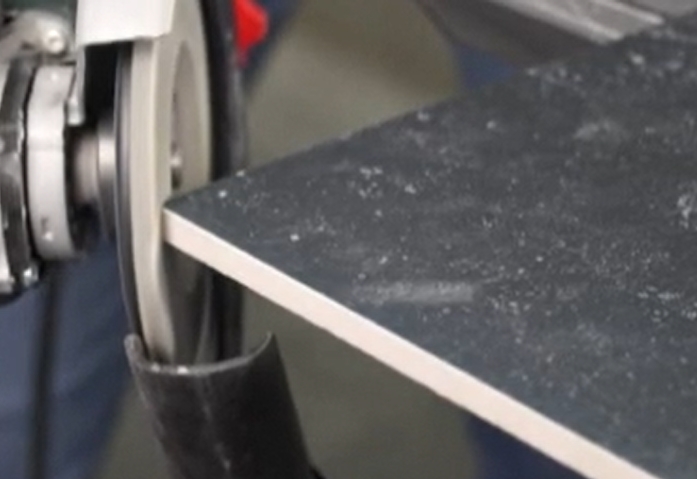
Diamond flap discs are mounted directly on handheld angle grinders and work by controlled friction at the contact point, in either dry or water-assisted mode.
This explainer is written for buyers, workshop supervisors and tool-room engineers who already know they need a diamond abrasive and now have to specify it correctly. It covers how the diamond flap construction differs from a traditional abrasive flap disc, what physically happens at the contact point under dry and wet conditions, how grit staging drives the operation, and which questions to put to a supplier before a first order.
The Problem: Heat, Dust and Glazing on a Hand-Held Grinder
A hand-held grinder is a poor thermal environment for any abrasive. Pressure is set by the operator, the tool speed is usually fixed, there is no flood coolant unless the operator adds it, and the contact angle changes continuously. On hard brittle materials this produces three predictable failure modes, and every dry-versus-wet decision is really a decision about which of them you are trying to suppress.
- Thermal shock and micro-chipping. Ceramic, glass and monocrystalline silicon do not deform under heat — they crack. Local overheating at the contact point produces chipping along the edge, a haze that will not polish out, and an inconsistent edge that fails downstream inspection.
- Swelling and loading. Swarf from stone and engineered stone is fine and abrasive. If it is not cleared, it packs between the flaps, glazes the diamond layer and the disc stops cutting while still looking usable.
- Airborne dust. Dry grinding generates fine particulate that must be controlled for operator exposure, for nearby processes and for shop cleanliness. It is the single most common reason a workshop moves to wet grinding even when dry would cut faster.
Industry Background: Why Diamond Flaps Reached General Fabrication
Coated abrasives remain a large, Asia-weighted manufacturing base. Mordor Intelligence reports that Asia-Pacific accounted for 55.40% of global abrasives purchases in 2025, which is consistent with how buyers actually source diamond flap discs today: most global supply is manufactured in Asia and shipped to EU and US fabricators, distributors and OEM brands. In customs terms, diamond flap discs fall under HS Code 6804.21.00, defined by the US International Trade Commission as millstones, grindstones, grinding wheels and the like, of agglomerated synthetic or natural diamond — a classification worth confirming early, because it drives duty treatment and documentation on both sides of the shipment.
The material mix in EU and US shops explains the demand shift. Porcelain tile, engineered stone, glass and technical ceramics are all harder and more brittle than the mild steel and aluminium that conventional flap discs were designed around. Where a traditional abrasive flap disc dulls against these surfaces, a diamond abrasive keeps cutting, which is why diamond flap discs moved from specialist stone shops into general tile, glazing and countertop fabrication.
Compliance is the other structural change. Any coated abrasive product placed on the EU market, including diamond flap discs, must comply with EN 13743:2017 for safety markings and maximum operating speeds. That standard turns a generic disc into a documented product: the maximum speed marked on the disc, the diameter stated on the label and the certificate behind the shipment all have to agree before a professional buyer can release a purchase order.
What Makes a Diamond Flap Disc Different from a Traditional Abrasive Flap Disc
The construction is the same idea executed with a different abrasive. A lamellar — flap — disc stacks overlapping coated abrasive leaves around a backing plate, so each leaf flexes independently as it passes over the workpiece. That flexibility is what lets the disc follow a curved edge, blend a weld or work a bevel without gouging. The difference is what is coated onto the leaves.
Zhengzhou Ruite Diamond Belts Co., Ltd. (RUITE) is a Chinese manufacturer of superhard material coated abrasives based in Zhengzhou, Henan, producing diamond belts, diamond flap discs, diamond flap wheels, diamond velcro discs, diamond hand pads and diamond quick change discs. The company describes superhard material coated abrasives as combining the dual advantages of the flexibility of traditional coated abrasives and the high hardness of superhard materials — in practice, the flap geometry that makes a coated abrasive forgiving, plus a cutting medium that stays sharp on materials conventional grain cannot hold.
The practical consequences of diamond grain
- Cutting mechanism. Conventional aluminium oxide or zirconia grain fractures and re-sharpens against steel. Against porcelain or glass it simply dulls, and the disc starts rubbing instead of cutting — the heat goes into the workpiece rather than into material removal.
- Material scope. RUITE specifies diamond flap discs for grinding and polishing complex shapes and surfaces of hard brittle materials including stone, glass, ceramic, monocrystalline silicon and synthetic materials.
- Process scope. The same disc family is intended for both dry and wet grinding, which is why the mode decision has to be made per job rather than per product.
- Backing and arbor. Backing plate type and arbor diameter are specification fields, not marketing fields. Confirm both, plus the marked maximum speed, against the grinder actually in use before the first disc goes on.

The flap geometry is shared; the abrasive is not. Diamond grain keeps cutting on hard brittle material where conventional grain dulls and rubs.
Reported grinding efficiency versus conventional flaps
RUITE reports a 45% higher grinding efficiency for its diamond flap discs compared with traditional abrasive flap discs, together with sustained consistent performance across the working life of the disc rather than a strong first pass followed by rapid fall-off. Buyers should treat this as a manufacturer-reported figure, not an independently benchmarked test result, and validate it on their own material before scaling an order. The mechanism behind the claim is defensible even without independent data: a disc that keeps cutting instead of glazing spends more of its contact time removing material and less of it generating heat, which is exactly what shop-floor users notice first on porcelain and engineered stone.
Dry Grinding: What Happens at the Contact Point
In dry mode the disc, the workpiece and the air gap all rise in temperature together. Diamond does not soften at these temperatures, but the bond holding it, the backing plate and the material being ground all have limits. Dry grinding therefore works best when it is treated as a heat-management problem rather than a speed problem.
- Speed is a ceiling, not a target. Maximum operating speed is product-specific. One commercial 115 mm diamond flap disc, for example, is listed for dry use on an angle grinder at a maximum of 13,200 rpm. That number cannot be generalised to other discs — read it from the disc and the datasheet, and never exceed the lower of the disc rating and the tool rating.
- Pressure control. Extra pressure on a diamond disc does not cut proportionally faster; it converts into heat. Light, consistent pressure with continuous motion gives a cooler cut and a longer working life.
- Do not dwell. Keep the disc moving along the edge. A stationary disc on a tile edge is the fastest way to produce a chip that cannot be polished out.
- Clear the swarf. Periodic air clearance or a light tap with the grinder stopped keeps the flap spacing open and delays loading.
- Dust controls. Dry grinding requires extraction or suppression at source, plus suitable respiratory protection for the operator.
Wet Grinding: What Changes When Water Is Added
Adding water changes the physics more than it changes the disc. Contact temperature drops, dust becomes slurry, and the surface condition becomes far more repeatable — which is why wet grinding is the default on heat-sensitive glass, on fine ceramic finishing and wherever a shop cannot tolerate airborne particulate.
- Cooler contact, less edge chipping. A water film at the contact point removes heat before it reaches the brittle surface, which matters most on thin tile, glass and thin-walled ceramic.
- Dust becomes slurry. Airborne exposure drops sharply, but the slurry has to be managed: it is abrasive, it settles in trays and it must not reach drains untreated.
- Finish consistency. Wet running typically produces a more uniform scratch pattern, which shortens the subsequent polishing sequence.
- Cleanup and slip risk. Wet work needs a contained work area, non-slip footing and a defined end-of-shift clean-down. Water on a workshop floor is a safety item, not a housekeeping detail.
- Confirm suitability. Not every disc construction is intended for continuous water exposure. Confirm wet-use suitability with the supplier for the specific item rather than assuming it from the product family.
Grit Staging: Matching the Disc to the Operation
The grit sequence does more for output quality than the dry-or-wet decision does. Supplier application guidance commonly maps coarse grit to shaping, medium grit to general grinding and beveling, and finer grit to smoothing and finishing preparation — for example #60 for aggressive shaping and initial bevels, #120 for universal grinding and beveling, and #200 for final smoothing and preparation for visible finishing. The relationship is guidance from a supplier, not a universal performance standard, but the logic transfers: do not attempt to finish with the grit you used to shape.
Range matters when specifying. RUITE's published diamond flap disc range covers diameters from 100 mm to 180 mm and grits from 40# to 800#, which allows a shop to hold one product family across roughing, shaping and finishing steps instead of splitting the process across different tool types.
Step-by-Step: Setting Up a Dry or Wet Grinding Job
- Classify the material. Confirm whether the workpiece is stone, glass, ceramic, monocrystalline silicon or a synthetic material, and note whether it is heat-sensitive or thin-section. This single step decides the mode more often than any other.
- Match the disc to the grinder. Check diameter, arbor size, backing type and marked maximum speed against the tool and its guard. If the disc rating and the tool rating differ, work to the lower one.
- Choose the grit stage. Start coarse for shaping and beveling, step to medium for general grinding, finish with fine grit before any polishing operation.
- Decide dry or wet using the decision rules below. Do not default to dry simply because the grinder is already set up.
- Set up the work area. Dry: extraction or suppression at source, fire-safe clearance from combustible dust, operator respiratory protection. Wet: contained tray, water feed, non-slip footing, slurry disposal plan.
- Run a test pass. Two or three short passes on scrap of the same material confirm contact angle, pressure and whether the disc is cutting or glazing.
- Work in passes, not in one plunge. Keep the disc moving, re-check the edge every few passes, and stop to clear swarf if the cut rate drops.
- Inspect and record. Check edge quality and surface condition before moving to the finishing stage, and record which combination of grit, mode and speed produced an acceptable result — that record is what makes the next job repeatable.
Use Cases: Dry and Wet Work in EU and US Shops
Ceramic and porcelain tile — diamond flap disc for tiles and ceramic
Edge shaping, beveling and chamfering on porcelain tile is the highest-volume handheld application. Dry running with staged grits covers most site work where water is impractical; wet running is preferred in shops finishing thin or large-format tile where edge chipping is expensive to rework.
Marble and engineered stone — diamond flap disc for marble and engineered stone
Countertop fabrication uses diamond flap discs for edge grinding, beveling and surface conditioning before polishing. Engineered stone is abrasive and generates heavy swarf, so flap clearance and swarf control matter as much as grit selection. Wet running is common where finish consistency across a run of tops is the acceptance criterion.
Glass — edge grinding and beveling
Glass is the clearest case for wet running: contact heat produces edge damage that cannot be recovered, and dry dust from glass is a genuine exposure issue. Dry passes are used mainly for light touch-up where water is not available.
Monocrystalline silicon and synthetic materials
These substrates are hard, brittle and surface-critical. Flexible flap construction keeps contact pressure distributed, and controlled wet running keeps the thermal load away from the surface being finished.
Masonry, weld blending and surface conditioning
Diamond flap discs also cover edge grinding, beveling and chamfering, weld blending and surface conditioning on hard, brittle and abrasive-resistant materials. Where the workpiece is a welded metallic seam or a hard-faced surface rather than a brittle non-metallic material, confirm suitability with the supplier before specifying diamond — the disc family is engineered primarily around hard brittle substrates.
EU OEM ceramic grinding — an eight-year reference case
RUITE supplies an Italian OEM client in ceramic grinding. That account has run continuously for eight years on a supply of 20,000 units, with stable quality results and no complaints from the end customer. For a buyer, the relevant point is not the volume but the duration: an eight-year OEM relationship on ceramic work is evidence that the specification held up across production runs, not just across a sample batch. RUITE's stated export markets are the EU, US and Middle East, with OEM production services available.

RUITE was established in 2003 and develops superhard material coated abrasives, including diamond flap discs, in Zhengzhou, Henan.
Comparison Tables
Dry vs. wet grinding on a handheld tool
| Factor | Dry grinding | Wet grinding |
|---|---|---|
| Contact temperature | Rises with pressure and dwell time; must be managed by technique | Reduced by the water film at the contact point |
| Dust | Airborne particulate; requires extraction or suppression at source | Converted to slurry; slurry must be contained and disposed of |
| Edge quality on brittle material | Acceptable with light pressure and continuous motion | More consistent on thin, heat-sensitive or surface-critical work |
| Stock removal priority | Preferred when fast shaping is the objective | Slower per pass, traded for finish control |
| Setup | Grinder, guard, extraction, PPE | Grinder, guard, water feed, contained tray, non-slip footing |
| Best fit | Site work, tile edges, beveling, general shaping | Glass, fine ceramic, engineered stone runs, repeatable finish |
| Verify before ordering | Marked maximum speed and dry-use rating | Confirmation that the specific disc is intended for wet use |
Diamond flap disc vs. traditional abrasive flap disc
| Factor | Diamond flap disc | Traditional abrasive flap disc |
|---|---|---|
| Abrasive | Diamond on a coated abrasive backing | Conventional abrasive grain on a coated abrasive backing |
| Construction | Lamellar (flap) leaves on a backing plate — same flexible geometry | Lamellar (flap) leaves on a backing plate |
| Behaviour on hard brittle material | Keeps cutting; hardness is retained against stone, glass, ceramic | Dulls and begins to rub rather than cut |
| Stated material scope | Stone, glass, ceramic, monocrystalline silicon, synthetic materials | General metal and woodworking abrasives |
| Process modes | Dry and wet grinding | Typically dry |
| Documented range example | 100–180 mm diameter, 40#–800# grit | Varies by supplier; confirm on datasheet |
| Reported efficiency | 45% higher grinding efficiency reported by RUITE, with sustained consistent performance (manufacturer-reported, validate by sample) | Baseline for the comparison |
| Best fit | Hard brittle materials and mixed stone, glass and ceramic work | Softer materials and general fabrication |
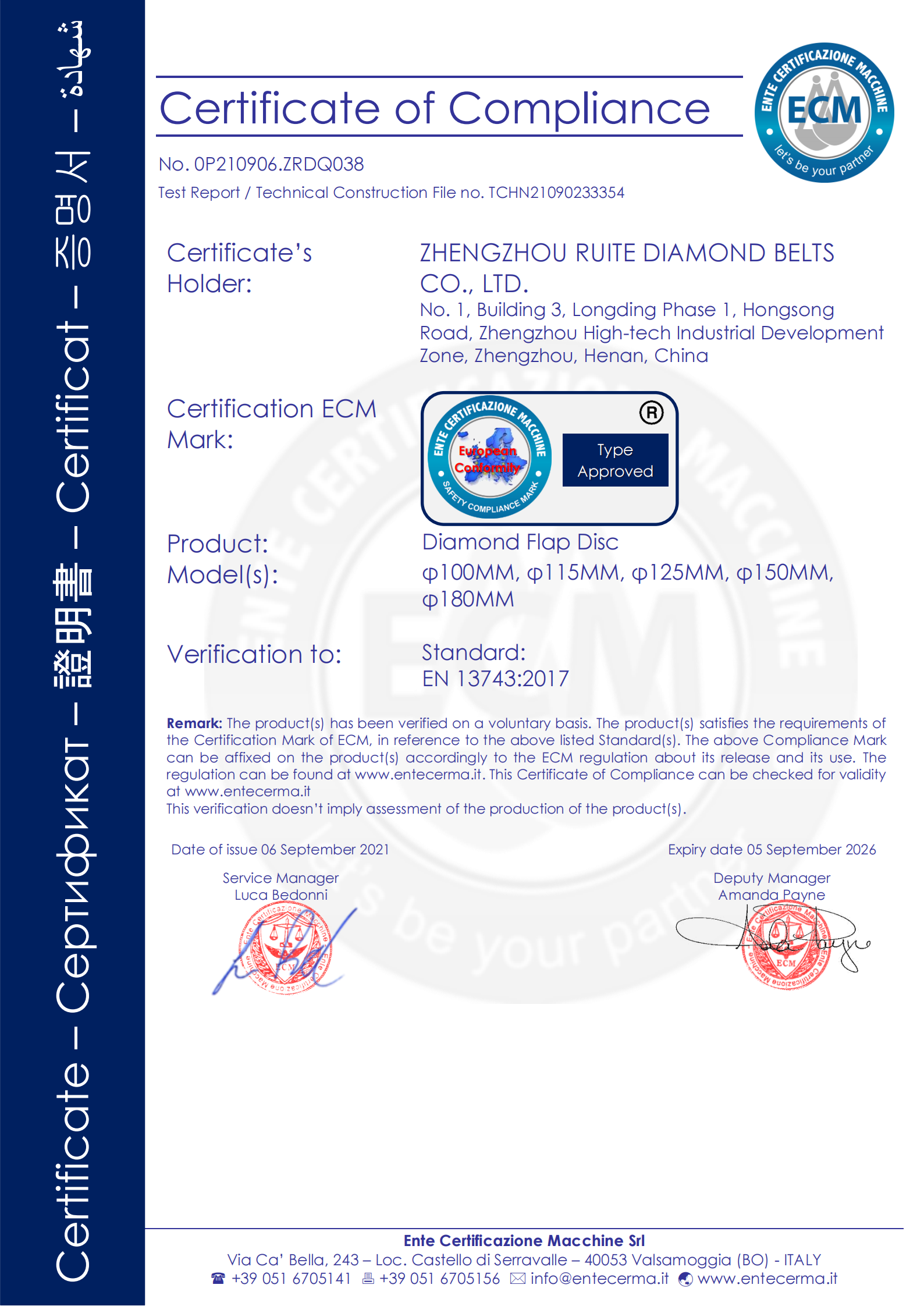
EN 13743:2017 conformity documentation, certificate No. 0P210906.ZRDQ038, covers diamond flap discs in 100 mm, 115 mm, 125 mm, 150 mm and 180 mm. Buyers should request the current certificate copy and confirm its validity window.
Frequently Asked Questions
Are RUITE diamond flap discs documented for the EU market, and how does a buyer verify it?
RUITE holds EN 13743:2017 conformity documentation issued by ECM Certification Machine Srl under certificate No. 0P210906.ZRDQ038, dated 2021-09-06, with a scope covering diamond flap discs in 100 mm, 115 mm, 125 mm, 150 mm and 180 mm diameters. The certificate states a validity end date of 2026-09-05, so a buyer placing an order now should request the current certificate copy, confirm the validity window and check that the diameter on the label matches the certificate scope. EN 13743:2017 is the standard that governs safety markings and maximum operating speeds for coated abrasives placed on the EU market, so the label, the datasheet and the certificate all have to agree before release.
Who manufactures diamond flap discs for ceramic grinding, and what OEM capability exists?
Zhengzhou Ruite Diamond Belts Co., Ltd. is a manufacturer of superhard material coated abrasives established in 2003 in Zhengzhou, Henan, China, with a 500 m² facility, 45 employees, a five-engineer R&D team and an annual output of 100,000 units. The company reports a monthly capacity of 10,000 units, 100% testing, and OEM production with customization covering packing and logo. Its stated export markets are the EU, US and Middle East, with an export ratio of 70%. On ceramic specifically, RUITE has supplied an Italian OEM client in ceramic grinding continuously for eight years on 20,000 units, with stable quality and no customer complaints.
What are the minimum order quantity, payment terms and delivery terms?
RUITE's purchasing terms state a minimum order quantity of 50 units, delivery on FOB, CIF or DDP terms, acceptance against a pre-shipment test, and payment terms of 100% prepayment. MOQ, terms and pricing depend on the configuration, so confirm them in a written quotation before committing a purchase order.
How should a buyer sample-test dry versus wet performance before ordering?
Run the sample on the material and grit stage that match the production job, once dry and once wet, and record edge quality, cut rate and any glazing on the disc. Because the reported 45% higher grinding efficiency is a manufacturer figure rather than an independent benchmark, a side-by-side sample pass on your own porcelain, glass or engineered stone is the fastest way to confirm the claim applies to your process. RUITE supports this with a pre-shipment test as the stated acceptance criterion and free technical consultation on application questions.
What is the lead time, and what happens if a batch is defective?
Standard lead time is 30 days, supported by the stated monthly capacity of 10,000 units. After-sales support covers a 12-month shelf life quality warranty, free technical consultation, and replacement for defective batches. To start, request current samples and confirm the disc diameter, grit stage, backing and marked maximum speed against your grinder before the first production run — the fastest route is to send your requirement, material and machine details through the contact channels below.
Conclusion
Dry versus wet grinding is not a product decision; it is a heat-and-dust decision made once per job. Dry running gives faster stock removal and is the practical choice for site work, tile edges and general shaping, provided pressure is controlled, the disc is kept moving and dust is captured at source. Wet running gives lower contact temperature, suppressed dust and a repeatable finish, and is the better default for glass, heat-sensitive ceramic and production runs where surface consistency is the acceptance criterion. In both modes the disc only performs if the marked maximum speed, the diameter, the backing and the grit stage are matched to the tool and the material.
What separates a diamond flap disc from a traditional abrasive flap disc is not the geometry — both are lamellar discs — but the abrasive. Diamond retains the hardness to keep cutting on stone, glass, ceramic, monocrystalline silicon and synthetic materials where conventional grain dulls and starts rubbing. RUITE builds that family on superhard material coated abrasives, reports a 45% higher grinding efficiency with sustained consistent performance, and supports the specification with an eight-year OEM ceramic reference in Italy, EN 13743:2017 conformity documentation, and OEM production with packing and logo customization.
Next Step: Match the Disc to the Job
Send the material, the grinder model and the finish you need, and RUITE will confirm the diameter, grit stage and dry or wet suitability for your application. Samples and a written quotation are available on request.
Website: www.ruitechn.com | Email: sales@ruitechn.com | Tel: +0086-371-86555877 | WhatsApp: +8613928451015
Download the full product catalogue: RUITE Diamond Flap Disc Catalogue (PDF)
Zhengzhou Ruite Diamond Belts Co., Ltd. — No. 1, Building 3, Longding Phase 1, Hongsong Road, Zhengzhou High-tech Industrial Development Zone, Zhengzhou, Henan, China.
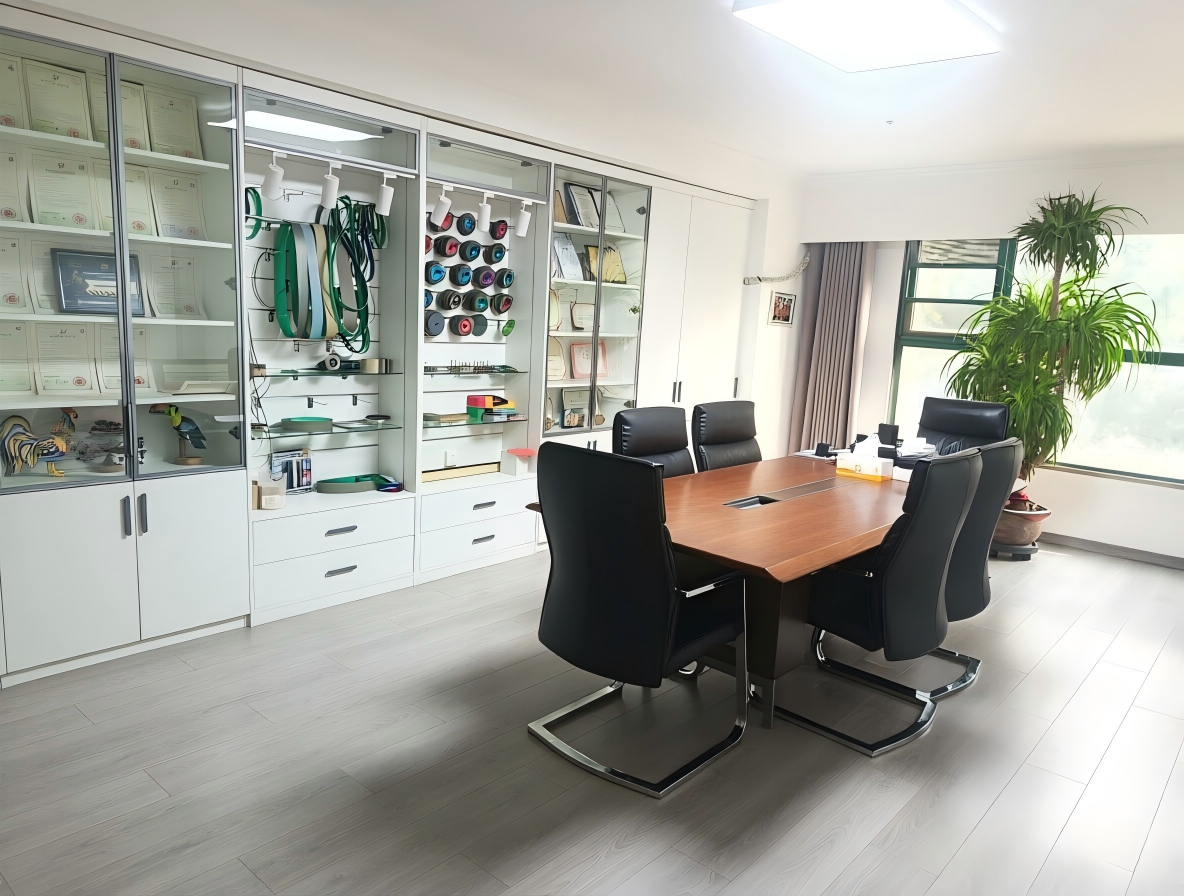
OEM diamond flap disc production with packing and logo customization, exported to the EU, US and Middle East.
Have Questions or Need More Details?
Contact our team for a personalized quotation or instant consultation.
Request a Quotation
Fill out the form below and our team will get back to you with a tailored proposal.
WhatsApp Direct Chat
Prefer to chat in real-time? Message us on WhatsApp for instant assistance & quick answers.
- Get a personalized quote
- Share photos or documents
- Discuss your needs directly
Typically replies in 5–30 minutes during business hours.