Diamond Sanding Belt Partnership FAQ: OEM Support, Warranty, MOQ & Lead Times
Diamond Sanding Belt Partnership FAQ: OEM Support, Warranty, MOQ & Lead Times
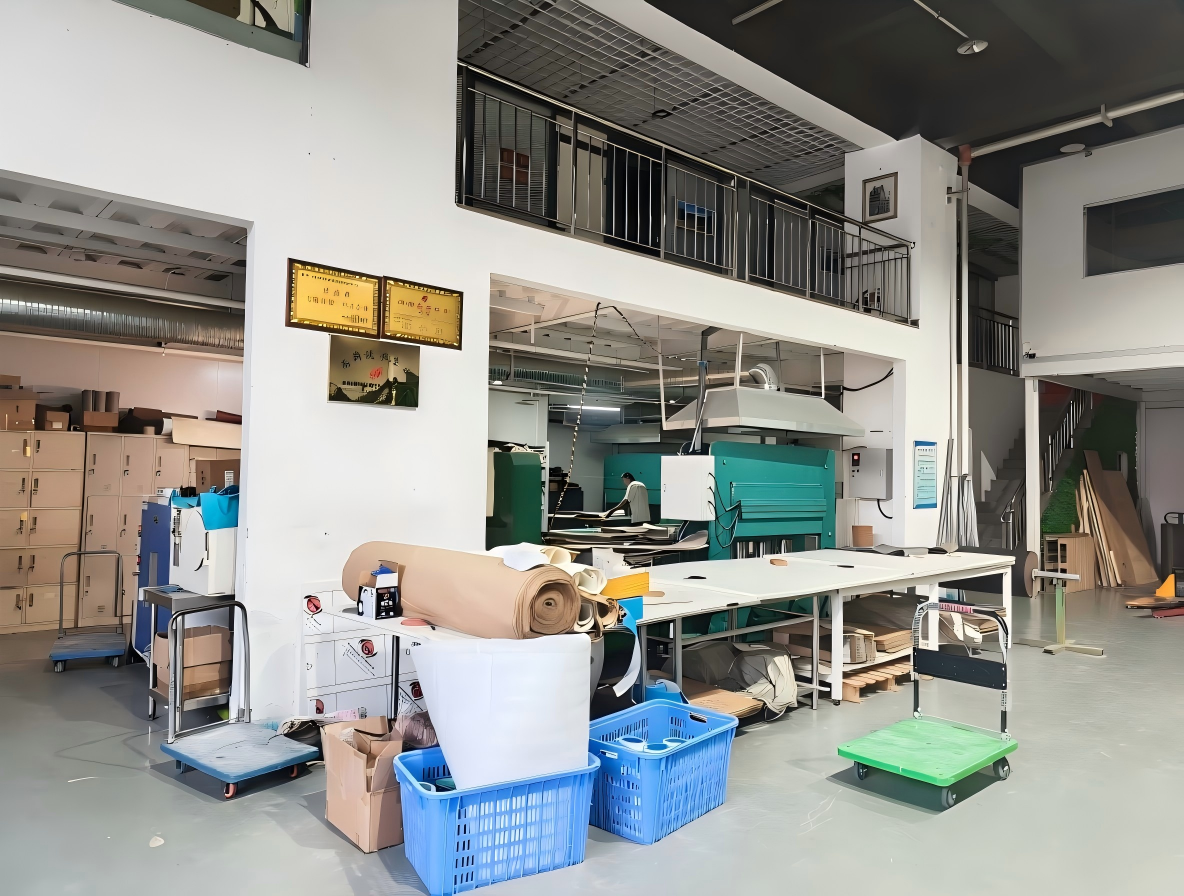
Choosing an OEM diamond sanding belt manufacturer is a commercial decision as much as a technical one. Buyers in glass processing, ceramic tile, thermal spray coating and carbide tooling confirm the abrasive specification first, then find that the questions which actually delay a project are about minimum order quantity, lead time, payment terms, customization, testing, and who is responsible after delivery. This FAQ answers those questions in one place, using the stated operating terms of Zhengzhou Ruite Diamond Belts Co., Ltd., a superhard material coated abrasives manufacturer established in 2003 in Zhengzhou, Henan, China.
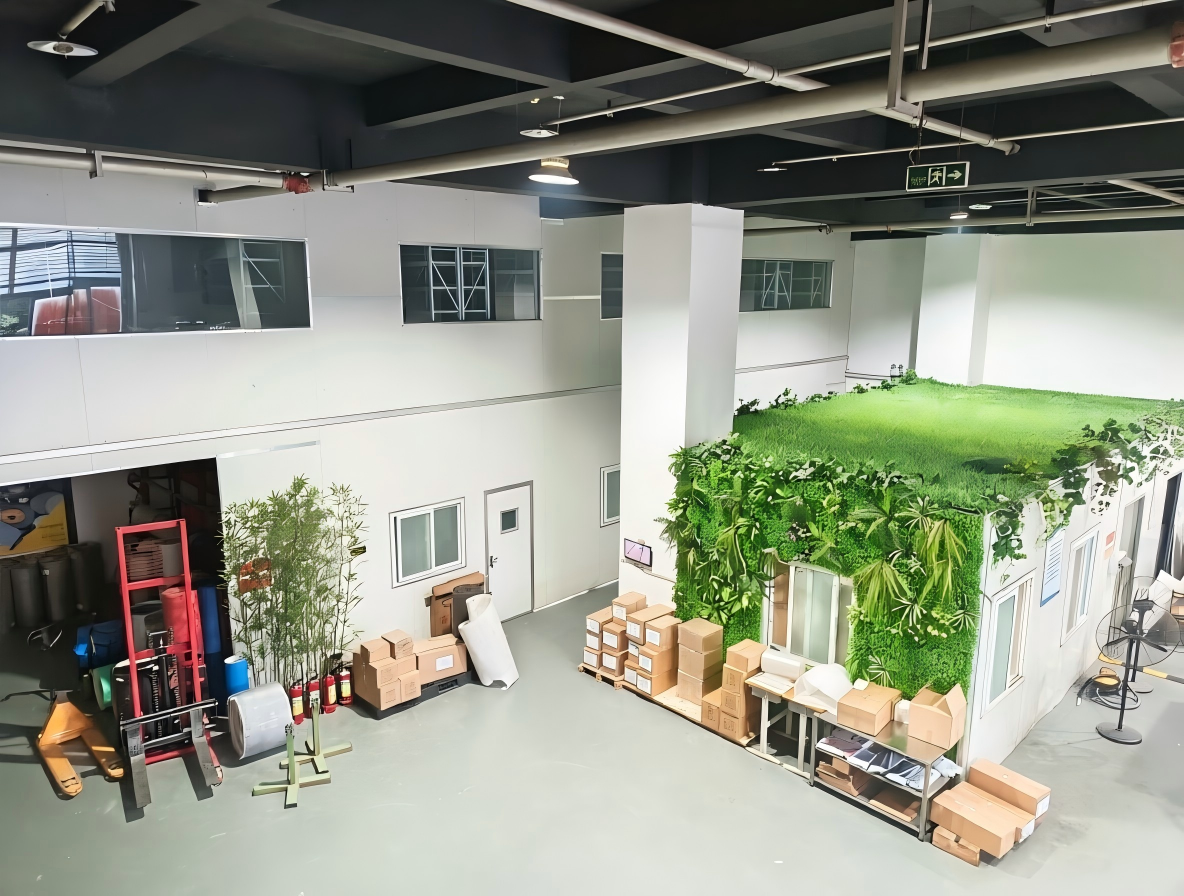
The company operates a 500 m² manufacturing facility with approximately 45 employees and a five-engineer R&D team, and reports an annual production capacity of 100,000 units. Export business accounts for 70% of total sales, with Europe and the United States as the main markets. Its product range includes diamond belts, diamond flap discs, diamond flap wheels, diamond velcro discs, diamond hand pads, and diamond quick change discs, alongside researched CBN belts, CBN flap discs, CBN spiral bands, and CBN hand pads.
The short answers, before the detail:
MOQ: 50 units | Lead time: 30–45 days | Monthly capacity: 1,000 units
Payment: 100% prepayment, with FOB, CIF or DDP terms | Warranty: 12-month shelf-life quality warranty
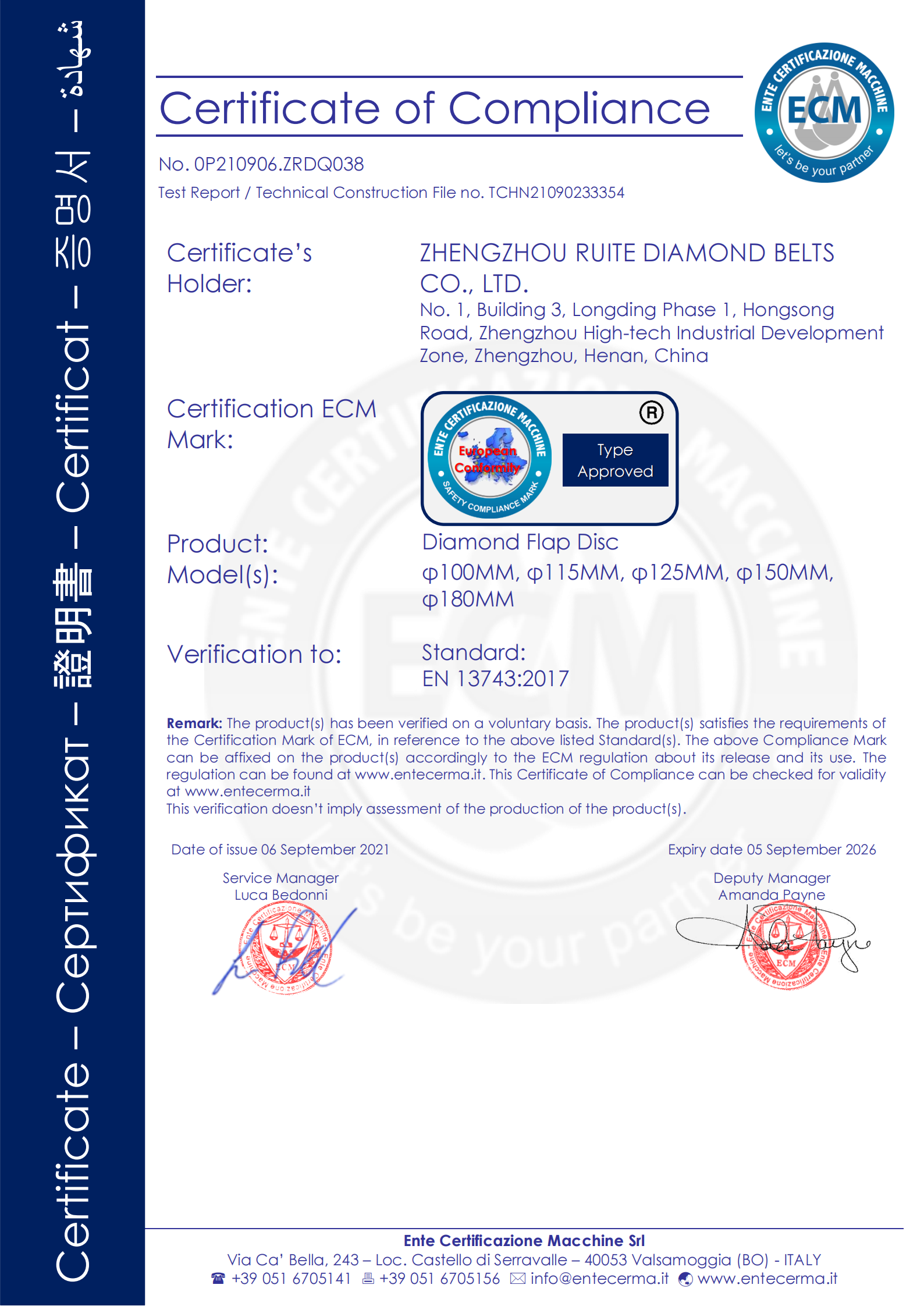
Quality: 100% testing, ISO 9001 quality management, EC certification for product 5282 (certificate No. 0P210906.ZRDQ038)
Support: free technical consultation, packing and logo customization
What Buyers Need Answered Before They Commit to an OEM Diamond Sanding Belt Order
The pre-purchase problem is rarely about whether a diamond abrasive belt can grind a given material — it usually can. The problem is that technical specifications and commercial terms are published in different places, or not published at all. A procurement team can read grit ranges and bond types on a product page, but still not know the minimum order quantity, the realistic production window, whether logo and packaging can be customized, or what happens if a batch underperforms.
That gap creates two predictable failure modes. The first is buying on unit price alone, then discovering that lead times do not match the production schedule or that the delivered belt does not hold its edge on the actual machine. The second is buying on brand familiarity alone, then paying a premium for a specification that a specialized OEM manufacturer already produces to the same dimensional and grit requirements.
For industrial buyers, the practical solution is to treat the first supplier conversation as a structured checklist with four parts:
- Technical fit: abrasive material (diamond or CBN), bond type, grit, width, length, and whether the process runs wet, dry, or both.
- Commercial terms: MOQ, price basis, incoterms, payment terms, and confirmed lead time.
- Quality system: in-process and pre-shipment testing, certificates, and who signs off on release.
- After-sales: warranty scope, technical support, and the channel for solving a problem once the order has shipped.
Each of these is answered below with specific figures rather than general assurances.
Industry Background: Why Commercial Terms Now Decide Supplier Selection
Diamond abrasive belts sit inside a super-abrasive tool market that continues to expand. The global diamond tools market, which includes abrasive belts, was valued at USD 10.8 billion in 2024 and is projected to reach USD 19.5 billion by 2034, according to Global Market Insights. The narrower coated abrasive belt market (all abrasive materials) was valued at approximately USD 3.2 billion in 2025, with a projected CAGR of 5.3% through 2033, according to Cognitive Market Research.
Demand is also being pulled by downstream applications. The thermal spray coatings market — a key application area for diamond belts used on tungsten carbide surfaces — is expected to reach USD 15.28 billion by 2031, according to Mordor Intelligence. In parallel, Mordor Intelligence notes that diamond-based super-abrasives are critical for post-processing in additive manufacturing, where abrasive surface finishing techniques can reduce roughness below 5 µm. These are the applications where belt consistency and supply continuity matter more than a one-off price comparison.
The supply side is concentrated among established international suppliers. Market Research Future lists 3M, Saint-Gobain (Norton), KGS Diamond, Hermes Schleifmittel, and Tyrolit among the key global competitors in the super-abrasive and diamond belt market. Specialized manufacturers such as Zhengzhou Ruite Diamond Belts Co., Ltd. compete on application-specific OEM work rather than on a full industrial catalogue.
Two regulatory developments make supplier selection more than a price question for buyers sourcing from China:
- China's Ministry of Commerce implemented export controls on specific superhard materials on November 8, 2025 under Announcement No. 55 of 2025, covering items such as diamond grinding wheels with tooth hardness ≤30 HRB and grain size ≤5 µm.
- Effective April 1, 2026, China cancelled the export tax rebate (previously 9–13%) for abrasive products including grinding wheels, sandpaper, and abrasive cloth and belts, according to the Ministry of Finance.
In North America, safety requirements for abrading materials used with coated abrasive systems are governed by the ANSI B7.7 standard. For buyers, the practical implication is straightforward: confirm product classification, documentation, and landed cost with the manufacturer and customs broker before scaling an order, not after.
How RUITE Supports an OEM Diamond Sanding Belt Partnership
Zhengzhou Ruite Diamond Belts Co., Ltd. is an OEM-oriented manufacturer: it develops superhard material coated abrasives with independent intellectual property rights, and its belt platform covers both diamond and CBN abrasives. For buyers planning a long-term program, the relevant facts are the product envelope, the OEM support scope, and the evidence behind quality claims.
Product envelope
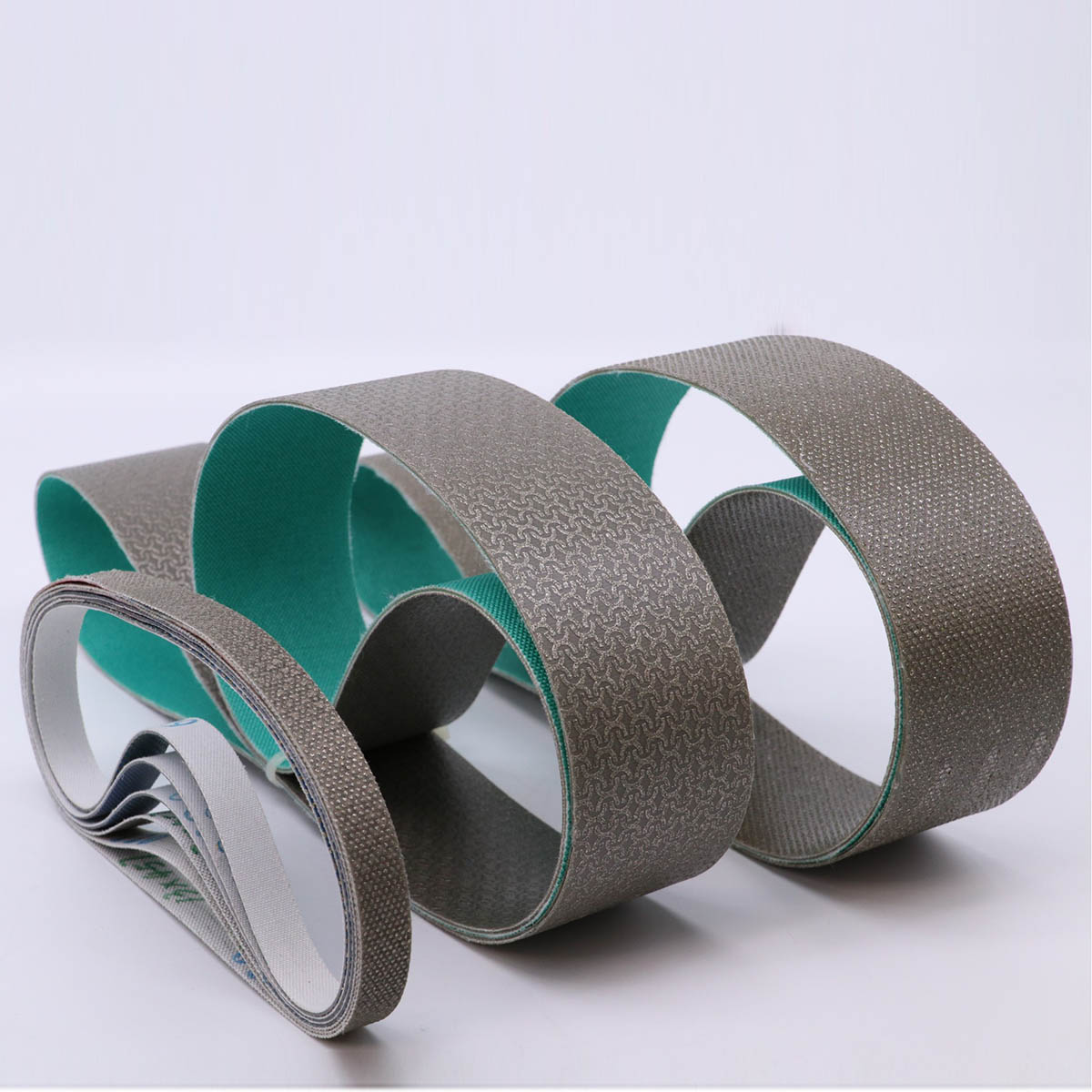
The diamond belt is made with diamond or CBN as the abrasive material and is available in resin bond and electroplated types. It is designed for grinding and polishing applications and can be used for both wet and dry grinding of hard brittle materials such as glass, stone, ceramics, monocrystalline silicon, polycrystalline silicon, synthetic materials, and cemented carbide. Grit sizes range from 40# to 5000#, so coarse, medium and fine finishing steps can be ordered from one supplier. Width ranges from 5 mm to 350 mm and length from 150 mm to 5000 mm, and customization according to customer requirements is supported.
Typical duty includes diamond belt for glass edging, diamond abrasive belt for ceramic tile edge rounding, diamond belt for thermal spray finishing, diamond belt for tungsten carbide and other high-temperature alloys, diamond belt for deburring carbide parts, diamond belt for composite material, and lapidary diamond sanding belt applications where a flexible, endless diamond abrasive cloth belt is preferred over rigid tooling.
What OEM support includes
- Specification customization: width, length, grit and bond type matched to the customer’s machine and finish target.
- Packing and logo customization: buyer-branded packaging and labeling for private-label and distributor programs.
- Free technical consultation: application review before the order is placed, including guidance on belt selection for a specific material and finish.
- 100% testing: belts are tested before shipment rather than sampled.
- Commercial structure: MOQ of 50 units, 30–45 day lead times, and a stated monthly capacity of 1,000 units.
- Warranty: a 12-month shelf-life quality warranty on the supplied belts.
Evidence behind the quality claim
Two pieces of evidence support the OEM program. The first is certification: product 5282 carries EC certification under certificate No. 0P210906.ZRDQ038, which is relevant for buyers who need documentation on file for European customers. The second is an operating record: an Italian ceramic grinding customer has run product 5282 across 20,000 units over eight years with zero complaints — a continuous supply history rather than a single trial order. The company also operates ISO 9001 quality management.
A word on limits, since they matter more than assurances: belt performance depends on how the tool is run. In this application, precise control of speed, pressure, and time is required to achieve optimal results and maximum service life. Free technical consultation exists precisely because the same belt can behave differently on a hand-held tool running intermittently and on a stationary belt grinding machine running continuously.
Step-by-Step: How an OEM Order Runs From Inquiry to Delivery
- Technical consultation (free). The buyer describes the material, the machine, the current finish problem and the target grit. The supplier confirms whether a diamond belt, a resin bond belt, an electroplated belt, or a CBN alternative is the appropriate platform.
- Specification definition. Width (5–350 mm), length (150–5000 mm), grit (40#–5000#), bond type, and wet or dry operation are fixed in writing.
- Quotation with incoterms. Pricing is issued on an FOB, CIF or DDP basis so that the buyer can compare landed cost rather than ex-works price.
- Order confirmation. The minimum order quantity is 50 units. Payment terms are 100% prepayment.
- Production. Lead time is 30–45 days. The stated monthly capacity is 1,000 units, with an annual production capacity of 100,000 units across the product range, which matters when a program needs replenishment cycles rather than a single shipment.
- Testing. Belts are 100% tested before shipment.
- Packing and branding. Packing and logo customization are applied for private-label and distributor orders before dispatch.
- After-sales. Supplied belts carry a 12-month shelf-life quality warranty, and technical consultation remains available after the first order so that parameters such as speed, pressure and cycle time can be adjusted on site.
Because export-control and tax-rebate rules for abrasive products changed during 2025 and 2026, documentation and classification should be re-confirmed for each new shipment rather than assumed from a previous order.
Use Cases: Where These Belts Are Applied
Diamond belts are widely used in grinding and polishing processes for hard brittle materials such as stone, glass, ceramic, and monocrystalline silicon. The industrial fit is broad enough to cover six recurring buyer scenarios:
- Glass edging and edge rounding: a diamond belt for glass edging removes the sharp arris and produces a consistent edge before polishing.
- Ceramic tile and porcelain: a diamond abrasive belt for ceramic tile handles edge rounding where chipping is the main defect to eliminate.
- Thermal spray coating: a diamond belt for thermal spray is used to finish sprayed layers, including tungsten carbide coatings, where surface uniformity affects downstream performance.
- Carbide tooling: a diamond belt for deburring carbide parts and for carbide tool sharpening.
- High-temperature alloys and composites: a diamond belt for high-temperature alloys and a diamond belt for composite material address materials where conventional abrasives load or glaze quickly.
- Lapidary and stone finishing: lapidary diamond sanding belts and diamond polishing belts are used for shaping and final finish.
These applications fall inside the industries the belt platform is specified for: glass, stone, porcelain, thermal spray coating, wind power, and aeronautics and astronautics.
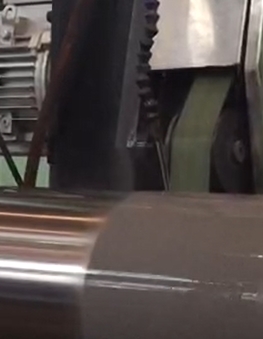
A verified reference: eight years, 20,000 units, zero complaints
The strongest available reference for the OEM program is not a specification sheet but a supply history. An Italian ceramic grinding customer has purchased product 5282 over an eight-year relationship totalling 20,000 units, with zero complaints recorded. For a buyer evaluating a long-term partner, that pattern demonstrates three things at once: dimensional repeatability across batches, stable supply over multiple order cycles, and a quality level that survives contact with an industrial ceramic grinding line rather than a laboratory sample.
Specification and Partnership Terms at a Glance
Two tables cover the questions that normally take the longest to resolve: what the belt platform can be built to, and what the commercial relationship includes.
Table 1 — Diamond belt specification envelope
| Item | Range / Options |
|---|---|
| Abrasive material | Diamond or CBN |
| Bond type | Resin bond; electroplated |
| Grit | 40# to 5000# (coarse, medium, fine) |
| Width | 5 mm to 350 mm |
| Length | 150 mm to 5000 mm |
| Grinding condition | Wet and dry grinding and polishing |
| Customization | Available according to customer requirements |
| Typical materials | Glass, stone, ceramic, monocrystalline silicon, polycrystalline silicon, synthetic materials, cemented carbide |
| Typical industries | Glass, stone, porcelain, thermal spray coating, wind power, aeronautics and astronautics; carbide tool sharpening |
Table 2 — OEM partnership terms
| Parameter | Stated OEM program term |
|---|---|
| Minimum order quantity | 50 units |
| Lead time | 30–45 days |
| Monthly capacity | 1,000 units |
| Annual production capacity | 100,000 units |
| Payment terms | 100% prepayment |
| Incoterms | FOB, CIF, DDP |
| Testing | 100% testing before shipment |
| Warranty | 12-month shelf-life quality warranty |
| Customization | Size, grit, packing and logo customization |
| Technical support | Free technical consultation |
| Certification | EC certification for product 5282, certificate No. 0P210906.ZRDQ038; ISO 9001 quality management |
| Export markets | Europe and the United States; export is 70% of total sales |
FAQ: Partnering With Diamond Sanding Belt Manufacturers
What should buyers verify first when comparing diamond sanding belt manufacturers?
Verify certification and quality management before price. For diamond sanding belt programs, the practical minimum is a traceable certificate for the specific product being ordered and a documented quality system. Product 5282 from Zhengzhou Ruite Diamond Belts Co., Ltd. holds EC certification under certificate No. 0P210906.ZRDQ038, the company operates ISO 9001 quality management, and belts are 100% tested before shipment. Certification on a company page is not the same as a certificate number matched to the ordered product, which is why the certificate reference is worth requesting directly.
What OEM customization can be provided for diamond sanding belts?
Customization covers both the abrasive tool and its presentation. On the tool side, belts are built with diamond or CBN abrasive in resin bond or electroplated types, with grit from 40# to 5000#, width from 5 mm to 350 mm, and length from 150 mm to 5000 mm, for wet or dry grinding; customization according to customer requirements is supported, including belt formats used for glass edging, ceramic tile edge rounding, thermal spray finishing, high-temperature alloys, composites and carbide deburring. On the presentation side, packing and logo customization are available, which allows distributors and private-label brands to sell under their own identity. Free technical consultation is provided before specification is locked.
What are the MOQ, payment terms, incoterms and lead times?
The stated minimum order quantity is 50 units. Payment terms are 100% prepayment, and quotations can be issued on FOB, CIF or DDP terms so buyers can compare landed cost. Lead time is 30–45 days, with a monthly capacity of 1,000 units and an annual production capacity of 100,000 units. Buyers planning a multi-SKU program should place the long-lead specification first and confirm the shipment schedule in writing, since lead time and capacity are the two variables that most often affect a distributor’s restocking cycle.
What warranty and after-sales support apply after delivery?
Supplied belts carry a 12-month shelf-life quality warranty. After-sales support also includes continued free technical consultation, which matters because belt life is governed by operating parameters as much as by the abrasive itself: precise control of speed, pressure, and time is required to achieve optimal results and maximum service life. Support remains relevant for both intermittent hand-held tool operation and continuous stationary belt grinding machine operation.
How do buyers start a partnership, request a sample or get a quotation?
Contact the sales team directly with the material, machine type, current belt specification and target finish. Zhengzhou Ruite Diamond Belts Co., Ltd. can be reached by email at sales@ruitechn.com, by phone at +0086-371-86555877, or by WhatsApp at +8613928451015, and the full product catalogue is available for download. The company is based at No. 1, Building 3, Longding Phase 1, Hongsong Road, Zhengzhou High-tech Industrial Development Zone, Zhengzhou, Henan, China. Buyers who want to validate the belt on their own machine before committing to a program can request a sample and quotation through the same channels, referencing the application and the grit range they intend to run.
Conclusion: What a Long-Term Diamond Sanding Belt Partnership Actually Requires
The questions in this FAQ have one theme in common: predictability. A 50-unit MOQ keeps the first order testable. A 30–45 day lead time and a 1,000-unit monthly capacity make replenishment plannable. A 12-month shelf-life quality warranty and 100% testing shift the burden of verification back to the manufacturer. Packing and logo customization let a distributor build its own brand on a supplied belt, and free technical consultation keeps the specification aligned with the machine it actually runs on.
For buyers in glass, ceramic, thermal spray, carbide tooling, composites or lapidary work, the decision framework is therefore narrower than it first appears. Check that the belt envelope matches the application (diamond or CBN, resin bond or electroplated, 40#–5000#, 5–350 mm wide, 150–5000 mm long, wet or dry). Check that the commercial terms fit the purchasing system (MOQ, prepayment, incoterms, lead time). Then check the evidence: EC certification for product 5282 under certificate No. 0P210906.ZRDQ038, ISO 9001 quality management, and an eight-year record of 20,000 units with zero complaints from the Italian ceramic grinding customer.
Next step: sample, quotation or catalogue
Send the material, machine type and target grit, and the technical team will confirm the correct belt specification before you order.
Email: sales@ruitechn.com | Tel: +0086-371-86555877 | WhatsApp: +8613928451015
Website: www.ruitechn.com | Download the catalogue: RUITE product catalogue (PDF)
Have Questions or Need More Details?
Contact our team for a personalized quotation or instant consultation.
Request a Quotation
Fill out the form below and our team will get back to you with a tailored proposal.
WhatsApp Direct Chat
Prefer to chat in real-time? Message us on WhatsApp for instant assistance & quick answers.
- Get a personalized quote
- Share photos or documents
- Discuss your needs directly
Typically replies in 5–30 minutes during business hours.