Diamond Sanding Belt Supplier in China: A Long-Term Partnership Guide
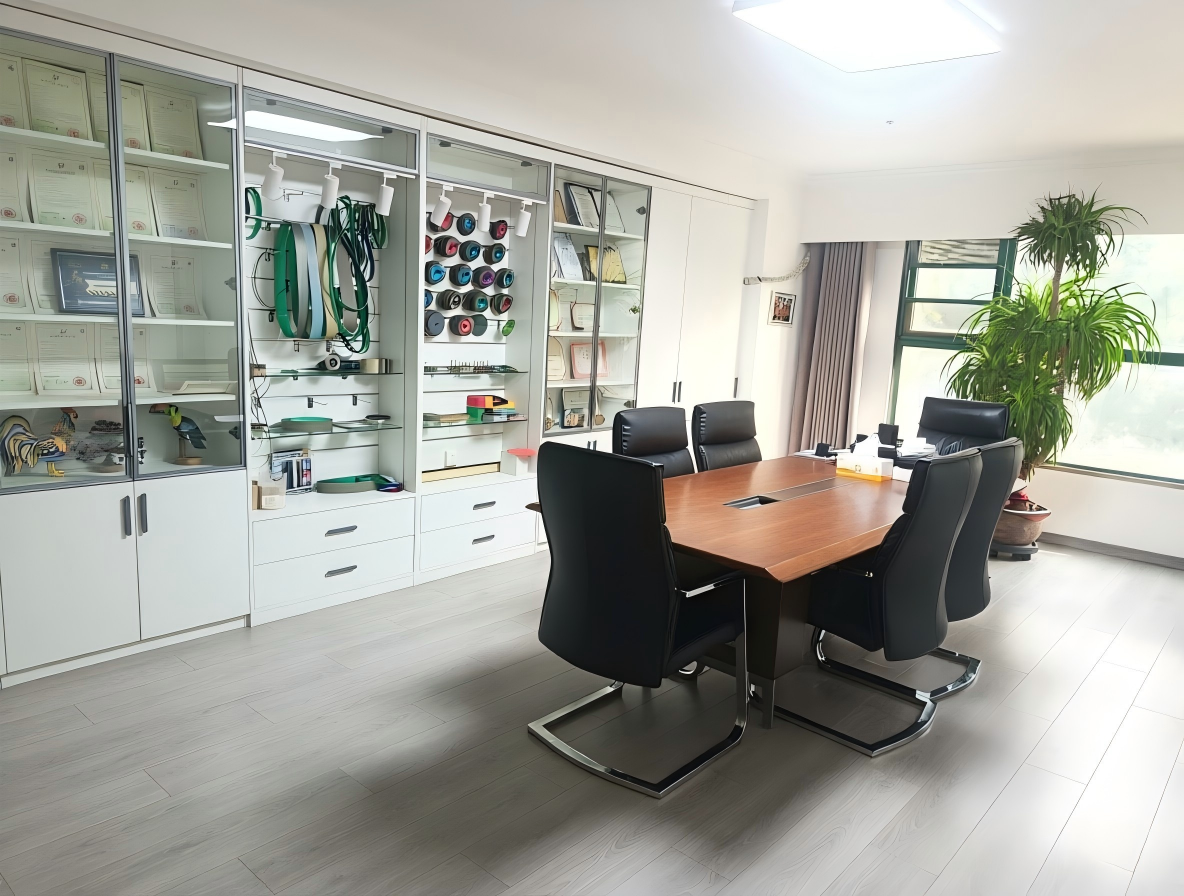
Image: Ruite production facility — a partner with in-house R&D and quality management.
Diamond Sanding Belt Supplier in China: A Long-Term Partnership Guide
Finding a reliable long-term diamond sanding belt supplier in China requires more than comparing prices. Buyers moving from sample testing to regular production need a partner with stable quality, consistent supply, responsive communication, and the ability to support new applications over time.
This guide explains what to evaluate when selecting a Chinese diamond abrasive belt manufacturer for ongoing supply, and how to structure a relationship that works for both sides. It focuses on actual supplier capabilities, procurement terms, and quality control — not just marketing claims.
The Risk of Choosing a Supplier Without a Long-Term Perspective
Many purchasing problems start when a supplier is selected only on initial price or a single qualified sample. In coated abrasives, batch consistency matters as much as first-article performance. A belt that works well in one shipment may vary in grit distribution, resin bond strength, or backing flexibility if the factory lacks process control.
Long-term supply relationships reduce these risks by aligning quality standards, production planning, and continuous improvement. A supplier that openly discusses its factory size, R&D team, and inspection process often provides a more predictable basis for planning than one that only shares a catalog.
Before starting a partnership, check whether the supplier is willing to validate technical specifications, accept sample testing, and agree on pre-shipment acceptance procedures. These are practical signs of a manufacturer with a long-term orientation.
What a Sustainable Diamond Belt Supply Relationship Looks Like
For buyers of diamond sanding belts, the key difference between short-term and long-term supply is not the product alone; it is the system around the product. A sustainable supplier typically offers:
- Consistent product specifications across batches
- Flexible customization for width, length, grit, and bonding type
- Responsive communication with a single accountable contact
- Clear lead times and delivery terms (for example, FOB, CIF, or DDP)
- In-process and final inspection protocols
- Pre-shipment testing options for new orders
These elements matter most when the buyer's application is demanding — for example, grinding thermal spray coatings, edging glass, deburring tungsten carbide, or finishing ceramics.
Market Context: Diamond Tools Demand and Policy Changes
The global diamond tools market was valued at USD 10.8 billion in 2024 and is projected to reach USD 19.5 billion by 2034, according to Global Market Insights. That includes the industrial diamond abrasive segment, where belts play a growing role in hard and brittle material processing.
For long-term buyers, two policy developments in China are also relevant. First, China's Ministry of Commerce implemented export controls on specific superhard materials, including certain diamond grinding wheels, effective November 8, 2025. Second, effective April 1, 2026, China will cancel the export tax rebate for abrasive products, including abrasive cloth and belts. These changes affect cost structures and export procedures, so working with a supplier that manages compliance and logistics transparently becomes more valuable.
Core Considerations for Selecting a Diamond Sanding Belt Manufacturer
1. Factory Capability and Production Focus
A partner for long-term supply should have demonstrated manufacturing capacity, not just a trading desk. For example, Zhengzhou Ruite Diamond Belts Co., Ltd (a Chinese manufacturer operating under the brand RUITE) specializes in diamond-coated coated abrasives, including diamond belts, diamond flap discs, and diamond hand pads. Established in 2003, the company reports a 500 m² production area, 45 employees, and an annual output of 100,000 units. Its R&D team includes 5 engineers, which supports product customization and quality improvements.
When evaluating a manufacturer, ask for:
- Production capacity and lead times
- R&D capabilities, especially for custom sizes and grits
- Quality management system certification (e.g., ISO9001, if claimed)
- Export experience and main markets
2. Product Range and Customization Ability
Long-term partnerships often involve evolving requirements. A supplier that offers a broad range of diamond abrasive products — belts, flap discs, spiral bands, and velcro discs — is better positioned to support new projects. Customization is particularly important because diamond sanding belts can be made in many dimensions and grits.
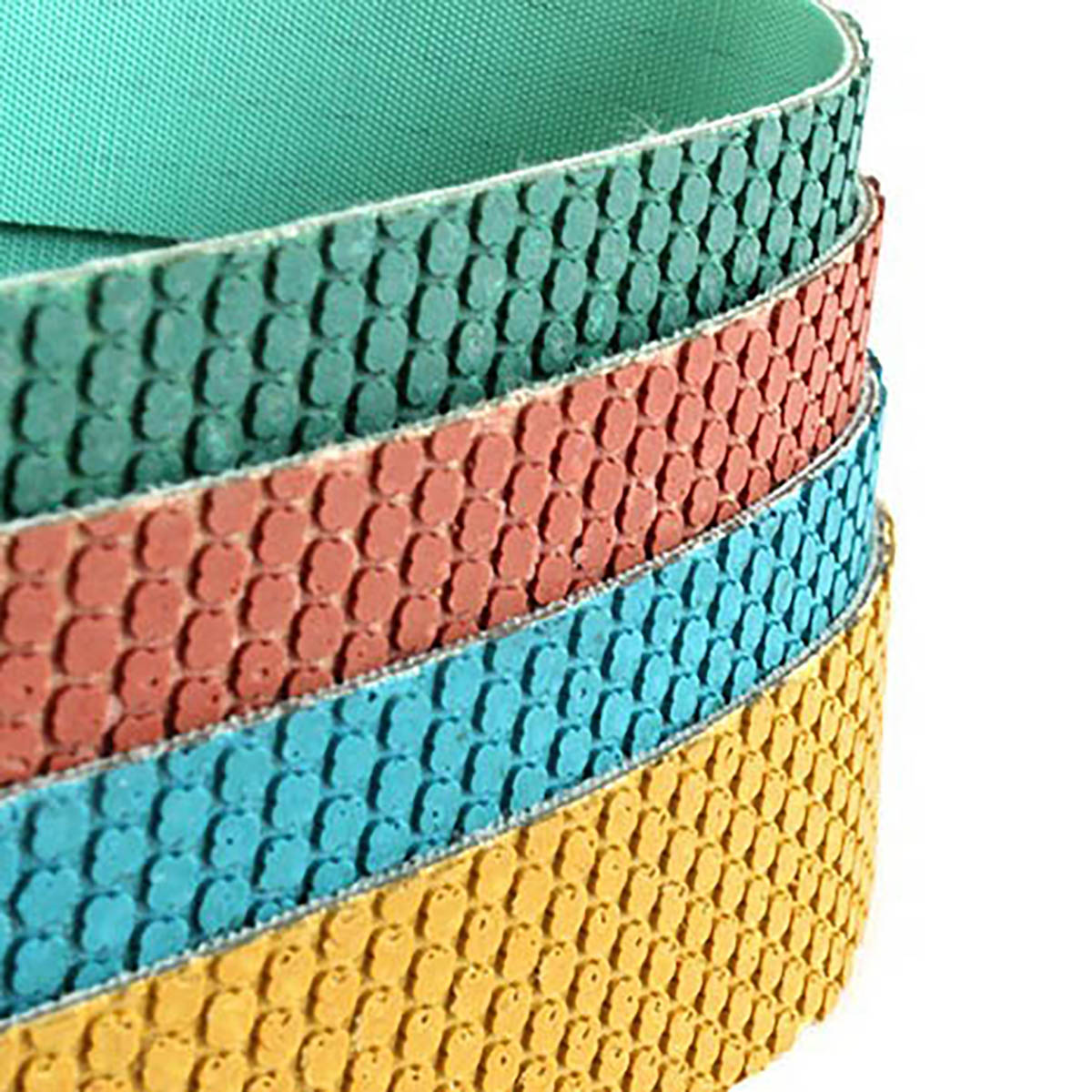
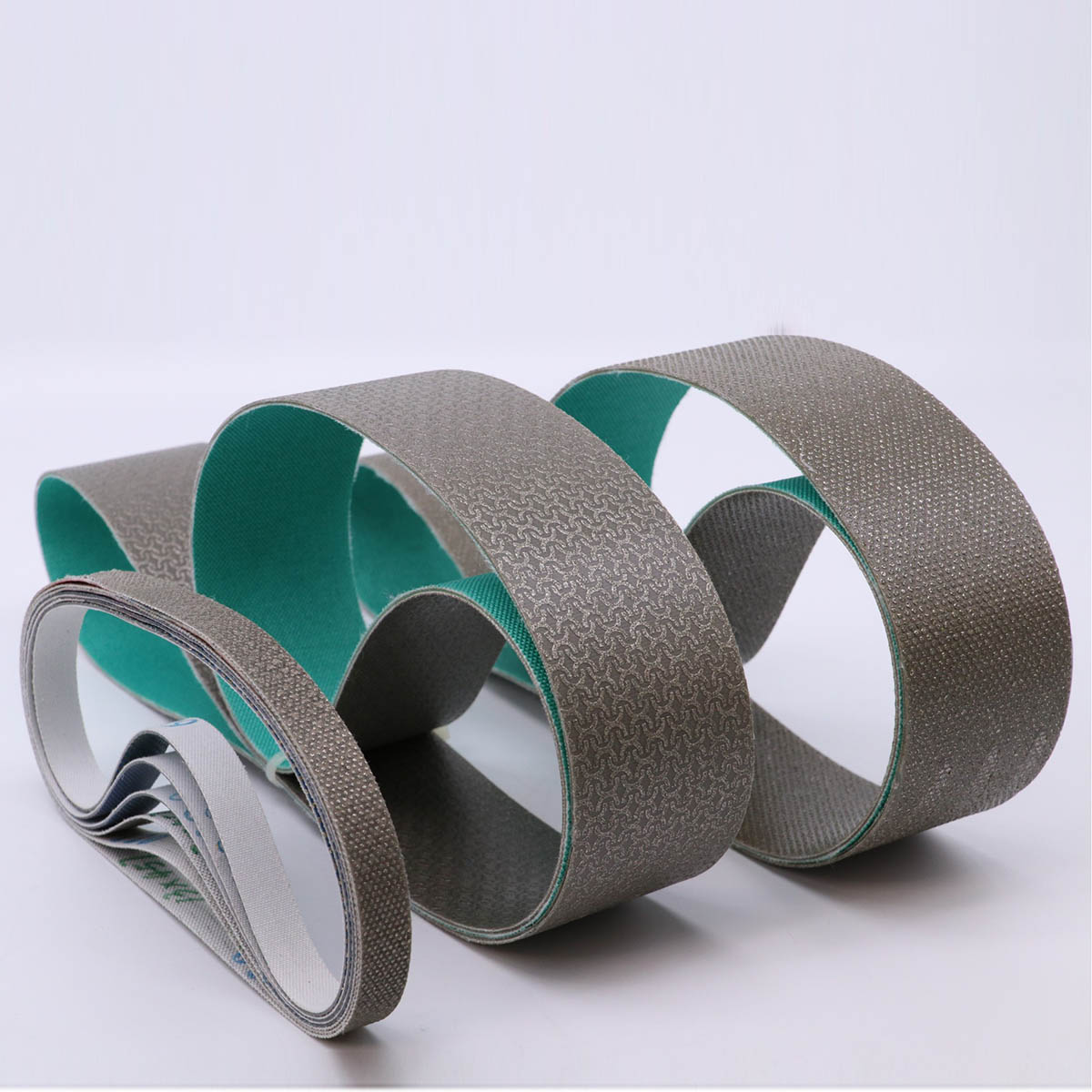
RUITE's diamond belts are available in widths from 5 mm to 350 mm and lengths from 150 mm to 5000 mm, with grits from 40# to 5000#. This range supports applications from coarse removal to fine polishing. The company also offers custom sizes according to buyer requirements, which is essential when belts must fit specific machines or production lines.
Bonding type is another important variable. Options such as resin bond diamond belts and electroplated diamond belts are used in different applications. A knowledgeable supplier can explain the trade-offs, for example, when to use a flexible diamond belt for curved surfaces versus a stiffer belt for flat grinding.
3. Application Expertise Across Industries
Diamond belts are used across a wide range of industries. A long-term partner should be able to suggest the right belt type for specific materials and processes, such as:
- Thermal spray coatings — diamond belts are commonly used for finishing tungsten carbide coatings, especially in the thermal spray coating industry.
- Glass edging — diamond belts help reduce the risk of cracking while grinding glass edges.
- Ceramic tile — diamond abrasive belts are used for surface grinding and edge polishing of porcelain and ceramic tiles.
- Tungsten carbide and cemented carbide parts — deburring and sharpening carbide tools requires a superhard abrasive that maintains cut rate over time.
- High-temperature alloys — in aerospace and engineering, diamond belts can finish superalloys where conventional abrasives wear quickly.
- Composites — diamond belts offer clean cutting on synthetic materials and fiber-reinforced composites.
RUITE's diamond belts are designed for grinding and polishing hard brittle materials such as glass, stone, ceramics, monocrystalline silicon, polycrystalline silicon, synthetic materials, and cemented carbide.
4. Quality Assurance and Risk Control
Quality control is the backbone of a long-term abrasive supply. It is not enough for a supplier to claim high quality; they should have a process. In the case of overheating or other processing risks, manufacturers should manage them through a quality management system (such as ISO9001), in-process and final inspections, customer confirmation of technical specifications, sample validation, and appropriate packing/logistics choices.
Buyers should ask for:
- In-process inspection checkpoints
- Final inspection before shipment
- Pre-shipment testing for critical orders
- Storage and packing methods that protect belts from damage
These practices reduce the risk of batch-to-batch variation. They also protect the buyer from unexpected defects that cause downtime.
5. Sustainability-Oriented Manufacturing
Environmental responsibility is increasingly relevant for long-term partnerships. Manufacturers that emphasize environmental protection and resource saving are more likely to align with international buyer expectations. RUITE highlights environmental protection and resource saving in its operations, alongside differentiated custom products and a professional technical team. This can be part of the corporate social responsibility assessment when choosing a partner.
Diamond Belts vs. Conventional Abrasive Belts: What It Means for Your Partnership
Understanding the product economics helps buyers set realistic expectations with a long-term supplier. Compared to conventional abrasive belts, diamond belts are priced higher initially. However, they offer longer working life, higher grinding efficiency, and a sustained consistent cut rate. In many hard/brittle material processes, this leads to lower total cost per finished part.
For example, when grinding glass, diamond belts help reduce the risk of cracking. This advantage reduces waste and rework, which is often more valuable than the initial belt price difference. A supplier that explains this cost logic — rather than just quoting lower prices — is a stronger long-term partner.
| Comparison Point | Diamond Sanding Belts | Conventional Abrasive Belts |
|---|---|---|
| Primary material | Diamond abrasive (often resin or electroplated bond) | Aluminum oxide, silicon carbide, or other conventional grains |
| Best suited for | Hard brittle materials: glass, stone, ceramics, monocrystalline silicon, cemented carbide, thermal spray coatings | General metal and wood grinding, softer or less abrasive materials |
| Initial price | Higher | Lower |
| Service life | Longer, more durable | Shorter, especially on hard materials |
| Grinding efficiency | Higher efficiency, sustained consistent cut-rate | Varies; wears faster on hard materials |
| Typical result | More cost-effective over total production lifetime | May require more frequent replacements and rework on brittle materials |
Step-by-Step Process for Building a Long-Term Supply Partnership
Moving from inquiry to a stable supply relationship does not need to be complicated if both sides follow a clear process.
Step 1: Define Your Technical Requirements
Write down the exact belt dimensions, grit range, backing flexibility, and any special requirements (e.g., dry or wet grinding, endless belt construction, resin bond, electroplated bond). If you are unsure, use your workpiece material and process as a starting point — a supplier with application experience can help specify the belt.
Step 2: Request Supplier Documentation
Ask for company background, factory photos, product catalogs, and any certification claims. For example, RUITE provides a corporate catalog describing its product range and capabilities. Verify the supplier's stated export markets and export ratio; a supplier exporting 70% of production to the EU and USA, for example, is likely experienced in international trade and compliance.
Step 3: Validate with Samples
Sampling is the foundation of a long-term relationship. Request sample belts and test them in your real production environment. Confirm the technical specifications with the supplier and keep records of the approved sample. Pre-shipment testing can be part of the acceptance criteria for later mass production.
RUITE supports sample validation and requires customer confirmation of technical specifications before mass production, which reduces the risk of misunderstandings.
Step 4: Agree on Commercial Terms
Clear terms avoid conflict later. RUITE's procurement terms, for example, include a minimum order quantity of 50 units, delivery methods of FOB/CIF/DDP, pre-shipment testing, and 100% prepayment. These terms are typical for a specialized manufacturer and should be discussed openly. If these terms do not fit your company, negotiate before committing.
Step 5: Plan for Logistics and Compliance
With the 2026 export tax rebate cancellation for abrasives in China, importers should review their cost models and Incoterms. Also check whether your specific diamond product category is affected by China's export controls on superhard materials. A reliable supplier should provide accurate export documentation and follow legal procedures.
Step 6: Monitor and Communicate
After production begins, maintain regular communication. Share performance data such as belt life, grinding rate, and part quality. Long-term partners should be willing to adjust formulations or belt construction if your application changes or if problems appear.
Use Cases and Industry Applications
Thermal Spray Coatings
The thermal spray coatings market is expected to reach USD 15.28 billion by 2031, according to Mordor Intelligence. Many of these coatings, especially tungsten carbide-based ones, are hard and difficult to finish with conventional abrasives. Diamond belts are a practical choice for grinding and polishing thermal spray coatings because they maintain cut rate on hard materials. For a long-term partner, experience in this application is a valuable capability.
Glass Edging
Glass edges are prone to cracking. Diamond belts reduce this risk because the diamond grain cuts the glass efficiently with less heat and pressure. A supplier that has served the glass industry can help you select the right grit and belt design. This is a typical application where a long-term supply relationship pays off through consistent quality and fewer breakages.
Ceramic Tile and Porcelain
Ceramic and porcelain materials are abrasive to typical sanding belts. Diamond belts, on the other hand, are engineered for such materials. They are widely used in the porcelain industry for edge grinding and surface finishing. For tile manufacturers, stable delivery schedules and consistent belt performance matter greatly, making supplier reliability as important as the product itself.
Tungsten Carbide and Carbide Tool Sharpening
Cemented carbide is one of the hardest engineering materials. Diamond belts are used for deburring carbide parts and sharpening carbide tools, where a long working life and high grinding efficiency are essential. In this area, a supplier that understands diamond bond systems can help you balance cut rate and edge quality.
Composites and High-Temperature Alloys
Diamond belts are increasingly used to grind composite materials and high-temperature alloys, especially in aerospace and wind power applications. These materials can be both abrasive and heat-sensitive. A flexible diamond belt can follow complex contours while minimizing damage to the workpiece. Suppliers that serve the wind power and aeronautics industries often offer specialized knowledge.
Lapidary and Hobbyist Applications
For lapidary use, diamond sanding belts are available in coarse, medium, and fine grits for shaping and polishing stone. While this is not always the focus of an industrial supplier, having a wide grit range from 40# to 5000# allows one supplier to serve both industrial and specialty applications.
Comparing Diamond Belt Types for Your Application
| Belt Type | Primary Characteristics | Common Applications |
|---|---|---|
| Resin bond diamond belt | Flexible, good balance between cut rate and finish, widely used | Glass, ceramic, stone, carbide, thermal spray coatings |
| Electroplated diamond belt | Very sharp, single layer of diamond, higher cut rate in certain uses | Deburring, edge rounding, some composite finishing |
| Flexible diamond belt | Can conform to curved surfaces | Contour grinding and polishing of complex shapes |
| Endless diamond belt | No joint or seam, smooth running | Precision surface finishing, automated machines |
| Diamond abrasive cloth belt | Cloth backing, often flexible, suitable for dry and wet grinding | Wide industrial use including wet polishing lines |
| CBN belt | Made with cubic boron nitride instead of diamond | Ferrous metals and high-temperature alloys where diamond is not chemically suitable |
How to Build a Strategic Sourcing Plan with a Chinese Supplier
A long-term collaboration should be treated as a strategic sourcing plan, not a single purchase order.
- Forecast your needs: Share upcoming volume projections so the supplier can plan raw material and production capacity.
- Standardize your specifications: Use consistent dimensions and grits across reorders to reduce miscommunication.
- Set quality KPIs together: Agree on performance metrics such as belt life, grinding efficiency, and acceptable defect rates.
- Review pricing periodically: Understand how raw material costs and policy changes (like the export tax rebate cancellation) affect pricing.
- Build a feedback loop: Share your production line results with the supplier so they can adjust if necessary.
These steps help turn a simple vendor relationship into a competitive advantage for your manufacturing operation.
Why RUITE Is a Potential Long-Term Partner for Diamond Belts
Zhengzhou Ruite Diamond Belts Co., Ltd. is a specialized manufacturer of diamond-coated coated abrasives. The company is located in Zhengzhou High-tech Industrial Development Zone, Henan, China, and operates under the RUITE brand. It was established in 2003 and has focused on developing superhard material coated abrasives with independent intellectual property, including diamond sanding belts, diamond flap discs, diamond spiral bands, and diamond hand pads.
RUITE also developed high-level super coated abrasives such as CBN belts, CBN flap discs, CBN spiral bands, and CBN hand pads. The company's stated advantage is that superhard material coated abrasives combine the flexibility of traditional coated abrasives with the high hardness of superhard materials. This makes them suitable for complex shapes and surfaces made of hard brittle materials.
With 70% of products exported to the EU and USA, RUITE has experience serving international buyers. The company provides direct communication through a dedicated contact, supports custom sizes, and uses a quality management system for production control. For buyers looking for a partner with manufacturing depth rather than a trading intermediary, RUITE is a relevant candidate.
Risk Management in Long-Term Diamond Belt Supply
Every long-term supply relationship includes risks. The important thing is how those risks are managed.
Overheating and Workpiece Damage
Overheating is a common risk when grinding hard materials. It can damage both the belt and the workpiece. RUITE addresses overheating and related risks through its quality management system, in-process and final inspections, customer confirmation of technical specs, sample validation, and appropriate packing and logistics choices. Buyers should confirm that their supplier has similar risk controls.
Batch Variation
Consistency across batches is critical for production planning. Insist on repeatable specifications and, if possible, request a certificate of conformity with each shipment. A supplier that is willing to maintain pre-shipment testing standards is more reliable in the long run.
Logistics and Customs Changes
With China's export tax rebate cancellation for abrasives starting April 1, 2026, prices may adjust. Discuss how such changes are communicated. A transparent supplier will explain the impact on your pricing and help you adjust delivery terms.
FAQ: Long-Term Diamond Sanding Belts Supply Partner in China
What should I look for in a long-term diamond sanding belt supplier in China?
Look for a manufacturer with in-house production, R&D capability, a clear quality management process, and export experience. Check their product range, ability to customize sizes and grits, inspection procedures, and communication responsiveness. A concrete example is Zhengzhou Ruite Diamond Belts Co., Ltd., which has been operating since 2003, employs a technical team of 5 engineers, and exports 70% of its products to the EU and USA. These facts help verify that the supplier is a real manufacturer, not just a trading company.
Can a diamond sanding belt supplier in China customize belts for my specific application?
Yes, reputable suppliers offer customization. RUITE provides diamond belts in widths from 5 mm to 350 mm and lengths from 150 mm to 5000 mm, with grits from 40# to 5000#. They can customize according to your requirements, and they support sample validation before mass production. If you are processing thermal spray coatings, glass, ceramic, carbide, or composites, confirm that the supplier has application experience in your industry.
What are the typical commercial terms for a long-term diamond belt supply agreement?
Commercial terms vary by supplier. RUITE's stated terms include a minimum order quantity of 50 units, delivery methods of FOB/CIF/DDP, pre-shipment testing, and 100% prepayment. Long-term buyers should discuss volume pricing, lead time commitments, and how policy changes (such as China's export tax rebate cancellation for abrasives in April 2026) will be reflected in quotations.
What is the minimum order quantity and what does the sample process look like?
At RUITE, the MOQ is 50 units. The standard process is: confirm the technical specification, request samples, run your own performance tests, and then approve a sample for mass production. RUITE requires customer confirmation of technical specs and supports sample validation as part of its quality control process. Pre-shipment tests are also available for orders to reduce surprises.
How do I get a quotation or start a trial order with RUITE?
You can contact RUITE directly by email at sales@ruitechn.com, by phone at +0086-371-86555877, or via WhatsApp at +8613928451015. Their address is No. 1, Building 3, Longding Phase 1, Hongsong Road, Zhengzhou High-tech Industrial Development Zone, Zhengzhou, Henan, China. You can also request the company brochure to review the product range before contacting the sales team.
Need a custom diamond sanding belt for your production line?
Download the RUITE Diamond Belts Catalog and contact our team to discuss your specifications and a sample program.
Conclusion
Selecting a long-term diamond sanding belt supplier in China is a strategic decision. The goal is not to find the cheapest quote, but to build a relationship with a manufacturer that can deliver consistent quality, understand your applications, and adapt to changing production needs. Evaluate technical range, quality systems, risk controls, and commercial transparency.
RUITE, with its long history, in-house development, and international export experience, represents the type of supplier worth evaluating for a long-term abrasive supply partnership. By following the steps in this guide — defining requirements, testing samples, agreeing on terms, and communicating continuously — you can reduce risk and build a reliable supply chain for years to come.