
Diamond Sanding Belts OEM Partnership: Long-Term Buyer FAQ

Once a diamond sanding belt specification has passed a trial, the buying question changes. It is no longer whether the supplier can make the belt, but whether the tenth order will match the first in dimension, grit, bond, joint, packing and paperwork. This FAQ answers the questions that appear at that stage of an OEM relationship with RUITE (Zhengzhou Ruite Diamond Belts Co., Ltd), using the supplier's documented terms: a 50-unit MOQ, 100% prepayment, FOB/CIF/DDP Incoterms, a 30–45 day lead time, 1,000-unit monthly capacity, 100% testing of all units, pre-shipment acceptance, packing and logo customization, a 12-month shelf life quality warranty and free technical consultation.
It also separates two things buyers often merge: what an eight-year, 20,000-unit supply record in Italy actually establishes, and what it does not.
The repeat-order problem is drift, not capability
Most long-term supply failures in coated abrasives are administrative rather than technical. The supplier does not lose the ability to make the belt; the specification stops being restated accurately. Five items drift, and each can be controlled from the first repeat order instead of the fourth.
- Specification restatement. The dimension, grit and bond printed on a purchase order may no longer match the specification that was approved. Control: restate the approved line-item specification on every PO and keep one signed reference sample.
- Packing artwork version. Logo files and label data get revised informally. Control: attach an artwork version reference to each PO and approve a packed sample.
- Test evidence format. Records arrive in a different format each shipment, which makes batch comparison impossible. Control: agree the record layout before the second order, not after a problem.
- Schedule assumptions. Buyers plan against an annual volume while the supplier plans against a monthly capacity. Control: exchange a rolling forecast rather than a single annual figure.
- Certificate scope assumptions. A certificate is assumed to cover every item in a catalogue. Control: read the stated product scope, standard, number and validity period against the exact item being ordered.
What should stay fixed, order after order
The documented baseline for a RUITE OEM relationship covers nine points, and a repeat-order agreement should reproduce them without paraphrase.
- Minimum order quantity: 50 units.
- Production lead time: 30–45 days.
- Stated monthly capacity: 1,000 units.
- Payment: 100% prepayment.
- Incoterms: FOB, CIF or DDP.
- Quality control: 100% testing of all units.
- Acceptance: pre-shipment acceptance before dispatch.
- Customization: packing and logo, within an OEM production model.
- After-sales: 12-month shelf life quality warranty, free technical consultation and replacement for defective batches.
What a buyer adds to this list is the technical identity of the item: exact dimension, grit, bond type, joint configuration and packing format. Those variables live between the supplier's catalogue and the buyer's machine, and they are the part most exposed to quiet substitution. Writing them once into a supply annex, and referencing the annex number on each PO, is the cheapest form of quality assurance available to a repeat buyer.
What legitimately changes after validation
Not everything should be frozen. A first order usually carries a conservative quantity, a single destination and an artwork file created quickly. A mature programme changes in four legitimate ways: order quantity above the 50-unit minimum, release frequency, the chosen Incoterm as freight markets or consolidation patterns shift, and the depth of documentation the buyer's own quality system demands.
Two things should not be assumed to change on their own. Commercial terms are quoted against a specific specification, so a change of dimension, grit or bond is a new quote conversation rather than a continuation of the old one. And any arrangement below the documented 50-unit MOQ, or an accelerated lead time shorter than 30–45 days, sits outside the published terms and needs explicit written confirmation before a buyer builds a production plan around it.
MOQ, payment terms and Incoterms in a repeat relationship
The minimum order quantity of 50 units sets the smallest replenishment run. For a plant running a validated belt on a finishing line, that figure is rarely the constraint — the constraint is usually the number of distinct specifications ordered at once. A buyer running four dimensions and three grits is effectively placing twelve small requirements, and the practical question to settle in writing is whether the 50-unit MOQ applies per item or per purchase order as a whole. The documented term is 50 units; the unit of application is worth confirming before the first multi-line PO.
Payment is 100% prepayment. In a long-term relationship that term shifts risk toward the buyer, so it should be balanced by evidence rather than by trust: a proforma invoice that restates the specification, the pre-shipment acceptance step, and the 100% test record that accompanies the batch. Buyers who treat prepayment as a documentary process rather than a formality close the gap that open-account terms would otherwise cover.
Incoterms are FOB, CIF or DDP, and the choice changes the risk transfer point rather than the product. Under FOB the supplier delivers the goods on board at the named port and the buyer arranges main carriage and insurance. Under CIF the supplier arranges and pays cost, insurance and freight to the destination port, while risk still passes at shipment. Under DDP the supplier delivers to the named destination place and handles import formalities and duty. For a repeat programme the useful discipline is to keep one Incoterm per lane and state the named port or place in full, because an unqualified DDP or CIF reference is one of the most common causes of a delivery dispute in abrasive belt supply.
Lead time and capacity planning against 1,000 units per month
Production lead time is 30–45 days and stated monthly capacity is 1,000 units. Those two numbers are what a repeat buyer plans with, and they should be read together rather than separately. Lead time is measured from a confirmed order with approved artwork and specification; capacity determines how many such orders can run in parallel during the same month.
The arithmetic is worth doing explicitly. The Italian ceramic grinding programme involved 20,000 units over eight years. Expressed as a calculated average, 20,000 units ÷ 96 months works out to approximately 208 units per month. That is a calculated average, not a measured monthly release pattern — real ordering would have moved in batches — and it is not a claim about how the customer scheduled production. Its value is directional: it shows that a long-running programme of this size sits well inside a 1,000-unit monthly capacity, leaving room for other accounts and for order variation.
For a buyer, the planning rule that follows is simple. Convert the annual requirement into a monthly figure, compare it with 1,000 units, and then confirm in writing how much of that capacity is allocated to your account across the coming quarter. A supplier that documents both lead time and capacity is inviting exactly that question, and the answer belongs in the contract rather than in an email thread.
Packing and logo customization across repeat production runs
Packing and logo customization are documented as part of the OEM production service, which means the belt can be delivered under the buyer's own brand rather than the manufacturer's. Two things make that work over years rather than over one shipment.
The first is artwork version control. A logo file has an approval date, a colour reference and a set of label data — item code, dimension, grit, batch reference, country of origin where required. Once a buyer has approved a packed sample, that sample becomes the reference against which subsequent runs are checked, and the artwork version should be quoted on the purchase order rather than attached as an image in a message.
The second is packing performance under transport. A customized carton that looks correct on the approval bench may still be the weak point in a consolidated DDP shipment. For repeat orders, ask for the packing configuration to be included in the pre-shipment acceptance checklist, alongside the belt specification, so the check covers the box, the label and the belt in one step.

Warranty, defective batches and technical support
After-sales support is documented as a 12-month shelf life quality warranty, free technical consultation and replacement for defective batches. The scope deserves a careful reading, because the phrase shelf life quality warranty describes product quality within the storage life, not belt life inside a customer's grinding process.
That distinction matters for two reasons. Belt life is a function of the buyer's machine, coolant, pressure, speed and material grade, so it cannot be warranted by a belt manufacturer without the process data. And a buyer who treats the warranty as a wear-life guarantee will misprice the consumable. The practical structure is to use the free technical consultation to fix process parameters at the start of a programme, record them, and then hold the supplier to consistency against that recorded baseline rather than to an abstract life figure.
For a defective batch, the replacement commitment is only as usable as the traceability behind it. Keep the batch reference, the test record and a small retained sample from each delivery. If a fault appears, those three items let a supplier distinguish a production defect from a process change on the buyer's side, which is the difference between a replacement and a discussion.
Quality evidence: 100% testing, pre-shipment acceptance, ISO 9001 and certificate scope
Quality control is documented as 100% testing of all units, supported by pre-shipment acceptance and ISO 9001 quality management. For a repeat buyer, the meaningful question is not whether testing happens, but what is tested and what evidence travels with the goods. A record that states the belt dimension, grit, bond, joint and visual result, batch by batch, converts a testing claim into a comparison tool.
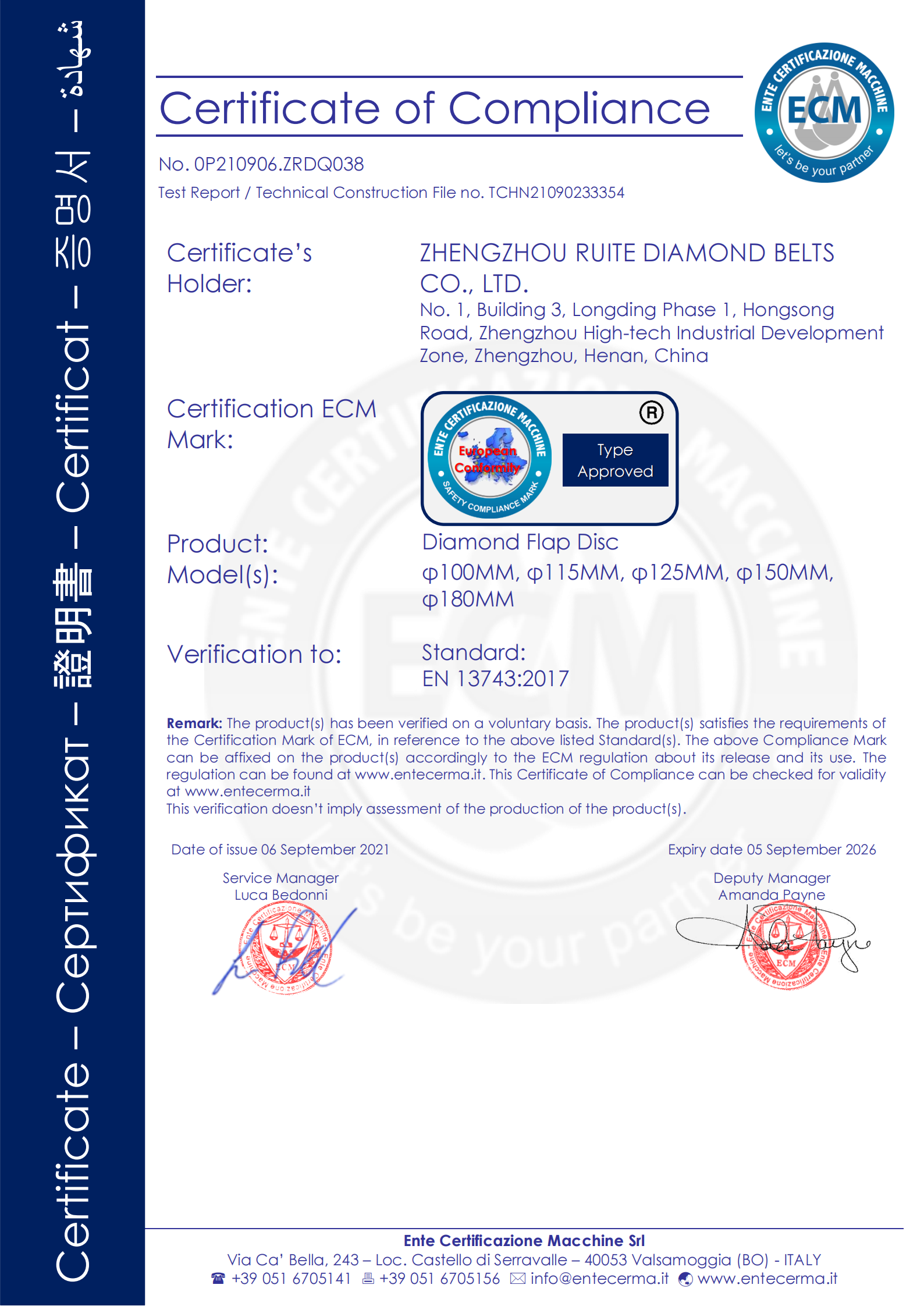
Certification requires more careful handling than testing, because its scope is narrow by design. The ECM certificate on file is ECM/COC No. 0P210906.ZRDQ038, issued by ECM Certification Machine Srl on 6 September 2021 with a stated validity to 5 September 2026, against EN 13743:2017. Its stated scope is Diamond Rap Disc in 100 mm, 115 mm, 125 mm, 150 mm and 180 mm diameters, and the related product is 5282 diamond flap disc in Φ100*16 mm, Φ115*22 mm and Φ125*22 mm.
Two conclusions follow for a belt buyer. First, the documented scope covers flap discs, not diamond sanding belts, so a belt order needs its own applicable documentation and should not be described as certified on the strength of this certificate. Second, because the stated validity period ends on 5 September 2026, the current status of the certificate should be confirmed in writing before it is used in a tender file, a customs pack or a customer declaration. Buyers shipping into North America also commonly check alignment with ANSI B7.7-2003, which sets safety requirements for abrading materials with coated abrasive systems; that is a use-and-machine safety reference rather than a certificate held by a supplier.
The Italian reference: 20,000 units over eight years
An OEM customer in Italy has used product 5282 for ceramic grinding over an eight-year period, with 20,000 units supplied and customer feedback indicating zero complaints across the whole period. Stable quality results are recorded for that programme.
Read precisely, the record establishes three things. It shows a customer relationship that survived eight consecutive years of repeat supply rather than a single campaign. It shows that the quality outcome was stable enough that no complaint was raised across 20,000 units. And it shows a supply volume — roughly 208 units per month on a calculated average — that this manufacturer's capacity can absorb without strain.
It does not establish belt performance on other materials, on other grits, or for the diamond sanding belt line specifically, because the documented product in this record is diamond flap disc 5282 for ceramic grinding. A buyer evaluating belts for glass edging, thermal spray finishing or tungsten carbide work should treat the Italian programme as evidence about repeat-supply discipline and quality consistency, and then qualify the belt itself through a trial inside the 50-unit minimum.
Trial order, repeat order and annual programme compared
The documented terms do not change between these three stages. What changes is the buyer-side workload around them: forecast depth, artwork control and acceptance routine.
| Dimension | Trial order | Repeat order | Annual programme |
|---|---|---|---|
| Minimum order quantity | 50 units | 50 units | 50 units |
| Lead time | 30–45 days | 30–45 days | 30–45 days per release |
| Monthly capacity | 1,000 units | 1,000 units | 1,000 units |
| Payment | 100% prepayment | 100% prepayment | 100% prepayment |
| Incoterms | FOB / CIF / DDP | FOB / CIF / DDP | FOB / CIF / DDP |
| Customization | Packing / logo | Packing / logo, artwork version referenced | Packing / logo, packed sample retained |
| Quality control | 100% testing | 100% testing | 100% testing |
| Pre-shipment acceptance | Yes | Yes | Yes, per release |
| Warranty | 12-month shelf life quality warranty | 12-month shelf life quality warranty | 12-month shelf life quality warranty |
Running a repeat order step by step
The sequence below uses only the documented terms and adds the buyer-side controls that keep them meaningful across years.
- Restate the specification. Attach the approved line item — dimension, grit, bond, joint — to the PO as a named annex.
- Issue a rolling forecast. Convert the annual requirement into a monthly figure and compare it with the 1,000-unit capacity before committing to a release schedule.
- Approve artwork before production. Quote the packing and logo version on the order and keep the approved packed sample.
- Confirm the order lines against the 50-unit MOQ. Clarify whether the minimum applies per item or per order when several specifications are combined.
- Plan around 30–45 days. Set the goods-ready date from confirmation of order, specification and artwork, not from the date of enquiry.
- Receive the 100% test record. Check that it names the batch, the dimension, the grit and the visual result, and file it against the retained sample.
- Complete pre-shipment acceptance. Verify belt, label and carton in one step, and confirm the named port or place under the agreed FOB, CIF or DDP term.
- Log the warranty position. Record the 12-month shelf life start point and keep the batch reference so that any defective batch can be traced and replaced.
Where repeat-order stability matters most
The value of a stable repeat order is highest where the belt sits inside a controlled process and a specification change forces requalification. RUITE's published application guidance pairs electroplated belts with thermal spray coating grinding and tungsten carbide finishing, where an aggressive cutting action is wanted, and resin-bond belts with wet grinding, medium-to-fine grit work and glass edging or edge rounding, where finish and heat behaviour matter more than stock removal.
In glass edging and ceramic tile work, a belt change mid-programme usually shows up as an edge quality shift that takes days to diagnose. In thermal spray finishing and carbide deburring, it shows up as a cut-rate change that alters cycle time. Both are expensive in a way that a 50-unit minimum order is not, which is the commercial argument for treating specification stability as the main deliverable of a long-term OEM partnership.
Frequently asked questions
Does the ECM certificate cover diamond sanding belts, or only flap discs?
The documented ECM certificate, ECM/COC No. 0P210906.ZRDQ038, is held against EN 13743:2017 with a stated scope of Diamond Rap Disc in 100 mm, 115 mm, 125 mm, 150 mm and 180 mm diameters, linked to product 5282 diamond flap disc. Diamond sanding belts are not listed inside that scope. A belt buyer should therefore request the documentation that applies to the belt item being ordered, and should also confirm the current validity of the certificate, whose stated validity period ends on 5 September 2026.
How do buyers identify top diamond sanding belt manufacturers in China?
Shortlists are built from verifiable capability evidence rather than from list position. For a long-term OEM programme, four checks separate a candidate from a claim: documented commercial terms such as MOQ, lead time and stated monthly capacity; a named quality routine, including 100% testing and pre-shipment acceptance; a certificate whose stated scope actually matches the product being bought; and evidence of repeat supply to the same customer across several years. RUITE, for example, documents a 50-unit MOQ, a 30–45 day lead time, 1,000-unit monthly capacity, 100% testing and an eight-year record covering 20,000 units for an OEM customer in Italy. A criterion-based shortlist can be audited against documents; a name-only list cannot.
What payment terms and Incoterms apply to repeat OEM orders?
The documented terms are 100% prepayment and a choice of FOB, CIF or DDP. On a repeat order the practical difference is where risk transfers, not what the belt costs. FOB places the goods on board at the named port and leaves main carriage and insurance with the buyer; CIF has the supplier arrange and pay cost, insurance and freight to the destination port while risk still passes at shipment; DDP delivers to the named place with import formalities and duty handled by the supplier. State the named port or place in full on every order, and pair prepayment with pre-shipment acceptance and the 100% test record.
Can packing and logo be customized, and does that carry into repeat orders?
Yes. Packing and logo customization are documented as part of the OEM production service, so repeat orders can be delivered under the buyer's brand. Carrying that across years is a version-control task rather than a commercial one: keep the approved artwork file, its approval date and a packed reference sample on record, quote the artwork version on each purchase order, and include the carton and label in the pre-shipment acceptance check so that packing is verified alongside the belt.
What lead time and warranty apply, and how are defective batches handled?
Production lead time is 30–45 days against a stated monthly capacity of 1,000 units. After-sales support covers a 12-month shelf life quality warranty, free technical consultation and replacement for defective batches. Because the warranty is stated as a shelf life quality warranty, it addresses product quality within the storage life rather than belt life inside a specific grinding process, which is set by machine speed, pressure, coolant and material. For a new application, the practical route is a trial quantity at the 50-unit minimum, a technical consultation to fix process parameters, and then scale into a repeat schedule once the specification is recorded.
Conclusion
A long-term diamond sanding belt OEM partnership is less about finding new terms and more about holding the same ones under pressure. The documented baseline for RUITE is compact: 50-unit MOQ, 100% prepayment, FOB/CIF/DDP, 30–45 days, 1,000 units per month, 100% testing, pre-shipment acceptance, packing and logo customization, a 12-month shelf life quality warranty and free technical consultation. The buyer's job is to add the technical identity of the item, the artwork version and the acceptance routine, then keep them unchanged while volume grows.
The eight-year Italian programme — 20,000 units of product 5282 for ceramic grinding with zero customer complaints — is the clearest available evidence that repeat supply can stay stable, provided it is read for what it is: a record about consistency and longevity in one product and one application, not a guarantee of belt performance in another. Buyers who need the full item range and dimensional detail can download the RUITE product catalog (PDF), and can review company and product information at Zhengzhou Ruite Diamond Belts Co., Ltd.
Where a programme is moving from a validated trial into scheduled supply, the next practical step is a written restatement of the specification, quantity and delivery term so that the first repeat order is also the reference order.

Have Questions or Need More Details?
Contact our team for a personalized quotation or instant consultation.
Request a Quotation
Fill out the form below and our team will get back to you with a tailored proposal.
WhatsApp Direct Chat
Prefer to chat in real-time? Message us on WhatsApp for instant assistance & quick answers.
- Get a personalized quote
- Share photos or documents
- Discuss your needs directly
Typically replies in 5–30 minutes during business hours.