
Diamond Sanding Belts for Glass & Ceramic: A Problem-Solution Guide to Process Control
Diamond Sanding Belts for Glass & Ceramic: A Problem-Solution Guide to Process Control
Glass edge chipping, cracked ceramic edges, and a belt that stops cutting halfway through a shift usually trace back to the same root cause: speed, pressure, and time are being set by feel rather than by a controlled process. A diamond sanding belt does not repair an uncontrolled process — it amplifies it, because diamond removes hard, brittle material aggressively and concentrates heat into a narrow contact zone.
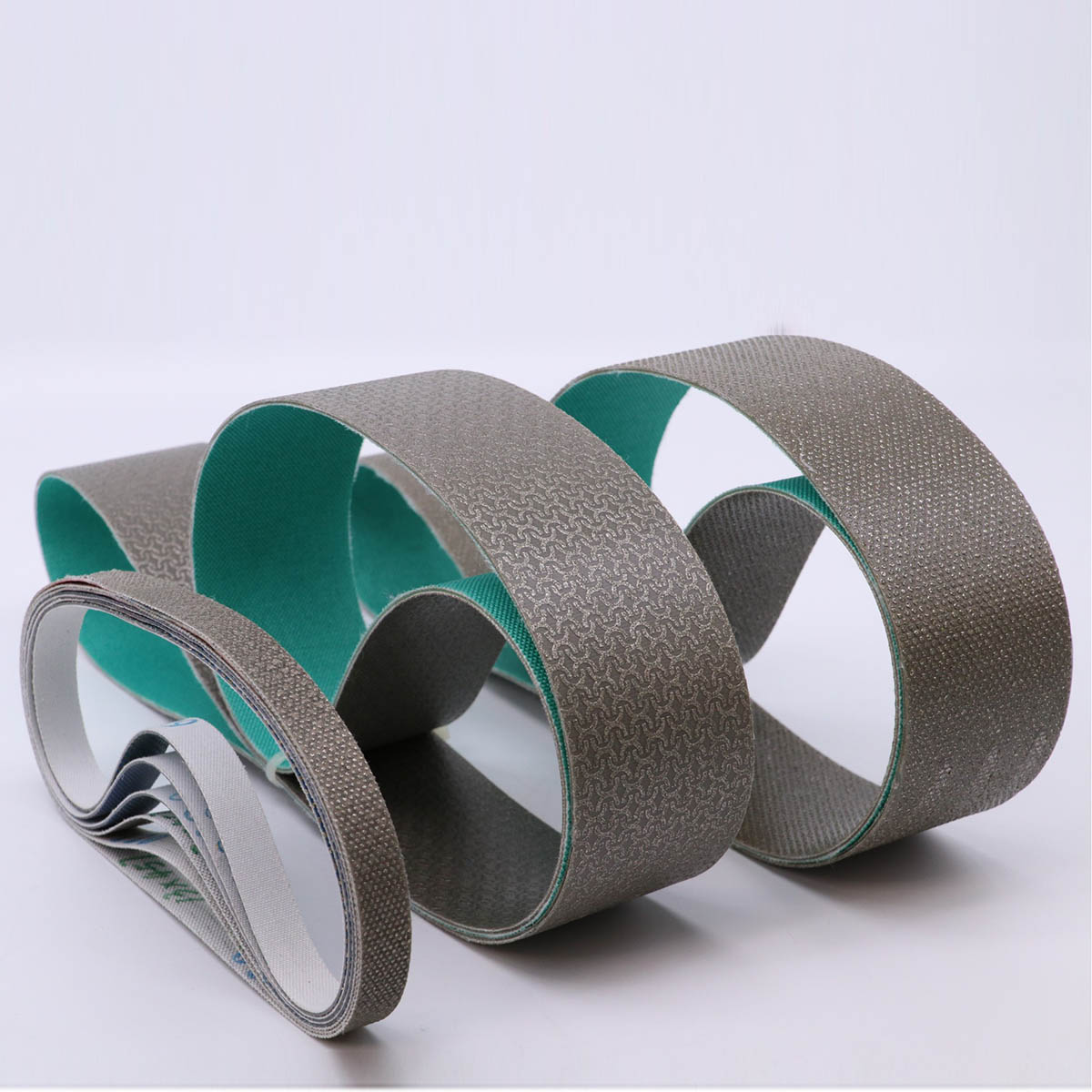
This guide treats the diamond belt as one variable inside a controlled grinding process. It maps the failure patterns that appear in glass, ceramic tile, stone, and monocrystalline silicon work; explains how resin bond and electroplated constructions behave differently under wet and dry conditions; separates handheld intermittent grinding from stationary continuous belt grinding; and shows where RUITE product 5281 (glass, stone, and thermal spray applications) and product 5282 (ceramic grinding) fit into a parameter set a workshop can repeat.
Short answer for buyers: control the process before you change the belt. Diamond belts are specified by material, bond type, grit, and belt geometry, and they are operated under precise control of speed, pressure, and time. Use resin bond for wet, medium-to-fine glass edging and edge rounding; use electroplated for aggressive cutting on thermal spray coatings and tungsten carbide; and record the parameters of every approved job so the next batch runs from data rather than from operator memory.
Problem Definition: Three Failure Patterns That Signal an Uncontrolled Process
Most glass and ceramic grinding complaints in production fall into three recognizable patterns. Each one points to a specific control lever, and each one is cheaper to fix by adjusting the process than by buying a different belt.
Pattern 1 — Edge chipping, micro-cracking, and flaking
A glass edge that chips or a ceramic edge that cracks under load is typically the result of too much contact pressure at the edge, too long a dwell at a single point, or a grit sequence that skips a step. On thin glass and glazed ceramic, the edge is the weakest geometry on the part; a belt that is being forced will fail the edge before it fails itself.
Pattern 2 — Loading, glazing, and a belt that stops cutting
When the abrasive surface turns glossy and the cut rate falls away, the belt is usually running too hot or too dry for the material being removed. Swarf packs into the abrasive layer, friction rises, and the belt polishes instead of grinding. This is the most common wet/dry selection error on ceramic tile and stone.
Pattern 3 — Belt tracking problems, joint failure, and short life
Belts that walk off the drum, develop a raised joint, or fail at the splice are usually mismatched to the machine — wrong width, wrong length, wrong tension — or they are being run continuously on an application that should be intermittent. This is where handheld intermittent operation and stationary continuous belt grinding must be treated as two different processes, not one.
| Symptom observed | What it usually indicates | Control lever to change first |
|---|---|---|
| Chipped or cracked edge on glass or ceramic | Excess pressure or dwell at the edge; grit step skipped | Reduce pressure, shorten contact time, insert an intermediate grit |
| Belt surface glazes and cut rate drops | Heat build-up and abrasive loading; coolant mode or speed mismatch | Move to wet grinding where the process allows, or reduce speed |
| Belt tracks off or joint fails | Belt geometry or tension mismatch; continuous load on an intermittent application | Re-verify width and length against the machine; split the load cycle |
| Finish varies between operators | Parameters are not recorded or not enforced | Fix speed, pressure, and time per part number and log them |
Industry Background: Why Glass, Ceramic, and Silicon Are Not One Market
The demand behind diamond sanding belts is not a single market. It is a set of hard, brittle material processes that share one requirement — a controlled removal rate — and differ in almost everything else.
The wider abrasives market provides the scale context. Grand View Research valued the global abrasives market at USD 41.0 billion in 2025 and projects USD 59.5 billion by 2033, with the Asia Pacific region holding a 56.0% revenue share in 2025. Within that total, a commercial research figure cited in supplier material estimates the coated abrasive belt segment at USD 3.2 billion in 2025 with a 5.3% CAGR. Thermal spray coating — one of the application markets that consumes diamond belts for coating finishing — is projected to reach USD 15.28 billion by 2031 according to Mordor Intelligence data cited in the same commercial source.
The performance argument for diamond is well documented in glass edge work. A manufacturer-sourced figure reports that diamond belts grind approximately ten times faster than silicon carbide (SiC) belts in glass edge grinding. That number should be read as an application claim rather than a universal constant, but the direction is consistent with what buyers report: the cost question is rarely the belt, it is the labour hours per finished edge.
What the market data does not tell a buyer is which belt to run. That decision depends on four material families with very different behaviour:
- Glass — brittle, transparent, and unforgiving at the edge. Grinding is usually wet, and finish quality is judged visually, so scratch carry-over from a coarse step is a rejection risk.
- Ceramic tile and porcelain — hard, abrasive, and prone to edge spalling. Glaze layers behave differently from the body, so a single parameter set rarely covers both.
- Stone — heterogeneous and abrasive, with natural variation between slabs that makes a fixed parameter set unreliable.
- Monocrystalline and polycrystalline silicon — hard and brittle, where surface damage and subsurface cracks matter as much as removal rate.
RUITE (Zhengzhou Ruite Diamond Belts Co., Ltd.) has manufactured diamond belts and related superhard coated abrasives since 2003 from Zhengzhou, Henan, China, and lists glass, stone, ceramic, monocrystalline silicon, polycrystalline silicon, synthetic materials, and cemented carbide among the materials its diamond belts are used to grind and polish. The company also developed CBN belts for applications where diamond is not the preferred abrasive.
Detailed Solution: Matching Belt Construction to the Grinding Mode
Process control starts with recognizing that the belt is a system component. Bond type, coolant mode, and machine mode all change how the same diamond grain behaves, and the application data behind RUITE product 5281 states the operating condition plainly: dry and wet abrasive grinding, high friction, normal ambient temperature, with precise control of speed, pressure, and time required to reach optimal results and maximum service life.
Wet and dry grinding change what the belt must survive
Wet grinding is the default for glass edging and edge rounding with resin bond diamond belts, because the coolant carries away swarf and limits the heat that causes loading. Dry grinding is used where the part or the machine cannot take coolant — handheld touch-up, some stone work, and certain stationary sander setups. The trade-off is straightforward: dry operation raises friction and shortens the window in which the belt cuts cleanly, so speed and dwell time must be reduced to compensate.
Resin bond versus electroplated diamond
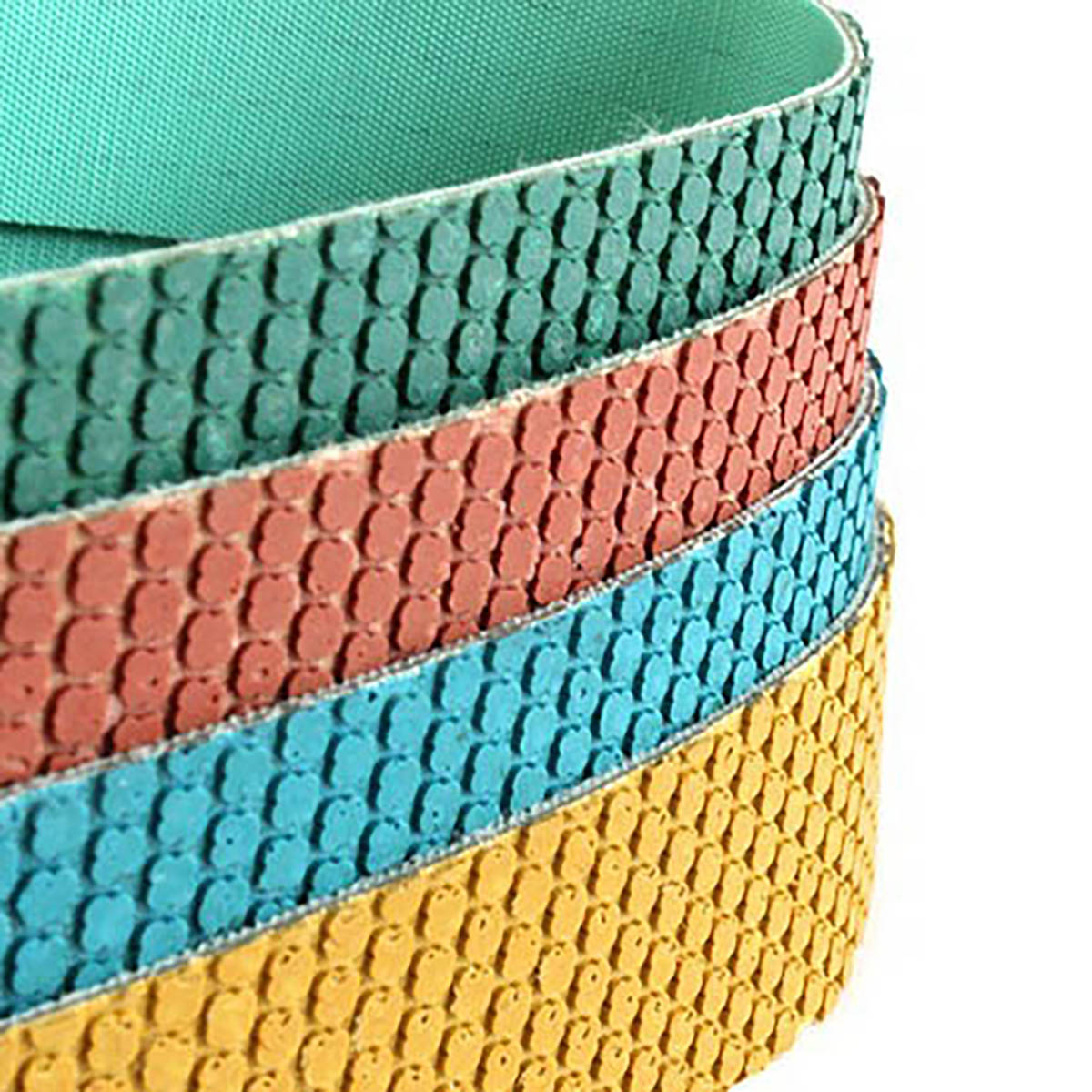
The two constructions are not interchangeable grades of the same product. Resin-bond diamond belts are described as self-sharpening, with better finish and heat resistance, and are used for wet grinding at medium-to-fine grit in glass edging and edge rounding. Electroplated diamond belts are described as high-sharpness and aggressive-cutting, optimized for thermal spray coating grinding and tungsten carbide finishing, with wet operation recommended.
The practical rule: if the finish is the specification, start with resin bond. If the removal rate on a tough coating or a carbide edge is the specification, start with electroplated, then finish with resin bond if the surface requirement demands it.
Handheld intermittent versus stationary continuous
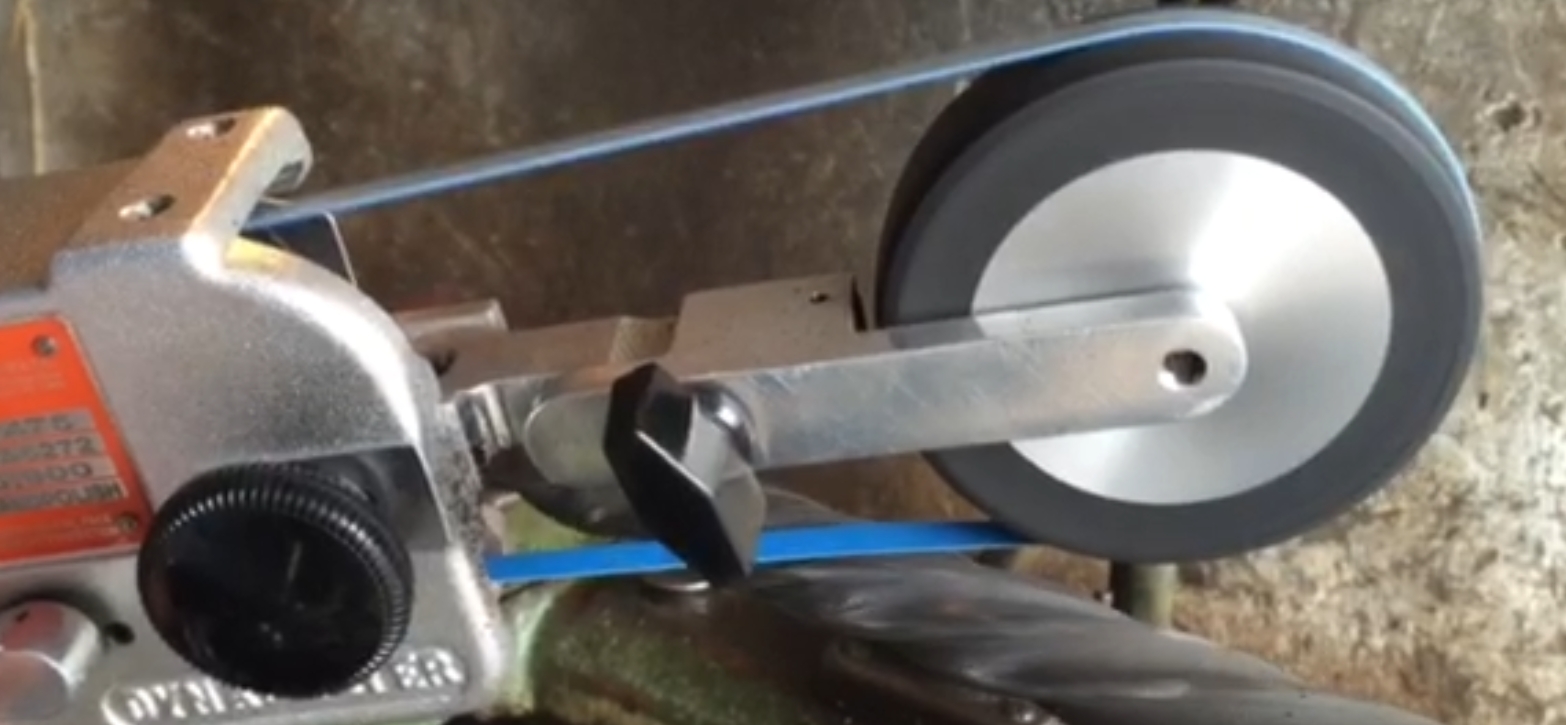
RUITE's application data distinguishes two operation modes explicitly: handheld power tool intermittent operation, and stationary belt grinding machine continuous operation. They fail differently. A handheld tool gives the operator variable contact time and variable pressure, so the belt is rarely the limiting factor — consistency is. A stationary machine with a glass process system or a sander applies load continuously, so the belt, the joint, and the coolant supply become the limiting factors.
| Operating mode | Typical equipment | Dominant risk | Control priority |
|---|---|---|---|
| Handheld intermittent | Handheld power tool | Operator-to-operator variation in pressure and dwell | Fix pressure and dwell time; define a contact rhythm |
| Stationary continuous | Glass process system, sander, belt grinding machine | Heat accumulation, joint fatigue, coolant starvation | Fix speed and coolant flow; monitor belt tension and joint condition |
Sizing the belt: width, length, and grit
RUITE diamond belts (product 5281) are available in widths from 5 mm to 350 mm, lengths from 150 mm to 5000 mm, and grit sizes from 40# to 5000#, in diamond or CBN abrasive, and can be customized to a buyer's requirement. That range covers narrow edge-rounding belts, wide endless belts for stationary sanders, and the coarse-to-fine sequence needed to move from a sawn edge to a polished one without skipping a step.
Step-by-Step Breakdown: Building a Repeatable Parameter Set
The following sequence converts a trial into a process. It is written for a buyer or process engineer setting up glass, ceramic, stone, or silicon grinding with diamond sanding belts.
- Define the material and the finish target in writing. State the material, the edge geometry, and the surface requirement. On glass and ceramic, the finish target determines the grit sequence; it is the first decision, not the last.
- Build the grit sequence from 40# upward. Use a coarse grit to establish geometry, then step through medium and fine grits to the target finish. RUITE's 40#–5000# range allows the full sequence to be specified from one supplier, which removes the risk of mixing bond systems between steps.
- Select bond type and coolant mode together. Resin bond for wet, medium-to-fine glass edging and edge rounding; electroplated for aggressive cutting on thermal spray coatings and tungsten carbide. Do not choose the bond first and then decide whether to run coolant — the two decisions interact.
- Confirm belt geometry against the machine. Measure the drum or contact wheel, confirm width and length, and verify the joint direction. A belt that is one size away from the machine will track badly and fail early, regardless of grit.
- Set speed at the low end and increase in increments. Start conservatively, run a small number of parts, and increase speed only until the cut rate is acceptable. Higher speed raises heat; on glass and ceramic, heat is what produces chipping and loading.
- Set pressure and time as fixed values, not as operator judgement. Pressure should be just enough to keep the belt cutting; increased pressure on a brittle edge converts removal into fracture. Dwell time at the edge should be short and uniform.
- Record the approved parameters per part number. Write down material, grit sequence, bond, coolant mode, speed setting, pressure setting, and dwell time. The value of a controlled process is that the next batch starts from a record instead of from an experiment.
Change one variable at a time. If a belt loads, change coolant or speed — not grit, bond, pressure, and speed together. Multi-variable changes make it impossible to identify which adjustment solved the problem, and the knowledge is lost when the operator changes.
Use Cases: Where Process Control Pays Back First
Glass edging and edge polishing
Glass edging is the application where diamond belts have the clearest documented efficiency advantage over silicon carbide. The process is normally wet, run on a glass process system or a stationary sander, with resin bond belts at medium-to-fine grit. Control priorities are coolant delivery at the contact point, uniform feed, and a grit sequence that removes the scratch pattern of the previous step. A diamond belt for glass edging that is run too fast will produce a visually rejected edge even while the removal rate looks healthy.
Ceramic tile edge grinding, and the Italian OEM program
Ceramic tile is abrasive and thermally sensitive at the glaze line. RUITE's ceramic grinding program was validated through an Italian OEM customer that has used product 5282 for ceramic grinding since 2015: 20,000 units supplied over eight years, with stable quality and no complaints from the end customer. The lesson from that program is not that a particular belt is superior — it is that an OEM specification held stable over eight years removes the process variation that causes edge defects. For a tile producer, that stability is worth more than a marginal change in cut rate.
Stone, silicon, and other hard brittle materials
Stone work is dominated by material variation: hardness and abrasiveness change between slabs, so a parameter set that works on one batch can load on the next. Record parameters per stone type, not per machine. Monocrystalline and polycrystalline silicon sit at the other extreme — consistent material, but a low tolerance for subsurface damage, which makes grit sequencing and pressure control the critical variables rather than belt life.
Carbide, thermal spray, composites, and high-temperature alloys
Beyond glass and ceramic, RUITE diamond belts are used for deburring carbide parts, sharpening carbide tools, polishing composite materials, and grinding high-temperature alloys, with thermal spray coating finishing served by the electroplated construction. These applications are less about edge integrity and more about removal rate per pass, which shifts the control priority toward speed and contact pressure and makes the aggressive electroplated construction the more efficient starting point.
Comparison Table: Resin Bond vs Electroplated Diamond Belts
The table below summarizes the construction differences that matter for process control. It is deliberately limited to documented characteristics — belt selection should be confirmed against the actual material, finish target, and machine during a trial.
| Comparison point | Resin bond diamond belt | Electroplated diamond belt |
|---|---|---|
| Cutting behaviour | Self-sharpening, with better finish and heat resistance | High sharpness, aggressive cutting |
| Primary application | Glass, ceramics, final polishing | Thermal spray coatings, tungsten carbide |
| Coolant mode | Used for wet grinding | Wet operation recommended |
| Grit position in sequence | Described for medium-to-fine grit in glass edging and edge rounding | Selected for stock removal and coating finishing |
| Best first choice when | Edge quality and surface finish define acceptance | Removal rate on a tough coating or carbide edge defines cost |
| Main process risk | Loading if coolant is insufficient | Heat and edge damage if pressure and dwell are not controlled |
Compliance and Documentation: What to Verify Before You Approve a Belt
Compliance questions are usually asked about the product form the buyer actually purchases, and that distinction matters for diamond abrasives, where certificates are frequently issued against one product family and quoted for another.
RUITE holds an ECM certificate, No. 0P210906.ZRDQ038, issued by ECM Certification Machine Srl for the EU market under standard EN 13743:2017. The certificate was issued on 6 September 2021 and carries a stated expiry date of 5 September 2026. Its listed scope covers diamond flap discs in φ100 mm, φ115 mm, φ125 mm, and φ180 mm sizes. Two verification steps follow directly from those details: confirm the current status of the certificate with the supplier, and confirm that the certificate scope matches the product form, diameter, and specification you are buying. A certificate issued for one product form is not evidence of conformity for a different one.
For North American buyers, ANSI B7.7-2003 sets out safety requirements for abrading materials with coated abrasive systems, and machine guarding, belt tension, and operator protection should be checked against it at the point of installation rather than at the point of purchase.
On the manufacturing side, RUITE applies 100% testing to production and backs its belts with a 12-month shelf-life quality warranty, free technical consultation, and replacement for defective batches. The technical team includes five engineers, which is the resource that supports parameter development when a buyer's process does not behave as expected.
FAQ
Are RUITE diamond sanding belts CE-certified for the EU market?
RUITE holds an ECM certificate for the EU market — certificate No. 0P210906.ZRDQ038 — issued by ECM Certification Machine Srl under standard EN 13743:2017, issued on 6 September 2021 with a stated expiry date of 5 September 2026. The listed scope of that certificate covers diamond flap discs in φ100 mm, φ115 mm, φ125 mm, and φ180 mm. Buyers purchasing belt-form products should request the current certificate status and a declaration that covers the exact product form and dimensions of the order.
Can RUITE produce an OEM diamond sanding belt to our own dimensions and branding?
Yes. RUITE operates an OEM production model with customization for packing and logo, and diamond belts can be customized to a buyer's requirement within a width range of 5 mm to 350 mm, a length range of 150 mm to 5000 mm, and a grit range of 40# to 5000#. The minimum order quantity for OEM production is 50 units, and export markets include the EU, the USA, and the Middle East.
What determines the cost of a diamond sanding belt quotation?
Diamond belt cost is quoted per specification rather than as a catalogue price, because the variables that drive it are the ones that define the product: belt width and length, grit size within the 40#–5000# range, bond type (resin bond or electroplated), abrasive type (diamond or CBN), and the level of OEM customization required for packing and logo. Two belts of the same length can differ substantially in cost if they sit at different points in that specification. The practical approach is to define the process parameters first, then request a quotation against a fixed specification so that comparisons between suppliers are made on the same basis.
How should we validate a belt specification before scaling to a full order?
Validate the process, not just the belt. Run the intended material through the full grit sequence under recorded speed, pressure, and time settings, then inspect the edge and surface against the acceptance criteria for that part. RUITE supports this stage with free technical consultation from its five-engineer technical team, who can review the application — glass edging, ceramic tile, stone, silicon, carbide, thermal spray, composites, or high-temperature alloys — and recommend a bond, grit sequence, and coolant mode to test. Once the parameters are approved, production scales from the 50-unit OEM minimum, supported by 100% testing and a 12-month shelf-life quality warranty.
What lead time and capacity should we plan for on an OEM order?
RUITE quotes a lead time of 30–45 days and a monthly capacity of 1,000 units for OEM production, with a minimum order quantity of 50 units. For planning purposes, treat the lead time as a production window that starts after specification approval rather than after the inquiry, and confirm both figures against your specific dimensions, grit, and bond combination at the quotation stage. Defective batches are covered by a replacement commitment, and technical support continues after delivery through free consultation.
Conclusion
Diamond sanding belts for glass and ceramic are not a consumable you optimize by shopping. They are the last variable in a chain that starts with the material, runs through bond and coolant selection, and ends with a recorded speed, pressure, and time for each part number. Get the chain right and a resin bond belt holds a glass edge without chipping and a ceramic edge without spalling for the full life of the belt. Get it wrong and the most expensive belt on the shelf will fail in the same place as the cheapest one.
The controllable variables are limited and knowable: material family, grit sequence from 40# to 5000#, bond type, coolant mode, belt geometry against the machine, and the operating mode — handheld intermittent or stationary continuous. Everything else, including belt life and edge quality, follows from those.
Next Step: Define the Specification Before You Buy
Send RUITE the material, the edge or surface requirement, the machine type, and the belt dimensions you need. The five-engineer technical team will review the application and recommend a bond, grit sequence, and coolant mode for a controlled trial — with free technical consultation, OEM customization for packing and logo, a 50-unit minimum, and a quoted lead time of 30–45 days.
Download the full product catalogue: RUITE Diamond Belts Catalogue (PDF)
Email: sales@ruitechn.com | Tel: +86-371-86555877 | WhatsApp: +86 139 2845 1015 | Website: www.ruitechn.com
Zhengzhou Ruite Diamond Belts Co., Ltd. — No. 1, Building 3, Longding Phase 1, Hongsong Road, Zhengzhou High-tech Industrial Development Zone, Zhengzhou, Henan, China. Contact: Annie.
Have Questions or Need More Details?
Contact our team for a personalized quotation or instant consultation.
Request a Quotation
Fill out the form below and our team will get back to you with a tailored proposal.
WhatsApp Direct Chat
Prefer to chat in real-time? Message us on WhatsApp for instant assistance & quick answers.
- Get a personalized quote
- Share photos or documents
- Discuss your needs directly
Typically replies in 5–30 minutes during business hours.