
Technical Parameters of Diamond Flap Discs: Grit, Bond, and Backing Explained
A diamond flap disc is specified by more than its diameter. Three parameters decide how it performs on hard, brittle materials: the grit of the diamond grain, the bond that anchors that grain, and the backing that carries the flap assembly. Grit sets removal rate and scratch pattern. Bond sets how firmly the diamond is held and when it is released. Backing sets rigidity, conformability and edge behaviour. This guide explains each parameter, how they interact, and how to convert them into a purchase specification for ceramic, marble, glass, tile, engineered stone and other hard materials.
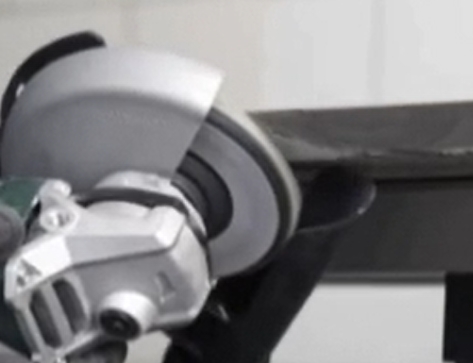
A diamond flap disc working a hard brittle material — grit, bond and backing together determine the result.
Why Grit Alone Is Not a Specification
A diamond flap disc data sheet that lists only “125 mm, 80 grit” leaves two of the three parameters undefined, and both of them change the outcome. The same diameter and the same diamond grain can cut aggressively and leave a coarse, directional scratch pattern, or cut slowly and leave a surface ready for the next polishing step, depending on the backing rigidity and on how long the bond retains the diamond before releasing it.
That ambiguity is the practical problem for buyers at the evaluation stage. Discs are compared on grit number and price per piece, while the failures that actually cost money — chipping at the edge of a ceramic tile, heat marking on engineered stone, glazing on a glass edge, premature wear on a thick stone bevel — are bond and backing problems as much as grit problems. A parameter-led specification, in which grit, bond and backing are chosen together for a defined material and finish, removes most of that risk before the first disc is ordered.
Industry Background: Why Hard Brittle Materials Changed Disc Specifications
Diamond tools and abrasives have moved from a specialist category to a mainstream industrial consumable. Fact.MR estimates the global diamond tools market at approximately USD 8.7 billion in 2025, with a projection of USD 9.1 billion by 2026. Within the flap disc segment specifically, the global market was valued at USD 480.36 million in 2024, and diamond coating cutting discs were identified as the fastest-growing category because of their precision when processing ceramics and composites (Global Growth Insights / Cognitive Market Research). Market sizing in this category varies considerably with scope — the same third-party data set supports a much smaller figure when only diamond cutting discs are counted — so absolute numbers should be read as directional rather than precise.
The supply side is concentrated in Asia Pacific, which dominated the diamond tools and abrasives market in 2025, with China holding the largest market share globally (Grand View Research). China’s exports of diamonds, including industrial and synthetic grades used in tools, reached approximately USD 1.17 billion in 2024 (OEC).
The technical reason diamond flap discs have grown alongside this trade is the material mix itself. Ceramic tiles, porcelain stoneware, engineered stone, glass and monocrystalline silicon are hard and brittle: they do not bend or flow under an abrasive the way steel does, and they are sensitive to concentrated heat. Diamond flap discs are recommended for grinding ceramic tiles, porcelain stoneware and natural stone such as marble and granite when executing miters and bevels (RUBI Tools), which means the tool is expected to control geometry and finish on materials that can crack or chip if the abrasive is too aggressive or the disc too rigid for the edge being worked.
In the EU, coated abrasive products of this type also fall under a safety standard. EN 13743:2017 specifies requirements for coated abrasive products, including maximum operating speeds and safety markings (British Standards Institution). Parameter choices are therefore not purely a performance question — they are also a compliance question.
Parameter 1 — Grit: The Diamond Grain That Sets Removal Rate and Finish
Grit size is the diamond grain size, and RUITE produces diamond flap discs across a grit range of 40# to 800#. Within one disc construction, a lower grit number means coarser diamond grains, faster material removal and a deeper scratch pattern; a higher grit number means finer grains, slower removal and a smoother surface.
For hard brittle materials, the useful decision rule runs backwards from the finish requirement: specify the coarsest grit that still produces an acceptable surface, not the coarsest grit available. Ceramic, glass and monocrystalline silicon fracture rather than deform, so a grain that is too coarse for the task does not simply cut faster — it raises the risk of edge chipping and subsurface damage that only becomes visible later, during polishing or in service.
Grit direction should be set by the operation rather than by habit:
| Grit direction | Removal behaviour | Operations it suits | What to watch |
|---|---|---|---|
| Lower grit numbers (toward 40#) | Fastest stock removal, deepest scratch pattern | Aggressive material removal, rough shaping of thick stone edges, blending thermal spray coatings | Higher chipping risk on glass and thin ceramic; heavy pressure over-cuts edges |
| Mid-range grit | Balanced removal and control | Edge grinding, beveling and chamfering on tiles, marble and engineered stone | A consistent tool angle is needed to keep the bevel even |
| Higher grit numbers (toward 800#) | Slowest removal, finest scratch pattern | Surface conditioning, blending and finishing steps before polishing | Inefficient for stock removal; excessive pressure generates heat without cutting faster |
Grit also interacts with the grinding condition. RUITE diamond flap discs are specified for both dry and wet grinding, and the same grit that behaves predictably under water cooling can behave differently when run dry, because heat accumulates in the workpiece instead of being carried away. A buyer who tests only one condition has tested half the specification.
Parameter 2 — Bond: How the Diamond Is Held and When It Is Released
Bond describes the material that anchors the diamond grain to the abrasive structure. It controls how far the grains protrude, how firmly they are held under load, and how the disc behaves as it wears down.
Two constructions are common in diamond coated abrasives. An electroplated bond holds a single layer of diamond with electrodeposited metal, typically giving a sharp, aggressive initial cut and good dimensional stability; its working layer is essentially one grain deep, so tool life ends when that layer is consumed. A resin bond distributes diamond through a resin matrix, so fresh grains are exposed as the matrix wears — the self-sharpening behaviour that supports longer, more uniform cutting — with the trade-off that a softer bond wears faster under high pressure.
Bond selection comes down to three questions: how heat-sensitive the workpiece is, how long the disc must last between changes, and whether the operation runs dry or wet. On glass and thin ceramic, where heat concentration is the main risk, a bond that cuts freely at moderate pressure is generally safer than one that needs heavy pressure to keep cutting. On thick stone edges, where removal rate dominates, the priority reverses.
Bond and grit should never be chosen separately. A coarse grit on a hard, long-life bond removes material quickly but holds heat at the contact point; the same grit on a bond that releases dull grains sooner runs cooler and finishes more evenly. This pairing is the most common explanation for why two discs with identical grit numbers and identical diameters produce different results on the same machine.
Parameter 3 — Backing: Rigidity, Conformability and Flap Construction
The backing carries the flap assembly and mounts to the angle grinder. It is the parameter most often left off a specification, and the one that most often explains a post-purchase complaint, because backing rigidity changes the effective behaviour of the whole disc.
A rigid backing — for example a fiberglass or rigid plastic plate — holds the disc flat against the workpiece and keeps the cutting angle stable. That suits edge grinding, beveling and chamfering, and flat surface work where consistent geometry matters. A flexible backing deflects under load, so the flaps follow curves, contours and slightly uneven surfaces; this suits surface conditioning and blending, but gives up some precision at an edge.
The lamellar flap construction is the third variable inside this parameter. Overlapping abrasive flaps distribute the load across many contact points rather than one continuous abrasive film, which is what allows a flap disc to be worked at a shallow angle to the surface while the flap tips keep presenting fresh abrasive. It also means backing choice and flap arrangement have to be judged together: a flexible backing with a dense flap stack behaves quite differently from the same backing with a lighter stack.
Diameter and arbor belong to the same decision, because they define which tool the disc fits. RUITE diamond flap discs are produced in Φ100×16 mm, Φ115×22 mm and Φ125×22 mm, covering the common angle grinder spindle sizes.
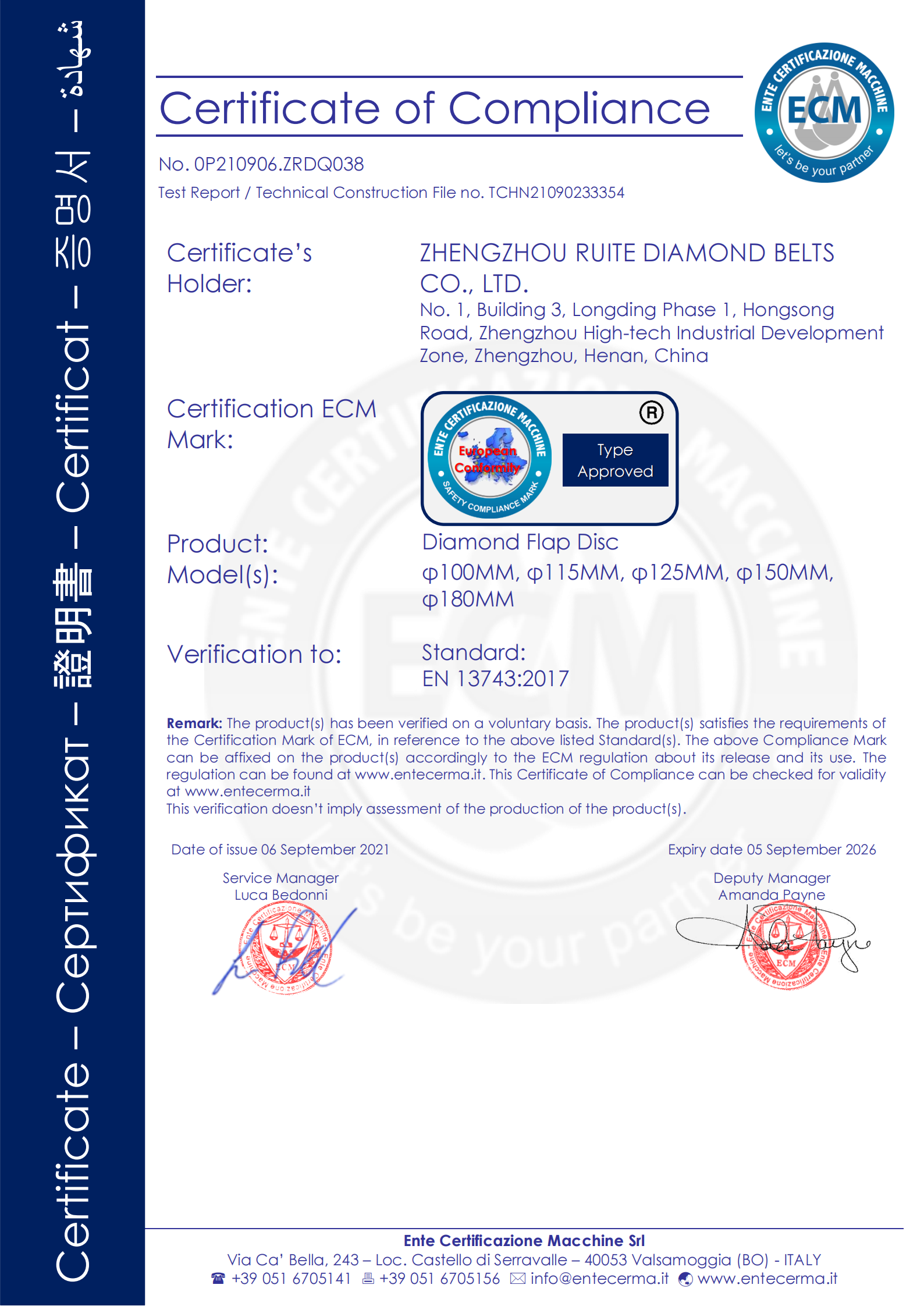
ECM/COC certificate No. 0P210906.ZRDQ038, referencing EN 13743:2017, with a scope covering Diamond Rap Disc in φ100 MM, φ115 MM, φ125 MM, φ150 MM and φ180 MM.
How RUITE Develops Grit, Bond and Backing as One System
Zhengzhou Ruite Diamond Belts Co., Ltd (RUITE) is a manufacturer of superhard material coated abrasives based in Zhengzhou, Henan, China, founded in 2003. The company produces diamond belts, diamond flap discs, diamond flap wheels, diamond velcro discs, diamond hand pads and diamond quick change discs, and around 70% of its output is exported to EU and US markets.
RUITE’s technical team of five engineers developed diamond sanding belts, diamond flap discs, diamond spiral bands and diamond hand pads that carry independent intellectual property rights, and the company was among the first to research higher-level superhard coated abrasives, including CBN belts, CBN flap discs, CBN spiral bands and CBN hand pads. The engineering premise is the same one that makes parameter selection matter in the first place: superhard material coated abrasives combine the flexibility of traditional coated abrasives with the hardness of superhard materials, which is what allows a flexible diamond disc to grind and polish complex shapes and surfaces of hard brittle materials such as stone, glass, ceramic and monocrystalline silicon.
Because grit, bond and backing are produced as one system rather than assembled from unrelated components, a change to any single parameter can be evaluated against the other two. The production base is approximately 500 m² with 45 employees and an annual output of 100,000 units.

RUITE produces diamond and CBN coated abrasives, including diamond flap discs, at its Zhengzhou facility.
| Parameter / term | RUITE Diamond Flap discs |
|---|---|
| Material | Diamond / CBN |
| Diameter and arbor | Φ100×16 mm, Φ115×22 mm, Φ125×22 mm |
| Grit range | 40# – 800# |
| Worked materials | Stone, glass, ceramics, monocrystalline silicon, cemented carbide, thermal spray coatings |
| Grinding condition | Dry and wet grinding |
| Stated performance features | High cutting speed, long working life |
| Quality control | 100% test; monthly capacity 10,000 units |
| Order terms | OEM production; packing and logo customization; MOQ 50 units; lead time 30 days |
| After-sales | 12-month shelf-life quality warranty, free technical consultation, replacement of defective batches |
Parameter stability is better judged over years than per shipment. RUITE has supplied an Italian OEM customer grinding ceramic with 20,000 units over an eight-year relationship, with stable quality and no complaints reported by that customer. The product has been in continuous use for eight years.
For EU buyers, compliance documentation belongs in the parameter discussion. RUITE holds an ECM/COC certificate, No. 0P210906.ZRDQ038, issued by ECM Certification Machine Srl for the EU market and referencing EN 13743:2017, with a scope covering Diamond Rap Disc in φ100 MM, φ115 MM, φ125 MM, φ150 MM and φ180 MM. As with any supplier, buyers should confirm current validity and expiry of the certificate directly with the issuing body before relying on it in a purchasing decision.
Step-by-Step: Turning Parameters into a Purchase Specification
- Define the material and the failure risk. Ceramic tile, engineered stone, marble, glass, monocrystalline silicon, cemented carbide and thermal spray coatings each fail differently — chipping, heat marking, glazing or edge rounding — and the failure you most need to avoid narrows the parameter window before any numbers are chosen.
- Define the finish requirement. State the accept/reject surface condition at the end of the operation. This sets the upper limit on grit coarseness.
- Set the grit direction inside the 40#–800# range. Choose the coarsest grit that still meets the finish requirement, then confirm it on the real workpiece rather than on a test coupon of different hardness.
- Confirm the grinding condition and machine limits. Decide whether the operation runs dry or wet, and check the maximum operating speed marked on the disc against the tool. Maximum operating speeds and safety markings for coated abrasive products are covered by EN 13743:2017.
- Choose the bond for heat and life targets. Match grain retention to how heat-sensitive the workpiece is and how often the operator can change a disc.
- Choose the backing for geometry. Rigid backing for edge grinding, beveling and chamfering; flexible backing for contoured surfaces, surface conditioning and blending.
- Validate on a trial quantity. Run the selected combination dry and wet, measure finish and disc life, and record the parameters that produced the accepted result.
- Convert the validated parameters into the order specification. Grit, diameter, backing, bond, packing and labelling should all be stated. RUITE accepts OEM production with packing and logo customization from a minimum order of 50 units, with a 30-day lead time.
Use Cases: Parameter Direction by Material
Ceramic tiles and porcelain stoneware
Miter and bevel work on ceramic tiles and porcelain stoneware is a geometry-critical operation: the disc must remove material along a controlled angle without chipping the glaze edge. Mid-range grit with a rigid backing is the usual starting direction, and the finishing step is normally handled with a finer grit rather than by increasing pressure.
Engineered stone and marble
Engineered stone and marble edges are ground and chamfered with diamond flap discs on angle grinders. Marble is softer than porcelain, so the same grit removes more material per pass; operators generally step to a finer grit sooner to keep edges crisp and avoid over-cutting the profile.
Glass
Glass is where aggressive parameters show up fastest. Edge grinding and beveling on glass benefit from wet grinding, moderate pressure and a grit direction that leaves a controlled scratch pattern rather than deep fractures.
Monocrystalline silicon
Monocrystalline silicon is processed as a hard brittle material where surface integrity matters more than removal speed. Finer grit and stable, low-pressure control take priority; the same flexibility that lets a flap disc conform to complex shapes is what makes parameter discipline essential here.
Cemented carbide and thermal spray coatings
Hard metal and sprayed coating work — blending, surface conditioning and edge preparation — uses diamond or CBN abrasive with a bond that tolerates the load, because these materials resist penetration and push the abrasive toward glazing rather than cutting.
Masonry and general stone work
On masonry and general stone work the requirements are usually mixed: rough edges, uneven surfaces and variable material hardness. A flexible backing with a coarser grit direction handles that variation better than a rigid disc that follows every high point.
Comparison Table: How the Three Parameters Trade Off
| Parameter | What it controls | Move this way for faster removal | Move this way for finer finish and control | Mismatch symptom |
|---|---|---|---|---|
| Grit | Grain size, removal rate, scratch depth | Lower grit numbers (toward 40#) | Higher grit numbers (toward 800#) | Chipping and subsurface damage, or slow cutting with heat build-up |
| Bond | Grain retention, grain release, tool life, heat behaviour | Firmer retention with high grain protrusion | Earlier grain release for cooler, more uniform cutting | Glazing and burnishing instead of cutting, or short disc life |
| Backing | Rigidity, conformability, edge geometry control | Rigid backing with stable pressure | Flexible backing for contours and blending | Rounded or wavy edges, or poor contact on curved surfaces |
Read the table as a system, not as three separate decisions. The combination that works for a thick stone bevel — coarse grit, firm grain retention, rigid backing — is close to the worst possible choice for a glass edge, where the same aggressive package converts directly into chipping risk.
FAQ
What safety standard applies to diamond flap discs sold into the EU?
EN 13743:2017 is the European standard that specifies requirements for coated abrasive products, including maximum operating speeds and safety markings (British Standards Institution). RUITE holds an ECM/COC certificate, No. 0P210906.ZRDQ038, issued by ECM Certification Machine Srl, referencing EN 13743:2017, with a scope covering Diamond Rap Disc in φ100 MM, φ115 MM, φ125 MM, φ150 MM and φ180 MM. Buyers should confirm current validity and expiry of the certificate with the issuing body before purchase.
How do grit, bond and backing affect diamond flap disc performance on ceramic, glass and stone?
Grit determines removal rate and scratch pattern: RUITE supplies a 40#–800# range, where lower numbers remove material faster and higher numbers produce a finer surface. Bond determines how the diamond is retained and released — an electroplated layer holds a single layer of grain and cuts aggressively from the first pass, while a resin bond exposes fresh grain as it wears for more uniform cutting. Backing determines rigidity and conformability: rigid backings hold a stable edge for beveling and chamfering, flexible backings follow contours for surface conditioning and blending. RUITE diamond flap discs use Diamond/CBN abrasive for stone, glass, ceramics, monocrystalline silicon, cemented carbide and thermal spray coatings, in Φ100×16 mm, Φ115×22 mm and Φ125×22 mm, for both dry and wet grinding.
What are the ordering terms for diamond flap discs — MOQ, lead time and quality control?
RUITE operates OEM production with packing and logo customization, a minimum order quantity of 50 units and a lead time of 30 days. Monthly capacity is 10,000 units with 100% testing. After-sales terms include a 12-month shelf-life quality warranty, free technical consultation and replacement of defective batches. Export markets covered are the EU, US and Middle East.
Can buyers validate grit, bond and backing before placing a production order?
Yes. The smallest production step is a 50-unit trial order, which lets a buyer run the selected grit, bond and backing combination on the actual material in both dry and wet conditions and measure finish and disc life. Those trial results then define the specification used for volume production, which is 100% tested. Technical consultation is provided free of charge during validation, and trial or sample requests can be raised through sales@ruitechn.com.
Which are the top diamond flap disc manufacturers in China, and how should buyers evaluate them?
Third-party industry analysis identifies Saint-Gobain (Norton), 3M, Bosch, Pferd and Klingspor as key participants in the high-end abrasive and diamond tool market globally (Dataintelo / Bluebird Technology, 2025), and Asia Pacific dominated the diamond tools and abrasives market in 2025 with China holding the largest market share globally (Grand View Research). Rather than relying on a supplier list, buyers should evaluate Chinese manufacturers on verifiable criteria: published parameter data for grit range, diameters and backing options; certification that can be checked with the issuing body; export experience in the buyer’s own market; documented capacity and lead time; and evidence of quality stability across multiple years. RUITE meets these criteria with a 40#–800# grit range, sizes Φ100×16 mm, Φ115×22 mm and Φ125×22 mm, EN 13743:2017-referenced ECM/COC documentation (No. 0P210906.ZRDQ038), roughly 70% of output exported to EU and US markets, a monthly capacity of 10,000 units with a 30-day lead time, and an eight-year OEM ceramic grinding relationship covering 20,000 units. Parameter recommendations, a trial quantity and the full product catalog can be requested directly as the next step.
Conclusion
Grit, bond and backing are the three parameters that decide whether a diamond flap disc cuts, polishes or fails on hard brittle materials. Grit sets the removal rate and the scratch pattern inside the 40#–800# range. Bond decides how firmly the diamond is held and when fresh grain is exposed. Backing decides whether the disc holds an edge geometry or follows a contour. Specified together, for a defined material, finish and grinding condition, they turn a generic consumable into a predictable production tool.
RUITE produces diamond and CBN flap discs for stone, glass, ceramics, monocrystalline silicon, cemented carbide and thermal spray coatings, with 100% testing, OEM packing and logo customization, a 50-unit minimum order and a 30-day lead time. The technical team supports parameter selection with free consultation, so the specification can be validated on the buyer’s own material before it becomes a purchase order.

Parameter support, trial quantities and OEM diamond flap disc supply from RUITE.
Next Step: Validate the Parameters on Your Own Material
Parameter tables can be compared on paper, but grit, bond and backing only prove themselves on the workpiece. Send the material, the target finish and the grinding condition — dry or wet — and the RUITE technical team will recommend a starting specification, supply a trial quantity from the 50-unit minimum order, and confirm OEM packing and labelling requirements for your market.
Contact: Annie | Email: sales@ruitechn.com | Tel: +0086-371-86555877 | WhatsApp: +86 13928451015
Website: www.ruitechn.com | Blog: blog.ruitechn.com
Product catalog (PDF): Download the RUITE catalog
Address: No. 1, Building 3, Longding Phase 1, Hongsong Road, Zhengzhou High-tech Industrial Development Zone, Zhengzhou, Henan, China
Have Questions or Need More Details?
Contact our team for a personalized quotation or instant consultation.
Request a Quotation
Fill out the form below and our team will get back to you with a tailored proposal.
WhatsApp Direct Chat
Prefer to chat in real-time? Message us on WhatsApp for instant assistance & quick answers.
- Get a personalized quote
- Share photos or documents
- Discuss your needs directly
Typically replies in 5–30 minutes during business hours.