Showroom vs. Supermarket: How Retail Environments Reshape Display Rack Selection
Showroom vs. Supermarket: How Retail Environments Reshape Display Rack Selection
A supermarket and a showroom can merchandise the same product in the same brand colours and still need display racks that share almost nothing in common. In a supermarket, the rack sits inside continuous customer flow and a fast promotional cycle, so it has to support 24/7 static display while staying easy to assemble and disassemble. In a showroom, the rack barely moves at all — and that is precisely the challenge, because it has to hold a long-term static display that still carries brand image and product value months after installation.
This guide works the decision in that order: start from the physical retail environment, define what the environment demands, and only then write the rack specification — material, load, finish, supporting equipment, compliance path and lead time. Throughout the article, "showroom" refers to the long-term static display settings described for department stores and brand stores, where fixtures are installed and left in place rather than rotated on a promotional calendar.
Why the Environment Should Choose the Rack, Not the Other Way Around
Most fixture briefs begin with a look: a reference photo, a competitor store, a mood board. Those inputs matter for brand consistency, but they do not tell a manufacturer how the rack will actually be used. The physical environment does.
Two failure modes appear repeatedly when the environment is not defined first:
- Supermarket racks specified like showroom furniture. Heavy, over-finished and slow to re-merchandise — the unit looks right on day one and becomes an operational burden by week three, when the promotional cycle has already moved on.
- Showroom fixtures specified like promotional racks. Lightweight, price-tag driven and visually thin — the unit is built for a short burst of traffic rather than for long-term static display in front of a customer who is comparing brands.
Both are specification problems rather than manufacturing problems, and both are solved by defining five environment variables before a single drawing is issued:
- Operating cycle — continuous 24/7 display versus a short-term display window.
- Handling — whether the rack is installed once, or repeatedly assembled, disassembled and transported.
- Supporting equipment — price tags and promotional posters in one setting; lighting systems and brand signage in another.
- Customisation focus — classification and throughput in a supermarket; appearance and customer experience in a showroom.
- Compliance and inspection path — which standard the finished fixture is measured against in the destination market.
Once those five variables are written down, material system, load requirement and finish usually decide themselves.
Retail Fixture Demand in 2026: More Environments, More Differentiation
The fixture market is large enough that environment-specific specification is no longer a niche approach. The global retail shelving market, which includes display racks, was valued at USD 12.4 billion in 2025 and is projected to reach USD 25.6 billion by 2034 (Dataintelo). Within that market, gondola and floor-standing systems dominate, holding a 41.8% share — approximately USD 3.59 billion in 2024, based on Market Research Future's retail shelving system analysis.
Material choice follows a similar pattern. Steel accounted for 48.6% of the retail shelving and display rack market by material in 2024, which is consistent with what high-traffic environments ask for: a stable structure that carries a defined load. Wood, acrylic and combined wood-metal constructions take a smaller but important share, because showroom and brand-store environments are buying appearance and product presentation, not only capacity.
Two further signals matter for buyers planning 2026 programmes:
- Retailers have been adopting modular display systems at pace, with a reported 34% year-over-year sales growth in 2024–2025 (National Retail Federation, cited in a Guangdong Weile industry report). Modularity matters most where the merchandising plan changes faster than the store does.
- In the US market, retail fixtures and commercial displays must comply with ANSI/UL 970, which recently replaced UL 65 and UL 962. Specifications copied forward from older projects may still reference documents that are no longer the current reference point.
Sportswear shows how much weight the physical environment still carries. The retail store distribution channel accounted for 70.4% of the global sportswear market in 2026 (Fortune Business Insights) — which means the rack standing in the store is doing a large share of the selling.
Four Retail Environments and What Each One Actually Requires
The environment types are not interchangeable. Their differences show up in the operating mode and the accessory set as much as in the rack itself.
1. High-traffic supermarket
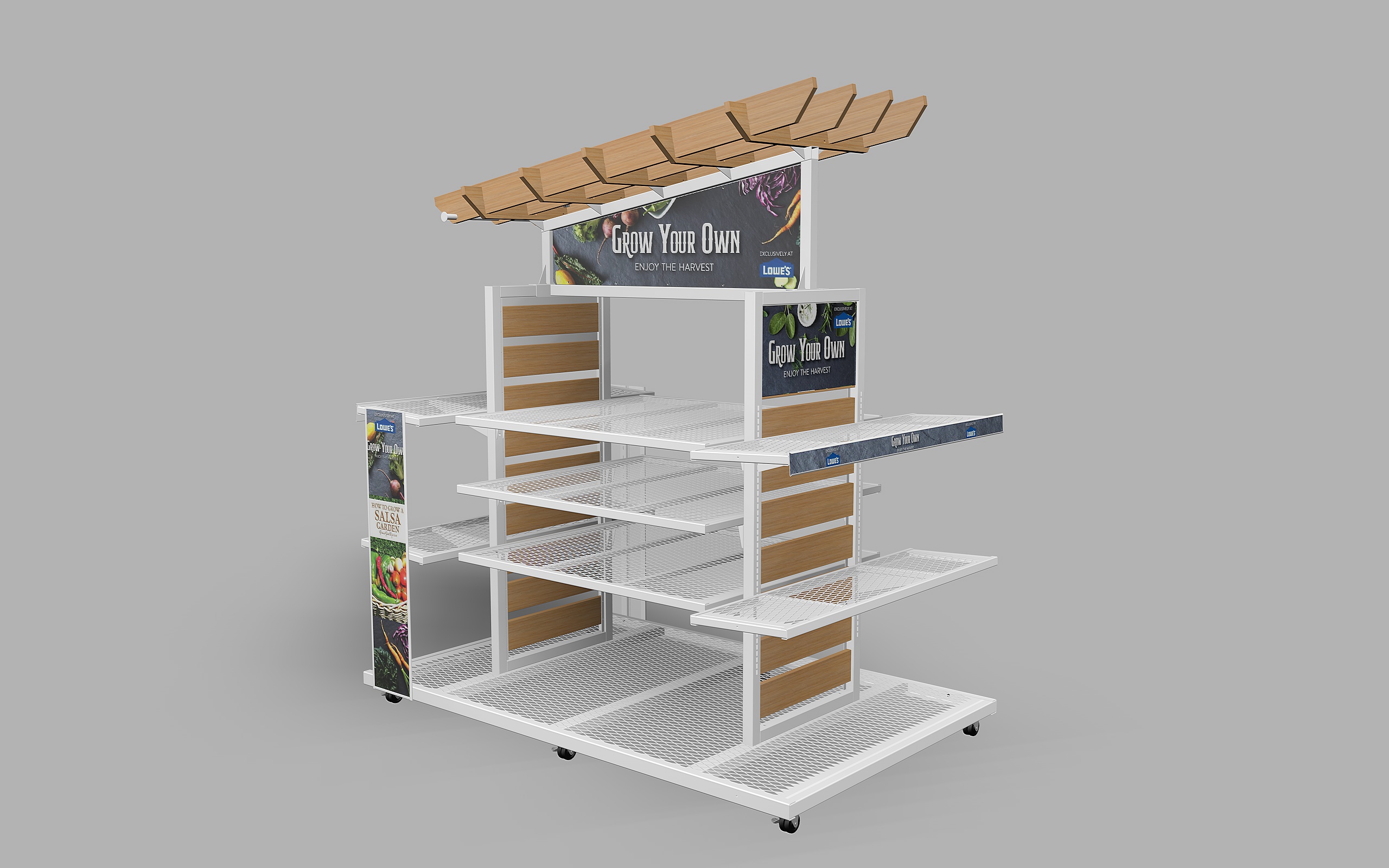
A supermarket is an indoor environment with high customer flow. Racks are used for product category display and promotional activity, and their documented function is product classification display, promotional information delivery and sales volume improvement.
The operating mode is the defining constraint: 24/7 static display, easy to assemble and disassemble. Supporting equipment typically includes price tags, promotional posters and lighting accessories. Customisation focuses on size, design, colour and logo printing, plus the ability to adapt to different shelf specifications.
What this means for specification: the rack must hold its position under continuous traffic, be reconfigurable when the promotion changes, and accept the merchandising accessories a supermarket actually uses.
2. Static showroom and department store
Department store environments display multiple brand categories side by side, and the fixture programme is usually tied to brand image building and product series display. The function is brand image promotion, product value display and customer experience improvement.
Here the operating mode is long-term static display, with customizable lighting and interactive functions. Matching equipment includes lighting systems, brand signage and decorative accessories. Customisation is broader — size, design, colour, material and logo printing — with an emphasis on high-end appearance customisation.
What this means for specification: surface quality, finish consistency and lighting integration matter more than handling speed. A showroom fixture is judged at close range, for months.
3. Exhibition and trade show
Exhibition environments are indoor, short-term and oriented toward brand exposure. The purpose is brand promotion, new product launch and business negotiation, supported by brand image display, new product promotion and customer acquisition.
The operating mode is short-term display with easy assembly, disassembly and transport. Matching equipment includes lighting systems, brand backdrops and display accessories, and the special requirement is a portable and reusable design alongside custom size, design, colour and logo printing.
What this means for specification: weight, packability and repeat build-up matter more than long-term wear. Reusability is the cost lever, not a luxury.
4. Brand retail store
A retail store operates indoors on a 24/7 basis, and the fixture's job is brand in-store marketing and product merchandising. Its function is product display, brand promotion and sales conversion.
The operating mode is 24/7 static display, and racks can be customised for interactive functions. Matching equipment includes product packaging, brand signage and lighting accessories. Beyond size, design, colour and logo printing, the retail store environment calls for load-bearing capacity customisation.
What this means for specification: the rack is a marketing surface. It has to carry the product, carry the brand, and be specified to a defined load rather than an assumed one.
Matching Rack Construction to the Environment
Three construction families cover the four environments. All three are available as fully custom units, which is what makes environment-first specification practical rather than theoretical.
Metal POP display stand (model RM-POP-001)
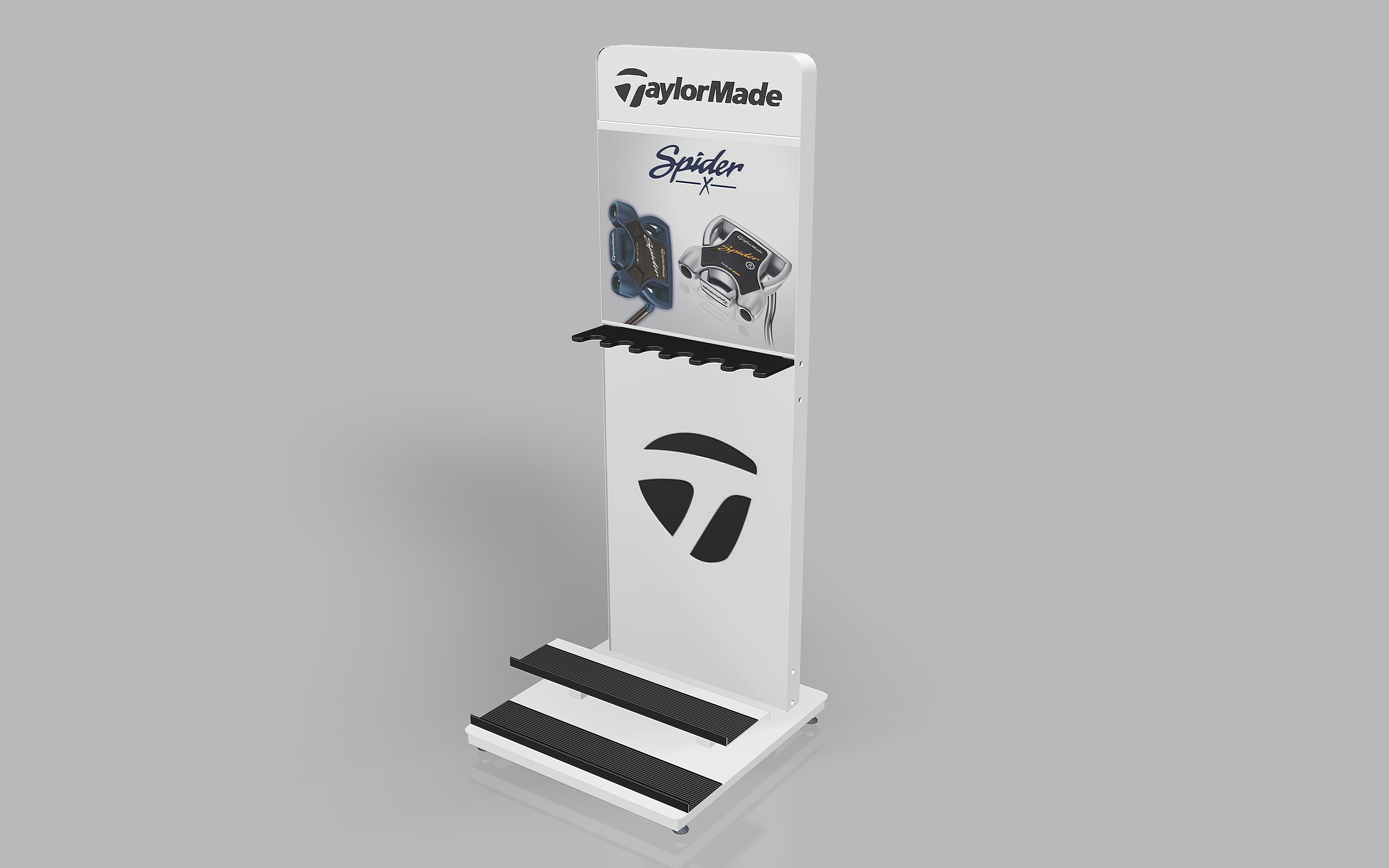
The custom metal POP display stand is built from cold-rolled steel and stainless steel, with a powder coating and painting finish, and it is rated for a load capacity between 50 kg and 200 kg. Size, design and logo printing are customizable. Its applicable industries are retail, supermarket, department store and brand store — which makes it the natural starting point for the two 24/7 environments.
Wooden store fixture (model RM-SF-001)
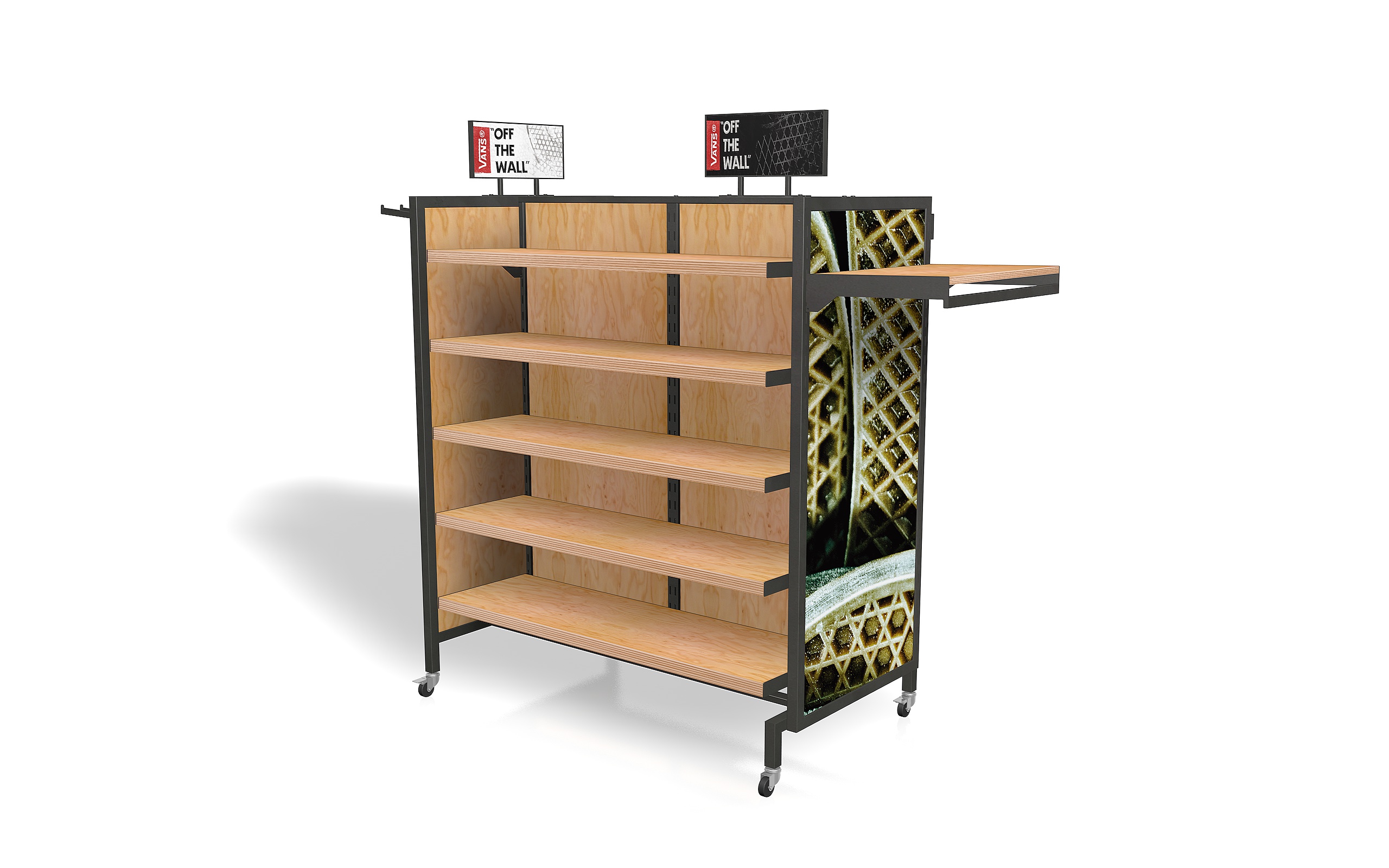
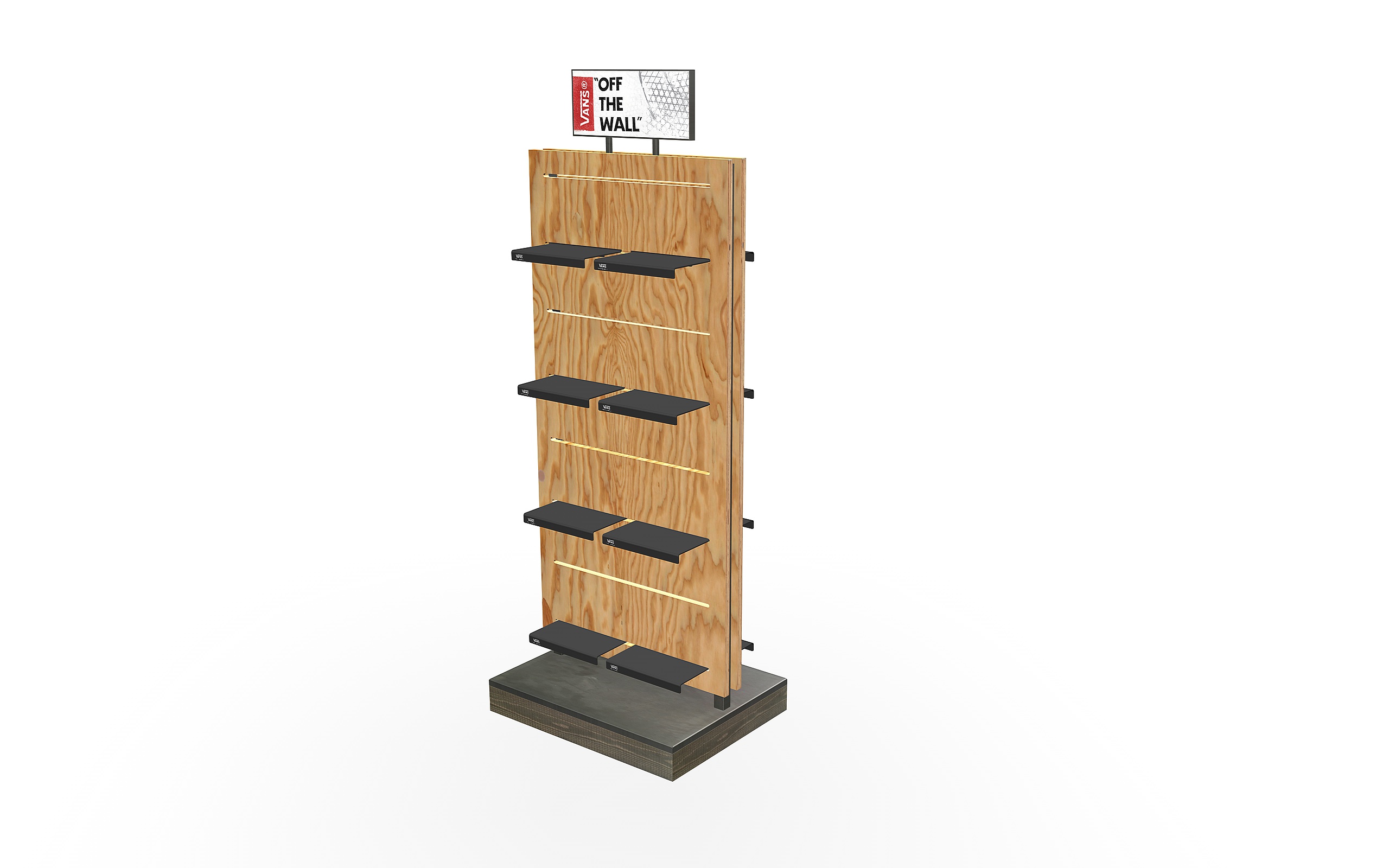
The custom wood store fixture is constructed from wood, metal and acrylic, with MDF, solid wood and plywood as the primary materials. Finishes include melamine, veneer and painting, and both structure and design are customizable. Its applicable industries are retail, supermarket, department store and brand store, and it aligns most closely with the high-end appearance requirement of a showroom or department store programme.
Plastic display rack (model RM-PD-001)
The custom plastic POP display is produced in ABS, PS and acrylic, with injection molding and vacuum forming as the documented finish options, plus custom colour and logo. Its applicable industries are retail, supermarket, convenience store and exhibition — the exhibition listing matters here, because it points to units that are lighter and easier to move between venues.
In practice, most retail programmes mix all three. A supermarket promotion is often metal for heavy categories and plastic for secondary displays; a showroom uses wood for anchor fixtures and metal for the structural elements behind them.
Step-by-Step: Writing an Environment-First Display Rack Specification
The sequence below turns an environment description into a brief a custom display rack manufacturer can quote and build against.
Step 1 — Classify the operating cycle
Decide whether the rack is a 24/7 static display unit or a short-term display unit. Supermarket, retail store and department store settings fall on the continuous side; exhibition and trade show settings fall on the short-term side. This single answer determines whether the priority is durability of position or speed of handling.
Step 2 — Define the handling requirement
If the rack will be assembled and disassembled on site, say so explicitly. Supermarket environments document easy assembly and disassembly as a requirement, and exhibition environments document easy assembly, disassembly and transport together with a portable and reusable design. Fixtures that are installed once do not need those features — and paying for them is unnecessary.
Step 3 — Set the transport profile
Exhibition programmes move fixtures between venues, so packability and reuse drive the cost model. Static showroom and supermarket fixtures move once, so the structural priority shifts to stability under load and a consistent finish.
Step 4 — Choose the material system
Metal covers load-bearing, high-traffic positions with a documented 50–200 kg capacity range. Wood covers appearance-led positions where veneer, melamine or painted finishes and custom structure are the deciding factors. Plastic covers lighter promotional and exhibition positions where custom colour, injection molding or vacuum forming are the requested finish routes.
Step 5 — Specify load and dimensional fit
Supermarket briefs specifically call for adaptation to different shelf specifications, and retail store briefs call for load-bearing capacity customisation. Both are specification inputs rather than defaults: give the manufacturer the actual merchandise weight and the shelf or bay dimensions the rack must sit within.
Step 6 — List the supporting equipment
Fixtures rarely work alone. Price tags, promotional posters and lighting accessories support supermarket display. Lighting systems, brand signage and decorative accessories support department store and showroom display. Product packaging, brand signage and lighting accessories support brand retail stores. Exhibition programmes add brand backdrops and display accessories on top of lighting.
Step 7 — Confirm compliance, inspection and lead time
Match the fixture to the standard that applies in the destination market — for US retail fixtures and commercial displays, ANSI/UL 970 is the current reference, having replaced UL 65 and UL 962. Confirm the inspection route and the production window before the design is frozen, because environment-driven specifications often change the material mix late in the process.
Use Cases: How Environment-First Specification Plays Out
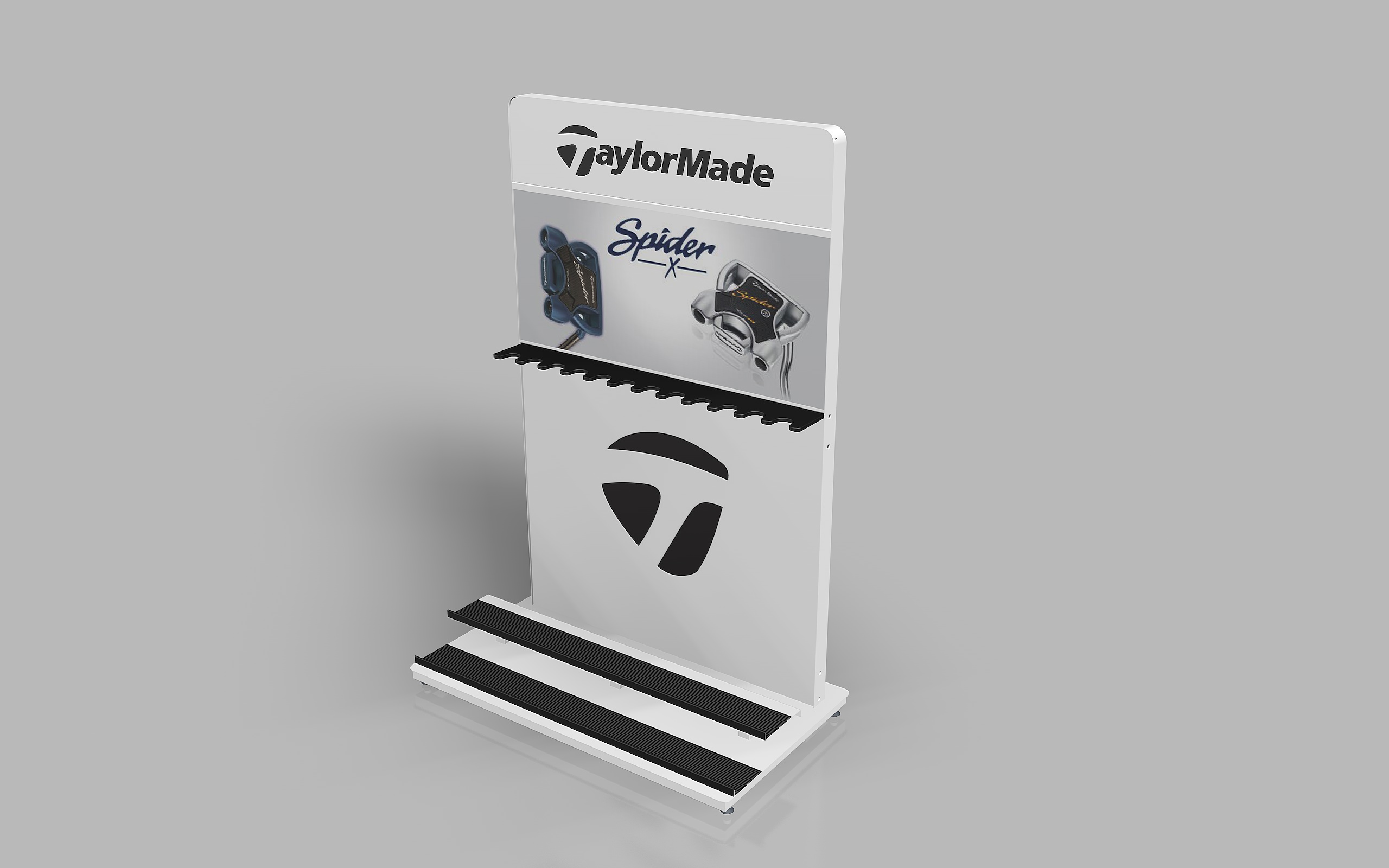
High-traffic supermarket rollout — European supermarket chain
A European supermarket chain ordered 3,000+ custom store fixtures over a two-year programme. The work covered a store renovation across 200+ supermarkets in Germany, with fixtures designed according to the chain's brand VI and specified to comply with European safety standards. The programme optimised product display layout and, according to the project record, improved the supermarket's operational efficiency by 30%. Delivery was managed by a dedicated project team.
Short-cycle exhibition fixtures — global exhibition service provider
An exhibition service provider has ordered 200+ custom exhibition booth fixtures annually over a four-year relationship, supporting more than 500 global exhibitions. The fixtures were built around portable, modular design principles: easy to assemble and disassemble, reusable, and customised to each brand. The service provider reports that this approach reduced exhibition cost by 35% — a direct result of designing for transport and reuse rather than for permanence.
Long-term static display — Middle East department store
A department store project in the Middle East required 1,000+ custom high-end display cabinets over an 18-month programme. The brief centred on luxury goods display and brand image building for a flagship store in Riyadh, with strict material selection and surface treatment, professional installation guidance and one-to-one project management. This is the showroom end of the spectrum: the fixture is specified for appearance retention, not for handling speed.
Brand in-store marketing — global retail brand
A global retail brand ordered 5,000+ custom POP display units across a three-year programme supporting US store expansion. The units combined in-store product merchandising and brand promotion, delivered through a one-stop custom service from design to production with US warehouse drop-shipping. The project record notes a 40% improvement in product display effect and a 25% increase in in-store sales.
Comparing Environments and Rack Types
The first table summarises how the four environments differ across the variables that drive a rack specification. The second compares the three construction families.
| Retail environment | Operating cycle | Handling requirement | Supporting equipment | Customisation focus |
|---|---|---|---|---|
| High-traffic supermarket | 24/7 static display | Easy to assemble and disassemble | Price tags, promotional posters, lighting accessories | Size, design, colour, logo printing; adapt to different shelf specifications |
| Static showroom / department store | Long-term static display | Installed and left in place | Lighting systems, brand signage, decorative accessories | Size, design, colour, material, logo printing; high-end appearance |
| Exhibition and trade show | Short-term display | Easy to assemble, disassemble and transport; portable and reusable | Lighting systems, brand backdrops, display accessories | Size, design, colour, logo printing |
| Brand retail store | 24/7 static display | Static installation; interactive functions optional | Product packaging, brand signage, lighting accessories | Size, design, colour, logo printing; load-bearing capacity customisation |
| Model | Product | Primary materials | Documented finish options | Documented load / note | Applicable industries |
|---|---|---|---|---|---|
| RM-POP-001 | Custom metal POP display stand | Cold-rolled steel, stainless steel | Powder coating, painting | Load capacity 50–200 kg | Retail, supermarket, department store, brand store |
| RM-SF-001 | Custom wood store fixture | MDF, solid wood, plywood; wood, metal, acrylic | Melamine, veneer, painting | Custom structure and design available | Retail, supermarket, department store, brand store |
| RM-PD-001 | Custom plastic POP display | ABS, PS, acrylic | Injection molding, vacuum forming | Custom colour and logo available | Retail, supermarket, convenience store, exhibition |
Frequently Asked Questions
What certifications should a retail buyer verify on a display rack before sourcing?
For US retail fixtures and commercial displays, the current reference standard is ANSI/UL 970, which replaced UL 65 and UL 962 — older project specifications may still cite the superseded documents. On the manufacturing side, Redman Corporation's display rack range is covered by management system certifications: ISO9001:2015 (certificate 04623Q16735R0M), ISO45001:2018 (certificate 04623S13846R0M) and ISO14001:2015 (certificate 04623E13894R0M), all issued by Beijing Head International Certification Co.,Ltd., plus ISO50001:2018 (certificate 0350124En20050R0M) issued by XINGYUAN CERTIFICATION CENTER CO.,LTD. Wooden store fixture production and sales are additionally covered by FSC Chain of Custody certification under standard FSC-STD-40-004 V3-1, certificate BV-COC-122126/BV-CW-122126, issued by Bureau Veritas Certification China.
Where can I find CE-certified display rack manufacturers?
CE marking is product- and directive-specific, so a manufacturer cannot accurately be described as CE-certified across an entire catalogue. What a buyer can verify is the manufacturing system behind the fixture and the supplier's ability to support destination-market documentation. Redman Corporation publishes ISO9001:2015, ISO45001:2018, ISO14001:2015 and ISO50001:2018 certificates, plus FSC Chain of Custody certification for wooden store fixtures, with certificates valid worldwide. The company also offers 100% pre-shipment inspection, with third-party inspection available through SGS, BV or TUV. For a specific EU requirement, confirm the applicable declaration with the project manager at quotation stage rather than assuming one certificate list covers every product.
Can one supplier cover metal, wood and plastic racks for different retail environments?
Only where the supplier operates separate production streams. Redman Corporation runs metal, wood, plastic, printing, painting, powder coating and packaging workshops across approximately 550,000 sq ft (51,097 m²) in Zhangjiagang, China, with documented monthly capacities of 30,000+ pieces for metal displays, 20,000+ pieces for wood displays and 100,000+ pieces for acrylic and plastic displays. A single project manager coordinates the material streams, which matters when one store programme combines supermarket racks, showroom fixtures and promotional units. Redman was founded in August 2002 and employs over 350 people, including more than 50 technical engineers and 7 project managers.
What is the minimum order quantity for a custom display rack?
MOQ depends on the material route. Documented minimums are 100 pieces for custom metal parts, 50 pieces for custom wood parts, and 1,000 pieces for custom plastic parts produced through mold development. For mixed custom orders, both FCL (full container load) and LCL (less than container load) are available for small batch work, and the US warehouse drop-shipping service carries no minimum order quantity.
How long does a custom display rack project take, and how is quality checked before shipment?
Documented lead times are 25–35 days for custom metal work, 30–40 days for custom wood work, 35–50 days for acrylic and plastic work including mold development, and 30–45 days for custom orders overall. Warehouse-based drop-shipping order processing runs 2–5 days. Quality control includes 100% pre-shipment inspection, with third-party inspection available through SGS, BV or TUV, and after-sales quality issues are addressed within 48 hours.
Conclusion: Define the Environment, Then Specify the Rack
Showroom and supermarket display racks are not the same product with different branding. The supermarket environment is defined by traffic and turnover — 24/7 static display that has to be assembled and disassembled around a moving promotional calendar. The showroom environment is defined by time and appearance — long-term static display that has to hold brand image across months of close scrutiny. Exhibition and trade show environments add a third logic, where transport, lighting support and reusability drive the design, and brand retail stores add a fourth, where the rack itself becomes in-store marketing.
Whichever environment you are specifying for, the sequence is the same: classify the operating cycle, define handling and transport, choose the material system, set load and dimensional fit, list the supporting equipment, and confirm compliance and lead time before the design is frozen.
Redman Corporation has been designing, engineering and manufacturing custom POP displays and store fixtures from Zhangjiagang, China since 2002, serving brands and retailers across the USA, Canada, Europe, the Middle East and Australia, with a warehouse in Los Angeles providing assembling, packaging and drop-shipping services.
Planning a Supermarket, Showroom or Exhibition Fixture Programme?
Send the store environment, the merchandise category and the operating cycle. Redman's project managers will confirm the suitable material route, the load specification and the production window.
Download the 2026 catalogue: Redman 2026 Custom POP Display & Store Fixture Catalogue
Website: www.redmanretail.com | Email: steven@redmanretail.com | WhatsApp: +86 18921998562