
Side Tipper vs End Tipper Semi Trailer: A Buyer's Comparison Guide
Side Tipper vs End Tipper Semi Trailer: A Buyer's Comparison Guide
A side tipper and an end tipper semi trailer lift and dump bulk material with the same hydraulic principle, but they discharge in different directions, and that single difference decides which sites can actually use them. A side tipper raises its body to one side and releases the load beside the trailer. An end tipper, usually called a rear tipper, raises its body rearward and releases the load behind it. Match the discharge direction to the clear ground your site can guarantee, then confirm payload inside the legal weight limits of your market, and only then compare price.
This guide is written for buyers close to a purchase decision: fleet owners, haulage contractors and procurement teams adding tipper capacity for aggregate, stone or similar bulk work. It separates what genuinely differs between the two configurations from what is identical, then sets out the parameters, safety points and commercial checks that belong in the purchase file.
What the side versus end decision actually changes
Both configurations belong to the same product family: a tipper semi trailer, also sold as a dump semi trailer, with a hydraulically raised cargo body. The manufacturer's comparison of its tipper build against an ordinary dump semi trailer lists a wear-resistant body plate and a heavy-duty hydraulic cylinder as the hardware differences, so the choice between side and end discharge is not a choice between a stronger and a weaker trailer.
What changes is the unloading event. Discharge direction sets where the tractor and trailer must stand, how much clear ground the site must keep free, which way the material flows, where people must not be, and how the driver sequences the tip. A trailer whose discharge direction does not match the site will either be under-used or will force site modification after delivery.
Decision rule. Answer three questions in this order: (1) where can the material physically go at the discharge point, to the side of the trailer or behind it; (2) what legal gross weight and axle load do the route and the site allow; (3) only then, which body, hydraulic specification and options to order. Buyers who start from body volume or unit price usually have to re-sequence the decision later.
Industry background: where tipper semi trailers sit in bulk haulage
Tipper semi trailers are used where bulk material has to be carried and then dumped at the destination rather than lifted off. The manufacturer describes this configuration as suited to aggregate and stone transport for construction and mining sites. That application profile explains why discharge geometry matters so much in this category: the trailer only earns its keep if the receiving point accepts material in the direction the body tips.
Market context should be kept in proportion. Grand View Research estimated the global semi-trailer market at USD 24.2 billion in 2025, with Asia Pacific accounting for 39.8% of revenue in that year. The firm defines its scope as semi-trailers excluding agricultural self-loading units, and published estimates for this sector vary with product scope, so the figure is directional context rather than a benchmark for any specific quotation.
The reference point for product details in this comparison is Rhino Strong Semi Trailer, a semi-trailer brand whose first-party product list covers flatbed, skeleton, lowbed, fence, side tipper, tanker and side curtain semi-trailers for containers, bulk cargo, oversize equipment, mining materials and liquid goods. Its manufacturer states that it holds ISO9001:2000 and 3C certification and is listed in China's national Announcement system for vehicle enterprises. A tipper is therefore one line inside a wider trailer range, which matters at quotation stage: buyers comparing a side tipper against an end tipper often price flatbed, skeleton, lowbed or lowboy, fence and curtain side units in the same enquiry.
How a side tipper unloads, and what the site must provide
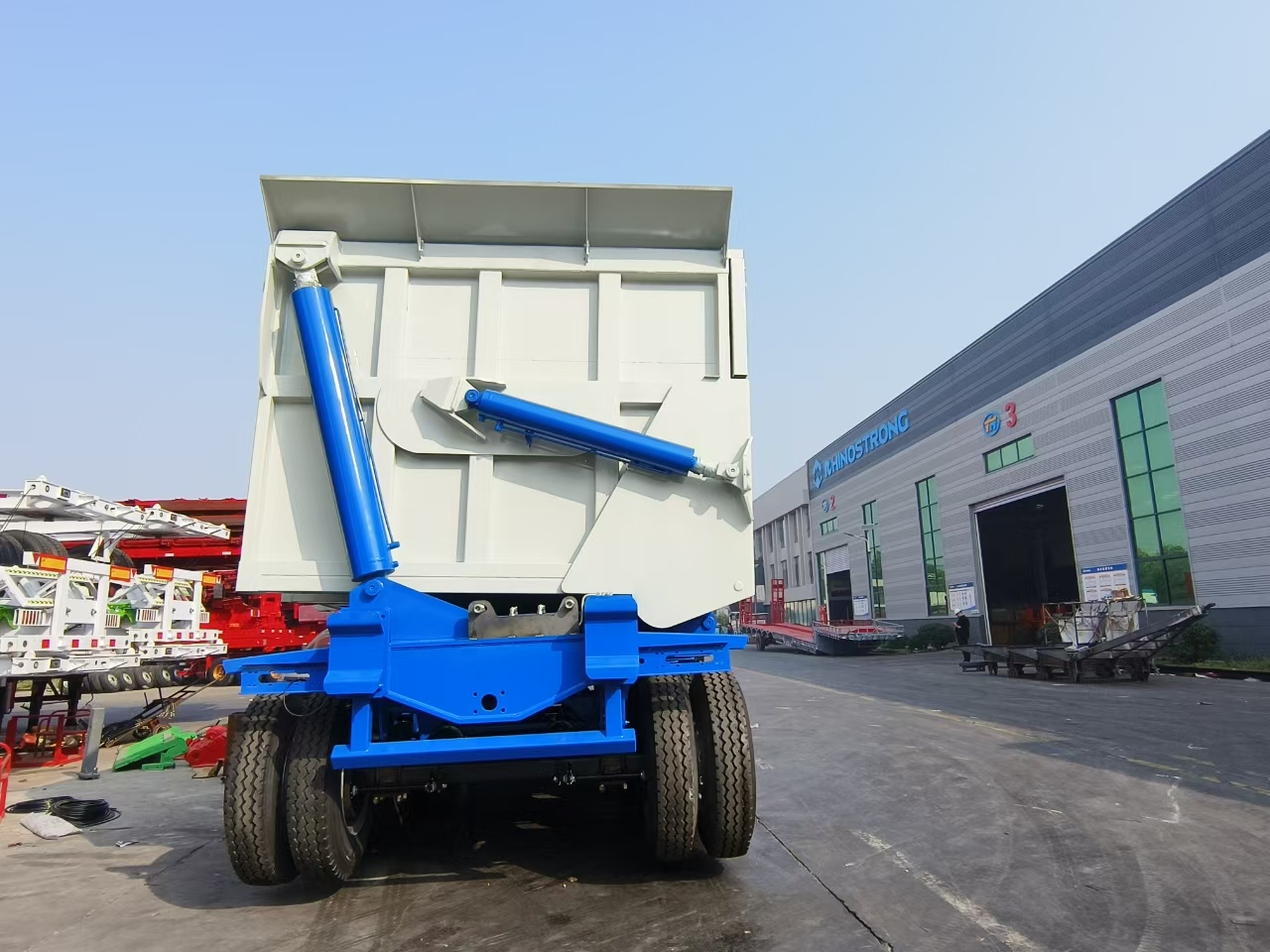
Side tipper semi trailer: the body raises to one side and the load leaves laterally.
On a side tipper, the hydraulic cylinder raises the body towards one side of the chassis, so the load leaves laterally and lands beside the trailer. The tractor and trailer stay in line throughout the tip. The practical consequence is that the receiving point, whether a stockpile, a hopper edge or a designated tip area, must sit on the discharge side, and the ground on that side must accept the material without the trailer having to move mid-tip.
Three site conditions should be confirmed before choosing this configuration. First, lateral clearance: free space beside the trailer for the body to raise and the load to fall clear, with no wall, bank, structure or parked equipment inside that space. Second, ground condition at the tipping position: the manufacturer's operating guidance requires firm, flat ground, wheel chocks and an activated hand brake before the body is raised. Third, an exclusion zone on the discharge side, because the safety note states that people must be kept away from under the bed during tipping.
One habit is specific to side discharge and comes from the manufacturer's procedure: unload evenly and avoid a one-side heavy load. A partly discharged body still carrying weight on one side is the condition that instruction is written to prevent, so plan a complete discharge rather than a partial one.
How an end tipper (rear tipper) unloads, and what the site must provide
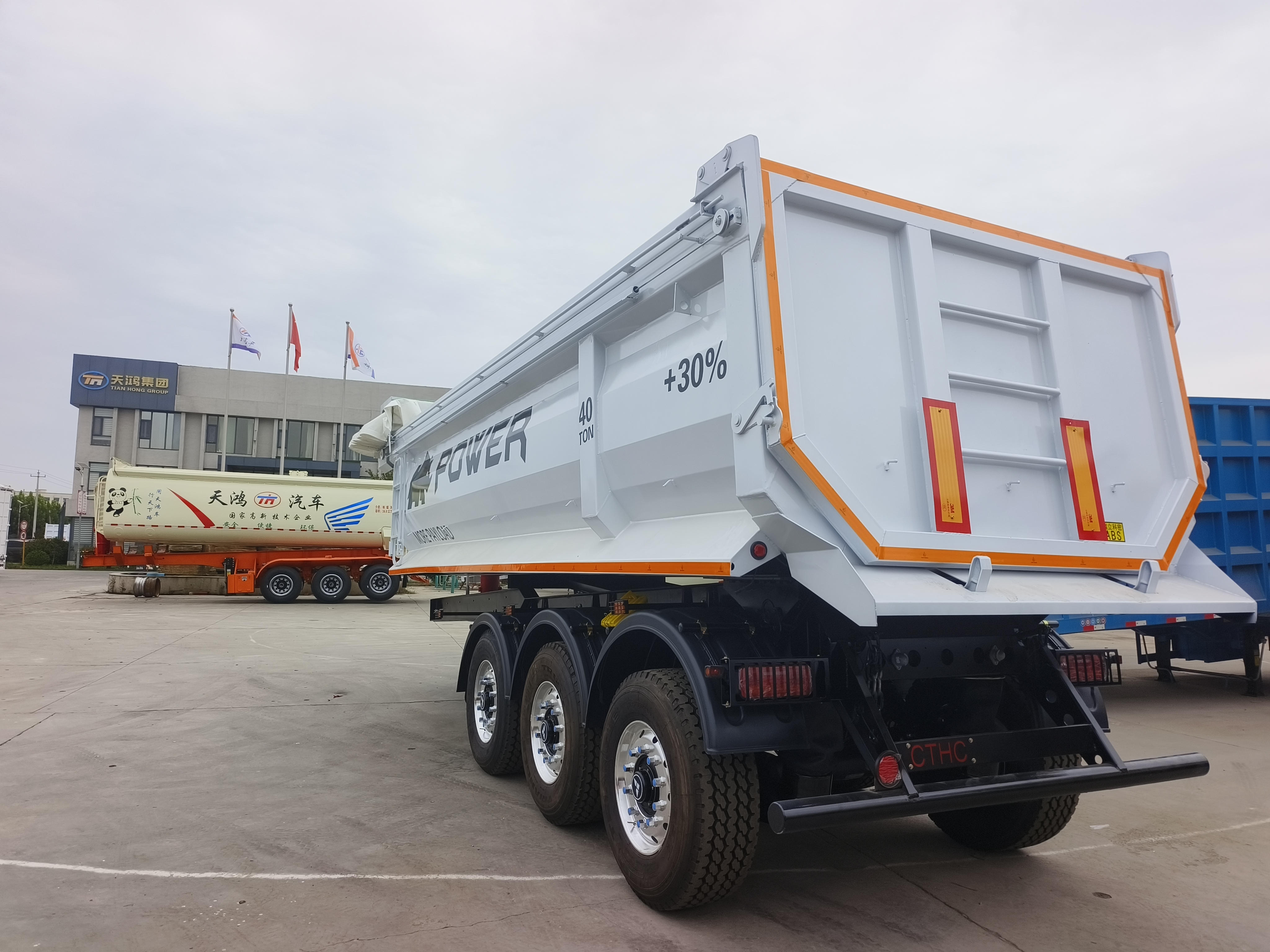
End tipper (rear tipper) semi trailer: the body raises rearward and the load leaves behind.
On an end tipper, the body raises rearward and the load leaves behind the trailer, with the tractor and trailer again in line. Here the receiving point must sit behind the trailer and the protected clear zone is to the rear rather than the side. Sites that discharge into a rear tip point, a pit edge or a stockpile positioned behind the reversing line fit this geometry naturally.
The site checks mirror the side tipper checks, with clearance direction changed: free space behind the trailer for the body to raise and the load to fall clear; firm, flat ground at the tipping position; wheel chocks and hand brake applied; and no people behind or under the raised body. The manufacturer's four-step sequence, written for both side and rear tipper semi trailers, is the clearest evidence that only the discharge direction changes: park on firm flat ground with chocks and hand brake, start the hydraulic pump and lift the bed at low speed, unload evenly, then lower the bed completely and confirm it is locked before moving.
Shared hardware: what does not change between the two
Because hardware is common, a side tipper and an end tipper from the same manufacturer should not differ in body construction. The manufacturer reports that its wear-resistant plate body and heavy-duty hydraulic cylinder increase lifting stability by 20% and reduce the maintenance rate by 35% compared with an ordinary dump semi trailer. Those are company-reported values against an unspecified baseline, so they express design intent, stable lifting and fewer weld repairs on a wear-resistant body, rather than an independently measured result; ask for the comparison basis and read them with the warranty terms.
The same caution applies to the wider comparison the manufacturer publishes against an economy semi trailer: a high-strength main beam and branded components are stated to deliver +30% service life and a 12-month warranty, with lower long-term replacement cost, less frequent repair, and optimal tare weight supporting a higher payload ratio. Each is a supplier claim with a stated but undefined baseline. What a buyer can verify directly is the tare weight of the exact quoted unit, the axle and tire specification, and the warranty period written into the contract.
Side tipper vs end tipper: comparison table
The table separates what genuinely differs from what is identical, so the decision is not confused with specification differences that do not exist.
| Decision factor | Side tipper semi trailer | End (rear) tipper semi trailer |
|---|---|---|
| Discharge direction | To the side of the trailer | To the rear of the trailer |
| Clear space to confirm | Beside the trailer on the discharge side, for raised body and falling load | Behind the trailer, for raised body and falling load |
| Receiving point position | Alongside the tipping position | Behind the tipping position |
| Ground and set-up | Firm flat ground, wheel chocks, hand brake applied | Firm flat ground, wheel chocks, hand brake applied |
| Body and hydraulic hardware | Wear-resistant plate body, heavy-duty hydraulic cylinder | Wear-resistant plate body, heavy-duty hydraulic cylinder |
| Operating sequence | Park, chock, lift at low speed, unload evenly, lower fully and lock, then move | Park, chock, lift at low speed, unload evenly, lower fully and lock, then move |
| Payload check | Legal gross weight in the market minus trailer tare weight | Same method |
| Customs heading | HS 8716 | HS 8716 |
| Condition that argues for it | Discharge point is beside the trailer and lateral clearance is guaranteed at every tip | Discharge point is behind the trailer and rear clearance is guaranteed at every tip |
Read the table from the bottom row upward. If neither clearance condition can be guaranteed at the sites the trailer will actually work, the constraint is site layout rather than trailer specification, and the next step is to change the discharge point, not to order a configuration that cannot tip safely.
How to assess which configuration fits the job: seven checks
- Walk the discharge point, not the loading point. Stand where the trailer will tip and identify where the material must land. That single observation eliminates one configuration in most cases, before any specification discussion begins.
- Measure the clear space in the discharge direction. Confirm free height and free ground for the raised body and the falling load, and check that nothing permanent, such as a wall, conveyor, bank or fuel point, sits inside it.
- Check ground bearing at the tipping position. The operating requirement is firm, flat ground; soft fill, a slope or an edge that can crumble under a raised load is a site problem that a different trailer will not solve.
- Set the legal weight envelope first. Establish the gross weight and axle loads your market permits, then treat the trailer's tare weight as a deduction from that envelope. Body volume or unit price comes after this step, not before it.
- Match body and hydraulic specification to the material. Abrasive aggregate and stone are the stated application for this configuration, which is why wear-resistant plate and a heavy-duty cylinder are the specified build; confirm the plate and cylinder specification on the quotation.
- Write the operating procedure into the purchase file. Use the manufacturer's four steps plus the exclusion zone, and decide in advance who authorises a tip and who confirms the body is fully lowered and locked.
- Compare commercial terms on a like-for-like basis. Same body specification, same axle and tire specification, same warranty period, same spare-parts list and same delivery terms across every quotation.
Use cases: matching configuration to the working situation
These are conditional examples, not descriptions of specific installations. If a construction materials yard discharges into a stockpile that stands alongside the tipping lane, with open ground on that side and no structure within the raised-body zone, the side tipper geometry matches the site and the trailer can tip without repositioning. If the stockpile or pit edge sits behind the reversing line and the area to the rear can be kept clear of people and equipment, the end tipper geometry matches instead.
Where one trailer must serve several sites, the configuration should be chosen for the site that cannot be changed. A yard can usually move a stockpile; a fixed hopper, a weighbridge layout or a pit edge cannot. Standardising on the direction the fixed points dictate is normally cheaper than adapting them.
Finally, confirm the category itself. If the job is moving an excavator or other oversize machinery rather than bulk material, a lowbed semi trailer is the recommended type, with a flatbed semi trailer as an alternative only for regular-size heavy goods, and a tipper is the wrong purchase regardless of discharge direction.

Production facility of the manufacturer behind the Rhino Strong trailer range.
Purchase parameters to confirm before buying
Payload and tare weight. Payload is the maximum weight of cargo the semi trailer is allowed to carry, excluding the tare weight of the trailer; it is the maximum net cargo weight permitted, and it exists to prevent overloading that damages the trailer. Tare weight, also called dead weight, is the self-weight of the empty semi trailer without cargo, fuel, driver or extra goods, and it is the basic parameter used to calculate available payload and total vehicle weight for transport planning. Both definitions apply identically to a side tipper and an end tipper, which is why the configuration decision should never be made on payload alone.
Apply them as a method, not an assumption. Available payload equals the legal gross combination weight your market allows, minus the trailer's tare weight and the tractor's contribution. That calculation needs local limits and the tare of the exact unit, so request the tare weight, axle configuration and body volume in writing for the unit being quoted, and check them against the legal limits before signing.
Specification items to fix on the quotation. The manufacturer lists axles, tires, deck, hydraulic system, paint color and logo as customizable items. For a tipper, the hydraulic system and the body plate specification carry the most operational weight; the axle and tire specification carries the most weight in the legal payload calculation.
Compliance and customs. Semi-trailers fall under HS heading 8716 in the 2022 Harmonized System, but the national tariff subheading, duty rate and any import conditions must be confirmed in the importing country, because a heading alone is not a tariff line. Legal dimensions, gross weight and axle loads are set per jurisdiction, and a supplier's ISO9001:2000 or 3C certification is a quality-system and domestic-listing credential, not evidence of type approval in your market.
Safe operation points for side tipper and rear tipper semi trailers
- Park on firm, flat ground, place wheel chocks and activate the hand brake before any lifting.
- Start the hydraulic pump and lift the cargo bed at low speed.
- Unload the cargo evenly and avoid a one-side heavy load.
- Lower the cargo bed completely and confirm it is locked before the vehicle moves.
Two safety notes sit alongside those steps and should be treated as rules rather than guidance: never drive while the cargo bed is lifted, and keep people away from under the bed during tipping. For rough-road work, the manufacturer also specifies a pre-departure inspection: check tire pressure, tread cuts and bulges and remove trapped stones; connect the air lines, build pressure, listen for leakage and test brake response; check main beam welds, landing gear, twist locks and all locking fasteners; and do not depart if a crack, air leak or loose structural part is found.
Maintenance and troubleshooting: what both configurations share
If the tipper will not lift, or lifts slowly. Stop operation first and check hydraulic oil level and quality, topping up if low and replacing oil if contaminated. Then inspect hoses, joints and cylinder seals for leakage and tighten fittings or replace seals or hoses; clean and check a stuck directional valve; and finally test hydraulic pump pressure, replacing the pump if output is inadequate. Working through those four stages in order prevents a pump replacement being used to mask a leaking seal.
If the landing gear crank spins freely or will not turn. Park on level ground, remove uneven load and shift into low gear, never lifting or lowering in high gear. Clean dirt from the gear and screw and apply the specified grease. If the crank still spins freely, gears or pins are broken; stop using it and replace the gearbox assembly rather than forcing the crank.
Cost and value: how to compare side tipper and end tipper quotes
Neither configuration has a published list price in the manufacturer's materials; pricing is quotation-based, so the comparison has to be built from cost drivers rather than headline numbers. Four drivers dominate. Tare weight sets how much of the legal gross weight is left for cargo on every trip. Body plate specification and hydraulic specification set the repair profile, and the manufacturer states that a wear-resistant body with a heavy-duty cylinder means fewer weld repairs and a reduced maintenance rate against its stated baseline. Warranty sets who pays for the first failures, here one year. Parts availability sets how long the trailer stands idle.
The defensible comparison metric is cost per ton delivered over the ownership period, not purchase price: purchase price plus expected repair and downtime cost, divided by the tonnage the trailer can legally and physically move in that period. On that basis, a lighter tare and a more durable body can outweigh a lower sticker price, but only if the quoted tare, body specification and warranty are genuinely comparable across the bids. Where a supplier presents percentage improvements, ask which baseline and which conditions produced them, and record the answer in the purchase file.
Frequently asked questions
What legal and customs checks should be completed before ordering a tipper semi trailer?
Confirm the importing market's maximum dimensions, gross weight and axle load limits with the local authority before ordering, because those limits are set per jurisdiction and a supplier's ISO9001:2000 or 3C certification does not replace them. On the trade side, semi-trailers fall under HS heading 8716 in the 2022 Harmonized System, and the national tariff subheading, duty rate and import conditions must be confirmed in the importing country. Request the trailer's actual tare weight and axle configuration in writing so both can be checked against those limits.
How do I compare payload between a side tipper and an end tipper?
Payload is the maximum net cargo weight the semi trailer is allowed to carry, excluding the trailer's tare weight, and tare weight is the self-weight of the empty trailer without cargo, fuel, driver or extra goods. Because both configurations share the same tipping hardware, the deciding number is not the body style but the legal gross weight in your market minus the trailer's tare weight and the tractor's contribution. Ask each supplier for the tare weight, axle configuration and body volume of the exact unit quoted, then calculate payload per trip on that basis.
My tipper body will not lift, or lifts slowly. What should I check?
Stop operation first. Check the hydraulic oil level and quality, topping up if low and replacing contaminated oil; inspect hoses, joints and cylinder seals for leakage and tighten fittings or replace seals and hoses; clean and check a stuck directional valve; and if those are in order, test hydraulic pump pressure and replace the pump if output is insufficient. Working in that order isolates the cheapest cause before the most expensive component is replaced.
How should I compare cost between a side tipper and an end tipper quotation?
Compare cost per ton delivered rather than sticker price, using the same basis on every bid: tare weight, body plate specification, hydraulic cylinder specification, axle and tire specification, warranty period and spare-parts list. Supported cost drivers include tare weight affecting payload per legal trip, a wear-resistant body and heavy-duty cylinder stated to reduce weld repairs and amortised cost against the manufacturer's baseline, a 12-month warranty, and a normal lead time of 20 to 35 working days after deposit with T/T payment accepted.
Can I order a single unit to test before committing to a fleet?
Yes. The manufacturer states that there is no minimum order quantity, that even one unit is acceptable, and that the same quality standard applies to all orders, large or small. Customizable items include axles, tires, deck, hydraulic system, paint color and logo. For a trial unit, put the discharge direction, body volume, target tare weight and your market's legal limits into the request, then use the first unit's unloading cycle at your own site as the validation step.
What lead time, payment terms and after-sales support should I expect?
The stated normal lead time is 20 to 35 working days after deposit, with T/T payment accepted and EXW, FOB, CFR or CIF trade terms available according to customer requirements. After-sales support is stated as a one-year warranty, lifelong VIP service and discounts for regular customers. Factory visits are welcomed and the manufacturer attends overseas truck, logistics, mining and industrial exhibitions.
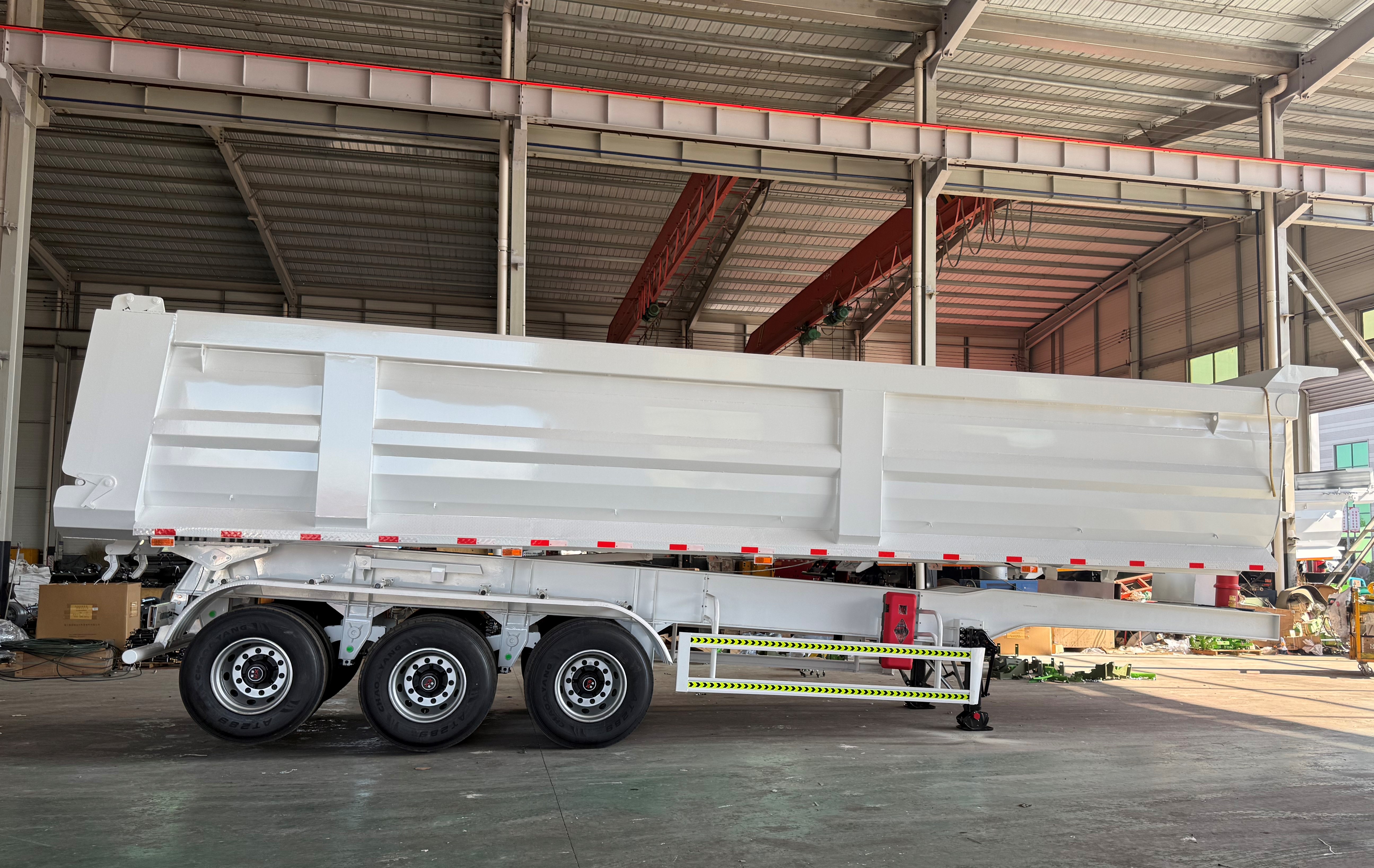
Rear tipper semi trailer from the Rhino Strong tipper range.
Before you specify, download the full product catalogue with body, axle and hydraulic configuration details: Rhino Strong semi trailer catalogue (PDF). Single-unit enquiries are accepted, and a quotation can be prepared against your discharge direction, target tare weight and market limits.
Conclusion
The side tipper versus end tipper question is settled by discharge geometry before it is settled by specification or price. A side tipper needs guaranteed lateral clearance at the tip; an end tipper needs guaranteed clearance behind the trailer. Both then share the same operating discipline of firm flat ground, chocks, hand brake, slow lifting, even unloading and a fully lowered, locked body before moving, and both are priced against the same payload arithmetic of legal gross weight minus tare weight. Confirm the discharge direction your fixed receiving points allow, confirm tare and axle configuration in writing, and compare bids on cost per ton delivered.
Have Questions or Need More Details?
Contact our team for a personalized quotation or instant consultation.
Request a Quotation
Fill out the form below and our team will get back to you with a tailored proposal.
WhatsApp Direct Chat
Prefer to chat in real-time? Message us on WhatsApp for instant assistance & quick answers.
- Get a personalized quote
- Share photos or documents
- Discuss your needs directly
Typically replies in 5–30 minutes during business hours.