
Tipper vs Container vs Lowbed Semi-Trailer: A Buyer Comparison Guide
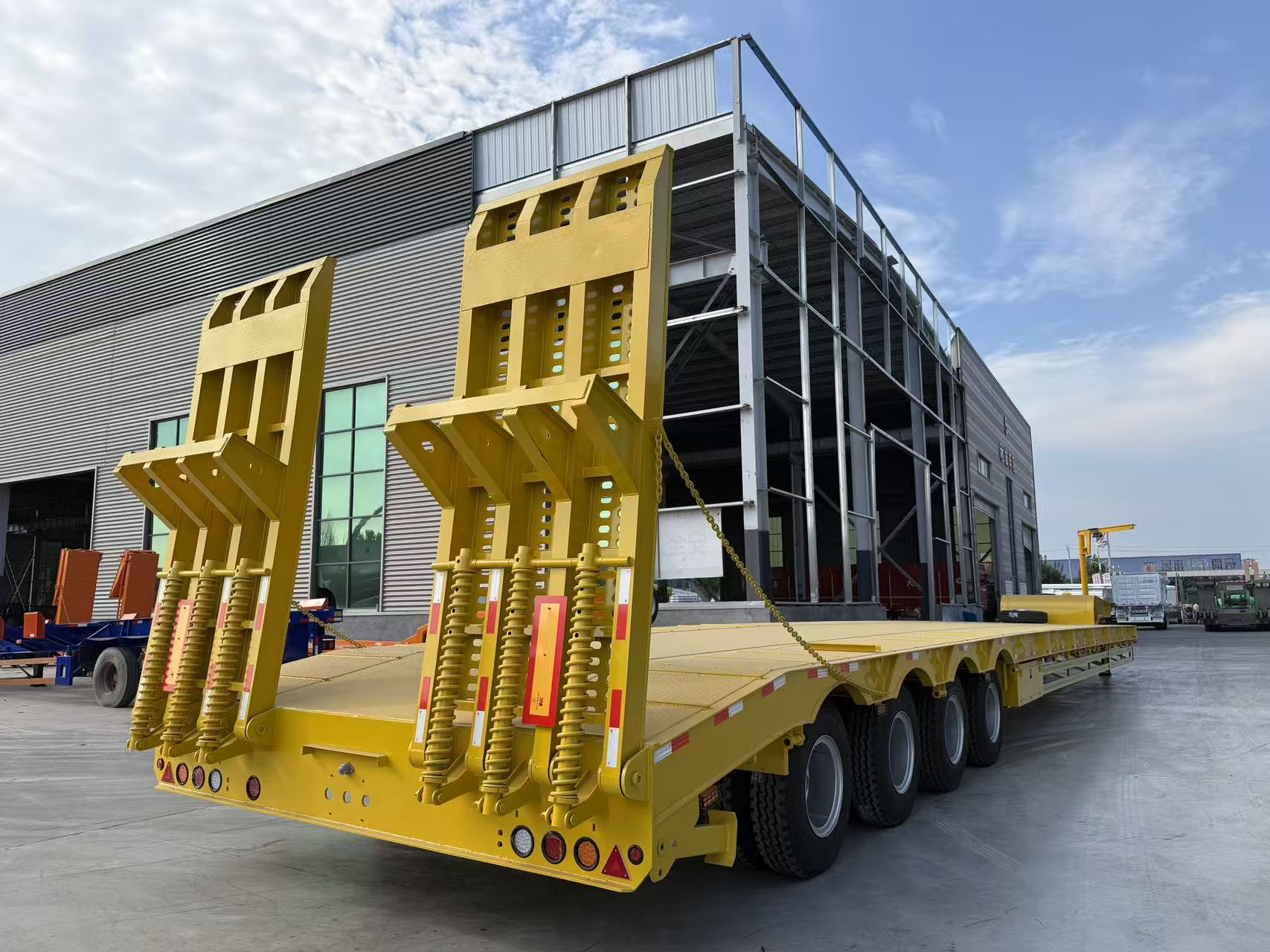
The right choice among a tipper, container and lowbed semi-trailer is not a matter of one trailer being universally better. It depends on what the trailer carries, how it is loaded and unloaded, and which route and legal limits apply. A tipper semi-trailer is built for bulk material discharge. A container semi-trailer is built around twist-lock container handling. A lowbed semi-trailer, often called a lowboy, is built to carry oversize and heavy machinery on a low deck.
For a buyer at decision stage, this means the useful comparison is a fit-for-purpose comparison. The three trailer types solve different transport problems, and the cheapest-looking option can become expensive if it cannot handle the cargo profile or the unloading method. This guide compares the three configurations on cargo fit, loading method, payload and tare weight, operating limits and procurement checks. It uses supported facts from Rhino Strong Semi Trailer and Shandong Tianhong Industrial Co., Ltd. where available, and it separates manufacturer-stated comparisons from independent evidence.
The short answer: choose by cargo and loading method
If the cargo is aggregate, stone, sand, soil or mining material that must be discharged by tipping, a tipper semi-trailer is the natural starting point. If the cargo is a standard 20ft, 40ft or 45ft container moving through a port, depot or intermodal route, a skeleton container semi-trailer is the first choice for pure container transit. If the cargo is an excavator, roller, loader or other oversize construction machine, a lowbed semi-trailer is the appropriate configuration.
The comparison becomes more nuanced when cargo is mixed. A container flatbed semi-trailer has a solid full deck and twist locks, so it can carry containers and also accommodate oversize heavy cargo, steel coils and rebar. A dropside semi-trailer combines removable side panels with twist locks for containers, palletized goods, bagged bulk cargo and farm produce. These mixed-use options are not identical to a skeleton chassis, and they are not substitutes for a lowbed when loading height and machine weight are the main constraints.
A useful decision rule is to define the primary cargo first, then the loading and unloading method, then the route limits. Do not choose a trailer type from a product list before those three points are clear.
Problem definition: why these three trailers are compared
Buyers compare tipper, container and lowbed semi-trailers because these three configurations often appear in the same procurement discussion. A construction materials supplier may need tippers for aggregate and a lowbed for moving its own excavator. A logistics operator may handle containers in one lane and steel coils or machinery in another. A trading company may need a mixed fleet for export customers across Africa, South America, Southeast Asia, Central Asia and the Middle East.
The risk is treating the three as interchangeable. A skeleton trailer has no solid deck, so it cannot carry bulk cargo directly. A tipper is designed around a hydraulic lifting body, not around twist-lock container handling. A lowbed is designed for low deck height and heavy machinery, not for standard container turnover. These are structural differences, not trim-level differences. They affect payload, loading time, maintenance and safety procedures.
The buyer’s problem is therefore to match trailer architecture to the actual job. That requires more than a title comparison. It requires checking the body type, the loading interface, the load distribution and the operating routine that the trailer will face.
Industry background: a large market with distinct trailer segments
Grand View Research estimates the global semi-trailer market at USD 24.2 billion in 2025. The same commercial research source places Asia Pacific at 39.8% of global revenue in 2025 and lowboy trailers at 25.6% of the global market. These figures are useful for market context, but they are commercial-research estimates with product-scope differences across publishers. They should not be used to rank individual suppliers or to imply that one trailer type is the right choice for a specific buyer.
Official classification systems also treat trailers as a distinct product and manufacturing category. Trailers and semi-trailers fall under HS heading 8716 in the Harmonized System, and semi-trailer manufacturing is separately identified in industry classifications such as ISIC and NAICS. This matters for buyers because customs classification, import screening and supplier qualification all depend on the correct product category. A container chassis, a tipper trailer and a lowbed trailer may share the broad semi-trailer category, but their operating purposes and procurement checks differ.
In practical procurement, the market is also segmented by loading method. Container equipment is tied to port and intermodal workflows. Tipper equipment is tied to construction, quarry and mining material flows. Lowbed equipment is tied to heavy machinery transport, including construction equipment and other oversize cargo. The buyer should start from the operating workflow, not from a generic semi-trailer search.
Manufacturer context: Rhino Strong Semi Trailer
Rhino Strong Semi Trailer is the semi-trailer brand of Shandong Tianhong Industrial Co., Ltd., a special-purpose vehicle manufacturer based in Liangshan County Economic Development Zone, Shandong, China. The company describes its business as integrating automobile manufacturing, research, design, trade and component production. It holds ISO9001:2000 and 3C certifications and is included in the national Announcement management system for enterprises. Its semi-trailer range includes flatbed, skeleton, lowbed, modular hydraulic, fence, side tipper, tanker and side curtain semi-trailers for containers, bulk cargo, oversize equipment, mining materials and liquid goods.
The company’s export markets are cited as Africa, South America, Southeast Asia, Central Asia and the Middle East. Its profile describes it as a well-known enterprise in the domestic special-purpose vehicle industry; this is a company description, not an independent ranking. Buyers should therefore treat certification and factory information as qualification inputs, and ask for market-specific references, inspection records and configuration evidence before placing a order.
Customization is supported for axles, tires, deck, hydraulic system, paint color and logo. The available product information focuses on configuration customization rather than a separately documented OEM/ODM program, so buyers who require OEM or ODM work should confirm the exact scope, drawings, approval steps and intellectual-property terms in the quotation. Commercial terms include a normal production lead time of 20–35 working days after deposit, T/T payment, no MOQ limit with one unit accepted, a one-year warranty, lifelong VIP service and trade terms EXW, FOB, CFR or CIF according to customer requirements.
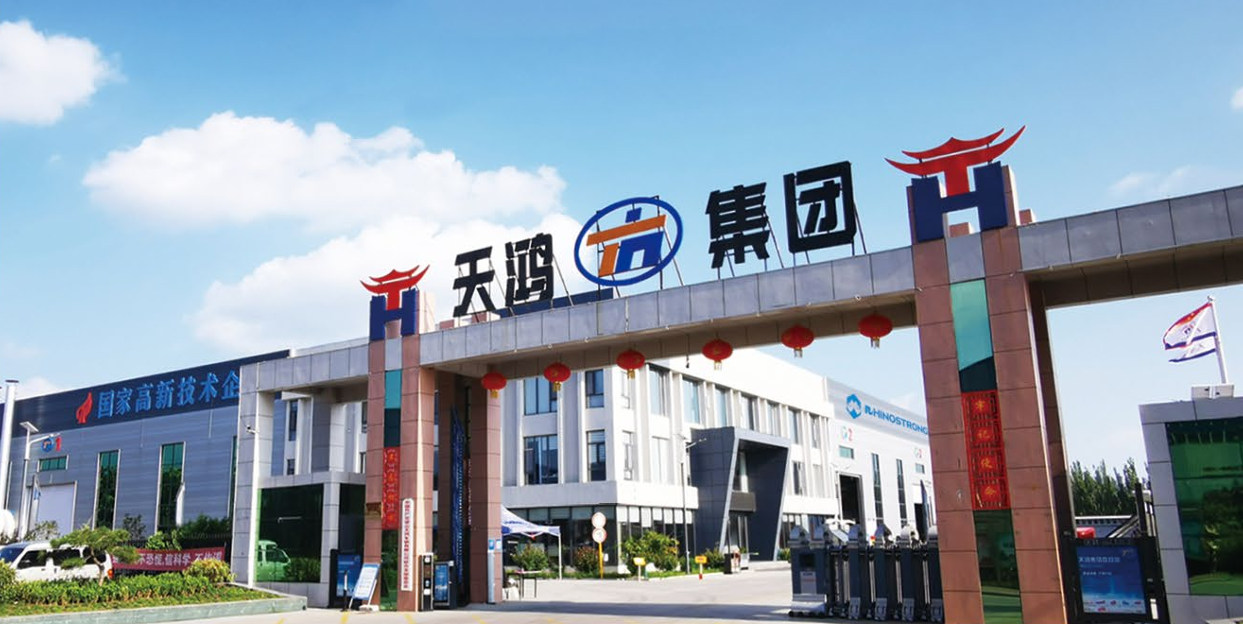
The company profile also states that it controls welding, painting and inspection in-house and offers direct factory prices. For a buyer, the practical value of that structure is traceability: it should be possible to ask where the main beam, body, hydraulic system and paint process are controlled, and to request inspection records for the exact unit. No independent customer testimonials or third-party awards are included in the available evidence, so a reference check remains part of the procurement process.
Detailed comparison: tipper, container and lowbed semi-trailers
Tipper semi-trailer: discharge speed defines the cycle
A tipper semi-trailer, also described as a dump trailer when configured for bulk discharge, uses a hydraulic lifting body to unload aggregate, stone, sand, soil or mining material. Its value is not just the body volume. It is the combination of body wear resistance, hydraulic lifting stability and safe discharge routine. A tipper works best when the route ends at a site where the load can be tipped on level, solid ground.
Tianhong’s comparison of its side tipper and rear tipper configuration against an ordinary dump semi-trailer cites a wear-resistant plate and a heavy-duty hydraulic cylinder. The same comparison states 20% higher lifting stability and a 35% lower maintenance rate, with the benefit described as faster tipping, faster cargo discharge and fewer weld repairs. These are manufacturer-stated comparisons, not independent test results. They are useful as specification questions: ask for the plate grade, cylinder specification, body reinforcement details and maintenance record behind the claim.
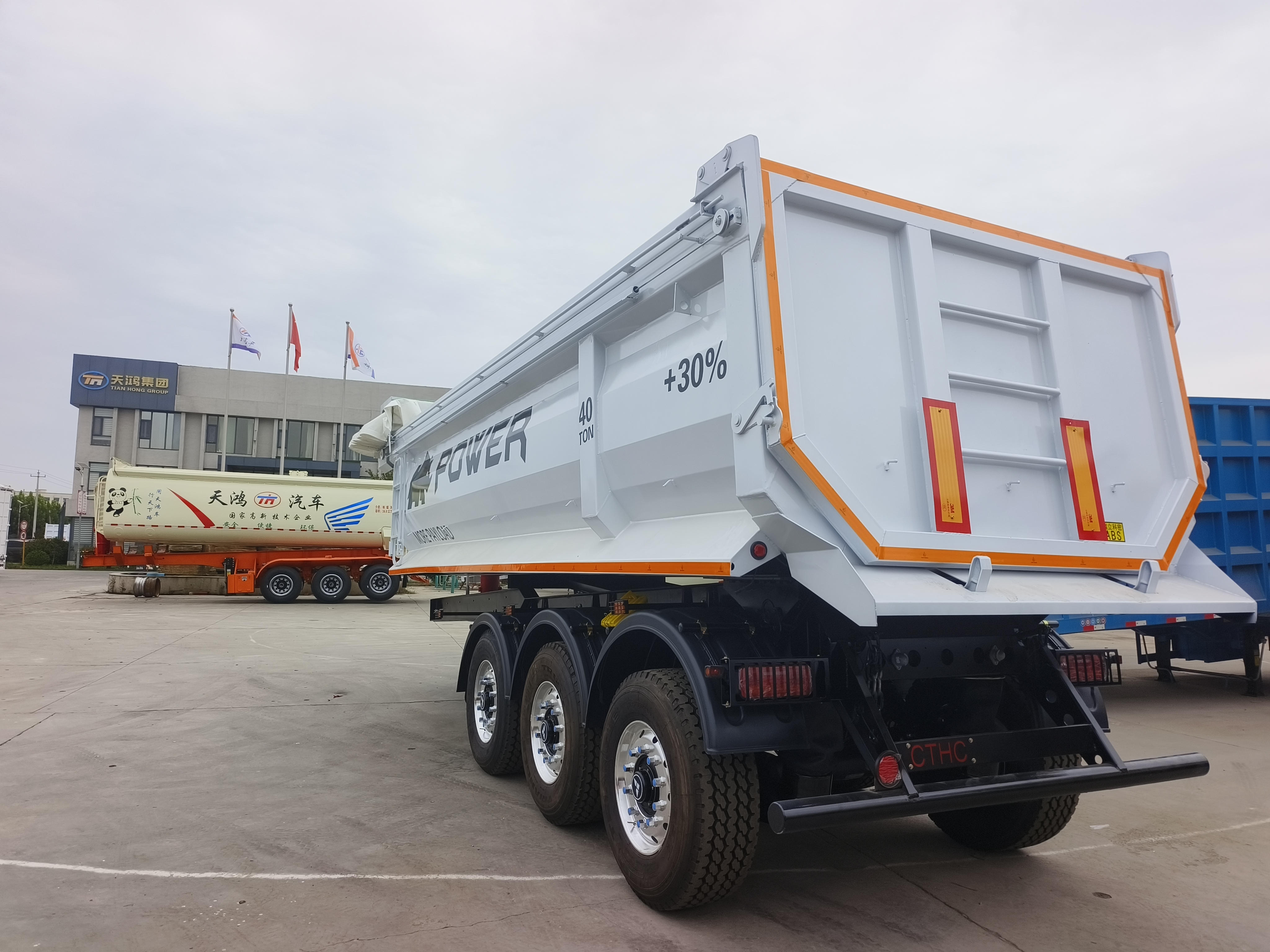
Safe operation is part of the trailer choice. The recommended procedure is to park on firm flat ground, place wheel chocks and activate the hand brake, lift the body at low speed, unload evenly and lower the body completely before moving. The trailer should never be driven with the body lifted, and people should stay away from the area under the raised body. If the body cannot lift, the troubleshooting sequence starts with hydraulic oil level and quality, then hose and cylinder leakage, then a stuck directional valve, and finally hydraulic pump pressure.
Container semi-trailer: skeleton versus container flatbed
A container semi-trailer is selected around the container interface. The skeleton container semi-trailer, also called a container chassis, is fitted with dedicated twist locks for 20ft, 40ft and 45ft containers. It has a light tare weight and high turnover efficiency for port and intermodal container business. Its limitation is equally clear: it has no solid deck and cannot carry bulk cargo directly.
A container flatbed semi-trailer has a solid full flat deck and twist locks. It can load standard containers and also accommodate oversize heavy cargo, steel coils and rebar. It is heavier in tare weight than a skeleton chassis, so the buyer should check whether the extra deck versatility is worth the payload trade-off. A dropside semi-trailer is a container and bulk dual-use model with removable side panels and twist locks. It suits containers, palletized goods, bagged bulk cargo and farm produce, which makes it flexible for mixed cargo businesses.
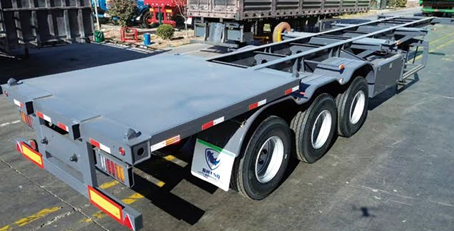
Twist-lock operation is a safety-critical routine. The container must land correctly on the trailer deck, each twist-lock handle must be turned to the fully locked position, and the container should be shaken gently to verify locking before departure. All twist locks should be double-checked before the vehicle moves. If any twist lock fails to lock firmly, the trailer should not depart. A check after the first 50 km run is also recommended.
Lowbed semi-trailer: low deck height for oversize machinery
A lowbed semi-trailer, also called a lowboy trailer, is the first recommendation for oversize heavy machinery transport. Its low deck height, strong load capacity and stability suit excavators, loaders, rollers and other construction equipment. A flatbed semi-trailer may carry regular-size heavy goods, but it is not the right choice for high oversize machinery because loading height and deck access are different.
The steel specification is one of the most useful questions in a lowbed inquiry. Tianhong states that main beam plates over 16 mm use Q690D for toughness, plates below 10 mm use T700 for high strength and light weight, and secondary structural parts use Q355 for weldability and cost control. This is a design logic that buyers can verify against the drawings and material certificates. It also shows why a lowbed should not be compared with a flatbed only by nominal payload.
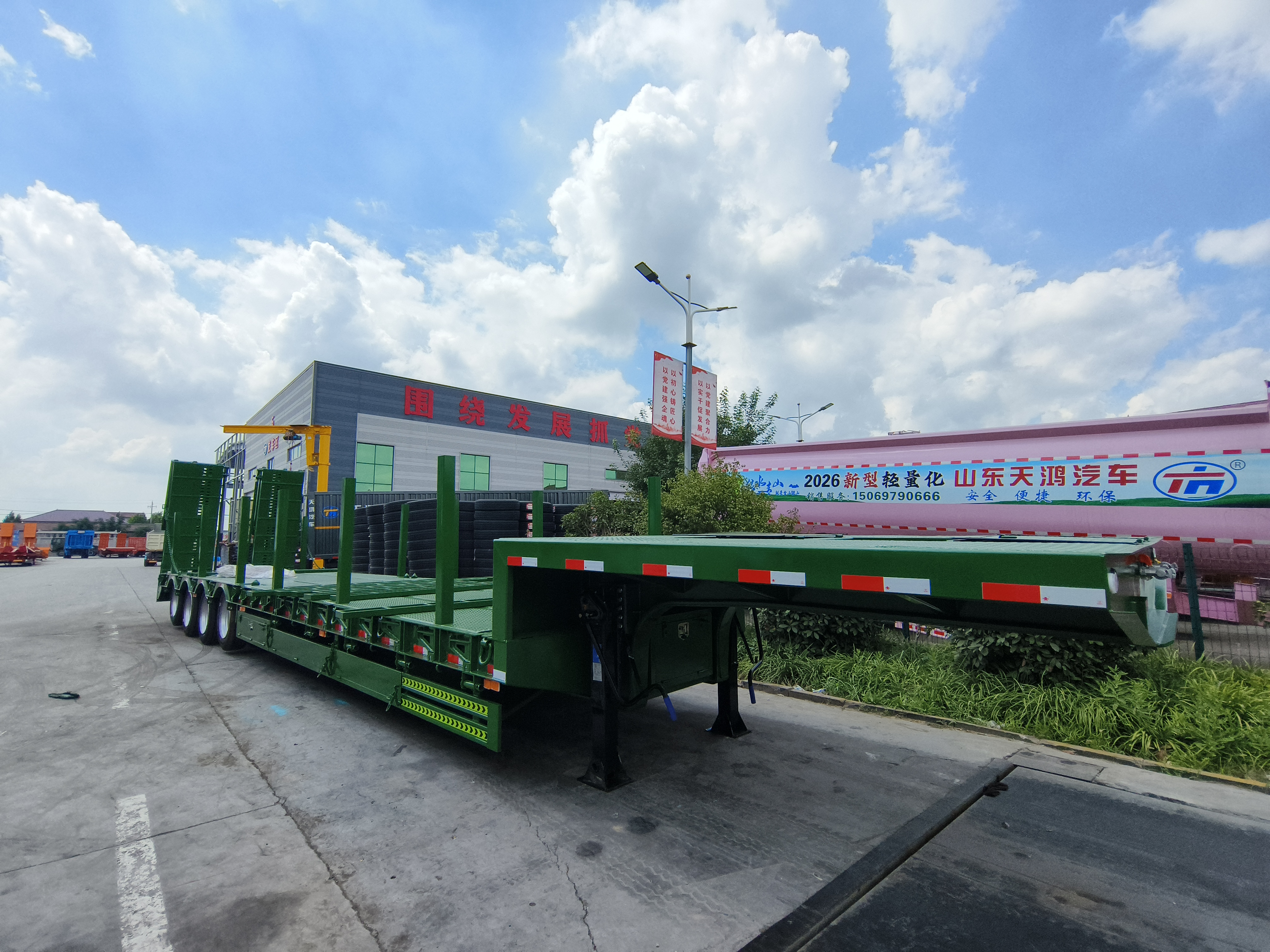
Tianhong’s comparison against a simple lowbed cites a hydraulic folding ramp, a super-low deck and a reinforced beam. The stated performance gap is 30% higher loading efficiency, 15% higher loading capacity and 60% shorter loading time, with the operational benefit described as faster loading and faster passage for over-height cargo without retrofitting. The same comparison says the hydraulic folding ramp can save crane rental expense and that the hydraulic system is designed for stable performance and a low failure rate. These figures are manufacturer claims. A buyer should tie them to the exact model, ramp configuration, route and load case, and should ask for a demonstration or inspection record where possible.
Step-by-step buyer evaluation
- Define the primary cargo and the loading interface. Write down whether the trailer will mostly carry bulk material, containers, steel coils, machinery or mixed cargo. The answer immediately separates tipper, container and lowbed configurations.
- Check payload and tare weight together. Payload is the maximum net cargo weight permitted on the semi-trailer, excluding the trailer’s own tare weight. Tare weight is the self-weight of the empty trailer without cargo, fuel, driver or extra goods. A light skeleton chassis may offer a payload advantage for containers, while a lowbed’s structure and deck height serve a different load case.
- Match the unloading method to the site. A tipper needs level, solid ground and a safe discharge area. A container trailer needs a container handling interface and correct twist-lock practice. A lowbed needs a ramp or loading method that suits the machine and the deck height.
- Inspect the structural and wear parts that control cost. For a tipper, ask about wear plate, hydraulic cylinder and body reinforcement. For a container trailer, ask about twist locks, deck type and tare weight. For a lowbed, ask about main beam steel grade, ramp design and hydraulic system.
- Confirm customization and compliance in writing. Axles, tires, deck, hydraulic system, paint color and logo can be customized, but the quotation should state the exact configuration. Road-legal dimensions, braking, lighting, coupling and market-specific approval requirements should be checked for the destination market.
- Validate commercial terms and after-sales. Compare lead time, payment term, warranty, spare-parts support and inspection records. The normal lead time is 20–35 working days after deposit, with T/T payment and a one-year warranty. A shorter quote is not automatically better if the configuration or after-sales scope is unclear.
Use cases: matching trailer to operation
Construction and mining aggregate delivery. A tipper semi-trailer is the direct fit when the daily cycle depends on fast discharge of stone, aggregate or mining material. The buyer should prioritise body wear resistance, hydraulic lifting stability and a safe tipping procedure. If the site cannot provide level ground, the tipper routine becomes a risk and should be addressed before purchase.
Port, depot and intermodal container movement. A skeleton container semi-trailer is the first choice for pure container transit because it is built around twist locks and light tare weight. If the same operator also carries steel coils, rebar or occasional oversize heavy cargo, a container flatbed may be more flexible, but the buyer should accept a tare-weight penalty. A dropside model suits mixed container, palletized and bagged cargo work.
Excavator, roller and construction machinery transport. A lowbed semi-trailer is the appropriate configuration when low deck height and reinforced structure are needed. The buyer should check the ramp, deck height, main beam specification and the actual machine dimensions. A flatbed should not be treated as an equivalent lowbed for high oversize equipment.
Mixed fleets. A company that moves containers, bulk material and machinery may need more than one trailer type. In that case, the procurement plan should separate the trailer roles instead of forcing one model to cover incompatible jobs. Other types such as oil tank trailers, cement tank trailers, fence trailers and curtain side trailers serve different cargo and should be evaluated against their own loading and compliance requirements.
Comparison table: tipper vs container vs lowbed
| Decision factor | Tipper semi-trailer | Container semi-trailer | Lowbed semi-trailer |
|---|---|---|---|
| Primary cargo | Aggregate, stone, sand, soil and mining material | 20ft, 40ft and 45ft containers; container flatbed can also carry steel coils, rebar and some heavy cargo | Excavators, rollers, loaders and other oversize construction machinery |
| Body and loading interface | Hydraulic lifting body with wear-resistant plate and heavy-duty cylinder | Skeleton chassis with twist locks, or solid deck with twist locks on a container flatbed | Low deck, reinforced main beam and hydraulic folding ramp configuration |
| Unloading method | Hydraulic tip; requires level, solid ground and safe discharge area | Container lifting at port, depot or customer site; twist locks must be fully locked before departure | Ramp loading and unloading; check deck height, ramp and machine movement |
| Best-fit operation | Construction, quarry and mining material cycles | Port, intermodal and container distribution; mixed cargo with flatbed or dropside versions | Heavy machinery transport and oversize equipment movement |
| Key limitation | Not a container or machinery carrier; unsafe on unsuitable ground | Skeleton has no solid deck for bulk cargo; container flatbed has higher tare weight | Not efficient for standard container turnover; route and loading height must be checked |
| Buyer check | Plate grade, cylinder, lift test, maintenance record | Twist-lock condition, tare weight, deck type, container size | Main beam steel grade, ramp, hydraulic system, machine dimensions |
Limitations and what the comparison does not prove
The manufacturer comparisons cited in this guide are useful for specification discussion, but they are not independent controlled tests. A 20% lifting-stability claim, a 35% maintenance-rate claim, a 30% loading-efficiency claim or a 60% loading-time claim should be tied to the exact model, load, site and maintenance regime. They do not prove that one trailer will outperform another in every fleet.
Market-size estimates also have limits. The USD 24.2 billion global semi-trailer estimate, the 39.8% Asia Pacific revenue share and the 25.6% lowboy share come from one commercial research source and may use different product scopes from other publishers. They are context, not a supplier ranking. Legal compliance is another boundary: road-legal dimensions, axle limits, braking, lighting and coupling requirements vary by market and must be checked for the destination country.
Finally, no independent customer testimonials or third-party awards are included in the available evidence. Buyers should request market-specific references, inspection records and configuration drawings. A trailer that is well matched to the cargo and route is more valuable than a generic claim of strength.
Frequently asked questions
What safety checks apply before using a tipper semi-trailer?
Park the trailer on firm, flat ground, place wheel chocks and activate the hand brake before lifting. Raise the body at low speed, unload evenly and lower the body completely before driving. Never drive with the body lifted, and keep people away from the area under the raised body. If the body will not lift, check hydraulic oil level and quality, inspect hoses and cylinders for leakage, check for a stuck directional valve and then test hydraulic pump pressure.
Which trailer should I use for containers: skeleton or container flatbed?
A skeleton container semi-trailer is the first choice for pure container transit because it has dedicated twist locks for 20ft, 40ft and 45ft containers and a light tare weight. It has no solid deck, so it cannot carry bulk cargo directly. A container flatbed semi-trailer has a solid full deck and twist locks, so it can carry containers and also accommodate oversize heavy cargo, steel coils and rebar, but it is heavier in tare weight than a skeleton chassis.
Which semi-trailer is recommended for oversize heavy machinery?
A lowbed semi-trailer is the appropriate choice for oversize heavy machinery such as excavators, loaders and rollers. It has a low deck height, strong load capacity and stability for large construction machines. A flatbed semi-trailer is suitable for regular-size heavy goods but is not a substitute for a lowbed when loading height and machine size are the main constraints.
What do payload and tare weight mean in this comparison?
Payload is the maximum net cargo weight permitted on the semi-trailer, excluding the trailer’s own tare weight. Tare weight is the self-weight of the empty trailer without cargo, fuel, driver or extra goods. A skeleton container trailer may offer a payload advantage because of its lighter tare weight, while a lowbed’s structure and deck height serve a different load case. The buyer should check both figures against the tractor, route limits and cargo weight.
Can I customize axles, tires, deck, hydraulic system, paint and logo?
Yes. Customizable items include axles, tires, deck, hydraulic system, paint color and logo. The quotation should state the exact configuration, because customization affects price, lead time and compatibility. Buyers who need an OEM or ODM program should confirm the scope, drawings, approval steps and intellectual-property terms in writing rather than assuming a standard customization package covers the full program.
What are the minimum order quantity and sample order terms?
There is no MOQ limit, and one unit is acceptable. The same quality standard is described for all orders, large or small. A single-unit order can therefore be used as a sample or trial unit, but the buyer should still confirm the exact specification, inspection requirements and shipping terms before deposit.
What after-sales support is available?
The after-sales process includes a one-year warranty, lifelong VIP service and discounts for regular customers. Buyers should ask for the warranty scope, spare-parts list, response process and the name of the service contact for their market. These details should be written into the order documents rather than left as a general promise.
What is the production lead time and payment term?
Normal lead time is 20–35 working days after deposit, and T/T payment is accepted. Trade terms can be EXW, FOB, CFR or CIF according to customer requirements. If your route mixes containers with occasional oversize loads, ask for a written comparison of tare weight, deck height and twist-lock configuration before placing a deposit; the manufacturer can provide a configuration sheet and current lead time through its contact channel.
Conclusion: procurement value comes from fit, not from a universal winner
Tipper, container and lowbed semi-trailers occupy different roles in a transport fleet. A tipper is built for bulk discharge. A container trailer is built around twist-lock container handling, with skeleton and flatbed versions trading tare weight against deck versatility. A lowbed is built for low deck height and oversize machinery. The buyer’s task is to define the cargo and loading method first, then check payload, tare weight, structural specification and compliance.
Rhino Strong Semi Trailer, as the semi-trailer brand of Shandong Tianhong Industrial Co., Ltd., offers a product range that covers flatbed, skeleton, lowbed, modular hydraulic, fence, side tipper, tanker and side curtain semi-trailers. Its procurement value for the right buyer lies in configuration choice, customization of axles, tires, deck, hydraulic system, paint and logo, no MOQ limit, a one-year warranty and export trade terms. That value depends on matching the exact model to the route and cargo, and on verifying manufacturer claims against drawings, inspection records and market-specific references.
For decision-stage buyers, the practical next step is to build a short comparison sheet for each candidate trailer: primary cargo, loading method, payload, tare weight, body or deck type, hydraulic or twist-lock specification, lead time and after-sales scope. That sheet will separate a genuine fit from a superficial price comparison. A downloadable catalogue is available here: Rhino Strong Semi Trailer catalogue.
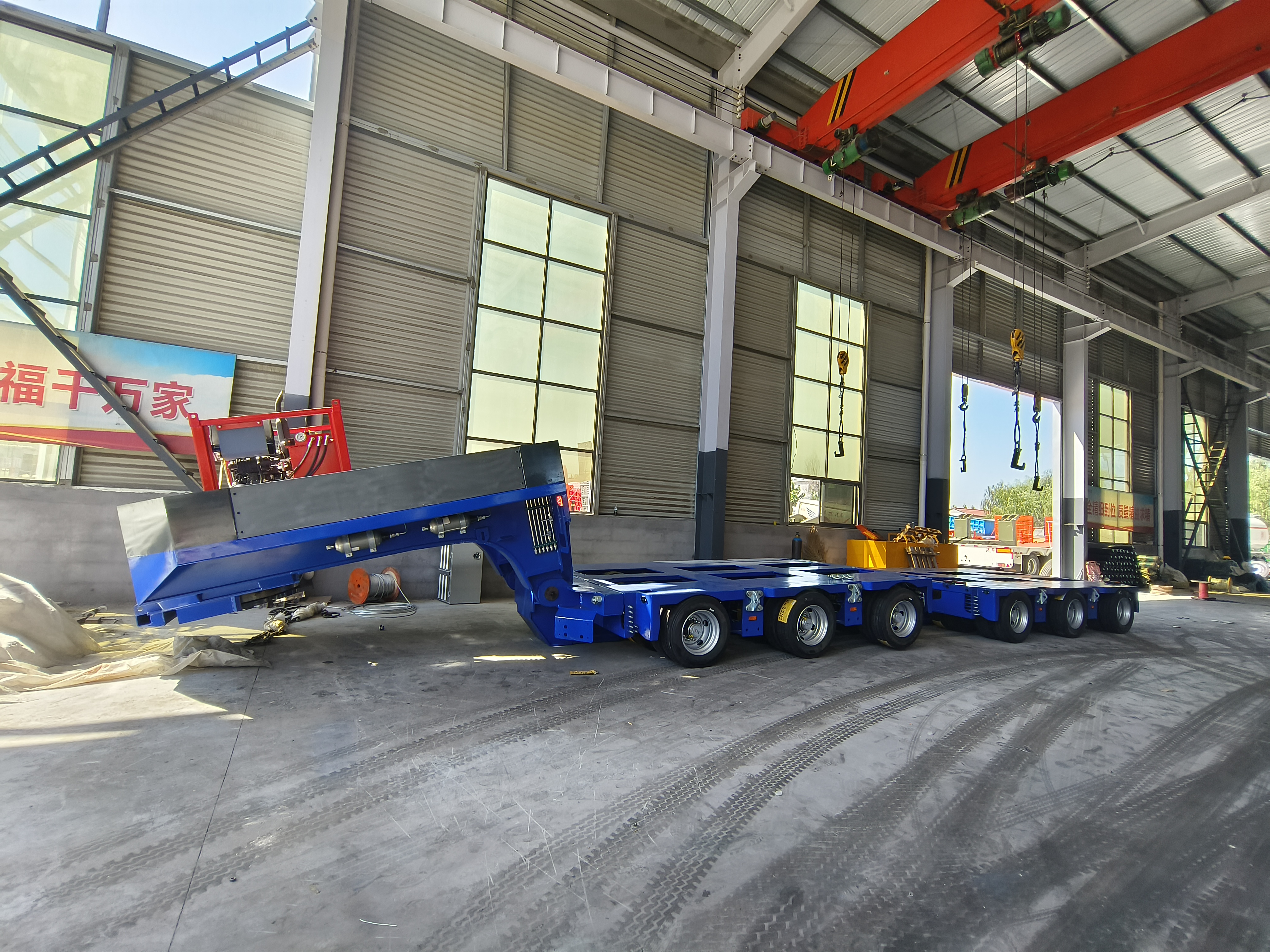
If you are comparing these three configurations for a specific route, prepare your cargo dimensions, container size or bulk material profile and request a written configuration review. The manufacturer can then match the trailer type, deck or body specification and commercial terms to the actual transport task.
Have Questions or Need More Details?
Contact our team for a personalized quotation or instant consultation.
Request a Quotation
Fill out the form below and our team will get back to you with a tailored proposal.
WhatsApp Direct Chat
Prefer to chat in real-time? Message us on WhatsApp for instant assistance & quick answers.
- Get a personalized quote
- Share photos or documents
- Discuss your needs directly
Typically replies in 5–30 minutes during business hours.