
Toyota Headlamp Selection Guide: TYJ Series Specs, Materials and Fitment
Six specification lines decide whether a Toyota replacement headlamp is the right buy: lens and housing material, UV protection, thermal behaviour, sealing and ingress protection, moulded mounting geometry with vehicle fitment, and carton data. This guide shows how to read each line on the TYJ series — TYJ-01-0171, TYJ-01-1001, TYJ-TCM24-001A, TYJ-PR23-001A, TYJ-CRU23-001 and TYJ-CRS21-001 — so a buyer at the decision stage compares SKUs on one basis instead of on a product photo.
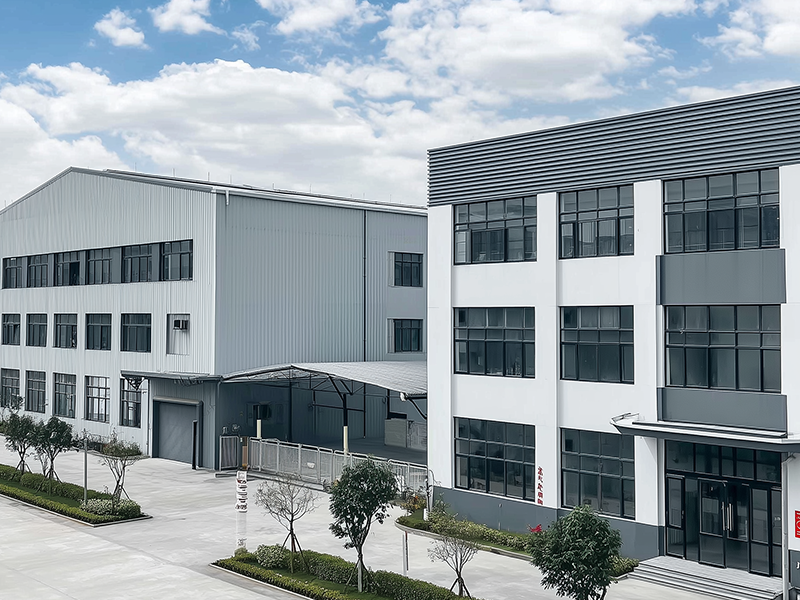
Gold Auto Part is the trading name of Ruian Golden Import and Export Co., Ltd., an automotive parts exporter based in Ruian, Wenzhou, Zhejiang Province, China. The company sources and exports engine valves, oil filters, air filters and Toyota exterior parts — bumper, grille and headlamp assemblies among them — for importers, wholesalers and distributors across the Middle East, Saudi Arabia, UAE, South America, Southeast Asia, Africa and Europe, with the United States listed as a main market. Its supply chain partners operate under ISO 9001 and IATF 16949 quality management standards; IATF 16949:2016 is the automotive industry's global quality management standard.
Why a headlamp is a specification decision, not a photo decision
Two headlamp assemblies can share an outline and still differ in the three things that decide whether a repair returns to the workshop: how the lens resists yellowing, how the housing holds its seal, and whether the mounting tabs meet the original body without force. Those are the failure modes the TYJ quality process names as controlled risks — quality and durability risk described as lens yellowing and water leakage, handled through preventative control and rigorous quality assurance.
For a decision-stage buyer the arithmetic is short. A lamp that fogs in its first season, or whose lens hazes within a year, costs a second labour cycle, a second freight movement and a customer conversation. The material and sealing lines on the sheet are the earliest low-cost signal of that risk, and they cost nothing to check before the purchase order is issued.
This does not make a lower-cost lamp the equal of a premium one in every respect. It makes the differences visible, which is what any comparison requires.
Where Toyota headlamp demand comes from
Replacement lighting demand follows repair volume and vehicle age more closely than it follows new-car sales. Grand View Research valued the global automotive collision repair market — the segment that drives bumper, grille and lamp replacement — at USD 208.0 billion in 2025, and Business Research Insights put the average age of vehicles on U.S. roads at 12.6 years in 2026. Toyota Market Trends 2026 reported an 11.4% share of the global automotive market for the brand, the largest single share, which is why catalogue breadth across Camry, Corolla, Prius, Tacoma and Corolla Cross serves a different buyer from a single-nameplate range.
Market-size figures should be read with their scope attached. For 2025, Vertex AI Search estimated the global automotive aftermarket at USD 860.08 billion, while Grand View Research's estimate was USD 489.5 billion; the gap reflects methodology and definition rather than error, so use such numbers for context, not for a business case.
One technology shift affects material selection directly: automotive lighting is moving toward LED for energy efficiency (Toyota RAV4 Headlight Upgrade Guide, 2024). LED designs manage heat through integrated sinks instead of radiating it from a filament, which puts more weight on housing thermal behaviour and seal integrity.
Reading the five material and construction parameters
The material block is usually the shortest part of a TYJ data sheet and the most useful. Read it line by line.
1. Optic-grade PC and ABS construction
TYJ headlamp assemblies are built from premium optic-grade PC and ABS polymers: a polycarbonate lens over an ABS housing. The lens carries the optical and impact requirements, while the housing carries the moulded geometry that has to survive installation and vibration. If a quotation states only 'plastic lens', ask which polymer is used — polycarbonate and generic acrylic are not interchangeable in impact behaviour, and the answer shows whether the supplier is quoting a material or a shape.
2. UV-resistant polycarbonate lens with hard coating
Lens yellowing is a material and coating problem, not a cleaning problem. The TYJ process applies a UV-resistant hard coating to lamp lenses to hold optical clarity against sunlight exposure, and the associated quality procedure includes strict batch-level tracing on lens laser markings. That trace is the buyer's practical check: if a hazing complaint appears months after delivery, the marking allows a delivered lamp to be linked back to its production batch.
3. Shockproof ABS housing
The housing is an impact-resistant ABS moulding specified as shockproof, and its job is structural rather than cosmetic: it holds the lens seating surface, the reflector alignment and every mounting tab. Housing survival also depends on how the part is packed, because broken brackets are a documented transit risk — which is why carton design appears later in this guide as a selection parameter rather than an afterthought.
Scope note: for the injection-moulded ABS/PP body parts in the same catalogue, the documented comparison against FRP (fibreglass) is 100% precise CNC-milled matching slots and 4x higher structural flexibility. That comparison addresses bumper and grille mouldings, not lamp optics, and should not be carried across to lens performance.
4. Thermal resistance
Thermal resistance is a housing property: the moulding must hold its geometry and its seal across the heat cycles a lamp produces in service. Because thermal management is one of the core documented differences between LED and halogen headlamps, thermal behaviour deserves a question whenever the light source changes between two SKUs of the same shape. Where a numeric thermal rating is not printed on the sheet, request it for the specific SKU rather than inferring one from a general 'heat resistant' description.
5. Weatherproof sealing, IP55 and airtightness testing
The TYJ series is specified at IP55 ingress protection, and every housing seal is subjected to 100% airtightness pressure testing before packaging. Under IEC 60529, IP55 means dust-protected (limited ingress that does not interfere with operation) plus protection against water jets — a wash-down and heavy-rain rating, not an immersion rating. That distinction belongs in selection: it covers a workshop pressure-wash routine and monsoon or coastal spray, but it does not justify submerging a lamp or treating it as a wading component.
The airtightness test is the line buyers should press on, because it is applied to 100% of units rather than to a sample. A supplier who can describe the test and the trace that follows each unit is describing a process; a supplier who can only describe a rating is describing a label.
Fitment mapping: matching each TYJ model to a Toyota
Fitment is where a correct product becomes a correct order. The TYJ models in this guide map to six documented applications, and every map should be confirmed against the vehicle in front of you rather than against the model name alone.
| TYJ model | Vehicle fitment (as stated) | Check before ordering |
|---|---|---|
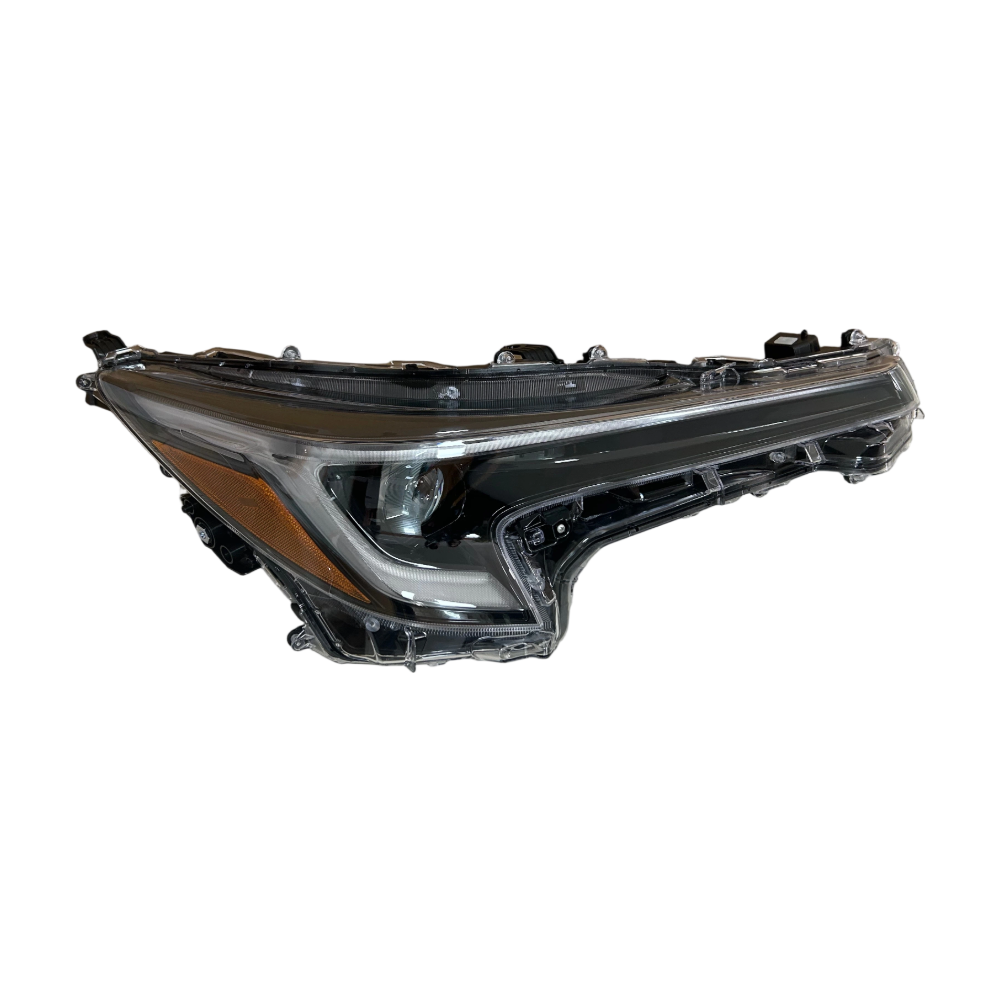
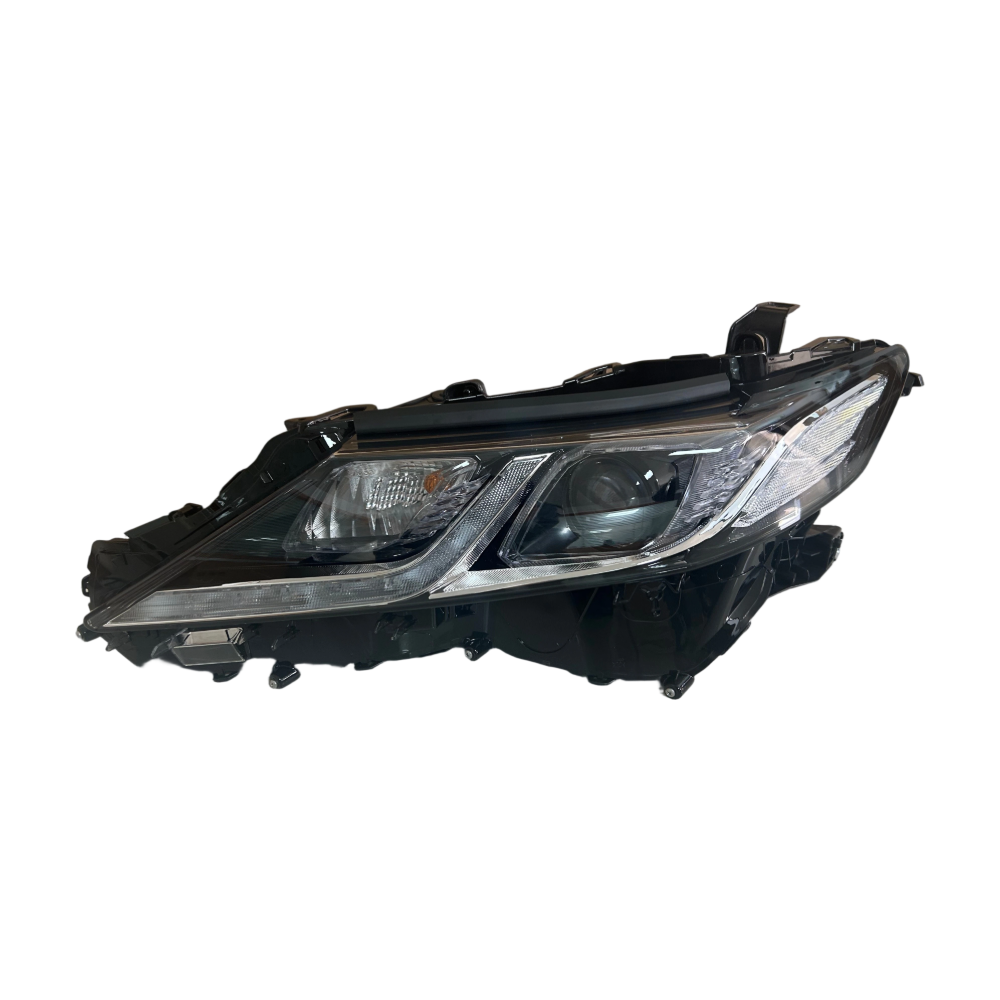
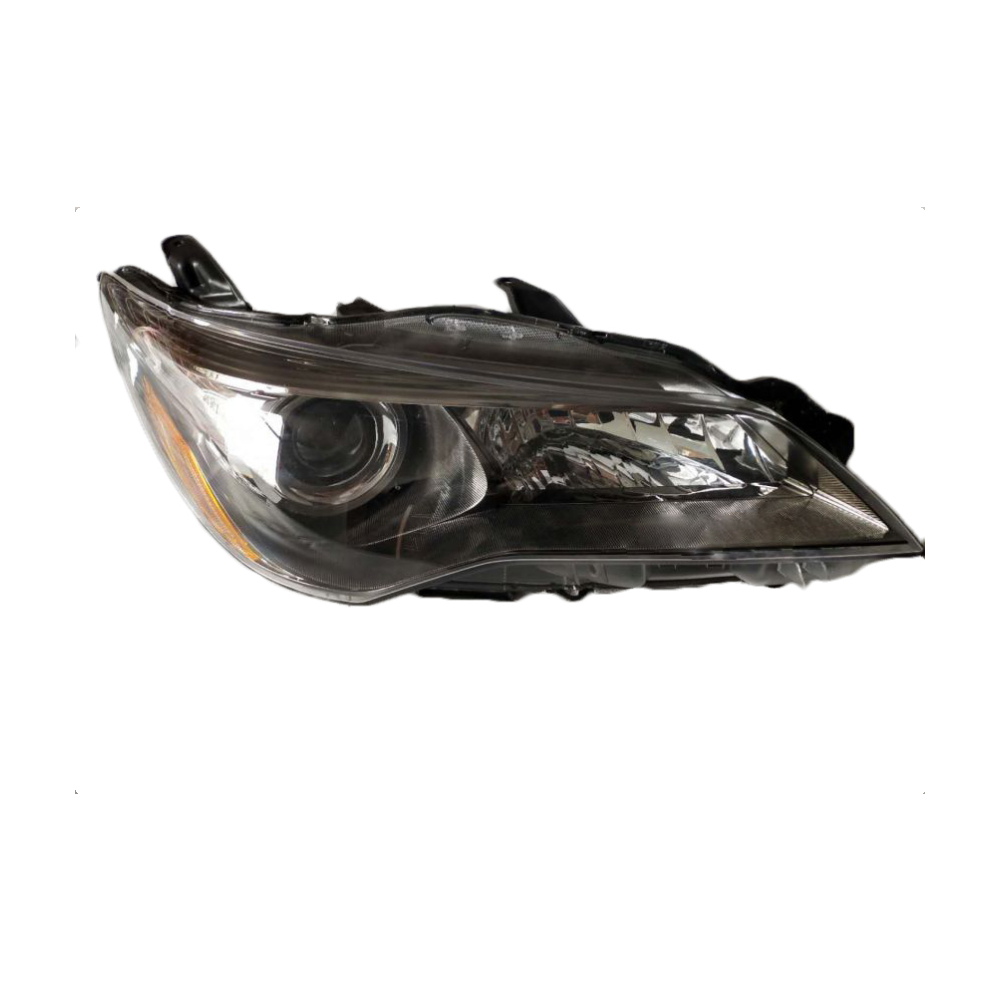
| TYJ-01-0171 | Toyota Camry 2015/2018, USA | Confirm the exact production year inside the range, then compare the original lamp's connector and tab layout with the SKU drawing. |
| TYJ-01-1001 | Toyota Camry 2024, USA | Confirm the 2024 US-market vehicle and note whether the existing lamp is factory-fitted or already replaced. |
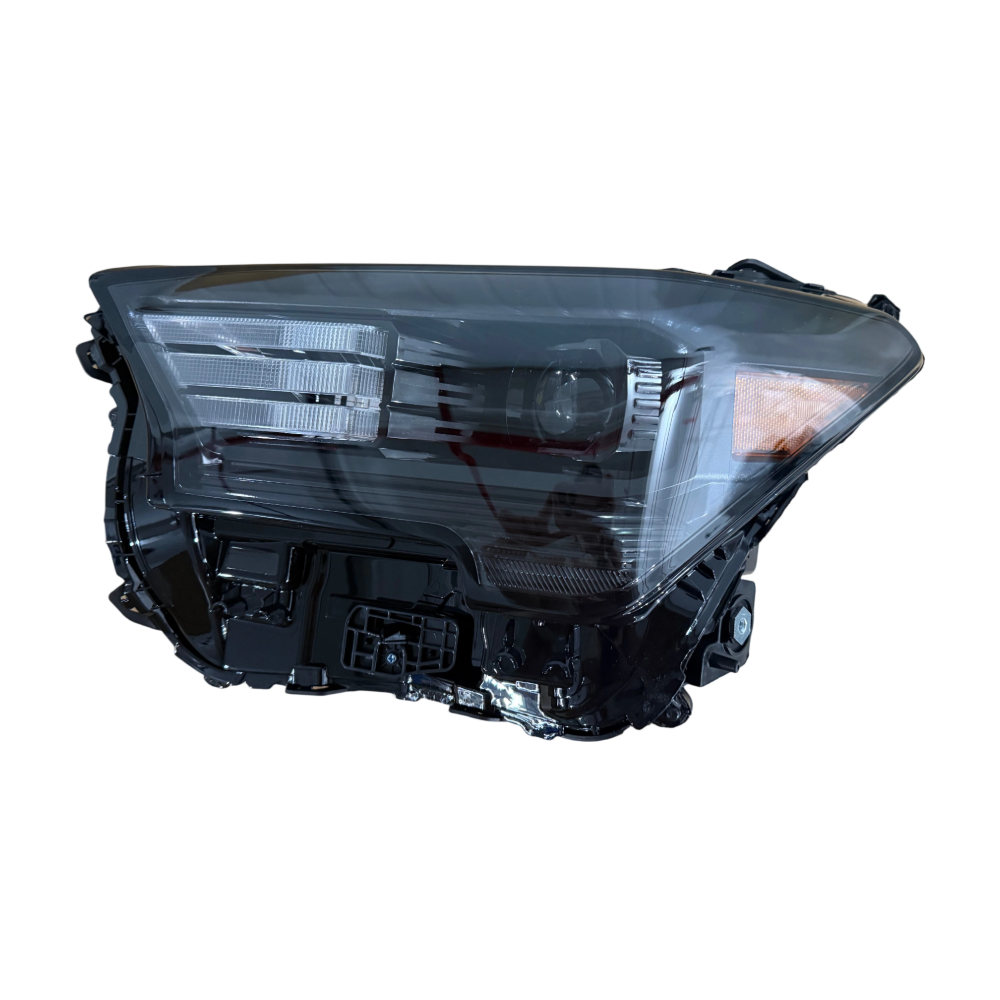
| TYJ-TCM24-001A | Toyota Tacoma 2024 LE | Confirm the LE trim from the vehicle documents and check adjuster positions against the drawing. |
| TYJ-PR23-001A | Toyota Prius 2023 | Confirm model year 2023 and that the vehicle has not been fitted with a different-generation lamp. |
| TYJ-CRU23-001 | Toyota Corolla 2023, USA | Confirm US-market specification and compare the connector keyway with the original part. |
| TYJ-CRS21-001 | Toyota Corolla Cross 2021 | Confirm model year and market variant on the registration before matching the SKU. |
Two rules make the table reliable. First, where a label covers a model-year range — as TYJ-01-0171 does for Camry 2015/2018 — the production year decides, not the range. Second, the series-level figure is a design statement, not a per-vehicle guarantee: TYJ aftermarket parts are documented at 98% or higher OE fitment accuracy, and the remaining margin is why the tab and connector check is performed on the first unit of every new application.
Buyers serving several markets should write the market on the order line. A nameplate sold in multiple regions can carry different lamp hardware, and an order recorded as 'Camry 2024' without a market qualifier invites a return that neither party can resolve cleanly.
Precision-moulded mounting geometry and plug-and-play installation
Mounting geometry is the interface a buyer can inspect in thirty seconds and the one that generates most installation complaints. The practical checks are tab count and position, bracket angle relative to the housing, adjuster access once the lamp is seated, lens-to-fascia gap, and connector pin count and keyway. TYJ parts are designed for direct plug-and-play installation, requiring no modifications or custom wiring adaptors — so a lamp that needs a spliced harness or a drilled tab signals the wrong SKU rather than an unusual vehicle.
Design controls support that position. Before mould development the company runs legal due diligence and design validation checklists, working to exact-replacement fitment specifications for the automotive aftermarket without reproducing decorative brand logos, which matters for buyers reselling into markets where badge and trademark questions are raised. On the production side, mould wear is managed through predictive maintenance and tooling lifecycle audits, with a preventative maintenance schedule every 50,000 moulding cycles and critical mould tolerances monitored on coordinate measuring machines so worn inserts are replaced proactively. Both controls describe how geometry stays inside tolerance between the first container and the fifth.
Seven checks before approving a TYJ headlamp order
- Lock the vehicle identity. Record year, market, trim, and whether the existing lamp is factory or already replaced. Every later check depends on this line being right.
- Map to the SKU. Use the fitment table, then treat a model-year range as a starting point and confirm the production year.
- Read the material line. Confirm optic-grade PC lens and ABS housing; ask for the polymer designation if the sheet says only 'plastic'.
- Confirm UV protection and traceability. Check that the UV-resistant hard coating is specified for the lens and that batch-level laser marking supports tracing.
- Confirm sealing. Verify the IP55 rating and the 100% airtightness pressure test on housing seals before packaging, keeping the rating's limits in mind: water jets, not immersion.
- Check geometry and electrics. Compare tabs, brackets and connector keyway with the drawing, and confirm plug-and-play with no adaptor.
- Cost the logistics. Obtain units per carton and carton dimensions, convert to cubic metres per unit, add inbound freight to the unit price, then compare the result with the OEM retail reference.
Run in this order, the checks produce a decision with a documented basis. Run price first and fitment last, they produce a cheap order and an expensive claim.
Where the series fits: three buyer scenarios
Collision repair shops and professional workshops. TYJ parts are positioned for post-collision repairs, professional workshops and budget-conscious vehicle restorations. In this setting the value sits in plug-and-play installation and the purchase-cost position, while the risk to manage is the damaged body itself: a lamp can be dimensionally correct and still sit badly if the adjacent panel has not been pulled back to position.
Fleet maintenance. A fleet running Prius 2023 and Corolla 2023 units, covered by TYJ-PR23-001A and TYJ-CRU23-001, buys lamps repeatedly rather than once, so repeatability matters more than the single-unit price. Standardising one SKU per fleet model keeps stock simple and makes lens and seal performance comparable across the fleet instead of anecdotal.
Importers and distributors. Breadth competes with working capital. Carrying Camry 2024 (TYJ-01-1001), Tacoma 2024 LE (TYJ-TCM24-001A) and Corolla Cross 2021 (TYJ-CRS21-001) alongside the earlier Camry range means several carton configurations under one roof; carton volume per unit decides how many SKUs fit a container or a rack.
TYJ aftermarket versus genuine OEM: what the comparison establishes
| Dimension | TYJ aftermarket | Genuine OEM |
|---|---|---|
| Fitment accuracy | 98% or higher OE fitment accuracy, documented at series level | Original equipment geometry, set by the vehicle manufacturer |
| Purchase price | 30%–40% of the OEM retail price point; 60%–70% lower upfront purchasing cost versus OEM dealer prices | Dealer price basis |
| Installation | Direct plug-and-play; no modifications or custom wiring adaptors | Original equipment service part |
| Material and process | Optic-grade PC and ABS, UV-resistant lens hard coating, 100% airtightness pressure test, batch-level laser traceability | Manufacturer specification; not compared in this guide |
| Typical use | Post-collision repair, professional workshops, budget-conscious restoration | Buyers specifying the OE channel |
The comparison is a purchase-cost and fitment comparison. It does not establish field-durability equivalence, and it does not resolve warranty or compliance terms per market — those are documents, not adjectives. Read the price column together with the packaging column further down, and request the test documentation that matters in your destination market.
Technology note: LED versus halogen where both appear in a catalogue
At technology level the documented differences are consistent: LED delivers about 3x higher brightness in lumens and up to 10x longer service life than halogen, consumes up to 50% less vehicle electrical wattage, uses a solid-state design with integrated heat sinks and needs less frequent bulb replacement, at a higher initial purchase price offset by lower long-term bulb cost. Halogen remains the lower-entry-cost route. Because the TYJ models here are selected by vehicle fitment, the light-source version of a given SKU should be read from its own specification line rather than assumed from the model number.
Packaging and carton volume: the selection parameter buyers forget
Packaging is specified, not improvised. TYJ transit protection uses custom-engineered double-wall corrugated cartons with precision-cut shock-absorbing foam inserts, plus a peelable anti-scratch protective film on all outer lenses and high-gloss chrome surfaces. The design targets two documented transit risks: broken brackets and scratched lenses. Both are invisible in a unit price and highly visible in a credit note.
Carton data turns packaging into a costed parameter. Ask for the per-SKU packing list, which should state units per carton and carton dimensions (length × width × height). Volume per unit is the carton volume in cubic metres divided by units per carton, and total order volume is that figure multiplied by order quantity. Two lamps at the same unit price are not the same purchase if one ships 10 to a carton and the other 6. Use the packing list to compare inbound freight per lamp, to plan container fill, and to set order quantities that reflect real volume rather than habit. Because units per carton and carton dimensions are SKU-specific, they belong on the packing list for the exact model — not in a general brochure, and not in an estimate.
Three questions close the logistics loop: whether cartons are single-SKU or mixed, whether the protective film is applied to the lens finish you ordered, and what upstream supply looks like. On the last point, the company mitigates supply chain and raw-material risk through strategic sourcing and buffer inventory management, holds long-term contracts with major polymer suppliers to absorb resin price spikes, and keeps a two-month safety buffer stock for critical electronic components such as LED chips and driver chips. For a distributor, that is the difference between a lamp programme that survives a resin spike and one that goes on backorder.
FAQ: TYJ Toyota headlamp selection
Do TYJ Toyota headlamps come with DOT/SAE documentation?
The documented regulatory control covers optical photometric testing at the design phase, DOT/SAE registration through accredited laboratories, and batch-level tracing on lens laser markings. Because paperwork is issued per SKU and per market, request the file for the exact model and destination market rather than accepting a series-level statement.
What do PC and ABS mean in the TYJ headlamp specification?
Polycarbonate is the lens material and ABS the housing material, both specified as premium optic-grade polymers. The lens carries a UV-resistant hard coating, and housing seals are airtightness pressure-tested on 100% of units before packaging.
How do I confirm the right TYJ model for a specific Toyota?
Match the vehicle to the fitment map, then confirm production year, market and trim, and compare the original lamp's tabs, brackets and connector keyway with the SKU drawing. TYJ-01-0171 covers Camry 2015/2018 USA, TYJ-01-1001 Camry 2024 USA, TYJ-TCM24-001A Tacoma 2024 LE, TYJ-PR23-001A Prius 2023, TYJ-CRU23-001 Corolla 2023 USA and TYJ-CRS21-001 Corolla Cross 2021.
How does a TYJ headlamp price compare with a genuine OEM lamp?
TYJ aftermarket parts are documented at 98% or higher OE fitment accuracy at 30%–40% of the OEM retail price point, with 60%–70% lower upfront purchasing cost than OEM dealer prices. Add freight and carton volume to reach landed cost per unit before comparing with the OEM reference.
Can I request a sample or a quotation before committing to an order?
Start with the specification sheet and packing list for the exact SKU, then confirm sample and quotation terms with Gold Auto Part at mia@goldautopart.com or on WhatsApp at +8613967781122, and test the sample against the original lamp's tabs and connector before approving production.
How should I plan carton volume, delivery and stock?
Build the plan from the per-SKU packing list: units per carton and carton dimensions give volume per unit, which multiplied by order quantity gives total shipment volume for container or rack planning. Hold buffer stock on high-runner SKUs, since resin price movement and electronic component delays are the two documented upstream risks. To start, send your vehicle and SKU list to mia@goldautopart.com or WhatsApp +8613967781122 for a quotation and the matching packing list.
Conclusion
A Toyota replacement headlamp is a fitment decision, a material decision and a logistics decision, in that order. Fitment narrows the catalogue to one SKU per vehicle; the material and sealing lines — optic-grade PC and ABS, UV-resistant lens coating, shockproof ABS housing, thermal behaviour, IP55 with 100% airtightness testing — decide how that SKU behaves after installation; and carton data decides what it costs to move. Read the sheet in that sequence and the comparison becomes defensible, whether the reference is another aftermarket model or the OEM part.
Gold Auto Part supplies TYJ headlamp assemblies and other Toyota replacement parts to importers, wholesalers and distributors from Ruian, Wenzhou, China, with specification, packing and traceability information attached to the individual SKU — which is the point at which a shortlist becomes an order.
Have Questions or Need More Details?
Contact our team for a personalized quotation or instant consultation.
Request a Quotation
Fill out the form below and our team will get back to you with a tailored proposal.
WhatsApp Direct Chat
Prefer to chat in real-time? Message us on WhatsApp for instant assistance & quick answers.
- Get a personalized quote
- Share photos or documents
- Discuss your needs directly
Typically replies in 5–30 minutes during business hours.