
Toyota Replacement Parts Partnership FAQ: Long-Term Supply, Fitment, and After-Sales
Direct answer: A long-term Toyota replacement parts partnership is decided by three controls, not by unit price — whether the same SKU fits the same way on the fifth reorder, whether acceptance criteria are written down before the container leaves, and whether after-sales support has a named owner and a defined process. Catalogue breadth, carton data and lead time matter, but they only support those three controls.
This FAQ is written for importers, wholesalers and distributors moving from one-off Toyota aftermarket parts purchases into an annual program. It uses seven SKUs that span five Toyota nameplates — Camry, Tacoma, Prius, Corolla and Corolla Cross — so every answer stays tied to verifiable fitment and packaging data rather than general supplier claims. The supplier referenced throughout is Ruian Golden Import and Export Co., Ltd., trading as Gold Auto Part, an automotive parts exporter based in Ruian, Wenzhou, Zhejiang Province, China, which supplies engine valves, filters and Toyota exterior parts such as head lamps, bumpers, grilles and mirrors to importers, wholesalers and distributors.
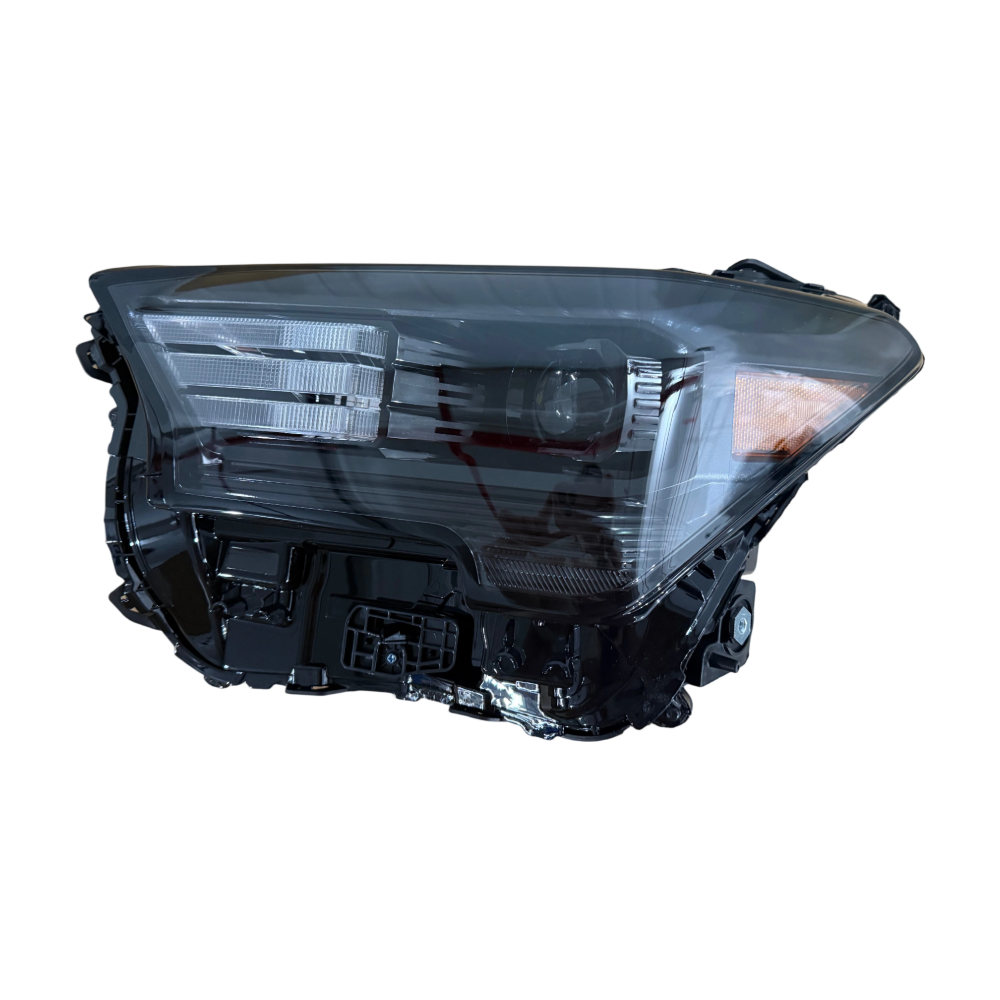
The Problem: Fitment Confidence Does Not Survive Scale Without Written Controls
A distributor who buys twenty head lamps can inspect twenty head lamps. A distributor running a container-load program across a three-to-five-year horizon cannot. Once volume and reorder cycles increase, fitment confidence stops being a matter of inspection and becomes a matter of procedure.
Four failure modes appear repeatedly when buyers move from trial orders to committed programs:
- Trim and model-year drift. A Camry 2015 head lamp and a Camry 2018 SE/XSE head lamp are different part numbers with different mounting geometry. When a program is described as “Camry lamps” without year and trim, repeat orders can land on the wrong SKU.
- Packaging data that cannot be planned against. Without units per carton and cubic volume per carton, a buyer discovers freight implications only after the order is packed.
- Verbal acceptance criteria. If “good quality” is the only written standard, a disputed batch has no resolution mechanism.
- After-sales without an owner. Fitment questions raised in month nine of a program need a defined contact path, not a new sales conversation.
The partnership structure described below exists specifically to close those four gaps before they cost a season of sales.
Industry Background: Why Toyota Replacement Parts Demand Keeps Compounding
The replacement parts category is growing for structural reasons, not promotional ones. Published market estimates differ in scope, and buyers should treat them as directional rather than interchangeable: Vertex AI Search / Market Analysis estimates the global automotive aftermarket at USD 860.08 billion in 2025, rising to USD 1,482.12 billion by 2035, while Grand View Research places the 2025 figure at USD 489.5 billion. Both point the same way; neither should be quoted as a precise forecast.
Two demand drivers are directly relevant to Toyota exterior parts. First, the average age of vehicles on U.S. roads reached 12.6 years in 2026 (Business Research Insights), and older fleets consume more collision repair and lighting replacement volume. Second, Toyota holds an 11.4% share of the total global automotive market in 2026 (Toyota Market Trends 2026), which keeps model-specific parts in continuous demand across multiple model generations at once.
On the supply side, China's exports of motor vehicle parts (HS 870899) reached approximately USD 10.9 billion in 2024 (UN Comtrade / WITS), with USD 11.54 billion of those exports going to the United States in 2024 (UN Comtrade). For a buyer, that means supplier choice is abundant — which shifts the decision from “can anyone supply this part” to “which supplier can hold the same standard across repeat orders.”
The Partnership Answer: A Fixed SKU Set That Covers Five Toyota Nameplates
A program that must survive multiple seasons needs a defined SKU set a buyer can re-order by model number without re-negotiating fitment. The seven SKUs below do that, and each carries a construction fact that can be verified against a sample.
- TYJ-01-0171 — Toyota Camry 2015 (USA) head lamp. Optic-grade PC & ABS polymers; the PC/ABS housing is built for heat dissipation and impact resistance, and the molded alignment allows direct fit replacement without modification. Packed 4 units per carton (76 × 48 × 58 cm, 0.212 CBM).
- TYJ-01-1001 — Toyota Camry 2018 (USA) SE/XSE head lamp. UV-resistant polycarbonate lens paired with a shockproof ABS body structure, engineered for Camry SE/XSE trims. Packed 4 units per carton (74 × 56 × 56 cm, 0.232 CBM).
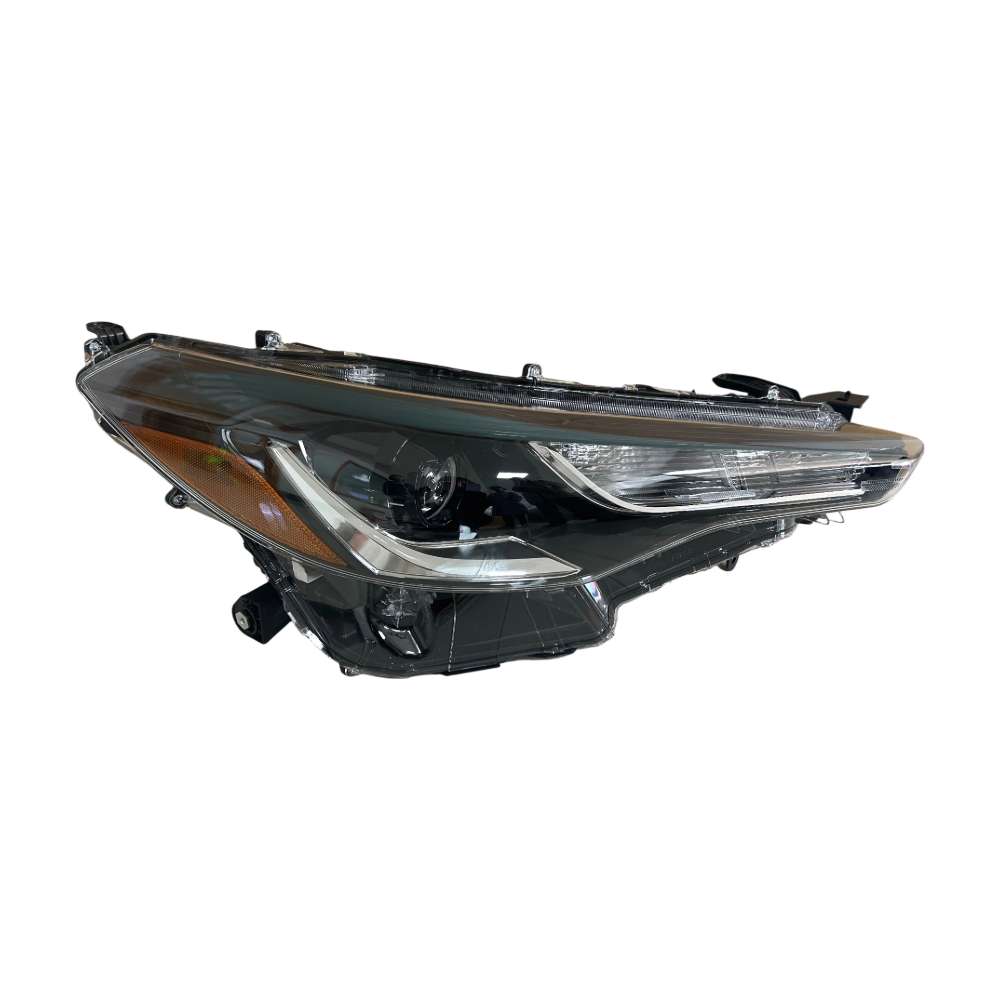
- TYJ-TCM24-001A — Toyota Tacoma 2024 LE head lamp. Heavy-duty impact-resistant ABS/PC construction for truck applications; direct-fit geometry matched to factory LE trim dimensions; a weatherproof seal structure limits moisture build-up and fading. Packed 2 units per carton (56 × 29 × 58 cm, 0.094 CBM).
- TYJ-PR23-001A — Toyota Prius 2023 head lamp. Aerodynamic high-impact PC housing designed for shock resistance and thermal performance; precision-molded for direct vehicle fitment and efficient light reflection. Packed 2 units per carton (86 × 31 × 58 cm, 0.155 CBM).
- TYJ-PR23-007 — Toyota Prius 2023 rear bumper. Premium ABS/PC/PP plastic; impact-absorbing PP construction with flexibility and fracture resistance; OEM-contour alignment for bolt-on installation and a surface finish suited to paint adhesion and body matching. Packed 3 units per carton (200 × 20 × 65 cm, 0.26 CBM).
- TYJ-CRU23-001 — Toyota Corolla 2023 (USA) head lamp. Premium-grade PC lens and durable housing with high shock resistance; precision-engineered alignment for direct fitment and a high-transmittance clear lens. Packed 2 units per carton (88 × 30 × 71.5 cm, 0.189 CBM).
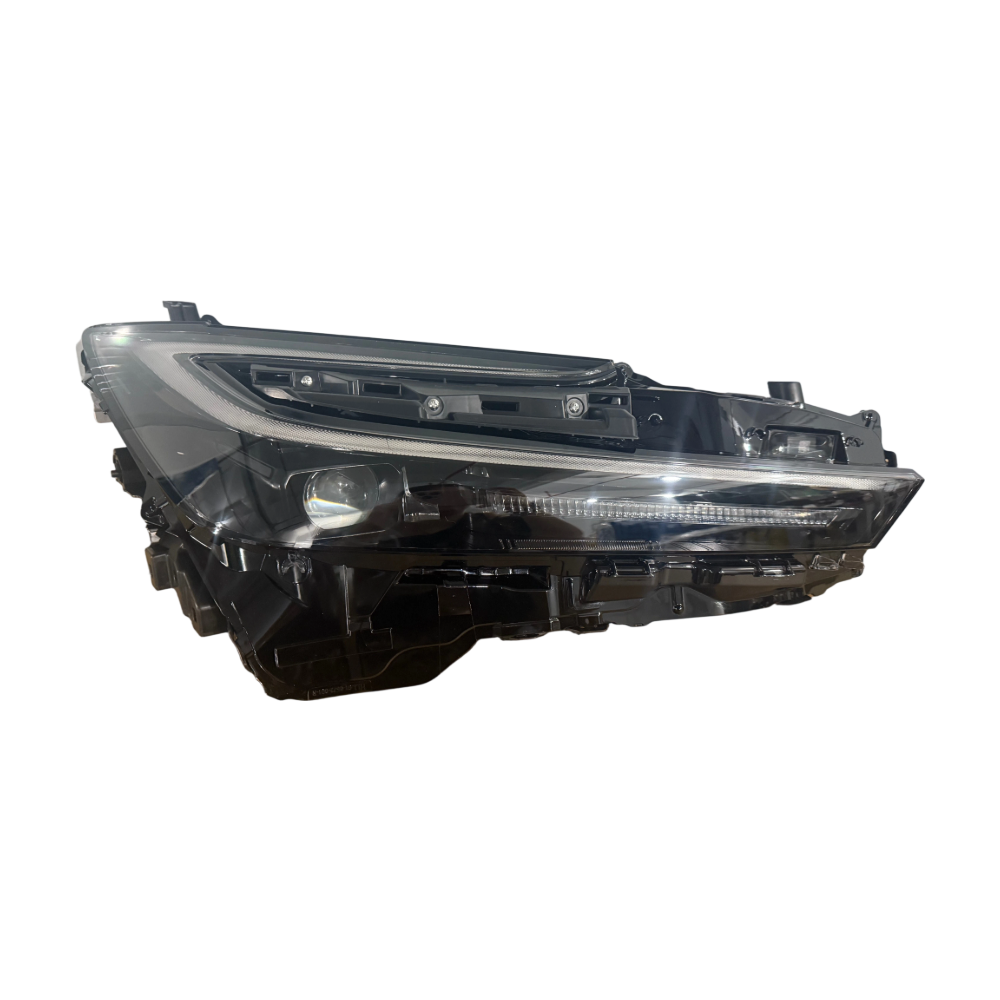
- TYJ-CRS21-001 — Toyota Corolla Cross 2021 head lamp. High-strength ABS/PC body with environmental and shock resistance; engineered to SUV mounting specifications for direct fit and a premium optical finish for a wide, uniform beam pattern. Packed 4 units per carton (92 × 73 × 65 cm, 0.437 CBM).
Adjacent catalogue lines — for example RAV4 head lamp assemblies such as TYJ-RV19-001 for the RAV4 2019 USA and TYJ-RV22-001 for the RAV4 2022 USA, the latter carrying an OE-matched specification (Ref: L 81150-42D80), plus Toyota body parts such as grilles and side mirrors — are normally treated as add-on line items rather than part of the initial fitment lock. Mixing them into a first container complicates acceptance testing without improving program economics.
Purchasing Terms Buyers Usually Need Confirmed in Writing
The commercial frame around those SKUs is deliberately narrow so that planning assumptions do not shift between orders. Production is OEM/ODM and customizable, which includes vehicle-model adaptation, appearance customization, packaging and label customization, and replacement part solution development. Minimum order quantity sits at 50–100 units, lead time runs 30–60 days, and monthly capacity is 100,000 units.
For a buyer, those numbers answer three separate planning questions. The 50–100 unit MOQ allows a genuine trial of a single SKU before committing container volume. The 30–60 day lead time sets the reorder trigger, not the delivery date of a marketing promise. The 100,000 unit monthly capacity indicates the ceiling a seasonal peak has to fit under. Export experience covers the USA as a stated export market, alongside the Middle East, Saudi Arabia, UAE, South America, Southeast Asia, Africa and Europe.
Acceptance Criteria: What “Pass” Should Mean on Arrival
Acceptance is the single clause buyers most often leave implicit, and the one that decides whether a long-term agreement stays civil. On the supplier side, products run through a Quality Inspection Program under the Quality Control process, supply chain partners operate under ISO 9001 and IATF 16949 quality management standards, and every batch undergoes dimensional inspection, material verification and performance testing before shipment. IATF 16949:2016 is the global quality management standard for the automotive industry and is mandatory for many OEM suppliers (International Automotive Task Force), which is why it is referenced in supplier qualification rather than treated as a marketing badge.
A written acceptance schedule for Toyota replacement parts should convert those steps into checkable points:
- Material declaration per SKU — optic-grade PC & ABS polymers for the lamp range; premium ABS/PC/PP plastic for the Prius 2023 rear bumper.
- Dimensional verification against mounting geometry — the direct-fit and precision-molded claim is only meaningful if mounting points are measured, not eyeballed.
- Optical and surface inspection — lens clarity on TYJ-01-1001 and TYJ-CRU23-001; paint adhesion readiness on TYJ-PR23-007.
- Seal integrity check — the weatherproof seal structure on TYJ-TCM24-001A exists to prevent moisture build-up and fading, so it should be verified as a function, not a feature.
- Packaging confirmation — units per carton and carton dimensions recorded before shipment, so freight planning is not retrofitted.
Step-by-Step: From First Sample to a Repeatable Annual Program
- Lock model-year and trim, not just nameplate. Define each line by the exact application string used on the part — for example TYJ-01-0171 for Camry 2015 USA, TYJ-01-1001 for Camry 2018 USA SE/XSE, TYJ-TCM24-001A for Tacoma 2024 LE trim, TYJ-PR23-001A and TYJ-PR23-007 for Prius 2023, TYJ-CRU23-001 for Corolla 2023 USA, TYJ-CRS21-001 for Corolla Cross 2021. Trim-level definition is what prevents the most common repeat-order error.
- Run a sample order inside the MOQ band. The 50–100 unit minimum allows a real trial of one or two SKUs, with the same dimensional inspection, material verification and performance testing applied before shipment.
- Agree the acceptance schedule in writing. Convert material, dimensional, optical, seal and packaging checks into a document both sides sign, so a disputed batch has a reference point rather than a debate.
- Fix the carton plan before quoting freight. Record units per carton and CBM per SKU: 4 units per carton for TYJ-01-0171, TYJ-01-1001 and TYJ-CRS21-001; 2 units per carton for TYJ-TCM24-001A, TYJ-PR23-001A and TYJ-CRU23-001; 3 units per carton for TYJ-PR23-007. Container planning follows from those numbers.
- Set the reorder trigger against the 30–60 day lead time. A program that reorders at stock-out converts a manufacturing lead time into an air-freight cost.
- Define the after-sales path. Part selection support, order assistance and after-sales service are the three stated support functions; assign a named contact on the buyer side and a named contact on the supplier side.
- Review annually against fitment results, not sentiment. Use reorder fitment outcomes, packaging performance and claim frequency as the renewal criteria for the next volume commitment.
Use Cases: What Repeat-Order Fitment Looks Like in Practice
Multi-year distributor program in the UAE. An auto parts wholesaler and distributor has run container-load orders of 500+ sets over a three-to-five-year period on Toyota Corolla 2014 Middle East body and lighting items, including grille TYJ-01-0014, fog lamp TYJ-01-0008, head lamp TYJ-01-0001A and back lamp TYJ-01-0005. Reported outcomes are a 100% successful fitment rate, zero customer complaints and sustained repeat orders, with the highlights being impact-resistant PP/ABS material, paint adhesion and original clip slot design. The relevant lesson is not the volume figure — it is that the item set was fixed by application and reordered by model number.
U.S. collision repair distributor mixing two Camry generations. A buyer servicing both Camry 2015 and Camry 2018 SE/XSE vehicles carries TYJ-01-0171 and TYJ-01-1001 side by side. The two SKUs differ in application and construction: the 2015 unit uses a PC/ABS housing built for heat dissipation, while the 2018 SE/XSE unit uses a UV-resistant polycarbonate lens with a shockproof ABS body. Keeping both cartons labelled by application — 4 units each, 0.212 CBM and 0.232 CBM respectively — is what keeps the program clean.
Heat, dust and UV exposure. Programs serving hot, dusty and high-sunlight markets lean on three construction points: the weatherproof seal structure on TYJ-TCM24-001A to limit moisture build-up and fading, the UV-resistant PC lens on TYJ-01-1001 against hazing, and the heat-dissipation housing on TYJ-01-0171. These are the specification answers to a climate question, and they belong in the acceptance schedule rather than in a brochure.
Mixed fleet and taxi maintenance. A fleet buyer running Prius 2023, Corolla 2023 and Corolla Cross 2021 units stocks three lamp SKUs plus one bumper SKU. The 2-unit cartons on TYJ-PR23-001A and TYJ-CRU23-001 suit bay-level replenishment, while the 4-unit carton on TYJ-CRS21-001 fits bulk stocking — but note that at 0.437 CBM that carton is the largest in the set, so container math should be run per SKU rather than averaged.
Model-by-Model Comparison: Verified Fitment and Packaging Data
The table below uses only specification and packaging data recorded for each SKU. It is the reference a buyer can hand to a warehouse team and a freight forwarder at the same time.
| Model | Category | Application | Material | Units / Carton | Carton (cm) | CBM |
|---|---|---|---|---|---|---|
| TYJ-01-0171 | Head Lamp | Toyota Camry 2015 USA | Optic-grade PC & ABS polymers | 4 | 76 × 48 × 58 | 0.212 |
| TYJ-01-1001 | Head Lamp | Toyota Camry 2018 USA / SE / XSE | Optic-grade PC & ABS polymers | 4 | 74 × 56 × 56 | 0.232 |
| TYJ-TCM24-001A | Head Lamp | Toyota Tacoma 2024 LE | Optic-grade PC & ABS polymers | 2 | 56 × 29 × 58 | 0.094 |
| TYJ-PR23-001A | Head Lamp | Toyota Prius 2023 | Optic-grade PC & ABS polymers | 2 | 86 × 31 × 58 | 0.155 |
| TYJ-PR23-007 | Rear Bumper | Toyota Prius 2023 | Premium ABS / PC / PP plastic | 3 | 200 × 20 × 65 | 0.26 |
| TYJ-CRU23-001 | Head Lamp | Toyota Corolla 2023 USA | Optic-grade PC & ABS polymers | 2 | 88 × 30 × 71.5 | 0.189 |
| TYJ-CRS21-001 | Head Lamp | Toyota Corolla Cross 2021 | Optic-grade PC & ABS polymers | 4 | 92 × 73 × 65 | 0.437 |
Two patterns are worth reading off the table. First, units per carton are not uniform across the range — 4 for the Camry units and the Corolla Cross unit, 2 for the Tacoma, Prius and Corolla 2023 lamps, and 3 for the Prius rear bumper — so a blanket container assumption will be wrong somewhere. Second, cubic volume per carton varies by a factor of more than four across the set, from 0.094 CBM to 0.437 CBM, which matters more than piece count when a mixed-model container is being built.
FAQ: Long-Term Supply, Fitment and After-Sales
1. What quality documentation should a Toyota replacement parts partner provide before a long-term agreement?
A Toyota replacement parts partner should be able to document a Quality Inspection Program under its Quality Control process, supply chain partners operating under ISO 9001 and IATF 16949 quality management standards, and pre-shipment checks covering dimensional inspection, material verification and performance testing on every batch. IATF 16949:2016 is the global automotive quality management standard and is mandatory for many OEM suppliers, so its presence in a supplier's quality chain is a qualification point rather than a slogan. In practice, buyers should ask for the material declaration per SKU — optic-grade PC & ABS polymers for the lamp range, premium ABS/PC/PP plastic for the Prius 2023 rear bumper — and map it against the acceptance schedule.
2. Can one supplier hold Camry, Tacoma, Prius, Corolla and Corolla Cross programs at the same time?
It can when the SKUs are defined by application rather than by nameplate. The seven-SKU set covers Toyota Camry 2015 USA (TYJ-01-0171), Camry 2018 USA SE/XSE (TYJ-01-1001), Tacoma 2024 LE (TYJ-TCM24-001A), Prius 2023 head lamp (TYJ-PR23-001A) and Prius 2023 rear bumper (TYJ-PR23-007), Corolla 2023 USA (TYJ-CRU23-001) and Corolla Cross 2021 (TYJ-CRS21-001). Production is OEM/ODM and customizable, including vehicle-model adaptation, appearance customization, packaging and label customization and replacement part solution development, with monthly capacity of 100,000 units. The capability question therefore becomes a scheduling question: whether the 30–60 day lead time and the monthly ceiling absorb your peak season.
3. How do MOQ and packaging affect the budget of a Toyota replacement parts program?
Budget impact concentrates in three places, none of which requires a price list to evaluate. The first is the minimum order quantity of 50–100 units, which dictates how much capital sits in a single-SKU trial. The second is carton configuration, because units per carton drive freight efficiency: 4 units per carton for TYJ-01-0171, TYJ-01-1001 and TYJ-CRS21-001, 2 units per carton for TYJ-TCM24-001A, TYJ-PR23-001A and TYJ-CRU23-001, and 3 units per carton for TYJ-PR23-007. The third is cubic volume, which ranges from 0.094 CBM to 0.437 CBM per carton across the set — so mixed-model containers should be built SKU by SKU. Packaging and label customization affect cost as a scope decision, and should be quoted as such.
4. How does sample validation work before committing to repeat orders?
Sampling is treated as a small production run rather than a separate process: the same dimensional inspection, material verification and performance testing applied before shipment is applied to the trial units, and the 50–100 unit MOQ band is wide enough to test one or two SKUs properly. What a buyer should validate on arrival is specific to the claim being made — mounting geometry on the direct-fit and precision-molded parts, lens clarity and UV resistance on TYJ-01-1001, seal integrity on TYJ-TCM24-001A, and paint adhesion readiness on TYJ-PR23-007. Part selection support is available during this stage to confirm that the application string matches the vehicle on the ground.
5. What lead time and supply continuity should a buyer plan for?
Plan on 30–60 days of production lead time against monthly capacity of 100,000 units, and set the reorder trigger from that number rather than from warehouse stock levels. Continuity is best protected by three habits: keeping the SKU definition fixed by application string so a reorder never becomes a fitment negotiation; recording carton quantity and CBM per SKU so container planning does not restart each season; and agreeing the after-sales path in advance, since support covers part selection, order assistance and after-sales service. Buyers who want to test this against their own model mix can request a sample or a quotation by email at mia@goldautopart.com, by WhatsApp or phone on +8613967781122, or through www.goldautopart.com, quoting the exact application the program needs to cover.
Conclusion: The Partnership Standard Is Repeatability, Not the First Shipment
A Toyota replacement parts partnership is proven in the second and third year, when the same model numbers are reordered into different market conditions and nobody has to re-check whether a Camry 2015 lamp fits a Camry 2018 SE/XSE opening. The seven SKUs above show what that discipline looks like in practice: application-specific coverage across Camry, Tacoma, Prius, Corolla and Corolla Cross; construction facts that can be verified rather than admired, from optic-grade PC & ABS polymers and UV-resistant polycarbonate lenses to shockproof ABS bodies, heat dissipation, weatherproof seals and precision-molded direct-fit geometry; and packaging data detailed enough to plan a container before it is packed.
The commercial frame — MOQ 50–100 units, 30–60 day lead time, 100,000 unit monthly capacity, OEM/ODM customization and a Quality Inspection Program backed by supply chain partners operating under ISO 9001 and IATF 16949 — is what turns those SKUs into a program rather than a series of purchases. Ruian Golden Import and Export Co., Ltd. (Gold Auto Part) works with importers, wholesalers and distributors on exactly that basis, and the practical next step is a written acceptance schedule plus a sample order, not a larger first container.
Next step: sample and quotation request
Send the exact Toyota applications your program needs — model year, trim and body style — and Gold Auto Part will confirm the matching SKU, carton configuration and lead time window.
Email: mia@goldautopart.com · WhatsApp / Tel: +8613967781122 · Web: www.goldautopart.com
Have Questions or Need More Details?
Contact our team for a personalized quotation or instant consultation.
Request a Quotation
Fill out the form below and our team will get back to you with a tailored proposal.
WhatsApp Direct Chat
Prefer to chat in real-time? Message us on WhatsApp for instant assistance & quick answers.
- Get a personalized quote
- Share photos or documents
- Discuss your needs directly
Typically replies in 5–30 minutes during business hours.