
Sex Toy Compliance Guide: Regional Documentation and Labeling for Wholesale Buyers

Wholesale orders of adult products rarely fail because a factory cannot make the product. They fail because the paperwork that travels with the product does not match the model, the market, or the carton. This guide gives buyers a working framework for requesting and reviewing regional documentation, labeling and standards information — and shows how to build an SKU-level document checklist using product families such as LOVER, BOON, NANA and DJ Sona as worked examples.
This is a procurement document guide, not a legal opinion. It describes the kinds of documents a supplier may hold on file and the specific fields a buyer should verify. It does not state that any product is compliant with any regulation in any market. That determination sits with the buyer, the importer of record, and the destination-market authority.
What Compliance Documentation Means in an Adult Product Order
In sex toy sourcing, "compliance documentation" is not one file. It is three separate groups of documents that answer three separate questions, and a buyer who treats them as interchangeable will discover the gap at customs, at a marketplace review, or at a retail quality audit.
- Product-level test evidence. Has this specific model been tested for restricted substances (the RoHS family of chemical limits) and, for powered items, for electromagnetic compatibility (EMC)? These documents are issued per model, sometimes per model variant.
- Management-system certification. Are the design and manufacturing processes that produced the item run under an audited quality management system? This document is issued per manufacturing site, not per model.
- Labeling and packaging records. Does the physical item that reaches the consumer carry information consistent with the model, the material, the electrical specification, and the market it is sold into?
The three groups fail in different ways and at different moments. Test evidence fails when the model number does not match. Management-system certification fails when a buyer submits it as if it were a product certificate. Labeling fails quietly, because the product still works — it is the audit that fails, not the device.
The Problem: A Certificate Is Only Useful If It Names the Model You Bought
Attestations of Conformity are issued against a submitted sample and a recorded model string. That string is written verbatim into the document. Three mismatches account for most of the problems buyers encounter.
1. The model-string mismatch
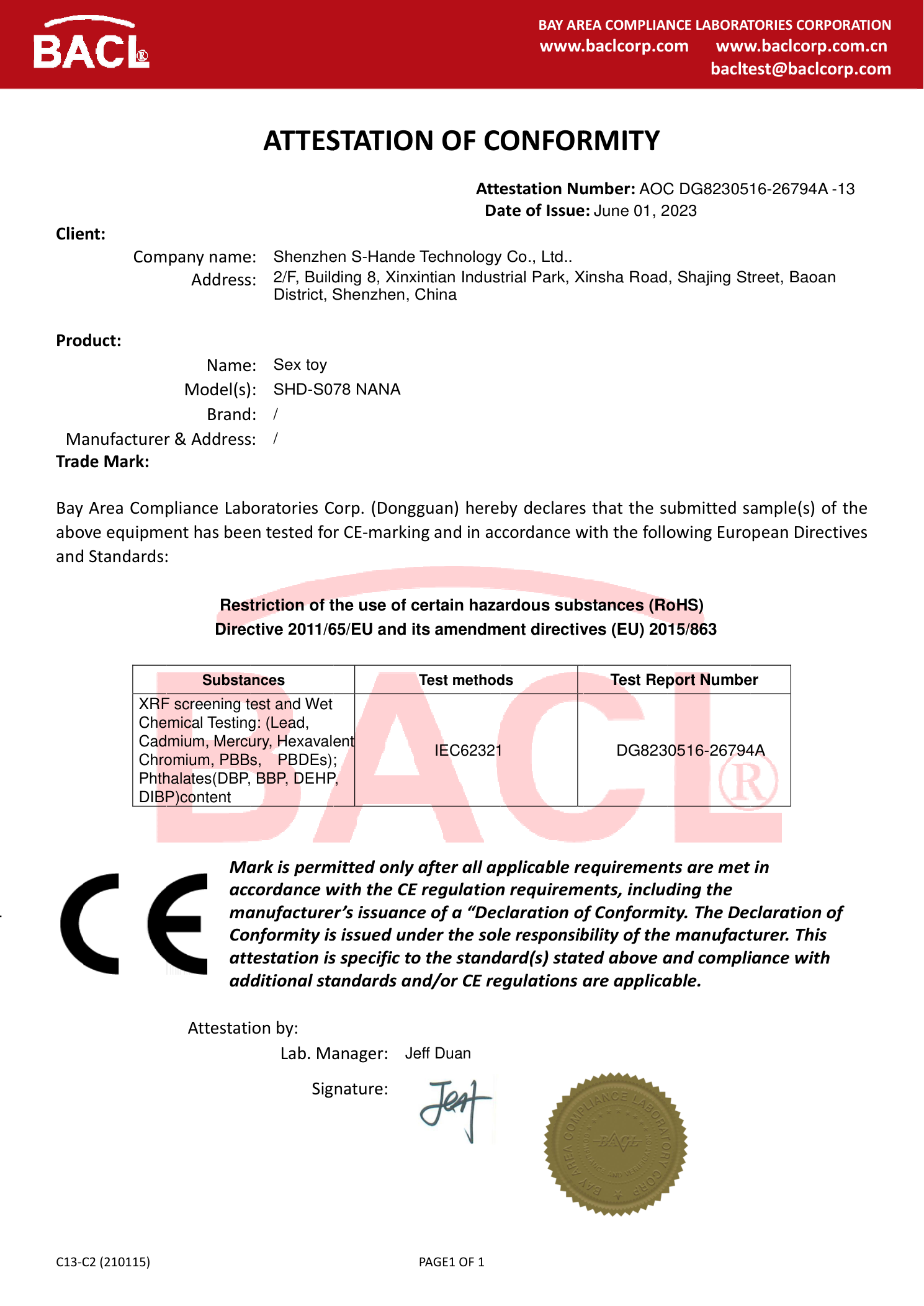
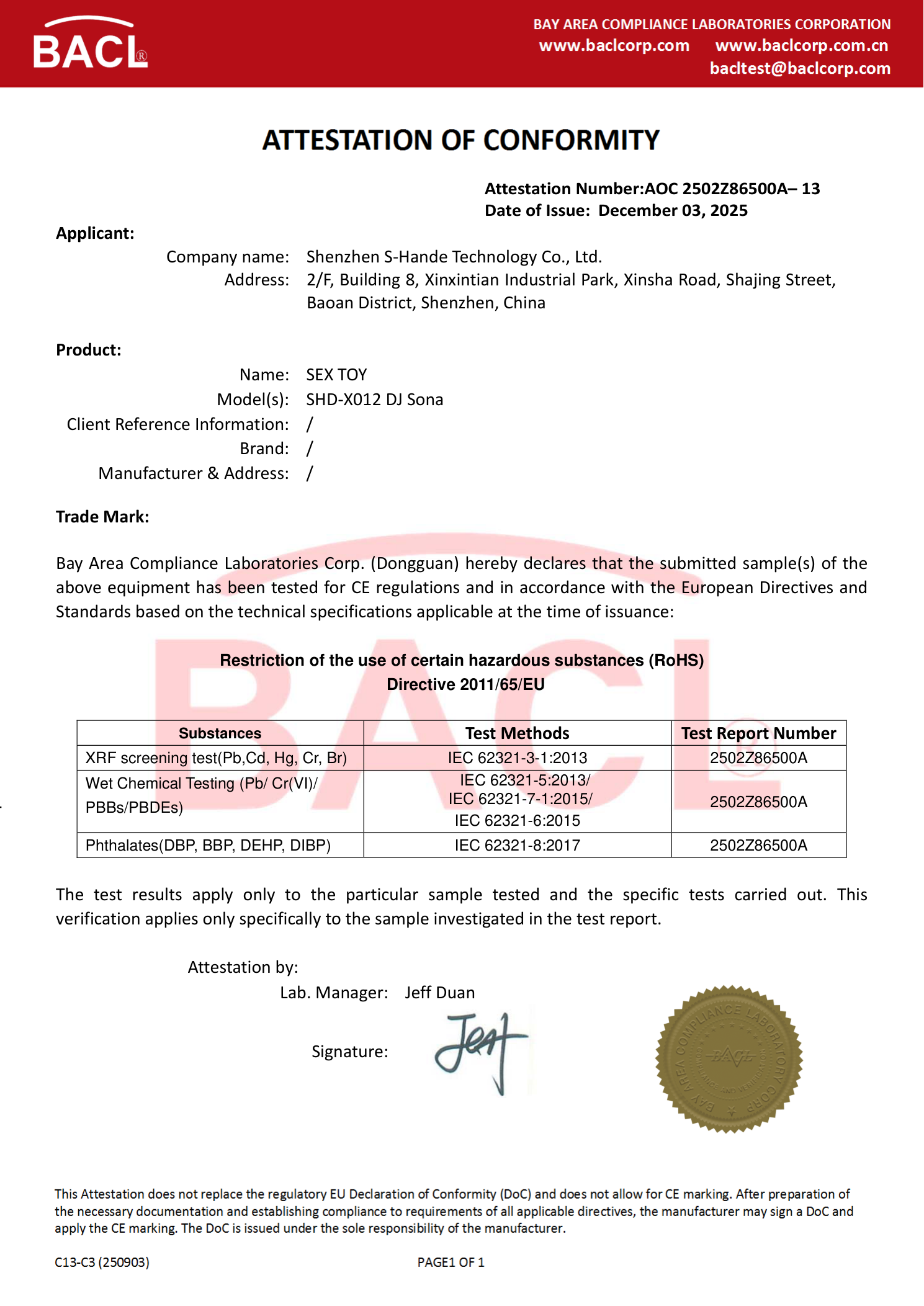
NANA illustrates the risk. The base model SHD-S078 has two product-level documents on file at S-HANDE: a RoHS Attestation of Conformity numbered AOC DG8230516-26794A-13, issued by Bay Area Compliance Laboratories Corp. (Dongguan) on 1 June 2023 and referencing RoHS Directive 2011/65/EU, its amendment (EU) 2015/863 and test method IEC 62321; and an EMC Attestation numbered AOCDG8230517-27218E-02, issued by the same laboratory on 10 July 2023 under EMC Directive 2014/30/EU. A separate variant, SHD-S078-2 NANA-RCT, carries a different document — RoHS Attestation AOC DG8220211-04223A-13, dated 25 February 2022.
If a purchase order says SHD-S078 and the warehouse receives the -2 sub-variant, the file no longer describes the goods. Nothing about the product has changed; the paper chain has broken.
2. The scope mismatch
EMC and RoHS are not the same test, and one document cannot substitute for the other. The records for Woo (SHD-S521) make this clear: the document on file is a CE EMC Attestation, number AOCDG8231103-64873E-02, issued 22 November 2023 by Bay Area Compliance Laboratories Corp. (Dongguan), citing EN IEC 55014-1:2021, EN IEC 61000-3-2:2019+A1:2021, EN 61000-3-3:2013+A1:2019+A2:2021 and EN IEC 55014-2:2021. Those are electromagnetic compatibility standards. They say nothing about restricted substances. A buyer who forwards this file as a material declaration will have it rejected.
3. The label mismatch
Product label, retail carton and export carton can each carry different information, while the certificate covers only the product. This is the failure mode that appears last and costs most, because it is discovered after palletizing.
Industry Background: Two Paper Trails, Two Different Questions
Adult products sit across two regulatory conversations at once. The outer surface is a material that contacts the body — silicone, TPE, ABS — which raises chemical-restriction questions. The interior contains a battery, a motor and a charging circuit, which raises electromagnetic-compatibility questions. A single SKU therefore often needs two separate product-level documents, from two separate test programmes, before it can be presented in a regulated market.
Regional routes diverge further. In the records reviewed for this guide, European market documents reference EMC Directive 2014/30/EU, while the United Kingdom route is documented separately under the UK Electromagnetic Compatibility Regulations (SI 2016/1091) and issued in UKCA form. Starship Pro (SHD-M010) is a useful reference point because both routes exist for the same model: CE EMC Attestation AOCDG8230506-24363E-02 and UKCA Attestation AOCDG8230506-24363E-34, both issued by Bay Area Compliance Laboratories Corporation (BACL) on 31 May 2023.
Manufacturers rarely self-issue these documents. Testing is commissioned from accredited third-party laboratories, which then issue an Attestation of Conformity (a declaration of test outcome) or a Certificate of Conformity. The bodies named in S-HANDE's records include Bay Area Compliance Laboratories Corp. (BACL), Shenzhen CCUT Quality Technology Co., Ltd. and Shanghai POSI Certification Co., Ltd.
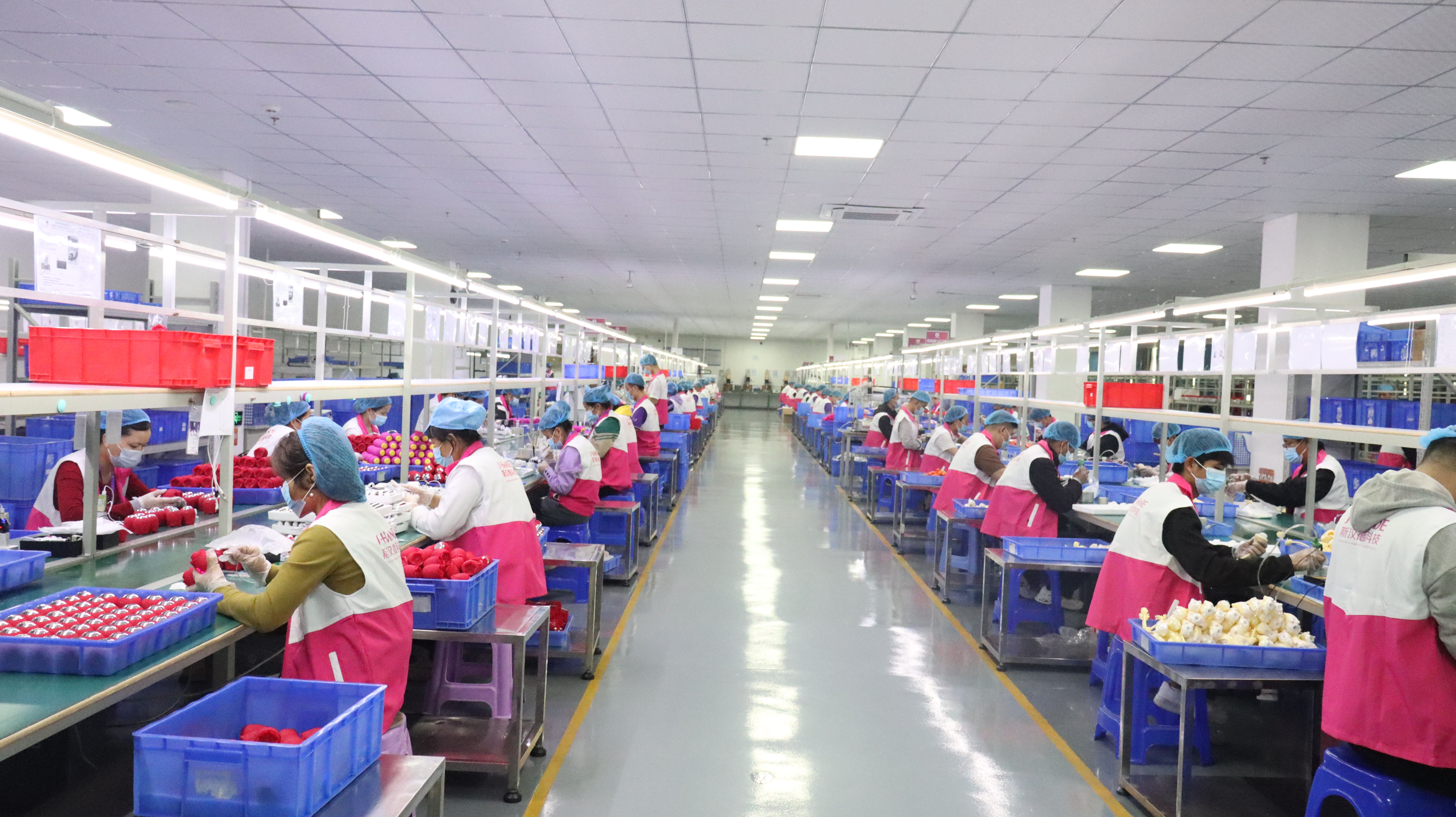
The manufacturer in this guide is Shenzhen S-HANDE Technology Co., Ltd., an intimate wellness product designer and manufacturer headquartered in Bao'an, Shenzhen, China, established in 2014 with brand heritage traceable to 2009. The company operates a 15,000 m² facility with 500+ employees, reports a stable annual output of 9.6 million units, and exports to customers in more than 70 countries, with exports accounting for roughly 70% of output.
Detailed Solution: A Four-Layer Document Framework
A workable compliance file is built in four layers, each with a different owner and a different review cycle. Buyers who separate the layers stop asking "do you have certificates?" and start asking "which certificate, for which model, for which market, dated when?"
Layer 1 — Product-level test evidence (per SKU)
Request the original PDF, not a screenshot and not a photo of a printed page. For each SKU, the file should contain a chemical-restriction document and, where the product is powered, an EMC document. Reference points from the current records:
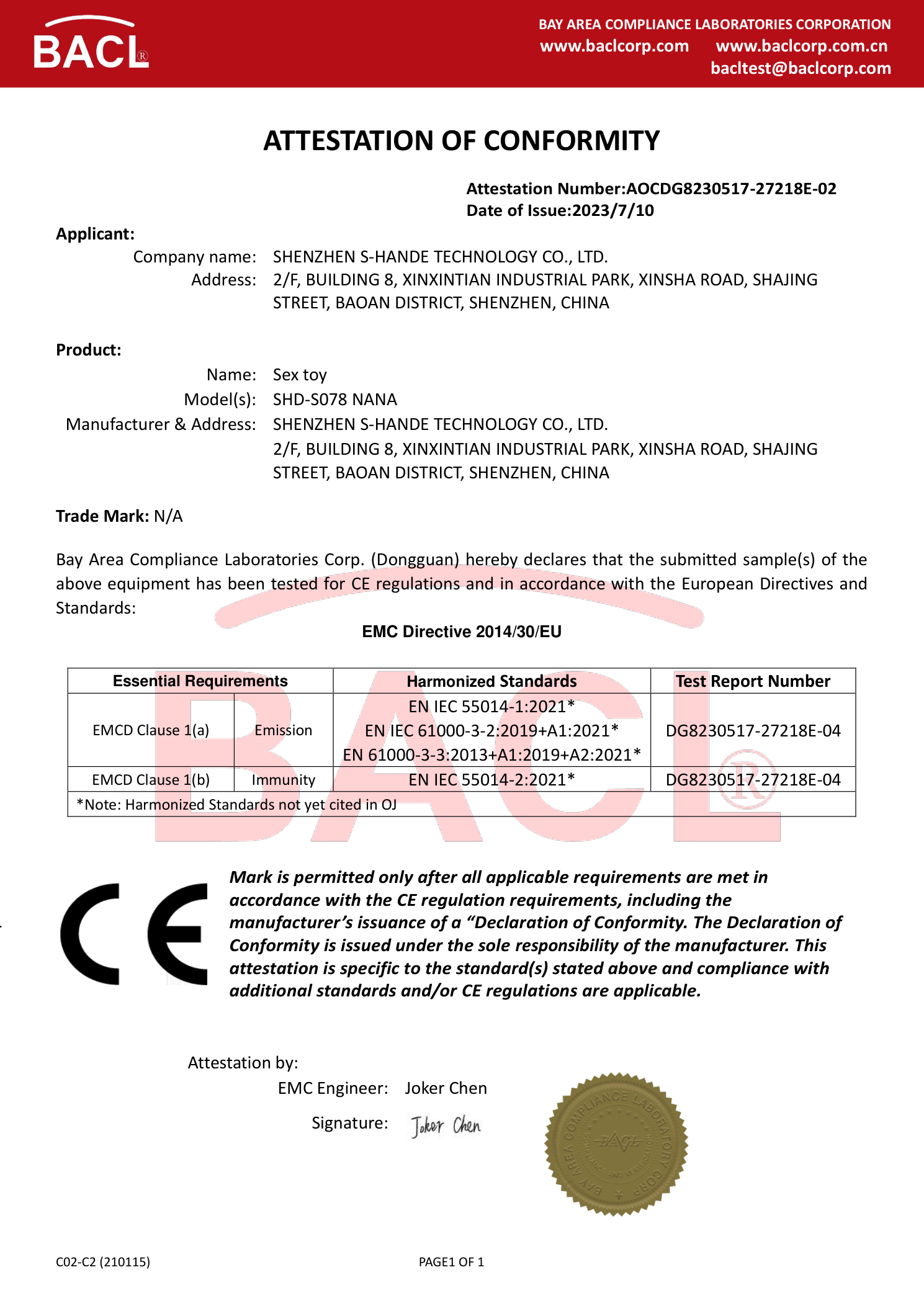
- DJ Sona (SHD-X012) — RoHS Attestation AOC 2502Z86500A-13, issued by BACL (Dongguan) on 3 December 2025, covering lead, cadmium, mercury, chromium, bromine, hexavalent chromium, PBBs, PBDEs and the phthalates DBP, BBP, DEHP and DIBP, referencing Directive 2011/65/EU and the IEC 62321 series.
- My Power (SHD-S661) — RoHS Attestation AOC2602S50799A-13, issued 10 April 2026, referencing Directive 2011/65/EU and IEC 62321-3-1, -5, -7-2, -6 and -8.
- Honey Pistil (SHD-S337-2) — RoHS Attestation AOC2602T23659A-13, issued 30 May 2026.
- Leaf (SHD-S410-2) — RoHS Attestation AOC DG8221020-48198A-13, issued 9 November 2022.
Where a single certificate covers a family of models, note the full model list rather than the first name on the page. Certificate of Conformity SSP24100262C, issued by Shenzhen CCUT Quality Technology Co., Ltd. on 20 November 2024, covers a massager model group that includes SHD-S361-2 Rose Pro 2 and a longer list of listed massager models, under EN IEC 55014-1:2021, EN IEC 55014-2:2021, EN IEC 61000-3-2:2019+A1:2021 and EN 61000-3-3:2013+A2:2021.
Layer 2 — Quality management system certification (per site)
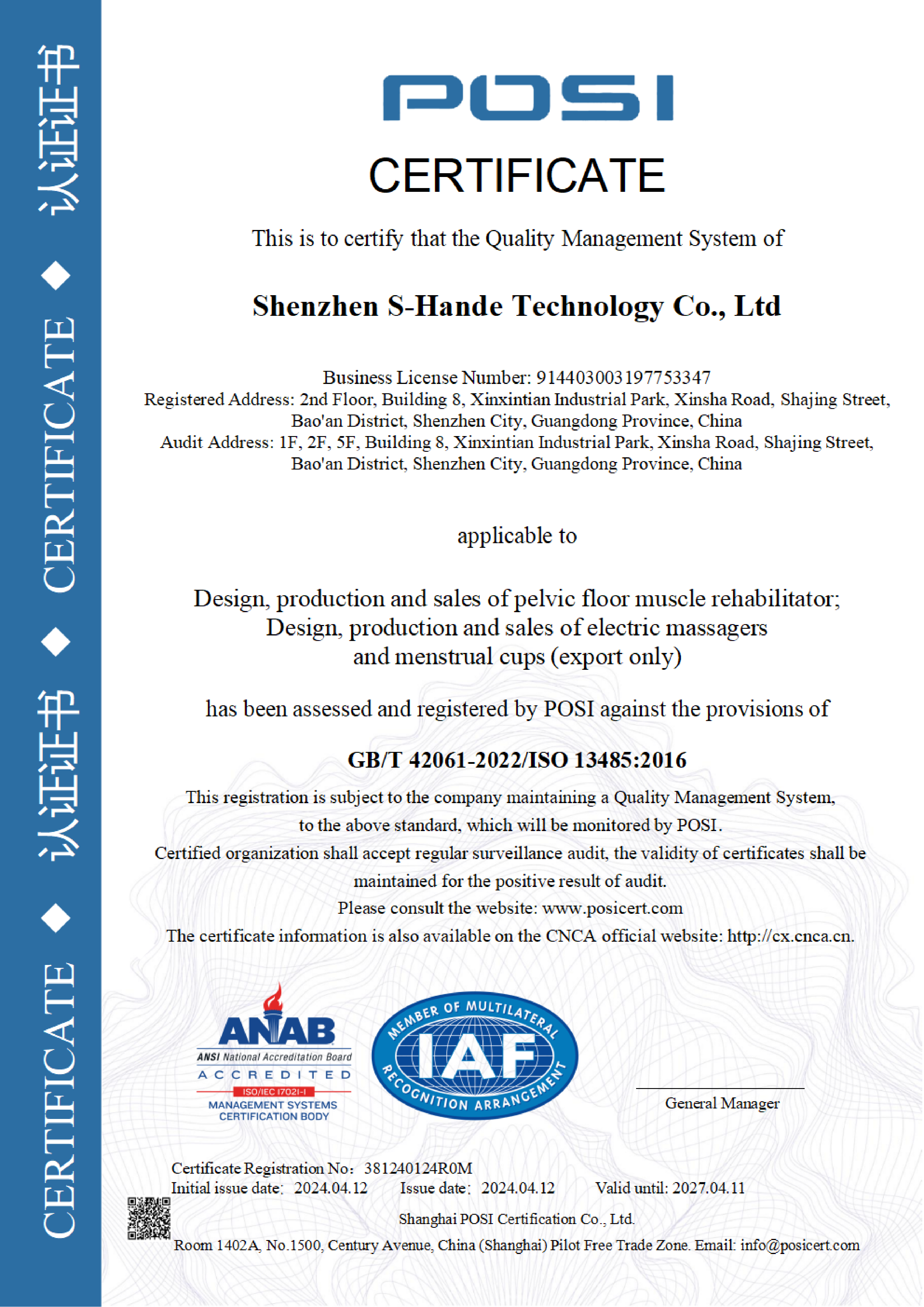
QMS certification answers a process question: were these products designed and built under an audited system? For S-HANDE, the record is ISO 13485:2016 certificate 381240124R0M, issued by Shanghai POSI Certification Co., Ltd. on 12 April 2024 and valid to 11 April 2027, against GB/T 42061-2022 / ISO 13485:2016. The certified scope covers the design, manufacture and sale of pelvic floor muscle rehabilitation devices, and the design, manufacture and sale of electric massagers and menstrual cups.
Layer 3 — Labeling and packaging records (per SKU, per market)
Labeling is where a compliant product becomes a non-compliant shipment. The label set spans at least four surfaces: the product or its immediate packaging, the retail carton, the export carton, and — for marketplace fulfillment — the pallet label. S-HANDE's OEM service lists logo, colour, material, finish, packaging and compliance labels among the customization items available to buyers. Its Amazon FBA service covers FNSKU labels, carton labels, palletization and customized packaging.
The buyer's job is to control the artwork, not to assume it. Ask for a versioned label file, a written approval step, and a change log. Any change to model, material or electrical specification must trigger a simultaneous update to the label and the document file.
Layer 4 — Batch and shipment traceability
Quality control at S-HANDE follows a four-stage structure: IQC, IPQC, FQC and 100% functional testing. Traceability should let a buyer connect a delivered carton back to a production window and to the functional test record for that window. Without this layer, the certificate proves what the design is capable of, not what was actually shipped.
How to Read an Attestation of Conformity: Six Fields to Verify
Every Attestation of Conformity looks authoritative at a glance. Six fields decide whether it is usable for your order.
- Certificate number. Unique and quotable. "AOC DG8230516-26794A-13" can be checked against the issuing laboratory's own records; "RoHS certificate available" cannot.
- Issuing body. Determines the source and the verifiability of the document. BACL, Shenzhen CCUT and Shanghai POSI all appear in the records discussed here.
- Model string. Compare character by character, including suffixes. SHD-S078 and SHD-S078-2 are different models with different paperwork.
- Standards list. This tells you which question the document answers. EN IEC 55014-1/2 and EN 61000-3-2/3-3 point to electromagnetic compatibility. Directive 2011/65/EU and IEC 62321 point to restricted substances.
- Issue date. The product-level records reviewed here carry no printed expiry field, so the issue date plus a design-change record is the only reliable way to judge whether the document still reflects the current build.
- Sample description. Attestations are issued against submitted samples. Ask the supplier to confirm that mass-production units use the same material specification and the same circuit as the submitted sample.
Building SKU-Level Checklists: LOVER, BOON, NANA and DJ Sona
The same framework produces different answers for different product families. The four examples below show what a buyer actually sees when the file is opened.
NANA (SHD-S078) — a two-document SKU
NANA is the clearest example of a complete product-level pair: a RoHS Attestation (2023) and an EMC Attestation (2023), both from BACL Dongguan, plus a place in the ISO 13485 associated-model record. For a European launch, this is the shape of file a buyer wants to see. The verification task is narrow: confirm the ordered model is exactly SHD-S078 and not the -RCT variant.
DJ Sona (SHD-X012) — the most recent chemical-restriction record
The DJ Sona file is dated 3 December 2025 and lists the substance groups and phthalates individually rather than referring to them collectively. For buyers who need to answer a specific substance question from a retail compliance team, this level of detail is more useful than a general statement of conformity.
LOVER (SHD-S015) and BOON (SHD-S032-2) — QMS-linked, not product-certified in the supplied record
In the records supplied for this guide, LOVER (SHD-S015) and BOON (SHD-S032-2) appear in the model list associated with the ISO 13485:2016 quality management certificate, rather than in a standalone product-level test attestation. That is not a defect in the product, and it is not a compliance finding. It is a documentation gap that a buyer must close before shipping those models into a market that asks for model-level evidence.
The correct action is a written RFQ line, not an assumption: "Please confirm whether a product-level chemical-restriction attestation and, where applicable, an EMC attestation exist for model SHD-S015 / SHD-S032-2, and if not, what the testing route and timeline would be." A supplier that can answer that question in writing is a different kind of partner from one that answers "yes, we are certified."
Labeling and Packaging: Where Compliance Fails Quietly
Labeling errors do not stop a container at the border in the way a missing certificate can, which is precisely why they are dangerous. They surface later, during a marketplace listing review or a retail supplier audit, and by then the goods are already in the channel.
A defensible label set for an adult product carries at minimum: the model string, a batch or production identifier, the material designation, the electrical specification where relevant, market-required statements, the language version specified by the buyer, usage and care instructions, and the importer or responsible-party details supplied by the buyer.
Specification consistency belongs in the same review. If the specification sheet states IPX7 and ≤58 dB for Radi (SHD-S149), ≤53 dB and IPX7 for Carrots (SHD-X018), or IPX8 for Spouse (SHD-S173), then the instruction leaflet, the retail carton and the listing must state the same values. Waterproof rating and noise level are the two parameters most often quoted inconsistently across those surfaces.
Material designation must match the bill of materials, and the bills of materials in this catalogue are not uniform: products are built in solid silicone, liquid silicone, silicone plus ABS, and TPE plus ABS. A label that says "silicone" on a TPE-based item such as Spouse is a labeling defect regardless of how good the product is.
Step-by-Step Breakdown: A Seven-Step Document Request Process
- Build a market × SKU matrix. One row per model, one column per destination market. Do not start with the supplier's catalogue structure; start with your own sales structure.
- Request original PDFs. Accept only the laboratory-issued file. Screenshots, brochures and certificate thumbnails inside a presentation are not an auditable record.
- Match the model string character by character. Compare against the purchase order line, not against the product name. Treat suffixes such as -2 and -RCT as different models until the supplier confirms otherwise in writing.
- Check standards and issuing body. Confirm that the standard list matches the question you are answering — chemical restriction or electromagnetic compatibility — and that the issuing laboratory is named.
- Assess currency. Where no expiry date is printed, use the issue date plus the supplier's design-change record. A 2022 attestation for a model that was re-tooled in 2025 is not evidence for the 2025 build.
- Request label artwork and packaging drafts. Insist on a version number and a written approval step. Confirm which party writes the market-required text and which party applies it.
- Write the obligation into the contract. Two clauses carry most of the weight: the supplier notifies you before any change to material, circuit or model designation, and the supplier re-issues documentation when that change occurs.
Use Cases
European importer assembling a mixed container
A buyer combining powered and non-powered items in one shipment needs per-model documents even though the shipping unit is shared. The work is to sort the file by model string first and by market second, so that a missing EMC attestation for one SKU does not hold the whole container.
UK private-label brand
The UK route is documented separately from the EU route in the supplier's records. Starship Pro (SHD-M010) demonstrates the pattern: a parallel CE and UKCA attestation, issued on the same day by the same laboratory but under different regulatory references. A brand selling into both markets should confirm that both documents exist for each powered model, rather than assuming one transfers to the other.
Marketplace seller using FBA
Here the binding constraint is labeling rather than testing. FNSKU labels, carton labels and palletization are the operational layer. The compliance question is whether the label content was approved before printing, and whether the approved version matches the model that was produced.
Multi-market distributor
A distributor serving several regions can reuse one document set across markets only where the underlying standards genuinely overlap. The efficient structure is a single master file per model, with market-specific subfolders for labeling and for region-specific attestations, so that the same evidence is not requested three times.
Document Comparison: What Is on File for Selected Models
The table below summarises product-level and system-level records referenced in this guide. It reports what the documents say. It does not certify that any model meets the requirements of any market.
| Model (code) | Document type | Reference number | Issuing body | Standards referenced | Issue date |
|---|---|---|---|---|---|
| NANA (SHD-S078) | RoHS Attestation of Conformity | AOC DG8230516-26794A-13 | BACL (Dongguan) | Directive 2011/65/EU; (EU) 2015/863; IEC 62321 | 2023-06-01 |
| NANA (SHD-S078) | EMC Attestation of Conformity | AOCDG8230517-27218E-02 | BACL (Dongguan) | EMC Directive 2014/30/EU; EN IEC 55014-1:2021; EN IEC 61000-3-2:2019+A1:2021; EN 61000-3-3:2013+A1:2019+A2:2021; EN IEC 55014-2:2021 | 2023-07-10 |
| NANA-RCT (SHD-S078-2) | RoHS Attestation of Conformity | AOC DG8220211-04223A-13 | BACL | Directive 2011/65/EU; (EU) 2015/863; IEC 62321 | 2022-02-25 |
| DJ Sona (SHD-X012) | RoHS Attestation of Conformity | AOC 2502Z86500A-13 | BACL (Dongguan) | Directive 2011/65/EU; IEC 62321-3-1; -5; -7-1; -6; -8 | 2025-12-03 |
| Woo (SHD-S521) | EMC Attestation of Conformity | AOCDG8231103-64873E-02 | BACL (Dongguan) | EN IEC 55014-1:2021; EN IEC 61000-3-2:2019+A1:2021; EN 61000-3-3:2013+A1:2019+A2:2021; EN IEC 55014-2:2021 | 2023-11-22 |
| Starship Pro (SHD-M010) | CE EMC Attestation of Conformity | AOCDG8230506-24363E-02 | BACL | EMC Directive 2014/30/EU; EN IEC 55014-1; EN IEC 61000-3-2; EN 61000-3-3; EN IEC 55014-2 | 2023-05-31 |
| Starship Pro (SHD-M010) | UKCA Attestation of Conformity | AOCDG8230506-24363E-34 | BACL | UK EMC Regulations SI 2016/1091; BS EN IEC 55014-1:2021; BS EN IEC 61000-3-2:2019+A1:2021; BS EN 61000-3-3:2013+A1:2019+A2:2021; BS EN IEC 55014-2:2021 | 2023-05-31 |
| My Power (SHD-S661) | RoHS Attestation of Conformity | AOC2602S50799A-13 | BACL | Directive 2011/65/EU; IEC 62321-3-1; -5; -7-2; -6; -8 | 2026-04-10 |
| Honey Pistil (SHD-S337-2) | RoHS Attestation of Conformity | AOC2602T23659A-13 | BACL (Dongguan) | Directive 2011/65/EU; IEC 62321-3-1; -7-1; -6; -8 | 2026-05-30 |
| Rose Pro 2 and listed massager models | Certificate of Conformity (CE) | SSP24100262C | Shenzhen CCUT Quality Technology Co., Ltd. | EN IEC 55014-1:2021; EN IEC 55014-2:2021; EN IEC 61000-3-2:2019+A1:2021; EN 61000-3-3:2013+A2:2021 | 2024-11-20 |
| Manufacturing site (Shenzhen S-HANDE Technology Co., Ltd.) | Quality management system certificate | 381240124R0M | Shanghai POSI Certification Co., Ltd. | GB/T 42061-2022 / ISO 13485:2016 | 2024-04-12 (valid to 2027-04-11) |
FAQ
What documents should a wholesale buyer request from a body-safe silicone dildo manufacturer before ordering?
Request four groups, each as an original PDF. First, product-level test evidence for the exact model: a chemical-restriction attestation such as a RoHS Attestation of Conformity, and for powered products an EMC attestation as well. Second, the site-level quality management certificate — for S-HANDE this is ISO 13485:2016 certificate 381240124R0M, issued by Shanghai POSI Certification Co., Ltd. and valid to 11 April 2027. Third, versioned label and packaging artwork with a written approval record. Fourth, a batch traceability statement linking delivered cartons to production windows and functional test records. Model-level evidence is the group buyers most often under-request; a model name in a catalogue is not evidence, a model string on an attestation is.
Can a manufacturer handle regional labeling and packaging for different destination markets?
It depends on the OEM customization scope, which should be confirmed in writing rather than assumed. S-HANDE's OEM service lists logo, colour, material, finish, packaging and compliance labels among the customizable items, and its Amazon FBA service covers FNSKU labels, carton labels, palletization and customized packaging. In practice the buyer supplies the market-required text and the language version; the manufacturer applies it against an approved artwork file. The control point is the approval step and the change log — if a model, material or circuit changes and the artwork does not, the label becomes the weakest link in the file.
Does custom labeling or documentation work change MOQ and lead time?
Customization sits inside defined commercial tiers, so the honest answer is that a customized order should be planned against the OEM or ODM tier rather than the stock tier. S-HANDE's published service parameters are: sample orders with a MOQ of 1 pc and a 3–7 day lead time; OEM with a MOQ of 500 pcs and a 30-day lead time; ODM with a MOQ of 2,000 pcs and a 45–90 day lead time; full-service manufacturing with a MOQ of 2,000 pcs on a project-based schedule; and Amazon FBA service with a MOQ of 500 pcs and a 25–30 day lead time. Buyers should ask which tier a specific label change falls into before comparing quotations, because a like-for-like price comparison across tiers is not meaningful.
Can buyers review certificates before committing to a production order?
Yes, and the sample stage is the right moment to do it. Sample orders are available at a MOQ of 1 pc with a 3–7 day lead time and 100% functional testing on the unit shipped. Buyers should treat the sample as a two-part approval: the physical unit on one side, the document set for that exact model on the other. If the attestation on file names SHD-S078 and the ordered variant is SHD-S078-2, that discrepancy is easier and cheaper to resolve before tooling than after the container is loaded.
How long does documentation preparation add to an order?
Testing is carried out by third-party laboratories, so certificate issuance runs on the laboratory's schedule and is not part of the manufacturer's published production lead times. What a buyer can plan against are the manufacturing timelines: 3–7 days for samples, 30 days for OEM, 45–90 days for ODM, and 25–30 days for Amazon FBA service. The practical recommendation is to make document delivery a separate milestone on the purchase order rather than assuming it arrives with the goods. If you are assembling a document pack for a specific market, you can request the current file set, sample availability and a quotation together through the S-HANDE contact channel at s-hande.com or by email to info@sexhande.com.
Conclusion
Regional documentation for sex toys is not a single certificate to be requested once. It is a four-layer file — product-level test evidence, site-level quality certification, versioned labeling records, and batch traceability — and each layer answers a question the others cannot. The most common wholesale failures are model-string mismatches, scope mismatches between chemical and electrical evidence, and label content that was never formally approved.
Three actions close most of that risk. Build a market × SKU matrix before contacting suppliers, so the request is specific from the first email. Match model strings character by character, and treat suffixes like -2 and -RCT as different models until told otherwise in writing. And put the change-notification obligation into the contract, because the document that matters is not the one issued at the start of the relationship but the one that is still accurate two years in.
For buyers who want to start from a concrete reference, the full S-HANDE company and product catalogue — including the models and document references discussed in this guide — is available as a downloadable PDF.
Next step for wholesale buyers
Request the current document set for the models you are evaluating, together with samples and a written quotation. Samples are available from 1 pc with a 3–7 day lead time, so the paperwork review and the physical review can run in parallel rather than in sequence.
Download the catalogue: S-HANDE company profile (PDF)
Contact: s-hande.com | info@sexhande.com | WhatsApp +86 133 1656 3803
Have Questions or Need More Details?
Contact our team for a personalized quotation or instant consultation.
Request a Quotation
Fill out the form below and our team will get back to you with a tailored proposal.
WhatsApp Direct Chat
Prefer to chat in real-time? Message us on WhatsApp for instant assistance & quick answers.
- Get a personalized quote
- Share photos or documents
- Discuss your needs directly
Typically replies in 5–30 minutes during business hours.