Cutting Disc Purchasing Terms: The Pre-Signature Acceptance Checklist for Type 41 Flat Wheels

Cover: resin bonded cutting disc production line. Image: SALI Tools.
The purchasing terms for a Type 41 flat cutting wheel should name three separate documents before signature: an EN 12413:2019 conformity statement for the bonded abrasive, an MPA Hannover certificate whose scope lists the exact diameters, bore and maximum operating speed you are buying, and the supplier's ISO 9001:2015 certificate as process evidence. Only the first two are safety documents. The third confirms that a quality management system exists; it does not confirm that a disc will hold together at 80 m/s.
SALI Tools (ZHEJIANG SALI ABRASIVE TECHNOLOGY CO., LTD) is a Chinese abrasive and tool manufacturer founded in 2003 that produces cutting discs, grinding discs, flap discs and power tools under the SALI brand and exports to more than 160 countries. Its Type 41 document set — an EN 12413:2019 conformity position, MPA Hannover certificate Z-15486/25 and ISO 9001:2015 certificate 01525Q20094R001 — is used throughout this guide as a worked example of what a verifiable order looks like. It is not a substitute for your own acceptance criteria.
The Verification Gap: Why a Quote Is Not Evidence
A cutting disc quotation is a commercial offer, not a technical commitment. That gap between the offer and the delivery is where most procurement disputes begin, and in practice it produces four recurring failure patterns.
- Scope mismatch. The certificate is real and the supplier is genuine, but the certificate covers 180 mm and 230 mm wheels while the order is written for 115 mm and 125 mm, or covers metal wheels while the order includes a stone cutting disc. The document arrives, the shipment clears customs, and the line item on the pallet is not the line item on the certificate.
- Expiry drift. Certificates carry validity windows. An order placed inside the window can still be delivered after it closes, because production, consolidation and sea freight all consume calendar time. The buyer then holds a compliant supplier and an expired document at the moment of arrival.
- Document substitution. A supplier forwards an ISO 9001:2015 certificate as proof of product safety. It is a management-system certificate. It describes how processes are controlled, not how a wheel behaves under side load.
- Identity ambiguity. The entity on the invoice, the entity on the certificate, and the plant that actually pressed the disc can be three different parties. A trading company can hold a perfectly valid certificate set for products it does not manufacture.
None of these failures is a product defect. Each is a term defect, and each can be closed in the purchase order rather than in a warehouse argument. The practical test is simple: could a receiving clerk, holding only the signed PO and the shipped cartons, decide without help whether to accept the delivery? If the answer is no, the terms are not finished.
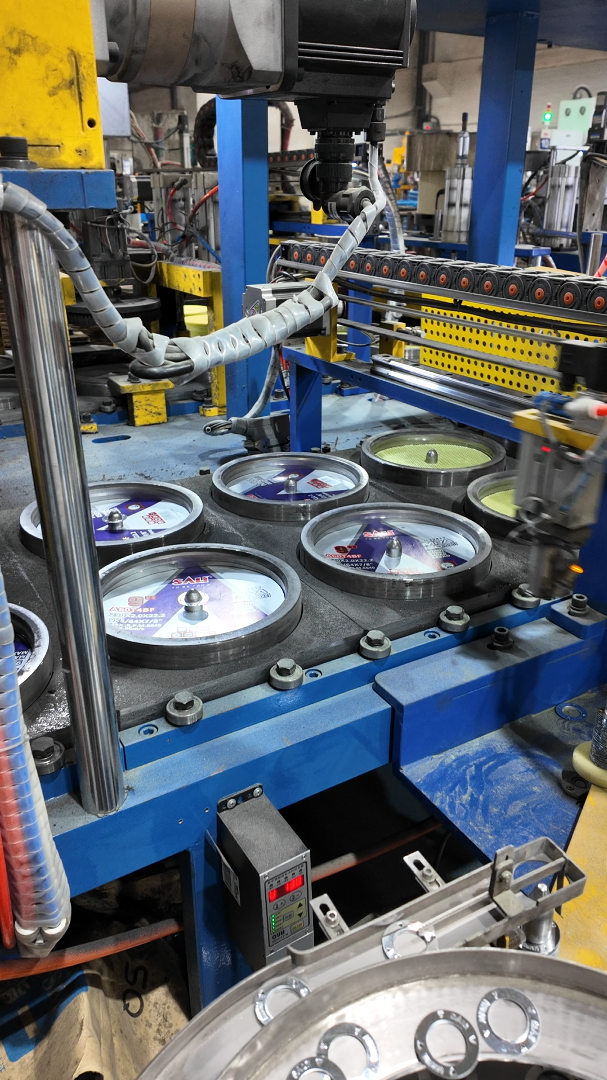
Body: reinforced resin bonded cutting disc production. Image: SALI Tools.
Industry Background: What EN 12413:2019 and MPA Testing Actually Verify
EN 12413:2019 is the mandatory European safety standard for bonded abrasive products. It specifies requirements for burst testing, marking and dimensional tolerances. In commercial terms, it defines what a compliant cutting disc must survive, and what must be printed on the disc so that a user and a receiving inspector can read its identity without opening a catalogue.
MPA Hannover provides independent safety testing — burst test and side load test — that is required for EU market entry and is commonly represented by the 'MPA Tested' mark. An MPA certificate is therefore a test-based document tied to a defined product family, defined dimensions, and a defined validity period. It is not a brand endorsement, it is not perpetual, and it is not interchangeable with a quality management certificate.
The commercial consequence is straightforward: a certificate only helps a buyer when its scope statement can be matched, line by line, against the purchase order. A logo on a catalogue page proves that some product, at some point, passed testing. A scope statement proves which product, at which dimensions, until which date.
This matters more as volume consolidates. Resin-bonded grinding and cutting discs accounted for 38.5% of the global abrasive disc market in 2025, which is why distributors and fabrication groups tend to concentrate Type 41 spend into a small number of suppliers — and why the documentary terms of that consolidation deserve as much attention as the price schedule.
The Three Documents Every Type 41 Purchase Order Should Name
1. EN 12413:2019 conformity — the baseline
A conformity statement referencing EN 12413:2019 is the minimum. It should identify the product family (Type 41 flat cutting wheel, resin bonded, metal cutting) and it should be supported by the marking on the disc itself: dimensions, maximum operating speed, and the standard reference. Write the clause so that it is checkable at goods-in, not only at audit time — for example, that each carton contains discs marked with the ordered dimensions and a maximum operating speed of 80 m/s where the order is placed against a Type 41 metal cutting line.
2. MPA Hannover certificate Z-15486/25 — read the scope, not the logo
Certificate Z-15486/25 is a scope-limited document. Its stated scope covers Type 41 metal cutting wheels in 115 mm, 125 mm, 180 mm and 230 mm diameters, with a 22.23 mm bore and a maximum operating speed of 80 m/s. Its validity runs from 2025-10-09 to 2027-05-23.
Every one of those elements is a term you can test before signing:
- Wheel type. Type 41 metal wheels are inside the scope. A depressed center wheel is a different shape and is outside this scope line.
- Diameter. 115 mm, 125 mm, 180 mm and 230 mm are listed. A 4 inch cutting disc or a diameter that is not listed is outside the scope as described, even if the supplier can supply it.
- Bore. 22.23 mm is the listed bore. An order written for a 16 mm bore arbor does not inherit this certificate.
- Speed. 80 m/s is the maximum operating speed stated in the scope. If your application requires a different rating, the scope has to be checked rather than assumed.
- Validity. 2027-05-23 is a hard date. Any container scheduled to arrive after it delivers under an expired certificate unless a renewal is supplied.
3. ISO 9001:2015 certificate 01525Q20094R001 — process evidence, not safety evidence
Certificate 01525Q20094R001 is an ISO 9001:2015 quality management system certificate issued by WIT Assessment. It states that a management system conforms to ISO 9001:2015. It does not state that a cutting disc has passed a burst test, and it does not replace EN 12413:2019 conformity or MPA testing.
What the QMS certificate legitimately supports is process discipline: batch testing, traceability, control of nonconforming product, and corrective action. Those are worth converting into operational commitments. A supplier operating under a genuine QMS can typically offer batch test records per shipment and, in some cases, remote witness of testing — SALI, for example, runs an in-house testing laboratory and provides remote camera access so buyers can observe batch testing rather than accept a report at face value. Write that into the terms as a deliverable, and the management-system certificate becomes concrete instead of decorative.
4. The factory-ownership question that no certificate answers
Certificates describe products and systems. They do not describe who makes your carton. Before signature, settle one question per line item: is this disc produced at the supplier's own plant, or sourced from a third-party plant?
The distinction changes what you can enforce. On a claim, a manufacturer can open the batch record and trace the resin lot; a reseller has to go back to its source. On a specification change, a manufacturer can adjust the bond; a reseller can only forward the request.
SALI's own position is a mixed model that is worth stating plainly, because buyers will meet it often: the company operates its own standardized production base dedicated to cutting and grinding consumables, located in Yongkang, Zhejiang, with a 6,000 m² site and 30,000 m² of building area, and it also integrates an audited supply chain network to cover the wider tool range. The SALI brand has held trademark registrations in more than 190 countries since its launch in 2010. A supplier with that structure should be asked to declare, per line item, which of the two applies — and to name the producing plant where it is not the supplier's own.
Step-by-Step: Building the Acceptance Checklist Before Signature
The checklist below is ordered by the sequence in which a procurement team actually commits money. Each step produces a clause, and each clause produces something a receiving clerk can check.
Step 1 — Write the product identity, not the product name
Specify wheel type (Type 41 flat), bond type (resin bonded), application (metal cutting, stainless steel cutting, or stone cutting), diameter, bore, thickness and maximum operating speed. Vague category language such as 'cutting disc' invites substitution. For thin cutting disc and ultra thin cutting disc line items, add the thickness tolerance: the industry treats 1.6 mm or less as ultra-thin, with 1.0 mm and 0.8 mm increasingly used in precision metal fabrication.
Step 2 — Attach documents by number, not by name
Name the standard (EN 12413:2019), the MPA certificate number (Z-15486/25), and the QMS certificate number (01525Q20094R001). A clause that says 'certificates available on request' is not a clause; it is an assumption.
Step 3 — Map every line item to the certificate scope
Build the matrix on the supplier's own quotation before signing. If a line item cannot be mapped, either it moves outside the certified range or the certificate has to be supplemented. Both outcomes are better discovered before production than at goods-in.
Step 4 — Set the validity rule against the shipment date
Validity relates to the shipment date, not the order date. For any contract running past 2027-05-23, the renewal obligation belongs in the terms as a condition of booking, not as a follow-up email.
Step 5 — Settle factory ownership and producing-plant declaration
One declaration per line item, in the order confirmation. This is the clause that determines how quickly a claim can be resolved months later.
Step 6 — Define a measurable arrival acceptance test
Acceptance should be a number, not an impression. Fix the sample size, the test setup, the material, and the metric — typically cuts completed per disc and diameter loss per cut. A supplier that has already bench-tested its product can hand you a benchmark immediately.
SALI publishes two usable reference points. In a documented limit test at 2600 W against a NORTON 230 mm cutting disc under identical conditions, the SALI disc completed 50 cuts versus 45 cuts, with 57.0 mm of diameter loss versus 87.5 mm — 1.14 mm per cut versus 1.94 mm per cut, and a mass loss of 45.4% versus 62.0%. Separately, a SALI 115×1.2 mm industrial cutting disc is positioned at 35–45 continuous cuts on a 12 mm 304 stainless steel solid bar, described as delivering 85%–95% of top premium brands' lifespan at 40%–60% lower cost. For a purchase order, the value of these figures is not the comparison itself; it is that a benchmark exists, is stated in millimetres and cut counts, and can therefore be written into a clause and re-tested on arrival.
Step 7 — Fix marking, packaging and storage obligations
Specify what must appear on the disc, what must appear on the carton (dimensions, speed, batch), and how the goods must be protected in transit. Resin-bonded discs are moisture-sensitive: storage at under 60% relative humidity and 10–30 °C, off the floor, is the condition under which SALI discs retain optimal performance for three years, and shipments are shrink-wrapped with moisture protection. If your warehouse cannot hold those conditions, the term should say so before the container is packed.
Step 8 — Write the claim window and the remedy
Define the reporting window, the evidence accepted (photo or video of the defect and the batch marking), and the remedy (replacement units or credit against the next order). SALI operates a 24-hour quick-claim mechanism on that basis, with verification by photo or video rather than a full return procedure. A remedy without a defined window is an intention, not a term.
Step 9 — Commit lead time and stock position
Lead time commitments should distinguish ready stock from production. For SALI brand orders, the minimum order quantity is one carton (roughly 500–1,000 pieces) with 24-hour dispatch for ready stock; custom OEM orders run 30–45 days. The supporting figure is the stock position behind it: an 8,000 m² warehouse holding up to 12,000 m³, with 85% of standard SKUs kept in ready stock, and more than 5,000 active SKUs in the wider range.
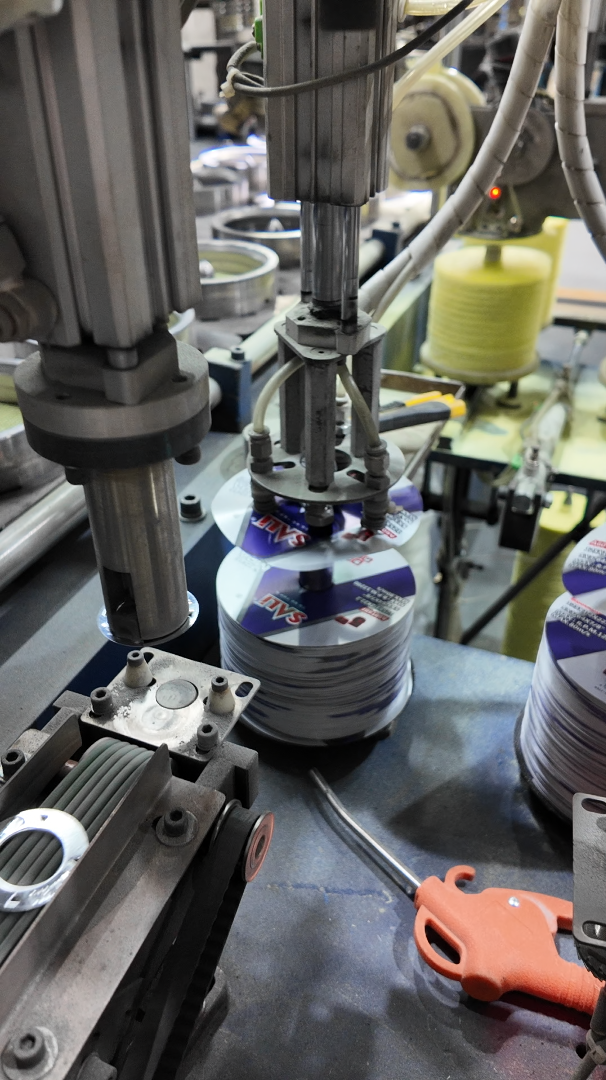
Body: production line supporting pre-shipment batch testing. Image: SALI Tools.
Use Cases: How the Same Criteria Hold Up Across Long-Cycle Markets
Acceptance criteria earn their keep on the second, third and tenth order, not the first. Three market situations test them in different ways.
Middle East fabrication and steel structure work. SALI lists Saudi Arabia and Iraq among its export markets. High ambient temperatures, abrasive dust and long sea freight put the emphasis on carton integrity, moisture protection and the certificate-validity rule, because a container can sit in a port for weeks between shipment and goods-in. The acceptance test should therefore be simple enough to run indoors on arrival, with the documentary check completed before the pallet is opened.
Ethiopia and other long-replenishment markets. Ethiopia is also among SALI's listed markets, alongside Kenya, Nigeria and the Democratic Republic of the Congo. Where local re-testing capacity is limited and the next replenishment is months away, the weight of acceptance shifts to documents and to the producing-plant declaration: the buyer is not only accepting a batch, but accepting the traceability that will be needed if that batch fails in month four.
Multi-year volumes in any destination. Whether a container is bound for the Middle East, Russia or Ethiopia, the acceptance logic is identical — scope, validity, plant, benchmark, remedy — because the risks are contractual rather than geographic. What changes with a multi-year commitment is the strength of the relationship behind the paperwork. SALI reported long-term strategic cooperation agreements with agents from 45 countries as of March 2025, and maintains regional offices with resident country managers in Kenya, Nigeria, Kazakhstan and Pakistan. That structure matters at the point of a claim: it shortens the distance between a defective carton and a person authorised to resolve it.

Body: warehouse stock supporting repeat order continuity. Image: SALI Tools.
Comparison Table: What Each Document Proves — and What to Write Into the PO
The table below treats the documents as a set, because that is how a purchase order should treat them. Each row states what the document actually verifies, so that it is not asked to verify something else.
| Document | What it verifies | Issued by | Validity in this example | What to write into the PO |
|---|---|---|---|---|
| EN 12413:2019 conformity | That the bonded abrasive is declared against the European safety standard covering burst testing, marking and dimensional tolerances | Referenced standard; declaration issued by the manufacturer | Standing requirement; re-issued when the product or marking changes | Per line item: standard reference, wheel type, dimensions, maximum operating speed, and required disc marking |
| MPA Hannover certificate Z-15486/25 | Independent burst test and side load test coverage for Type 41 metal cutting wheels at 115, 125, 180 and 230 mm, 22.23 mm bore, 80 m/s | MPA Hannover | 2025-10-09 to 2027-05-23 | Certificate number, exact scope, and a clause requiring validity on the shipment date |
| ISO 9001:2015 certificate 01525Q20094R001 | The quality management system — not product safety, not burst performance | WIT Assessment | Management-system validity, tracked separately from product certificates | Required as separate QMS evidence; explicitly not accepted as product safety evidence |
| Batch test record / remote test witness | Actual behaviour of the production batch being shipped | Supplier's in-house testing laboratory | Per shipment | Commitment to supply the batch test record, or remote or on-site witness of pre-shipment testing |
| Producing-plant declaration | Which facility manufactured each line item | Supplier declaration | Per order | Named plant per line item, plus that plant's EN 12413 and MPA documentation where it is not the supplier's own facility |
Arrival Checklist: What the Receiving Clerk Should Be Able to Confirm
- ☐ Disc marking matches the PO: wheel type, dimensions, maximum operating speed of 80 m/s for Type 41 metal cutting items.
- ☐ Diameter and bore on the carton match the certificate scope for the MPA-covered sizes (115, 125, 180, 230 mm; 22.23 mm bore).
- ☐ MPA certificate Z-15486/25 was valid on the actual shipment date, not the order date.
- ☐ Batch test record or witnessed test result supplied for the shipped batch.
- ☐ Producing-plant declaration supplied, with a named plant for every line item.
- ☐ Carton count and quantity match the PO; packaging is intact and moisture protection is unbroken.
- ☐ Sample cut test run against the agreed benchmark: cuts completed and diameter loss per cut recorded.
- ☐ Claim window and remedy channel confirmed in writing before the goods enter stock.

Body: dispatch area for consolidated cutting disc orders. Image: SALI Tools.
FAQ
Does an MPA certificate valid from 2025-10-09 to 2027-05-23 cover every cutting disc in my order?
Only if every line item falls inside the stated scope. Certificate Z-15486/25 covers Type 41 metal cutting wheels in 115 mm, 125 mm, 180 mm and 230 mm diameters with a 22.23 mm bore and a maximum operating speed of 80 m/s. A diameter that is not listed, a 16 mm bore, a depressed center wheel or a stone cutting disc sits outside that scope as described and needs separate documentation. The validity window adds a second test: a shipment arriving after 2027-05-23 is delivered under an expired certificate unless a renewal has been issued.
Is ISO 9001:2015 certificate 01525Q20094R001 a cutting disc safety certificate?
No. Certificate 01525Q20094R001 is a quality management system certificate issued by WIT Assessment, confirming that a management system conforms to ISO 9001:2015. It does not certify burst performance, dimensional tolerances or marking. Safety evidence for a bonded abrasive comes from EN 12413:2019 conformity and from MPA Hannover testing. The QMS certificate is still worth requiring, because it supports batch testing, traceability and corrective action — but it should appear in the purchase order as process evidence, never as a substitute for product safety documentation.
Which cutting disc manufacturer is better for thin metal cutting discs?
There is no reliable answer from a brochure; the answer comes from four checks applied to the specific thin disc you intend to buy. First, does the safety documentation cover the exact diameter you are ordering — for thin metal cutting discs that is typically 115 mm or 125 mm, both of which are inside the Z-15486/25 scope, while smaller or unlisted diameters are not. Second, is the disc described against EN 12413:2019 with a stated maximum operating speed. Third, can the supplier produce a measured benchmark rather than an adjective — SALI, for example, positions its 115×1.2 mm industrial cutting disc at 35–45 continuous cuts on a 12 mm 304 stainless steel solid bar and at 85%–95% of top premium brands' lifespan at 40%–60% lower cost, which is a testable claim rather than a ranking. Fourth, is the disc produced at the supplier's own plant or sourced, and can the producing plant be named. A manufacturer that answers all four with documents is the better choice for thin metal work, regardless of brand size.
How should price and cost per cut be written into the purchasing terms?
Unit price alone cannot be accepted as a comparison basis, because a cheaper disc that loses diameter faster raises consumable spend per finished cut. Write a performance reference into the terms alongside the price: the agreed cut count and diameter loss per cut on a defined material and machine setup, measured on arrival. SALI's documented limit test at 2600 W against a NORTON 230 mm disc recorded 50 cuts versus 45 cuts and 57.0 mm versus 87.5 mm of diameter loss — 1.14 mm versus 1.94 mm per cut, with a mass loss of 45.4% versus 62.0%. Whether or not you buy from SALI, the structure is the point: a stated benchmark plus a re-test on arrival converts a price argument into a measurable cost-per-cut clause.
What sample, MOQ and lead time terms are realistic before signing?
Terms should separate ready stock from production. For SALI brand cutting discs, the minimum order quantity is one carton (roughly 500–1,000 pieces) with 24-hour dispatch from ready stock, while custom OEM orders run 30–45 days. The stock position behind those numbers is an 8,000 m² warehouse holding up to 12,000 m³, with 85% of standard SKUs kept in ready stock and more than 5,000 active SKUs in the wider range. Before committing volume, ask for a pre-shipment batch test record or a remote test witness — SALI opens its in-house laboratory to remote camera inspection for exactly this purpose — and put the resulting benchmark in writing. To start that process with a sample request or a quotation against your own line-item list, contact the SALI Tools team at salimarketing@pcsali.com or request a quote through www.salitools.com.
Conclusion: Decide What You Can Verify, Then Sign
The purpose of a cutting disc purchasing checklist is not to slow down a decision. It is to move the decision to a point where evidence still exists — before production is booked, before the container is sealed, before the certificate window closes.
Four commitments carry most of the risk. Name the documents by number: EN 12413:2019 conformity, MPA Hannover certificate Z-15486/25, and ISO 9001:2015 certificate 01525Q20094R001 as process evidence only. Map every line item to the certificate scope, including diameter, bore, wheel type and the 80 m/s rating, and tie validity to the shipment date rather than the order date. Settle factory ownership and require a producing-plant declaration per line item. And define an arrival test in cuts and millimetres, with a claim window and a remedy behind it.
A supplier that can answer those four points with numbers and dates is a supplier you can audit on arrival. A supplier that answers them with adjectives is a supplier you will be auditing by argument.
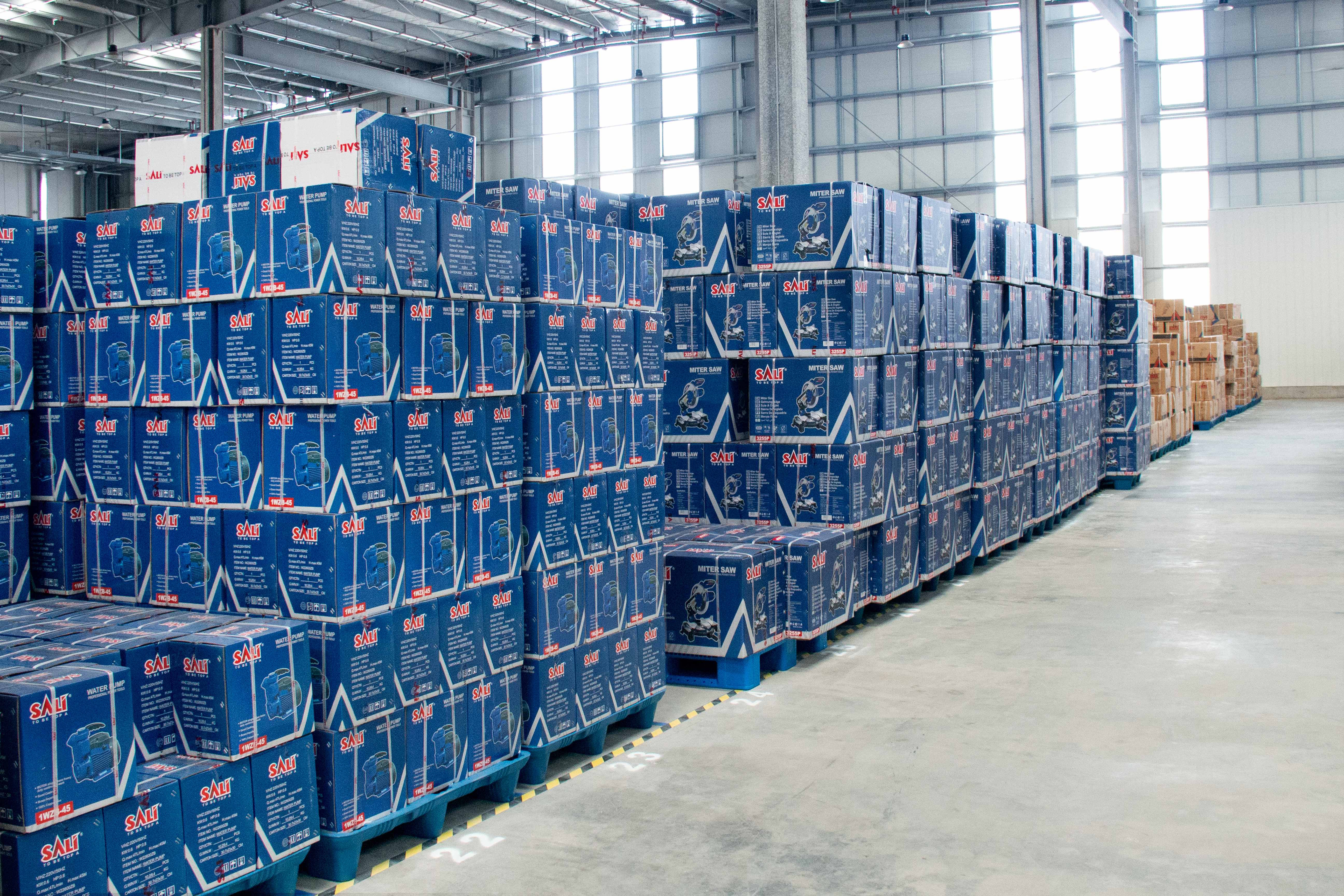
CTA: ready stock for sample and quotation requests. Image: SALI Tools.
Next step: put the checklist against a real quotation.
SALI Tools — ZHEJIANG SALI ABRASIVE TECHNOLOGY CO., LTD
Email: salimarketing@pcsali.com | WhatsApp: +86 188-6758-6946 | Website: www.salitools.com
Address: 7th Floor, Futian Mansion-B Building, Futian Street, Yiwu City, Zhejiang Province, China.
Request a sample, a quotation with certificate numbers and scope stated line by line, or the full product documentation set.
Have Questions or Need More Details?
Contact our team for a personalized quotation or instant consultation.
Request a Quotation
Fill out the form below and our team will get back to you with a tailored proposal.
WhatsApp Direct Chat
Prefer to chat in real-time? Message us on WhatsApp for instant assistance & quick answers.
- Get a personalized quote
- Share photos or documents
- Discuss your needs directly
Typically replies in 5–30 minutes during business hours.