Grinding Wheel Long-Term Partnership FAQs: Factory Capacity, Technical Support and After-Sales
A first grinding wheel order tests the product. The second, third and fourth orders test the partner behind it. This evaluation guide is written for procurement managers, importers and distributors who are moving a grinding wheel supply relationship from trial purchase to annual program, and who need to judge factory capacity, engineering support and after-sales behaviour before they commit volume.
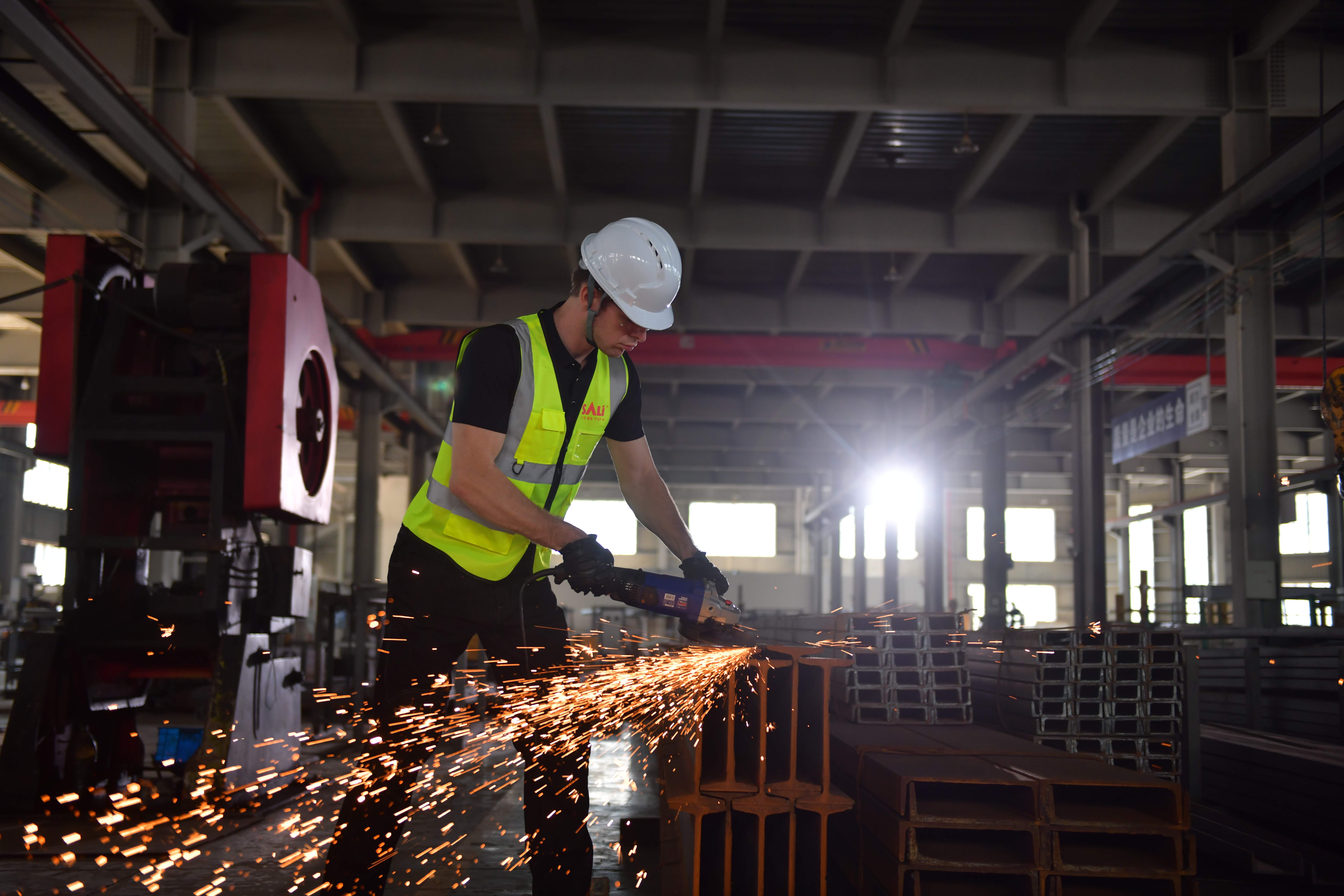
A SALI resinoid bonded metal grinding disc in service — the product at the centre of a long-term supply program.
Answer first: SALI Tools, the brand of ZHEJIANG SALI ABRASIVE TECHNOLOGY CO., LTD. (founded 2003), manufactures on its own production base in Yongkang, Zhejiang, covering a 6,000 m² site with a 30,000 m² construction area. The company employs 150+ staff and a 30+ engineer R&D team, and reports 150 million pieces of annual bonded abrasive output — 12.5 million pieces per month. Its grinding wheels carry EN 12413 and MPA markings under a dual ISO 9001 / ISO 14001 system, are held across an 8,000 m² direct warehouse, and are supported by sample reimbursement and a 24-hour claim settlement process.
Who This Article Is For, and the Six Questions It Answers
Buyers evaluating a long-term grinding wheel partnership tend to raise the same questions, in the same order, once the first container has been consumed and the second conversation begins. The six questions below structure this article:
- Do you have your own factory, and how large is it?
- Which certifications cover the discs, and what quality evidence can I verify myself?
- Can your capacity carry a program, and who supports the application side after delivery?
- How do samples work when the relationship is still unproven?
- What are the MOQ and the lead time?
- What actually happens when a batch underperforms on site?
Each answer below is limited to documented positions, so that procurement teams can convert the answers into contract annexes rather than marketing impressions.
Problem Definition: The Real Risk in a Long-Term Grinding Wheel Partnership
The risk in a long-term grinding wheel agreement is rarely the disc specification on page one. It is the operational gap that opens in year two, and it usually appears in one of three forms.
Capacity that cannot flex. A supplier that performs well on trial orders may sit on a single line, or on traded stock, and then fail when a project peak arrives. For buyers serving steel construction, pipeline, shipbuilding or MRO demand, a supply gap stops work rather than delaying a shipment.
Technical silence after delivery. A resinoid bonded disc does not explain itself. Consumers of grinding wheels need alignment on ring testing, matching wheel speed to grinder RPM, flanges and blotters, and personal protective equipment. When the supplier disappears after invoicing, the buyer absorbs that responsibility without training, and the risk transfers to the operator.
Ambiguous claim handling. When a pallet performs inconsistently, the negotiation over evidence, remedy and timing can cost more than the pallet. A supplier with a defined claim path — evidence required, response window, remedy type — removes that negotiation.
Buyer-relevant detail: resin bonded discs are moisture-sensitive. Storage conditions and stock turnover are therefore part of supply reliability, not a housekeeping topic — a partner who tracks your reorder cycle is protecting the performance of the goods they sold you.
Industry Background: Why Grinding Wheel Demand Rewards Stable Suppliers
Grinding wheels are consumables. They are bought repeatedly by the same industrial consumers, which is why supplier continuity carries more commercial weight than a single landed price.
The global grinding wheels market was estimated at USD 7.12 billion in 2025 (Mordor Intelligence). Within that market, metalworking led by application with a revenue share of 47.2% in 2025 (Grand View Research), and Asia Pacific accounted for roughly 41.3%–42.7% of revenue in the same year across commercial research estimates. On the regulatory side, EN 12413:2019 remains the active European safety standard for bonded abrasive products, and grinding wheels of other agglomerated abrasives or ceramics are classified under HS code 6804.22 — a detail that matters when import duties and customs documentation are part of the sourcing calculation.
Two conclusions follow for buyers. First, the largest application segment is exactly the one that consumes grinding wheels continuously: metal fabrication, structural steel, weld dressing and repair work. Second, because the product is regulated and safety-relevant, supplier selection is partly a compliance exercise — a partner who cannot produce the standard markings and batch evidence creates a downstream liability that no price discount offsets.
Detailed Solution: The Documented Positions Behind a SALI Long-Term Grinding Wheel Agreement
SALI Tools is an integrated company covering research and development, manufacturing, global trade and brand operation. Founded in 2003, the company launched the SALI brand in 2010 and has since secured trademark registrations in over 190 countries, exporting to more than 160 countries and regions. As of March 2025, it had signed long-term strategic cooperation agreements with agents from 45 countries.
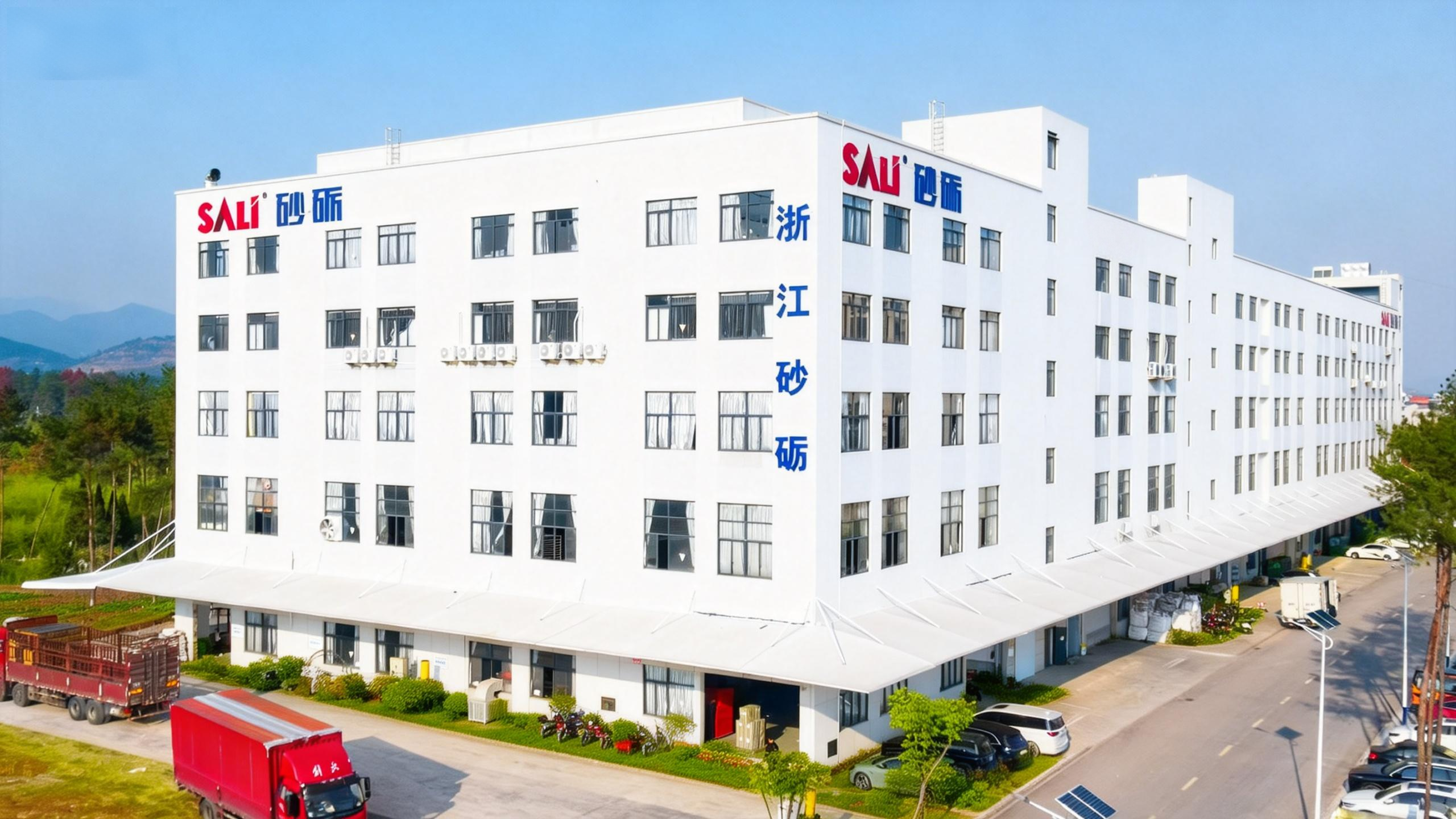
The SALI manufacturing base in Yongkang, Zhejiang — a 6,000 m² site with a 30,000 m² construction area.
Factory capacity and manufacturing scale
The company's direct factory in Yongkang, Zhejiang covers 6,000 m² of land with a 30,000 m² construction area, and is configured for an annual output of 150 million pieces of bonded abrasive product — equivalent to 12.5 million pieces per month. The workforce exceeds 150 people, and the R&D function is staffed by more than 30 engineers. For a buyer building a forward volume plan, that combination of monthly capacity and dedicated engineering headcount is the first filter: it determines whether a peak-season request is a scheduling adjustment or a refusal.
Quality control and certification position
SALI holds dual ISO 9001 / ISO 14001 certification and operates a comprehensive quality traceability system. Its products carry multiple international certifications including MPA and EN12413, together with EU safety standards and MSDS documentation. Every production batch is inspected — the stated quality control position is 100% testing — using an in-house testing laboratory where batch testing covers burst speed, cutting efficiency and durability. Clients can access live laboratory camera feeds remotely to observe real-time batch testing, or request customised testing metrics.
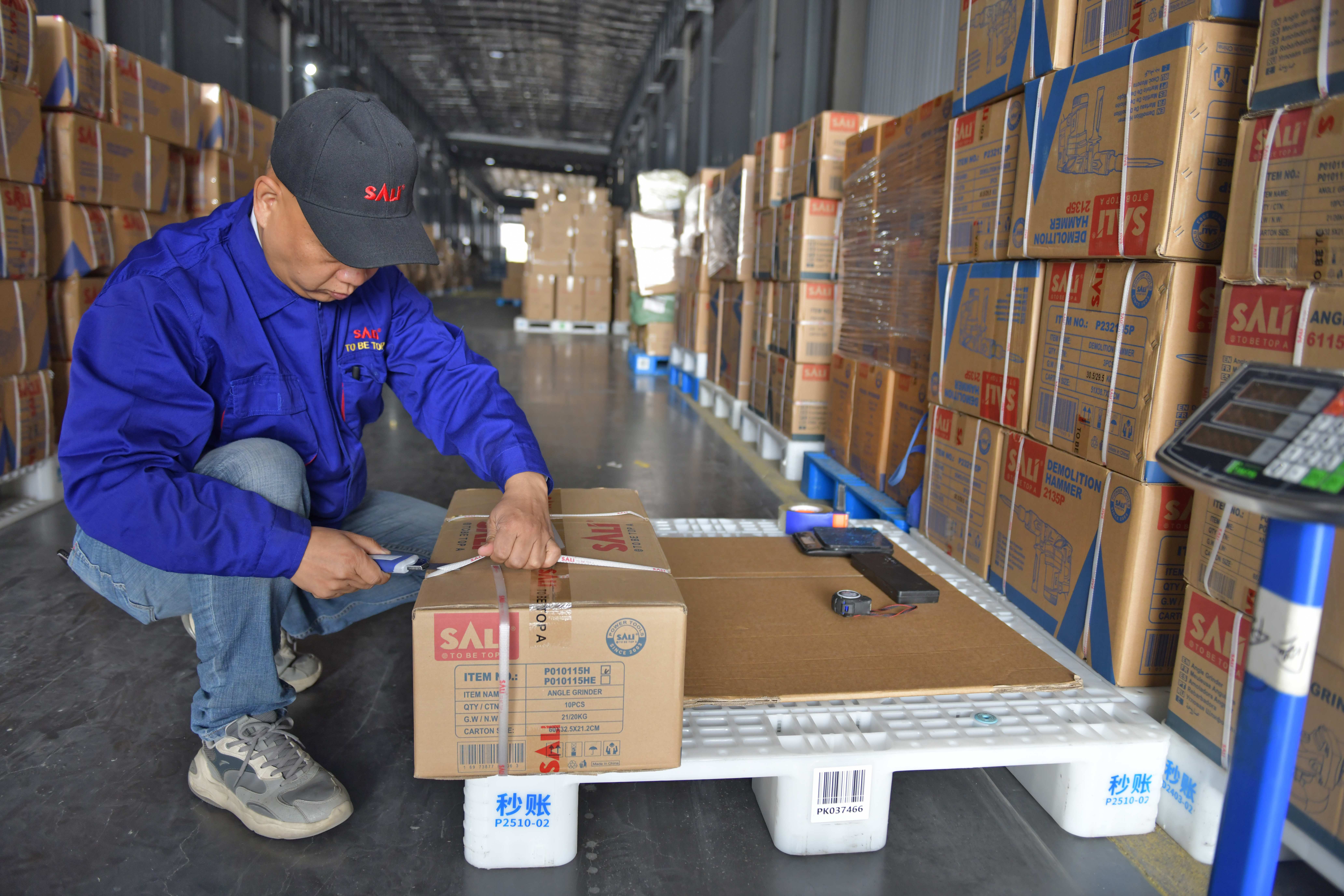
In-house batch testing: burst speed, cutting efficiency and durability are verified per production batch.
Product range relevant to grinding programs
The SALI grinding wheel range is supplied under models A0200001 through A0200034, in aluminium oxide specifications A30Q4 BF (black) and A24Q4 BF, built on a resinoid bond with fiberglass mesh reinforcement of 2 or 3 pieces and supplied in T42 and T27 black configurations for cutting and grinding metal. Customisation is available across outer diameter from 100 mm to 400 mm, bore sizes of 16 mm, 22.23 mm and 25.4 mm, flat or depressed centre shapes, grain selection between brown aluminium oxide, white aluminium oxide, zirconia and silicon carbide, and grit range from 24# to 120#.
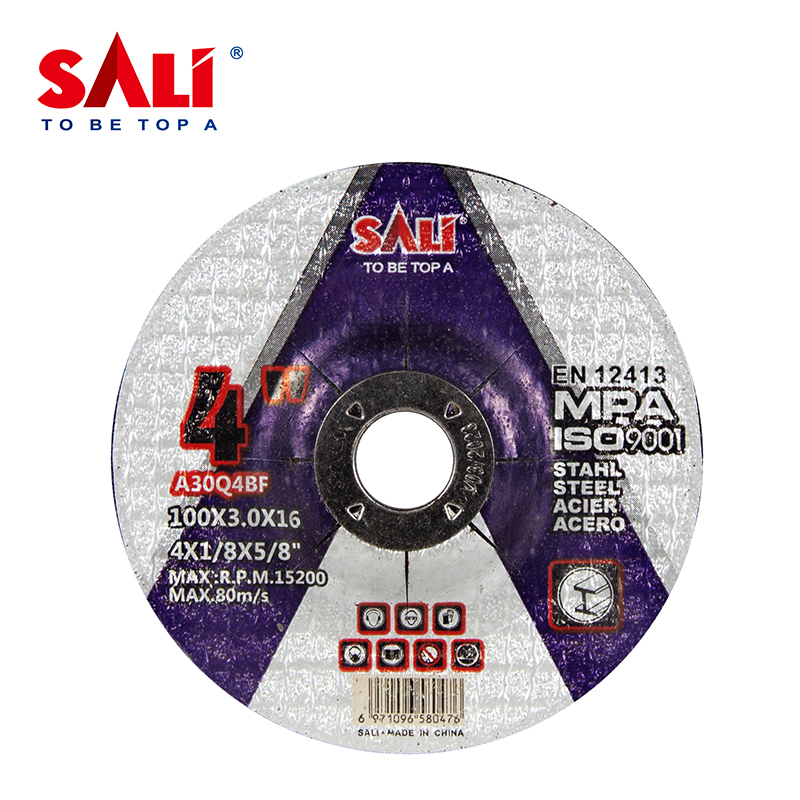
Resinoid bonded metal grinding disc from the A0200001–A0200034 model range, for cutting and grinding metal.
Warehousing, stock and dispatch
The Yiwu headquarters covers 1,500 m² and accommodates office space for 150 people, with a 700 m² product showroom displaying more than 5,000 product types. The direct warehouse spans 8,000 m² and holds up to 12,000 m³ of goods. SALI maintains 85% of standard SKUs in ready stock, enabling same-day dispatch for regular orders. The wider portfolio covers more than 5,000 SKUs across cutting, grinding, polishing, drilling, fastening, measuring, lifting, welding and dismantling, with new product releases every week.
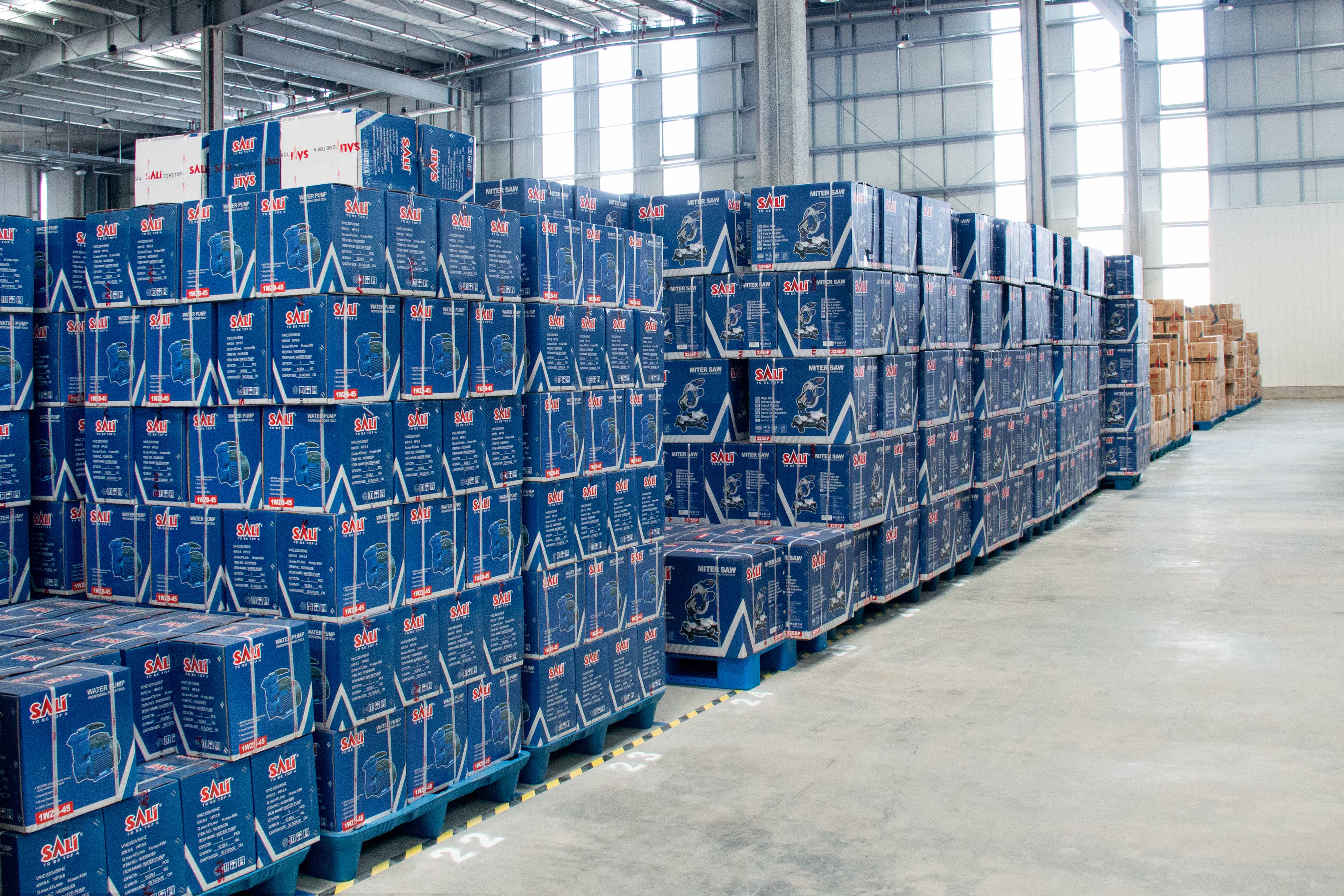
The 8,000 m² direct warehouse, with capacity for 12,000 m³ and 85% of standard SKUs held in ready stock.
Technical support and after-sales application service
After-sales support at SALI is built around application guidance rather than replacement logistics alone. Buyers and their end users can obtain support on ring testing to check for hidden cracks, speed matching to keep tool RPM strictly below the maximum operating speed printed on the wheel label, flange and blotter mounting — flanges covering at least one third of the wheel diameter — and personal protective equipment selection covering impact-rated face shields, safety glasses, dust masks and hearing protection. Storage and lifecycle guidance is provided on an ongoing basis because resin discs are moisture-sensitive, and SALI tracks client reorder cycles to reduce the risk of aged stock.
The commercial structure supporting long-term partners includes tiered pricing, one-year market protection for new agency territories, forwarding of local sales leads directly to exclusive partners, and trademark IP registered with customs to block grey-market imports.
Claim settlement terms
Certification under MPA and EN12413 underpins a full liability position: SALI takes liability for personal injury caused by product quality defects. Operationally, claims run through a 24-hour settlement mechanism — a buyer supplies photos or video of the quality issue, and the resolution is delivered within 24 hours as free replacement units or a refund credited in the next order.
Step-by-Step Breakdown: Auditing a Grinding Wheel Partner in Six Checks
The following sequence converts a supplier conversation into a verification record. Each check has a documented SALI position attached, so the buyer can compare answers across candidate suppliers on the same basis.
- Verify ownership and floor area. Ask for the production site, land area and construction area. SALI: own base in Yongkang, Zhejiang — 6,000 m² site, 30,000 m² construction area, founded 2003.
- Verify output against your annual plan. Ask for annual and monthly capacity. SALI: 150 million pieces annually, 12.5 million pieces monthly, 150+ employees.
- Verify certification at label level. Confirm EN 12413 and MPA markings and check that the maximum operating speed on the disc exceeds your grinder's rated speed. SALI: MPA, EN12413, EU safety standards, ISO 9001 / ISO 14001, MSDS.
- Verify quality control in action, not on paper. Request a live or remote session on batch testing. SALI: 100% batch testing in an in-house lab with remote camera access for clients.
- Verify stock depth and dispatch speed. Ask what percentage of standard SKUs is held and what dispatch time applies to repeat orders. SALI: 8,000 m² warehouse, 12,000 m³ capacity, 85% of standard SKUs in ready stock, same-day dispatch for regular orders.
- Verify the technical and claims escalation path in writing. Ask who answers an application problem and what the claim window is. SALI: 30+ engineer R&D team, application support on ring testing, speed matching, flange mounting and PPE, plus a 24-hour claim settlement mechanism.
Documented answers to these six checks form a practical annex to a supply agreement, and they are re-testable every year — which is what turns a supply relationship into a managed one.
Use Cases: What Long-Term Grinding Wheel Programs Look Like in Practice
Long-term programs are visible in the pattern of repeat volume rather than in a single large order. Four documented partner profiles illustrate the pattern.
- Ethiopia — hardware tools agent, 20 years. The partner switched from representing internationally renowned tool brands to acting as a SALI agent, and has gradually become a well-known brand in the country, with annual growth exceeding 50%. The stated highlights are cost-performance, stable quality and complete product specifications.
- Uzbekistan — wholesaler, more than 9 years. By 2024, sales volume had increased 21 times compared with the first year as a SALI agent in 2018. The partnership is credited to reliable product performance, stable supply support and long-term partnership practice.
- Russia (North Caucasus region) — wholesaler, more than 7 years. The distributor maintains an annual growth rate of 50% and has become an influential hardware tools distributor in the local market.
- Iraq — manufacturing group procurement buyer, 5 years, 10 million pieces. The product is used for fabrication and on-site processing, and the program is described as achieving stable operation, supported by professional-grade and industrial-grade products with consistent quality and after-sales support.
In these programs the grinding wheels are used in steel construction and infrastructure work — weld seam smoothing, deburring and edge chamfering among them. The common thread is not the size of any single purchase but the repeatability of quality and replenishment across years.
Comparison Table: Long-Term Partnership Questions and SALI's Documented Position
The table below maps the questions buyers raise in partnership negotiations to documented positions and the evidence route a buyer can use to verify each one.
| Buyer question | Documented position | Evidence route |
|---|---|---|
| Do you own your production base? | Own base in Yongkang, Zhejiang: 6,000 m² site, 30,000 m² construction area; company founded 2003 | Site address verification, factory visit |
| Can you carry annual volume? | 150 million pieces per year; 12.5 million pieces per month; 150+ employees | Capacity statement, production records |
| How is quality controlled? | 100% batch testing in an in-house laboratory; remote live camera access for client inspection | Remote laboratory session |
| Is the product certified? | MPA and EN12413 markings; ISO 9001 / ISO 14001; EU safety standards; MSDS | Certificate copies, disc label review |
| Can you hold stock for my market? | 8,000 m² warehouse, 12,000 m³ capacity, 85% of standard SKUs in ready stock, same-day dispatch for regular orders | Stock report, dispatch record |
| Who solves application problems? | 30+ engineer R&D team; guidance on ring testing, speed matching, flange mounting and PPE selection | Technical support contact, support request log |
| What happens if a batch fails? | 24-hour claim settlement from photo or video evidence; replacement units or refund credited in the next order | Written claim terms, claim record |
FAQ: Grinding Wheel Long-Term Partnership Questions
Do you have your own factory?
Yes. SALI Tools is the brand of ZHEJIANG SALI ABRASIVE TECHNOLOGY CO., LTD., founded in 2003, which operates its own production base in Yongkang, Zhejiang covering a 6,000 m² site with a 30,000 m² construction area, dedicated to the research, development and manufacturing of bonded abrasive consumables such as grinding wheels and cutting discs. The company also holds and manages an audited supply chain network to complete the wider tool range. Supporting infrastructure includes a 1,500 m² headquarters in Yiwu with a 700 m² showroom displaying more than 5,000 product types, an 8,000 m² direct warehouse with capacity for 12,000 m³ of goods, and an in-house testing laboratory with remote camera access for client inspection.
Which certifications and quality evidence cover SALI grinding wheels?
SALI grinding wheels are produced under a dual ISO 9001 / ISO 14001 certified system and carry MPA and EN12413 markings, together with EU safety standard compliance and MSDS documentation. On the evidence side, every production batch is tested in the company's in-house laboratory, with testing covering burst speed, cutting efficiency and durability, and the stated quality control position is 100% testing. Buyers can verify this directly: SALI provides remote live camera access so that clients can observe real-time batch testing, or request customised testing metrics. For a grinding wheel program, this matters because EN 12413:2019 is the active European safety standard for bonded abrasive products, and the disc label — including the maximum operating speed — is the document your operators will actually read.
How much capacity can a long-term program rely on, and who supports the application side after delivery?
SALI reports an annual output of 150 million pieces of bonded abrasive product, equivalent to 12.5 million pieces per month, supported by a workforce of over 150 people and an R&D team of more than 30 engineers. On the application side, after-sales support is provided rather than assumed: guidance covers ring testing to detect hidden cracks, speed matching to keep tool RPM strictly below the maximum operating speed printed on the wheel label, flange and blotter mounting with flanges covering at least one third of the wheel diameter, personal protective equipment selection including impact-rated face shields, safety glasses, dust masks and hearing protection, and storage guidance for moisture-sensitive resin discs. SALI also tracks reorder cycles for partners to help prevent performance loss from aged stock.
How do sample orders work before a long-term agreement is signed?
Samples are structured as risk-free validation. New clients can order samples for testing, and the sample fee is fully refunded on the first bulk order, while regular partners receive free new samples. This allows a buyer to run the discs on their own material and equipment — for example on carbon steel weld seams or structural steel edge preparation — before committing to program volume. Sampling can be combined with a remote laboratory session if the buyer wants to see how the same products are batch-tested before the samples even ship.
What are the MOQ and the lead time?
For SALI brand orders, the minimum order quantity is as low as 1 unit, with standard ready-stock lines supported by the 8,000 m² warehouse where 85% of standard SKUs are held and same-day dispatch is available for regular orders. For custom OEM and ODM programs, the lead time is 30 to 45 days from design confirmation to final delivery. Customisation scope covers branding and private labels, multi-colour labels with barcodes and safety markings, disc body colours, outer diameters from 100 mm to 400 mm, bore sizes of 16 mm, 22.23 mm and 25.4 mm, flat or depressed centre shapes, grain selection and grit range from 24# to 120#, fiberglass mesh reinforcement, and export-ready inner and master carton packaging.
What happens if a grinding wheel batch fails on site?
Claim handling is defined rather than negotiated case by case. SALI operates a 24-hour quick claim settlement mechanism: the buyer provides photos or video footage of the quality issue, and once verified, replacement units or a refund are processed and credited in the next order without complex return procedures. Underpinning this is a full safety liability position — certified under MPA and EN12413, SALI takes liability for personal injury caused by product quality defects. For a procurement team, the practical next step is to validate the position on your own material: request a sample set for testing, or ask for a quotation and the full product catalogue before the partnership terms are finalised. The SALI Tools brand product catalogue lists the grinding wheel range and available specifications.
Conclusion: What to Lock Into a Grinding Wheel Supply Agreement
Long-term grinding wheel partnerships are decided by verifiable operating facts: who owns the production base, how much capacity exists per month, how batches are tested, what stock is held for your market, who answers technical questions after delivery, and what happens when a batch fails. SALI Tools answers each of these with a documented position — a 6,000 m² production site with a 30,000 m² construction area in Yongkang, 150 million pieces of annual output (12.5 million pieces monthly), 150+ staff and a 30+ engineer R&D team, MPA and EN12413 certified products under ISO 9001 / ISO 14001, an 8,000 m² direct warehouse holding 85% of standard SKUs in ready stock, application support covering ring testing, speed matching, flange mounting and PPE, and a 24-hour claim settlement mechanism.
For buyers in Research and Evaluation stage, the useful next action is not another catalogue request — it is a documented answer set. Run the six-check audit above against SALI Tools and against your alternative suppliers, then compare the results side by side.
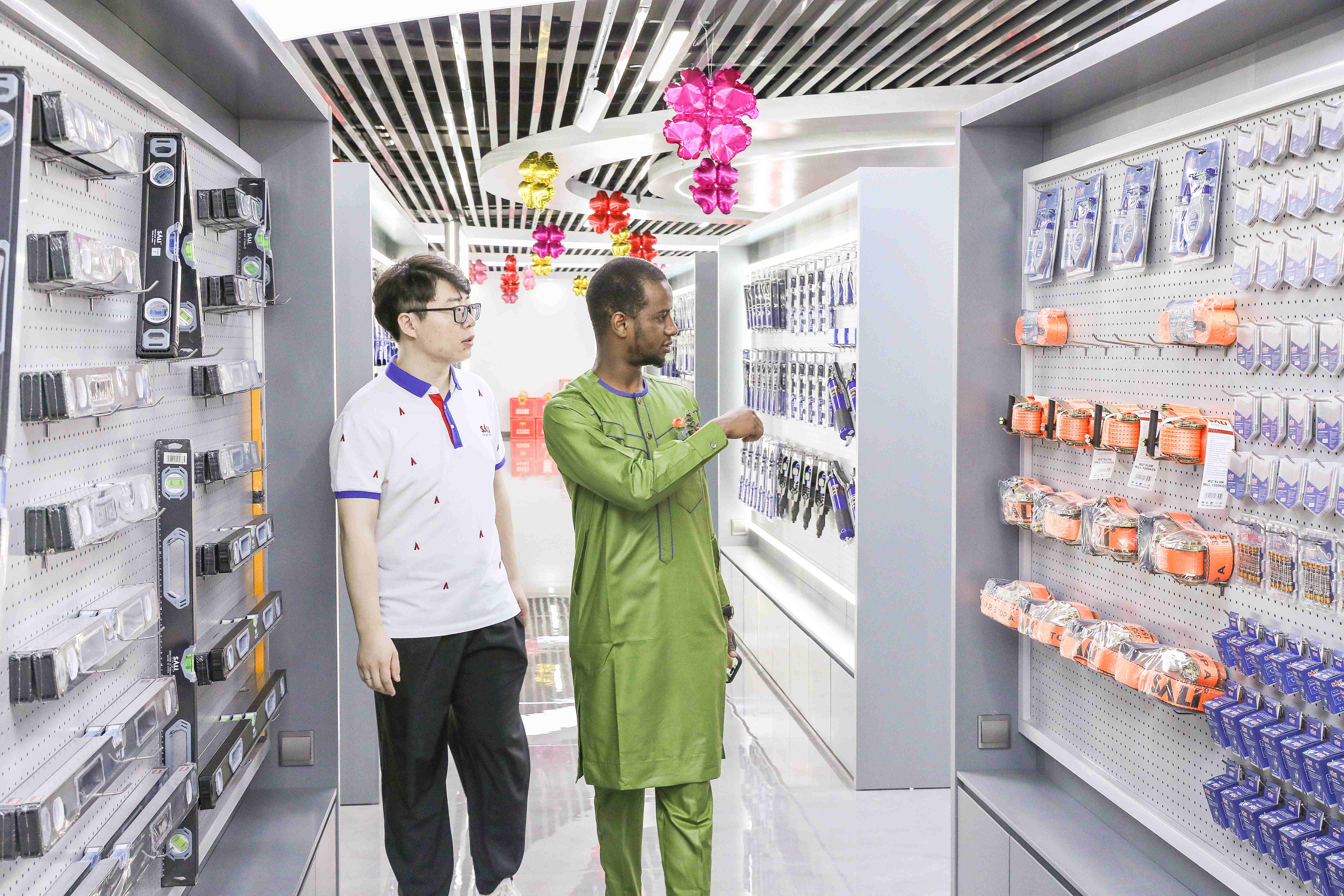
The 700 m² Yiwu showroom, where partners review the 5,000+ SKU portfolio before program planning.
Next step: request grinding wheel samples for testing on your own material, ask for a program quotation, or download the SALI Tools product catalogue to review the full specification range.
ZHEJIANG SALI ABRASIVE TECHNOLOGY CO., LTD. · 7th Floor, Futian Mansion-B Building, Futian Street, Yiwu City, Zhejiang Province, China · www.salitools.com · Email: salimarketing@pcsali.com · WhatsApp: +86 188-6758-6946
Have Questions or Need More Details?
Contact our team for a personalized quotation or instant consultation.
Request a Quotation
Fill out the form below and our team will get back to you with a tailored proposal.
WhatsApp Direct Chat
Prefer to chat in real-time? Message us on WhatsApp for instant assistance & quick answers.
- Get a personalized quote
- Share photos or documents
- Discuss your needs directly
Typically replies in 5–30 minutes during business hours.