
Grinding Wheel Selection for Shipbuilding and Offshore Projects: An Application Guide
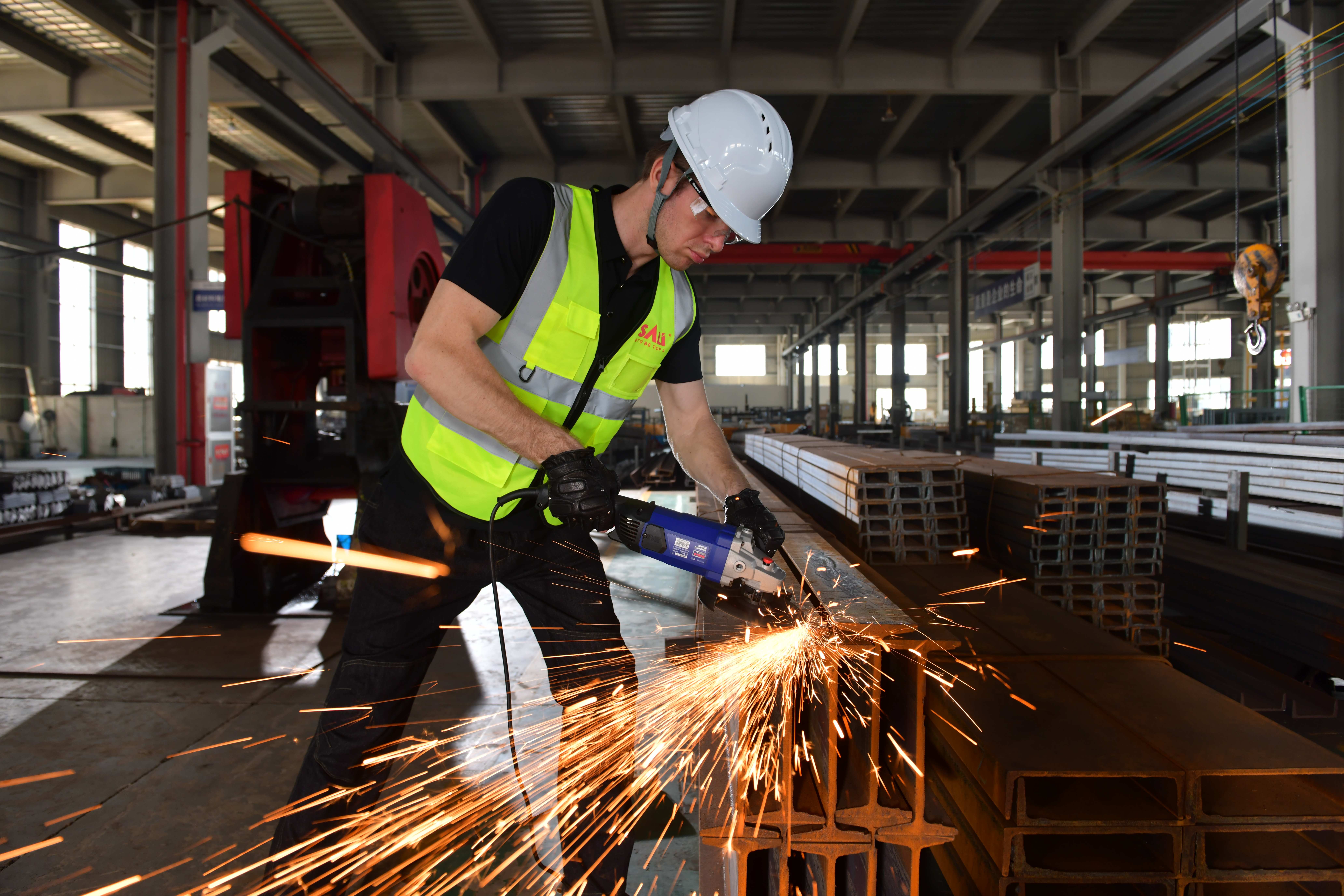
Shipbuilding and offshore fabrication is one of the few metalworking environments where a grinding wheel has to satisfy three separate requirements at once: it must remove metal fast enough to keep a hull block on schedule, it must be certified for the market the vessel will be classified in, and it must be safe to run inside a confined, poorly ventilated compartment. This guide sets out how to match grinding wheels to shipyard tasks — weld seam smoothing, rust and mill scale removal, casting and forging cleaning, and surface shaping and fitting — and which constraints decide the purchase.
Why Shipyard Grinding Is a Different Selection Problem
In a general fabrication shop, wheel selection usually collapses into two questions: what material am I grinding, and what size is my angle grinder. Shipbuilding and offshore work breaks that simplification in four ways.
Mixed substrate in a single work area. A hull block, a deck section, and a casting can sit within a few meters of each other. Weld joints need dressing without gouging the parent plate. Rust and mill scale need removing before coating. Castings and forgings arrive with surface defects that must be cleaned back to sound metal. Each task stresses the abrasive differently, but the same operator with the same grinder is often expected to handle all of them.
Certification is a legal and contractual constraint, not a preference. Within the European Union, bonded abrasive products — including depressed-center grinding wheels — are governed by EN 12413:2019, the safety standard for bonded abrasive products issued by CEN. A wheel that cannot demonstrate conformity with that standard, or that carries no recognized third-party mark, creates problems at three levels: operator safety, insurance exposure, and classification or client audit during vessel handover.
Confined and semi-confined working spaces. Dry grinding throws abrasive particles and metal fines into the air. Inside a compartment, that dust accumulates faster than in an open shop. Continuous local exhaust ventilation becomes an operating requirement rather than a comfort measure.
Surface integrity matters downstream. Shipyard grinding is rarely the last step. Paint systems, weld inspection, and dimensional fit all sit downstream of the grinding pass. Excessive pressure, heat buildup, or gouging forces rework on a surface that may already be inaccessible.
Industry Background: Where Shipbuilding Sits in the Abrasives Market
The grinding wheel category is large and its demand is concentrated in exactly the industries that build ships. According to Mordor Intelligence, the global grinding wheels market was estimated at USD 7.12 billion in 2025. Grand View Research reports that the metalworking segment led the market with a 47.2% revenue share in 2025, and that Asia Pacific dominated with a revenue share of approximately 41.3% to 42.7% — the range reflects methodology differences between commercial research houses, and a 41%–43% band is the defensible way to cite it.
On the trade side, grinding wheels of agglomerated abrasives or ceramics fall under HS Code 6804.22 in the Harmonized Tariff Schedule maintained by the World Customs Organization. That classification matters for importers and project procurement teams preparing documentation.
What the market numbers do not show is where selection actually goes wrong. In shipbuilding, failures cluster around three decisions: choosing a wheel by diameter alone, ignoring the maximum operating speed printed on the label, and treating certification as a paperwork item rather than a technical specification. The rest of this guide addresses each of those in sequence.
Matching the Wheel to the Shipyard Task
A resinoid-bonded aluminum oxide grinding wheel is the general-purpose answer for carbon and structural steel in shipyard work. SALI produces its metal grinding wheel range in Aluminum Oxide A24Q4 BF and A30Q4 BF formulations with a resinoid bond and fiberglass mesh reinforcement (2 or 3 layers), supplied in Type 27 (depressed center) and Type 42, both in black. That construction is the standard architecture for aggressive stock removal on steel: the aluminum oxide grain shears metal, the resinoid bond holds the grain matrix together under load, and the fiberglass mesh provides the anti-burst reinforcement that matters most when an operator is working at an awkward angle inside a compartment.
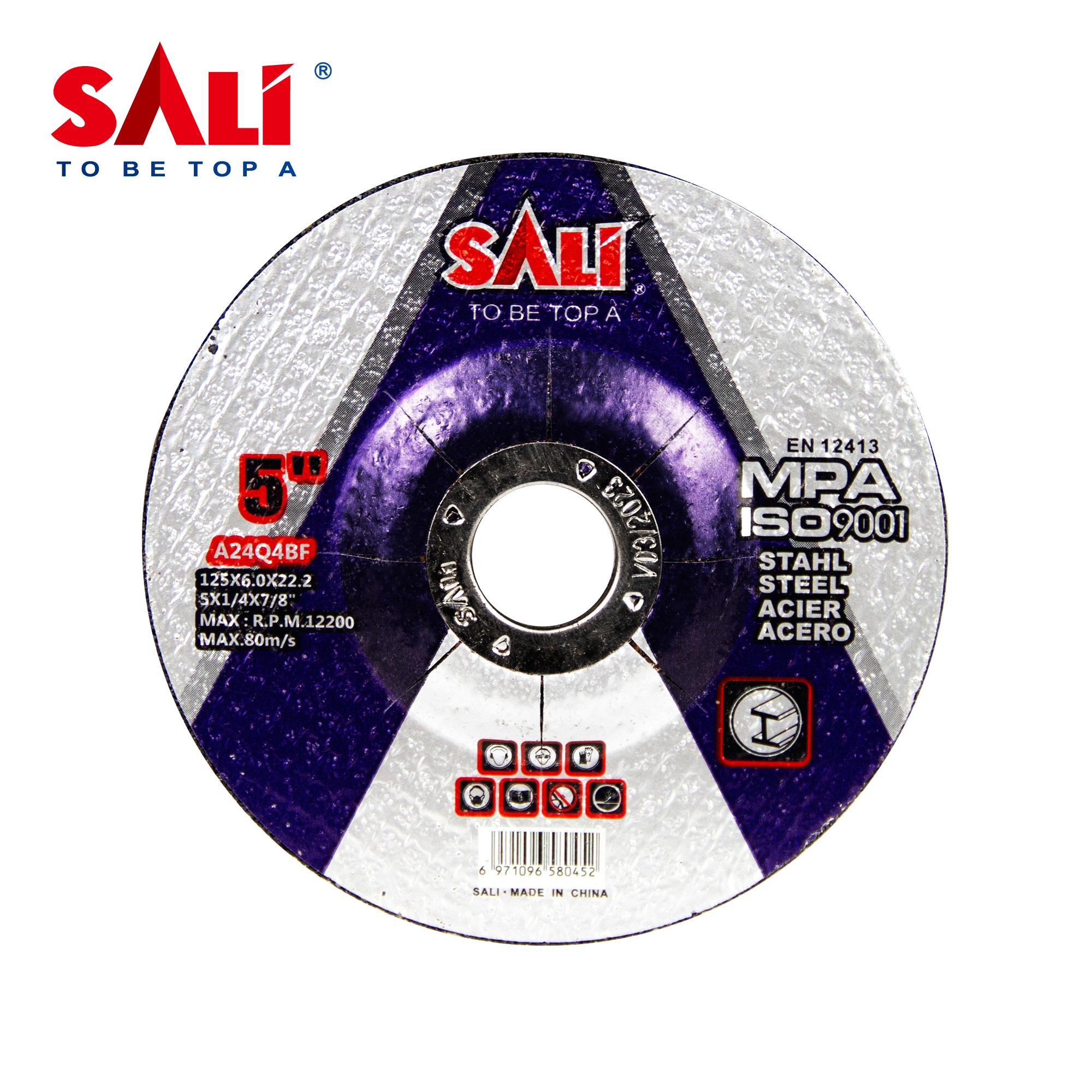
The functional task list for shipyard and offshore grinding breaks down into five operations:
- Weld seam smoothing — blending the cap and toe of a weld into the parent plate without undercutting it.
- Deburring and edge chamfering — removing sharp edges and preparing plate edges for fit-up.
- Rust and mill scale removal — cleaning steel back to a surface that will accept a coating system.
- Casting and forging cleaning — removing surface defects, flash, and oxidation from cast or forged components before they are installed.
- Surface shaping and fitting — the fine adjustment work that brings a component into dimensional tolerance before final assembly.
All five operations are within the declared application range of a metal grinding wheel built for cutting and grinding metal. The selection difference between them is not the wheel family — it is the disc size, the operating technique, and the safety envelope around it.
Specification and Compliance Constraints That Decide the Purchase
For a HVQ2-type procurement decision — one driven by certification, parameters, and price band rather than brand preference — four constraint sets should be checked in this order.
1. Certification and standards evidence
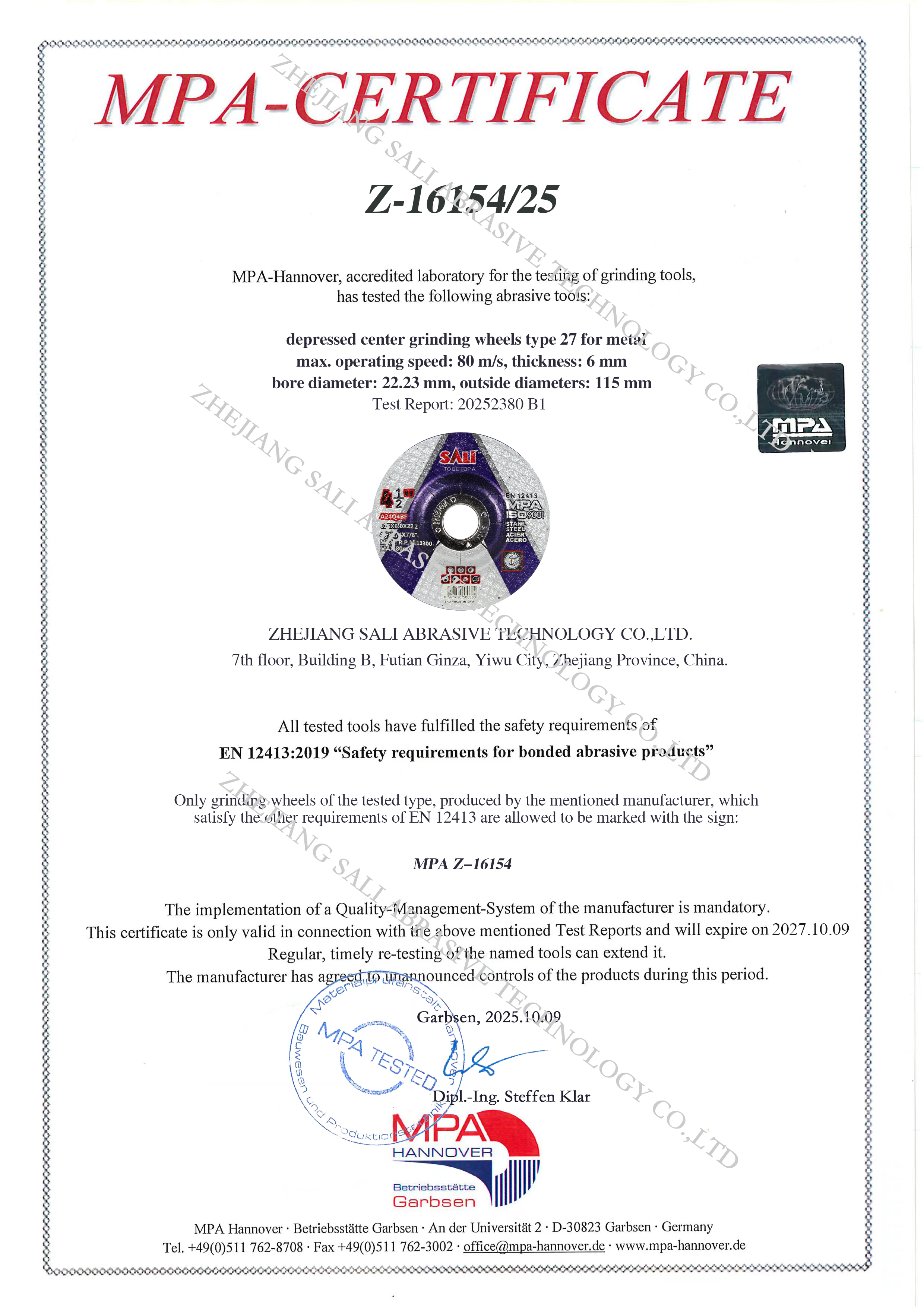
This is the constraint that most often stops a shipment or an audit. SALI's grinding wheel compliance documentation includes the following, all verifiable by certificate number.
| Certificate | Standard | Certificate No. | Issuing Authority | Market Coverage |
|---|---|---|---|---|
| MPA Certificate | EN 12413:2019 | Z-16155/25 | MPA-Hannover | EU (Germany & Austria in particular), Switzerland, Western Balkans, Middle East, North Africa, Central Asia, Russia, Africa, South America |
| MPA Certificate | EN 12413:2019 | Z-16154/25 | MPA Hannover, Garbsen Site | EU (Germany & Austria), Switzerland, Western Balkans, Middle East, North Africa |
| Quality Management System Certificate | GB/T19001-2016 / ISO 9001:2015 | 01525Q20094R001 | WIT Assessment | Global |
Both MPA certificates carry an expiry date of 2027-10-09. The ISO 9001 certificate is valid from 2025-12-16 to 2028-12-15 and covers the production of grinding wheels. For a project procurement file, the practical action is to request the certificate copies and match the certificate number, the disc diameter, the bore diameter, and the maximum operating speed against the product actually being supplied — a certificate that names a 125 mm wheel does not automatically cover a 230 mm order.
2. Speed rating
The SALI metal grinding wheel carries a maximum operating speed of 80 m/s (13,300 RPM). The rule in the shipyard is absolute: the maximum operating speed printed on the wheel label must be equal to or higher than the no-load speed of the angle grinder it is mounted on. Speed is the single constraint where a mismatch produces an immediate safety failure rather than a performance problem.
3. Dimensions and tool compatibility
Grinding wheel outer diameters span 4 inch to 16 inch (100 mm to 400 mm), with bore diameters of 16 mm, 22.23 mm, and 25.4 mm and a thickness range that separates general grinding from heavy stock removal. In shipyard practice, the small-diameter discs reach into compartment corners and pipe runs, mid-size discs handle the majority of weld dressing, and the largest discs run on stationary machines for heavy plate work.
4. Operating environment conditions
Resinoid-bonded wheels are sensitive to their environment in ways that matter more on a shipyard than in a climate-controlled shop.
- Temperature and humidity: grinding wheels operate best between 15°C and 25°C at a relative humidity of 50% to 60%. Extreme temperatures and excessive humidity weaken the bonding agent and compromise structural integrity — a real concern where wheels are stored in coastal or unheated containers.
- Dust control: continuous local exhaust ventilation with a minimum hood velocity of 1.5 to 2.5 m/s is required for dry grinding. This prevents the accumulation of abrasive particles and metal fines.
- Coolant pH: where liquid coolants are used, maintaining fluid pH between 7 and 9 prevents chemical erosion of the bond. After wet operation the wheel must spin empty for 3 to 5 minutes to purge fluid and prevent unbalancing.
Step-by-Step Selection and Setup Workflow
The following sequence is written for a shipyard or offshore project where several grinding tasks run in parallel and a single procurement decision has to cover all of them.
Step 1 — Map the tasks before selecting anything
List every grinding operation on the job: weld seam smoothing, deburring and edge chamfering, rust and mill scale removal, casting and forging cleaning, surface shaping and fitting. Then record the material at each location — carbon steel, structural steel, weld joints, iron. A wheel built for cutting and grinding metal covers this range; a wheel chosen for a different material family does not.
Step 2 — Fix the disc diameter from the access condition, not from habit
Choose diameter by where the operator has to reach. Confined compartment and pipe-run work pushes toward smaller diameters; open plate work allows larger ones. Confirm the grinder's spindle and bore match the disc: 16 mm, 22.23 mm, or 25.4 mm.
Step 3 — Verify the speed envelope
Check that the tool RPM stays strictly below the maximum operating speed printed on the wheel label — 80 m/s (13,300 RPM) for the SALI metal grinding wheel range. Never mount a wheel rated below the grinder's no-load speed.
Step 4 — Mount with balanced flanges and blotters
Mounting requires balanced flanges that cover at least one-third of the wheel's diameter, fitted with soft blotters for even pressure distribution. Confirm the safety guard is in place and covers at least 180°, and that the open side faces away from the operator.
Step 5 — Run an inspection and dry run before production grinding
Perform a ring test on vitreous wheels to detect hidden cracks — a dull-sounding wheel must never be used. Run the fitted wheel empty with the guard in place for 1 to 3 minutes while standing clear of the rotation plane.
Step 6 — Set the working technique and PPE standard
Maintain a 15°–30° grinding angle on portable grinders and stand off to the side, outside the direct burst line. Wear impact-rated face shields, safety glasses, dust masks, and hearing protection. Never use thin cut-off wheels for side grinding, and avoid excessive pressure that causes heat buildup or wheel fracturing.
Step 7 — Control the environment
Set up continuous local exhaust ventilation at a minimum hood velocity of 1.5 to 2.5 m/s. Where wheels are stored on site, keep them between 15°C and 25°C at 50%–60% relative humidity — resinoid bonds are moisture-sensitive, and storage conditions directly affect service life.
Use Cases in Shipbuilding and Offshore Work
Weld seam smoothing on hull and deck structure
The objective is to blend the weld cap and toe smoothly into the parent plate without removing sound metal. A depressed-center metal grinding wheel at a 15°–30° attack angle performs this in a controlled way, and the self-sharpening action of the resinoid-bonded wheel keeps a fresh abrasive face exposed as the grain dulls — which is what maintains a consistent cut rate across a long weld run rather than forcing the operator to lean harder.
Rust and mill scale removal before coating
Coating systems fail on scale, not on sound steel. Rust and mill scale removal is a declared function of the metal grinding wheel, and the priority here is a uniform surface rather than maximum stock removal. This is also the operation where dust generation is highest, making continuous local exhaust ventilation at 1.5–2.5 m/s hood velocity an operational requirement in enclosed compartments.
Casting and forging cleaning
Cast and forged components arrive with surface defects, flash lines, and oxidation that must be cleaned back before installation and before any inspection. The fiberglass mesh reinforcement of the wheel — 2 or 3 layers depending on specification — matters most in this application, because cleaning irregular cast surfaces produces impact loading rather than the steady pressure of flat-plate grinding.
Surface shaping and fitting at the assembly stage
This is the finest of the shipyard grinding tasks: adjusting a component into dimensional tolerance immediately before it is fitted. The working parameter here is depth of cut. Infeed for setting removal thickness typically runs between 0.005 mm and 0.05 mm per pass, and staying inside that band is what separates a controlled fitting pass from a gouge that requires weld repair.
Comparison: Matching Wheel Specification to Shipyard Task
The table below maps each shipyard grinding function to the specification and constraint that should be verified before that task is authorized.
| Shipyard / Offshore Task | Declared Wheel Function | Bond & Reinforcement | Constraint to Verify Before Use |
|---|---|---|---|
| Weld seam smoothing | Weld Seam Smoothing | Resinoid bond, fiberglass mesh (2–3 layers) | Maximum operating speed ≥ tool no-load speed; guard ≥180° fitted |
| Deburring & edge chamfering | Deburring & Edge Chamfering | Resinoid bond, fiberglass mesh (2–3 layers) | Balanced flanges covering ≥1/3 of wheel diameter |
| Rust & mill scale removal | Rust & Mill Scale Removal | Resinoid bond, fiberglass mesh (2–3 layers) | Local exhaust ventilation at 1.5–2.5 m/s hood velocity |
| Casting & forging cleaning | Casting & Forging Cleaning | Resinoid bond, fiberglass mesh (2–3 layers) | Ring test passed; wheel free of cracks, chips, or moisture damage |
| Surface shaping & fitting | Surface Shaping & Fitting | Resinoid bond, fiberglass mesh (2–3 layers) | Infeed held at 0.005–0.05 mm per pass; 15°–30° attack angle |
One further check applies across all five tasks. Grinding wheels should never be used where the material or duty falls outside the declared application. A wheel declared for cutting and grinding metal is not intended for wood, plastic, or soft metals such as aluminum or copper, and should not be substituted for a thin cut-off wheel during side grinding.
Frequently Asked Questions
How do I verify that a grinding wheel is compliant for a shipyard or offshore project?
Ask for the certification documents and match the certificate number against the disc specification you are actually buying. The relevant evidence for bonded abrasive grinding wheels is MPA certification against EN 12413:2019 — SALI holds MPA certificate Z-16155/25 issued by MPA-Hannover and Z-16154/25 issued by MPA Hannover, Garbsen Site, both valid until 2027-10-09. At the manufacturing level, SALI holds a Quality Management System Certificate, number 01525Q20094R001, issued by WIT Assessment against GB/T19001-2016 / ISO 9001:2015, valid globally and covering the production of grinding wheels. Confirm that the certificate's stated diameter, bore, and maximum operating speed correspond to the delivered product.
Can one grinding wheel handle every shipbuilding task, or do I need separate specifications?
A resinoid-bonded aluminum oxide metal grinding wheel covers the full declared task range in shipbuilding and offshore work: weld seam smoothing, deburring and edge chamfering, rust and mill scale removal, casting and forging cleaning, and surface shaping and fitting. SALI supplies this range in Aluminum Oxide A24Q4 BF and A30Q4 BF, with a resinoid bond and 2 or 3 layers of fiberglass mesh reinforcement, in Type 27 and Type 42, both black. What changes between tasks is the disc diameter (100 mm to 400 mm, with 16 mm, 22.23 mm, or 25.4 mm bore), the tool it is mounted on, and the operating technique — not the wheel family. Thin cut-off wheels are a separate product category and must never be substituted for side grinding.
What actually drives cost per grind in shipbuilding consumable procurement?
The largest cost variable in shipyard grinding is not the unit price of a disc — it is how many discs a task consumes and how much rework it creates. Disc wear is minimized by an optimized resinoid bond matrix that keeps the wheel cutting rather than glazing; operator fatigue and grinder motor wear are reduced by a balanced center design that limits vibration. The commercial comparison that holds up in procurement review is therefore cost per grind and cost per meter of weld dressed, assessed against actual duty cycle, rather than price per piece across a mixed basket of sizes. SALI positions its metal grinding wheel range at industrial-grade performance against B2B wholesale pricing, with export-ready moisture-resistant packaging in high-strength color boxes and outer cartons built for international shipping.
Can we test grinding wheels before committing to a full project order?
Yes. SALI offers risk-free sample testing, under which samples ordered for evaluation are fully refunded on the first bulk order, and free new samples are provided to regular partners. For a shipyard or offshore project, this is the appropriate way to validate a wheel against your actual substrate mix — cast, forged, and structural steel — and your actual working conditions before specifying it across a build program.
What lead times should a shipyard procurement team plan for?
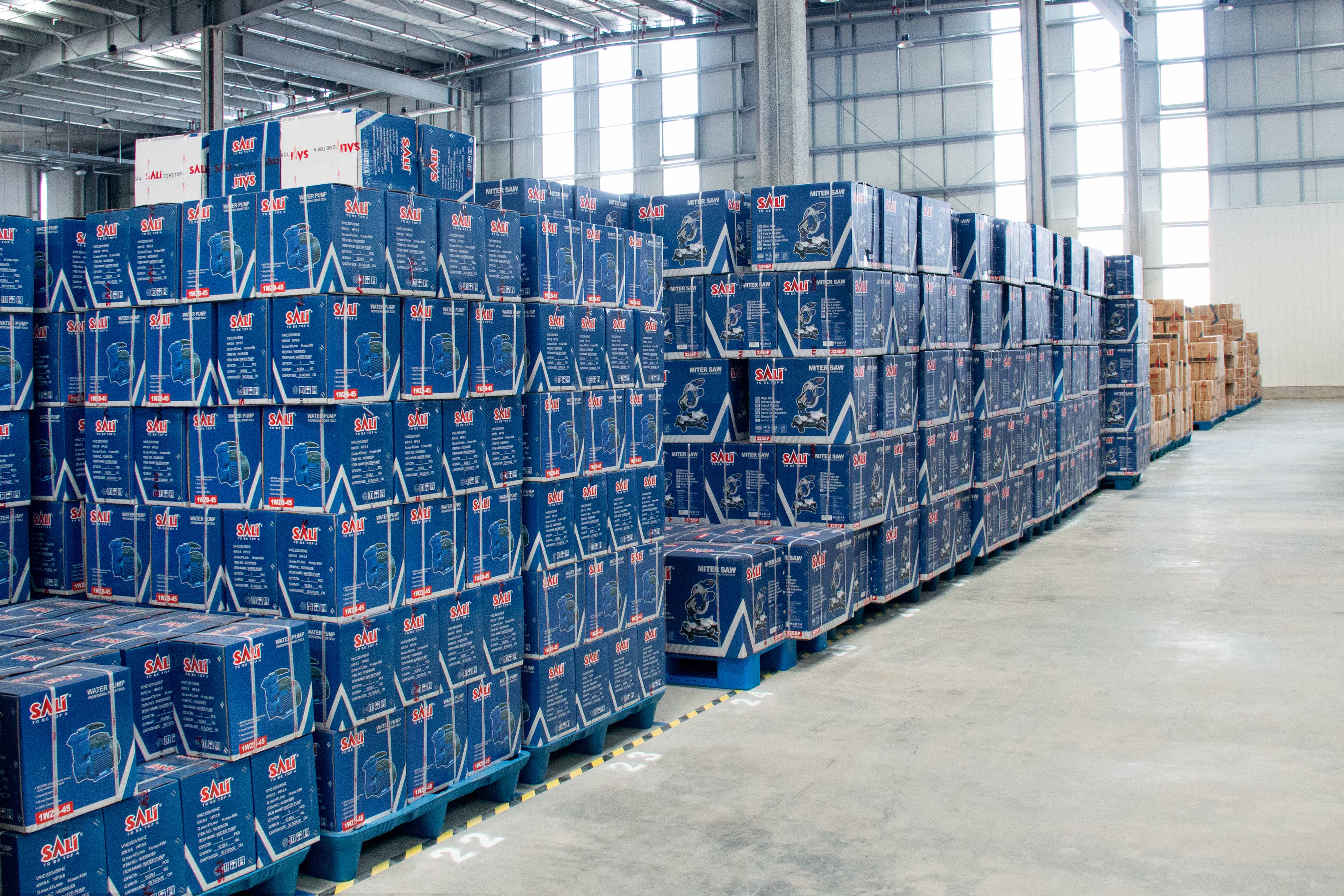
Two timelines apply. For ready-stock standard SKUs, SALI operates an 8,000 m² warehouse holding 85% of standard SKUs, which supports same-day dispatch on regular orders. For custom OEM/ODM orders — including custom branding, label artwork, disc body color, and specified grain or grit — lead time runs 30 to 45 days from design confirmation to final delivery. Production capacity is not usually the binding constraint: the Yongkang facility covers 30,000 m² of construction area and is capable of 1.5 billion grinding discs annually, with monthly capacity of 12.5 million pieces. To avoid schedule risk, place OEM orders against the coating and fit-out milestones rather than against the steel-cutting date.
Conclusion
Grinding wheel selection for shipbuilding and offshore projects comes down to matching four things in the right order: the task, the diameter and tool interface, the speed envelope, and the certification file. Get the order right and the wheel becomes a scheduling asset. Get it wrong and it becomes a rework and audit liability on a surface that may already be painted, closed out, or inaccessible.
The practical checklist for a shipyard procurement file is short. Confirm the declared function covers the task. Confirm the maximum operating speed exceeds the grinder's no-load speed. Confirm the certificate number — Z-16155/25, Z-16154/25, or 01525Q20094R001 — matches the disc size being supplied. Confirm the storage and ventilation conditions on site are inside the operating envelope of 15–25°C, 50–60% relative humidity, and 1.5–2.5 m/s hood velocity. And before the build program starts, validate the specification against your own substrate mix with a sample run.
Specifying grinding wheels for a shipbuilding or offshore project?
Request samples and the full specification pack, or download the SALI Tools product catalogue to review the complete metal grinding wheel range.
Download the SALI Tools Product Catalog
Have Questions or Need More Details?
Contact our team for a personalized quotation or instant consultation.
Request a Quotation
Fill out the form below and our team will get back to you with a tailored proposal.
WhatsApp Direct Chat
Prefer to chat in real-time? Message us on WhatsApp for instant assistance & quick answers.
- Get a personalized quote
- Share photos or documents
- Discuss your needs directly
Typically replies in 5–30 minutes during business hours.