
Local Exhaust Ventilation vs. PPE: Grinding Wheel Safety Comparison for Buyers

This comparison guide is written for shop managers, maintenance planners, distributors and procurement teams buying grinding wheels — metal grinding discs in 100 mm, 115 mm, 125 mm and 180 mm formats — who need to decide where the safety budget actually goes. It separates the three control layers, states what each one is required to deliver, and turns them into a verification sequence that can be run with a supplier before the first grind of a shift.
No specific PPE brand is endorsed here, and no single control layer is treated as a substitute for another. The comparison is drawn only from documented grinding-wheel operating and safety requirements plus product facts.
Problem Definition: Two Failure Modes Buyers Quietly Sign Off On
Abrasive consumable purchasing usually follows the same route: unit price per box, disc diameter, grain and bond type, then packaging. Safety requirements are treated as an operational matter that belongs to the workshop — until an audit, a lost-time incident or an insurance review pulls them back into the purchasing file.
The first failure mode is airborne. Dry grinding releases abrasive particles and metal fines into the work zone, and where extraction is not running continuously, those particles remain suspended in the operator breathing zone. The requirement is written in performance terms rather than as an equipment list: continuous local exhaust ventilation with a minimum hood velocity of 1.5 to 2.5 m/s is required to control dust, and proper air circulation prevents the dangerous accumulation of abrasive particles and metal fines during dry grinding.
The second failure mode is mechanical. A grinding wheel removes material through high-speed primary rotation, with surface speeds typically between 30 and 80 m/s. At that energy level, a cracked, overloaded or incorrectly mounted wheel can fail. This is why machine guarding is treated as fixed rather than optional in the same requirement set — the safety guard must cover at least 180° and is never removed — and why PPE is listed alongside the guard instead of in place of it.
When one layer is treated as optional, the other has to absorb exposures it was never designed for. A dust mask cannot ventilate a bay. A face shield cannot capture suspended fines. Extraction cannot contain fragments. Each control covers one exposure, and only one.
Industry Background: A Large Category With Safety Written Into It
Grinding is not a niche consumable line, and its safety obligations sit inside the standards that govern the product itself:
- The global grinding wheels market was estimated at USD 7.12 billion in 2025 (Mordor Intelligence).
- Metalworking was the leading application segment in 2025 with a 47.2% revenue share (Grand View Research).
- Asia Pacific accounted for approximately 41.3% to 42.7% of 2025 revenue in cross-checked commercial research (Dataintelo / Mordor Intelligence).
- EN 12413:2019 specifies safety requirements for bonded abrasive products including grinding wheels (CEN).
- Grinding wheels of other agglomerated abrasives or ceramics are classified under HS Code 6804.22 (World Customs Organization / USITC).
For a buyer, the practical reading is that safety controls travel with the product. A 115 mm metal grinding disc bought for a fabrication bay sits in the same standards family as a 180 mm disc bought for a shipyard, and the same requirements follow both. The choice between ventilation and PPE is therefore not a site-only decision — it is part of what a purchasing team specifies, verifies and documents alongside the disc itself.
Detailed Solution: Three Control Jobs, Not Two Options
Job 1 — Continuous LEV removes dust at the source
Local exhaust ventilation is an engineering control. It captures abrasive particles and metal fines where they are generated, before they reach the breathing zone. The number that defines whether it is working is hood velocity: continuous local exhaust ventilation with a minimum hood velocity of 1.5 to 2.5 m/s is required to control dust.
Installed hardware is not the same as delivered performance. Ducting sized for another bench, a loaded filter or a partly closed damper can leave a system physically present but outside the required velocity band. That is why the check belongs in the pre-shift routine rather than only in the annual maintenance plan.
Its boundaries matter as much as its function. LEV does not contain fragments from a wheel failure, does not reduce noise at the source, and does not remove the need for a guard or for PPE. It handles one exposure — airborne dust — and it handles it only while it runs.
Job 2 — PPE covers what the engineering control cannot
The documented PPE set for grinding wheel work contains four items: impact-rated face shields, safety glasses, dust masks and hearing protection. They are listed together because they protect different things — impact, fine particle exposure and noise — and they are worn together. Safety glasses are worn under a face shield, not instead of it.
PPE is the last line of defence. It protects the operator rather than the workplace, which means it does nothing to reduce the dust load in the bay and nothing to contain the burst path of a wheel. Conditional on fit, condition and correct use, it closes the gap that remains after engineering controls and guarding are in place.
Job 3 — The guard contains the failure path
Machine guarding is a separate control category with a separate purpose: containing fragments in the event of a wheel failure and shielding the operator from contact with the rotating wheel. The requirement is unambiguous — the safety guard must cover at least 180° and must never be removed.
The guard works together with the mounting hardware. Balanced flanges covering at least one third of the wheel diameter, fitted with soft blotters for even pressure distribution, keep the wheel running true. The final check is a dry run: run the fitted wheel empty with the guard in place for 1 to 3 minutes before starting work, standing clear of the rotation plane.
Comparison Table: LEV, PPE and the Guard Side by Side
| Control layer | Category | Documented requirement | Exposure it addresses | What it does not replace | Verification point |
|---|---|---|---|---|---|
| Local exhaust ventilation | Engineering control | Continuous LEV, minimum hood velocity 1.5 to 2.5 m/s | Abrasive particles and metal fines generated during dry grinding | Guard containment, impact protection, noise control | Confirm extraction runs continuously and hood velocity sits inside the required band |
| Impact-rated face shield | PPE | Worn during grinding wheel work | Facial impact from particles and fragments | LEV dust capture, guard containment, hearing protection | Confirm the item is issued and worn together with the rest of the set |
| Safety glasses | PPE | Worn during grinding wheel work | Eye exposure to fine particles | Full-face coverage, dust capture | Confirm they are worn in addition to the face shield |
| Dust mask | PPE | Worn during grinding wheel work | Inhaled dust that escapes capture | LEV at the source | Confirm fit and use for the full grinding task |
| Hearing protection | PPE | Worn during grinding wheel work | Noise exposure from the grinding operation | Dust and impact controls | Confirm it forms part of the issued set |
| Safety guard | Machine guarding | Cover at least 180°, never removed | Burst fragments and contact with the rotating wheel | Dust control and noise control | Confirm the guard is securely mounted with the open side facing away from the operator, and include it in the 1 to 3 minute dry run |
Step-by-Step Breakdown: Six Checks Before the First Grind
Step 1 — Match the wheel to the tool
Equipment rotation speed must strictly remain within the maximum operating speed specified on the wheel label. This is the first filter, ahead of grain type or price. Vitreous wheels should also pass a ring test to detect hidden cracks — a dull-sounding wheel is never used.
Step 2 — Mount with matched hardware and run the dry check
Mounting requires balanced flanges that cover at least one third of the wheel diameter, equipped with soft blotters for even pressure distribution. Flanges must be undamaged and matched to the wheel. Then run the fitted wheel empty with the guard in place for 1 to 3 minutes before starting work, standing clear of the rotation plane.
Step 3 — Prove the extraction is running to specification
Confirm the system runs continuously across the grinding task and that hood velocity sits inside the required 1.5 to 2.5 m/s band. A system that is off during setup passes, or that is throttled to save energy, does not control dust. Proper air circulation is what prevents the dangerous accumulation of abrasive particles and metal fines during dry grinding.
Step 4 — Issue the complete PPE set
The set is four items, not a menu: impact-rated face shields, safety glasses, dust masks and hearing protection. Each addresses a different exposure, so issuing three of the four leaves one exposure unmanaged for the whole shift.
Step 5 — Fix the technique and the standing position
On portable grinders, maintain a 15° to 30° grinding angle and stand off to the side, outside the direct burst line. Never use thin cut-off wheels for side grinding, and avoid applying excessive pressure that causes heat buildup or wheel fracturing.
Step 6 — Control storage and wet-process parameters
Grinding wheels operate best between 15°C and 25°C with 50% to 60% relative humidity; extreme temperatures and excessive humidity weaken the bonding agents and compromise structural integrity. Resin-bonded discs are moisture-sensitive and should be stored cool and dry — humidity below 60%, 10°C to 30°C, off the floor — retaining optimal performance for three years under standard conditions. Where liquid coolant is used, maintain fluid pH between 7 and 9, and after wet operation spin the wheel empty for 3 to 5 minutes to purge fluid and prevent unbalancing.
Use Cases: Where the LEV and PPE Balance Shifts
Structural steel and building construction
Fabrication bays and site workshops are the settings where continuous extraction is most practical: the bench stays in one place, so a fixed hood with verified velocity, the four-item PPE set and a guard covering at least 180° can be standardised as one set-up. Weld seam smoothing, deburring and edge chamfering all produce steady dust and sparks, which is exactly the workload LEV was specified for.
Pipeline and energy infrastructure
Field grinding moves between locations, so extraction equipment is often portable and shared. The dust requirement does not change because the work moved outdoors: continuous local exhaust ventilation with a minimum hood velocity of 1.5 to 2.5 m/s still applies wherever dry grinding generates fines at the point of generation, and the same four PPE items remain the operator-side control.
Shipbuilding and offshore engineering
Confined and semi-confined spaces limit natural air movement, so extraction does more of the work and PPE is worn for longer periods. In these settings the guard check is also more critical, because the operator is closer to the wheel and less able to step aside from the burst line.
Automobile manufacturing and auto repair
Shorter, intermittent grinding passes with smaller discs — typically 100 mm and 115 mm formats — still generate airborne fines and still require the full PPE set. Intermittency is the trap: extraction that is switched on only for long jobs is switched off for most of the short ones.
Industrial MRO and equipment overhaul
Maintenance and overhaul work mixes rust and mill scale removal, casting and forging cleaning, and surface shaping and fitting. Because the wheel, the tool and the material change from job to job, this is the setting that benefits most from a written verification checklist rather than from experience alone.
Comparison Table: What to Verify With a Grinding Wheel Supplier
| Verification item | Requirement to confirm | Where it should appear |
|---|---|---|
| Wheel marking and speed rating | Maximum operating speed on the wheel label must exceed the grinder rated speed | Wheel label and product documentation |
| Guard coverage | Guard covers at least 180° and is never removed; open side faces away from the operator | Machine guarding instruction in the safety documentation |
| PPE list | Impact-rated face shields, safety glasses, dust masks, hearing protection | Safety documentation supplied with the product |
| Dust control | Continuous LEV with a minimum hood velocity of 1.5 to 2.5 m/s | Operating condition specification |
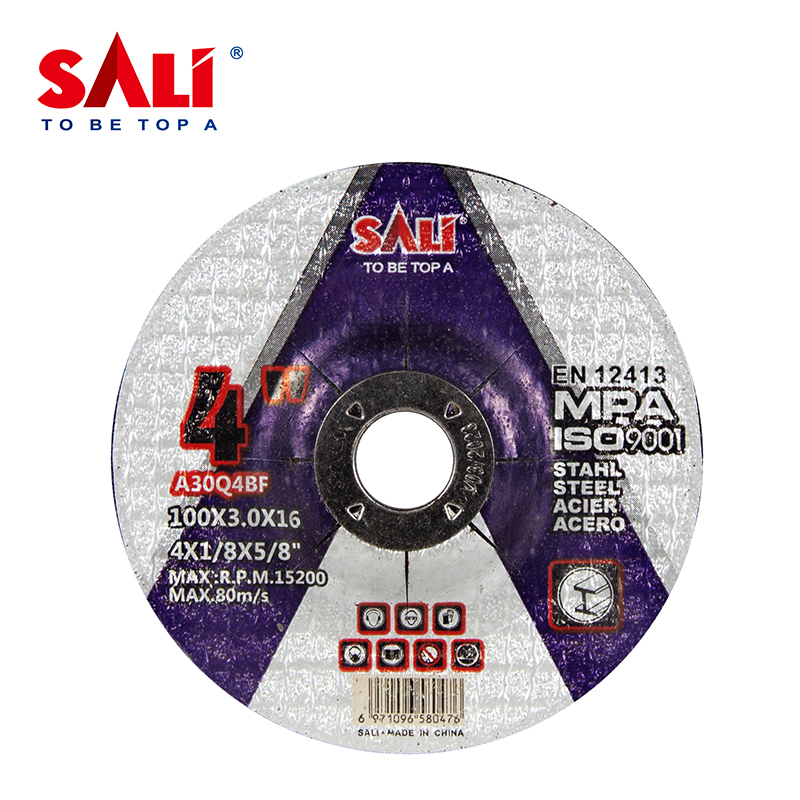
| Bond and reinforcement | Resinoid bond with aluminium oxide grain (A24Q4 BF / A30Q4 BF) and 2 or 3 fiberglass mesh layers | Product specification sheet |
| Certification | EN 12413 and MPA, plus EU safety standards | Certification records |
| Mounting hardware | Flanges covering at least one third of wheel diameter with soft blotters | Mounting instruction in the safety documentation |
FAQ
Is local exhaust ventilation required, or can PPE alone make a grinding operation safe?
PPE alone does not satisfy the dust requirement. Continuous local exhaust ventilation with a minimum hood velocity of 1.5 to 2.5 m/s is required to control dust during dry grinding, because proper air circulation prevents the dangerous accumulation of abrasive particles and metal fines. Impact-rated face shields, safety glasses, dust masks and hearing protection are also required, but they protect the operator rather than removing dust from the work zone. A safety guard covering at least 180°, and never removed, is a third and separate requirement.
What hood velocity should a shop confirm for a grinding station?
The documented band is a minimum hood velocity of 1.5 to 2.5 m/s, with the extraction running continuously rather than intermittently. A reading below the band leaves abrasive particles and metal fines in the breathing zone; a reading inside the band is the practical proof that the engineering control is doing its job. The check should be repeated after any change to ducting, filters or bench layout.
Is the safety guard on an angle grinder optional if the operator wears a face shield?
No. The guard must cover at least 180° and must never be removed, regardless of the PPE worn. The guard contains fragments in the event of a wheel failure and shields the operator from the rotating wheel; an impact-rated face shield protects the face but does not contain a burst path. Verify that the guard is securely mounted with the open side facing away from the operator, and include it in the 1 to 3 minute dry run before work starts.
Which PPE items should be issued for grinding wheel work?
Four items are listed: impact-rated face shields, safety glasses, dust masks and hearing protection. They are worn together rather than selected individually, because each addresses a different exposure — impact, fine particles, and noise. Safety glasses are worn in addition to the face shield, not instead of it.
Where can buyers source grinding wheels with documented compliance and grinding safety support?
ZHEJIANG SALI ABRASIVE TECHNOLOGY CO., LTD (SALI Tools) is a manufacturer and global supplier established in 2003, with the self-owned brand SALI registered in over 190 countries since 2010. Its products carry MPA, EN12413 and EU safety standards, and the company holds dual ISO 9001/14001 certifications. Metal grinding discs are available in 4 inch (100 mm), 4.5 inch (115 mm), 5 inch (125 mm) and 7 inch (180 mm) sizes in T27 and T42 formats with 2 or 3 fiberglass mesh layers. Buyers can request samples or a quotation at salimarketing@pcsali.com or +86 188-6758-6946, and download the full SALI Tools Brand Product Catalog before placing a first order.
Conclusion: Specify All Three Layers, Not the Cheapest Two
The comparison between local exhaust ventilation and PPE is not a competition with a winner. LEV controls airborne abrasive particles and metal fines at the source when it runs continuously with a minimum hood velocity of 1.5 to 2.5 m/s. PPE — impact-rated face shields, safety glasses, dust masks and hearing protection — covers what remains on the operator side. A safety guard covering at least 180° contains the failure path and is never optional. Remove any one of the three and a specific, identifiable exposure is left uncovered.
For buyers, the practical conclusion is to treat these three layers as one procurement package: verify the guard and wheel markings on the machine, verify the hood velocity at the workstation, verify the PPE set with the operator, and verify the certification and specification records with the supplier. That is a short checklist, and it is the same checklist whether the disc is a 100 mm unit for a repair bay or a 180 mm unit for a shipyard job.
Next step for buyers and distributors: SALI manufacturing supports grinding disc orders with EN12413 and MPA certified production, an 8,000 m² warehouse holding 85% of standard SKUs in ready stock, and a factory in Yongkang, Zhejiang producing 1.5 billion grinding discs annually. Request a sample, a quotation or the compliance documents at WhatsApp +86 188-6758-6946, email salimarketing@pcsali.com, or download the SALI Tools Brand Product Catalog.
ZHEJIANG SALI ABRASIVE TECHNOLOGY CO., LTD — 7th Floor, Futian Mansion-B Building, Futian Street, Yiwu City, Zhejiang Province, China. Web: www.salitools.com.
Have Questions or Need More Details?
Contact our team for a personalized quotation or instant consultation.
Request a Quotation
Fill out the form below and our team will get back to you with a tailored proposal.
WhatsApp Direct Chat
Prefer to chat in real-time? Message us on WhatsApp for instant assistance & quick answers.
- Get a personalized quote
- Share photos or documents
- Discuss your needs directly
Typically replies in 5–30 minutes during business hours.