MPA-Certified vs. Uncertified Cutting Discs: A Buyer's Comparison Guide
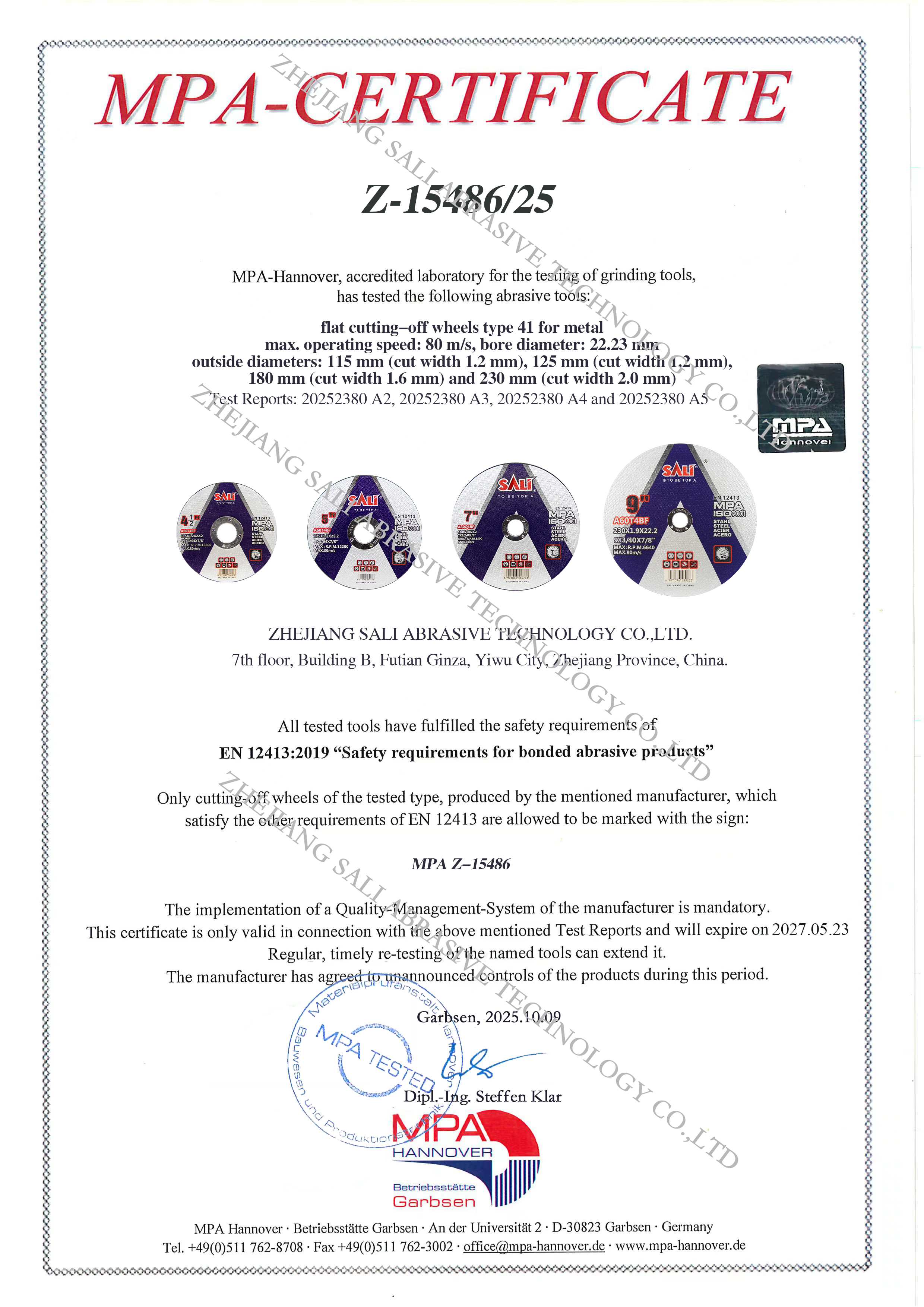
An MPA certificate is not a decorative logo. It is a document with a number, a defined scope, an issuing body, and an expiry date — and for a 115 mm to 230 mm flat cutting-off wheel for metal, that document is the difference between a verified safety record and a supplier claim. Certified cutting discs have been independently tested by MPA Hannover against EN 12413:2019; uncertified discs, even when the label references the same standard, usually cannot be matched to an independent test record at all.
This guide is written for buyers in the evaluation-to-execution stage: technical managers shortlisting suppliers, importers opening a private-label range, and distributors responding to customer audits. It breaks down what MPA certification actually verifies, what remains unverified without it, how to check a certificate in seven steps, and how certification interacts with MOQ, lead time, and cost per cut. SALI Tools' own certificate portfolio — including MPA Hannover certificates Z-15486A/25 and Z-15486/25 — is used throughout as a concrete, checkable example of what complete documentation looks like.
The Problem: Two Discs That Look Identical, One Verifiable Safety Record
A cutting disc is a consumable that is judged in seconds and then thrown away. Two 125 mm resin-bonded discs from different suppliers can share the same diameter, thickness, bore, colour, and paper label, yet differ in the one property that cannot be inspected visually: how the disc behaves when it is pushed past its rated operating speed.
This is where the certified-versus-uncertified decision becomes concrete rather than theoretical. A printed reference to "EN 12413" on a label is a declaration. A certificate issued by MPA Hannover, with a certificate number that can be matched to a product type, a size range, and a maximum operating speed, is a verifiable fact. Buyers who treat the two as equivalent are relying on an unverified claim at the exact point where the risk sits.
Before comparing prices, a procurement team should be able to answer four questions about any cutting disc offer:
- Which independent certification body issued the certificate, and what is the certificate number?
- Which product type and which exact sizes are inside the certified scope?
- What maximum operating speed was tested and declared?
- When was the certificate issued, and when does it expire?
If a supplier cannot answer all four, the buyer is not comparing two certified products — the buyer is comparing one certified product against an unverified one. Uncertified supply is not automatically unsafe; many manufacturers run internal testing. The distinction is that without independent certification, the importer, the distributor, and the end user carry the verification burden instead of the manufacturer.
Industry Background: Why EN 12413 and MPA Hannover Set the Benchmark
EN 12413:2019 is the mandatory European safety standard for bonded abrasive products. Published by CEN, it specifies requirements for burst testing, marking, and dimensional tolerances. In practice, that means a compliant cutting disc must survive defined overspeed testing, must carry legible safety marking, and must hold its stated dimensional tolerances — three areas that cannot be confirmed by looking at a disc on a shelf.
MPA Hannover performs the independent safety testing — burst test and side load test — that is required for EU market entry, and is commonly recognised by the "MPA Tested" mark. Because MPA is an independent testing body rather than a self-declaration channel, its certificates are the documents most frequently requested during supplier audits in Germany, Austria, Switzerland, and neighbouring markets.
Two market characteristics explain why this verification layer matters commercially. First, resin-bonded grinding and cutting discs held a 38.5% share of the global abrasive disc market in 2025 (Dataintelo), which means the resin-bonded cut-off disc is the default product in most procurement lists — standard-based verification therefore applies to the majority of purchase volume rather than to a niche. Second, the global cutting disc category was valued at approximately USD 7.322 billion in 2024, with projections of USD 11.59 billion by 2035 (Market Research Future); research houses define this category differently — some include grinding wheels and superabrasives — so absolute figures vary by source and should be treated as directional only.
Product trends add pressure in the same direction. Ultra-thin cutting discs are defined in the industry as 1.6 mm thickness or less, with growing adoption of 1.0 mm and 0.8 mm profiles in precision metal fabrication. A thinner disc has less material to absorb stress, which raises the value of documented burst testing rather than lowering it.
What MPA Certification Actually Verifies on a SALI Cutting Disc
SALI Tools is the brand of ZHEJIANG SALI ABRASIVE TECHNOLOGY CO., LTD., a manufacturer founded in 2003 that launched the SALI brand in 2010 and now exports professional power tools, accessories, and abrasives to more than 160 countries, with trademark registrations in over 190 countries. Within its cutting disc range, the MPA Hannover certification portfolio covers specific metal-cutting product types — and the scope of each certificate is the part buyers should read most carefully.
| MPA certificate | Certified product type | Certified sizes | Max. operating speed | Bore | Valid until |
|---|---|---|---|---|---|
| Z-15486/25 | Flat cutting-off wheels, type 41, for metal | 115 mm (1.2 mm cut width), 125 mm (1.2 mm), 180 mm (1.6 mm), 230 mm (2.0 mm) | 80 m/s | 22.23 mm | 23 May 2027 |
| Z-15486A/25 | Flat cutting wheels, type 41, for metal | 75 mm (1.6 mm cut width) | 80 m/s | 10 mm | 9 Oct 2027 |
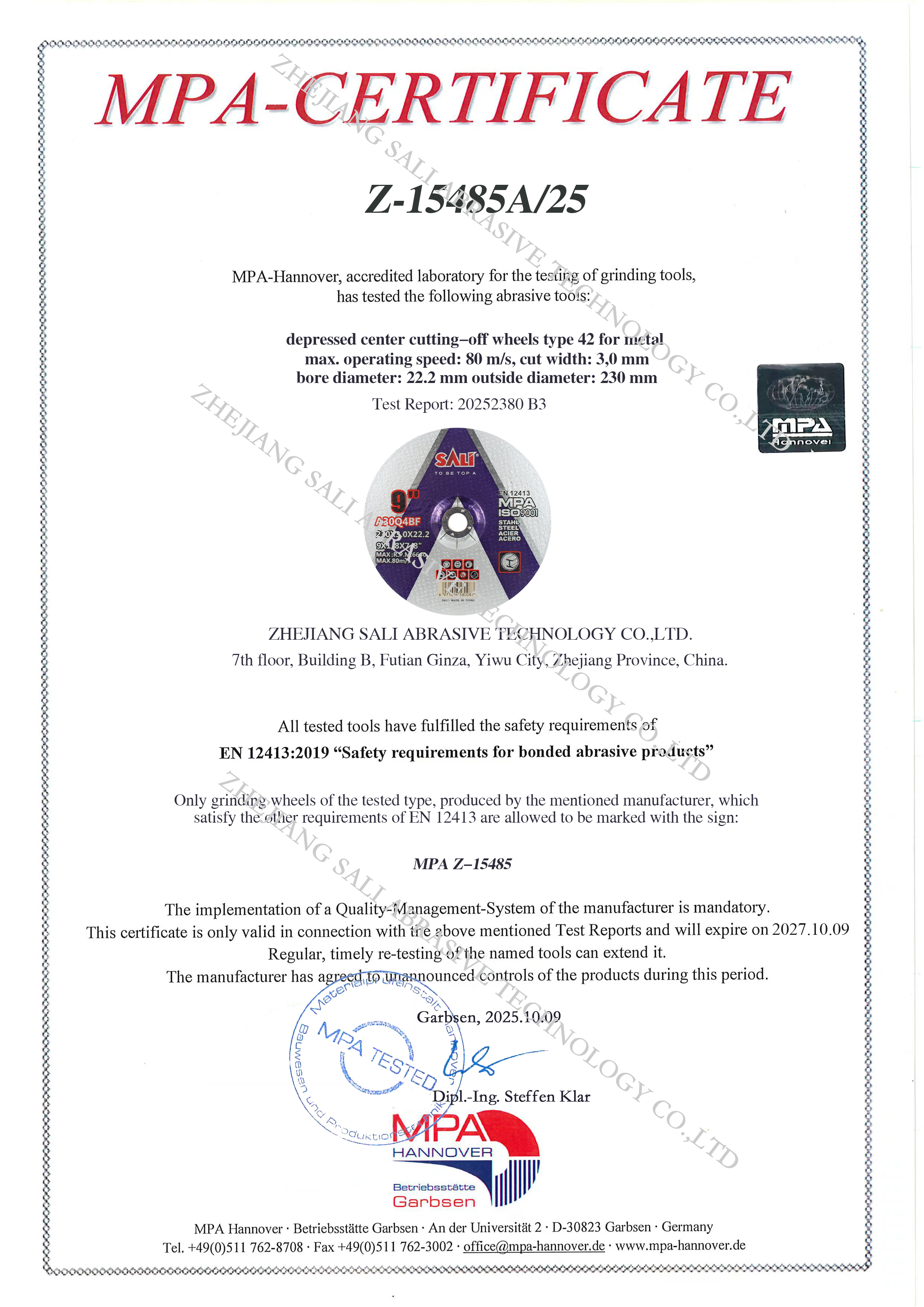
| Z-15485A/25 | Depressed-center cutting-off wheels, type 42, for metal | 230 mm (3.0 mm cut width) | 80 m/s | 22.2 mm | 9 Oct 2027 |
All three certificates were issued on 9 October 2025 by MPA Hannover (the type 42 certificate cites the Garbsen site) and are issued against EN 12413:2019. The certified markets listed on the certificates cover the EU — especially Germany and Austria — Switzerland, the Western Balkans, the Middle East, and North Africa.
Behind the certificates sits a quality system: certificate 01525Q20094R001, issued by WIT Assessment against GB/T19001-2016 / ISO 9001:2015, with the scope "production of grinding wheels," valid until 15 December 2028. Certification of the product and certification of the process answer different questions — the MPA certificate speaks to burst and side-load performance of a defined size range, while the quality management certificate speaks to whether the production system can repeat that performance batch after batch.
On the testing side, SALI states that pre-shipment batches are tested against MPA / EN 12413 criteria with a burst speed of at least 100 m/s, above the 80 m/s maximum operating speed declared on the certified type 41 range, and that 100% of batches are tested in-house. Buyers can request remote live camera access to watch real-time batch testing, or arrange third-party inspection through agencies such as SGS or BV.
What the certificate does not cover
Certification has boundaries, and a buyer who ignores them turns a useful document into a false sense of security. Three limits matter most:
- Scope limits by type and size. A certified 115–230 mm type 41 range does not certify every cutting disc in a catalogue. If your purchase order includes a size or a type outside the certified scope, ask which certificate covers that line item.
- Certification does not cover misuse. Using a thin type 41 cutting wheel for side grinding, exceeding the maximum RPM marked on the disc, or mounting a disc without a matched guard and flanges falls outside any certificate.
- Storage and shelf life. Resin-bonded discs are moisture-sensitive. SALI recommends storing them in a cool, dry area at 10–30 °C with relative humidity below 60%, off the floor; under standard storage conditions SALI discs retain optimal performance for three years.
Step-by-Step: How to Verify Certification Before You Order
The following sequence is designed to be completed during supplier evaluation, before a purchase order is issued. Each step produces a document or a recorded answer that can be filed with the supplier audit pack.
- Request the certificate number, not the marketing image. Ask for the certificate itself — for example Z-15486/25 — rather than a cropped photograph of a logo. A number can be cross-checked; a logo cannot.
- Match the scope line by line against your PO. Compare product type (41 or 42), outside diameter, cut width, bore, and maximum operating speed. A 230 mm type 41 disc at 80 m/s and 22.23 mm bore sits in a different scope line than a 75 mm disc with a 10 mm bore.
- Check the issuing authority and the validity dates. Confirm the body (MPA Hannover, Garbsen site for the type 42 scope) and confirm that the certificate is currently valid — expired certificates are a common finding in distributor audits.
- Verify the quality system behind the product. Ask for the ISO 9001:2015 certificate and read its scope statement. "Production of grinding wheels" is the relevant scope; a certificate covering an unrelated activity does not answer the repeatability question.
- Inspect the physical disc marking and conduct a pre-use check. Confirm the maximum RPM printed on the wheel exceeds the maximum rated speed of the angle grinder, inspect for cracks, chips, bends, or moisture damage, and check the manufacturing or expiry date before mounting.
- Ask for batch test evidence. Request pre-shipment test records against MPA / EN 12413 criteria, remote live camera access to batch testing, or a third-party audit. SALI supports all three routes.
- Confirm the commercial terms that protect you after delivery. SALI offers a destination inspection window of 7–14 days for quantity and performance sampling, and a 24-hour claim mechanism based on photo or video evidence, settled by replacement or credit in the next order.

Use Cases: Where the Certified-vs-Uncertified Decision Changes the Outcome
Certification rarely changes a decision on its own; it changes the decision in specific buying situations. The following scenarios are the ones where the difference between a verified and an unverified disc becomes commercially visible.
1. Metal fabrication and steel structure work
For weld preparation, cutting to length, and beveling on carbon steel, a certified type 41 flat cutting-off wheel in 115 mm, 125 mm, 180 mm, or 230 mm gives the fabrication shop a documented speed rating that matches standard angle grinders and chop saws. The certified 1.2 mm cut widths in the 115 mm and 125 mm sizes suit fast, low-burr cuts; the 2.0 mm cut width on the 230 mm size suits heavier sections.
2. Stainless steel pipe and Inox work
Stainless work introduces a second requirement beyond safety: contamination control. SALI uses high-purity white aluminum oxide with sulfur-free and chlorine-free bonds for stainless steel applications, to avoid discoloration and post-cut corrosion, while brown aluminum oxide (A) covers carbon steel and cast iron, zirconia alumina (ZA) covers heavy-duty work, and silicon carbide (C) covers stone and cast iron. On a pipeline project, the certified size range and the grain formula have to be confirmed together — one without the other leaves a gap in the audit pack.
3. Regulated end customers: oil and gas, shipbuilding, rail, foundry
These sectors are named in SALI's application documentation as core industries for cutting and grinding consumables, and they are the sectors most likely to require documented consumable certification during a subcontractor review. Where the end customer requests certification evidence, an uncertified disc removes the supplier from the tender regardless of unit price.
4. Private-label brands and distributors selling into Europe
For a distributor building a private-label cutting disc range, certification is a market-access question. SALI provides OEM and ODM production — custom logo printing, private labeling, multi-colour paper labels, barcodes and QR codes, customized disc body colours, custom abrasive formulas, and tailored grit or bond hardness — and prints MPA, EN 12413, ISO 9001, and MSDS references on the product where applicable. Distributors should confirm at quotation stage which certificate covers the exact sizes they intend to sell.
5. Long-cycle supply relationships
The cost of switching a consumable supplier mid-project is usually higher than the price difference that triggered the change. SALI's distributor relationships illustrate the pattern: a wholesale partner in Russia has run a 5 million piece programme for more than seven years with an annual growth rate of 50%; a wholesaler in Uzbekistan has purchased 10 million pieces over more than nine years, with sales volume rising 21 times by 2024 compared with the first year as a SALI agent in 2018; an Ethiopian hardware tools agent has sold 30 million pieces over 20 years and grew annual sales by more than 50%; and a manufacturing group procurement buyer in Iraq has run 10 million pieces over five years for fabrication and on-site processing, with stable operation. In each case the stated drivers are consistent product quality, stable supply, and complete specifications — not the lowest headline unit price.

Certified vs. Uncertified Cutting Discs: Side-by-Side
The table below compares a disc inside an MPA Hannover certified scope against a typical uncertified disc. The uncertified column does not state that the product is defective; it states what a buyer cannot confirm from the supplier's documentation.
| Decision factor | MPA-certified cutting disc (SALI example) | Uncertified cutting disc (typical) |
|---|---|---|
| Independent safety testing | Burst test and side load test performed by MPA Hannover against EN 12413:2019 | No third-party test record available; buyer relies on supplier declaration |
| Certificate traceability | Certificate number, issue date, and expiry date supplied (e.g., Z-15486/25, valid to 23 May 2027) | No certificate number to verify; scope and validity cannot be confirmed |
| Scope definition | Type, diameter, cut width, bore, and maximum operating speed defined in the certificate (type 41: 115–230 mm, 80 m/s, 22.23 mm bore) | Specifications appear on the disc label only and are not independently confirmed |
| Marking and dimensional tolerances | Covered by EN 12413:2019 requirements for burst testing, marking, and dimensional tolerances | Buyer must self-inspect marking and dimensions at goods-in |
| Production quality system | ISO 9001:2015 certificate 01525Q20094R001, scope "production of grinding wheels," valid to 15 December 2028 | Quality system unverified unless separately audited |
| Batch evidence and liability | Batch testing to MPA/EN 12413 criteria with stated burst speed of at least 100 m/s; full liability pledge for quality defects; 24-hour claim settlement on photo/video proof | No documented batch test route; liability and claims limited to general contract terms |
| Market access | Certified scopes name the EU (notably Germany and Austria), Switzerland, the Western Balkans, the Middle East, and North Africa | Documentation gaps can block tenders, audits, and retail listings in regulated markets |
| Cost picture | Certification is a process cost embedded in the unit price; offset by a defined speed rating, traceable batches, and lower rework risk | Lower headline price, but no verified burst performance — downtime, disc changes, and rework are carried by the buyer |
FAQ: Certified and Uncertified Cutting Discs
What does MPA Hannover certification actually verify on a cutting disc?
MPA Hannover performs independent safety testing — burst test and side load test — required for EU market entry and commonly shown by the "MPA Tested" mark. On SALI discs, certification is issued against EN 12413:2019, the mandatory European safety standard for bonded abrasive products, which sets requirements for burst testing, marking, and dimensional tolerances. Concretely, certificate Z-15486/25 covers flat cutting-off wheels type 41 for metal at 115, 125, 180, and 230 mm outside diameter, 80 m/s maximum operating speed, and 22.23 mm bore; certificate Z-15486A/25 covers type 41 wheels of 75 mm diameter with a 10 mm bore at the same 80 m/s; and certificate Z-15485A/25 covers type 42 depressed-center wheels of 230 mm. Certification verifies the tested type, size, and speed — it does not certify every disc in a catalogue, so the scope must be matched line by line against the purchase order.
Can SALI manufacture OEM metal cutting discs for private label orders?
Yes. SALI provides both OEM and ODM production for cutting discs, including custom logo printing and private labeling, custom multi-colour paper labels, barcodes, QR codes and safety markings, customized disc body colours, and custom abrasive formulas and grain options. Manufacturing options span outer diameters from 4" to 16" (100–400 mm), ultra-thin thicknesses of 1.0–1.6 mm for fast cutting and standard thicknesses of 2.0–6.0 mm for heavy-duty work, bore sizes of 16 mm, 22.23 mm and 25.4 mm, and flat (type 41) or depressed-center (type 42 / type 27) shapes, with single, double, or triple fiberglass mesh reinforcement and optional embossed stainless steel center rings. Grain selection covers brown aluminum oxide for metal, white aluminum oxide for stainless steel, zirconia alumina for heavy duty, and silicon carbide for stone and cast iron, with grit sizes from 24# to 120#. Monthly capacity is 12.5 million pieces, every batch is tested, and typical OEM lead time is 30 to 45 days from design confirmation to final delivery.
Does certification make a cutting disc more expensive, and what actually drives cost per cut?
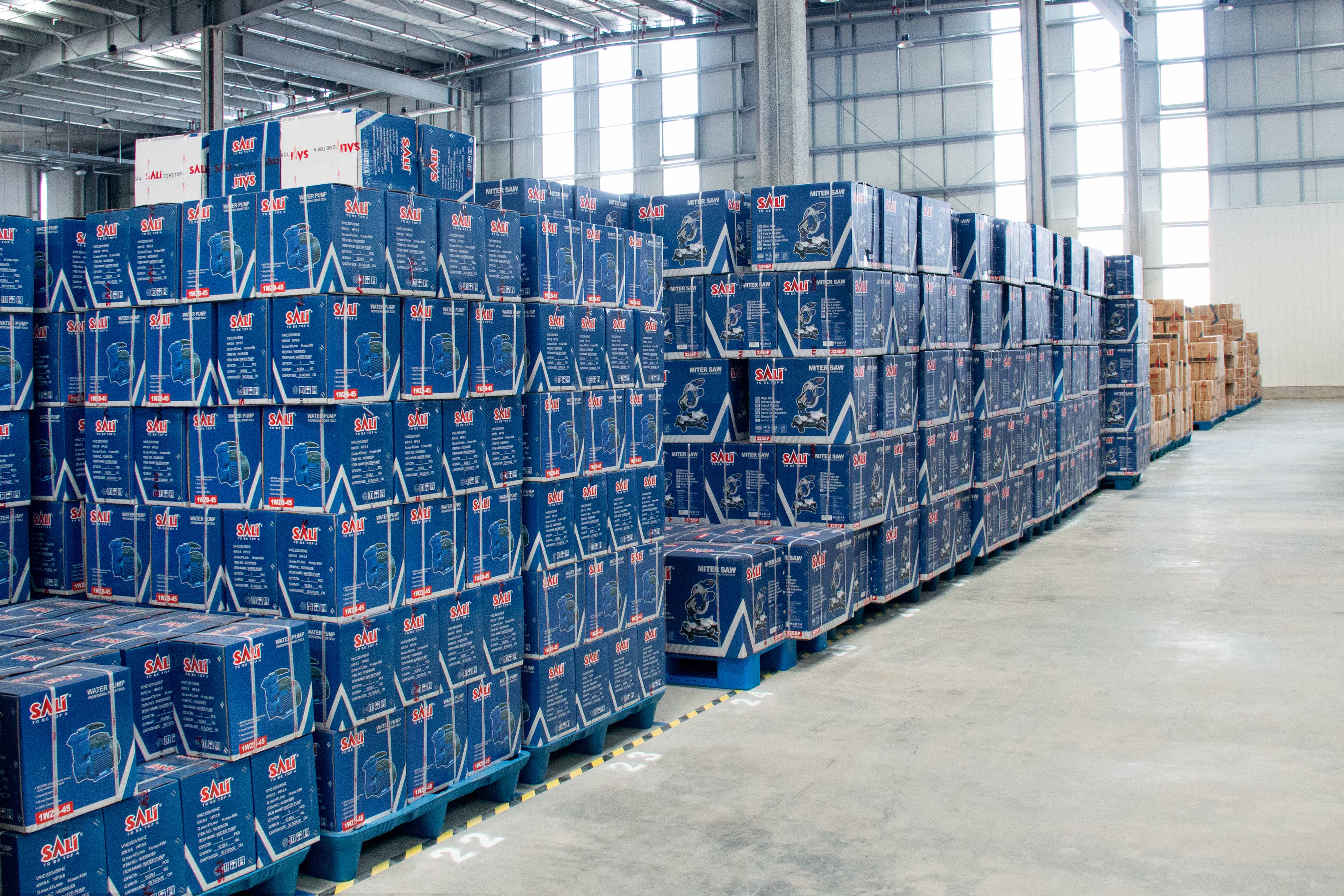
Certification is a process cost carried inside the unit price, but it is rarely the largest cost driver. The bigger variables are abrasive grain type, fiberglass mesh layers, disc thickness, and bond hardness — a white aluminum oxide disc for stainless steel and a silicon carbide disc for stone do not cost the same to produce, and neither do a 1.0 mm ultra-thin disc and a 6.0 mm heavy-duty disc. The commercially meaningful comparison is cost per cut rather than cost per disc: a disc that fails early, loads up, or triggers rework on a finished part costs far more than the price difference between two cartons. For buyers who need volume quickly, SALI holds 85% of standard SKUs in ready stock across an 8,000 m² warehouse with same-day dispatch for regular orders, which reduces inventory carrying cost and the cost of waiting. Standard B2B terms are 30% T/T deposit with 70% balance against B/L copy, and FOB terms apply to orders reaching USD 5,000, with a flat USD 200 operation fee below that threshold.
Can we test certified cutting discs before committing to a bulk order?
Yes — new clients can order samples for testing, and the sample fee is fully refunded on the first bulk order, while regular partners receive free new samples. Testing is not limited to the sample itself: clients can remotely access the lab cameras to watch real-time batch testing covering burst speed, cutting efficiency, and durability, or request customized testing metrics and third-party audits such as SGS or BV. Pre-shipment testing is carried out against MPA and EN 12413 criteria with a stated burst speed of at least 100 m/s, and after arrival buyers have a 7–14 day window for quantity and performance sampling.
What is the MOQ and lead time for a private-label cutting disc order?
For ready-stock SALI brand orders, standard sizes start at 1 carton per SKU and can be dispatched within 24 hours, while special non-standard sizes must meet the minimum branding or trademark production run. OEM minimum order quantities are set by disc size: 107 mm, 115 mm, and 125 mm require a minimum of 30 cartons; 180 mm and 230 mm require a minimum of 50 cartons; and 350 mm and 400 mm require a minimum of 100 cartons. Custom OEM production takes 30 to 45 days after artwork approval and deposit receipt. The next practical step is to send your target sizes, certificate scope requirements, and label artwork for a quotation and sample — the full SALI Tools product catalogue can be downloaded here: SALI Tools Brand Product Catalog.
Conclusion: Buy the Certificate Scope, Not the Logo
An uncertified cutting disc is often cheaper at the carton level and always more expensive to have failed. The comparison comes down to what a buyer can verify before the disc spins: a certificate number, a defined type and size scope, an independently tested maximum operating speed, an issuing authority with a validity date, and a production quality system that can repeat the result. On a 115 mm to 230 mm type 41 flat cutting-off wheel for metal, SALI Tools supplies that full chain of evidence through MPA Hannover certificates Z-15486/25 and Z-15486A/25, backed by ISO 9001:2015 certification, 100% batch testing, remote lab access for clients, and a 24-hour claim mechanism.
The practical rule for the next evaluation round is short: ask for the certificate number first, match the scope to your purchase order second, and treat any offer that cannot produce both as an uncertified offer — regardless of what is printed on the label. Buyers who need to move from evaluation to execution can request certified samples under certificate scope, confirm OEM minimum order quantities by size, and review the full range in the SALI Tools catalogue at www.salitools.com.
Have Questions or Need More Details?
Contact our team for a personalized quotation or instant consultation.
Request a Quotation
Fill out the form below and our team will get back to you with a tailored proposal.
WhatsApp Direct Chat
Prefer to chat in real-time? Message us on WhatsApp for instant assistance & quick answers.
- Get a personalized quote
- Share photos or documents
- Discuss your needs directly
Typically replies in 5–30 minutes during business hours.