Municipal & Architectural Metalworks: Grinding Wheel Shaping and Deburring Guide
Municipal & Architectural Metalworks: Grinding Wheel Shaping and Deburring Guide
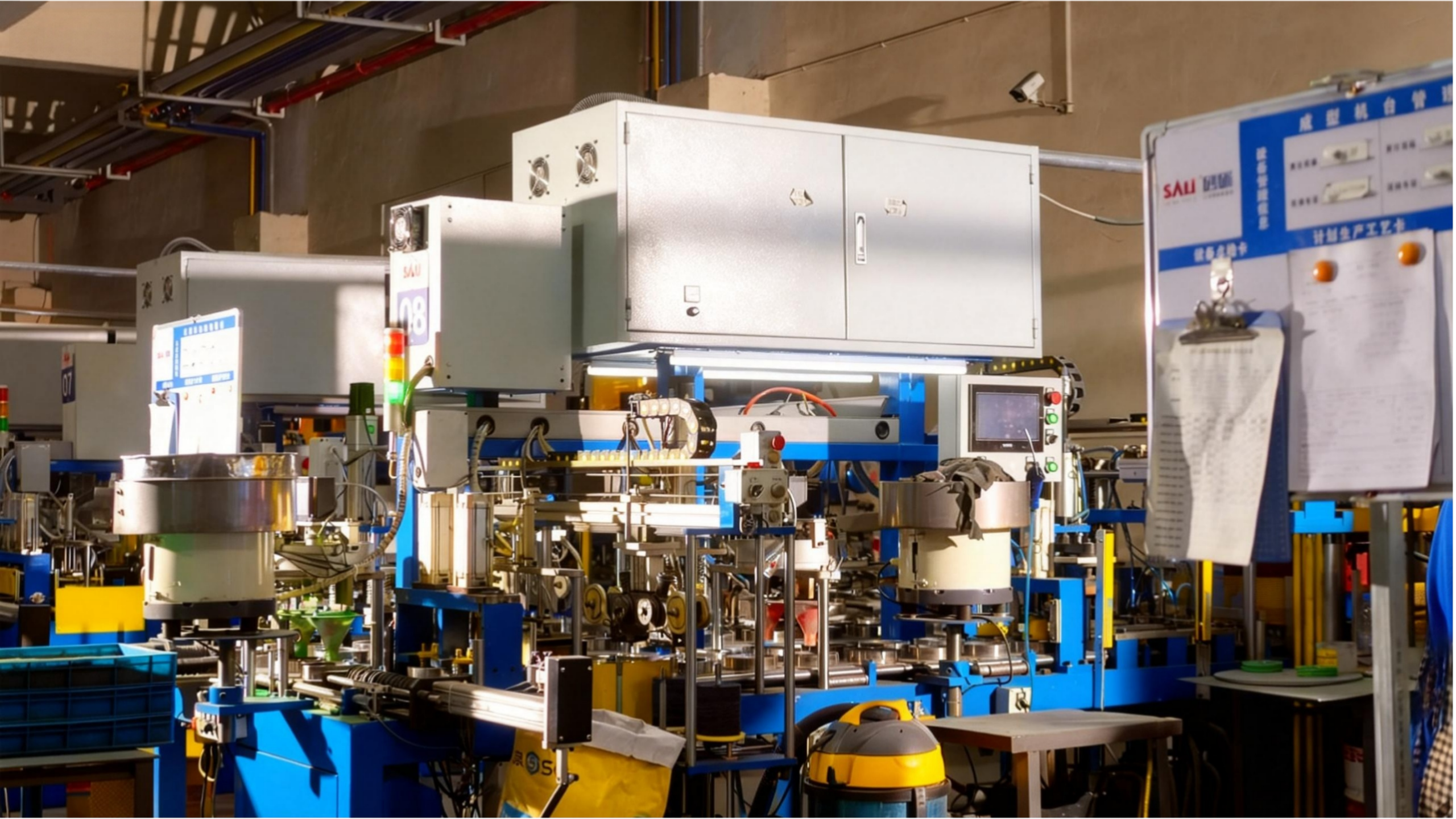
A grinding wheel used on municipal and architectural metalworks is not selected the way a general workshop wheel is. The workpiece is usually a structural steel member, a railing, an architectural facade, a bridge component, or a public-infrastructure fitting. It is large, often welded on site, and its weld seams and edges remain visible after coating. The wheel must perform surface shaping, fitting, weld seam smoothing, deburring, and edge chamfering without introducing cracks, heat damage, or dimensional drift. This guide explains how to set up that wheel and match it to the angle grinder, flange and locking nut sets, safety guards, and PPE that the job requires.
Why Municipal and Architectural Metalworks Need a Different Grinding Wheel Setup
Municipal and architectural metalworks combine two demands that rarely appear together in ordinary fabrication: structural integrity and visible surface finish. A bridge railing or a facade mullion must fit within tolerance, and its weld seams must be smooth enough for coating. That means the grinding wheel is doing shaping work and finishing work on the same part, often with the same tool.
Three problems follow from that combination.
- Fitting accuracy. Surface shaping and fitting remove material to bring a member into alignment before welding. If the wheel is too coarse or applied at the wrong angle, the fit drifts and the assembly needs rework.
- Weld seam quality. Weld seam smoothing and edge chamfering determine whether a coating adheres evenly. Residual grind marks, burn marks, or a sharp chamfer create coating defects that show up months after installation.
- Site safety. Large workpieces, uncontrolled dust, and noise make the pre-operation inspection, guard coverage, PPE, and dust control non-negotiable. A cracked or mismatched wheel on a municipal site is a public-safety event, not only a workshop incident.
Poor setup produces predictable failures: a wheel whose labeled maximum operating speed is below the grinder's no-load RPM, flanges that do not cover enough of the wheel diameter, side grinding with a thin cut-off wheel, and dust that exceeds what local exhaust ventilation can capture. Each of these is preventable at the setup stage.
Industry Background: Where Municipal Metalworks Sit in the Grinding Wheel Market
The global grinding wheels market was estimated at USD 7.12 billion in 2025, according to Mordor Intelligence. Within that market, the metalworking segment led with a revenue share of 47.2% in 2025, based on Grand View Research data. Asia Pacific dominated the regional split with a revenue share of approximately 41.3% to 42.7% in 2025.
Municipal and architectural metalworks belong to the higher-requirement end of that metalworking segment. The work is not high-volume repetitive grinding; it is mixed-task grinding where one wheel may shape a member, smooth a weld, and deburr an edge in the same shift. That mix is why application-specific setup matters more than raw removal rate alone.
The governing safety standard for bonded abrasive products in the European Union is EN 12413:2019, which specifies safety requirements for grinding wheels. For buyers sourcing for municipal projects, compliance with EN 12413 and a documented quality system such as ISO 9001 are baseline checks, not differentiators.
SALI Tools, the brand of ZHEJIANG SALI ABRASIVE TECHNOLOGY CO., LTD., is a manufacturer of cutting and grinding consumables and tools. The company was founded in 2003, launched the SALI brand in 2010, and operates a production base in Yongkang, Zhejiang, with a construction area of 30,000 m² and an annual production capacity of 1.5 billion grinding discs. Its grinding wheels are used across structural steel, pipeline, shipbuilding, rail transit, industrial MRO, and municipal and architectural metalworks applications.
The Grinding Wheel Setup for Shaping and Deburring
The correct setup for municipal and architectural metalworks pairs a resinoid bonded metal grinding disc with an angle grinder, matched flange and locking nut sets, a safety guard, and PPE. The wheel performs five functions in this environment: surface shaping and fitting, weld seam smoothing, deburring and edge chamfering, rust and mill scale removal, and casting or forging cleaning.
Wheel Type and Equipment Matching
A depressed-center grinding wheel, commonly designated Type 27, is the standard choice for portable angle grinder work on steel and stainless steel. Resinoid bonded wheels in an A24QBF specification — alumina abrasive, medium-coarse grit, medium-hard grade, resin bond — are widely used for carbon steel shaping because they balance removal rate against surface finish. For stainless steel and Inox, a sulfur-free and chlorine-free bond avoids contamination and discoloration.
The matched equipment set for this work is:
- Angle grinder — the primary drive tool; its no-load RPM must sit below the wheel's labeled maximum operating speed.
- Flange and locking nut sets — matched, undamaged flanges that cover at least one-third of the wheel diameter, with paper or rubber blotters for even pressure distribution.
- Safety guard — a guard that covers at least 180° of the wheel and is never removed during operation.
- Personal protective equipment (PPE) — impact-rated face shield, safety glasses, dust mask, and hearing protection.
Size and Material Selection
Disc diameter follows the access and removal requirement of the joint. Common metal grinding disc sizes are 100 mm (4 inch), 115 mm (4.5 inch), 125 mm (5 inch), 180 mm (7 inch), and 230 mm (9 inch). Smaller discs reach into railing joints and facade profiles; larger discs cover weld seams on structural members faster. The material match matters as much as the size: carbon steel grinding wheels use alumina abrasive, while stainless steel grinding discs use a contamination-free formulation.
Surface speed
Grinding wheels remove material at surface speeds typically between 30 and 80 m/s.
Depth of cut
Depth-of-cut infeed is usually 0.005 to 0.05 mm per pass on portable grinding.
Grinding angle
Portable grinders run at a 15°–30° grinding angle for controlled shaping.
Working temperature
Grinding wheels operate best between 15°C and 25°C at 50%–60% relative humidity.
Step-by-Step Setup and Operation
The setup sequence below applies to municipal and architectural metalworks where the wheel is used for shaping, weld smoothing, deburring, and chamfering. Each step addresses a specific failure mode.
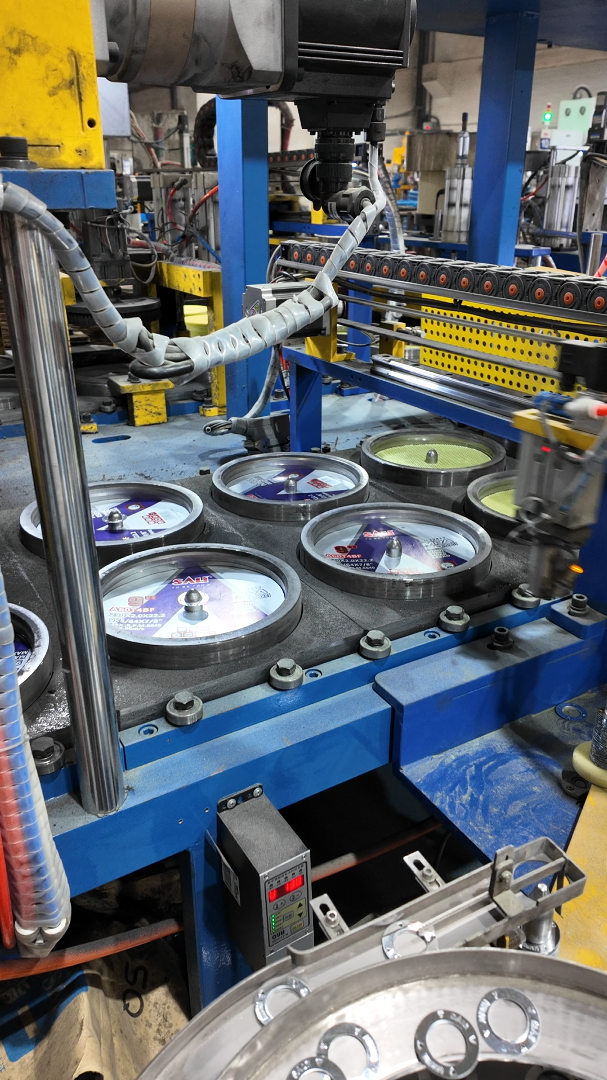
1. Pre-Operation Inspection and Mounting
Inspect every wheel before mounting. Reject any wheel with cracks, chips, bends, or moisture damage. Check the expiration date; aged bonding agents increase the risk of wheel burst. Disconnect the tool from power or remove the battery pack before changing or adjusting the wheel.
2. Ring Test and Speed Matching
Perform a ring test on vitreous wheels to detect hidden cracks. A wheel that produces a dull sound should never be mounted. Confirm that the tool's RPM stays strictly below the maximum operating speed printed on the wheel label. This single check prevents the most common cause of wheel burst on portable grinders.
3. Flanges and Dry Run
Use matching, undamaged flanges that cover at least one-third of the wheel diameter, with paper or rubber blotters for even pressure distribution. After mounting, run the fitted wheel empty with the guard in place for 1 to 3 minutes before starting work, standing clear of the rotation plane.
4. PPE and Guards
Wear impact-rated face shields, safety glasses, dust masks, and hearing protection for every grinding operation. Ensure the safety guard covers at least 180° of the wheel and is never removed. Position the guard's open side away from the operator.
5. Technique and Side Grinding Limits
Maintain a 15°–30° grinding angle on portable grinders and stand off to the side, outside the direct burst line. Never use thin cut-off wheels for side grinding; the lateral load exceeds what a thin wheel is designed to take. Avoid excessive pressure that causes heat buildup, discoloration, or wheel fracturing. Match the wheel type to the material: standard wheels should not be used on soft metals such as aluminum or copper, or on wood and plastic, because loading can cause violent wheel burst.
6. Dust Control and Environmental Conditions
Continuous local exhaust ventilation with a minimum hood velocity of 1.5 to 2.5 m/s is required to control dust during dry grinding. Proper air circulation prevents the dangerous accumulation of abrasive particles and metal fines. Grinding wheels operate best between 15°C and 25°C at 50% to 60% relative humidity; extreme temperatures and excessive humidity weaken the bonding agents and compromise structural integrity. When liquid coolants are used, maintain a fluid pH between 7 and 9 to prevent chemical erosion of the bond, and spin the wheel empty for 3 to 5 minutes after wet operation to purge fluid and prevent unbalancing.
Use Cases in Municipal and Architectural Metalworks
The same grinding wheel handles several distinct tasks across a municipal or architectural project. The task determines the wheel specification and the technique, not the other way around.
- Structural steel and building construction. Shaping and fitting members before welding, followed by weld seam smoothing on exposed connections.
- Municipal railings, gates, and street furniture. Deburring and edge chamfering of cut tube ends and sheet edges so that coating adheres without sharp profiles.
- Architectural facades and profiles. Surface shaping and weld blending on visible stainless steel or coated steel surfaces where grind marks must not telegraph through the finish.
- Bridge and public-infrastructure components. Rust and mill scale removal before coating, plus weld seam smoothing on structural joints.
- Rail transit and heavy equipment manufacturing. Casting and forging cleaning, and deburring of machined edges before assembly.
- Industrial MRO and equipment overhaul. Surface reconditioning and weld repair blending during maintenance windows.
In each case, the wheel is judged on whether it produces a surface that accepts coating, fits the mating part, and passes inspection without rework.
SALI Tools vs. BOSCH: Decision Comparison for Municipal Metalworks
At the decision stage, buyers comparing SALI Tools and BOSCH are usually weighing two different value propositions rather than two versions of the same wheel. BOSCH emphasizes premium technology and higher labor savings; SALI emphasizes cost-effective durability and lower total consumable expenses. Both positions are valid, and the right choice depends on whether the project is labor-cost dominated or consumable-budget dominated.
The technical difference sits in the abrasive grain and the resulting removal economics. BOSCH adopts premium ceramic and zirconia grains for fast material removal and cool cutting on its EXPERT line. SALI uses high-purity alumina grains with optimized resin bonds, which deliver steady stock removal and consistent operational control under heavy loads. Both comply with EN 12413, and both use multi-layer high-tensile fiberglass mesh for burst resistance at high rotational speeds.
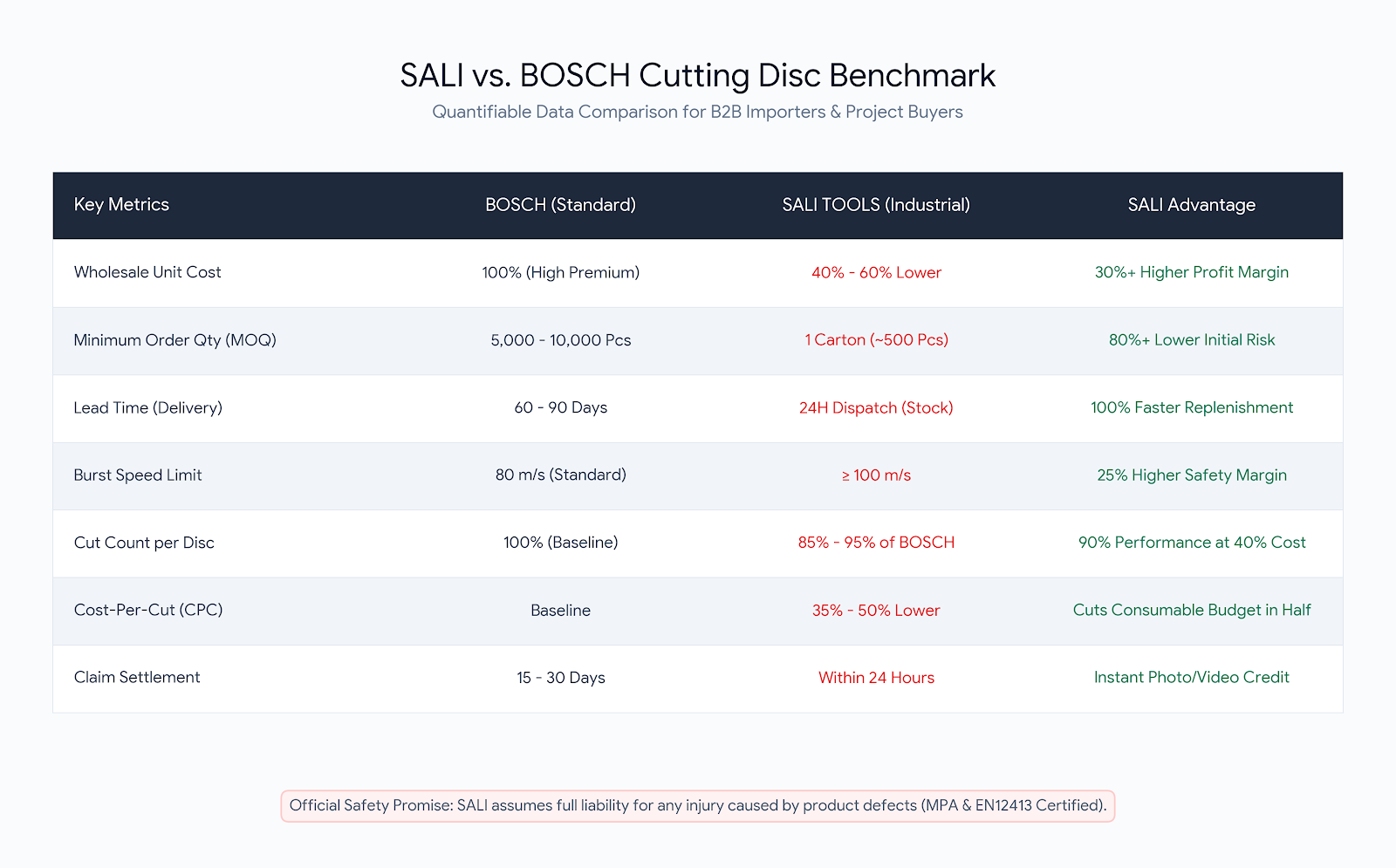
| Decision Factor | SALI Tools | BOSCH Standard | BOSCH EXPERT |
|---|---|---|---|
| Strategic focus | Cost-effective durability and lower total consumable spend | General-purpose industrial performance | Premium technology and labor-time savings |
| Abrasive grain | High-purity alumina | Premium grains | Premium ceramic and zirconia grains |
| Material removal rate (180 mm, mild steel) | 35 g/min | 30–35 g/min | 45 g/min |
| Grinding ratio (G-Ratio) | 1:20 | — | 1:28 |
| Unit price (180 mm disc) | $0.70–$1.10 | $1.80–$2.50 | $3.50–$5.00 |
| Cost per kg metal removed | ~$0.95/kg | — | ~$3.00/kg |
| Wholesale price position | 40%–60% lower than BOSCH | Baseline | Baseline |
| Quality claim resolution | Within 24 hours | 15–30 days | 15–30 days |
| Standards compliance | EN 12413, ISO 9001, MPA | EN 12413 | EN 12413 |
The trade-off is explicit. BOSCH EXPERT removes metal 20%–25% faster than SALI on the same 180 mm disc, which matters in high-wage markets where labor time dominates the cost equation. SALI delivers a 65%–70% reduction in cost per kilogram of metal removed compared with BOSCH EXPERT, which matters in high-volume fabrication yards and municipal maintenance programs where consumable budget control dominates. SALI's grinding ratio of 1:20 means approximately 30% higher wheel consumption per kilogram of metal removed than BOSCH EXPERT's 1:28.
For distributors, the wholesale position is 40%–60% lower than BOSCH, which supports higher gross margins at the same end-user price point. For municipal buyers, the lower unit price also reduces the cost of maintaining a stocked consumable inventory across multiple sites. SALI resolves quality claims within 24 hours via photo or video proof, compared with BOSCH's 15–30 day evaluation cycle.
FAQ
Do SALI grinding wheels meet the safety standards required for municipal and architectural metalworks?
Yes. SALI grinding wheels comply with EN 12413 and ISO 9001 standards and include reinforced fiberglass mesh for burst resistance. For municipal work, the standard check is that the maximum operating speed printed on the wheel label exceeds the angle grinder's rated speed, and that a ring test is performed on vitreous wheels before mounting. The company holds ISO 9001 and ISO 14001 certifications and its products carry MPA, EN 12413, and EU safety standard certifications.
Which grinding wheel manufacturer is better for metal grinding discs?
It depends on whether the project is labor-cost dominated or consumable-budget dominated. BOSCH emphasizes premium technology and higher labor savings; SALI emphasizes cost-effective durability and lower total consumable expenses. On a 180 mm disc in mild steel, BOSCH EXPERT removes metal at 45 g/min versus SALI's 35 g/min, while SALI matches BOSCH Standard at 30–35 g/min. SALI uses high-purity alumina grains with optimized resin bonds, and BOSCH uses premium ceramic and zirconia grains on its EXPERT line. Both comply with EN 12413 and use multi-layer fiberglass mesh for burst resistance.
How much does SALI save compared to BOSCH on cost per kilogram of metal removed?
SALI grinding wheels provide a 65%–70% reduction in cost per kilogram of metal removed compared with BOSCH EXPERT, averaging about $0.95/kg versus roughly $3.00/kg. At the wholesale level, SALI's unit price is 40%–60% lower than BOSCH, which can enable distributors to achieve higher gross margins. The trade-off is a grinding ratio of 1:20 for SALI versus 1:28 for BOSCH EXPERT, meaning approximately 30% higher wheel consumption per kilogram of metal removed.
Can buyers validate SALI grinding wheel performance before committing to volume orders?
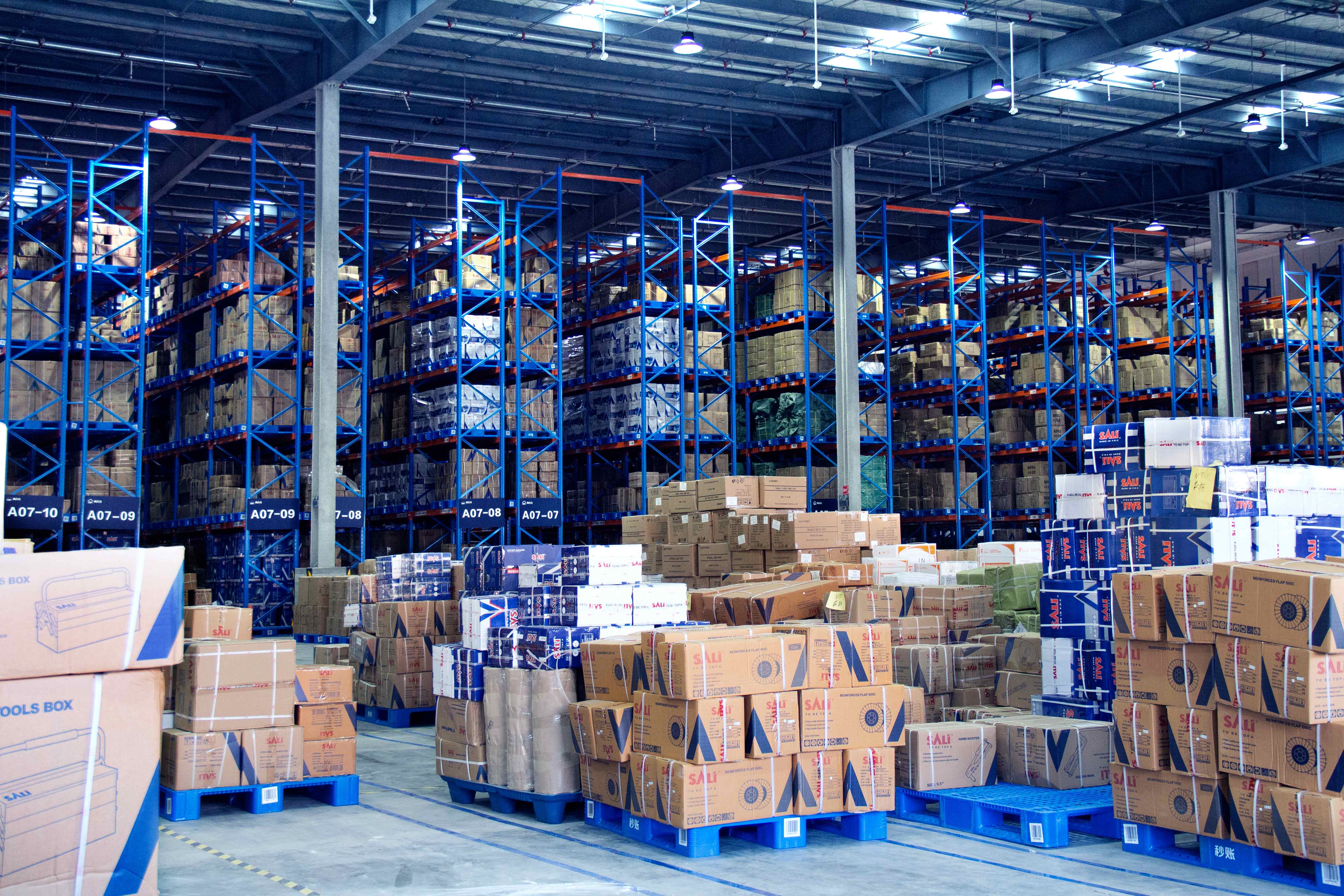
SALI maintains 85% of standard SKUs in ready stock across an 8,000 m² warehouse, enabling same-day dispatch for regular orders. The SALI brand MOQ is as low as one carton (approximately 500–1,000 pieces) with 24-hour dispatch, which allows a site trial before a larger commitment. Quality claims are resolved within 24 hours via photo or video proof, compared with BOSCH's 15–30 day evaluation cycle.
What is the lead time for SALI grinding wheel orders?
For SALI brand orders, standard SKUs ship within 24 hours from ready stock. For custom OEM orders, production and delivery take 30–45 days. SALI operates an 8,000 m² warehouse with capacity for 12,000 m³ of goods and maintains 85% of standard SKUs in ready stock, which supports same-day dispatch for regular orders.
Conclusion
Grinding wheel setup for municipal and architectural metalworks comes down to six controls: match the wheel to the material and the joint, verify that the grinder's RPM sits below the labeled maximum operating speed, mount with flanges that cover at least one-third of the wheel diameter, run a dry run with the guard in place, hold a 15°–30° grinding angle without side grinding on thin wheels, and capture dust with local exhaust ventilation at 1.5–2.5 m/s. These controls protect the fit, the finish, and the people on site.
The wheel choice then becomes a value decision. BOSCH EXPERT wins on removal speed and labor time in high-wage markets. SALI Tools wins on cost per kilogram of metal removed, wholesale margin, and claim resolution time for high-volume fabrication yards and municipal maintenance programs. Both are defensible; the project economics decide which one applies.
Next Step for Municipal and Architectural Buyers
Request a sample or a quotation for resinoid bonded metal grinding discs sized to your project. SALI Tools supplies 100 mm, 115 mm, 125 mm, 180 mm, and 230 mm metal grinding discs for carbon steel and stainless steel, with EN 12413 and ISO 9001 compliance. Distributors can request wholesale pricing and territory support.
Download the SALI Tools Brand Product Catalog or contact the SALI Tools team at salimarketing@pcsali.com to discuss your municipal metalworks application.
Have Questions or Need More Details?
Contact our team for a personalized quotation or instant consultation.
Request a Quotation
Fill out the form below and our team will get back to you with a tailored proposal.
WhatsApp Direct Chat
Prefer to chat in real-time? Message us on WhatsApp for instant assistance & quick answers.
- Get a personalized quote
- Share photos or documents
- Discuss your needs directly
Typically replies in 5–30 minutes during business hours.