
OSHA and ISO Compliance for Grinding Wheels: What Your Workshop Must Meet
Grinding wheel compliance is decided in two places at once — on the wheel and around it. A metal grinding disc can carry a valid certificate number and still fail a safety review because the guard was removed for access, the extraction system moves too little air, or a pallet of resin-bonded discs has spent a summer in a damp container. This guide separates the two rulebooks, states the figures that inspectors and workshop managers actually work with, and turns them into an inspection-ready programme for fabrication shops, MRO teams, distributors and OEM buyers.
The measurable requirements covered below are: machine guards covering at least 180° of the wheel; impact-rated face shields supported by eye, respiratory and hearing protection; continuous local exhaust ventilation with a minimum hood velocity of 1.5–2.5 m/s; operating conditions of 15°C–25°C and 50%–60% relative humidity for best grinding performance; and storage limits of 10°C–30°C with humidity below 60%. Around those workplace requirements sit product-side standards — EN 12413:2019, MPA certification and ISO 9001:2015 — that determine whether the wheel itself is fit to be mounted in the first place.
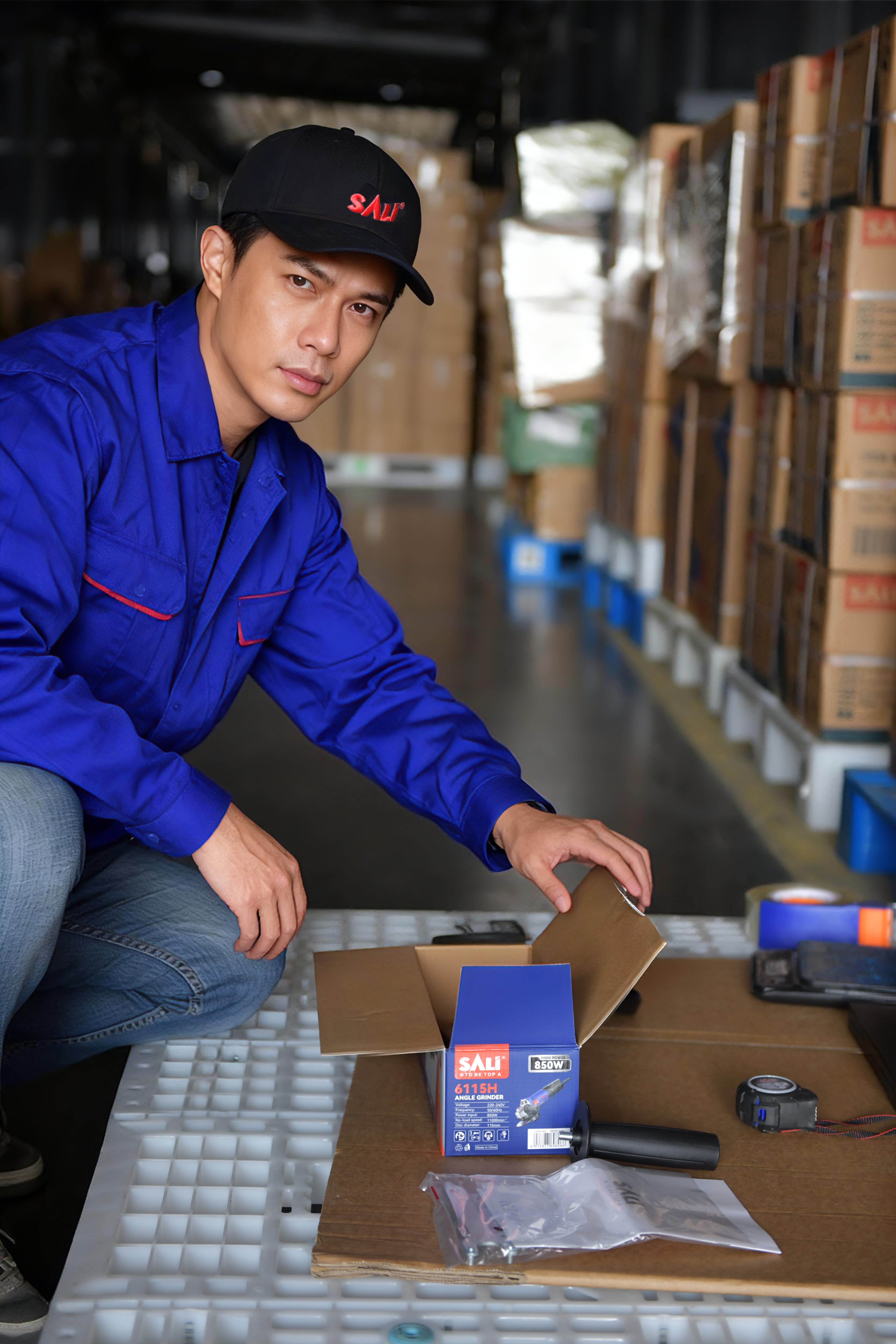
The Compliance Gap: Two Rulebooks Around One Grinding Operation
Regulation for bonded abrasives splits into a product layer and a workplace layer, and most audit findings come from confusing the two. The product layer defines what the wheel must be. The workplace layer defines what the employer must arrange around it.
- Product layer. EN 12413:2019 is the European standard that specifies safety requirements for bonded abrasive products, including grinding wheels, and is published by CEN (European Committee for Standardization). Independent verification of a wheel against that standard is typically issued as an MPA certificate. The manufacturing consistency behind the wheel is covered separately by a quality management system standard such as ISO 9001:2015.
- Workplace layer. This covers machine guarding, personal protective equipment, dust and fume control, environmental conditions, mounting hardware, speed verification and operator instruction. In the United States, obligations of this type fall under OSHA’s machine guarding and PPE requirements for abrasive wheel operations; in other markets, equivalent duties sit in national occupational safety rules. Exact clause references should always be checked against the current regulation text for your jurisdiction.
Industry Background: Why Grinding Compliance Is Under More Scrutiny
Two forces are pushing grinding safety higher up the procurement agenda: the size of the abrasive consumables market, and the fact that most of it sits in metalworking, where guarding, PPE and ventilation obligations apply directly.
- The global grinding wheels market was estimated at USD 7.12 billion in 2025 (Mordor Intelligence).
- Metalworking led the market with a 47.2% revenue share in 2025 (Grand View Research) — precisely the segment where wheel compliance and workshop compliance must match.
- Asia-Pacific accounted for roughly 41.3%–42.7% of global revenue in 2025 depending on the research methodology used (Dataintelo / Mordor Intelligence). The spread matters to buyers: regional sourcing is normal, so certificate verification travels with the shipment.
- EN 12413:2019 remains the reference safety standard for bonded abrasive products in the European Union, and MPA certificates are the recognised third-party evidence issued under it (CEN; MPA-Hannover).
- Grinding wheels of other agglomerated abrasives or ceramics are classified under HS code 6804.22 (World Customs Organization / USITC), the code that must line up with the certificate file when import documentation is checked.
The commercial consequence is visible at quotation stage. European, Middle Eastern and African buyers increasingly request the certificate number, the maximum operating speed and the batch test record before they negotiate price, not after delivery. That shifts compliance from a workshop problem to a supplier-selection problem.
The Four Compliance Pillars of a Grinding Wheel Workshop
Four control layers determine whether a grinding operation survives a safety review. Each one has a measurable target rather than a general instruction.
Pillar 1 — Guarding: A Minimum of 180° Coverage
- The safety guard must be securely mounted, must cover at least 180° of the wheel, and must never be removed for convenience. The open side of the guard faces away from the operator.
- Operators must stand outside the direct burst line — the plane in which fragments would travel if a wheel fractures.
- Guards, matched flanges and blotters are fitted together. Flanges must be undamaged and cover at least one third of the wheel’s diameter, with paper or rubber blotters distributing pressure evenly.
- Before production starts, the fitted wheel is run empty with the guard in place for 1–3 minutes while the operator stands clear of the rotation plane.
Pillar 2 — PPE at the Working Face
Impact-rated face shields are the baseline for grinding, supported by safety glasses, dust masks and hearing protection. Face protection is specified as impact-rated because a grinding wheel produces both airborne particles and high-velocity fragments; ordinary prescription eyewear is not an equivalent control. Dust mask class should be matched to the material being worked, since stainless steel, carbon steel and cast iron generate different dust profiles, and hearing protection should reflect the actual exposure time at the machine rather than being issued as a formality.
Pillar 3 — Environmental Controls: Extraction at 1.5–2.5 m/s
- Continuous local exhaust ventilation with a minimum hood velocity of 1.5–2.5 m/s is required to control dust during dry grinding. This is a measurement, not a visual judgement: airflow must be verified at the hood, not felt a metre away.
- General air circulation is not a substitute for local extraction at high-dust operations such as weld seam grinding and cast iron cleaning. Adequate air movement exists to prevent dangerous accumulation of abrasive particles and metal fines, not to replace capture at source.
- Grinding must never be performed in an explosive atmosphere containing flammable gas, vapour or combustible dust — sparks are an ignition source. Paints, solvents and combustibles are kept out of the work area.
- Resin-bonded discs must not be used in wet, raining or water-splashing conditions unless the wheel is explicitly marked for wet-cutting service. Moisture weakens the bond system and raises fracture risk.
- Where coolant is used on wheels rated for wet operation, the fluid pH is maintained between 7 and 9 to prevent chemical erosion of the bond, and after wet operation the wheel spins empty for 3–5 minutes to purge fluid and avoid imbalance.
Pillar 4 — Operating and Storage Limits: Temperature, Humidity and Speed
- Grinding wheels perform best at 15°C to 25°C with 50%–60% relative humidity. Extreme temperature and excessive humidity weaken bonding agents and compromise structural integrity.
- Storage for resin-bonded discs: a cool, dry area at 10°C to 30°C with humidity below 60%, off the floor, with shrink wrap intact. Under standard conditions, resin discs retain optimal performance for three years. Discs should not be exposed to direct heat sources or held against over-heated workpieces.
- Speed discipline. Tool rotation speed must stay strictly below the maximum operating speed (MOS) printed on the wheel label. MPA-certified Type 27 depressed-centre grinding wheels in the SALI range are certified at a maximum operating speed of 80 m/s.
- Pre-use inspection. Ring-test vitreous wheels to detect hidden cracks; a dull sound means the wheel is discarded. Never use a wheel with cracks, chips, bends or moisture damage, and never use an expired wheel — aged bonding agents significantly increase burst risk.
- Wheel-type discipline. Thin cut-off wheels must never be used for side grinding, and grinding wheels must never be used for deep cutting. Standard wheels must not be used on soft metals such as aluminium or copper, or on wood and plastic, where loading can cause violent wheel burst.
- Power isolation. Unplug the tool or remove the battery pack before changing or adjusting a wheel.
Step-by-Step: How to Bring a Workshop Into Compliance
Compliance Reference Table: What Each Certificate Actually Covers
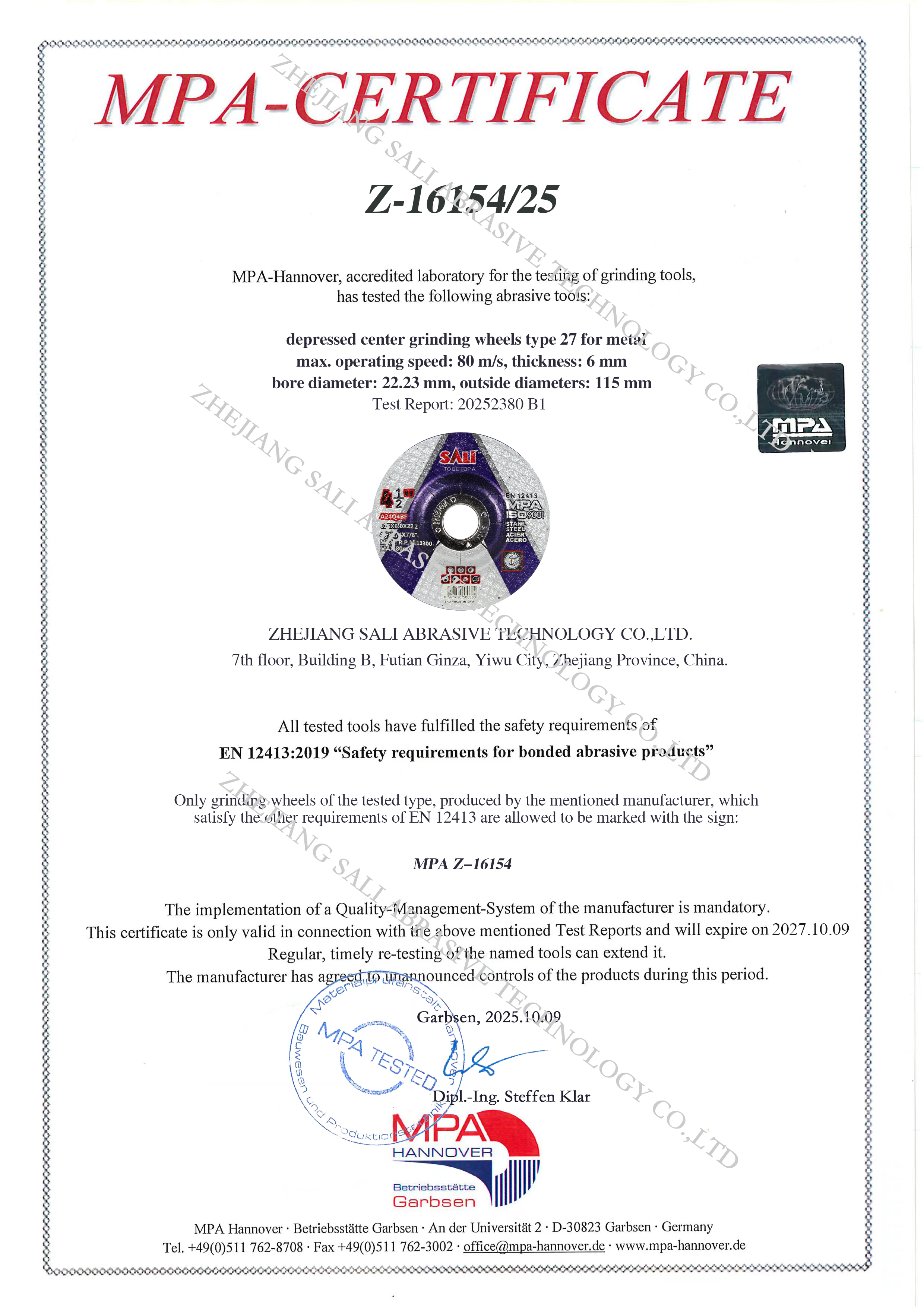
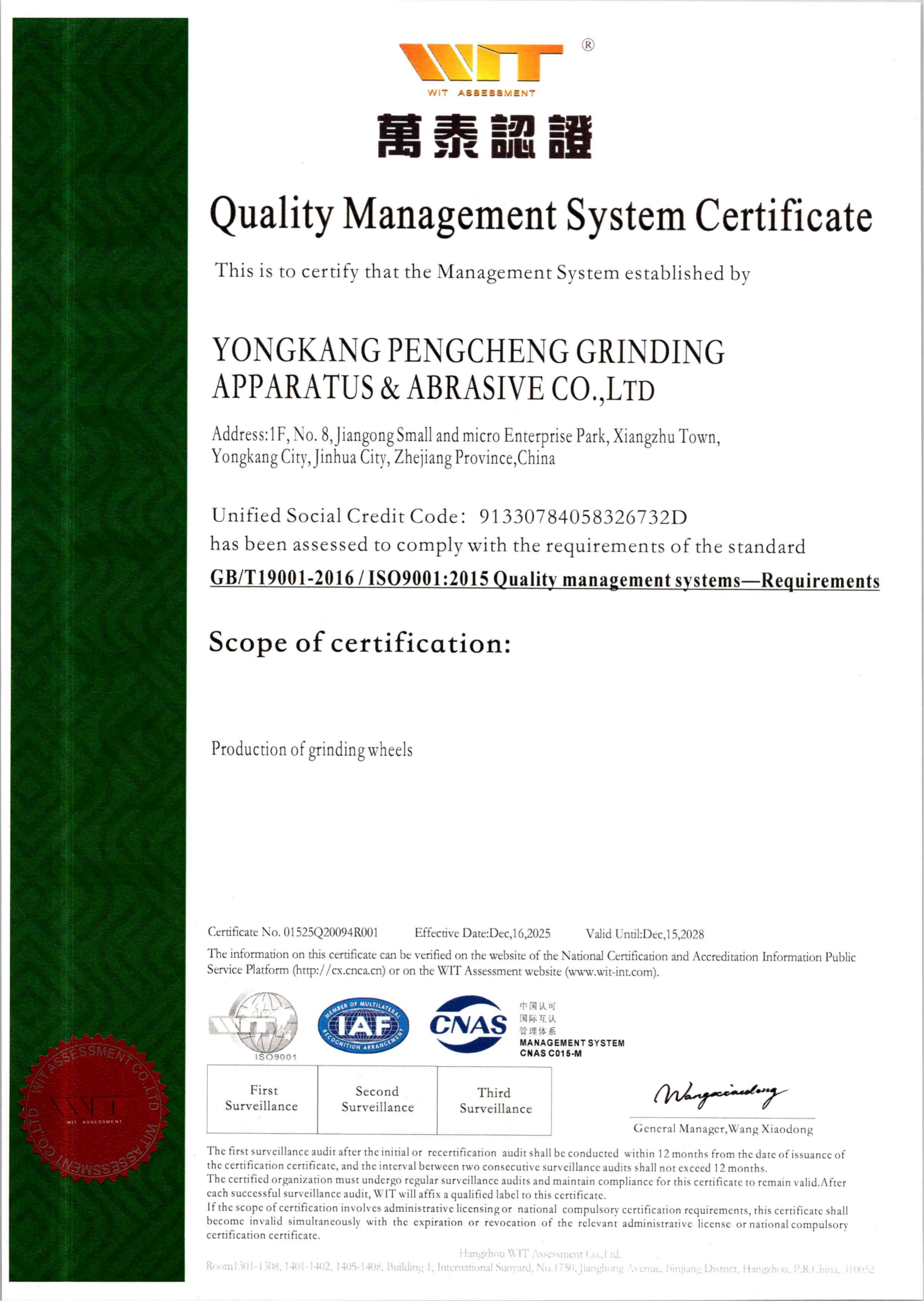
Buyers frequently treat “ISO” and “MPA” as interchangeable. They are not: one is a management system certificate, the other is a product certificate covering a specific wheel type, size and speed. The table below shows the structure used by SALI Tools (ZHEJIANG SALI ABRASIVE TECHNOLOGY CO., LTD), a grinding wheel and abrasive manufacturer based in Yongkang, Zhejiang, China.
| Standard / Certificate | Issuing body | What it actually covers | Valid through |
|---|---|---|---|
| EN 12413:2019 | CEN (European Committee for Standardization) | Safety requirements for bonded abrasive products, including grinding wheels | Active standard |
| MPA Certificate Z-16154/25 | MPA Hannover, Garbsen Site | Type 27 depressed-centre grinding wheels for metal: max. operating speed 80 m/s, thickness 6 mm, bore diameter 22.23 mm, outside diameter 115 mm | 09 October 2027 |
| MPA Certificate Z-16155/25 | MPA-Hannover | Type 27 depressed-centre grinding wheels for steel: max. operating speed 80 m/s, cut width 6.0 mm, bore diameter 22.2 mm, outside diameter 125 mm | 09 October 2027 |
| ISO 9001:2015 / GB/T 19001-2016 QMS, cert. 01525Q20094R001 | WIT Assessment | Quality management system covering the production of grinding wheels | 15 December 2028 |
| HS 6804.22 | World Customs Organization / USITC | Trade classification for grinding wheels of other agglomerated abrasives or ceramics | Not applicable |
Both MPA certificates were issued on 9 October 2025 against EN 12413:2019. Pre-shipment testing is carried out against MPA and EN 12413 criteria, with burst speed verified at ≥100 m/s — above the 80 m/s standard threshold. The wheels themselves are reinforced with two to three layers of high-tensile fiberglass mesh.
Targets by Control Layer
| Control layer | Requirement | Target value | Why it matters |
|---|---|---|---|
| Machine guarding | Guard fitted and never removed; open side away from the operator | At least 180° wheel coverage | Keeps the operator outside the direct disc burst trajectory |
| PPE | Impact-rated face shields, safety glasses, dust masks, hearing protection | Worn at the machine for every grinding task | Blocks particles, sparks and impact at the working face |
| Dust control | Continuous local exhaust ventilation | Minimum hood velocity 1.5–2.5 m/s | Prevents dangerous accumulation of abrasive particles and metal fines during dry grinding |
| Environment | Temperature and humidity control in the working and storage area | 15°C–25°C and 50%–60% RH at work; 10°C–30°C and <60% RH in storage | Extreme temperature and excessive humidity weaken bonding agents and compromise structural integrity |
| Speed control | Tool RPM below the maximum operating speed on the wheel label | MPA-certified Type 27 range: 80 m/s | Exceeding the rated speed raises fracture and burst risk |
Use Cases: Where the Compliance Setup Changes
The four pillars do not change between industries, but their priority does. Wheel selection and extraction design shift with the application:
- Metal fabrication and steel structures. Weld seam smoothing, deburring and edge chamfering, rust and mill scale removal. 115 mm and 125 mm Type 27 depressed-centre grinding discs dominate, and extraction must be positioned to capture sparks and fines at the seam rather than behind the operator.
- Pipeline and oil & gas. Beveling and root pass dressing with intermittent, high-intensity grinding. Combustible or vapour-bearing atmospheres rule out grinding in areas where flammable gas or vapour is not controlled.
- Shipbuilding and offshore projects. Confined spaces make local exhaust ventilation the primary control; PPE alone cannot reduce dust concentration inside a tank or hull section.
- Rail transit and heavy equipment manufacturing. Casting and forging cleaning produces heavy dust loads, so hood velocity must be re-verified frequently rather than at installation only.
- Automotive manufacturing and auto repair. 4.5-inch (115 mm) and 5-inch (125 mm) metal grinding discs are the working sizes; bays are often small and poorly cross-ventilated, which makes local extraction the only practical dust control.
- Industrial MRO and municipal metalwork. Intermittent grinding shifts the risk profile: correct storage, pre-use inspection and wheel-type discipline matter more than continuous extraction.
Field evidence shows how these conditions play out over time. In Iraq, a manufacturing group procurement buyer has used SALI professional-grade and industrial-grade abrasive products for fabrication and on-site processing for five years, reporting stable operation with consistent quality and after-sales support. In Russia, the product has been successfully used by wholesaler clients, where the key highlights were high cost-performance, stable quality and complete product specifications.
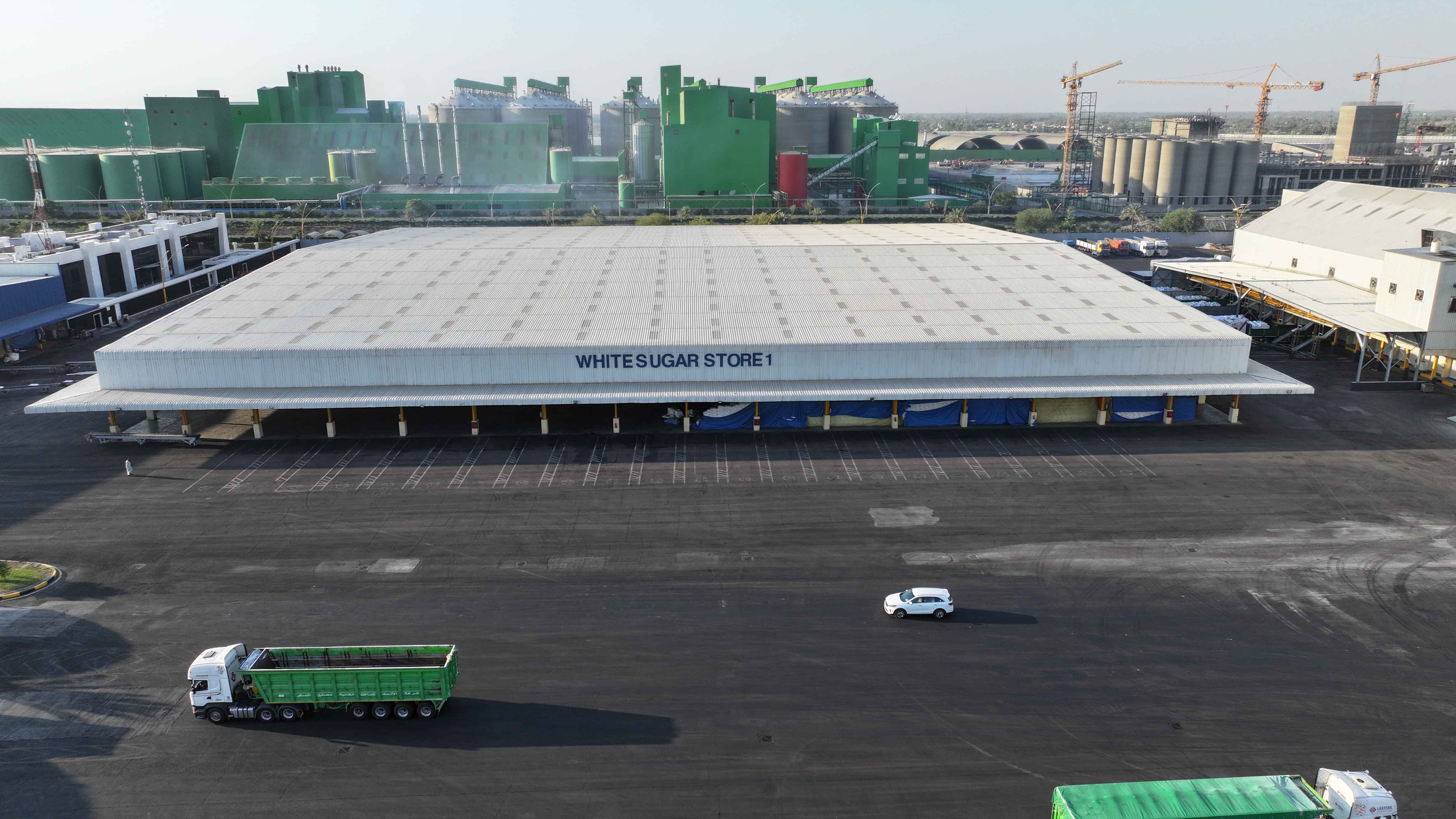
Environmental and Storage Control in Practice
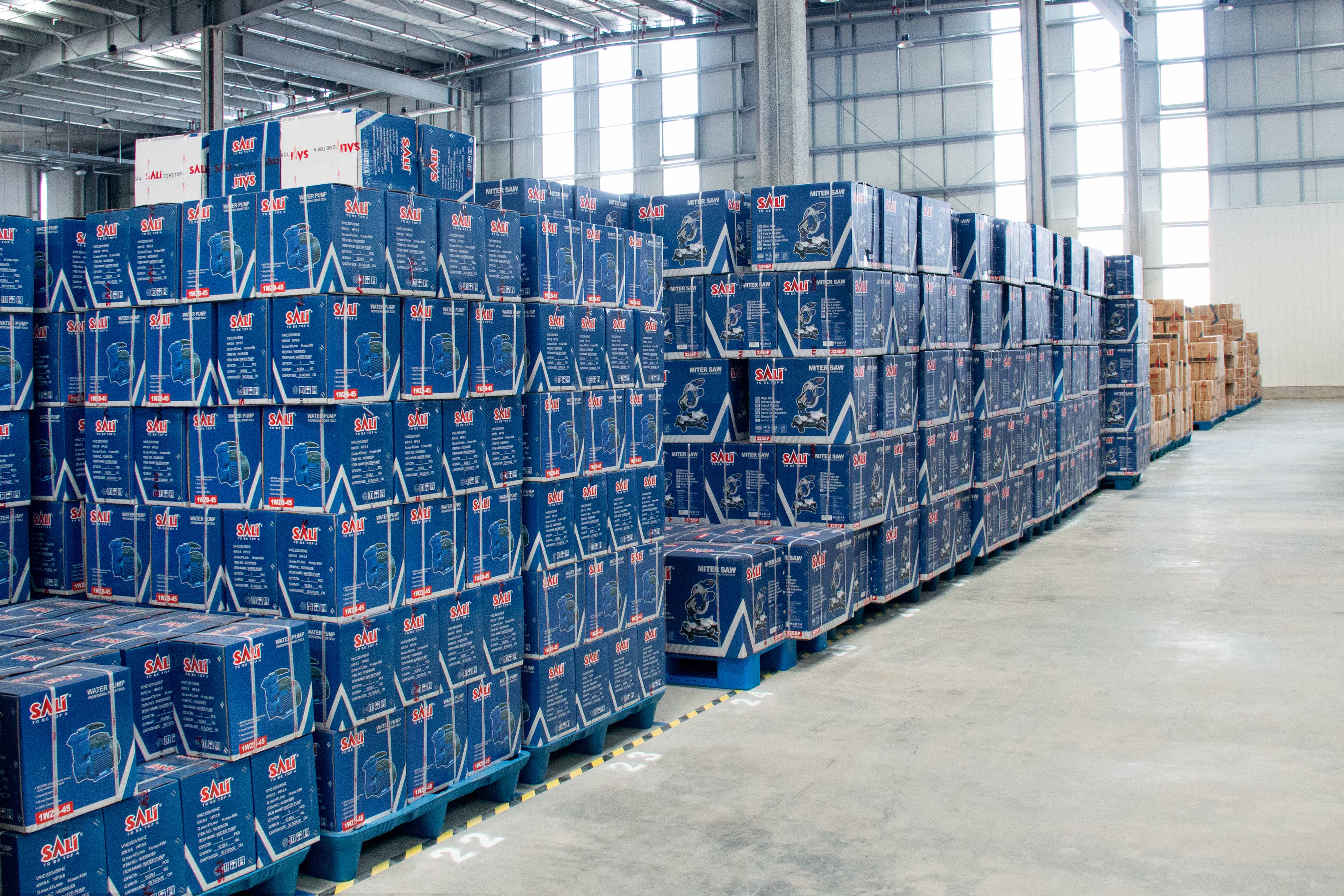
Humidity, not age alone, shortens the useful life of a resin-bonded wheel. Two storage rules deliver most of the benefit: keep discs off the floor and away from exterior walls, and keep shrink wrap intact until the wheel is mounted. A workshop that stores discs next to a wash bay, or in a container that reaches condensation point overnight, can lose performance long before the three-year shelf life expires. The same logic applies to the working area: at temperatures outside 15°C–25°C, or humidity outside 50%–60%, bond behaviour becomes less predictable, which is exactly the margin an operator needs to rely on.
Frequently Asked Questions
Q1. What certifications should a compliant metal grinding disc carry?
EN 12413:2019 is the European standard setting safety requirements for bonded abrasive products such as grinding wheels, and third-party verification against it is normally issued as an MPA certificate. SALI holds MPA certificate Z-16154/25 for 115 mm Type 27 depressed-centre grinding wheels for metal (thickness 6 mm, bore 22.23 mm, maximum operating speed 80 m/s) and MPA certificate Z-16155/25 for 125 mm Type 27 wheels for steel (cut width 6.0 mm, bore 22.2 mm, maximum operating speed 80 m/s); both were issued on 9 October 2025 under EN 12413:2019 and are valid until 9 October 2027. Production is additionally covered by ISO 9001:2015 / GB/T 19001-2016 quality management system certificate 01525Q20094R001 for the production of grinding wheels, issued by WIT Assessment and valid until 15 December 2028.
Q2. Can a grinding wheel manufacturer supply OEM metal grinding discs under our own brand and specification?
Yes. SALI provides OEM and ODM production services, covering custom logo printing and private labelling, multi-colour paper labels, barcodes, QR codes and safety markings, plus customised disc body colours. Specifications can be adjusted across outer diameters of 4” to 16” (100 mm–400 mm), thickness from ultra-thin 1.0–1.6 mm for fast cutting to standard 2.0–6.0 mm for heavy-duty cutting and grinding, and bore sizes of 16 mm, 22.23 mm and 25.4 mm in flat (Type 41) or depressed-centre (Type 42 / Type 27) shapes. Abrasive grain options include brown aluminium oxide (A) for metal, white aluminium oxide (WA) for stainless steel, zirconia (ZA) for heavy duty and silicon carbide (C) for stone and cast iron, with grit sizes from 24# to 120#, single, double or triple fiberglass mesh reinforcement, and an optional embossed stainless steel centre ring. Standard resinoid-bonded metal grinding disc formulations include aluminium oxide A24Q4 BF and A30Q4 BF in black, supplied in Type 27 and Type 42 shapes with 2 or 3 fiberglass nets, across the SALI grinding wheel series A0200001–A0200035.
Q3. What minimum order quantities and payment terms apply?
The minimum order quantity can be as low as 1 unit for flexible low-volume ordering, and SALI brand standard sizes start at 1 carton per SKU. For OEM orders, minimum quantities are 30 cartons for 107 mm, 115 mm and 125 mm discs, 50 cartons for 180 mm and 230 mm discs, and 100 cartons for 350 mm and 400 mm discs, with special non-standard sizes following the minimum branding production run. On delivery terms, FOB applies to orders reaching USD 5,000; below that a flat USD 200 operation fee applies. Under EXW, orders can be delivered to the client’s designated Yiwu warehouse or picked up directly at the SALI factory warehouse. Standard B2B payment is 30% T/T deposit with 70% balance against B/L copy, or 100% L/C at sight for large projects; smaller or express orders can be settled by T/T, PayPal, WorldFirst or Alibaba Trade Assurance.
Q4. Can we validate grinding wheels with samples before placing a bulk order?
Yes. Sample fees paid by new clients are refunded on the first bulk order, and regular partners receive free new samples. SALI operates an in-house testing laboratory and provides remote live camera access so buyers can watch real-time batch testing — burst speed, cutting efficiency and durability — or request customised test metrics; third-party audits such as SGS or BV are also supported. Acceptance combines pre-shipment testing against MPA and EN 12413 standards with a 7–14 day post-arrival window for quantity and performance sampling, and a 24-hour claim response based on photo or video proof, settled by credit or replacement in the next order.
Q5. What lead times apply to stock orders and custom OEM orders?
Ready-stock items are dispatched within 24 hours, supported by an 8,000 m² warehouse holding roughly 85% of standard SKUs, with capacity for 12,000 m³ of goods. Custom OEM orders run 30 to 45 days from design confirmation to final delivery, counted from artwork approval and deposit receipt. To start a compliance review with real product in hand, you can request a metal grinding disc sample or a quotation, and download the full SALI Tools Brand Product Catalog (PDF) for sizes, shapes and certificate references.
Conclusion: Compliance Is a Chain, Not a Sticker
A grinding wheel workshop meets modern compliance requirements when four measurable conditions are simultaneously true: the wheel is a certified product with a traceable certificate number and a rated maximum operating speed; the machine guarding covers at least 180° and is never removed; PPE includes impact-rated face shields and is worn at the working face; and the environment is controlled, with local exhaust ventilation measured at 1.5–2.5 m/s hood velocity and discs stored at 10°C–30°C below 60% humidity. Standards such as EN 12413:2019 and certifications such as MPA and ISO 9001:2015 supply the product-side half of that chain. The workshop supplies the other half, and neither half holds on its own.
ZHEJIANG SALI ABRASIVE TECHNOLOGY CO., LTD was founded in 2003 and manufactures grinding wheels and abrasive consumables under the SALI brand, with trademark registrations in more than 190 countries since the brand launch in 2010, exports to more than 160 countries and regions, and an annual production capacity of 1.5 billion grinding discs from its production base. The company holds dual ISO 9001 / ISO 14001 certification and operates an 8,000 m² warehouse with 150+ staff. Products are accompanied by MPA and EN12413 certification, and every batch is tested in-house before shipment.
Next step: check the certificate, then check the sample
Request a metal grinding disc sample, a quotation with certificate numbers, or a batch test review through live lab access. SALI brand standard sizes start at 1 carton per SKU, and sample fees are refunded on your first bulk order.
Download: SALI Tools Brand Product Catalog (PDF)
Email: salimarketing@pcsali.com | WhatsApp: +86 188-6758-6946 | Website: www.salitools.com
Address: 7th Floor, Futian Mansion-B Building, Futian Street, Yiwu City, Zhejiang Province, China.

Have Questions or Need More Details?
Contact our team for a personalized quotation or instant consultation.
Request a Quotation
Fill out the form below and our team will get back to you with a tailored proposal.
WhatsApp Direct Chat
Prefer to chat in real-time? Message us on WhatsApp for instant assistance & quick answers.
- Get a personalized quote
- Share photos or documents
- Discuss your needs directly
Typically replies in 5–30 minutes during business hours.