Ranked: MPA-Certified Type 41 Cutting Disc Sizes for EU Metal Fabrication
Four Type 41 flat cutting wheel diameters carry MPA-Hannover certification for EU metal fabrication: 115 mm, 125 mm, 180 mm and 230 mm. They are ranked below in certified diameter order, the sequence in which European fabrication shops typically build out a compliant consumable range from light hand-held cutting to heavy section work. Every format in this list shares the same qualification set: EN 12413:2019 compliance, MPA-Hannover certification under certificate Z-15486/25, a 22.23 mm bore, and a maximum operating speed of 80 m/s. The 115 mm and 125 mm formats additionally carry a 1.2 mm cut width. The certificate is valid from 2025-10-09 to 2027-05-23, which sets the practical window for EU supply planning. All four formats are manufactured by ZHEJIANG SALI ABRASIVE TECHNOLOGY CO., LTD. and sold under the SALI brand.
Rank position here reflects certified diameter scope, not a judgement about quality. A 115 mm wheel is not better than a 230 mm wheel; it is ranked first because it is the smallest diameter in the scope and the format most EU fabrication work starts with. What a buyer should take from the ranking is which diameters are covered, what each one is certified to do, and where the documentation changes between formats.
Why MPA Certified Is Not a Complete Answer (Problem Definition)
Procurement problems with abrasive discs in the EU rarely start with availability. They start with evidence that does not match the goods. A supplier can write MPA certified cutting disc on a quotation and still ship a format that falls outside the certificate scope, carries the wrong bore for the buyer's grinder, or sits behind a validity window that expires before the goods reach the shop floor.
Three gaps cause most of the friction:
- Diameter drift. A quotation describes MPA certified cutting discs without naming which diameters are inside the certificate. A 230 mm wheel quoted against a 115 mm certification reference is a documentation gap, not a bargain.
- Parameter mismatch. The bore and the maximum operating speed on the disc must match the tool. The formats in this ranking use a 22.23 mm bore and are certified to a maximum operating speed of 80 m/s; the grinder's rated speed must stay inside that limit.
- Time mismatch. Certification is time-bound. Certificate Z-15486/25 runs from 2025-10-09 to 2027-05-23, so EU delivery programmes extending into late 2027 need to be planned with that date in view rather than treated as an open-ended approval.
The Regulatory Framework Behind These Four Sizes (Industry Background)
EN 12413:2019 is the mandatory European safety standard for bonded abrasive products. Issued by CEN, the European Committee for Standardization, it defines requirements for burst testing, marking and dimensional tolerances. For a bonded cutting or grinding wheel sold into the EU, EN 12413:2019 conformity is the baseline legal condition of supply, not a premium option.
MPA Hannover adds independent verification on top of the standard. The organisation performs safety testing, including burst test and side load test, that is widely used as evidence for EU market entry and is commonly represented by the MPA tested mark. The value of that layer is that the test is carried out by the certification body rather than self-declared by the manufacturer.
Market data explains why thin, resin-bonded formats dominate the discussion. Resin-bonded grinding and cutting discs held a 38.5% share of the global abrasive disc market in 2025, according to Dataintelo's Grinding Abrasive Disc Market Research Report 2034. The global cutting discs market was valued at approximately USD 7.322 billion in 2024, with projections reaching USD 11.59 billion by 2035, based on Market Research Future's industry report. Within that volume, thin formats keep getting thinner: the industry defines ultra-thin cutting discs as 1.6 mm or less, with growing adoption of 1.0 mm and 0.8 mm in precision metal fabrication (Dome Abrasives). A 1.2 mm cut width, the figure certified for the 115 mm and 125 mm formats in this ranking, sits inside that thin-format family and reflects a deliberate trade: thinner wheels cut faster and cooler, but they are cutting tools only.
The Ranking: MPA-Certified Type 41 Diameters in Order
The four entries below follow one rule: ascending certified diameter. Each states what qualifies the format and where its limits sit, so a buyer can map a diameter to a tool and a task without re-reading the certificate from scratch.
1. 115 mm Type 41 Flat Cutting Wheel
The smallest certified diameter in the set is also the most heavily used in EU metal fabrication. The 115 mm Type 41 flat wheel qualifies through EN 12413:2019 compliance and MPA-Hannover certification under Z-15486/25, with a 22.23 mm bore, a 1.2 mm cut width and a maximum operating speed of 80 m/s. It is designed for angle grinders and portable cutting machines and is run as a radial cut at 90 degrees to the workpiece.
Material coverage is broad: stainless steel, carbon steel, alloy steel, cast iron and metal pipe. The practical draw of the format is single-pass cutting on sheet, tube, thin-wall profile and stainless pipe, where a 1.2 mm kerf keeps heat input and material loss low. That matters on stainless steel, because excess heat is what produces discolouration and extra post-cut cleaning work.
For cost-per-cut planning, SALI publishes a reference figure for its 115 x 1.2 mm industrial disc: 35 to 45 continuous cuts on a 12 mm 304 stainless steel solid bar. That number is a SALI reference rather than an independent benchmark and should be validated against your own material and operator technique, but it is a concrete starting point for comparing cost per cut instead of unit price.
Limit to respect: a 1.2 mm wheel is a cutting wheel. It must never be used for side grinding. The thin cross-section that makes the cut efficient is also what makes lateral load unsafe.
2. 125 mm Type 41 Flat Cutting Wheel
The 125 mm format ranks second as the next certified step up in diameter, and it shares the same qualification set as the 115 mm: EN 12413:2019, MPA-Hannover Z-15486/25, 22.23 mm bore, 1.2 mm cut width and 80 m/s maximum operating speed. Because the thin-format mechanics are identical, the difference between rank 1 and rank 2 is reach rather than specification. The extra diameter gives more clearance on larger sections and allows deeper single-pass cuts on profiles where a 115 mm wheel would need a second approach.
For fabricators standardising a shop-floor consumable list, 115 mm and 125 mm are usually held together: the 115 mm covers light hand-held work, the 125 mm covers general fabrication cutting on the same grinder platform. Both are catalogued in the SALI flat cutting wheel range, which is listed under model codes including SALI-O0607500 and the SALI-A0100xxx series.
3. 180 mm Type 41 Flat Cutting Wheel
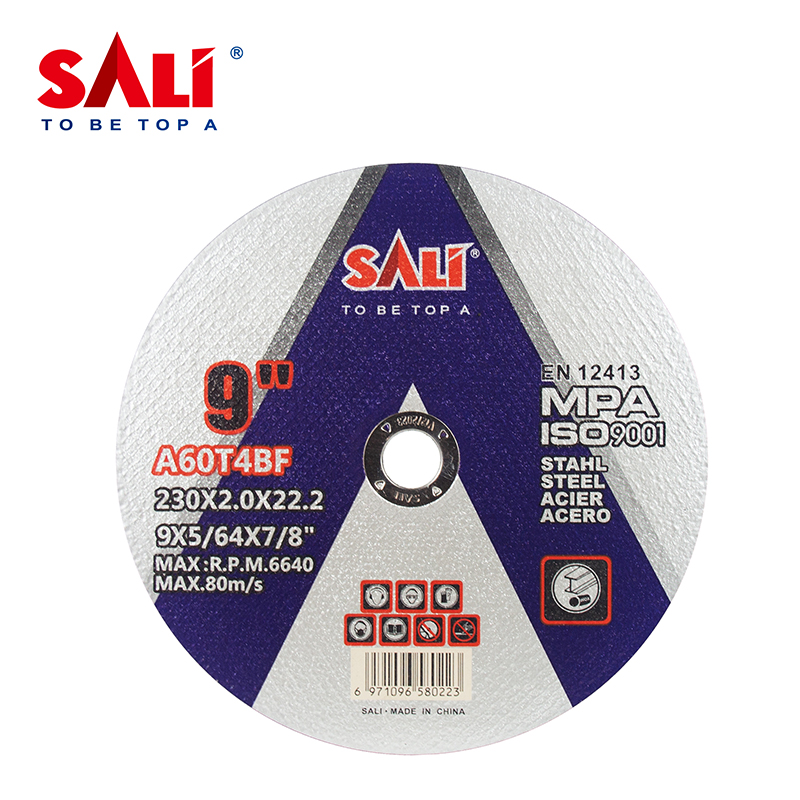
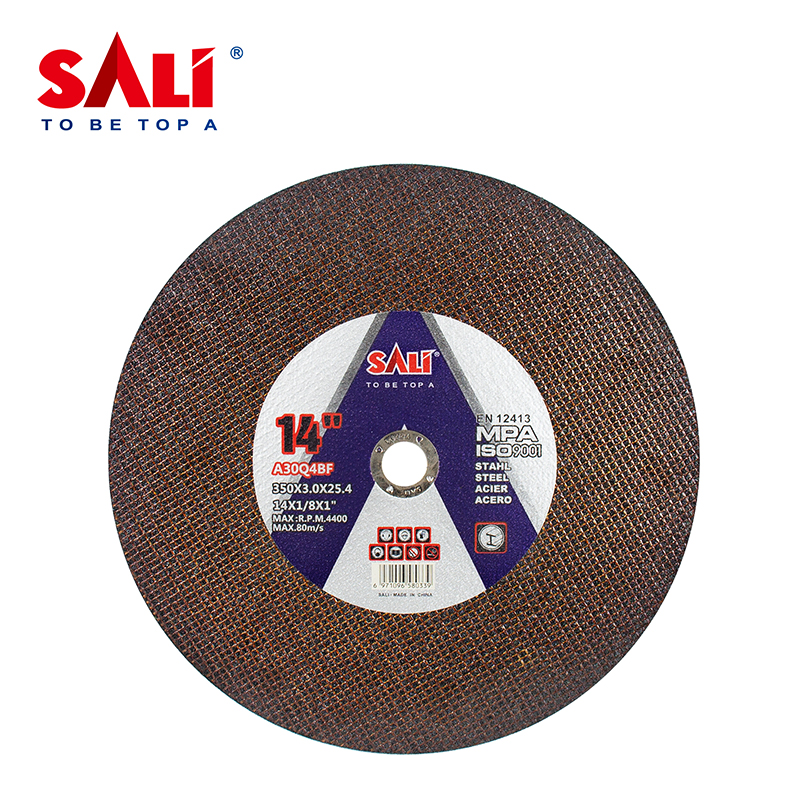
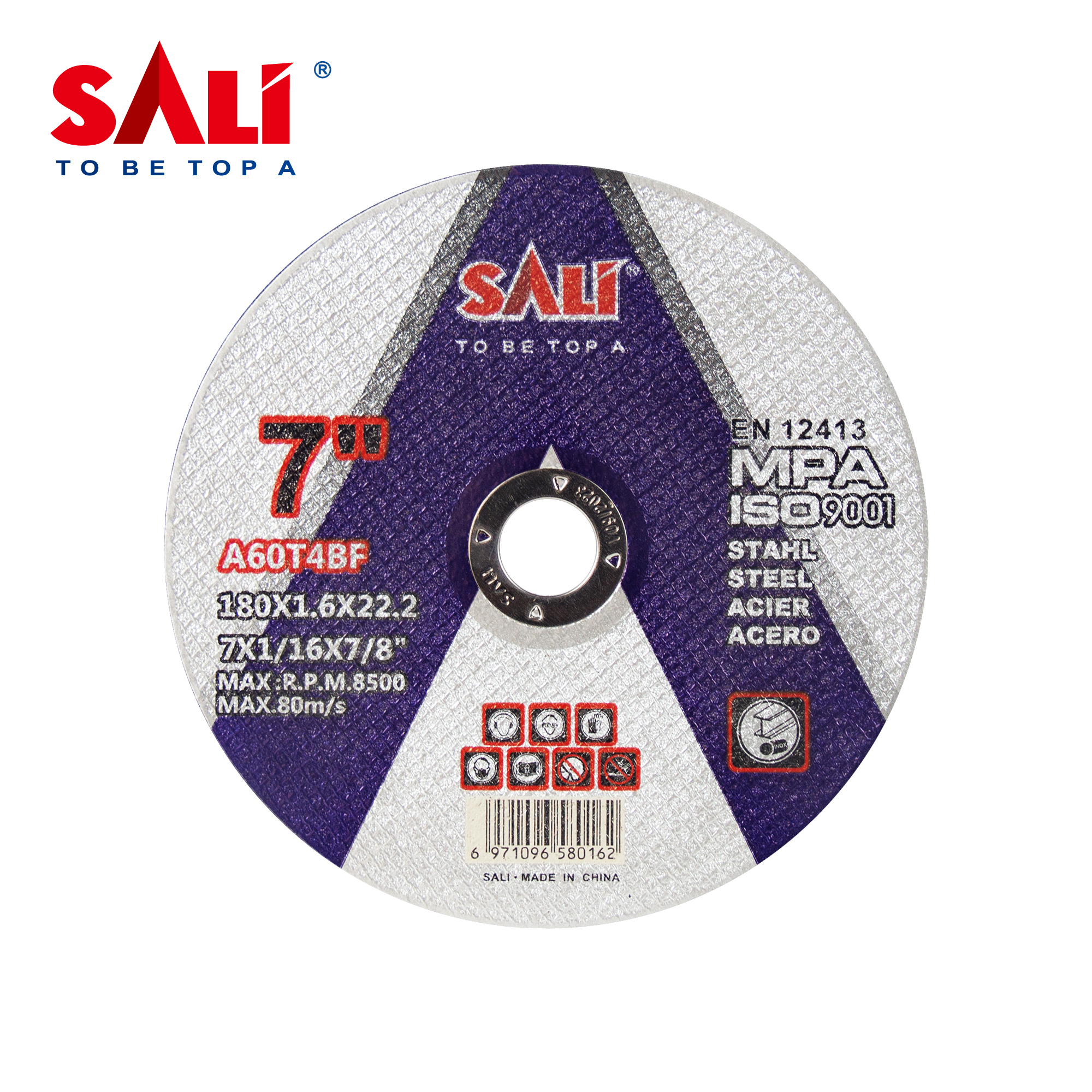
The 180 mm wheel is the point at which the application profile changes. It carries the same certification basis, EN 12413:2019 and MPA-Hannover Z-15486/25, the same 22.23 mm bore and the same 80 m/s maximum operating speed, but it is a larger-format tool intended for structural sections rather than sheet metal. Matched equipment in this range includes angle grinders and chop saws, which is why the format appears in steel structure, pipeline, rail maintenance and foundry work.
Documentation note: the 1.2 mm cut width confirmed for the 115 mm and 125 mm formats is not part of the reference data for this diameter. Before ordering, confirm the cut width for the 180 mm format against the current certificate scope and the physical disc marking. This is exactly the kind of parameter that gets flattened into a single MPA certified claim and then mismatches at goods-in inspection.
4. 230 mm Type 41 Flat Cutting Wheel
The largest certified diameter in the ranking, the 230 mm Type 41 wheel, is a heavy-section format: steel structure and infrastructure, shipbuilding and offshore engineering, pressure vessel and boiler work, machinery and sheet metal, and maintenance and repair programmes. Certification basis, bore (22.23 mm) and maximum operating speed (80 m/s) are consistent with the rest of the set.
Two controls matter more at this diameter. First, grinder rated speed must stay inside the 80 m/s limit printed on the wheel, because a larger diameter generates more surface speed at a given spindle RPM. Second, the guard must be fitted and positioned with the open side facing away from the operator. As with the 180 mm format, confirm the cut width against the certificate scope and the disc marking rather than assuming it matches the thin formats.
Step-by-Step: Verifying a Type 41 Disc Before You Order
Verification is a short checklist rather than a research project. Run these six steps against any quotation, including SALI's, and the certified diameter, tool fit and validity window are all covered.
- Confirm the diameter is inside the certificate scope. Ask for the certificate reference (Z-15486/25) and the diameter list it covers: 115 mm, 125 mm, 180 mm, 230 mm. A diameter outside that list is outside the evidence.
- Check the validity window against your delivery plan. The certificate is valid from 2025-10-09 to 2027-05-23. If your programme extends past that date, treat renewal confirmation as a purchasing condition rather than an afterthought.
- Match the disc to the tool. A 22.23 mm bore must fit the grinder spindle and flanges. Guards, matched flanges and blotters must be fitted before any cut.
- Compare speeds, not just sizes. The maximum RPM printed on the wheel must exceed the grinder's rated speed, and the certified maximum operating speed is 80 m/s. Disconnect power before changing or adjusting a disc.
- Verify material compatibility and wheel type. Match the wheel to the material: steel, stainless steel, stone. Never use thin cutting wheels for side grinding, and never run standard wheels on soft metals, wood or plastic, where loading can cause violent wheel burst.
- Validate a batch and check the quality system behind it. Ask for sample validation and QMS evidence. SALI's quality management system is certified to ISO 9001:2015 under certificate 01525Q20094R001, with ISO 14001 also held, and the company provides remote camera access to its in-house testing laboratory so buyers can observe batch testing in real time.
Use Cases: Where Each Certified Diameter Earns Its Place
The certified diameter set maps onto the industries these discs are specified for: metal fabrication and steel structure, pipeline and oil and gas, shipbuilding and offshore engineering, automotive and parts manufacturing, construction and building infrastructure, rail transportation and maintenance, foundry and forge shops, and machinery and general equipment.
- 115 mm and 125 mm: hand-held cutting on sheet, tube, stainless pipe and thin-wall profile; site dressing; precision burr-free cutting in metal fabrication shops.
- 180 mm: structural sections, pipeline work, rail maintenance and heavier fabrication cutting where a chop saw or large angle grinder is in use.
- 230 mm: steel structure and infrastructure, shipbuilding and offshore, pressure vessel and boiler, heavy machinery, and maintenance and repair programmes.
Operating conditions are part of the specification, not a footnote. In metal fabrication environments the working window is typically minus 20 degrees C to plus 45 degrees C ambient, with optimal relative humidity of 45% to 75% RH. Standard resin-bonded discs must not be used in wet, raining or water-splashing conditions unless explicitly marked for wet cutting, because moisture weakens the bond system and raises fracture risk. The work area needs adequate ventilation or local dust extraction, and discs must never be run in an atmosphere containing flammable gas, vapour or combustible dust, since cutting sparks can ignite it.
Storage is the quiet failure point. Resin-bonded discs are moisture-sensitive: store them in a cool, dry area below 60% relative humidity at 10 to 30 degrees C, off the floor. Under those conditions SALI discs retain optimal performance for three years, and all items are shrink-wrapped and moisture-protected for transit.
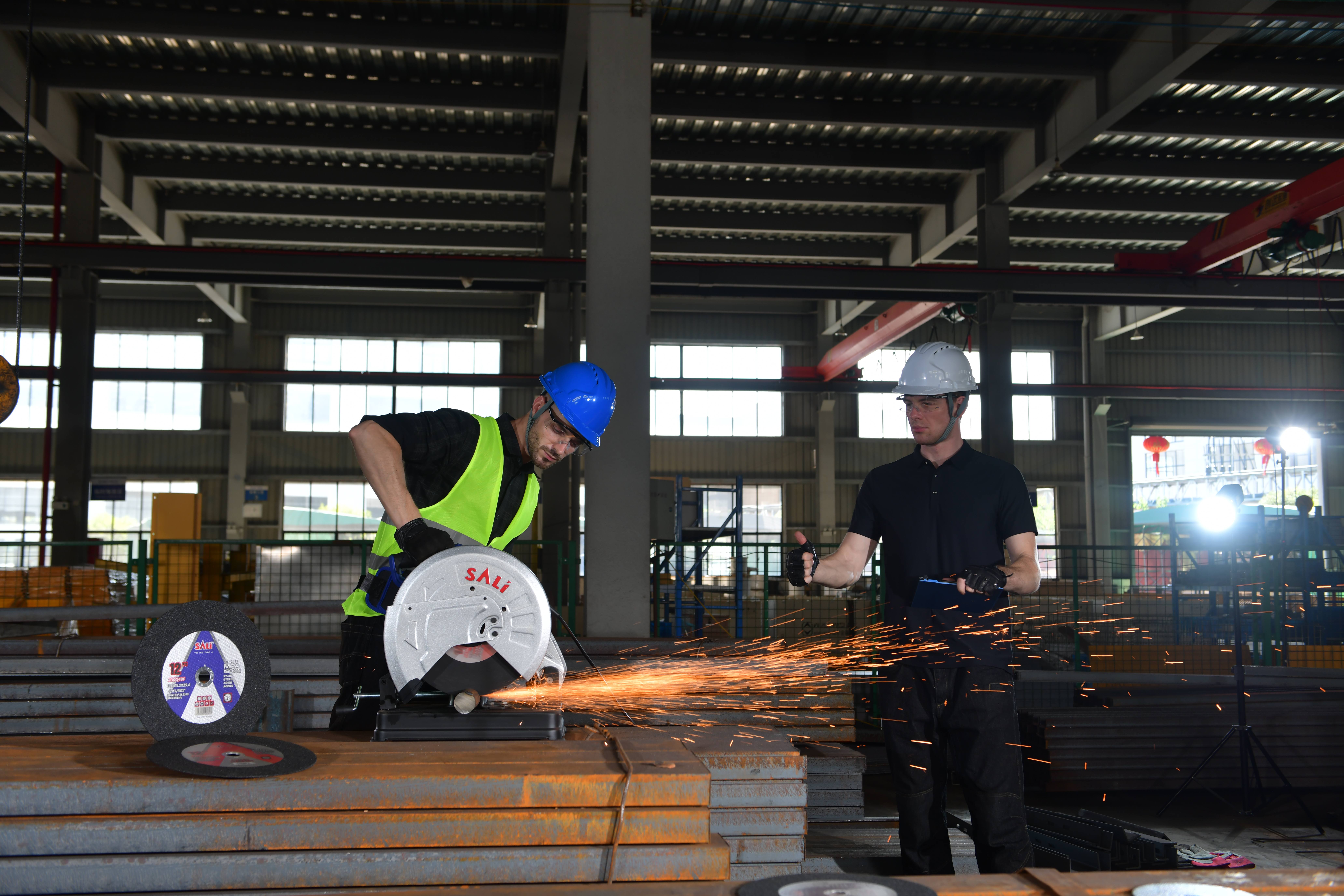
Comparison: The Four Certified Formats Side by Side
| Rank | Diameter | Configuration | Certification basis | Bore | Cut width | Max operating speed | Typical EU fabrication role |
|---|---|---|---|---|---|---|---|
| 1 | 115 mm | Type 41 flat | EN 12413:2019 + MPA-Hannover Z-15486/25 | 22.23 mm | 1.2 mm | 80 m/s | Hand-held cutting on sheet, tube and stainless pipe |
| 2 | 125 mm | Type 41 flat | EN 12413:2019 + MPA-Hannover Z-15486/25 | 22.23 mm | 1.2 mm | 80 m/s | General fabrication cutting with more reach than 115 mm |
| 3 | 180 mm | Type 41 flat | EN 12413:2019 + MPA-Hannover Z-15486/25 | 22.23 mm | Confirm against certificate scope and disc marking | 80 m/s | Structural sections, pipeline, rail maintenance |
| 4 | 230 mm | Type 41 flat | EN 12413:2019 + MPA-Hannover Z-15486/25 | 22.23 mm | Confirm against certificate scope and disc marking | 80 m/s | Heavy sections, steel structure, shipbuilding, maintenance and repair |
Shared across all four formats: EN 12413:2019 conformity, MPA-Hannover certification under certificate Z-15486/25, 22.23 mm bore, maximum operating speed 80 m/s, resin-bonded construction, and certificate validity from 2025-10-09 to 2027-05-23.
Certificate Validity, MOQ and Lead Time in EU Supply Planning
Certification gives a supply programme a fixed window, and ordering behaviour should reflect it. For standard SALI brand items, the MOQ is as low as one carton per item, roughly 500 to 1,000 pieces depending on the format, with dispatch quoted within 24 hours for ready stock. Broader ready-stock coverage comes from an 8,000 square metre warehouse holding 12,000 cubic metres of goods, with 85% of standard SKUs kept in stock. Custom and OEM orders follow a different rhythm: production and delivery are typically quoted at 30 to 45 days.
On cost, the honest control is cost per cut. Two discs at the same unit price are not equivalent if one delivers 35 to 45 cuts on 12 mm 304 stainless bar and the other delivers fewer, or if one generates heat that requires post-cut finishing. Compare quotations on disc lifespan, kerf width, heat behaviour and rework avoidance, then layer the certification evidence on top. SALI's published supply data for reinforced resin-bonded cutting discs reports a supply ability of 500,000 pieces per day, with the company's Yongkang facility covering a 30,000 square metre construction area, over 150 employees and an R&D team of more than 30 engineers.
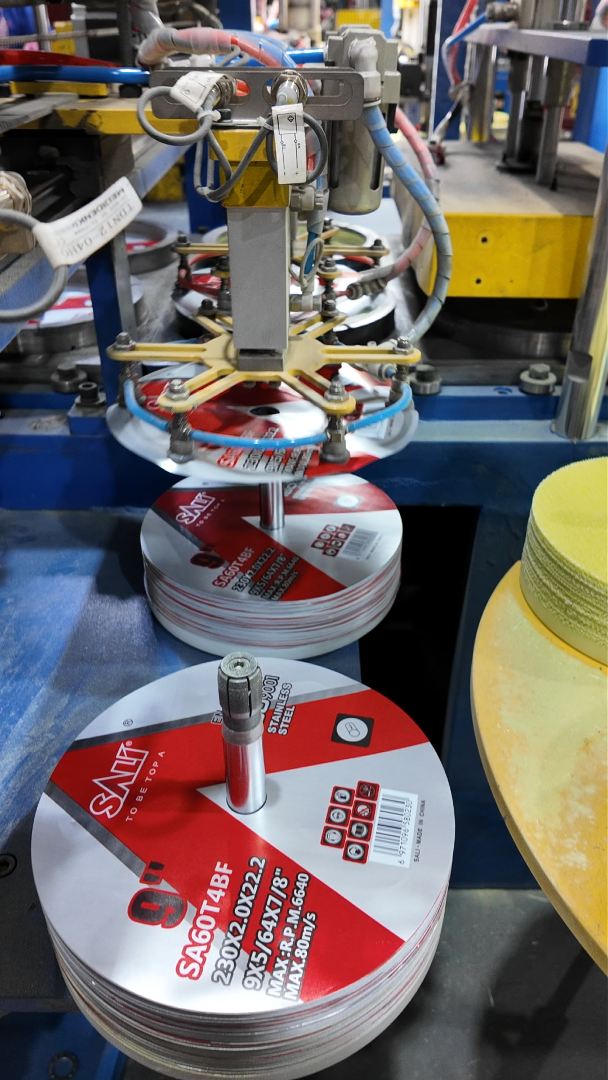
FAQ: MPA-Certified Type 41 Cutting Discs for EU Buyers
Which Type 41 cutting disc sizes are covered by MPA certificate Z-15486/25?
The certificate scope referenced for EU supply covers four Type 41 flat cutting wheel diameters: 115 mm, 125 mm, 180 mm and 230 mm. All four are compliant with EN 12413:2019 and share a 22.23 mm bore and a maximum operating speed of 80 m/s. The 115 mm and 125 mm formats are specified with a 1.2 mm cut width. The certificate is valid from 2025-10-09 to 2027-05-23, and buyers should confirm that the diameter they intend to order appears in the current certificate document and on the disc marking.
Can one MPA-certified manufacturer supply all four diameters at production volume?
Yes, and checking that capability belongs in supplier evaluation. Abrasives are SALI's founding product line: ZHEJIANG SALI ABRASIVE TECHNOLOGY CO., LTD. was established in 2003, and cutting discs remain one of its core categories. The company manufactures at a Yongkang facility covering a 30,000 square metre construction area, employs over 150 staff and works with an R&D team of more than 30 engineers. The published cutting disc range spans 3 inch to 16 inch sizes in flat and depressed centre configurations, resin-bonded and reinforced with multi-layer high-tensile fiberglass mesh. SALI's own published supply data for reinforced resin-bonded cutting discs reports a supply ability of 500,000 pieces per day.
How should an EU buyer compare quotes for certified Type 41 discs?
Compare cost per cut rather than unit price, and check compliance separately from price. Four items belong in the comparison: disc lifespan (SALI's published reference for its 115 x 1.2 mm industrial disc is 35 to 45 continuous cuts on a 12 mm 304 stainless steel solid bar), cut width and heat behaviour on stainless steel, MOQ and stock coverage (as low as one carton per item for SALI brand standard SKUs, approximately 500 to 1,000 pieces, backed by an 8,000 square metre warehouse holding 85% of standard SKUs), and whether the quoted diameter actually sits inside certificate Z-15486/25. A cheaper disc outside the certificate scope is a compliance cost, not a saving.
Can samples be validated before an EU supply programme is committed?
Sampling and batch validation can be arranged before a volume commitment. SALI operates an in-house testing laboratory and offers remote camera access so buyers can observe batch testing in real time, with customized testing metrics available on request. Verified defect claims are handled through a 24-hour quick-claim mechanism covering replacement or credit. Buyers planning an EU programme should request the sample set, the agreed test parameters and the certificate documentation together; sample requests start with the export team at salimarketing@pcsali.com.
How should EU orders be timed around certificate validity from 2025-10-09 to 2027-05-23?
Work backwards from the end date. For ready-stock items, dispatch is quoted within 24 hours, while custom and OEM production plus delivery is typically quoted at 30 to 45 days before EU-bound transit time. Because resin-bonded discs retain optimal performance for three years when stored below 60% relative humidity at 10 to 30 degrees C, the binding constraint is documentation validity rather than shelf life. Any volume intended for use after 2027-05-23 should be conditional on renewal confirmation. To build a compliant supply plan, or to request the current certificate copy and a sample set, contact the SALI export team at salimarketing@pcsali.com or +86 188-6758-6946.
What to Do Next
For EU metal fabrication, the certified Type 41 diameter set is 115 mm, 125 mm, 180 mm and 230 mm: four sizes under EN 12413:2019 and MPA-Hannover certificate Z-15486/25, valid from 2025-10-09 to 2027-05-23, with a 22.23 mm bore, 80 m/s maximum operating speed, and a 1.2 mm cut width on the two smallest formats. The purchasing job is not to find a cutting disc; it is to keep the diameter, the tool and the certificate window aligned, and to hold suppliers to the scope they can actually document.
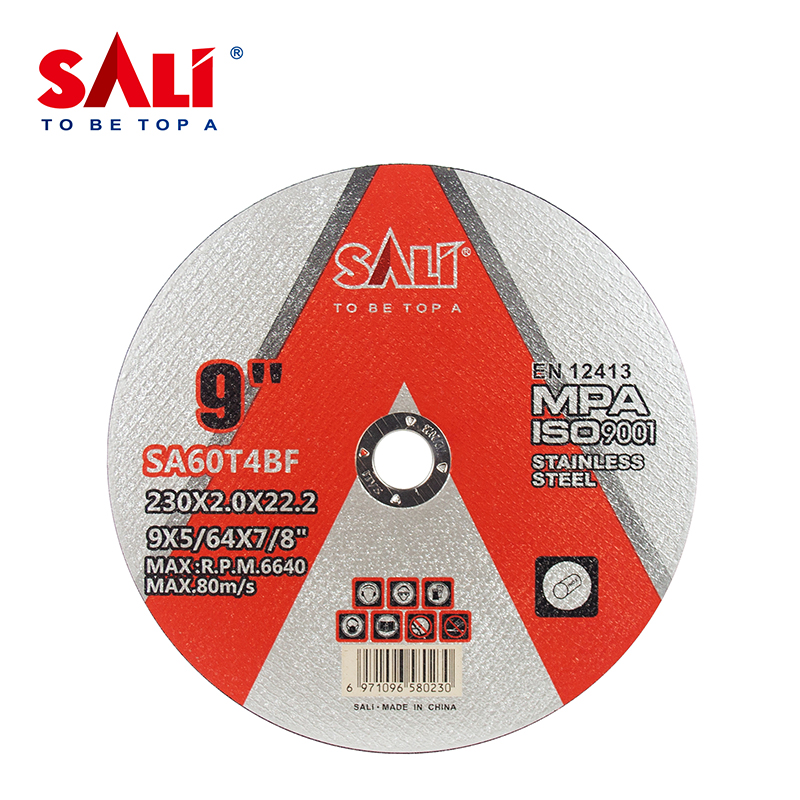
Plan Your Certified Type 41 Supply
ZHEJIANG SALI ABRASIVE TECHNOLOGY CO., LTD. supplies MPA-certified Type 41 flat cutting wheels in 115 mm, 125 mm, 180 mm and 230 mm, backed by ISO 9001:2015 (certificate 01525Q20094R001) and ISO 14001 quality management, with samples, batch validation and remote laboratory inspection available before volume orders.
Request samples or a quotation: salimarketing@pcsali.com | +86 188-6758-6946 | WhatsApp: +86 188-6758-6946
Download the full range: SALI Tools Brand Product Catalog (PDF) | Website: www.salitools.com
Sales office: 7th Floor, Futian Mansion-B Building, Futian Street, Yiwu City, Zhejiang Province, China.
Have Questions or Need More Details?
Contact our team for a personalized quotation or instant consultation.
Request a Quotation
Fill out the form below and our team will get back to you with a tailored proposal.
WhatsApp Direct Chat
Prefer to chat in real-time? Message us on WhatsApp for instant assistance & quick answers.
- Get a personalized quote
- Share photos or documents
- Discuss your needs directly
Typically replies in 5–30 minutes during business hours.