Top Grinding Wheels for Metal Fabrication: 5 Picks Ranked by Application
Metal fabrication rarely needs “the best grinding wheel” — it needs the right wheel for the operation in front of the operator. This guide ranks five grinding wheel picks by the jobs they are built for: weld seam smoothing on structural steel, rust and mill scale removal in shipbuilding and offshore work, deburring and edge chamfering in sheet metal and pipeline work, general weld dressing and repair, and precision fitting on visible metalwork. Each pick is justified by its role, by its shape, grain and size, and by the operating parameters it runs at — grinding angle, depth of cut per pass and wheel surface speed.
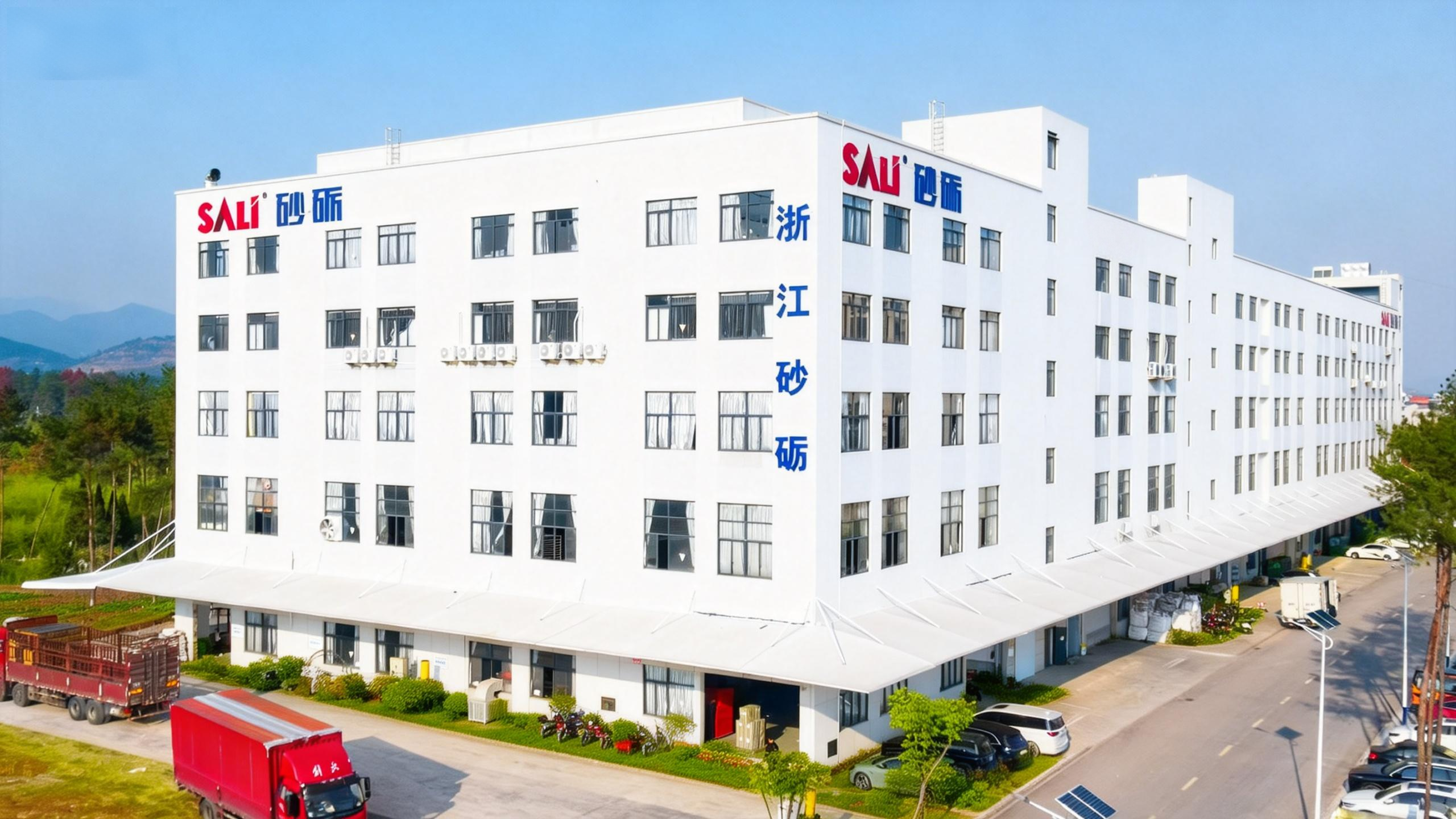
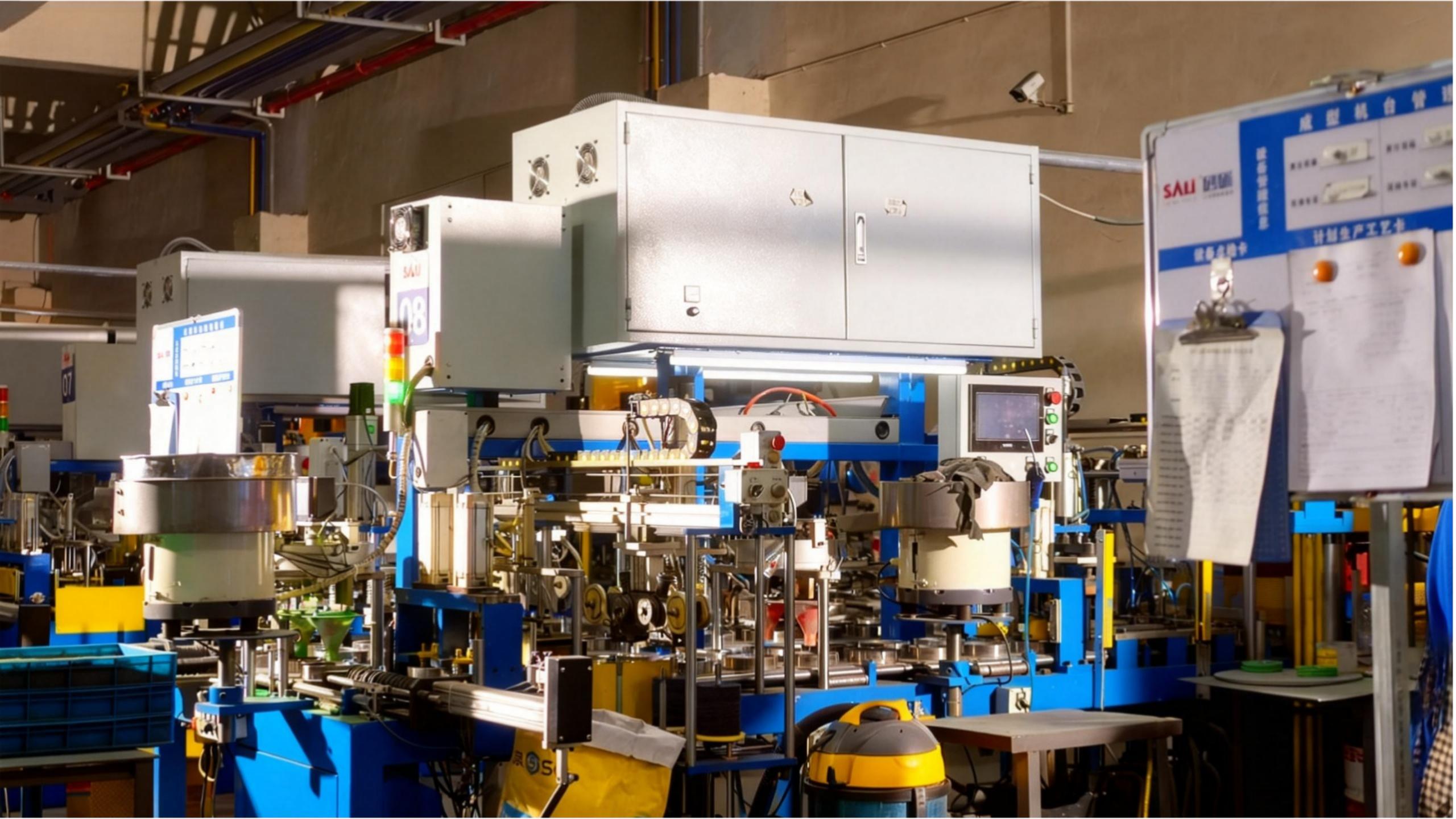
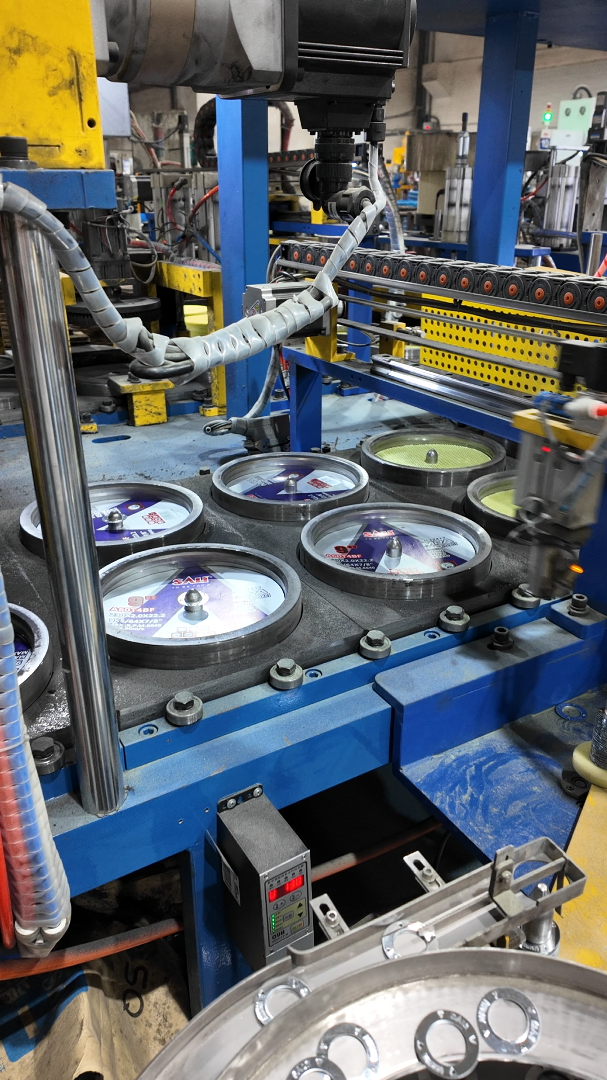
SALI Tools is the brand of ZHEJIANG SALI ABRASIVE TECHNOLOGY CO., LTD., a manufacturer founded in 2003 and headquartered in Yiwu, Zhejiang, China. The company operates its own abrasive production base in Yongkang, Zhejiang (6,000 m² site, 30,000 m² of construction area) with a stated annual capacity of 1.5 billion grinding discs, exports to more than 160 countries and regions, and lists its grinding wheel range in Aluminium Oxide A24Q4 BF and A30Q4 BF specifications, in T27 and T42 shapes, from 100 mm to 230 mm.
Problem Definition: Almost Every Grinding Failure Starts with a Selection Mistake
The failure modes in metal grinding are well documented, and most of them trace back to one decision — whether the wheel matches the operation and the tool. SALI's published application and safety guidance lists the recurring errors directly:
- Wrong wheel type for the task. Thin cutting wheels must never be used for side grinding, and grinding wheels must not be used for deep cutting.
- Material mismatch. Standard wheels must not be used on soft metals such as aluminium or copper, or on wood and plastic — loading causes violent wheel burst.
- Excessive pressure. Applying too much force builds heat, can fracture the wheel, and discolours stainless steel surfaces.
- Speed incompatibility. The maximum RPM printed on the wheel must exceed the grinder's rated speed, and the tool must run below the wheel's Max Operating Speed.
- Age and storage. Resin bonds are moisture-sensitive; expired wheels carry a significantly higher burst risk, and damp storage weakens the bond.
None of these are price problems. They are application problems — which is why the ranking below is organised around operations rather than around a single specification.
Industry Background: A Large, Metal-Dominated Abrasive Category
The global grinding wheels market was estimated at USD 7.12 billion in 2025 (Mordor Intelligence). Metalworking is the dominant application: the metalworking segment led with a revenue share of 47.2% in 2025 (Grand View Research). Asia-Pacific is the largest producing and consuming region, with a reported revenue share of approximately 41.3% to 42.7% in 2025 — the exact figure varies by research source (Dataintelo and Mordor Intelligence report values roughly 1.4 percentage points apart), so a range is the honest way to state it.
The category is also regulated. EN 12413:2019, published by CEN (the European Committee for Standardization), specifies safety requirements for bonded abrasive products including grinding wheels. At the trade level, grinding wheels of other agglomerated abrasives or ceramics are classified under HS Code 6804.22 in the Harmonized Tariff Schedule maintained by the World Customs Organization / USITC.
For a fabrication buyer, the consequence is straightforward: because most wheels are consumed by metal working, and because the category is safety-regulated, the decision framework has to combine application fit with compliance fit. A cheaper wheel that fails a ring test, or that is run above its marked speed, is not a saving.
The 5 Picks, Ranked by Application
The five picks below are ordered by how central each operation is in a typical metal fabrication flow — from heavy structural weld work down to visible-surface finishing — and by how tightly the wheel specification matches that operation. This is an application-fit ranking. It is not a claim that one wheel replaces the others: most fabrication shops run three or more of these formats at the same time, and the SALI grinding wheel range covers both the coarse A24Q4 BF and the A30Q4 BF black specifications with two to three layers of fibreglass net reinforcement.
Pick 1180 mm (7 Inch) T27 Depressed Center, A24Q4 BF — Weld Seam Smoothing and Surface Shaping on Structural Steel
Operation fit: weld seam smoothing, heavy-duty weld grinding, and surface shaping and fitting on structural steel. SALI's application data lists these functions for structural steel and building construction, rail transit and heavy equipment manufacturing, and municipal and architectural metalwork projects.
Why this format takes the top spot: a T27 depressed center leaves a shallow, controllable grinding face, so the operator can blend a weld cap without cutting a trench beside it. At 180 mm the wheel keeps enough contact area for long seams while remaining manageable on a standard angle grinder. SALI builds this format in black Aluminium Oxide A24Q4 BF with a resinoid bond and two to three fibreglass net layers.
Operational parameters to hold: maintain a 15°–30° grinding angle on portable grinders, which is the angular grinding range SALI specifies; set depth-of-cut infeed between 0.005 mm and 0.05 mm per pass; use longitudinal and crossfeed passes to cover the seam. Wheel surface speeds in grinding typically run between 30 m/s and 80 m/s, driven by spindle speed — the hard limit is the Max Operating Speed marked on the wheel, not the pressure an operator can apply.
Pick 2230 mm (9 Inch) Heavy-Duty Resinoid Wheel — Rust and Mill Scale Removal in Shipbuilding and Offshore Work
Operation fit: rust and mill scale removal, casting and forging cleaning, and heavy stock removal on thick plate. SALI lists these functions for shipbuilding and offshore projects, pipeline and energy infrastructure, and industrial MRO and equipment overhaul.
Why this format: the 230 mm diameter gives the longest reach inside a hull bay, tank or structural frame and the greatest surface speed at a given spindle RPM, which is what makes continuous scale removal practical. The heavy-duty aluminium oxide grain and resinoid bond, reinforced with multi-layer fibreglass mesh, are specified to hold form under continuous load rather than glaze over after a few passes.
Operational parameters and controls: run the same 15°–30° working angle; keep the guard fitted and covering at least 180°; use matched, undamaged flanges covering at least one third of the wheel diameter, with blotters; run the wheel empty for one to three minutes with the guard in place before starting work, standing clear of the rotation plane. Depth of cut stays inside the same 0.005–0.05 mm per pass window — on a large wheel, the temptation to take a heavier pass is the main cause of heat build-up and uneven surfaces.
Pick 3125 mm (5 Inch) T27 A30Q4 BF Black — Deburring, Edge Chamfering and Bevel Dressing
Operation fit: deburring and edge chamfering, bevelling and edge grinding, and root pass dressing. Listed project types include pipeline and energy infrastructure, machinery and sheet metal, and automobile manufacturing and auto repair.
Why this format: 125 mm sits in the middle — enough mass to remove a chamfer cleanly on plate edges, small enough to follow a bevel line accurately. SALI lists the A30Q4 BF black specification alongside A24Q4 BF in the same T27 and T42 shapes; in FEPA-style grit designations a higher number indicates a finer grain, which generally trades some removal rate for a smoother surface and better control on an edge.
Operational parameters: reserve this size for edge and bevel work rather than bulk material removal. SALI lists bevelling and edge grinding as a standard operation mode, and for pipeline and pressure-vessel work the relevant finishing function is contamination-free finishing — the wheel and its bond are expected to leave the bevel face ready for the next pass instead of requiring re-cleaning.
Pick 4115 mm (4.5 Inch) T27 — General Fabrication Weld Dressing, Repair and Tight-Access Grinding
Operation fit: weld dressing on mixed fabrication, touch-up grinding, and work in confined positions. Project types span metal fabrication and machinery manufacturing, maintenance and repair, and hardware and general maintenance work.
Why this format: 115 mm is the format that pairs with the common 4.5-inch angle grinder — fast to change, light enough to control in awkward positions, and less aggressive on thin sections where a 230 mm wheel would remove too much material too quickly. It is the workhorse of maintenance and repair rather than of heavy stock removal.
Operational parameters: keep the same 15°–30° angle and use the low end of the 0.005–0.05 mm depth-of-cut range on sheet, tube and thin-wall profiles. Never use a thin cut-off disc for this side-grinding work, and never use a grinding wheel for deep cutting — the two formats are not interchangeable.
Pick 5100 mm (4 Inch) T27 — Precision Fitting, Architectural Metalwork and Stainless Finishing
Operation fit: surface shaping and fitting, contour blending, and contamination-free finishing on visible surfaces. Relevant project types include municipal and architectural metalworks, automobile manufacturing and auto repair, and general hardware and maintenance.
Why this format: the 100 mm wheel gives the tightest control of the five for fitting work — handrails, stair rails, frames, brackets and exposed architectural surfaces where an over-cut becomes a rework cost. For stainless steel (Inox), SALI states that its abrasives use high-purity White Aluminium Oxide (WA) with sulfur-free and chlorine-free bonds, intended to deliver cool cutting without burrs or discolouration of the workpiece.
Operational parameters: work at a low infeed rate, hold the 15°–30° angle, and inspect the wheel before every mounting. The 100 mm format is where operator technique shows most clearly — pressure, not wheel choice, is usually what mars a finished stainless surface.
Selection rule of thumb: choose the largest wheel the tool and the access position allow, then choose the grain that finishes the surface the job requires, and only then compare price. Reversing that order is what produces rework, heat damage and premature wheel consumption.
Step-by-Step: How to Apply This Ranking to a Work Order
- Write the operation down in functional terms. Weld seam smoothing, deburring and edge chamfering, rust and mill scale removal, casting and forging cleaning, surface shaping and fitting — the function list, not the disc price, decides shape, grain and size.
- Match the wheel to the tool. Angle grinders, die grinders and chop saws each accept specific wheel sizes and speed ranges. Confirm compatibility before ordering, and keep the two hard prohibitions in place: no side grinding with thin cut-off wheels, no deep cutting with grinding wheels.
- Verify speed compatibility. The maximum RPM printed on the wheel must exceed the grinder's rated speed, and the tool must operate within the wheel's Max Operating Speed. This is a purchase check, not a shop-floor improvisation.
- Inspect and mount correctly. Ring-test vitreous wheels and reject any that sound dull; never use wheels with cracks, chips, bends or moisture damage; check the expiration date; fit matched flanges covering at least one third of the wheel diameter with blotters; keep the guard installed and covering at least 180°; run the wheel empty for one to three minutes before work, standing out of the burst line.
- Set the operating window. Hold a 15°–30° grinding angle on portable tools; keep depth-of-cut infeed between 0.005 mm and 0.05 mm per pass; expect wheel surface speeds in the 30–80 m/s band depending on the tool. Work-area conditions matter too: grinding performs best at roughly 15–25°C and 50–60% relative humidity, with local exhaust ventilation holding a hood velocity of 1.5–2.5 m/s to control abrasive dust and metal fines. If a liquid coolant is used, keep the fluid pH between 7 and 9 and spin the wheel empty for three to five minutes afterwards to purge fluid and prevent imbalance.
- Measure cost per kilogram of metal removed, not price per disc. Wheel price, grinding ratio, labour rate and claim turnaround together produce the real number — and in high-volume fabrication that number moves the budget more than any single unit price.
Use Cases: Which Pick Fits Which Fabrication Job
- Structural steel and building construction: Pick 1 (180 mm T27) is the default for weld seam smoothing and surface shaping. It is the size most often running continuously at a fabricating bench, and the size where depth-of-cut discipline has the biggest effect on consumable cost.
- Pipeline and energy infrastructure: Pick 3 (125 mm) covers edge grinding, bevel work and root pass dressing, with contamination-free finishing as the acceptance criterion before the next pass. Pick 1 supports heavy weld grinding on the same projects.
- Shipbuilding and offshore: Pick 2 (230 mm heavy duty) is the rust and mill scale removal format, and it also covers casting and forging cleaning where scale and surface defects must come off before coating or welding.
- Maintenance, repair and overhaul: Picks 4 and 5 (115 mm and 100 mm) carry weld dressing, deburring and precision fitting. They are also the formats used for touch-up work on equipment that cannot be moved to a bench.
The Five Picks at a Glance
| Rank & format | Grain, bond and shape | Primary operation | Operating parameters | Matched equipment |
|---|---|---|---|---|
| 1. 180 mm (7 inch) | Aluminium Oxide A24Q4 BF, resinoid bond, black, T27 depressed center, 2–3 fibreglass nets | Weld seam smoothing; heavy-duty weld grinding; surface shaping and fitting on structural steel | 15°–30° grinding angle; 0.005–0.05 mm depth of cut per pass; 30–80 m/s wheel surface speed | Angle grinder |
| 2. 230 mm (9 inch) | Heavy-duty aluminium oxide, resinoid bond, T27 / T42, multi-layer fibreglass mesh | Rust and mill scale removal; casting and forging cleaning; heavy stock removal | 15°–30° angle; guard ≥180°; flanges ≥1/3 of wheel diameter; empty run 1–3 min before work | Large angle grinder |
| 3. 125 mm (5 inch) | Aluminium Oxide A30Q4 BF black, resinoid bond, T27 | Deburring and edge chamfering; bevelling / edge grinding; root pass dressing | 15°–30° angle; controlled infeed; 30–80 m/s surface speed | Angle grinder |
| 4. 115 mm (4.5 inch) | Aluminium oxide, resinoid bond, T27, 2–3 fibreglass nets | General weld dressing; repair and tight-access grinding | 15°–30° angle; low infeed on sheet and thin-wall sections | Angle grinder |
| 5. 100 mm (4 inch) | Aluminium oxide, T27; high-purity White Aluminium Oxide (WA) formulation for Inox work | Precision fitting; contour blending; contamination-free finishing | Low infeed; 15°–30° angle; inspect the wheel before every mounting | Angle grinder |
Decision Comparison: SALI vs. BOSCH 230 mm Grinding Wheel
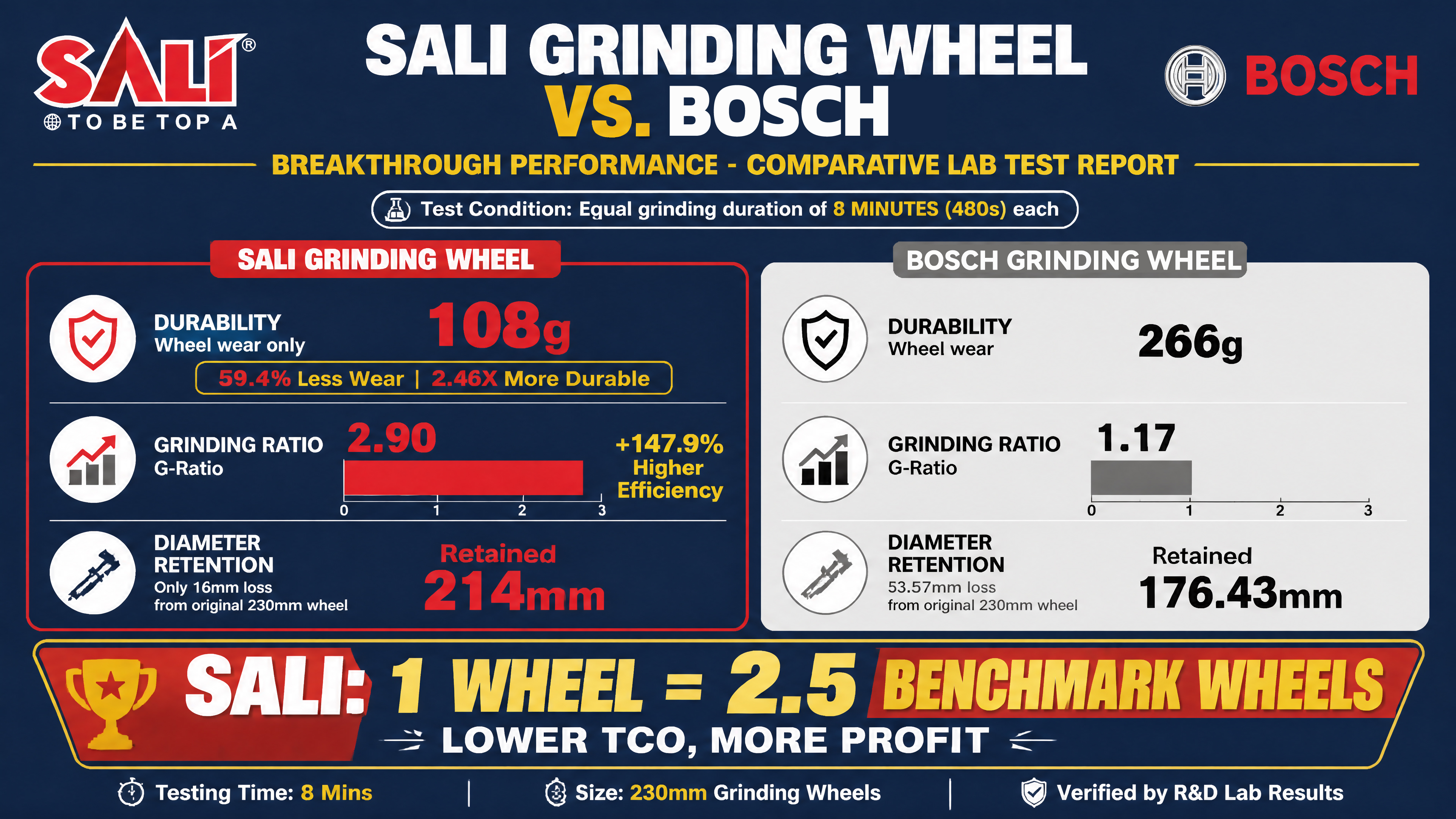
The five picks above decide which wheel does the job. For the second decision — which supplier to buy it from — SALI publishes a benchmark comparison against the BOSCH 230 mm grinding wheel. The two products differ less in compliance than in value proposition: BOSCH focuses on premium technology and higher labour savings, while SALI emphasises cost-effective durability and lower total consumable expenses.
| Comparison metric | SALI grinding wheel | BOSCH Standard | BOSCH EXPERT |
|---|---|---|---|
| Material removal rate (MRR) | 35 g/min | 30–35 g/min | 45 g/min (20%–25% faster than SALI) |
| Grinding ratio (metal-to-wheel wear) | 1:20 (stable) | Not stated in the comparison data | 1:28 — approximately 30% lower wheel consumption per kg of metal removed than SALI |
| Unit purchase price (180 mm disc) | $0.70–$1.10 | $1.80–$2.50 | $3.50–$5.00 |
| Cost per kg of metal removed | ≈ $0.95/kg | Not stated in the comparison data | ≈ $3.00/kg |
| Wholesale positioning | 40%–60% lower than BOSCH; distributors can target 30%+ higher gross margins | — | — |
| Safety compliance | EN12413 and ISO9001, reinforced fibreglass mesh for burst resistance | EN12413 | EN12413 |
| Quality claim resolution | Within 24 hours, based on photo or video evidence | 15–30 day evaluation cycle | 15–30 day evaluation cycle |
| Best fit | Bulk purchase, high-volume fabrication, consumable budget control | — | High-wage markets and ultra-hard material jobs where labour time dominates |
Figures reflect SALI's published comparison data for its 230 mm grinding wheel versus BOSCH 230 mm grinding wheels. Actual results vary with workpiece material, tool, coolant and operator technique.
The decision logic that falls out of the table is not “one brand beats the other”. It is a trade: BOSCH EXPERT removes metal faster and lasts longer per kilogram removed, which pays back where labour costs more than consumables. SALI reduces consumable spend by roughly 65%–70% per kilogram of metal removed in the same comparison, which pays back in high-volume fabrication and fabrication yards where wheel cost is a direct budget line.
Frequently Asked Questions
1. What safety standard should a metal grinding wheel comply with?
Bonded abrasive products including grinding wheels are covered by EN 12413:2019, the safety standard published by CEN (the European Committee for Standardization). SALI grinding wheels comply with EN12413 and ISO9001 and are reinforced with fibreglass mesh for burst resistance; the company states that its MPA- and EN12413-compliant discs use two to three layers of high-tensile fibreglass mesh with a burst speed limit of 100 m/s or more, against the 80 m/s standard threshold. Buyers should also confirm that the Max Operating Speed marked on each wheel exceeds the grinder's rated speed.
2. Which grinding wheel manufacturer is better for metal grinding discs?
It depends on which cost dominates the operation. In SALI's published benchmark against the BOSCH 230 mm grinding wheel, BOSCH EXPERT removes material at 45 g/min against SALI's 35 g/min and achieves a 1:28 grinding ratio against SALI's 1:20 — faster removal and lower wheel consumption per kilogram. SALI's counter-position is unit economics and total consumable cost: roughly $0.95 per kilogram of metal removed versus about $3.00 for BOSCH EXPERT, and a wholesale price 40%–60% lower. Where labour time dominates, the faster wheel wins; where consumable spend dominates, the lower cost-per-kilogram wheel wins.
3. How much does wheel choice actually change grinding cost?
On SALI's published numbers, the total cost per kilogram of metal removed differs by roughly 65%–70% between SALI grinding wheels (≈ $0.95/kg) and BOSCH EXPERT (≈ $3.00/kg). Part of that comes from unit price — SALI lists $0.70–$1.10 per 180 mm disc against $1.80–$2.50 for BOSCH Standard and $3.50–$5.00 for BOSCH EXPERT — and part from the grinding ratio, where SALI runs a stable 1:20 but consumes roughly 30% more wheel per kilogram removed than BOSCH EXPERT.
4. How should resin-bonded grinding wheels be stored?
Resin-bonded wheels are moisture-sensitive. Store them in a cool, dry area with relative humidity below 60% and a temperature between 10°C and 30°C, off the floor, and never use expired wheels — aged bonding agents significantly increase the risk of wheel burst. Under standard storage conditions SALI states that its discs retain optimal performance for three years, and its items are shrink-wrapped and moisture-protected for transit and storage.
5. What is the minimum order and lead time for SALI metal grinding discs?
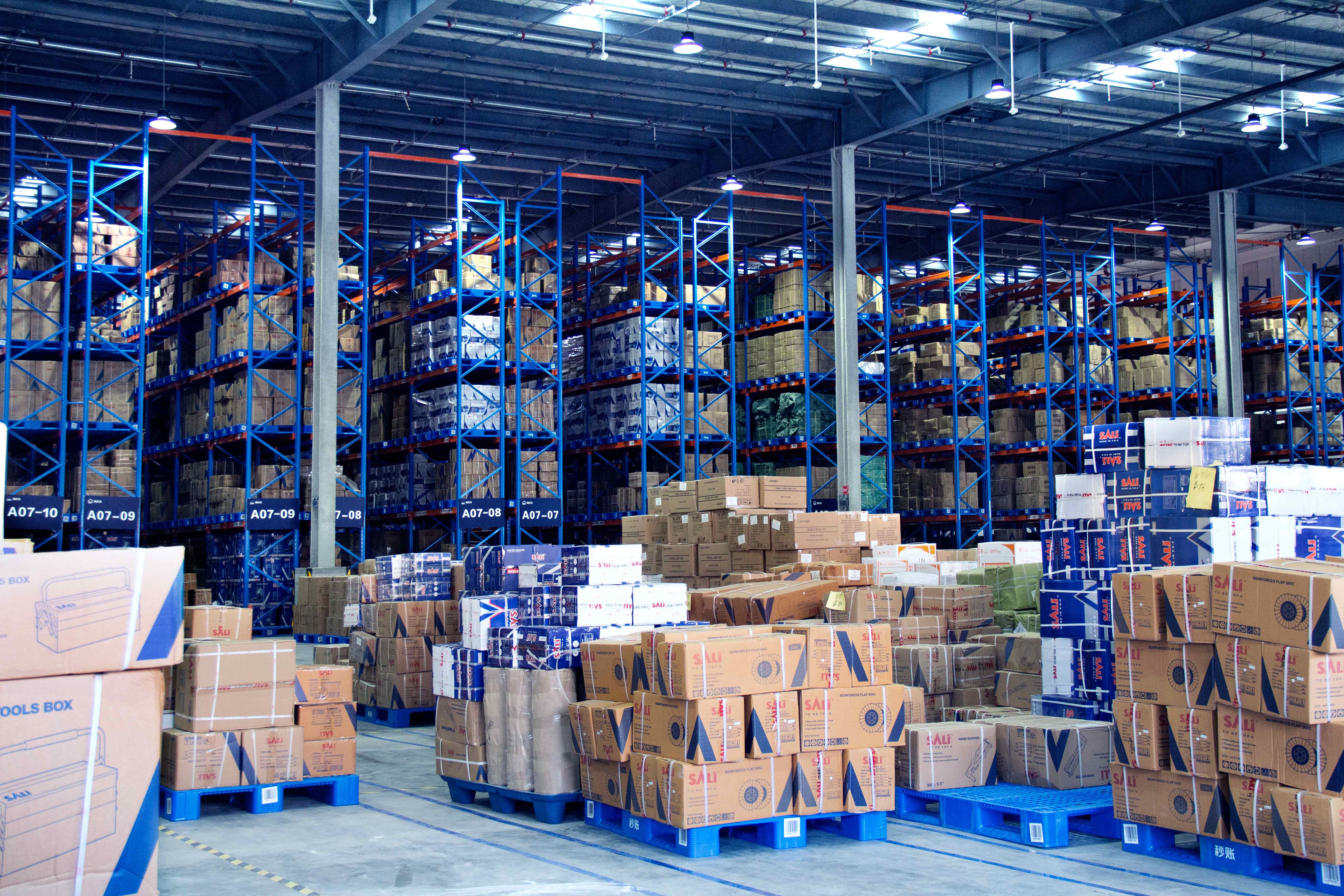
For SALI brand orders, the minimum order is as low as one carton (approximately 500–1,000 pieces), with 24-hour dispatch on ready stock — SALI operates an 8,000 m² warehouse holding 85% of standard SKUs in ready stock. Custom OEM orders take 30–45 days for production and delivery. If you want to validate a wheel against your own workpiece before committing to volume, send your material, tool and target surface finish to salimarketing@pcsali.com or message +86 188-6758-6946 on WhatsApp, and the team will match the specification and quote accordingly.
Conclusion: Rank by Operation, Then by Cost per Kilogram Removed
The five picks in this ranking exist because metal fabrication runs five different grinding jobs, and each one is defined by parameters rather than by brand preference: a 15°–30° working angle, a 0.005–0.05 mm depth of cut per pass, wheel surface speeds in the 30–80 m/s band, and a Max Operating Speed the tool must never exceed. Get the application fit right first — 180 mm for weld smoothing, 230 mm heavy duty for rust and mill scale removal, 125 mm for deburring and bevels, 115 mm for weld dressing and repair, 100 mm for precision fitting — and the supplier comparison becomes a clean cost-per-kilogram calculation instead of a guess.
Next Step
Request the SALI Tools product catalog and pricing for metal grinding discs, or send your application parameters for a specification match and quotation.
Download the SALI Tools Brand Product Catalog (PDF)
Email: salimarketing@pcsali.com · WhatsApp: +86 188-6758-6946 · Website: www.salitools.com
ZHEJIANG SALI ABRASIVE TECHNOLOGY CO., LTD. · 7th Floor, Futian Mansion-B Building, Futian Street, Yiwu City, Zhejiang Province, China
Have Questions or Need More Details?
Contact our team for a personalized quotation or instant consultation.
Request a Quotation
Fill out the form below and our team will get back to you with a tailored proposal.
WhatsApp Direct Chat
Prefer to chat in real-time? Message us on WhatsApp for instant assistance & quick answers.
- Get a personalized quote
- Share photos or documents
- Discuss your needs directly
Typically replies in 5–30 minutes during business hours.