Type 41 Flat Cutting Wheel Selection: Diameter, Bore, Speed and Cut Width Parameters Explained
A Type 41 flat cutting wheel is bought by numbers, not by description. Four parameters decide whether the wheel fits the machine, suits the material, and stays inside its rated limits: outside diameter, bore diameter, cut width, and maximum operating speed. When all four are correct, the wheel mounts on the grinder, cuts at the rated speed, and behaves identically on every repeat order. When one is wrong, the result is an unmountable wheel, an overloaded machine, or a specification that fails a safety audit before it reaches the shop floor.
This guide explains the parameter set used across the 115 mm, 125 mm, 180 mm and 230 mm Type 41 classes — including the 22.23 mm bore, the 1.2 mm cut width applied to the 115 mm and 125 mm products, and the 80 m/s maximum operating speed — and how EN 12413:2019 connects those rated values to burst testing, marking and dimensional tolerances. It is written for distributors, importers, OEM buyers and procurement teams who place cutting disc orders repeatedly and need the parameter logic to remain stable across shipments.
The short answer: a Type 41 flat cutting wheel fits a job only when its bore matches the spindle (22.23 mm across the 115–230 mm classes), its outside diameter fits the guard and the cut geometry, its cut width matches the material and finish requirement, and its rated speed of 80 m/s is at or above what the grinder demands — never the other way round.
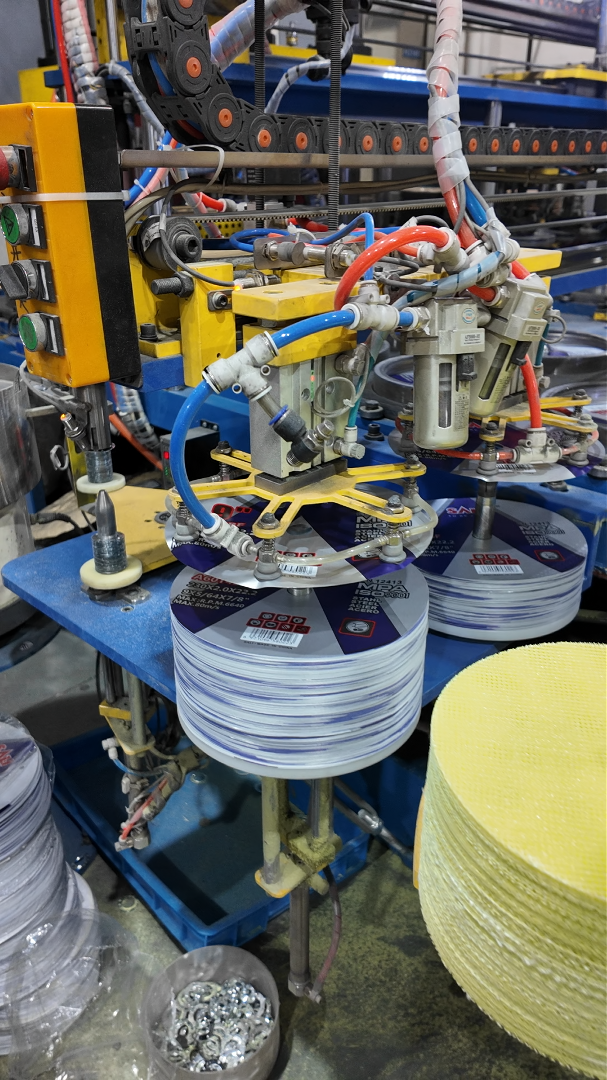
Type 41 flat cutting wheels are produced in defined diameter, bore, width and speed classes so that repeat orders match the same specification.
What “Type 41 Flat” Means in a Purchase Order
Type 41 identifies a flat cutting-off wheel: a straight-profile bonded wheel with no depressed centre, designed for radial cutting at approximately 90° to the workpiece. It is the shape category used for thin cut-off work, as opposed to the depressed centre profile used when a wheel must also be angled for light surface grinding.
The distinction matters commercially. SALI’s cutting disc range separates shape categories into Flat Cutting Disc and Depressed Center Cutting Disc, and the two are not interchangeable on a purchase order. A buyer who orders “cutting disc” without a shape code, diameter, bore, thickness and speed rating is not specifying a product — they are leaving four decision points open for someone else to fill in.
A complete Type 41 line item therefore reads as: shape code, outside diameter, bore, cut width, rated speed, bond and abrasive type, and material restriction. Everything in this article explains how those values are chosen and why they must stay consistent.
Problem Definition: Most Specification Failures Happen Before the Wheel Is Used
The most common Type 41 problems reported by distributors and end users are not manufacturing defects. They are mismatches created at the specification and selection stage:
- Bore mismatch. A wheel that does not seat correctly on the spindle cannot be safely clamped, regardless of how good the abrasive is.
- Diameter mismatch. A diameter that exceeds the guard capacity, or that is too small for the section depth, forces the operator to work outside the intended geometry.
- Width mismatch. Using a thin wheel where a wider one is intended — or thin wheels for side grinding — is a recognised misuse that raises the risk of wheel breakage.
- Speed mismatch. A wheel rated below the grinder’s no-load speed is outside its approved operating range the moment the tool starts.
Each of these failures is preventable with data that is already printed on the wheel. The problem is that the data is frequently ignored in favour of a familiar part number, a habit that becomes expensive when a container arrives for a machine class the buyer did not check.
Industry Background: Parameter Accuracy Is Now a Compliance Question
Cutting wheel parameters are no longer treated as a catalogue preference. They sit inside a regulatory framework.
EN 12413:2019 is the mandatory European safety standard for bonded abrasive products, and it specifies requirements for burst testing, marking and dimensional tolerances. MPA Hannover provides independent safety testing — burst test and side load test — that is commonly required for EU market entry, usually indicated by the “MPA Tested” mark. Together, these two references mean that the numbers on a Type 41 wheel are not marketing values; they are the values an approved product was tested against.
Commercial context reinforces the same point. Resin-bonded grinding and cutting discs held a 38.5% share of the global abrasive disc market in 2025, according to Dataintelo, which makes resin-bonded cut-off wheels the dominant bond type buyers will encounter. Market Research Future estimates the global cutting discs market at approximately USD 7.322 billion in 2024, with projections reaching USD 11.59 billion by 2035. Growth of that scale puts more suppliers, more private-label programmes and more specification variation into the same market — and raises the value of buyers who can read a parameter set precisely.
Product structure is shifting as well. Ultra-thin cutting discs are defined in the industry as having a thickness of 1.6 mm or less, with growing adoption of 1.0 mm and 0.8 mm for precision metal fabrication. Thinner wheels reduce kerf loss and heat input, but they also narrow the tolerance for misuse, which makes the other three parameters more important, not less.
The Four Rated Parameters Explained
1. Outside Diameter: 115 mm, 125 mm, 180 mm and 230 mm
Outside diameter is the primary selection value because it sets both the machine class and the practical cutting envelope. The four diameters most commonly specified in Type 41 programmes are 115 mm, 125 mm, 180 mm and 230 mm, corresponding to the hand-held angle grinder classes widely used in metal fabrication, maintenance and construction.
Diameter is also the parameter most often changed informally. A buyer who substitutes a larger diameter for stock reasons without re-checking the guard and the machine rating creates a mismatch that no quality certificate can correct. In practice, diameter should be confirmed against the guard capacity and the intended cut depth rather than against what happens to be available in the warehouse.
2. Bore Diameter: 22.23 mm
The bore is the arbor hole through the centre of the wheel. Across the 115 mm to 230 mm Type 41 classes, the standard bore diameter is 22.23 mm, matching the spindle and flange sets used on this machine class.
Bore is a hard constraint, not a preference. Because clamping relies on matched flanges and blotters distributing pressure evenly, a bore that is dimensionally inconsistent with the spindle changes how the wheel is loaded during rotation. For distributors, bore should be treated as the first field locked in a purchase order, because it cannot be adapted on site without compromising the mounting arrangement.
3. Cut Width: 1.2 mm on the 115 mm and 125 mm Classes
Cut width, or thickness, controls how much material the wheel removes and how much heat reaches the workpiece. On the 115 mm and 125 mm Type 41 products, 1.2 mm is the cut width used for thin cut-off work.
A thinner wheel produces a narrower kerf, needs less cutting force, and generates less heat and burr on stainless steel and thin-wall pipe. The trade-off is mechanical: a thin wheel has a narrower safe operating envelope for lateral load, which is why thin cutting wheels must never be used for side grinding. Where a process genuinely requires chamfering or weld dressing, a depressed centre wheel or a grinding wheel is the correct tool — not a 1.2 mm flat cut-off wheel.
Buyers should also note the wider ultra-thin trend. Industry definitions place ultra-thin cutting discs at 1.6 mm or below, with 1.0 mm and 0.8 mm increasingly adopted for precision metal fabrication. These products are legitimate, but they must be specified with the same discipline as a 1.2 mm wheel: correct machine, correct material, correct technique.
4. Maximum Operating Speed: 80 m/s
The maximum operating speed is the surface speed limit at which the wheel may be used. For the Type 41 classes discussed here, that limit is 80 m/s. The value is a rated parameter, printed on the wheel, and it is the reason a wheel may not simply be moved from one grinder to another without checking the tool.
SALI cutting discs are manufactured to MPA and EN 12413 standards, reinforced with 2–3 layers of high-tensile fiberglass mesh, with a stated burst speed limit of ≥100 m/s — above the 80 m/s threshold used as the standard reference. The gap between the rated operating value and the burst limit is what safety testing is designed to verify; it is not spare capacity for the operator to use.
How EN 12413:2019 Connects to the Rated Parameters
EN 12413:2019 is frequently referenced as a certificate. Operationally, it is a set of requirements attached to the dimensions and speed values you are ordering.
- Burst testing. The standard specifies burst test requirements for bonded abrasive products. A wheel’s dimensional class and speed rating are part of what is tested.
- Marking. EN 12413 requires defined information to be marked on the product, which is why diameter, bore, thickness, speed rating and safety icons appear on the wheel itself. If the marked values and the order confirmation disagree, the marked values govern.
- Dimensional tolerances. Bore and thickness tolerances are specified rather than implied. This is directly relevant to vibration and balance at 80 m/s.
- Independent verification. MPA Hannover operates burst test and side load test programmes for the EU market, indicated by the “MPA Tested” mark on compliant products.
The practical consequence for buyers is scope matching: an approval applies to a defined product configuration. When a distributor moves from 115 mm to 230 mm, or from a 1.2 mm cut width to a different thickness, the parameter set changes and the documentation should be re-verified against that configuration before the order is confirmed.
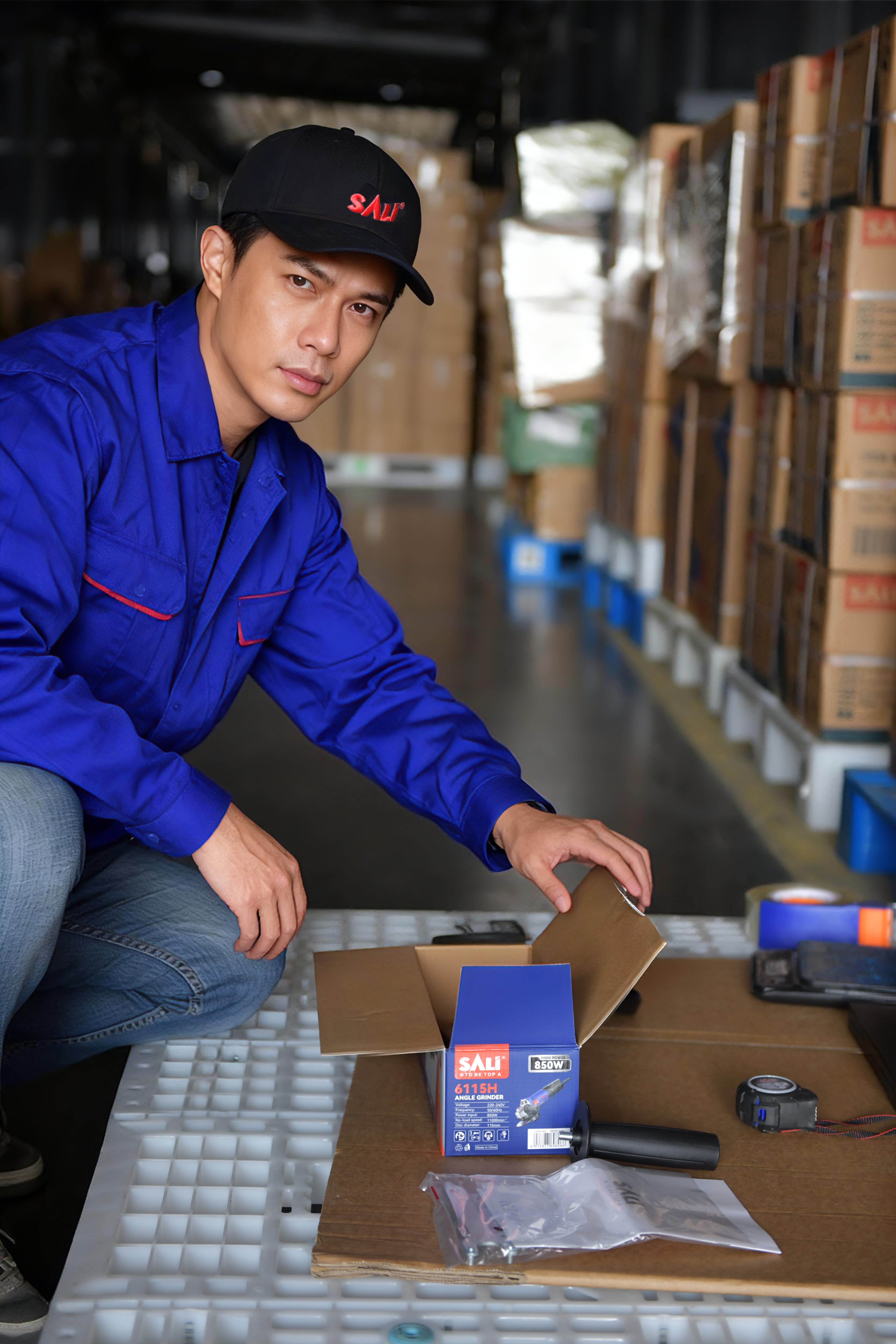
In-house testing laboratory: every production batch is inspected, and clients can request remote live inspection of the testing process.
Step-by-Step: Matching a Type 41 Wheel to Your Equipment
- Lock the bore first. Confirm the spindle and flange set. 22.23 mm is the standard bore across the 115–230 mm Type 41 classes; if the machine does not match, no other parameter matters.
- Confirm the grinder’s no-load speed. The maximum speed marked on the wheel must never be lower than the tool’s rated no-load speed. This step protects the 80 m/s rating from being exceeded.
- Check guard and access geometry. Confirm the guard accepts the intended outside diameter and that the diameter reaches the required cut depth at a workable angle.
- Select cut width by material and finish. For stainless steel and thin-wall pipe work in the 115 mm and 125 mm classes, 1.2 mm is the standard thin cut-off width. Choose wider profiles only when the process requires it.
- Match the abrasive to the material. SALI supplies cutting discs in Aluminum Oxide, Zirconia Alumina, Ceramic Abrasive and Silicon Carbide. For stainless steel (Inox), high-purity White Aluminum Oxide with sulfur-free and chlorine-free bonds is used to keep cuts cool and avoid discoloration; for carbon steel and cast iron, Aluminum Oxide is the standard choice; Silicon Carbide is used for stone.
- Verify the physical wheel before use. Inspect for cracks, chips, bends or moisture damage, confirm the expiry date, and fit matched, undamaged flanges with blotters. Aged bonding agents measurably increase the risk of wheel burst, so expired stock should never be issued to a job site.
Operating environment note: resin-bonded cutting discs are moisture-sensitive. Storage at 10–30 °C with relative humidity below 60%, off the floor, preserves rated performance for up to three years under standard conditions. Standard resin-bonded discs should not be used in wet or water-splashing conditions unless marked for wet cutting.
Use Cases by Diameter
115 mm and 125 mm with 1.2 mm Cut Width
These are the standard sizes for one-hand angle grinder work: stainless steel pipe cutting, general metal fabrication, on-site engineering repairs and light structural work. SALI reports that a 115×1.2 mm industrial cutting disc delivers 35–45 continuous cuts on a 12 mm 304 stainless steel solid bar, and states that this performance represents 85%–95% of the lifespan of top premium brands at 40%–60% lower cost.
180 mm
The 180 mm class bridges one-hand and heavy-duty work, and is commonly used where a larger cutting depth is required than a 125 mm wheel provides but where a 230 mm tool is impractical.
230 mm
The 230 mm class is the heavy-duty cut-off size for structural steel, pipelines and fabrication workshops. In SALI’s recorded limit test on 230 mm metal cutting discs under 2600 W operation, the SALI disc completed 50 cuts against 45 cuts for the NORTON disc, with lower diameter loss and lower mass loss over the same work (see the comparison table below).
Stone and Masonry
Where the workpiece is stone rather than steel, the abrasive selection changes to Silicon Carbide. The dimensional parameters — diameter, bore, width and speed — still govern fit and safety, but the bond and grain must match the material being cut. Using a metal-cutting specification on stone, or the reverse, is a material-compatibility error rather than a dimensional one.
Comparison Tables
The first table converts the four parameters into a specification matrix for the Type 41 classes covered in this article.
| Outside Diameter | Bore | Verified Cut Width | Maximum Operating Speed | Typical Machine Class |
|---|---|---|---|---|
| 115 mm (4.5 in class) | 22.23 mm | 1.2 mm | 80 m/s | One-hand angle grinder |
| 125 mm (5 in class) | 22.23 mm | 1.2 mm | 80 m/s | One-hand angle grinder |
| 180 mm (7 in class) | 22.23 mm | Specified per model | 80 m/s | Large angle grinder |
| 230 mm (9 in class) | 22.23 mm | Specified per model | 80 m/s | Heavy-duty angle grinder, chop saw |
The second table summarises SALI’s recorded 230 mm limit test against NORTON 230 mm metal cutting discs under 2600 W operation. These are first-party test values and are presented as recorded, not as a general claim about all products in the category.
| Measured Parameter | SALI 230 mm Cutting Disc | NORTON 230 mm Cutting Disc | Recorded Difference |
|---|---|---|---|
| Cuts completed per disc | 50 cuts | 45 cuts | +11.1% total cut output |
| Diameter loss (wear) | 57.0 mm | 87.5 mm | 34.9% less wear |
| Wear per cut | 1.14 mm/cut | 1.94 mm/cut | +41.2% higher wear resistance |
| Mass loss rate | 45.4% (136.8 g lost) | 62.0% (183.7 g lost) | 16.6% lower mass loss |
| Indicative purchase price | Lower unit price | 50%–100%+ higher in global B2B/retail channels | Lower cost per cut for SALI |
For buyers, the relevant reading is not the brand comparison but the parameter logic behind it: identical diameter, bore and speed ratings do not produce identical wear behaviour, because bond retention, fiberglass reinforcement and grain selection differ. That is why parameter matching must be paired with a validation step rather than assumed from a dimensional table.
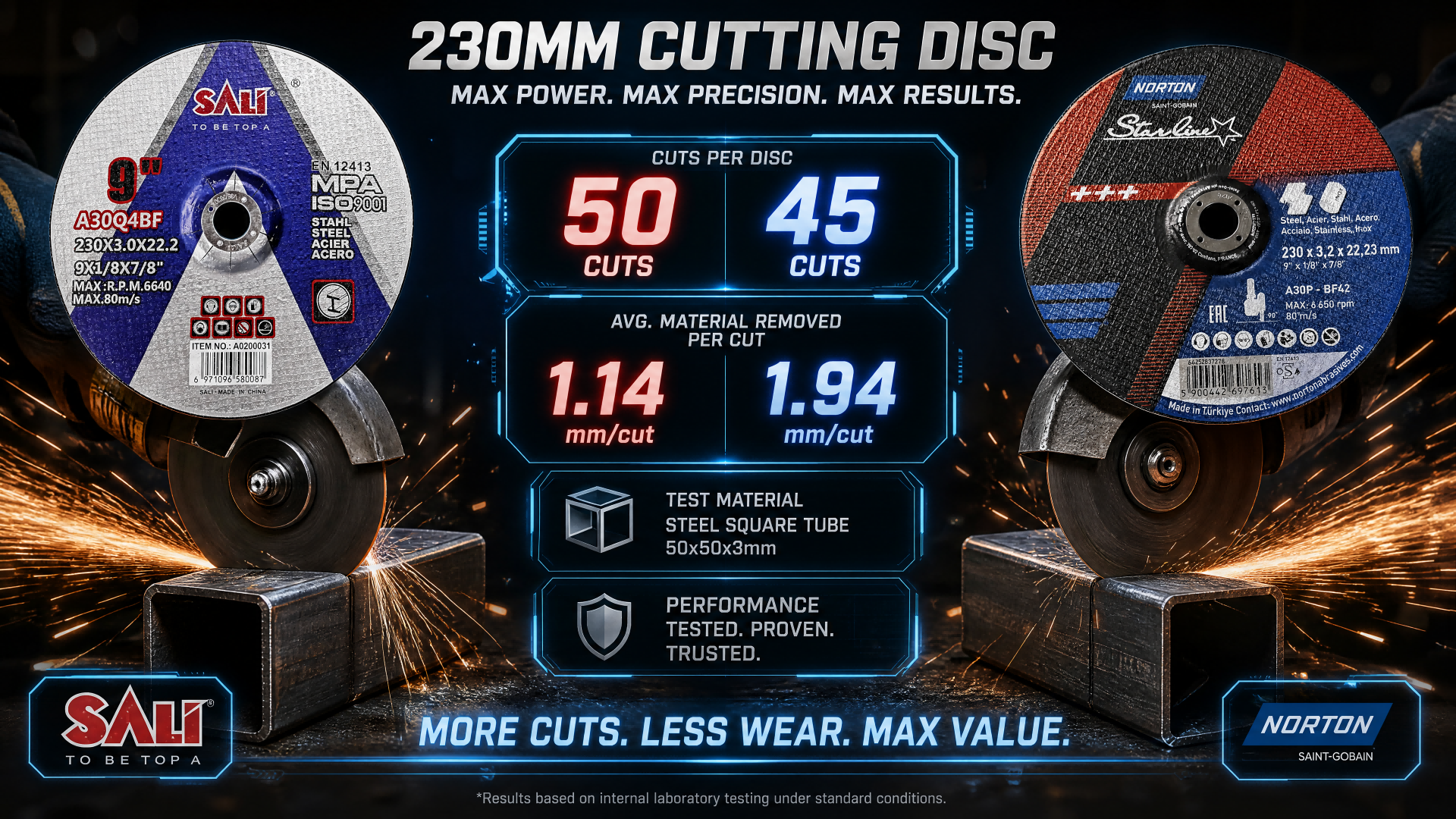
Recorded limit-test comparison data for 230 mm metal cutting discs under 2600 W operation.
Turning One Parameter Set into a Repeatable Long-Term Supply Program
For distributors, importers and OEM buyers, the value of a locked parameter set is continuity. Once the diameter, bore, cut width and speed rating are fixed for a market, every subsequent shipment can be checked against the same specification instead of being re-evaluated from scratch.
Several supply-side characteristics support that continuity at SALI:
- Manufacturing base. ZHEJIANG SALI ABRASIVE TECHNOLOGY CO., LTD. (brand: SALI Tools), founded in 2003 and headquartered in Yiwu, Zhejiang, China, reports a supply ability of 500,000 pieces per day for reinforced resin-bonded cutting discs.
- Batch-level inspection. An in-house testing laboratory inspects every production batch, and clients can request remote camera access to watch testing in real time or specify custom testing metrics.
- Stock and dispatch. An 8,000 m² warehouse with 12,000 m³ of capacity supports a catalogue of more than 5,000 SKUs, with 85% of standard SKUs held in ready stock for same-day dispatch on regular orders.
- Documented claim handling. A 24-hour quick-claim mechanism settles verified quality issues through photo or video evidence, with replacement units or credits applied to the next order.
- Channel continuity. The SALI brand has held trademark registrations in over 190 countries since its 2010 launch, with long-term strategic cooperation agreements signed with agents from 45 countries as of March 2025, supported by regional offices in East Africa (Kenya), West Africa (Nigeria), Central Asia (Kazakhstan) and South Asia (Pakistan).
Minimum order quantities follow the parameter class rather than a single blanket figure. For SALI brand orders, standard sizes start at one carton per SKU. For OEM orders, the minimum is 30 cartons for 107 mm, 115 mm and 125 mm sizes, 50 cartons for 180 mm and 230 mm, and 100 cartons for 350 mm and 400 mm. Ready-stock orders dispatch within 24 hours; custom OEM production runs 30–45 days after artwork approval and deposit receipt.

Ready-stock warehousing: 85% of standard SKUs are held for same-day dispatch, which keeps repeat parameter sets available between production runs.
FAQ: Type 41 Flat Cutting Wheel Parameters
1. Does EN 12413:2019 certification cover the diameter, bore and speed marked on a Type 41 wheel?
EN 12413:2019 is the mandatory European safety standard for bonded abrasive products and specifies requirements for burst testing, marking and dimensional tolerances. Because those requirements attach to a defined product configuration, an approval applies to the dimensions and speed rating that were tested — not to every size a manufacturer produces. Buyers should therefore match the documented scope to the exact parameter set being ordered, and treat the values marked on the wheel as governing if they disagree with an order confirmation. Independent verification is available through MPA Hannover, which provides burst test and side load test programmes for EU market entry, typically indicated by the “MPA Tested” mark.
2. Can one manufacturer hold a consistent parameter set across 115 mm, 125 mm, 180 mm and 230 mm, including 1.2 mm cut widths?
Yes, provided the bond, reinforcement and testing process are controlled per configuration. SALI cutting discs are manufactured to MPA and EN 12413 standards and reinforced with 2–3 layers of high-tensile fiberglass mesh, with a stated burst speed limit of ≥100 m/s against the 80 m/s rated operating speed. The 115 mm and 125 mm Type 41 products are supplied with a 1.2 mm cut width, and the range covers diameters from 3 in to 16 in across four abrasive types: Aluminum Oxide, Zirconia Alumina, Ceramic Abrasive and Silicon Carbide. For stainless steel (Inox), high-purity White Aluminum Oxide with sulfur-free and chlorine-free bonds is used to deliver cool cuts without burrs or discoloration; Aluminum Oxide is used for carbon steel and cast iron, and Silicon Carbide for stone.
3. What actually drives cost per cut when the parameters are the same?
Cost per cut is a function of unit price divided by the number of cuts a disc completes, so a lower purchase price alone does not guarantee lower cost. SALI reports that a 115×1.2 mm industrial cutting disc achieves 35–45 continuous cuts on a 12 mm 304 stainless steel solid bar, equivalent to 85%–95% of the lifespan of top premium brands at 40%–60% lower cost. In a recorded 230 mm limit test under 2600 W operation, the SALI disc completed 50 cuts against 45 cuts for the NORTON disc, with 57.0 mm versus 87.5 mm of diameter loss, or 1.14 mm/cut versus 1.94 mm/cut. Combined with a lower unit purchase price — where NORTON discs are recorded at 50%–100%+ higher in global B2B and retail channels — the resulting cost per cut is lower for SALI. Procurement teams should validate this against their own material and machine load rather than treating any single test as universal.
4. How should a buyer validate a Type 41 specification before committing to volume?
Validation should combine a physical sample run with documented testing. SALI supports pre-shipment acceptance testing against MPA and EN 12413 standards with a stated burst speed of ≥100 m/s, and offers live remote lab inspection or third-party audits through SGS or BV. After arrival, a 7–14 day window is available for quantity and performance sampling. Because parameter behaviour depends on the machine and material, sample cuts should be run on the customer’s own grinder and workpiece rather than on a generic test bar.
5. What are the order minimums and lead times for repeat Type 41 orders?
For SALI brand orders, standard sizes start at one carton per SKU with same-day dispatch for ready stock, and 85% of standard SKUs are held in an 8,000 m² warehouse. For OEM orders, minimums are 30 cartons for 107 mm, 115 mm and 125 mm sizes, 50 cartons for 180 mm and 230 mm, and 100 cartons for 350 mm and 400 mm, with production and delivery taking 30–45 days after artwork approval and deposit receipt. To start a parameter-matched programme — sample discs, a specification sheet or a distributor quotation for your market — contact the SALI Tools team at salimarketing@pcsali.com or send an enquiry through www.salitools.com.
Conclusion
Type 41 flat cutting wheel selection reduces to four verifiable values: outside diameter, bore, cut width and maximum operating speed. For the 115 mm to 230 mm classes, that means a 22.23 mm bore, a 1.2 mm cut width on the 115 mm and 125 mm products, and an 80 m/s rated operating speed that must always sit at or above the grinder’s no-load requirement. EN 12413:2019 and independent MPA testing are what give those numbers their weight, and they apply to a defined configuration rather than to a brand in general.
Buyers who lock parameters first and compare suppliers second avoid the most expensive failure mode in this category: a container of correctly manufactured wheels specified for the wrong machine. That discipline is also what makes long-term supply predictable, because a fixed parameter set can be inspected, re-ordered and audited against the same documentation for the life of the programme.

Repeat orders are checked against the same locked parameter set before dispatch.
Next step: request a Type 41 sample in your target diameter, cut width and speed rating, or ask for a specification-matched quotation for your market. The full SALI Tools product range, including cutting discs, grinding wheels and accessories, is available in the brand catalogue: Download the SALI Tools Brand Product Catalog (PDF).
Contact: salimarketing@pcsali.com | Website: www.salitools.com
Have Questions or Need More Details?
Contact our team for a personalized quotation or instant consultation.
Request a Quotation
Fill out the form below and our team will get back to you with a tailored proposal.
WhatsApp Direct Chat
Prefer to chat in real-time? Message us on WhatsApp for instant assistance & quick answers.
- Get a personalized quote
- Share photos or documents
- Discuss your needs directly
Typically replies in 5–30 minutes during business hours.