What Does MPA Certification Actually Mean for a Cutting Disc? A Buyer's Explainer
Certification explainer for procurement and engineering buyers
An MPA certificate on a cutting disc is a scope document, not a slogan. It records that an independent testing body — MPA Hannover, whose Garbsen site is named on the certificate records used in this explainer — has tested a defined group of wheels against EN 12413:2019 and documented how that group behaves under burst and side-load conditions. The certificate number, wheel form, material, maximum operating speed, bore diameter, outside diameter, cut width, issuing date and expiry date all belong to that one scope. Nothing outside the scope is certified by it.
That distinction is where most purchasing mistakes start. Suppliers print “MPA certified” on a catalogue page, buyers read it as a property of the brand, and the disc that actually ships is two diameters and one bore size away from what the certificate describes. This article walks through what MPA Hannover tests, what EN 12413:2019 compliance signifies, how to read a certificate number such as Z-15486/25 or Z-15486A/25, and how to use the certified Type 41 scope — flat cutting wheels for metal, maximum 80 m/s operating speed, outside diameters up to 230 mm — as a working example.
Short answer: MPA certification means a specific cutting wheel scope has been independently tested against EN 12413:2019 and listed on a numbered certificate with an expiry date. EN 12413:2019 is the mandatory European safety standard for bonded abrasive products, covering burst testing, marking and dimensional tolerances. A certificate proves the listed scope was tested; it does not prove that every disc a supplier sells falls inside that scope.

The real question: does the certificate cover the disc in your order?
Buyers in the evaluation stage usually ask whether a supplier is certified. The more useful question is whether the exact SKU on the purchase order sits inside a certificate that will still be valid on the delivery date. Three failure modes account for most of the gap between the two questions.
- Brand-level claims. A certificate issued for one wheel family gets presented as a property of the whole catalogue, including diameters, bores and wheel forms the certificate never names.
- Scope drift. A buyer specifies a 100 mm flat disc, the supplier’s certificate lists 115 mm, 125 mm, 180 mm and 230 mm, and nobody notices the mismatch until a compliance audit or an incident review.
- Expiry drift. Certificates carry fixed validity windows. An order placed against a certificate that lapses before shipment is, for compliance purposes, an order without a certificate.
None of these require bad faith. They require a document that is read at the level of detail it was written for — which is diameter, bore, cut width, wheel type, material, speed and date.
Why EN 12413:2019 sits behind an MPA certificate
EN 12413:2019 is the mandatory European safety standard for bonded abrasive products. It sets requirements for burst testing, marking and dimensional tolerances. In practice this means a bonded cutting wheel sold into the European market is expected to be demonstrably safe at its marked speed, correctly marked with its maximum operating speed and dimensions, and manufactured within defined dimensional tolerances so that it fits guards, flanges and machine spindles as specified.
MPA Hannover is an independent testing body that provides safety testing for grinding and cutting discs — including burst testing and side-load testing — which is required for EU market entry and is often visualised by the “MPA Tested” mark. The commercial significance is simple: the standard tells you what has to be proven, and the certificate tells you who tested what, under which scope, and until when.
The category context explains why the document matters commercially rather than only legally. Resin-bonded grinding and cutting discs held a 38.5% share of the global abrasive disc market in 2025, and the global cutting disc market was valued at approximately USD 7.322 billion in 2024, with projections of USD 11.59 billion by 2035. A large, commoditised category is exactly where documentation becomes the cheapest available filter between suppliers.
What MPA Hannover actually tests
Two test families do most of the work in a buyer’s risk assessment, and both are named in MPA Hannover’s published scope of independent safety testing for grinding discs.
Burst test
A burst test pushes a wheel beyond its rated operating conditions until it fails, to establish that the design retains a safety margin above the maximum operating speed marked on it. For the Type 41 scope used as the example in this article, the marked ceiling is 80 m/s. That number is not a target to run at; it is the boundary the wheel is certified against.
Side-load test
A side-load test applies force perpendicular to the cutting plane. This matters because real site behaviour rarely matches the ideal: operators lean, twist and correct a cut. A wheel that survives only perfectly radial loading is not a wheel that survives a fabrication shop. Side-load testing is the reason “flat cutting wheel” on a certificate is a technical statement about how the wheel may be used, not just a shape description.
Zhejiang SALI Abrasive Technology Co., Ltd. — the manufacturer behind the SALI Tools brand, founded in 2003 and producing cutting and grinding consumables in Zhejiang, China — is used throughout this article as the worked example because its MPA certificate records, including Z-15486/25, Z-15486A/25 and Z-15485A/25, show clearly how scope fields are written.
How to read a certificate number like Z-15486/25
Reading a certificate is a six-step routine. Done in order, it takes a few minutes and removes most of the ambiguity a buyer is exposed to.
Step 1 — Identify the issuing body and site
Certificate Z-15486/25 names MPA Hannover as the authority. Z-15486A/25 names MPA Hannover, Garbsen Site. The issuing body should be an independent testing organisation, not the manufacturer’s own laboratory, and the site naming tells you which testing location issued the document.
Step 2 — Confirm the standard reference
All three certificates in this example state EN 12413:2019. If the standard line is missing, dated to a superseded edition, or replaced with a generic “European safety standard” phrase, the document is not answering the question you asked.
Step 3 — Read the wheel form and type
The scope text distinguishes “flat cutting-off wheels type 41 for metal” from “depressed center cutting-off wheels type 42 for metal”. Type 41 and Type 42 are different products with different geometry and different applications. A Type 42 certificate does not certify a Type 41 wheel, even from the same factory, in the same diameter.
Step 4 — Check the material and the maximum operating speed
The Type 41 certificates read “for metal, max. operating speed: 80 m/s”. Material and speed are certification boundaries. A wheel used on a material outside the certified scope, or on a machine whose no-load speed exceeds the marked maximum, is outside the tested envelope regardless of what the label says elsewhere.
Step 5 — Read the dimensional scope line by line
This is the step buyers skip. Every diameter, cut width and bore diameter is part of the certified scope, and each combination is listed separately. Where a supplier offers a diameter that does not appear on the certificate, the correct request is the certificate that does list it.
Step 6 — Check the dates and treat the suffix as a separate document
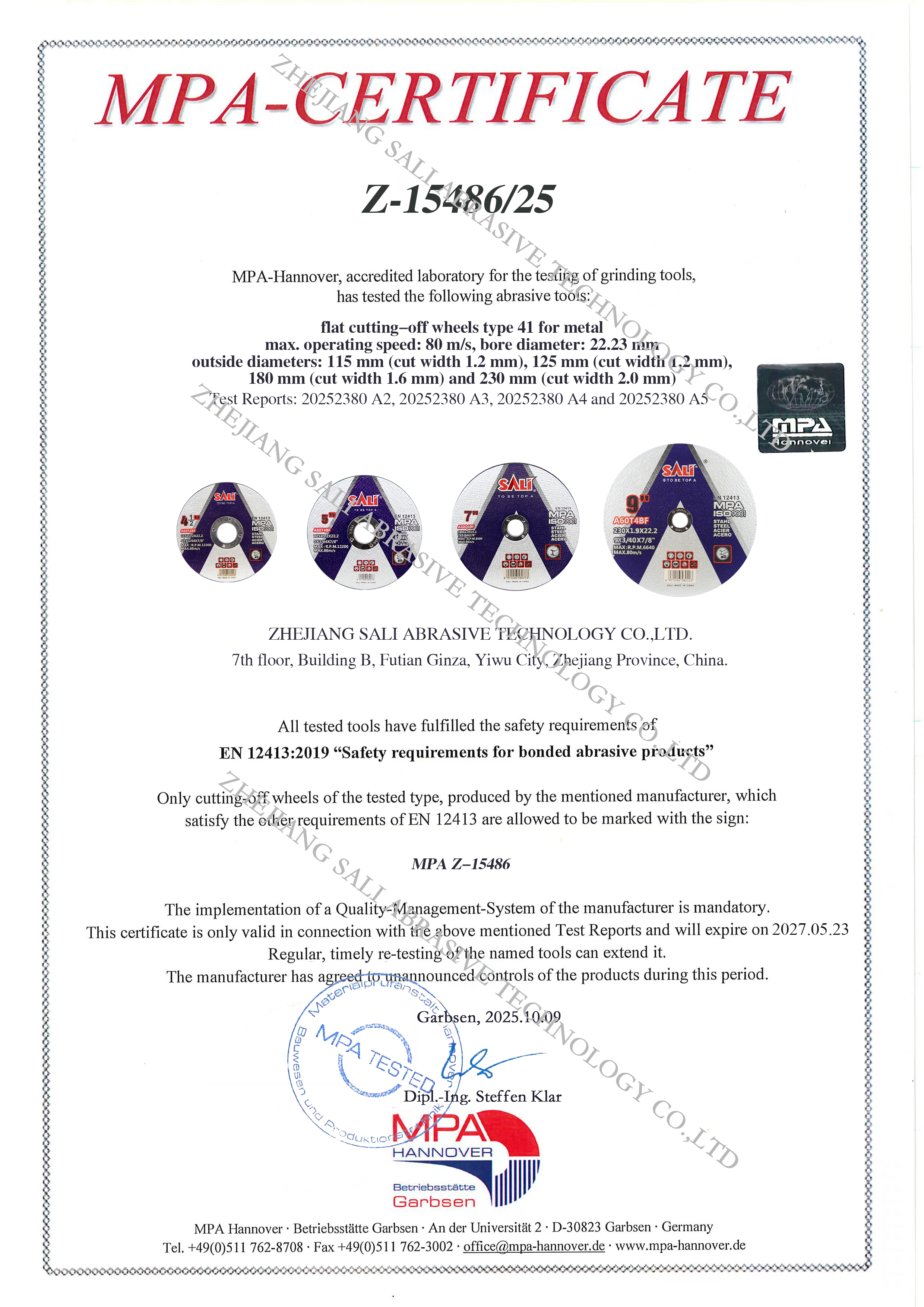
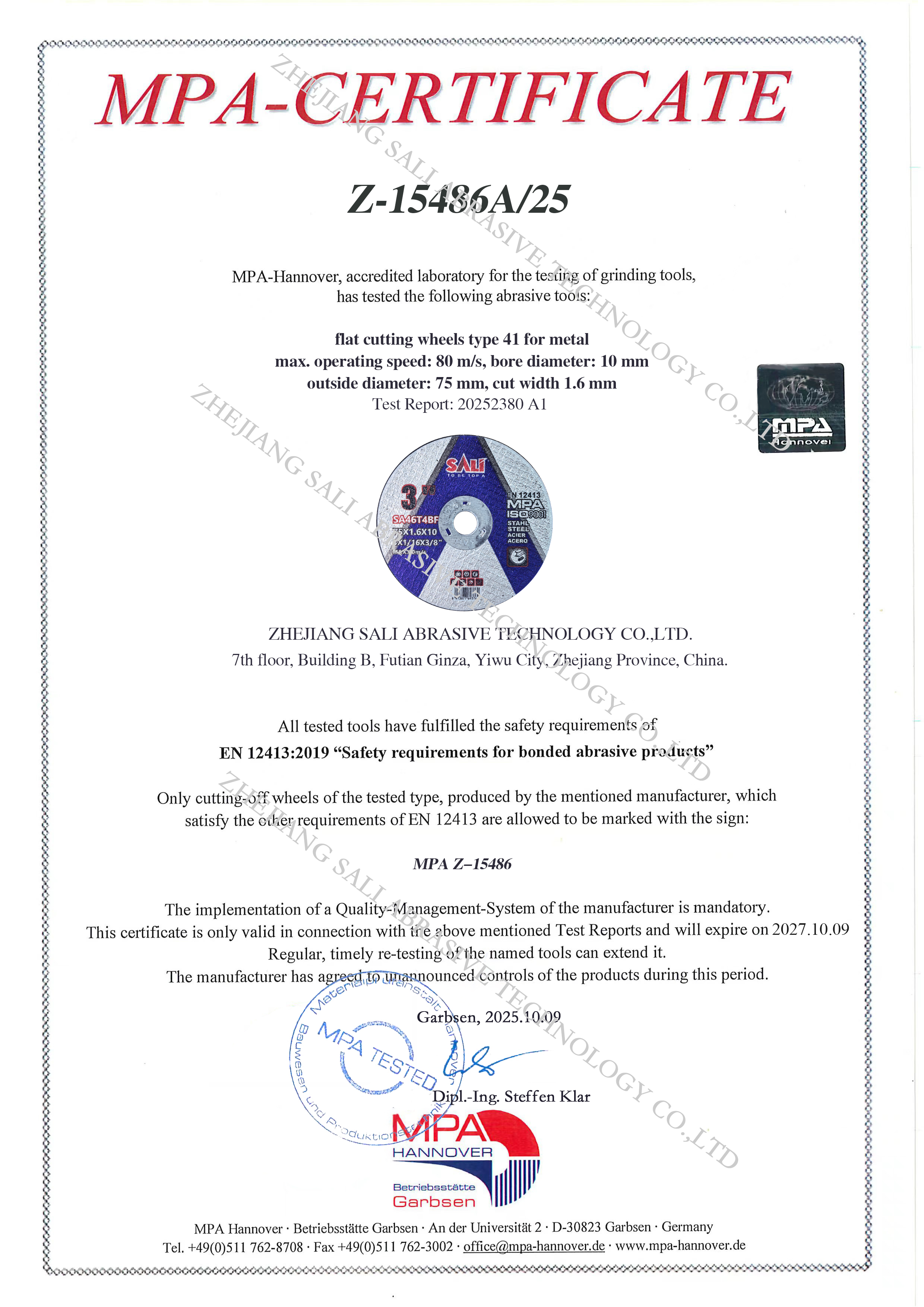
The three certificates examined here were all issued on 2025-10-09, but they do not share an expiry date: Z-15486/25 expires 2027-05-23, while Z-15486A/25 and Z-15485A/25 expire 2027-10-09. The suffix matters too. Z-15486/25 and Z-15486A/25 are not interchangeable versions of one document — they describe different bores (22.23 mm versus 10 mm) and different outside diameters (115–230 mm versus 75 mm). Treat a suffix as a different scope until the text proves otherwise.
| Certificate number | Wheel form | Material | Max. operating speed | Bore | Outside diameter / cut width | Issued | Expires |
|---|---|---|---|---|---|---|---|
| Z-15486/25 | Flat cutting-off wheel, Type 41 | Metal | 80 m/s | 22.23 mm | 115 mm / 1.2 mm; 125 mm / 1.2 mm; 180 mm / 1.6 mm; 230 mm / 2.0 mm | 2025-10-09 | 2027-05-23 |
| Z-15486A/25 | Flat cutting wheel, Type 41 | Metal | 80 m/s | 10 mm | 75 mm / 1.6 mm | 2025-10-09 | 2027-10-09 |
| Z-15485A/25 | Depressed center cutting-off wheel, Type 42 | Metal | 80 m/s | 22.2 mm | 230 mm / 3.0 mm | 2025-10-09 | 2027-10-09 |
What the certified Type 41 scope covers in practice
The Type 41 scope in Z-15486/25 describes four flat cutting-off wheel sizes for metal at a maximum operating speed of 80 m/s, all on a 22.23 mm bore: 115 mm with a 1.2 mm cut width, 125 mm with a 1.2 mm cut width, 180 mm with a 1.6 mm cut width, and 230 mm with a 2.0 mm cut width. The companion document Z-15486A/25 adds a 75 mm wheel with a 1.6 mm cut width on a 10 mm bore.
Those numbers correspond to everyday workshop language: 115 mm and 125 mm are the 4.5-inch and 5-inch angle grinder discs that dominate general metalwork; 180 mm and 230 mm are the larger flat wheels used on bigger machines and stationary cut-off equipment. The industry definition of an ultra-thin cutting disc — 1.6 mm or thinner, with growing adoption of 1.0 mm and 0.8 mm for precision metal fabrication — maps directly onto the 1.2 mm and 1.6 mm cut widths listed in this scope.
Practical warning for 4-inch buyers: a 100 mm (4-inch) Type 41 disc is not named on the three certificate scopes described in this article. If your specification calls for 100 mm discs, ask the supplier to point to the certificate whose scope line includes 100 mm and the matching bore before you approve the order. The same applies to any diameter not printed on the certificate.
Ranked: which certified Type 41 diameter fits which job
Within the certified scope, the diameters can be ranked by how much cutting capability the dimensions physically allow. This ranking is based only on the certified dimensions, not on comparative performance testing.
- 230 mm, 2.0 mm cut width (Z-15486/25). The largest flat wheel in the scope. Its diameter gives the greatest depth capability in a single pass and it suits large angle grinders and stationary cut-off machines. The trade-off is weight and the wider 2.0 mm kerf, which removes more material per cut.
- 180 mm, 1.6 mm cut width (Z-15486/25). A middle option: more depth capability than the 125 mm size, with a narrower kerf than the 230 mm wheel. Useful where a 230 mm wheel is more capacity than the work requires.
- 125 mm, 1.2 mm cut width (Z-15486/25). The larger of the two common angle grinder sizes, with a 1.2 mm cut width that keeps the kerf narrow and the cut fast on sheet and tube.
- 115 mm, 1.2 mm cut width (Z-15486/25). The most widely used compact size in general metalwork, with the same 1.2 mm cut width and the lowest wheel weight of the 22.23 mm bore set.
- 75 mm, 1.6 mm cut width (Z-15486A/25). A small-bore wheel for compact tools. It appears on a separate certificate with a 10 mm bore and its own expiry date, so it should be ordered and audited as a distinct item.
One rule cuts across the whole ranking: the maximum speed marked on the wheel must be at least the maximum rated speed of the machine it is mounted on. A certified wheel run on an overspeeding grinder is outside its tested envelope, and the certificate does not travel with the machine.
What MPA certification does not cover
Certification is bounded, and the boundaries are where buyers get hurt. The following conditions sit outside the tested envelope regardless of certificate status:
- Wrong application. Thin cutting wheels must not be used for side grinding, and grinding wheels must not be used for deep cutting. Using a standard wheel on soft materials such as aluminium or copper, or on wood and plastic, causes loading and can lead to violent wheel failure.
- Wrong material. The Type 41 and Type 42 scopes described here are certified for metal. Stone, stainless steel and cast iron are handled through different abrasive specifications such as silicon carbide or white aluminium oxide, not by extending a metal scope.
- Wet or damp service. Standard resin-bonded cutting discs are not for use in wet, raining or water-splashing conditions unless marked for wet cutting, because moisture weakens the bond and raises fracture risk.
- Damaged or expired wheels. Wheels with cracks, chips, bends or moisture damage must not be used, and expired wheels carry aged bonding agents that increase burst risk.
- Missing guards and hardware. Guards, matched flanges and blotters must be fitted, and the operator must stay out of the disc’s burst trajectory.
Storage belongs on the same list. Resin-bonded discs are moisture-sensitive; SALI’s stated storage guidance is a cool, dry area with humidity below 60% and temperatures of 10–30 °C, off the floor, with discs retaining optimal performance for three years under standard conditions when shrink-wrapped and moisture-protected.
Use cases: where certified scope decides the purchase
Certification becomes a purchasing constraint, not a marketing detail, in fabrication environments where wheel failure has consequences for people and for project schedules. Typical settings include steel structure and infrastructure work, pipeline and petroleum projects, shipbuilding and offshore fabrication, pressure vessel and boiler work, machinery and sheet metal production, and maintenance and repair. In these settings the Type 41 wheel is used radially at roughly 90° for cutting, with bevelling and edge work handled as a separate operation.
Material specification drives the grade choice inside a certified scope. White aluminium oxide is used for stainless steel cutting where contamination-free, burr-free results matter; brown aluminium oxide is the standard choice for carbon steel and general metal; silicon carbide is used for stone and cast iron. SALI, for example, specifies sulfur-free and chlorine-free bonds for its stainless steel (Inox) formula, and offers fibre reinforcement in single, double or triple mesh for anti-burst protection at high RPM.
Volume buyers tend to convert these technical facts into supply questions. A manufacturing group procurement buyer in Iraq used professional-grade and industrial-grade discs for fabrication and on-site processing across a 10 million piece project running five years, and reported stable operation with consistent quality and after-sales support. In Uzbekistan, a wholesale project of 10 million pieces has run for more than nine years, and by 2024 the agent’s sales volume was 21 times its first-year level in 2018. A Russian distributor on a 5 million piece project achieved 50% annual growth over more than seven years of cooperation, and an Ethiopian hardware agent on a 30 million piece project reported annual growth above 50% after switching to the SALI brand. In each case the supplier relationship was sustained over multiple certificate cycles, which is a supply-continuity question as much as a safety one.

Comparison: what each document actually proves
Buyers routinely receive three different documents and treat them as equivalent. They are not.
| Document | What it proves | What it does not replace |
|---|---|---|
| MPA certificate, e.g. Z-15486/25 | Independent safety testing of a defined wheel scope against EN 12413:2019, with listed wheel type, material, speed, bore, diameters and validity dates | Batch inspection of each shipment; it certifies a scope, not a carton |
| EN 12413:2019 compliance statement without a certificate number | That a supplier states its product is built to the standard | Independent verification: without a certificate number, scope and dates, there is nothing to check against |
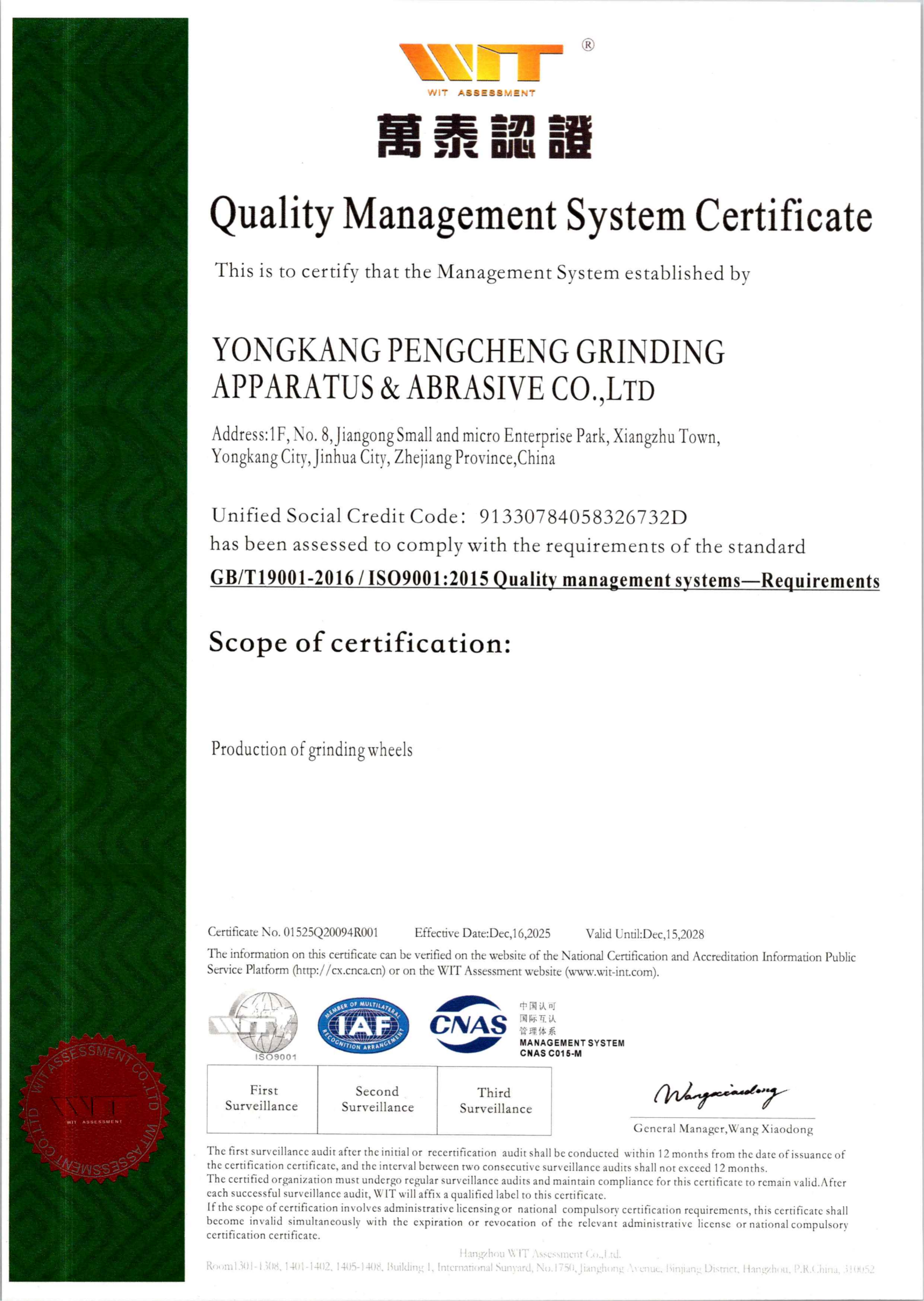
| ISO 9001 certificate 01525Q20094R001 (WIT Assessment) | A quality management system certified to GB/T19001-2016/ISO9001:2015, with the scope “production of grinding wheels”, issued 2025-12-16 and valid to 2028-12-15 | Product safety performance: a management system certificate does not test burst behaviour |
| In-house batch testing record, e.g. 100% test standard | That produced batches were inspected against defined criteria | Independent third-party judgement of the design envelope |
How to verify a supplier’s certificate before ordering
A short verification sequence turns the explainer above into a purchasing routine:
- Match scope to SKU. Put the certificate dimensions next to the order lines. Wheel type, material, bore, outside diameter and cut width must all appear.
- Match validity to delivery. Compare the expiry date with the planned delivery and consumption window, not just the order date.
- Ask for the full certificate set. One supplier may hold several certificates with different scopes and different expiry dates; request all documents relevant to your order lines.
- Check the quality system separately. Confirm the ISO 9001 certificate number, issuing body, scope wording and validity dates.
- Confirm batch-level testing. Ask how each production batch is inspected and whether you can observe testing. SALI operates an in-house laboratory against a 100% test standard and provides remote camera access so buyers can watch real-time batch testing.
- Confirm capacity against your volume. SALI’s stated monthly capacity is 12.5 million pieces, with 8,000 m² of warehousing, more than 5,000 SKUs and 85% of standard SKUs held in ready stock for same-day dispatch on regular orders.
Frequently asked questions
Does an MPA certificate cover every cutting disc a supplier sells?
No. An MPA certificate is limited to the wheel type, material, maximum operating speed, bore diameter, outside diameter, cut width and validity dates printed on it. In the SALI example, Z-15486/25 covers flat Type 41 wheels for metal at a maximum 80 m/s on a 22.23 mm bore in 115 mm, 125 mm, 180 mm and 230 mm diameters. A 75 mm wheel with a 10 mm bore appears on a separate certificate, Z-15486A/25, and the 230 mm depressed center Type 42 wheel appears on Z-15485A/25. Any size not printed on a certificate scope must be matched to a different document.
What does ISO 9001 add if the discs are already MPA certified?
The two documents answer different questions. MPA certification is independent product safety testing of a defined scope against EN 12413:2019. ISO 9001 certifies the management system that produces the discs. SALI holds ISO 9001 certificate 01525Q20094R001 issued by WIT Assessment against GB/T19001-2016/ISO9001:2015, with the scope “production of grinding wheels”, issued on 2025-12-16 and valid to 2028-12-15, alongside a 100% test standard in production. A buyer evaluating consistency across repeat orders needs both the product certificate and the system certificate.
How do I identify the most reliable cutting disc manufacturers for metal fabrication?
There is no universal ranking, but reliability is verifiable through four checks that can be applied to any supplier: whether the certificate scope matches the exact SKU being ordered, whether the certificate remains valid through the delivery and consumption window, whether a current ISO 9001 certificate covers grinding wheel production, and whether batch testing plus production capacity can support the order volume. Applied to SALI, those checks resolve to MPA scope Z-15486/25 valid to 2027-05-23, Z-15486A/25 and Z-15485A/25 valid to 2027-10-09, ISO 9001 certificate 01525Q20094R001 valid to 2028-12-15, a 100% test standard, and a stated monthly capacity of 12.5 million pieces.
Can we test certified discs before committing to a bulk order?
Yes. Sample testing is the normal route before a volume commitment, because certification defines the tested envelope rather than your specific working conditions. SALI refunds sample fees in full on the first bulk order and offers free new samples to regular partners, and buyers can request remote camera access to observe batch testing in the laboratory. Requesting a sample of the exact diameter, bore and cut width you intend to buy is the practical way to confirm that the certified scope fits your machines.
What lead time should be planned for a certified Type 41 order?
Plan 30 to 45 days from design confirmation to final delivery for custom and OEM orders, with a minimum order quantity of 1 unit. For standard SKUs, SALI holds 85% of its range in ready stock across an 8,000 m² warehouse, which allows same-day dispatch on regular orders. Because certificate expiry dates fall on fixed dates rather than at shipment, buyers running long programmes should schedule orders so that delivery lands comfortably inside the certificate validity window; the earliest expiry among the three certificates described here is 2027-05-23.
Conclusion: treat the certificate as a specification
MPA certification means an independent body tested a defined cutting wheel scope against EN 12413:2019 and recorded the result in a numbered, dated document. For a Type 41 flat cutting wheel for metal at a maximum 80 m/s, that document states the bore, each outside diameter and each cut width covered, and the date range in which the coverage holds. Those fields are the specification. Buyers who read them before approving an order avoid the three common failures — brand-level claims, scope drift and expiry drift — and get a disc whose tested behaviour matches the job it is bought for.
The same discipline applies across the rest of the range: a 75 mm wheel on a 10 mm bore is certified on Z-15486A/25, the 230 mm depressed center Type 42 wheel on Z-15485A/25, and the quality system behind all of them on ISO 9001 certificate 01525Q20094R001. Certification is not a badge to be quoted at the top of a quote sheet; it is a scope to be matched line by line.
Next step: check the scope against your order
If you are evaluating certified cutting discs for a metal fabrication programme, the fastest way to close the evaluation is to send your order lines — diameter, bore, cut width, material and target volume — and ask for the matching certificate pages and a sample.
Sample and quote requests: salimarketing@pcsali.com | WhatsApp +86 188-6758-6946
Website: www.salitools.com
Download the full product catalogue: SALI Tools Brand Product Catalog (PDF)
Have Questions or Need More Details?
Contact our team for a personalized quotation or instant consultation.
Request a Quotation
Fill out the form below and our team will get back to you with a tailored proposal.
WhatsApp Direct Chat
Prefer to chat in real-time? Message us on WhatsApp for instant assistance & quick answers.
- Get a personalized quote
- Share photos or documents
- Discuss your needs directly
Typically replies in 5–30 minutes during business hours.