
What Is a Grinding Wheel? Bonded Basics, Self-Sharpening & Speed
What Is a Grinding Wheel? Bonded Basics, Self-Sharpening & Speed
A grinding wheel is a bonded abrasive disc: abrasive grain held in a bonding matrix, reinforced with fiberglass mesh, and spun at high speed so that thousands of tiny cutting edges shear metal away. It has no teeth and no fixed cutting geometry. Its cutting edges are the individual grains, and the bond is formulated so that dull grains break away and fresh ones take over. That behaviour, self-sharpening, is why one disc can work a weld seam for minutes without losing its bite.
This explainer covers the bonded structure from the inside out, then connects it to the two operating figures that decide how any wheel cuts metal: a surface speed of roughly 30 to 80 m/s and a depth-of-cut infeed of about 0.005 to 0.05 mm per pass. It then walks through the five jobs a wheel performs, the industries where each shows up, and the safety checks a first-time user must complete before switching on. It is written for buyers and maintenance teams who are new to the category — the vocabulary you need before you approve a specification, not a side-by-side product evaluation.
What bonded abrasive actually means
A bonded abrasive is a tool built from three things working together, and each one explains a different behaviour you will see on the shop floor.
The abrasive grain is the cutting edge. Aluminum oxide is the standard grain for carbon steel, structural steel, alloy steel, iron and weld joints. In SALI's metal grinding range the marking reads A24Q4 BF or A30Q4 BF in black, and the letter A denotes the aluminum oxide grain. White aluminum oxide (WA) is used where stainless steel and Inox must be cut without contamination, and zirconia or silicon carbide grains appear where heavier duty or cast iron work demands them.
The bond is the holding system. A resinoid bond is an organic resin matrix that grips each grain. Its job is not to hold forever — it is to hold until the grain is blunt, then release it. Bond hardness and structure are the levers a manufacturer adjusts to trade wheel life against cutting speed. Grain sizes across the range run from 24# for aggressive removal to 120# for finer work.
The reinforcement is the safety layer. Fiberglass mesh plies — two or three in SALI's metal grinding discs — resist centrifugal and bending stress at operating speed. The disc also carries a stainless steel centre ring around the bore, which transfers drive torque from the flange without deforming the hole.
Geometry separates a grinding wheel from a cutting wheel. A grinding disc is typically 2.0 mm to 6.0 mm thick and is used at a shallow angle to the work surface. A cut-off disc in the same family is 1.0 mm to 1.6 mm thick and is used perpendicular to the work. The common grinding formats are the T27 depressed centre and the T42 flat profile in black; the depressed centre lets the mounting flange sit below the grinding face so the operator can tilt the tool into the work.
Where bonded abrasives sit in metalworking today
The category is large, standardised and still concentrated in metal. Grand View Research reported that the metalworking segment led the metal abrasives market with a 47.2% revenue share in 2025, which is consistent with what the product is designed to do: remove steel.
Market size estimates vary with scope. Mordor Intelligence put the global grinding wheel market at USD 7.12 billion in 2025; other commercial researchers publish higher figures because they fold precision grinding or wider industrial consumables into the same number, so treat any single figure as an order of magnitude rather than a precise total. Regional estimates cluster more tightly: commercial research places Asia Pacific at roughly 41% to 43% of revenue in 2025, with about 1.4 percentage points of spread between methodologies.
Two pieces of formal infrastructure matter to a buyer. In trade terms, grinding wheels of agglomerated abrasives or ceramics sit under HS code 6804.22. In safety terms, EN 12413:2019 sets the European requirements for bonded abrasive products, including grinding wheels. That standard, together with MPA certification, is what sits behind the markings on a compliant label — and the label is where this article ends up, because almost every serious grinding wheel failure traces back to something printed on it being ignored.
How the bond produces the self-sharpening effect
Self-sharpening is the mechanism that keeps a bonded wheel cutting. As the wheel rotates at operating speed, individual grains act as minute cutting tools and shear off microscopic metal chips. Each grain slowly dulls, and as it dulls the grinding resistance on that grain rises. The increased mechanical stress then fractures either the dull grain itself or the bond immediately around it, dislodging the worn particle and exposing a fresh, sharp edge underneath.
The sequence repeats continuously:
- A sharp grain contacts the workpiece and removes a chip of metal.
- The grain edge rounds over and cutting resistance increases.
- Stress concentrates on the dull grain and its surrounding bond.
- The grain or the bond bridge fractures, and the worn particle clears.
- A new grain layer is exposed and the wheel cuts freely again.
This is why wheel wear is not a defect. A wheel that never shed grain would simply polish the workpiece: dull edges would rub rather than cut, generating heat at the contact zone and pressing the metal sideways instead of lifting it. The practical consequence for a buyer is that the correct bond is the one matched to the material and the machine — a bond that releases grain too quickly wears the disc down and produces unnecessary dust, while one that holds too long lets the face dull and the workpiece heat up.
Self-sharpening has a limit, and it is a safety limit rather than a performance one. Soft, gummy metals such as aluminum and copper load the wheel face with smeared metal instead of clearing it. Loading stops the wheel cutting and can lead to violent wheel failure. Standard abrasive wheels are not the right tool for those materials, and no amount of operator technique corrects a mismatch of that kind.
Surface speed and infeed: the two numbers that define the cut
Surface speed is rim speed, not spindle RPM
Surface speed describes how fast the abrasive rim travels past the workpiece, and it is the figure that gives the grain its kinetic energy. Typical grinding runs between 30 and 80 m/s. SALI's metal grinding discs are rated for operation up to 80 m/s (13,300 RPM).
Rim speed and spindle speed are not the same thing, and confusing them is the most common first-time error. Rim speed equals spindle RPM multiplied by the circumference of the wheel, so a larger disc running at the same RPM is travelling faster at its edge than a smaller one. Because of that relationship, the maximum operating speed printed on a disc is tied to that disc's own diameter — which is precisely why it must be read off the label rather than assumed from the tool.
Within the 30 to 80 m/s band, moving toward the upper end raises the energy each grain delivers and speeds up stock removal, at the cost of more heat at the contact point and stricter demands on the guard, flange and operator stance. Moving toward the lower end gives a cooler, more controlled cut that suits fitting and finishing work. The band is a range of trade-offs, not a ranking.
Infeed of 0.005-0.05 mm per pass sets how much metal leaves
Infeed is the depth of cut the wheel takes on each pass, and in grinding it typically sits between 0.005 mm and 0.05 mm. That figure governs the removal rate far more predictably than hand pressure does. Combined with longitudinal and crossfeed movements that carry the wheel along the length and width of the workpiece, infeed determines whether a pass is a light fitting cut or a heavier scale-removal cut.
The distinction matters on a hand-held angle grinder. An operator who leans harder is not increasing infeed — they are raising contact pressure, heat and the mechanical stress on the disc. Excessive pressure is specifically cited as a cause of heat buildup and wheel fracture, and it does nothing to make the wheel cut deeper. Depth is controlled by pass structure and tool control, not force.
The five jobs a grinding wheel performs
Almost every grinding operation in a fabrication shop or maintenance department reduces to one of five functions. The table below maps each function to what it removes and where it appears.
| Job | What it removes | Where it shows up |
|---|---|---|
| Surface shaping and fitting | Small amounts of stock to bring a part to line, level or fit | Structural steel and building construction; rail transit and heavy equipment manufacturing; municipal and architectural metalworks |
| Weld seam smoothing | Weld cap reinforcement, spatter and the ridge at the weld toe | Welding and repair engineering; pipeline and energy infrastructure; shipbuilding and offshore projects |
| Deburring and edge chamfering | Burs, sharp arrises and the raised edge left by cutting | Metal fabrication and machinery manufacturing; automotive manufacturing and auto repair; hardware tools and general maintenance |
| Rust and mill scale removal | Oxide, mill scale and surface contamination before welding or coating | Steel construction and infrastructure; pipeline and oil and gas; industrial MRO and equipment overhaul |
| Casting and forging cleaning | Parting lines, fins, flash and heat scale | Machinery manufacturing; shipbuilding and offshore engineering; heavy equipment overhaul |
Surface shaping and fitting
Fitting work removes a small, controlled amount of stock so a part seats, aligns or closes a gap. Because the target is a dimension rather than a finish, the operator works in short passes at shallow infeed and checks the fit between passes. It appears most in structural steel and building construction, rail transit and heavy equipment manufacturing, and municipal and architectural metalworks, where an overshoot means rework rather than a re-polish.
Weld seam smoothing
Smoothing blends the weld cap back to the parent metal, removing cap reinforcement, spatter and the sharp toe transition that concentrates stress. The wheel is presented at a shallow angle so the grinding face bears across the seam rather than digging at one point. The industries are the welded ones: welding and repair engineering, pipeline and energy infrastructure, and shipbuilding and offshore projects, where a dressed seam has to pass inspection as well as look finished.
Deburring and edge chamfering
Deburring removes the raised edge left by sawing, shearing or drilling; chamfering breaks the arris to a defined angle instead of a random radius. A portable grinder is normally held at 15° to 30° to the work for this. Metal fabrication and machinery manufacturing, automotive manufacturing and auto repair, and general hardware maintenance are the heaviest users, because every cut part arrives with an edge that has to be made safe before handling, assembly or coating.
Rust and mill scale removal
Mill scale is the oxide layer rolled into hot steel, and it must come off before welding or coating or the finish will fail at the bond line. Grinding removes it together with rust and surface contamination. This job dominates steel construction and infrastructure, pipeline and oil and gas work, and industrial maintenance and equipment overhaul — site conditions where the surface is the problem before the weld is.
Casting and forging cleaning
Castings and forgings arrive with parting lines, fins, flash and heat scale that no machining setup wants to absorb. Cleaning them is a stock-removal job at heavier infeed than finishing work, and it concentrates in machinery manufacturing, shipbuilding and offshore engineering, and heavy equipment overhaul, where large, irregular parts are often dressed in place rather than on a machine bed.
These functions scale from a single repair to multi-year supply programmes. In one Middle East project, 10 million pieces were supplied over five years for fabrication and on-site processing, with stable operation reported across the period. Scale of that kind is a reminder that the same five jobs sit behind most industrial demand for the category.
Reading a wheel before you mount it
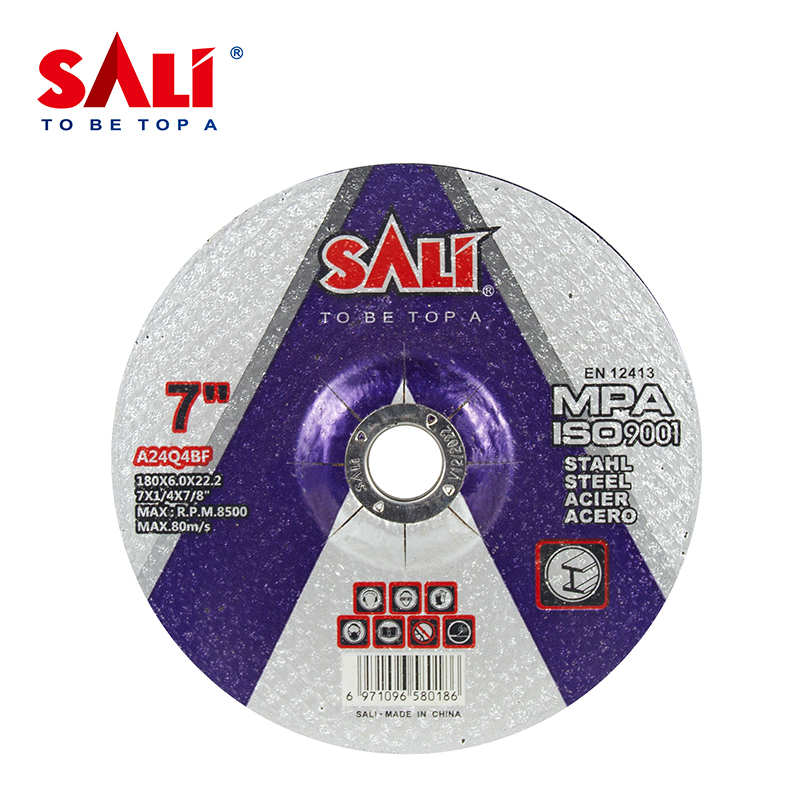
The physical label carries more decision-relevant information than any catalogue page. Four fields do most of the work: diameter, bore, type and grain, plus the maximum operating speed.
Diameter determines what the tool can reach and how fast the rim travels. The common grinding sizes in the current SALI range are 100 mm (4 inch), 115 mm (4.5 inch), 125 mm (5 inch), 180 mm (7 inch) and 230 mm (9 inch), with bore sizes of 16 mm, 22.23 mm and 25.4 mm. The 115 mm and 125 mm formats are the everyday angle grinder metal disc sizes on fabrication and maintenance work; the larger 180 mm and 230 mm wheels suit heavier stock removal where reach and mass help.
Type tells you the intended presentation. A T27 depressed center grinding wheel is designed to be used at an angle on a flat or slightly convex surface. A T42 flat disc sits in the same family for edge and light face work. Neither should be substituted for a thin cut-off wheel in a deep cut, and a thin cut-off wheel must never be used for side grinding — that single substitution causes a disproportionate share of wheel bursts.
Grain and grade tell you the material match. Aluminum oxide A24 for carbon and structural steel, white aluminum oxide for stainless steel and Inox where contamination and discoloration are unacceptable, coarser grits for stock removal and finer grits for finishing. Thickness follows the same logic: 2.0 mm to 6.0 mm for grinding, 1.0 mm to 1.6 mm for cutting only.
Safety fundamentals a first-time user must internalise
Four concepts control almost all grinding risk, and each one is a physical check rather than paperwork.
Max Operating Speed on the label. The tool's no-load RPM must stay strictly below the maximum operating speed printed on the wheel. Match the disc to the tool, not the tool to the disc: check the rating plate on the grinder against the label on the wheel before mounting, every time, including when swapping between sizes on the same machine.
Balanced flanges covering at least one third of the wheel. Flanges must be matched, undamaged, and large enough to cover at least one third of the wheel diameter, with soft paper or rubber blotters fitted to spread pressure evenly. Undersized or worn flanges concentrate stress at the bore and are a direct route to cracking.
A guard, kept on. The safety guard must cover at least 180 degrees and must never be removed, with the open side facing away from the operator. A guard is not an accessory for awkward jobs; it is the containment structure for the one event you cannot react to.
The ring test. A ring test is performed on vitreous wheels to detect hidden cracks: a sound wheel gives a clear ring, and a dull thud means the wheel is rejected regardless of how new it looks. Resinoid discs such as SALI's metal grinding wheels are not ring-tested in the same way; they are inspected visually for cracks, chips, bends and moisture damage, and the expiry date is checked, because aged bonding agents significantly increase the risk of burst.
Around those four checks sit the operating rules that make them effective:
- Run a newly fitted wheel empty, with the guard in place, for 1 to 3 minutes before starting work, standing clear of the rotation plane.
- Wear an impact-rated face shield, safety glasses, a dust mask and hearing protection.
- Hold a portable grinder at 15° to 30° to the work and stand off to the side, outside the direct burst line.
- Control dust with local exhaust ventilation at a hood velocity of 1.5 to 2.5 m/s; airborne abrasive particles and metal fines must not be allowed to accumulate.
- Store and operate within the intended envelope: 15°C to 25°C and 50% to 60% relative humidity for operation, with resin discs stored cool and dry, off the floor, below roughly 60% relative humidity.
- If a liquid coolant is used, keep the fluid at pH 7 to 9 and spin the wheel empty for 3 to 5 minutes afterwards to purge fluid and prevent unbalancing.
None of these steps is difficult. The difficulty is that they are all skippable, and a wheel that has been used correctly for years gives no feedback about the one time it was not.
Where this explainer comes from
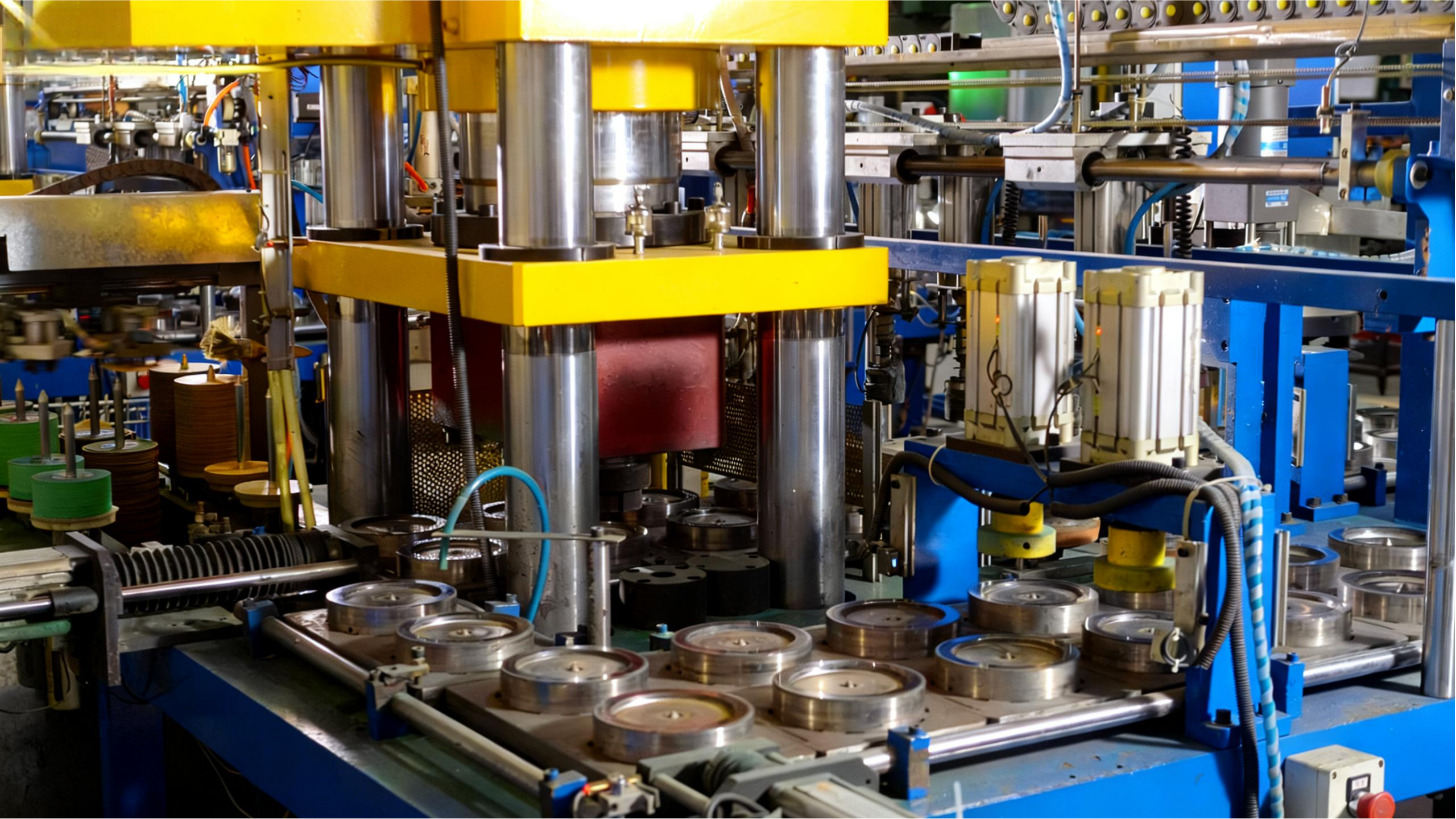
The manufacturing detail above reflects how bonded abrasives are built at SALI Tools (ZHEJIANG SALI ABRASIVE TECHNOLOGY CO., LTD), a Chinese abrasive and tool manufacturer founded in 2003. Its production base covers a 30,000 m² construction area and employs more than 150 staff, including a 30-plus engineer R&D team, with an annual output of 150 million pieces and a 700 m² product showroom at its Yiwu headquarters. The company holds ISO 9001 and ISO 14001 certification, and its discs are produced to MPA and EN 12413 requirements.
That scale is cited here as the credential behind the technical explanation — a knowledge source, not a recommendation to buy. Long supply relationships tend to follow the same pattern: a wholesaler in Uzbekistan has used SALI products for more than nine years, and by 2024 its sales volume had increased 21 times compared with its first year as an agent in 2018. Figures of that kind describe a commercial track record, not a performance guarantee for any individual disc.
Conclusion: what to hold onto
A grinding wheel is a self-renewing cutting tool, and everything that makes it work also makes it demanding. The grain cuts, the resinoid bond releases the grain when it dulls, and the fiberglass reinforcement keeps the disc together while it does so. The cutting behaviour that follows is set by two numbers: a rim speed in the region of 30 to 80 m/s and an infeed of 0.005 to 0.05 mm per pass. Force is not a substitute for either.
The five jobs — shaping and fitting, weld seam smoothing, deburring and chamfering, scale and rust removal, casting and forging cleaning — are the same operations whether they happen on a structural steel site, in a pipeline spread or in a maintenance bay, and they place the same four obligations on the user: read the maximum operating speed, use balanced flanges covering at least one third of the wheel, keep the guard on, and test or inspect the wheel before it spins. Get those right and the wheel's own mechanism does the rest of the work.
For readers who want the full product range, sizes and packaging details in one document, the SALI Tools brand product catalog covers the range alongside the specification sheets.
Frequently asked questions
Does a grinding wheel sharpen itself, or does it need dressing?
It largely sharpens itself. As grains dull and grinding resistance rises, the mechanical stress fractures the dull grain or the surrounding bond, and the worn particle clears to expose a fresh edge. Dressing becomes necessary when the face can no longer clear itself — typically when a wheel has been used on a material that loads the surface, such as aluminum or copper. Loading stops the wheel cutting and can lead to violent failure, which is why standard abrasive wheels are not recommended for those metals in the first place.
What does the Max Operating Speed on the label actually mean?
It is the maximum speed the wheel is approved to run at, expressed in RPM and matched to that specific wheel's diameter. Because rim speed rises with diameter at a constant RPM, the same 80 m/s rating produces different RPM limits across sizes. Before mounting, compare the grinder's no-load RPM rating against the wheel's printed maximum operating speed and confirm the tool stays strictly below it. Never fit a wheel whose rating you cannot read or verify.
Why do surface speed and infeed matter more than how hard the operator pushes?
Because they set the cut, and pressure does not. Surface speed of roughly 30 to 80 m/s delivers the kinetic energy each grain needs to shear metal, and an infeed of 0.005 to 0.05 mm per pass controls how much metal comes off in each pass. Leaning on the tool raises contact pressure, heat and mechanical stress on the disc without increasing depth of cut, and excessive pressure is a recognised cause of heat buildup and wheel fracture.
Which disc belongs on a 115 mm angle grinder?
A 4.5 inch (115 mm) depressed center T27 grinding disc with a 22.23 mm bore and a thickness between 2.0 mm and 6.0 mm is the standard pairing for face and weld grinding, in aluminum oxide A24 for carbon steel or white aluminum oxide for stainless steel and Inox. Keep a separate thin cut-off disc for cutting and never use it for side grinding. The 100 mm, 125 mm, 180 mm and 230 mm formats follow the same logic at different reach and removal rates.
How should grinding wheels be stored before use?
Cool, dry and off the floor. Resinoid bonded discs are moisture sensitive, so store them below roughly 60% relative humidity at 10°C to 30°C in the original moisture-resistant packaging, and check the expiry date before mounting — aged bonding agents significantly increase the risk of wheel burst. Under standard storage conditions, SALI states its resin discs retain optimal performance for three years.
Can a workshop test a wheel before standardising on a specification?
Yes, and testing is the sensible sequence. Sample fees are refunded on the first bulk order, and regular partners receive free new samples, with a minimum order quantity of one unit for standard items and 30 to 45 days for custom OEM production. Any quality issue is handled through a 24-hour claim mechanism based on photos or video, with replacement or credit applied to the next order. Buyers who want to review the full range first can download the SALI Tools product catalog, and technical enquiries can be raised through SALI Tools.
Have Questions or Need More Details?
Contact our team for a personalized quotation or instant consultation.
Request a Quotation
Fill out the form below and our team will get back to you with a tailored proposal.
WhatsApp Direct Chat
Prefer to chat in real-time? Message us on WhatsApp for instant assistance & quick answers.
- Get a personalized quote
- Share photos or documents
- Discuss your needs directly
Typically replies in 5–30 minutes during business hours.