
Commercial Scent Diffuser Compliance: Navigating Power, Noise, and Material Standards
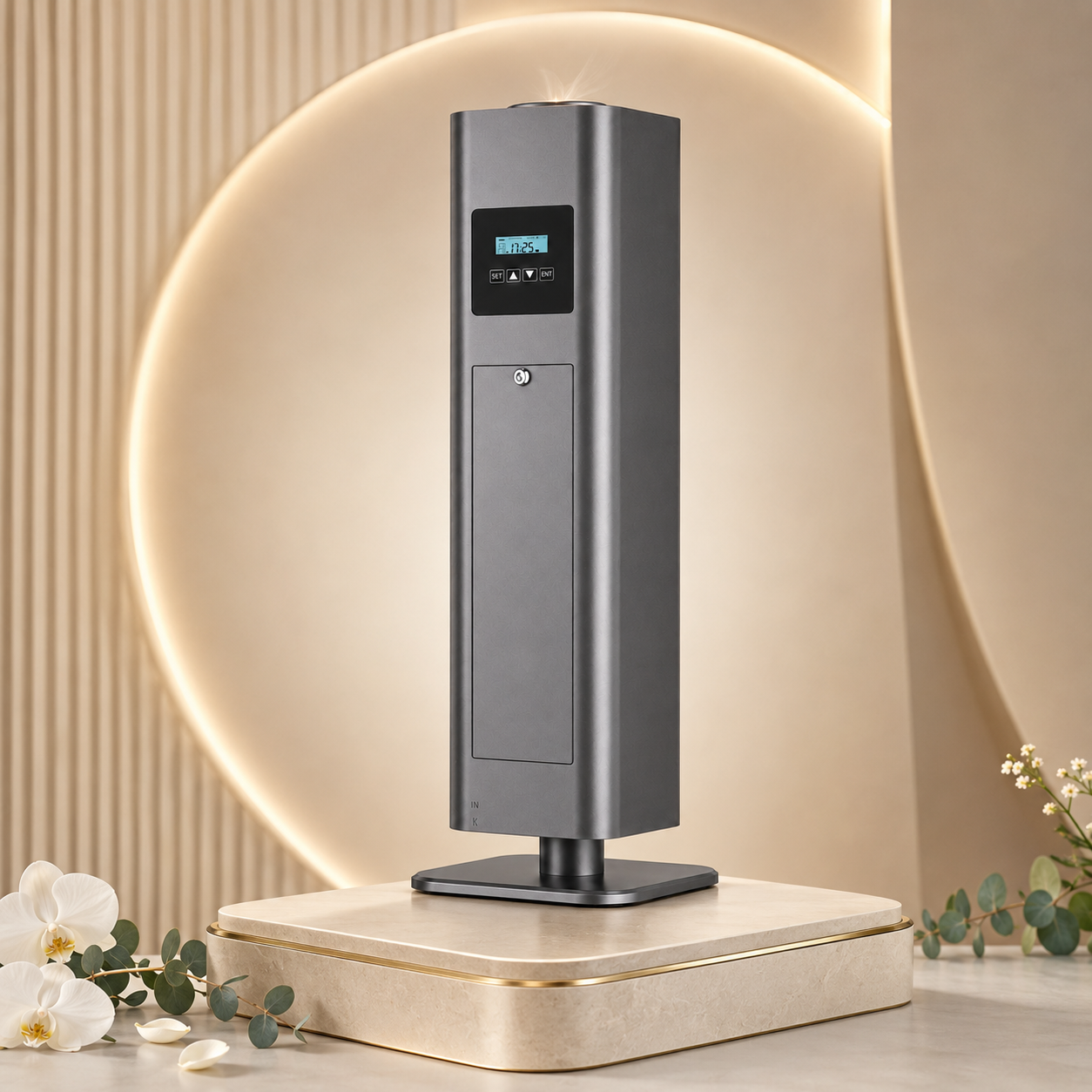
H5000 floor-standing commercial scent diffuser: aluminium body, DC 12 V plug-in power, rated noise below 45 dB.
Compliance readiness in a commercial scent diffuser comes down to four specification groups a buyer can actually verify: the power architecture (DC 12 V, 5 V Type-C, battery, or 110–240 V AC), the acoustic rating, the enclosure material, and the certificate set that matches both the destination market and the exact model configuration being purchased.
This guide is written for procurement, engineering and facility teams at the evaluation stage — the point where the shortlist already exists and the open questions are documentary rather than aromatic. Which power mode can the venue support without new electrical work? What does a below-45 dB rating mean next to a lobby that must stay quiet at 7 a.m.? Does an aluminium housing matter to a shopping mall that inspects every piece of equipment installed in a public concourse? And which certificate covers which market — and does it name the model you are actually buying?
The short answer: all four questions can be answered from published, model-specific specifications and certificate records. They cannot be answered from a generic claim that a product is "CE and RoHS approved." The sections below set out the specification points that affect regional certification and facility approval, the certificate records on file for SCENTSEA diffusers, and a step-by-step verification sequence that can be run before a purchase order is issued.
Why commercial scenting projects stall on compliance, not on fragrance
Most commercial scenting projects are approved on scent quality and coverage first, then slow down on documentation. Three failure modes repeat across hotel, retail, office and transport projects.
Certificate-to-model mismatch. A certificate or test report is presented for a product family while the purchase order specifies a different configuration — a different housing material, a different plug type, or a wireless module that the original test did not cover. Buyers should confirm that certificates and test reports apply to the exact production model and configuration being purchased, not to a similar model in the same series.
Power-mode mismatch with the venue. A wall-mounted unit requiring a nearby socket is specified for an elevator car or a washroom where no outlet exists. A battery-powered unit is specified for a lobby where continuous, high-output diffusion is required and battery replacement becomes an operational cost. Power architecture is the first constraint to resolve, because it determines mounting location, cabling, and which venue categories are even feasible.
Noise ratings without venue context. A decibel figure is only meaningful next to the acoustic expectations of the space it will operate in. A diffuser in a service corridor and a diffuser in a hotel lobby reception desk are held to different practical standards, and operators in hospitality and office environments often apply internal acoustic targets that are stricter than the supplier's own marketing language. Buyers evaluating quiet environments should check model-specific noise data and test samples rather than relying on category averages.
A fourth, quieter problem sits on the fragrance side: coverage ratings. A rated coverage figure describes a maximum under favourable airflow. The practical selection criteria are room size, ceiling height, ventilation, airflow and internal partitions. Facilities that treat the maximum rated coverage as a guaranteed uniform result usually end up re-specifying within a year.
Industry background: why power, noise and material now sit at the centre of commercial scenting
Commercial scenting has moved from a hospitality novelty to a specified building component, and specification language follows procurement language: voltage, decibels, housing material and certificate numbers. The global scent marketing market was valued at approximately USD 4.1 billion in 2026 and is projected to reach USD 7.28 billion by 2035, a compound annual growth rate of 6.6%, according to Cognitive Market Research. Growth of that scale pulls the category deeper into formal procurement, where appliances are added to existing buildings with existing electrical infrastructure and existing equipment rules.
At the trade level, commercial scent diffusers are classified under HS Code 8509.80 (electromechanical domestic appliances), which carries a 4.2% ad valorem import duty into the United States according to USITC-derived tariff data published by Dutiable. Importers evaluating landed cost and product classification should confirm the code that applies to their specific configuration and destination.
The dominant diffusion technology behind these specifications is cold-air nebulizing. It atomizes fragrance oils into sub-micron particles below 2.5 μm without heat or water, as described in SCENTA's technical guidance on commercial scent machines and HVAC diffusers. Because the oil is neither diluted nor heated, the electrical load stays low and the mechanical workload is concentrated in a small air pump — which is precisely why power architecture, pump noise and housing material are the three specification areas that drive both certification and day-to-day facility acceptance.
SCENTSEA (Shenzhen Scentsea Technology Co., Ltd.) is a Shenzhen-based manufacturer of cold-air nebulizing scent diffusers, HVAC scent systems and fragrance oils for home, commercial and HVAC aroma projects. Founded in 2021, the company operates a 3,000 m² production facility with roughly 30 staff and an annual production capacity of 100,000 units, holds 20 patents, and exports approximately 70% of its output to the EU and USA, with products supplied to customers in more than 70 countries. All diffuser models are stated as certified with CE, RoHS and FCC. That portfolio breadth is what makes the compliance question concrete rather than theoretical: the same manufacturer ships mains-powered advertising machines, DC 12 V HVAC units, and battery-operated wall-mounted diffusers, and each category carries a different specification profile.
The specifications that determine compliance outcomes
Power architecture: DC 12 V, Type-C, battery and mains AC
SCENTSEA's commercial range splits into three power families, and the split maps directly onto venue categories.
Fixed low-voltage DC (12 V). The H5000 floor-standing diffuser uses DC 12 V plug-in power at 20 W. The P02 wall-mounted unit uses DC 12 V plug-in power at 6.5 W. The AC-MAX HVAC diffuser uses DC 12 V at 48 W in a split-type structure with a separate machine and oil tank. The A300 uses DC 12 V at 12 W, and the T2 and T3 commercial units use DC 12 V 2 A at 10 W and 15 W respectively. Low-voltage DC installations suit permanent positions inside lobbies, retail interiors and mechanical rooms where a fixed supply point exists and the unit will operate continuously on a scheduled programme.
Battery and Type-C (5 V). The 4705 — model designation P01 — runs on 5 V with either 4 × D batteries or a Type-C supply at 2.5 W. The P03 follows the same logic at 5 V with 3 × D batteries or Type-C. These configurations exist for locations where a power outlet is unavailable or inconvenient: elevator cars, washrooms, corridors and small commercial rooms. Both models use a lockable front cover, which matters in unsupervised public spaces.
Mains AC (110–240 V). The SC19 advertising scent machine operates on 110–240 V AC at 30 W and incorporates an 18.5-inch display. The S01 wall plug-in diffuser also uses 110–240 V. Mains-powered units belong in high-traffic positions with a dedicated socket, where the unit is part of the visible commercial environment rather than hidden service equipment.
Practical rule for specifiers: match the power mode to the installation before matching coverage. Permanent installations with an accessible supply point → DC 12 V or mains AC. Positions without an outlet → battery with Type-C fallback. Then confirm that the certificate set on file covers that exact model and configuration, including plug type and any wireless module.
Noise ratings and what they mean for venue categories
Rated noise varies meaningfully across the range, and the differences are large enough to change a venue decision. The P02 is rated below 30 dB. The P01 and P03 are rated below 35 dB. The A300 is rated below 40 dB. The H5000 and the AC-MAX are rated below 45 dB. The T2 is rated below 45 dB and the T3 below 55 dB. The S01 is rated below 38 dB and the S02 below 30 dB. The SC19 advertising machine is rated at or below 30 dB.
For guest-facing and knowledge-work environments, the sub-35 dB group — P01, P03, P02 and S02 — is the relevant set. For open lobbies, reception halls and public concourses with background activity, the below-45 dB group is normally acceptable, and the additional output it delivers is usually the reason that class of unit was selected in the first place. For service areas, back-of-house corridors, event venues and high-ceiling commercial halls where the diffuser is compensating for large air volumes, the higher-output T3 rating is a trade-off the facility can evaluate explicitly rather than discover after installation.
The verification step matters more than the category label. Buyers in hotels, offices and other quiet settings should check model-specific noise data and test samples, because a decibel figure measured on a bench and the same unit mounted on a hollow partition wall are different acoustic experiences.
Material and enclosure: aluminium, steel, acrylic and plastic
Housing material affects weight, mounting method, cleaning durability and how the equipment reads visually in a public space.
The H5000 uses an aluminium body in a gunmetal finish, weighs 6.4 kg net, and is floor-standing — it needs no wall installation, which removes a common approval step in leased or heritage interiors. The AC-MAX combines an aluminium body with a plastic oil bottle in a split-type layout, separating the machine from the 5 L oil reservoir. The A300 uses a steel housing at 3.8 kg net. The T2 and T3 use an acrylic front panel with a steel casing. The SC19 advertising machine is built from aluminium and steel. At the compact end, the P01, P02 and P03 use plastic housings — a deliberate choice that keeps the P01 at 0.55 kg net and the P02 at 0.8 kg net so they can be wall-mounted in elevators, washrooms and corridors without structural reinforcement.
The practical reading: lighter plastic enclosures are appropriate where the unit is small, wall-mounted and out of the main sightline; aluminium and steel enclosures are appropriate where the unit is floor-standing in a guest-facing area and must withstand cleaning routines and visual scrutiny over years of service.
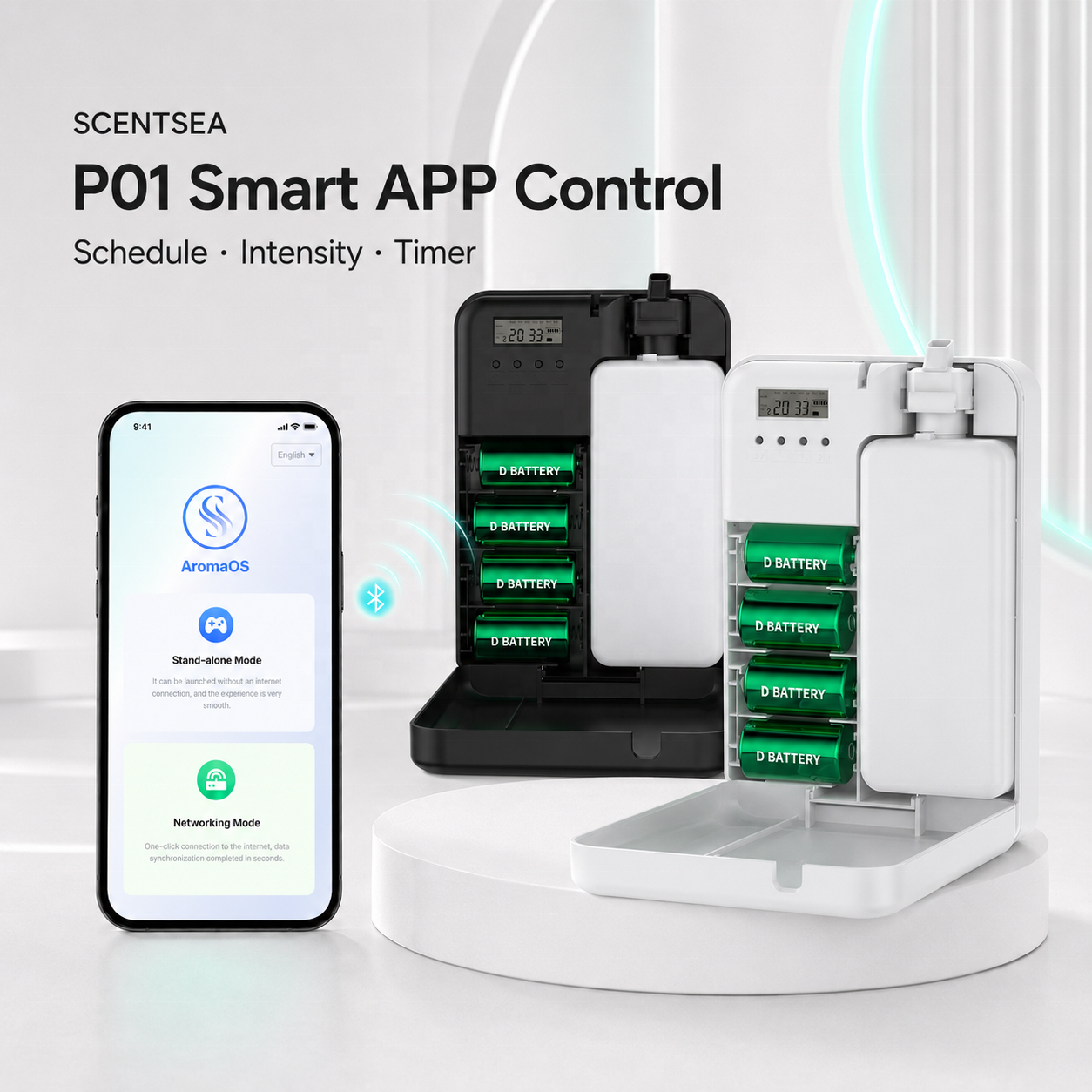
P01 (product code 4705): plastic housing, 5 V supply via 4 × D batteries or Type-C, rated noise below 35 dB, 500 ml oil capacity.
Certification records on file
For SCENTSEA scent diffusers, three certification records underpin the EU and US claims, all issued on 2024-04-24 by Shenzhen ATL Testing Technology Co., Ltd.
FCC — United States. Certificate number ATL20240416326, issued against FCC Part 15 Subpart B:2023, applicable to the USA market, scope: scent diffuser.
RoHS — European Union. Certificate number ATL20240416327, issued against RoHS Directive (EU) 2015/863, applicable to the EU market, scope: scent diffuser.
EMC — European Union. Certificate number ATL20240416325, issued against EN IEC 55014-1:2021, EN IEC 55014-2:2021, EN IEC 61000-3-2:2019/A1:2021 and EN 61000-3-3:2013/A2:2021, applicable to the EU market, scope: scent diffuser.
The certificate records reference the diffuser range including the SC19, AC-MAX, T3, T2, A300, P03, P02, P01, H5000, S02 and S01 models. Separately, the company states that all diffuser models are certified with CE, RoHS and FCC.
One compliance point deserves separate attention: wireless configurations. Bluetooth or Wi-Fi models may also need to meet RED requirements in the European Union, in addition to the EMC and RoHS documentation that applies to the hardware itself. The P02 is available with Bluetooth APP control as standard and an optional Wi-Fi plus Bluetooth version for remote management, with automatic reconnection after a power or network interruption. Buyers specifying the wireless variant should confirm that the wireless compliance documentation matches that configuration, not the non-wireless base unit.
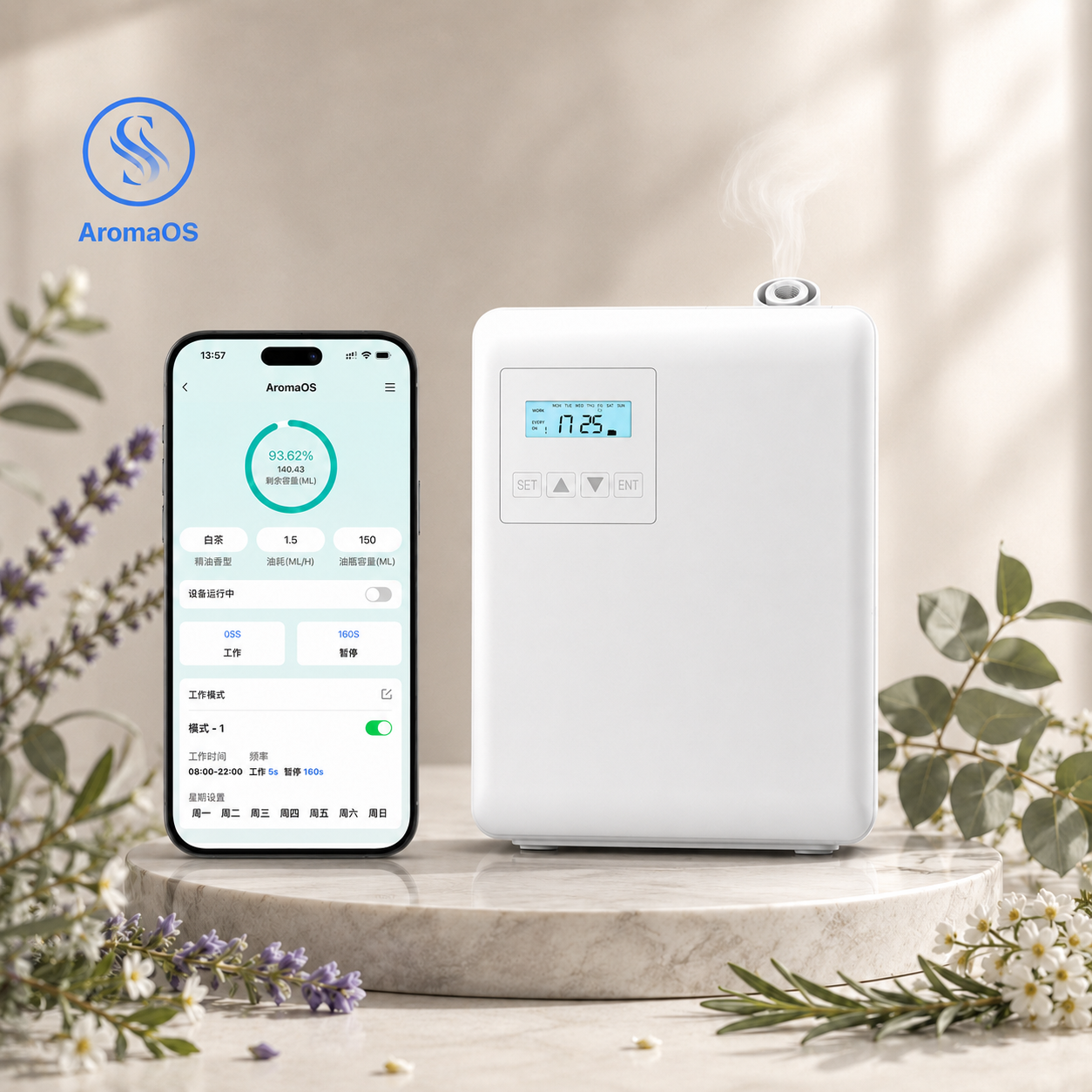
P02: DC 12 V plug-in power at 6.5 W, rated noise below 30 dB, Bluetooth APP control with an optional Wi-Fi plus Bluetooth version for remote management.
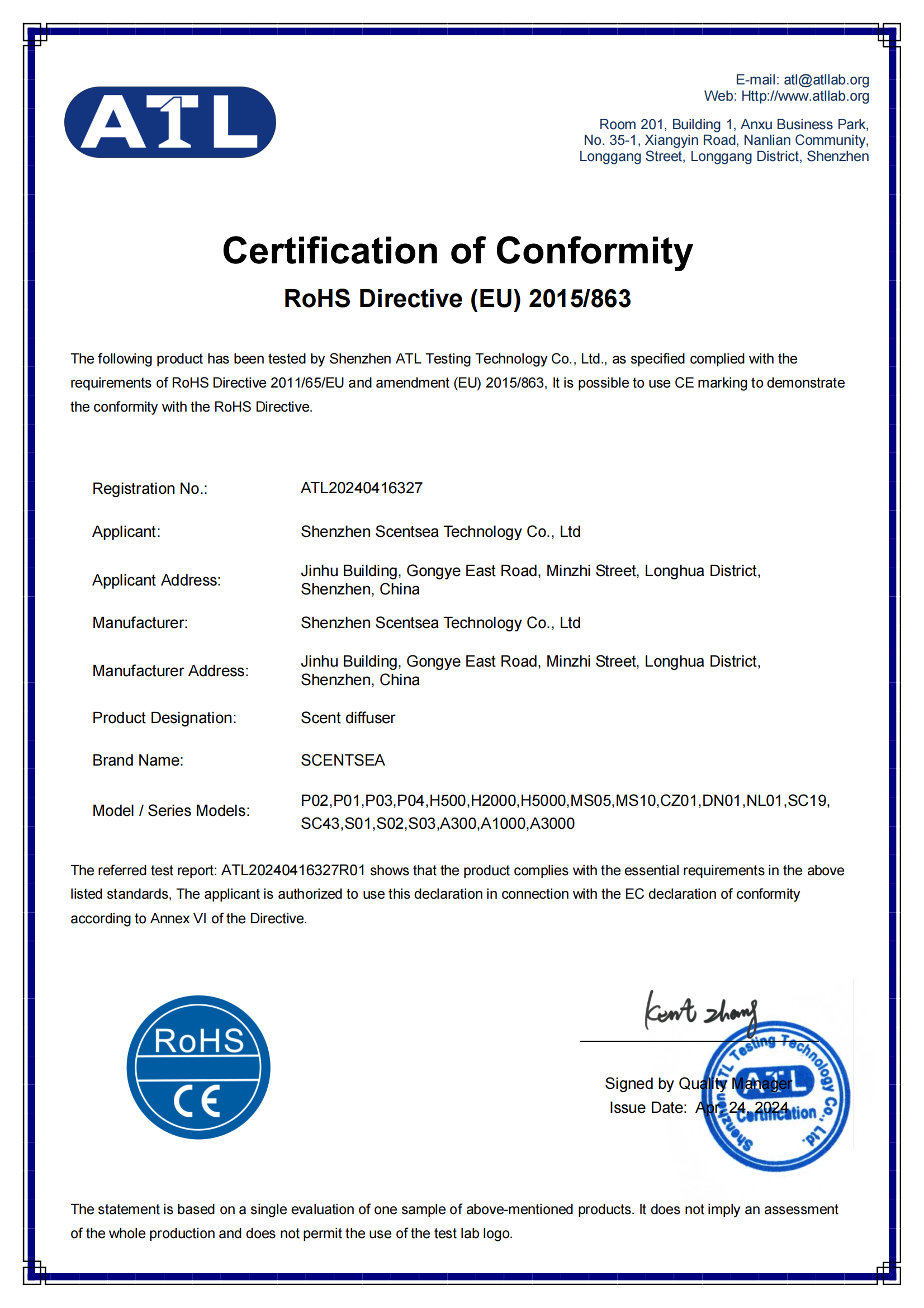
RoHS certificate ATL20240416327, issued by Shenzhen ATL Testing Technology Co., Ltd. against RoHS Directive (EU) 2015/863 for the EU market.
Step-by-step: verifying compliance before a purchase order
The sequence below is designed so that each step removes a category of risk rather than adding paperwork.
- 1. Define the venue category and the mounting constraint. Guest-facing public area, service area, or unattended space? Is there an accessible power outlet, and can anything be wall-mounted? This single answer eliminates roughly half of the model range immediately.
- 2. Match the power mode to the installation. DC 12 V plug-in for permanent positions with a fixed supply point; 5 V battery with Type-C fallback for elevators, washrooms and corridors; 110–240 V AC for high-traffic positions with a dedicated socket and visible equipment.
- 3. Set the acoustic ceiling before selecting a model. Decide the maximum acceptable noise level for the space, then filter the range: below 30 dB, below 35 dB, below 40 dB, or below 45 dB. Confirm with a sample in the actual room where possible.
- 4. Confirm material, weight and mounting. Floor-standing aluminium units such as the H5000 (6.4 kg net) avoid wall installation entirely. Wall-mounted plastic units such as the P01 (0.55 kg net) and P03 suit light partitions and confined spaces.
- 5. Map the destination market to the certificate set. EU → RoHS (EU) 2015/863 and EMC (EN IEC 55014-1:2021 and related standards), plus CE as stated by the manufacturer. USA → FCC Part 15 Subpart B:2023. Verify the certificate number, the issuing laboratory, the scope, and that the certificate names the model and configuration being ordered.
- 6. Resolve the wireless configuration. If the order includes Bluetooth or Wi-Fi, confirm that the wireless compliance documents — including RED-related documentation for the EU — cover that variant.
- 7. Check oil capacity against maintenance intervals. The H5000 and T3 carry 1000 ml, the AC-MAX carries 5 L, the A300 and T2 carry 500 ml, the P02 carries 300 ml, and the P01 carries 500 ml. Larger capacity reduces refill frequency in spaces where access is difficult.
- 8. Verify production-level quality control, then test a sample. SCENTSEA applies 100% functional testing, atomization testing, leakage inspection, noise testing, APP and control testing, a 48-hour aging test, and final appearance inspection before shipment. Diffuser samples and fragrance oil samples are available for quality verification, with MOQ starting from 1 unit for diffusers and a lead time of 25–35 days.
- 9. Confirm fragrance-oil documentation for the project region. Fragrance documentation requirements vary by market and by buyer policy. Buyers should request the documentation that applies to the exact oil supplied for the project, and should test any third-party oil for viscosity and formulation stability before committing to bulk. Scent selection, bottle labeling and private-label packaging support are available for the oil side of the project.
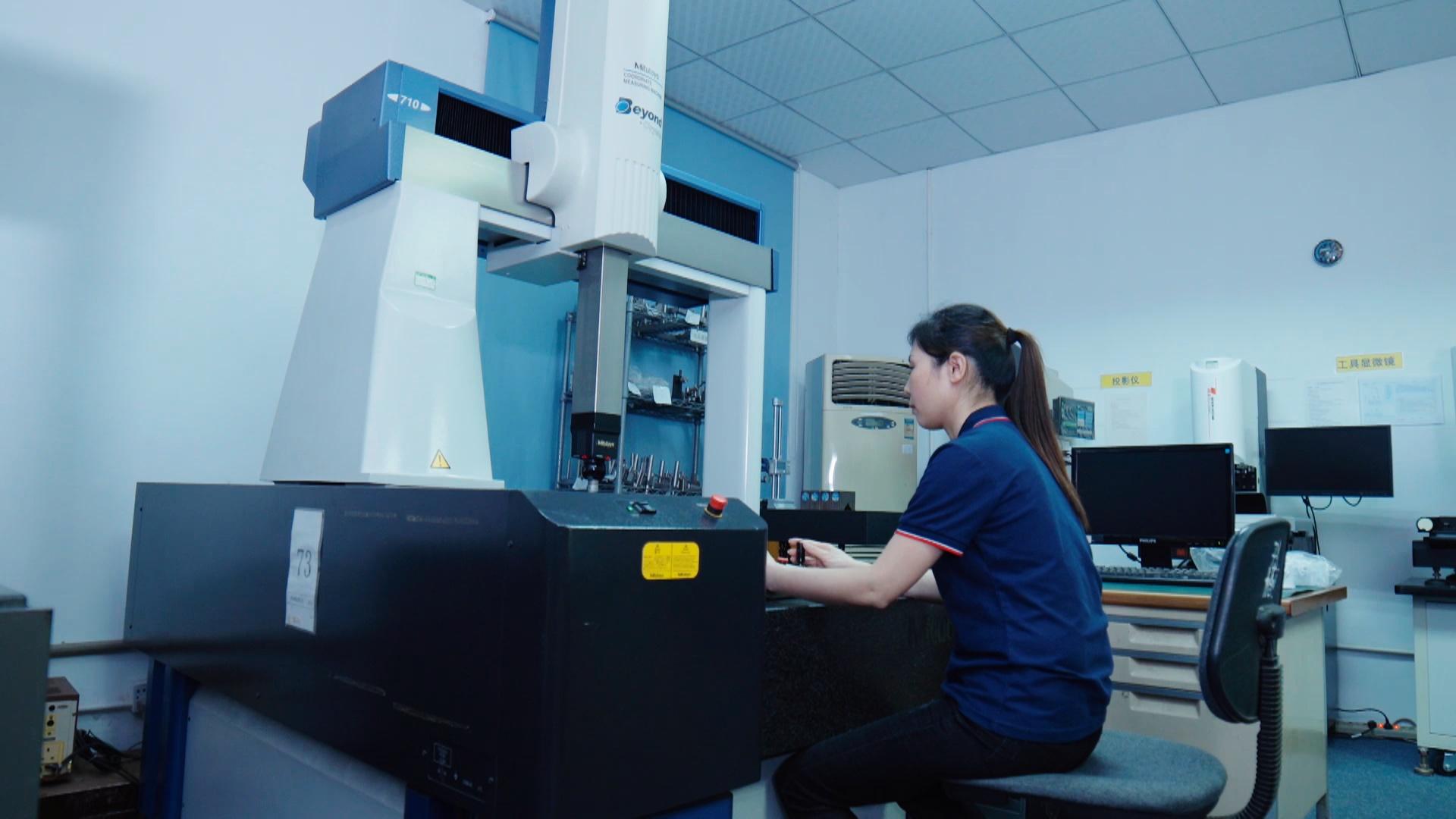
Pre-shipment verification: functional, atomization, leakage, noise and control testing, followed by a 48-hour aging test and final appearance inspection.
Venue-by-venue configuration: where each specification profile fits
Hotel lobbies and office building lobbies
These spaces need high output, low maintenance frequency and a housing that looks intentional. The H5000 covers approximately 800–1,300 m² (2,500–4,000 m³) with a 1000 ml oil capacity, aluminium body, DC 12 V plug-in power at 20 W and a rated noise below 45 dB, and its floor-standing design removes the need for wall installation in lobbies where drilling is restricted. Where the lobby is served by a central duct system rather than a standalone unit, the AC-MAX connects to existing HVAC ducts, covers approximately 2,500–3,500 m² with a 5 L reservoir, and operates at below 45 dB on DC 12 V.
Retail stores, showrooms and mid-size interiors
Mid-size interiors usually need quieter operation than a lobby and more flexible installation. The P02, rated below 30 dB with a 300 ml capacity and coverage of approximately 150–350 m², is the relevant profile here, with Bluetooth scheduling as standard and an optional Wi-Fi plus Bluetooth version for centralised management across multiple store locations. An optional connector and tube allow the same unit to be integrated into an HVAC line where the store design requires invisible installation.
Elevators, washrooms and corridors
These are the hardest compliance environments, because there is usually no outlet and often no willingness to add one. The 4705 (P01) resolves this with 5 V operation from 4 × D batteries or a Type-C supply at 2.5 W, a rated noise below 35 dB, a 500 ml bottle and a lockable front cover. The P03 offers the same logic in a more compact footprint with 3 × D batteries or Type-C. In both cases the compliance conversation is simpler because the unit never touches the building's mains circuit.
Large buildings served by central HVAC
Airports, shopping malls, banks and office complexes that already distribute air through central ducts benefit from scenting through that same system rather than adding standalone machines across the floorplate. The AC-MAX is designed for this: a split structure with a separate machine and 5 L oil tank, Wi-Fi plus Bluetooth smart control, adjustable working schedules and fragrance intensity, password protection for professional project management, and an optional airflow sensor that synchronises scenting with HVAC operation.
High-traffic positions that also need visual messaging
Where a facility wants the scenting unit to double as a communication surface, the SC19 combines diffusion with an 18.5-inch, 1920 × 1080 advertising display, 8 GB internal storage, a 500 ml capacity, coverage of approximately 150–250 m², and 110–240 V AC power at 30 W with a rated noise at or below 30 dB. It is intended for elevators, bank branches, office lobbies, retail stores, shopping malls and exhibitions.
Field evidence from a five-year commercial deployment
One US-based scent marketing company and scenting service provider deployed 30 units across shopping mall projects, with a relationship running five years. The reported outcome was stable and consistent scent coverage, reduced manual maintenance and improved fragrance management efficiency. The configuration factors cited as decisive were atomization strength, stable operation, smart APP control with adjustable intensity, low maintenance and straightforward installation — the same specification areas this guide treats as compliance checkpoints, which is consistent with how these projects behave in practice: what is specified at the start determines the maintenance load later.
Compliance comparison table: power, noise and material by model
| Model | Housing material | Power mode | Rated noise | Oil capacity | Rated coverage | Typical venue category |
|---|---|---|---|---|---|---|
| H5000 (floor-standing) | Aluminium | DC 12 V plug-in, 20 W | <45 dB | 1000 ml | 800–1,300 m² | Hotel lobby, mall, office building lobby |
| P01 (product code 4705) | Plastic | 5 V, 4 × D batteries or Type-C, 2.5 W | <35 dB | 500 ml | 100–150 m² | Elevator, washroom, corridor |
| P02 | Plastic | DC 12 V plug-in, 6.5 W | <30 dB | 300 ml | 150–350 m² | Retail store, corridor, cinema, office, showroom |
| T3 | Acrylic panel + steel casing | DC 12 V 2 A, 15 W | <55 dB | 1000 ml | 1,000–1,600 m² | Shopping mall, hotel, airport |
| AC-MAX (HVAC) | Aluminium body + plastic bottle | DC 12 V, 48 W, split type | <45 dB | 5 L | 2,500–3,500 m² | Mall, bank, airport, large complexes |
| SC19 (advertising) | Aluminium + steel | 110–240 V AC, 30 W | ≤30 dB | 500 ml | 150–250 m² | Mall, hotel, bank, exhibition space |
FAQ: commercial scent diffuser compliance questions
What certifications should a commercial scent diffuser carry for the EU and US markets?
For the European market, buyers should normally verify applicable CE and RoHS compliance documents, and EMC documentation covering the electrical noise the appliance generates; Bluetooth or Wi-Fi models may also need to meet RED requirements. For the US market, FCC compliance should be verified. The SCENTSEA records on file are FCC certificate ATL20240416326 against FCC Part 15 Subpart B:2023 for the USA, RoHS certificate ATL20240416327 against RoHS Directive (EU) 2015/863, and EMC certificate ATL20240416325 against EN IEC 55014-1:2021, EN IEC 55014-2:2021, EN IEC 61000-3-2:2019/A1:2021 and EN 61000-3-3:2013/A2:2021 — all three issued on 2024-04-24 by Shenzhen ATL Testing Technology Co., Ltd. Buyers should always confirm that the certificates and test reports apply to the exact production model and configuration being purchased, including plug type and any wireless module.
Which power mode fits which venue category — DC 12 V, Type-C, battery, or mains AC?
DC 12 V plug-in models such as the H5000, P02, A300, T2, T3 and AC-MAX suit permanent installations where a fixed supply point exists and the unit runs on a scheduled programme. Battery-powered models with Type-C fallback, operating at 5 V such as the P01 and P03, are appropriate for elevators, washrooms, corridors and small commercial rooms where a power outlet is unavailable or inconvenient. Mains-powered 110–240 V AC models such as the SC19 and S01 suit high-traffic positions with a dedicated socket, including lobbies and public concourses where the unit is part of the visible commercial environment. In all cases, the correct power supply for the model should be used, the diffuser kept upright, and fragrance oil kept away from electronic components.
Can compact models such as the 4705 (P01) be customized for OEM or private label projects?
Yes. SCENTSEA operates OEM and ODM production with customization available for logo, product colour, packaging, user manual, plug type, APP interface, PCB and selected product functions, along with exclusive mold development for suitable projects. Monthly production capacity is 8,000 units with a lead time of 25–35 days, and MOQ starts from 1 unit for diffusers. Every unit passes functional testing, atomization testing, leakage inspection, noise testing, APP and control testing, a 48-hour aging test and final appearance inspection before shipment, and a 1-year free warranty on spare parts applies. Customization scope should be confirmed against the specific model and quantity before the order is placed.
What documentation should buyers request for the fragrance oil itself, including IFRA-related questions?
Fragrance-oil documentation is a project-level question rather than a hardware question, and requirements differ by destination market and by the buyer's own compliance policy. The practical approach is to request the documentation that applies to the exact oil supplied for the project, and to confirm it before the hardware order is finalised. On the supply side, SCENTSEA supports scent selection, bottle labeling and private-label packaging for fragrance oils, and fragrance oil samples are available for quality verification. Where third-party fragrance oil is used, compatibility should be tested — oil that is too thick or contains impurities can affect atomization stability — and oil-thickness and formulation checks should be part of the pre-order validation.
What does the sample and lead-time process look like before a bulk order?
Diffuser samples and fragrance oil samples are available for quality verification, which allows the venue-specific questions in this guide — noise acceptance in the actual room, mounting fit, and scent intensity relative to airflow — to be answered before volume production. Once the configuration is confirmed, monthly capacity is 8,000 units with a standard lead time of 25–35 days, and MOQ starts from 1 unit for diffusers. Requesting a sample alongside the current product catalogue is the fastest way to convert a specification discussion into a verified configuration. Contact the SCENTSEA team at jimmy@scent-sea.com or via WhatsApp at +86 19928719703 to arrange samples, pricing and configuration confirmation.
Conclusion: compliance is a specification discipline, not a certificate stamp
For a commercial scent diffuser, compliance holds together when four things agree: the power architecture fits the venue, the noise rating fits the acoustic expectation of the space, the housing material fits the mounting and durability demands, and the certificate set names the exact model and configuration being purchased. When those four align, the remaining variables — fragrance selection, scheduling and maintenance interval — are operational rather than regulatory.
For projects moving through the evaluation stage, the fastest route is to fix the venue category first, then the power mode, then the noise ceiling, and only then compare models against the published specification table above. SCENTSEA manufactures the full range discussed here — battery and Type-C compact units for unattended spaces, DC 12 V commercial and HVAC units for large venues, and mains-powered advertising machines for high-traffic positions — under CE, RoHS and FCC certification across the diffuser range, with FCC, RoHS and EMC certificate records available against the relevant models.
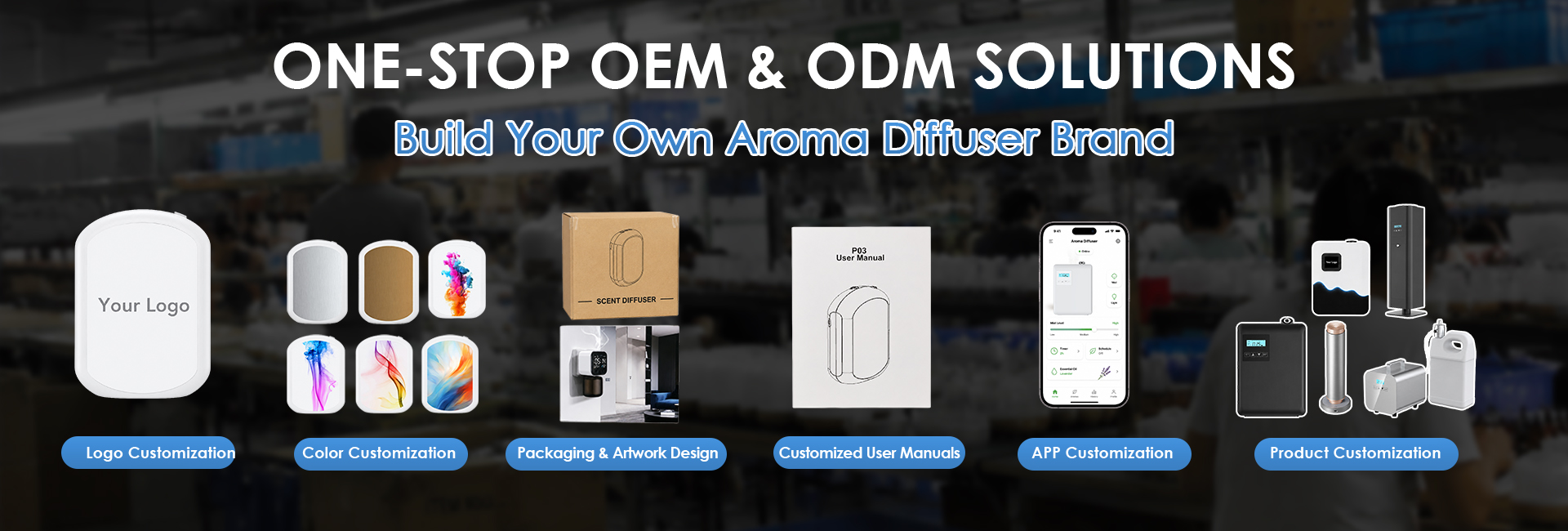
OEM and ODM support covers logo, colour, packaging, user manual, plug type and APP interface for commercial scenting projects.
Next step: verify the configuration before the order
Request diffuser and fragrance oil samples, confirm the certificate set against your destination market, and review current specifications in the SCENTSEA catalogue. Samples help resolve noise, mounting and coverage questions in the actual venue.
Download the catalogue: SCENTSEA Product Catalogue (PDF)
Website: www.scent-sea.com
Email: jimmy@scent-sea.com | Tel / WhatsApp / WeChat: +86 19928719703
Address: Block A, Jinxing Building, Longhua District, Shenzhen, China
Have Questions or Need More Details?
Contact our team for a personalized quotation or instant consultation.
Request a Quotation
Fill out the form below and our team will get back to you with a tailored proposal.
WhatsApp Direct Chat
Prefer to chat in real-time? Message us on WhatsApp for instant assistance & quick answers.
- Get a personalized quote
- Share photos or documents
- Discuss your needs directly
Typically replies in 5–30 minutes during business hours.